Morphological and anatomical evidence support a new wild cassava: Manihot fallax... 139
Morphological and anatomical evidence support
a new wild cassava:
Manihot fallax
(Crotonoideae,
Euphorbiaceae), from Mato Grosso, Brazil
Marcos José da Silva1, Laís de Souza Inocencio2, Rodolfo Carneiro Sodré2, Alexandre Antonio Alonso1,3
1 Laboratório de Morfologia e Taxonomia Vegetal, Universidade Federal de Goiás, CP 131, 74001-970, Goiânia, GO, Brazil 2 Postgraduate Student, Postgraduate Program in Plant Biodiersity, Universidade Federal de Goiás, CP 131, 74001-970, Goiânia, GO, Brazil 3 Laboratório de Anatomia Vegetal, Universidade Fede-ral de Goiás, CP 131, 74001-970, Goiânia, GO, Brazil
Corresponding author:Marcos José da Silva ([email protected])
Academic editor:G. Levin | Received 6 October 2017 | Accepted 7 December 2017 | Published 19 December 2017 Citation: Silva MJ, Inocencio LS, Sodré RC, Alonso AA (2017) Morphological and anatomical evidence support a new wild cassava: Manihot fallax (Crotonoideae, Euphorbiaceae), from Mato Grosso, Brazil. PhytoKeys 91: 139–156. https://doi.org/10.3897/phytokeys.91.21465
Abstract
During the preparation of the taxonomic treatment of Manihot in the Midwest Region of Brazil, a new species was found. Manihot fallax M.J. Silva & L.S. Inocencio is described, illustrated and morphologically compared with similar simple-leaved species. The conservation status, geographic distribution (including map), ecology, phenology and notes about leaf anatomy of the new species are given. The synonymisation of M. robusta M. Mend. & T. B. Cavalc. under M. attenuata Müll. Arg. and lectotypes for M. attenuata and
M. brachystachys Pax & K. Hoffm are also proposed. An emended description of M. attenuata is proposed as the original description is incomplete as it lacks information on the pistillate flowers, fruits and seeds.
Keywords
Central Brazil, leaf anatomy, nomenclature, typification, Manihoteae
Introduction
The taxonomy of Manihot was studied by Rogers and Appan (1973), who recognised 98 species distributed into 19 sections. The genus is monophyletic and has a complex taxonomy (Duputié et al. 2011, Silva 2014). In Brazil, it is represented by over
PhytoKeys 91: 139–156 (2017) doi: 10.3897/phytokeys.91.21465 http://phytokeys.pensoft.net
Copyright Marcos José da Silva et al. This is an open access article distributed under the terms of the Creative Commons Attribution License (CC BY 4.0), which permits unrestricted use, distribution, and reproduction in any medium, provided the original author and source are credited.
RESEARCH ARTICLE
Launched to accelerate biodiversity research
80 species, especially growing in the Cerrado region, in rocky fields and grasslands (Silva 2014, Silva et al. 2017).
Despite the revision of Manihot (Rogers and Appan 1973), taxonomic studies about this genus in Brazil are scarce. Manihot is cited in floristic surveys of Euphorbiaceae (Cord-eiro 1992, Sátiro and Roque 2008) or as an isolated genus (Allem 1997, Rodrigues 2007, Carmo-Júnior et al. 2013, Orlandini and Lima 2014). In the last four years, a number of species of Manihot have been described in Brazil in the coastal sand plains of the state of Sergipe (Martins et al. 2011), in the semi-arid region of the state of Bahia (Martins et al. 2014) and in Cerrado sensu lato of the state of Goiás (e.g. Mendoza et al. 2015, Silva et al. 2013, 2016, 2017, Silva 2014, 2015, Silva and Sodré 2014).
Considering the species of Manihot present in the Midwest Region of Brazil, the knowledge about the genus is scarce mainly in the states of Mato Grosso and Mato Grosso do Sul, where BFG (2015) reported 17 and 6 species respectively. However, taking into consideration that the flora of these states is relatively poorly known, that Manihot has its main diversity centre in the Brazilian Cerrado and also that these states have their areas covered predominantly by Cerrado vegetation, it is plausible to conclude that the number of species of the genus has been underestimated in Mato Grosso and Mato Grosso do Sul.
During the preparation of the taxonomic treatment of Manihot in the Midwest Re-gion of Brazil, some collections were found from Serra Azul, Serra do Roncador, Serra do Taquaral and neighbouring areas in the state of Mato Grosso, which could not be assigned to any known species. One of these species, with entire and unlobed leaves and habit slender and virgate, is hereby illustrated, described as new and designated as M. fallax. The new species is compared with M. attenuata Müll. Arg. and M. weddelliana
Baill., the taxa most morphologically similar to it and its phenology, conservation status and geographic distribution are also presented. The leaf anatomy of the new species and the species most morphologicaly similar to it were also compared because leaf anatomy constitutes an important tool for delimiting taxa in Manihot (e.g. Vannucci 1982, Cunha Neto et al. 2014, Cunha Neto et al. 2017 and Graciano-Ribeiro et al. 2016). Additional-ly, as part of these studies on Manihot of the Cerrado flora, M. robusta as a synonym of M. attenuata Müll. Arg. is proposed and M. attenuata and M. brachystachys Pax & K. Hoffm are lectotypified. An emended description of M. attenuata is provided, as the original description is incomplete as it lacks information on the pistillate flowers, fruits and seeds.
Materials and methods
Morphological and taxonomic studies
pro-Morphological and anatomical evidence support a new wild cassava: Manihot fallax... 141
tologues, type and historical collections (17 exsiccatae) of the same and also of exten-sive field work in their areas of occurrence, as well as analyses of 30 collections from herbaria (BR, CEN, F, G, HRCB, HUEFS, IBGE, K, MG, MO, NY, P, RB, S, SP, UB and UFG). The terminology used in the description of both species is based on specific literature such as Pohl (1827), Pax (1910) and Rogers and Appan (1973); the last was employed mainly for the inflorescence types and venation pattern. All the samples used in the description of the new species, including the holotype, were deposited in the UFG herbarium and the isotypes will be sent to K, NY and MO. The acronyms of herbaria previously cited follow Thiers (2017, continuously updated)
The conservation assessment of both the species was based on field observations and applying the IUCN Red List Categories and Criteria (IUCN 2014). The geo-graphic distribution map was made using the software QGIS (Quantum GIS Devel-opment Team) version 2.8.1, which was used for the geographic coordinates obtained both during the collection expeditions and from the labels of the collections examined. The extent of occurrence (EOO) was calculated with the Geospatial Conservation As-sessment Tool (GeoCAT - http://geocat.kew.org), (Bachman et al. 2011).
Anatomical studies
Leaves of the type collection of the new species (i.e. L. S. Inocencio, A. O. Souza, L. L. C. Antunes and C. C. Oliveira 293) and M. attenuata (M. J. Silva 4063/UFG) with fully expanded leaf blades were fixed in FAA (formaldehyde/glacial acetic acid/ethanol 50% at 1:1:18 v/v/v) for 48h and transferred to 70% ethanol (Johansen 1940). Freehand sections of the median portion of the leaf blade and petiole of the samples were cleared in sodium hypochlorite solutions (20%), rinsed with distilled water, stained with aqueous 1% astra blue and aqueous 1% Safranin (Bukastch 1972) and mounted in aqueous glycerine solu-tion (1:1). For epidermal analysis, classificasolu-tion and observasolu-tion of stomata distribusolu-tion, leaf blade segments were dissociated using a hydrogen peroxide and acetic acid solution (Franklin 1945). Sections were examined and photographed using a Leica ICC50 camera coupled with a Leica DM500 microscope (Leica Microsystems, Heerbrugg, Switzerland).
Taxonomic treatment
Manihot fallax M.J. Silva & L.S. Inocencio, sp. nov.
urn:lsid:ipni.org:names:77174267-1
Figs 1, 2
Diagnosis. Shrubs slender and virgate, up to 1.9 m tall; leaves light green, entire, un-lobed, with secondary veins perpendicular to the midvein. Stipules 1–3 × 0.2–0.3 mm, setaceous, entire, early caducous; racemes 2.5–6 cm long, solitary, subspicate, staminate buds obovoid, stamens with filaments pubescent, pistillate calyx dialisepalous and fruits light green, without wings.
Morphological and anatomical evidence support a new wild cassava: Manihot fallax... 143
Description. Shrubs 1–1.9 m tall, slender and virgate, monoecious, glabrous. Stem solid in cross section, greenish to reddish, glossy and waxy in young parts; latex clear, abun-dant; roots fibrous. Stipules 1–3 × 0.2–0.3 mm, setaceous, margins entire, early caducous; petiole 0.3–0.7 mm long, angulate, greenish. Leaves alternate spiral, sparsely distributed along the branches, but more concentrated near apex, blades 8–14 × 1–2 cm, lanceolate, narrowly elliptic or linear, entire, unlobed, non-peltate, base obtuse, apex obtuse with a short mucro, firmly membranaceous to chartaceous, glabrous on both surfaces, adaxial surface dark green, abaxial surface glaucous, the latter with a smooth wax pattern, ve-nation camptodromous-brochidodromous, primary and secondary veins impressed on both surfaces, the secondary veins perpendicularly arranged in relation to the midvein, all of them pinkish to yellowish. Racemes 2.5–6 cm long, staminate or bisexual, soli-tary, terminal or arising from dichotomy of the branches, glabrous, angulate, glaucous to cinereous, waxy. Staminate flowers: buds 5.8–6 × 3.9–4 mm, obovoid, yellowish-green, without purplish pigmentation; bracts 6–6.1 × 3.9–4 mm, widely elliptic, foliaceous, apex acuminate, persistent; bracteoles situated along the lower third up to half of the pedicel, 4–4.1 × 0.4–0.5 mm, lanceolate, foliaceous, persistent, subopposite; pedicels 0.5–0.7 mm long, cylindrical, glabrous, light green; calyx 13.2–14 × 5.9–6 mm, campanulate, yellow-ish, without purplish pigmentation, shortly tomentose internally, lobes widely triangular, ovate to oblong, apex obtuse, base truncate; stamens 10, in two whorls of five, filaments pubescent near apex, the longer 12.5–12.6 mm long, the shorter 8.4–8.5 mm long, both thickened; anthers 5–7 mm long, oblong, dorsifixed, bright yellow; disc 10-lobed, intras-taminal, dark yellow. Pistillate flowers: buds 6–9 × 4–6 mm, ovoid, green-yellowish, with-out purplish pigmentation; bracts 6.4–7 × 2.9–3 mm long, widely ovate, margin entire, glabrous; bracteoles 3.7–3.8 × 0.8–0.9 mm, lanceolate, foliaceous, persistent, margin en-tire, apex acuminate, opposite along the lower third of the pedicel, glabrous; pedicels 4–6 mm long, cylindrical-clavate, glabrous, green; sepals 10–12 × 5–7 mm, lanceolate, apex acute, shortly tomentose externally, yellowish, without purplish pigmentation; ovary 4–6 × 3–4 mm, globose to ovoid, glabrous, green, disc patelliform, lobed, yellow; styles 3, shortly united at the base, stigmatic surface 2–3 mm long, densely papillose. Capsules 0.9–1.5 × 0.8–1.2 cm, oblong, light green, smooth, glabrous, without wings, dehiscence septicidal and loculicidal; columella (carpophore) persistent, 0.9 × 2–2.2 mm (width at narrowest point in middle), narrowly alate. Seeds 0.7–1 × 0.39–0.4 cm, oblong-ellipsoid, dark grey, with black spots; caruncle triangular, prominent, apex bilobed, cream to yellowish.
Distribution and ecology. Manihot fallax appears endemic to the state of Mato Grosso (Fig. 3), where it grows in Cerrado sensu stricto on flat or slope areas and also in grasslands, on clayey and sandy soils, between 385 m and 642 m elevation.
Phenology. The species has been collected with flowers and fruits from October to March.
Etymology. The specific Latin epithet “fallax” refers to deceptive and was chosen due to the false similarity of the new species to M. attenuata and M. weddelliana.
Morphological and anatomical evidence support a new wild cassava: Manihot fallax... 145
Figure 3. Distribution map of Manihot fallax sp. nov and M. attenuata.
Specimens Examined. Brazil.MatoGrosso. Barra do Garças, Serra Azul, trilha as usina, próximo a sede da Moçonaria, 17 Mar 1990, fl., fr., L. Santoss.n. (UFMT/ ICLMA 00856); próxima da cidade, nas imediações da antena do Cristo, 09 Mar 1991, fl., fr., L. Santos s.n. (UFMT/ICLMA 00866); Serra do Taquaral, Cerrado, 23 Nov 1997, fl., fr., L. C. Bernacci & G. Arborcz 2525 (UFMT, IAC); cerrado do Mar-cello, 15°50'50.9"S, 52°15'54.7"W, 14 Nov 2005, fl., fr., I. Faria & M. L. Mayer 339
(UFMT/ICLMA); gruta do pezinho, 15°50'29.6"S, 52°16'50"W, 28 Dec 2005, fl., I. Faria, M. L. Mayer & Moisés 517 (UFMT/ICLMA); Parque Estadual da Serra Azul, 15°51'S, 52°16'W, 21 Oct 2005, fl., M. Sanchez 2216 (UFMT/ICLMA); ib., 21 Feb 2006, fl., fr., I. Faria, M. L. Mayer & M. S. M. Ramos 787 (UFMT/ICLMA); ib., 15°52'S, 52°16'W, 04 Oct 2006, fl., R. Freitas & M. L. Mayer 145 (UFMT/ICLMA);
ib., 13 Feb 2007, fl., R. Freitas & M. L. Mayer 404 (UFMT/ICLMA); ib., 1 Mar 2007, fl., fr., R. Freitas & M. L. Mayer 445 (UFMT/ICLMA); BR 158 na altura do km 726, margem esquerda, sentido Nova Xavantina, adjacências da Serra do Roncador, 15°17'21.8"S, 52°11'38.7"W, 389 m a.s.l., 28 Jan 2014, L. S. Inocencio, A. O. Souza & G. H. Silva 68, 69, 70, 71, 72 and 73 (UFG); ib., 15°17'9.7"S, 52°11'15.5"W, 385 m a.s.l., 26 Jan 2015, fl. fr., L. S. Inocencio, A. O. Souza, L. L. C. Antunes & C. C. Olivei-ra, 290, 291, 292 and 294 (UFG); BR 158, na altura do km 726, margem esquerda, sentido Nova Xavantina, 15°17'9.8"S, 52°11'22.3"W, 422 m a.s.l., 1 Feb 2015, fl. fr.,
Vale dos Sonhos, 52°13'54"S, 15°20'54"W, 642 m a.s.l., 24 Mar 2016, R. C. Sodré, T. P. Mendes & J. A. Oliveira 2174 (UFG).
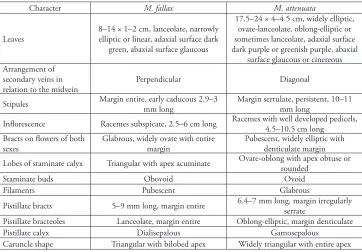
Discussion. Manihot fallax stands out from the other species of the genus with entire and unlobed leaves (Silva 2015) by its shrubby, slender, virgate habit up to 1.9 m tall, leaves ascendant and in a spiral arrangement along the branches. It morphologically re-sembles M. weddelliana and M. attenuata, especially the latter, in the aspect of the leaves, racemes conspicuously pedunculate, bracts of flowers of both sexes showy and foliaceous and calyx internally shortly tomentose. However, M. fallax differs from M. weddelliana in its shrubby, slender and virgate habit (vs. subshrub up to 0.5 cm tall in M. weddelliana), leaves without repand margins (vs. leaves with repand margins) and bracts of both stami-nate and pistillate flowers ovate, with margins entire and apex acute or obtuse (vs. widely elliptic, with margins very serrated and apex conspicuously acuminate). The combination of the characters listed in table below serve to differentiate M. attenuata from M. fallax.
Regarding leaf anatomical features, M. fallax differs from M. attenuata in having the vascular cylinder with arch-shaped collateral vascular bundles surrounded by peri-cyclic fibres in the midvein (Fig. 4A), uniseriate epidermis in the median portion of both surfaces of the leaf blade (Fig. 4B), at the edge (Fig. 4C) and petiole with collat-eral vascular bundles discontinuous in the vascular cylinder (Fig. 4N). In M. attenuata, the vascular cylinder has collateral vascular bundles in a flattened arc, not surrounded by pericyclic fibres in the midvein (Fig. 4D), epidermal cells without papillae in the median portion of the abaxial surface of the leaf blade (Fig. 4E), but with druses in the
Table 1. Morphological characters useful in separating M. fallax from M. attenuata.
Character M. fallax M. attenuata
Leaves 8–14 × 1–2 cm, lanceolate, narrowly elliptic or linear, adaxial surface dark green, abaxial surface glaucous
17.5–24 × 4–4.5 cm, widely elliptic, ovate-lanceolate, oblong-elliptic or sometimes lanceolate, adaxial surface dark purple or greenish purple, abaxial
surface glaucous or cinereous Arrangement of
secondary veins in
relation to the midvein Perpendicular Diagonal
Stipules Margin entire, early caducous 2.9–3 mm long Margin serrulate, persistent, 10–11 mm long
Inflorescence Racemes subspicate, 2.5–6 cm long Racemes with well developed pedicels, 4.5–10.5 cm long Bracts on flowers of both
sexes Glabrous, widely ovate with entire margin Pubescent, widely elliptic with denticulate margin Lobes of staminate calyx Triangular with apex acuminate Ovate-oblong with apex obtuse or rounded
Staminate buds Obovoid Ovoid
Filaments Pubescent Glabrous
Pistillate bracts 5–9 mm long, margin entire 6.4–7 mm long, margin irregularly serrate Pistillate bracteoles Lanceolate, margin entire Oblong-elliptic, margin denticulate
Pistillate calyx Dialisepalous Gamosepalous
Morphological and anatomical evidence support a new wild cassava: Manihot fallax... 147
Figure 4. Leaf anatomy of species. A–J Cross section of the leaf blade. Manihot fallax (A–C): A Me-dian portion of the midvein B Median portion of the leaf blade; abaxial epidermis papilose and stomata indicated by arrow C Edge. Manihot attenuata (D–J): D Median portion of the midvein E Median por-tion of the leaf blade; note stomata (arrow) and epidermal idioblast with druse (arrowhead) F Detail of epidermal idioblast with druse (arrowhead) G Laticifers in the midvein phloem (arrowheads) H Detail of the epidermis and collenchyma in the midvein I Vascular bundles with parenchymatical sheath in the median portion of the leaf blade (arrowheads correspond to laticiferous) J Vascular bundles in the median portion of the leaf blade (arrowheads correspond to laticifers) K–M Dissociated epidermis of both species.
protoplast (Fig. 4E, F), as well as petiole with collateral vascular bundles continuous in the vascular cylinder (Fig. 4O).
Both M. fallax and M. attenuata have midveins with angular collenchyma on both surfaces, ground parenchyma surrounding the vascular cylinder (Fig. 4A, D, H), iso-bilateral mesophyll (Fig. 4B, E), edges with annular collenchyma (Fig. 4C), paren-chymatic sheath surrounding the secondary veins towards the epidermal cells on both surfaces of the leaf blade (Fig. 4I) and other veins without sheath (Fig. 4J). Laticifers are also found in both species distributed along the phloem cells in the midvein, petiole and median portion of the leaf blade (Fig. 4G). Additionally, the petiole has epidermal cells and cortex similar to those of the midvein (Fig. 4N, O). The stomata are paracytic in both species (Fig. 4K), evenly distributed on the abaxial surface of the leaf blade (Fig. 4L) and in a parallel and continuous band on each side of the midrib (Fig. 4M). Due to the stomatal pattern, both species have amphistomatic leaves.
Amongst the anatomical features that differ between M. fallax and M. attenuata, the presence the fibres in the vascular cylinder in the midvein, the papillae in the epi-dermal cells and the arrangement and number of collateral bundles in the petiole have been cited by Allem (1984), Cunha Neto et al. (2014) and Graciano-Ribeiro et al. (2016) as characters that help differentiate species in Manihot.
Manihot attenuata Müll. Arg. (1874: 442) emend. M.J. Silva Figs 5, 6
Manihot brachystachys Pax & K. Hoffm., Planzenr. (Engler) 4, Fam. 147, II: 97. 1910. Type. Brazil. Südbrasilianishe Provinz, Staat Goiaz, 8 Jan 1898, fl., Glaziou 22126 (lectotype, designated here: P [P04786133!]; isolectotypes: BR [BR000005101320!], G [G00441911!], K [000600417!], P [P04786134!, P04786135!], S [S-R-9076!]).
Manihot robusta M. Mend. & T. B. Cavalc. Arnaldoa 22(2): 297, 2015.
Type. BRAZIL. Alto Paraíso de Goiás, Parque Nacional Chapada dos Veadei-ros, ca. 0.3 km da GO-239, sentido sede alojamento do ICMBio (lado direito), 14°09'55.92"S, 47°47'25.62"W, 1046 m a.s.l., 31 Oct 2014, M. Mendoza, J.B.A. Bringel, A.A. Santos and T. Reis 4343,syn. nov.(holotype: CEN!; isotypes: HRCB!, HUEFS!, K!, MG, MO!, NY!, RB!, SP!, UB!).
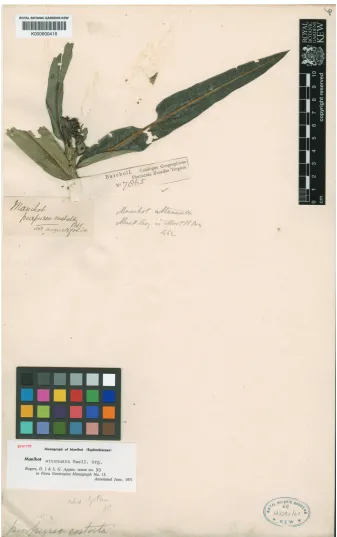
Type. BRAZIL. Goiás: inter Goyaz et Cavalcante, Burchell 7865 (lectotype, designated here: K [K000600418!]; isolectotypes: BR [BR510866!], G!).
Morphological and anatomical evidence support a new wild cassava: Manihot fallax... 149
Figure 5.Manihot attenuata. A Habit B Details of the branch showing the persistent stipule C Stipule D Staminate bracts E Staminate bracteole F Staminate bud G Staminate flower H Staminate flower with calyx split and open I Pistillate bracts J Pistillate bracteole K Pistillate flower, note the gamosepalous calyx L Pistillate flower with calyx split and open M Fruit N Seed, ventral side O Seed, dorsal side. Drawn by Cristiano Gualberto from the holotype.
both surfaces, adaxial surface dark purple or greenish purple, abaxial surface glaucous to cinereous, the latter with a smooth wax pattern, venation camptodromous-bro-chidodromous, primary veins prominent on both surface, secondary veins impressed on both surfaces, diagonally arranged towards the midvein, all pinkish to purplish. Racemes 4.5–10.5 cm long, staminate or bisexual, solitary, terminal or arising from dichotomy of the branches, erect or pendent, congested, glabrous, angulate, glaucous to cinereous, waxy. Staminate flowers: buds 4–7 × 3–6 mm, widely ovoid, yellowish, without purplish pigmentation; bracts 10–15 × 3–7 mm, widely ovate, foliaceous, apex acuminate, margins sparsely and irregularly denticulate, persistent; bracteoles situated along the lower third up to half of the pedicel, 4–4.6 × 1–1.5 mm, ovate or ovate-laceolate, foliaceous, persistent, subopposite; pedicels 3–3.2 mm long, cylin-drical, glabrous, light green; calyx 7–15 × 5–10 mm, campanulate, green-yellowish, without purplish pigmentation, shortly tomentose internally, lobes ovate-oblong with apex obtuse or rounded, base truncate; stamens 10, in two whorls of five, gla-brous, the longer 7.5–7.6 mm long, the shorter 4.5–4.6 mm long, both thickened, anthers 3–4 mm long, oblong, bright yellow, dorsifixed; disc 10-lobed, intrastami-nal, dark yellow. Pistillate flowers: buds 6–8 × 4–6 mm, ovoid, green-yellowish, with-out purplish pigmentation; bracts 5–9 × 1.5–5 mm long, widely ovate, entire, apex acuminate, margin irregularly serrate, glabrous, persistent; bracteoles 4–6 × 1–3 mm, oblong-elliptic, foliaceous, persistent, margin denticulate, apex acuminate, opposite along the lower third of the pedicel, glabrous; pedicels 4–5 mm long, cylindrical-clavate, glabrous, green; calyx 7–9 × 5–7 mm, campanulate, yellowish green, with-out purplish pigmentation, glabrous externally, shortly tomentose internally, lobes triangular, base truncate; ovary 5–7 × 2–3 mm, ovoid to oblong, glabrous, green, disc patelliform, lobed, yellow; styles 3, shortly united at the base, densely papil-lose lobed. Capsules 0.8–1.8 × 0.7–1.2 cm, oblong, light green, smooth, glabrous, without wings, waxy, dehiscence septicidal and loculicidal; columella (carpophore) persistent, 0.78–0.8 × 1.2–1.3 mm (width at narrowest point in middle), dilating to 2–2.2 mm at both tip and base, narrowly alate. Seeds 7–10 × 5–6 mm, oblong, dark grey or cinereous, with black spots; caruncle prominent, widely triangular with entire apex, cream.
Morphological relationships and characterisation. Manihot attenuata is easily recognised by its shrub habit; erect or decumbent habit; large leaves (17.5–24 × 4–4.5 cm) that are purplish; sparsely serrate, persistent stipules; bracts and bracteoles of both staminate and pistillate flowers widely ovate, pubescent externally and acuminate at the apex; usually pendent inflorescences; and pubescent stigmatic branches. It is mor-phologically similar to M. fallax. However, it differs by the set of characters cited in Table 1 and also according the anatomical characters previously discussed.
Morphological and anatomical evidence support a new wild cassava: Manihot fallax... 151
Phenology. The species has been collected with flowers from November to March, with the flowers more common from September to December and with fruits from December to March.
Conservation Status.Manihot attenuata is here classified as Vulnerable (VU) ac-cording to the IUCN Red List Categories and Criteria (IUCN 2014) because it has an extent of occurrence of ca. 9850 km2. However, the species has populations with more 20 individuals and it grows in environments inappropriate for farming and habita-tions, as well as in protected areas such as the Chapada dos Veadeiros National Park.
Typification. Müller (1874) described M. attenuata in Flora Brasiliensis based on
Burchell 7865 from Goiás state. Pax (1910) recognised M. attenuata as a good species without comment about its typification and established M. brachystachys. Rogers and Appan (1973) subordinated M. brachystachys Pax & K. Hoffm. as a synonym of M. attenuata without comment or typification of the latter. Analysing all type collections of both species confirmed that both species need to be lectotypified. The collection
Burchell 7865 (Fig. 7) deposited in the herbarium K (K000600418) as lectotype of M. attenuata was designated here because it complies with the protologue and has flowers. Based on this same principle, the collection Glaziou 21126 at P (P04786133) was pro-posed as a lectotype of M. brachystachys; isolectotypes are BR (BR0000005101320), G (G00441911), K (K000600417), P (P04786134, P04786135) and S (S-R-9076). M. brachystachys was also recognised as a synonym for M. attenuata because the characters used by Pax (1910) to differentiate them (e.g. leaf type, habit, fusion of floral parts) overlap and are variable within populations.
Recently, Mendoza et al. (2015) published M. robusta as a new species from Cha-pada dos Veadeiros region in Goiás state. Reviewing all collections used by the au-thors in the description of M. robusta, based on the images provided by them and the characters cited to differentiate M. robusta from M. attenuata (e.g. habit and aspect of growth, secondary vein numbers, inflorescence position and numbers, bract shape and length), it is concluded that the characters cited by the authors overlap and are variable within populations. Furthermore, all collections of M. robusta are from the same location as the type of M. attenuata. It is therefore considered that M. robusta is a synonym of M. attenuata.
Morphological and anatomical evidence support a new wild cassava: Manihot fallax... 153
leva ao Cânion I, entre fendas de rocha, 14°09'6.55"S, 47°48'0.74"W, 1114 m a.s.l., 29 Sep 2012, fl., M. J. Silva et al. 4421 (UFG); 2.5 km em direção ao rio Preto, 26 Oct 2012, fl., M. J. Silva et al. 4502 and 4506 (UFG); na subida para o alojamento dos brigadistas do PNCV, 22 Oct 2011, fl., M. J. Silva et al. 3885 (UFG); Parque Nacional Chapada dos Veadeiros, estrada que leva ao alojamento dos brigadistas, 14°9'53.6"S, 47°47'25.7"W, 1034 m a.s.l., 31 Oct 2014, fl., L. S. Inocencio et al. 180, 181, 182 and
183 (UFG); ib., segundo morro a nordeste do alojamento principal dos brigadistas do PNCV, 27 Oct 2012, fl., M. J. Silva et al. 4503 and 4507 (UFG); topo da serra à direita da estrada que leva ao Cânion I, 14°09'05.7"S, 47°48'00"W, 1130 m a.s.l., 23 Nov 2012, fl., L.C.S. Almeida & I. A. M. Watanabe 67 and 69 (UFG); estrada para Vale da Lua, 24 Nov 2012, fl., M. J. Silva et al. 4589 (UFG); trilha a partir do dos alojamentos do PNCV em direção ao Cânion I, 14°08'S, 47°43'W, 1086 m a.s.l., 29 Nov 2012, fl.,
L. C. S. Almeida et al. 50 (UFG); afloramento rochoso à nordeste do Cânion I, 14°9'S, 47°48'W, 1082 m a.s.l., 29 Nov 2012, fl., L. C. S. Almeida et al. 51, 52 and 56 (UFG); subida de acesso ao alojamento dos brigadistas do PNCV, 14°09'37.6"S, 47°57'2.3"W, 1034 m a.s.l., 22 Feb 2014, fl., fr., M. J. Silva et al. 5921 (UFG); cerca de 500 m do alojamento dos brigadistas, 14°9'22.4"S, 47°47'38.9"W, 1089 m a.s.l., 13 Dec 2014, fl., L. S. Inocencio et al. 278 (UFG); Parque Nacional da Chapada dos Veadeiros, estrada que leva ao alojamento principal do Parque, 04 Jan 2015, fl., R. C. Sodré, M. J. Silva & C. H. G. M. Filho 1636 (UFG). Cavalcante, exatos 8 km a noroeste de Cavalcante ao longo da estrada de terra que leva à Colinas do Sul, 13°50'S, 47°33'W, 12 Dec 1986, fl., fr., A. C. Allem et al. 11307 (CEN); estrada Minaçu-Cavalcante passando pela balsa Serra Branca (COTERRA), à cerca de 126 km do rio Tocantins, 13°41'07"S, 47°51'22"W, 740 m a.s.l., 10 Nov 2000, fl., G. P. Silva 4421 (UFG); cerca de 4 km da Vila Veneno, na direção do rio São Félix, cerca de 12 km da Balsa da Coterra, 13°32'10"S, 48°03'29"W, 380 m a.s.l., 25 Jan 2001, fl., B. M. T. Walter et al. 4807
(UFG). Chapada dos Veadeiros, imediações da Serra do Ministro, a aproximadamente 500 m da estrada entre Cavalcante e Colinas do Sul, 13°54'34"S, 47°38'55,4"W, 20 Jan 2014, fr., R. C. Sodré et al. 1193 (UFG). Minaçu, 7 km após a entrada norte do canteiro de obras, 13°28'00"S, 48°23'00"W, 920 m a.s.l., 10 Mar 1992, fl., fr., T. B. Cavalcanti et al. 1112 (CEN). Niquelândia, Reservatório em formação do AHE Serra da Mesa, região na margem direita do rio Maranhão, próximo ao rio das Almas, 14°34'50"S, 48°59'07"W, 440 m a.s.l., 16 Oct 1997, fl., B. M. T. Walter 3924 (CEN).
Acknowledgments
Morphological and anatomical evidence support a new wild cassava: Manihot fallax... 155
References
Allem AC (1997) Notas taxonômicas sobre as tribos Phyllantheae, Dalechampieae e Maniho-teae (Euphorbiaceae) no Rio Grande do Sul, Brasil. Iheringia, Série Botânica 22: 3–15. Allem AC (1984) A revision of Manihot section Quinquelobae (Euphorbiaceae). Dissertation,
Department of Botany, University of Reading.
Bachman S, Moat J, Hill AW, de la Torre J, Scott B (2011) Supporting Red List threat assess-ments with GeoCAT: geospatial conservation assessment tool. ZooKeys 150: 117–126. https://doi.org/10.3897/zookeys.150.2109
BFG (2015) Growing knowledge: an overview of seed plant diversity in Brazil. Rodriguésia 66: 1085–1113. https://doi.org/10.1590/2175-7860201566411
Bukastch F (1972) Bemerkungen Zur Doppelfärbung Astrablau-Safranin. Mikrokosmos61: 255. Carmo-Júnior JE, Sodré RC, Silva MJ, Sales MF (2013) Manihot (Euphorbiaceae s.s.) no
Parque Estadual da Serra Dourada, Goiás, Brasil. Rodriguésia 64: 727–746 https://doi. org/10.1590/S2175-78602013000400005
Cordeiro I (1992) Flora da Serra do Cipó, Minas Gerais: Euphorbiaceae. Boletim de Botânica da Universidade de São Paulo 13: 169–217. https://doi.org/10.11606/issn.2316-9052. v13i0p169-217
Cunha Neto IL, Martins FM, Caiafa AN, Martins MLL (2014) Leaf anatomy as subsidy to the taxonomy of wild Manihot species in Quinquelobae section (Euphorbiaceae). Brazilian Journal of Botany: 481–494. https://doi.org/10.1007/s40415-014-0057-2
Cunha Neto IL, Martins FM, Martins MLL, Silva LRO (2017) Comparative leaf anatomy of wild Manihot Mill. species (Euphorbiaceae) from Chapada Diamantina, Bahia, Brazil. Nordic Journal of Botany 35: 207–219. https://doi.org/10.1111/njb.01324
Duputié A, Salick J, Mackey D (2011) Evolutionary biogeography of Manihot (Euphorbi-aceae), a rapidly radiating Neotropical genus restricted to dry environments. Journal of Biogeography 38: 1033–1043. https://doi.org/10.1111/j.1365-2699.2011.02474.x Franklin GL (1945) Preparation of thin sections of synthetic resins and wood-resin composites,
and a new macerating meethod for wood. Nature 155: 51. https://doi.org/10.1038/155051a0 Graciano-Ribeiro D, Hashimoto-Freitas DY, Nassar NMA (2016) Comparative petiole anatomy of
cassava (Manihot) species. Genetics and Molecular Research 15: 1–13. https://doi.org/10.4238/ gmr.15017495
IUCN (2014) Guidelines for using the IUCN red list categories and criteria (Ver. 11). IUCN, Gland, Switzerland and Cambridge. http://www.iucnredlist.org/documents/RedList-Guidelines.pdf
Johansen DA (1940) Plant microtechnique. McGraw Hill, New York.
Martins MLL, Carvalho PCL, Amorim AM (2011) A remarkable new Manihot (Euphorbiaceae) from the coastal sand plains of Sergipe, Brazil. Phytotaxa 32: 57–60. https://doi.org/10.11646/ phytotaxa.32.1.5
Martins MLL, Carvalho PCL, Ledo CAS, Amorim AM (2014) What’s new in Manihot (Euphor-biaceae)? Systematic Botany 39: 485–489. https://doi.org/10.1600/036364414X680780 Mendoza FJM, Simon MF, Cavalcanti TB (2015) Three new endemic species of Manihot
Müller JA (1874) Euphorbiaceae. In: Martius CFP, Eichler AWM (Eds) Flora Brasiliensis 11 (2). E. Fleischer, Leipzig, 1–750.
Orlandini P, Lima LR (2014) Sinopse do gênero Manihot Mill. (Euphorbiaceae) no Estado de São Paulo, Brasil. Hoehnea 41: 51–60. https://doi.org/10.1590/S2236-89062014000100005 Pax F (1910) Manihot Adans. In: Engler HGA (Ed.) Das Pflanzenreich IV. 147 II, Heft 44.
Wilhelm Engelmann. 21–111.
Pohl JE (1827) Plantarum brasilie icones et descriptiones 1. A. Strauss, Wien, 1–134.
Rodrigues AS (2007) As tribos Dalechampieae Müll. Arg. e Manihoteae Melchior (Euphorbia-ceae) no Distrito Federal. MSc Thesis, Universidade de Brasília.
Rogers DJ, Appan SG (1973) Manihot and Manihotoides (Euphorbiaceae). A computer as-sisted study. Flora Neotropica (Monograph no. 13). Hafner Press, New York.
Sátiro LN, Roque N (2008) A família Euphorbiaceae nas caatingas arenosas do médio rio São Francisco, BA, Brasil. Acta Botanica Brasilica 22: 99–118. https://doi.org/10.1590/ S0102-33062008000100013
Silva MJ (2014) Manihot veadeirensis (Euphorbiaceae s. s.): a new species from the Brazilian Cer-rado. Systematic Botany 39: 1161–1165. https://doi.org/10.1600/036364414X682625 Silva MJ (2015) Manihot appanii (Euphorbiaceae s. s.), a new species from Brazil, and a key
to the species with unlobed or very shortly lobed leaves. Systematic Botany 40: 168–173. https://doi.org/10.1600/036364415X686477
Silva MJ, Alonso AA, Sodré RC (2016) Manihot pachycaulis sp. nov. (Euphorbiaceae) from the Brazilian Cerrado. Nordic Journal of Botany 34: 60–65. https://doi.org/10.1111/njb.00967 Silva MJ, Sodré RC (2014) A dwarf species of Manihot Mill. (Euphorbiaceae s.s.)
from the highlands of Goiás, Brazil. Systematic Botany 39: 222–226. https://doi. org/10.1600/036364414X678134
Silva MJ, Sodré RC, Almeida LCS (2013) A new endemic species of Manihot (Euphorbi-aceae s. str.) from the Chapada dos Veadeiros, Goiás, Brazil. Phytotaxa 131: 53–57. https://doi.org/10.11646/phytotaxa.131.1.10
Silva MJ, Soares TN, Oliveira PRO (2017) Morphological characteristics and genetic evidence reveals a new species of Manihot (Euphorbiaceae, Crotonoideae) from Goiás, Brazil. Phy-toKeys 77: 99–111 https://doi.org/10.3897/phytokeys.77.11738
Thiers B (2017) Index Herbariorum: A global directory of public herbaria and associated staff. New York Botanical Garden’s Virtual Herbarium, New York. http://sweetgum.nybg.org/ih/ Vannucci AL (1982) Anatomia comparada de duas espécies nativas de Manihot Mill.