Proceedings of the 55th Annual Meeting of the Association for Computational Linguistics (Short Papers), pages 196–202 Proceedings of the 55th Annual Meeting of the Association for Computational Linguistics (Short Papers), pages 196–202
Attention Strategies for Multi-Source Sequence-to-Sequence Learning
Jindˇrich Libovick´y and Jindˇrich Helcl
Charles University, Faculty of Mathematics and Physics Institute of Formal and Applied Linguistics
Malostransk´e n´amˇest´ı 25, 118 00 Prague, Czech Republic
{libovicky, helcl}@ufal.mff.cuni.cz
Abstract
Modeling attention in neural multi-source sequence-to-sequence learning remains a relatively unexplored area, despite its use-fulness in tasks that incorporate multiple source languages or modalities. We pro-pose two novel approaches to combine the outputs of attention mechanisms over each source sequence,flatandhierarchical. We compare the proposed methods with exist-ing techniques and present results of sys-tematic evaluation of those methods on the WMT16 Multimodal Translation and Au-tomatic Post-editing tasks. We show that the proposed methods achieve competitive results on both tasks.
1 Introduction
Sequence-to-sequence (S2S) learning with atten-tion mechanism recently became the most suc-cessful paradigm with state-of-the-art results in machine translation (MT) (Bahdanau et al., 2014; Sennrich et al., 2016a), image captioning (Xu et al., 2015; Lu et al., 2016), text summariza-tion (Rush et al., 2015) and other NLP tasks.
All of the above applications of S2S learning make use of a single encoder. Depending on the modality, it can be either a recurrent neural net-work (RNN) for textual input data, or a convolu-tional network for images.
In this work, we focus on a special case of S2S learning with multiple input sequences of possibly different modalities and a single output-generating recurrent decoder. We explore various strategies the decoder can employ to attend to the hidden states of the individual encoders.
The existing approaches to this problem do not explicitly model different importance of the inputs to the decoder (Firat et al., 2016; Zoph and Knight,
2016). In multimodal MT (MMT), where an im-age and its caption are on the input, we might ex-pect the caption to be the primary source of in-formation, whereas the image itself would only play a role in output disambiguation. In automatic post-editing (APE), where a sentence in a source language and its automatically generated transla-tion are on the input, we might want to attend to the source text only in case the model decides that there is an error in the translation.
We propose two interpretable attention strate-gies that take into account the roles of the indi-vidual source sequences explicitly—flat and hier-archical attention combination.
This paper is organized as follows: In Sec-tion 2, we review the attenSec-tion mechanism in single-source S2S learning. Section 3 introduces new attention combination strategies. In Section 4, we evaluate the proposed models on the MMT and APE tasks. We summarize the related work in Sec-tion 5, and conclude in SecSec-tion 6.
2 Attentive S2S Learning
The attention mechanism in S2S learning allows an RNN decoder to directly access information about the input each time before it emits a sym-bol. Inspired by content-based addressing in Neu-ral Turing Machines (Graves et al., 2014), the at-tention mechanism estimates a probability distri-bution over the encoder hidden states in each de-coding step. This distribution is used for comput-ing the context vector—the weighted average of the encoder hidden states—as an additional input to the decoder.
The standard attention model as described by Bahdanau et al. (2014) defines the attention en-ergieseij, attention distributionαij, and the
text vectorciini-th decoder step as:
eij =v>a tanh(Wasi+Uahj), (1)
αij =
exp(eij)
PTx
k=1exp(eik)
, (2)
ci= Tx
X
j=1
αijhj. (3)
The trainable parameters Wa and Ua are
projec-tion matrices that transform the decoder and en-coder statessiandhj into a common vector space
andva is a weight vector over the dimensions of
this space. Tx denotes the length of the input
se-quence. For the sake of clarity, bias terms (applied every time a vector is linearly projected using a weight matrix) are omitted.
Recently, Lu et al. (2016) introduced sentinel gate, an extension of the attentive RNN decoder with LSTM units (Hochreiter and Schmidhuber, 1997). We adapt the extension for gated recurrent units (GRU) (Cho et al., 2014), which we use in our experiments:
ψi=σ(Wyyi+Wssi−1) (4)
whereWy andWsare trainable parameters, yi is
the embedded decoder input, andsi−1 is the pre-vious decoder state.
Analogically to Equation 1, we compute a scalar energy term for the sentinel:
eψi =v>a tanh
Wasi+Ua(ψ)(ψisi)
(5)
whereWa,Ua(ψ)are the projection matrices,vais
the weight vector, andψisiis the sentinel vector.
Note that the sentinel energy term does not depend on any hidden state of any encoder. The sentinel vector is projected to the same vector space as the encoder state hj in Equation 1. The termeψi is added as an extra attention energy term to Equa-tion 2 and the sentinel vectorψisiis used as the
corresponding vector in the summation in Equa-tion 3.
This technique should allow the decoder to choose whether to attend to the encoder or to fo-cus on its own state and act more like a language model. This can be beneficial if the encoder does not contain much relevant information for the cur-rent decoding step.
3 Attention Combination
In S2S models with multiple encoders, the decoder needs to be able to combine the attention informa-tion collected from the encoders.
A widely adopted technique for combining mul-tiple attention models in a decoder is concatena-tion of the context vectors c(1)i , . . . , c(iN) (Zoph and Knight, 2016; Firat et al., 2016). As men-tioned in Section 1, this setting forces the model to attend to each encoder independently and lets the attention combination to be resolved implicitly in the subsequent network layers.
In this section, we propose two alternative strategies of combining attentions from multiple encoders. We either let the decoder learn the αi
distribution jointly over all encoder hidden states (flat attention combination) or factorize the dis-tribution over individual encoders (hierarchical
combination).
Both of the alternatives allow us to explicitly compute distribution over the encoders and thus interpret how much attention is paid to each en-coder at every decoding step.
3.1 Flat Attention Combination
Flat attention combination projects the hidden states of all encoders into a shared space and then computes an arbitrary distribution over the projec-tions. The difference between the concatenation of the context vectors and the flat attention combina-tion is that theαicoefficients are computed jointly
for all encoders:
α(ijk)= exp(e
(k)
ij )
PN n=1
PTx(n)
m=1exp
e(imn)
(6)
whereTx(n) is the length of the input sequence of
the n-th encoder and e(ijk) is the attention energy of the j-th state of the k-th encoder in the i-th decoding step. These attention energies are com-puted as in Equation 1. The parametersvaandWa
are shared among the encoders, andUais different
for each encoder and serves as an encoder-specific projection of hidden states into a common vector space.
them into a single space using linear projections:
ci = N
X
k=1
TXx(k)
j=1
α(ijk)Uc(k)h(jk) (7)
whereUc(k)are additional trainable parameters.
The matricesUc(k)project the hidden states into
a common vector space. This raises a question whether this space can be the same as the one that is projected into in the energy computation using matrices Ua(k) in Equation 1, i.e., whether
Uc(k)=Ua(k). In our experiments, we explore both
options. We also try both adding and not adding the sentinelα(iψ)Uc(ψ)(ψisi)to the context
vec-tor.
3.2 Hierarchical Attention Combination The hierarchical attention combination model computes every context vector independently, similarly to the concatenation approach. Instead of concatenation, a second attention mechanism is constructed over the context vectors.
We divide the computation of the attention dis-tribution into two steps: First, we compute the context vector for each encoder independently us-ing Equation 3. Second, we project the context vectors (and optionally the sentinel) into a com-mon space (Equation 8), we compute another dis-tribution over the projected context vectors (Equa-tion 9) and their corresponding weighted average (Equation 10):
e(ik)=vb>tanh(Wbsi+Ub(k)c(ik)), (8)
βi(k)= exp(e
(k)
i )
PN
n=1exp(e (n)
i )
, (9)
ci = N
X
k=1
βi(k)Uc(k)c(ik) (10)
where c(ik) is the context vector of the k-th en-coder, additional trainable parameters vb andWb
are shared for all encoders, andUb(k)andUc(k)are
encoder-specific projection matrices, that can be set equal and shared, similarly to the case of flat attention combination.
4 Experiments
We evaluate the attention combination strategies presented in Section 3 on the tasks of multi-modal translation (Section 4.1) and automatic post-editing (Section 4.2).
0 5 10 15 20 25 30 35
0 10 20 30 40 50
BLEU
Epochs concatenation
[image:3.595.310.522.60.217.2]flat hierarchical
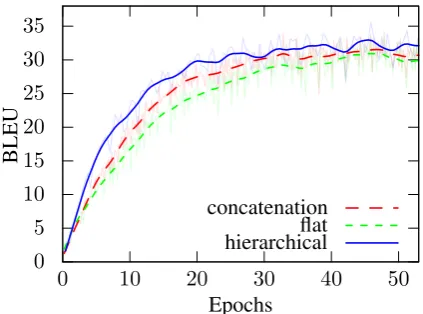
Figure 1: Learning curves on validation data for context vector concatenation (blue), flat (green) and hierarchical (red) attention combination with-out sentinel and withwith-out sharing the projection ma-trices.
The models were implemented using the Neural Monkey sequence-to-sequence learning toolkit (Helcl and Libovick´y, 2017).12 In both
setups, we process the textual input with bidirec-tional GRU network (Cho et al., 2014) with 300 units in the hidden state in each direction and 300 units in embeddings. For the attention projection space, we use 500 hidden units. We optimize the network to minimize the output cross-entropy us-ing the Adam algorithm (Kus-ingma and Ba, 2014) with learning rate10−4.
4.1 Multimodal Translation
The goal of multimodal translation (Specia et al., 2016) is to generate target-language image cap-tions given both the image and its caption in the source language.
We train and evaluate the model on the Multi30k dataset (Elliott et al., 2016). It con-sists of 29,000 training instances (images together with English captions and their German trans-lations), 1,014 validation instances, and 1,000 test instances. The results are evaluated us-ing the BLEU (Papineni et al., 2002) and ME-TEOR (Denkowski and Lavie, 2011).
In our model, the visual input is processed with a pre-trained VGG 16 network (Simonyan and Zis-serman, 2014) without further fine-tuning.
Atten-1http://github.com/ufal/neuralmonkey 2The trained models can be downloaded from
tion distribution over the visual input is computed from the last convolutional layer of the network. The decoder is an RNN with 500 conditional GRU units (Firat and Cho, 2016) in the recurrent layer. We use byte-pair encoding (Sennrich et al., 2016b) with a vocabulary of 20,000 subword units shared between the textual encoder and the decoder.
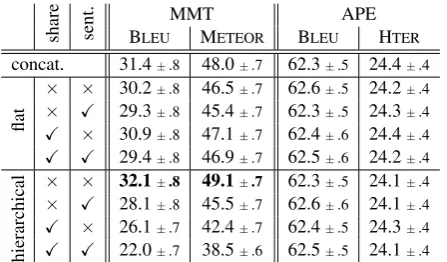
The results of our experiments in multimodal MT are shown in Table 1. We achieved the best results using the hierarchical attention combina-tion without the sentinel mechanism, which also showed the fastest convergence. The flat com-bination strategy achieves similar results eventu-ally. Sharing the projections for energy and con-text vector computation does not improve over the concatenation baseline and slows the training al-most prohibitively. Multimodal models were not able to surpass the textual baseline (BLEU 33.0).
Using the conditional GRU units brought an improvement of about 1.5 BLEU points on aver-age, with the exception of the concatenation sce-nario where the performance dropped by almost 5 BLEU points. We hypothesize this is caused by the fact the model has to learn the implicit atten-tion combinaatten-tion on multiple places – once in the output projection and three times inside the con-ditional GRU unit (Firat and Cho, 2016, Equa-tions 10-12). We thus report the scores of the in-troduced attention combination techniques trained with conditional GRU units and compare them with the concatenation baseline trained with plain GRU units.
4.2 Automatic MT Post-editing
Automatic post-editing is a task of improving an automatically generated translation given the source sentence where the translation system is treated as a black box.
We used the data from the WMT16 APE Task (Bojar et al., 2016; Turchi et al., 2016), which consists of 12,000 training, 2,000 validation, and 1,000 test sentence triplets from the IT domain. Each triplet contains an English source sentence, an automatically generated German translation of the source sentence, and a manually post-edited German sentence as a reference. In case of this dataset, the MT outputs are almost perfect in and only little effort was required to post-edit the sen-tences. The results are evaluated using the human-targeted error rate (HTER) (Snover et al., 2006) and BLEU score (Papineni et al., 2002).
share sent. BLEUMMTMETEOR BLEUAPEHTER concat. 31.4±.8 48.0±.7 62.3±.5 24.4±.4
flat
× × 30.2±.8 46.5±.7 62.6±.5 24.2±.4
× X 29.3±.8 45.4±.7 62.3±.5 24.3±.4
X × 30.9±.8 47.1±.7 62.4±.6 24.4±.4
X X 29.4±.8 46.9±.7 62.5±.6 24.2±.4
hierarchical
× × 32.1±.8 49.1±.7 62.3±.5 24.1±.4
× X 28.1±.8 45.5±.7 62.6±.6 24.1±.4
X × 26.1±.7 42.4±.7 62.4±.5 24.3±.4
[image:4.595.309.533.61.192.2]X X 22.0±.7 38.5±.6 62.5±.5 24.1±.4 Table 1: Results of our experiments on the test sets of Multi30k dataset and the APE dataset. The col-umn ‘share’ denotes whether the projection matrix is shared for energies and context vector computa-tion, ‘sent.’ indicates whether the sentinel vector has been used or not.
Following Libovick´y et al. (2016), we encode the target sentence as a sequence of edit operations transforming the MT output into the reference. By this technique, we prevent the model from para-phrasing the input sentences. The decoder is a GRU network with 300 hidden units. Unlike in the MMT setup (Section 4.1), we do not use the conditional GRU because it is prone to overfitting on the small dataset we work with.
The models were able to slightly, but signifi-cantly improve over the baseline – leaving the MT output as is (HTER 24.8). The differences be-tween the attention combination strategies are not significant.
5 Related Work
Attempts to use S2S models for APE are relatively rare (Bojar et al., 2016). Niehues et al. (2016) con-catenate both inputs into one long sequence, which forces the encoder to be able to work with both source and target language. Their attention is then similar to our flat combination strategy; however, it can only be used for sequential data.
Source: a man sleeping in a green room on a couch .
Reference: ein Mann schl¨aft in einem gr¨unen Raum auf einem Sofa .
Output with attention:
ein Mannschläft
auf einemgrünen
Sofain einemgrünen
Raum.
(1)
(2)
(3)
[image:5.595.113.250.62.154.2](1) source, (2) image, (3) sentinel
Figure 2: Visualization of hierarchical attention in MMT. Each column in the diagram corresponds to the weights of the encoders and sentinel. Note that the despite the overall low importance of the image encoder, it gets activated for the content words.
Caglayan et al. (2016) used an architecture very similar to ours for multimodal translation. They made a strong assumption that the network can be trained in such a way that the hidden states of the encoder and the convolutional network occupy the same vector space and thus sum the context vec-tors from both modalities. In this way, their mul-timodal MT system (BLEU 27.82) remained far bellow the text-only setup (BLEU 32.50).
New state-of-the-art results on the Multi30k dataset were achieved very recently by Calixto et al. (2017). The best-performing architecture uses the last fully-connected layer of VGG-19 network (Simonyan and Zisserman, 2014) as de-coder initialization and only attends to the text en-coder hidden states. With a stronger monomodal baseline (BLEU 33.7), their multimodal model achieved a BLEU score of 37.1. Similarly to Niehues et al. (2016) in the APE task, even fur-ther improvement was achieved by synthetically extending the dataset.
6 Conclusions
We introduced two new strategies of combining attention in a multi-source sequence-to-sequence setup. Both methods are based on computing a joint distribution over hidden states of all en-coders.
We conducted experiments with the proposed strategies on multimodal translation and automatic post-editing tasks, and we showed that the flat and hierarchical attention combination can be applied to these tasks with maintaining competitive score to previously used techniques.
Unlike the simple context vector concatenation, the introduced combination strategies can be used with the conditional GRU units in the decoder. On top of that, the hierarchical combination strategy exhibits faster learning than than the other strate-gies.
Acknowledgments
We would like to thank Ondˇrej Duˇsek, Rudolf Rosa, Pavel Pecina, and Ondˇrej Bojar for a fruit-ful discussions and comments on the draft of the paper.
This research has been funded by the Czech Science Foundation grant no. P103/12/G084, the EU grant no. H2020-ICT-2014-1-645452 (QT21), and Charles University grant no. 52315/2014 and SVV project no. 260 453. This work has been using language resources developed and/or stored and/or distributed by the LINDAT-Clarin project of the Ministry of Education of the Czech Repub-lic (project LM2010013).
References
Dzmitry Bahdanau, Kyunghyun Cho, and Yoshua
Bengio. 2014. Neural machine translation by
jointly learning to align and translate. CoRR
abs/1409.0473. http://arxiv.org/abs/1409.0473. Ondˇrej Bojar, Rajen Chatterjee, Christian Federmann,
Yvette Graham, Barry Haddow, Matthias Huck, An-tonio Yepes, Philipp Koehn, Varvara Logacheva, Christof Monz, Matteo Negri, Aurelie N´ev´eol, Mar-iana Neves, Martin Popel, Matt Post, Raphael Ru-bino, Carolina Scarton, Lucia Specia, Marco Turchi, Karin Verspoor, and Marcos Zampieri. 2016. Find-ings of the 2016 conference on machine
transla-tion (WMT16). In Proceedings of the First
Ozan Caglayan, Walid Aransa, Yaxing Wang, Marc Masana, Mercedes Garc´ıa-Mart´ınez, Fethi Bougares, Lo¨ıc Barrault, and Joost van de Wei-jer. 2016. Does multimodality help human and machine for translation and image captioning? In Proceedings of the First Conference on Ma-chine Translation. Association for Computational Linguistics, Berlin, Germany, pages 627–633. http://www.aclweb.org/anthology/W16-2358. Iacer Calixto, Qun Liu, and Nick Campbell.
2017. Incorporating global visual features into
attention-based neural machine translation. CoRR
abs/1701.06521. http://arxiv.org/abs/1701.06521. Kyunghyun Cho, Bart van Merrienboer, Dzmitry
Bah-danau, and Yoshua Bengio. 2014. On the proper-ties of neural machine translation: Encoder–decoder
approaches. In Proceedings of SSST-8, Eighth
Workshop on Syntax, Semantics and Structure in Statistical Translation. Association for Computa-tional Linguistics, Doha, Qatar, pages 103–111. http://www.aclweb.org/anthology/W14-4012. Michael Denkowski and Alon Lavie. 2011. Meteor
1.3: Automatic metric for reliable optimization and
evaluation of machine translation systems. In
Pro-ceedings of the Sixth Workshop on Statistical Ma-chine Translation. Association for Computational Linguistics, Edinburgh, United Kingdom, pages 85– 91. http://www.aclweb.org/anthology/W11-2107. Desmond Elliott, Stella Frank, Khalil Sima’an, and
Lu-cia SpeLu-cia. 2016. Multi30k: Multilingual
english-german image descriptions. CoRRabs/1605.00459.
http://arxiv.org/abs/1605.00459.
Orhan Firat and Kyunghyun Cho. 2016.
Con-ditional gated recurrent unit with attention
mechanism.
https://github.com/nyu-dl/dl4mt-tutorial/blob/master/docs/cgru.pdf. Published
online, versionadbaeea.
Orhan Firat, Kyunghyun Cho, and Yoshua
Ben-gio. 2016. Multi-way, multilingual neural
ma-chine translation with a shared attention
mecha-nism. In Proceedings of the 2016 Conference of
the North American Chapter of the Association for Computational Linguistics: Human Language Technologies. Association for Computational Lin-guistics, San Diego, CA, USA, pages 866–875. http://www.aclweb.org/anthology/N16-1101. Alex Graves, Greg Wayne, and Ivo Danihelka. 2014.
Neural turing machines. CoRR abs/1410.5401.
http://arxiv.org/abs/1410.5401.
Jindˇrich Helcl and Jindˇrich Libovick´y. 2017. Neural monkey: An open-source tool for sequence learn-ing. The Prague Bulletin of Mathematical Lin-guistics(107):5–17. https://doi.org/10.1515/pralin-2017-0001.
Sepp Hochreiter and J¨urgen Schmidhuber. 1997. Long
short-term memory. Neural Comput.9:1735–1780.
https://doi.org/10.1162/neco.1997.9.8.1735.
Marcin Junczys-Dowmunt and Roman
Grund-kiewicz. 2016. Log-linear combinations of
monolingual and bilingual neural machine
trans-lation models for automatic post-editing. In
Proceedings of the First Conference on Ma-chine Translation. Association for Computational Linguistics, Berlin, Germany, pages 751–758. http://www.aclweb.org/anthology/W/W16/W16-2378.
Diederik P. Kingma and Jimmy Ba. 2014. Adam:
A method for stochastic optimization. CoRR
abs/1412.6980. http://arxiv.org/abs/1412.6980. Jindˇrich Libovick´y, Jindˇrich Helcl, Marek Tlust´y,
Ondˇrej Bojar, and Pavel Pecina. 2016. CUNI
system for WMT16 automatic post-editing
and multimodal translation tasks. In
Pro-ceedings of the First Conference on Machine Translation. Association for Computational Linguistics, Berlin, Germany, pages 646–654. http://www.aclweb.org/anthology/W/W16/W16-2361.
Jiasen Lu, Caiming Xiong, Devi Parikh, and
Richard Socher. 2016. Knowing when to
look: Adaptive attention via a visual sentinel
for image captioning. CoRR abs/1612.01887.
http://arxiv.org/abs/1612.01887.
Jan Niehues, Eunah Cho, Thanh-Le Ha, and
Alex Waibel. 2016. Pre-translation for
neu-ral machine translation. CoRR abs/1610.05243.
http://arxiv.org/abs/1610.05243.
Kishore Papineni, Salim Roukos, Todd Ward,
and Wei-Jing Zhu. 2002. Bleu: a method
for automatic evaluation of machine
transla-tion. In Proceedings of 40th Annual Meeting
of the Association for Computational
Linguis-tics. Association for Computational Linguistics,
Philadelphia, Pennsylvania, USA, pages 311–318. https://doi.org/10.3115/1073083.1073135.
Alexander M. Rush, Sumit Chopra, and Jason We-ston. 2015. A neural attention model for
abstrac-tive sentence summarization. InProceedings of the
2015 Conference on Empirical Methods in Natu-ral Language Processing. Association for Computa-tional Linguistics, Lisbon, Portugal, pages 379–389. https://aclweb.org/anthology/D/D15/D15-1044. Rico Sennrich, Barry Haddow, and Alexandra
Birch. 2016a. Edinburgh neural machine
translation systems for WMT 16. In
Pro-ceedings of the First Conference on Machine Translation. Association for Computational Linguistics, Berlin, Germany, pages 371–376. http://www.aclweb.org/anthology/W/W16/W16-2323.
Rico Sennrich, Barry Haddow, and Alexandra
Birch. 2016b. Neural machine translation of
rare words with subword units. In
1: Long Papers). Association for Computational Linguistics, Berlin, Germany, pages 1715–1725. http://www.aclweb.org/anthology/P16-1162.
Karen Simonyan and Andrew Zisserman. 2014. Very deep convolutional networks for
large-scale image recognition. CoRR abs/1409.1556.
http://arxiv.org/abs/1409.1556.
Matthew Snover, Bonnie Dorr, Richard Schwartz, Lin-nea Micciulla, and John Makhoul. 2006. A study of translation edit rate with targeted human annotation. In Proceedings of association for machine transla-tion in the Americas. volume 200.
Lucia Specia, Stella Frank, Khalil Sima’an, and Desmond Elliott. 2016. A shared task on multi-modal machine translation and crosslingual image description. InProceedings of the First Conference on Machine Translation. Association for Computa-tional Linguistics, Berlin, Germany, pages 543–553. http://www.aclweb.org/anthology/W16-2346.
Marco Turchi, Rajen Chatterjee, and Matteo Negri.
2016. WMT16 APE shared task data.
LIN-DAT/CLARIN digital library at the Institute of For-mal and Applied Linguistics, Charles University in Prague. http://hdl.handle.net/11372/LRT-1632.
Kelvin Xu, Jimmy Ba, Ryan Kiros, Kyunghyun Cho, Aaron Courville, Ruslan Salakhudinov, Rich
Zemel, and Yoshua Bengio. 2015. Show,
at-tend and tell: Neural image caption
gener-ation with visual attention. In David Blei
and Francis Bach, editors, Proceedings of the
32nd International Conference on Machine Learn-ing (ICML-15). JMLR Workshop and Confer-ence Proceedings, Lille, France, pages 2048–2057. http://jmlr.org/proceedings/papers/v37/xuc15.pdf. Barret Zoph and Kevin Knight. 2016. Multi-source