Proceedings of the 55th Annual Meeting of the Association for Computational Linguistics- Student Research Workshop, pages 4–10 Proceedings of the 55th Annual Meeting of the Association for Computational Linguistics- Student Research Workshop, pages 4–10
Improving Distributed Representations of Tweets - Present and Future
Ganesh Jawahar
Information Retrieval and Extraction Laboratory IIIT Hyderabad
Telangana, India
Abstract
Unsupervised representation learning for tweets is an important research field which helps in solving several business applica-tions such as sentiment analysis, hashtag prediction, paraphrase detection and mi-croblog ranking. A good tweet represen-tation learning model must handle the id-iosyncratic nature of tweets which poses several challenges such as short length, in-formal words, unusual grammar and mis-spellings. However, there is a lack of prior work which surveys the represen-tation learning models with a focus on tweets. In this work, we organize the mod-els based on its objective function which aids the understanding of the literature. We also provide interesting future direc-tions, which we believe are fruitful in ad-vancing this field by building high-quality tweet representation learning models.
1 Introduction
Twitter is a widely used microblogging platform, where users post and interact with messages, “tweets”. Understanding the semantic represen-tation of tweets can benefit a plethora of applica-tions such as sentiment analysis (Ren et al.,2016; Giachanou and Crestani, 2016), hashtag predic-tion (Dhingra et al., 2016), paraphrase detec-tion (Vosoughi et al., 2016) and microblog rank-ing (Huang et al.,2013;Shen et al.,2014). How-ever, tweets are difficult to model as they pose several challenges such as short length, informal words, unusual grammar and misspellings. Re-cently, researchers are focusing on leveraging un-supervised representation learning methods based on neural networks to solve this problem. Once these representations are learned, we can use
off-the-shelf predictors taking the representation as in-put to solve the downstream task (Bengio,2013a; Bengio et al., 2013b). These methods enjoy sev-eral advantages: (1) they are cheaper to train, as they work with unlabelled data, (2) they reduce the dependence on domain level experts, and (3) they are highly effective across multiple applications, in practice.
Despite this, there is a lack of prior work which surveys the tweet-specific unsupervised represen-tation learning models. In this work, we attempt to fill this gap by investigating the models in an or-ganized fashion. Specifically, we group the mod-els based on the objective function it optimizes. We believe this work can aid the understanding of the existing literature. We conclude the pa-per by presenting interesting future research direc-tions, which we believe are fruitful in advancing this field by building high-quality tweet represen-tation learning models.
2 Unsupervised Tweet Representation Models
There are various models spanning across differ-ent model architectures and objective functions in the literature to compute tweet representation in an unsupervised fashion. These models work in a semi-supervised way - the representations gener-ated by the model is fed to an off-the-shelf pre-dictor like Support Vector Machines (SVM) to solve a particular downstream task. These mod-els span across a wide variety of neural network based architectures including average of word vec-tors, convolutional-based, recurrent-based and so on. We believe that the performance of these mod-els is highly dependent on the objective function it optimizes – predicting adjacent word (within-tweet relationships), adjacent (within-tweet (inter-(within-tweet relationships), the tweet itself (autoencoder),
Unsupervised Tweet Representation Models
Modeling within-tweet relationships
Modeling inter-tweet relationships
Paragraph2Vec (ICML’14)
Conceptual SE (ACL’16)
Modeling from structured
resources
Modeling as an autoencoder
Modeling using weak supervision
Skip-thought (NIPS’15)
FastSent (NAACL’16)
Siamese CBOW (ACL’16)
Ganesh et al. (ECIR’17)
CHARAGRAM (EMNLP’16)
Wieting et al. (ICLR’16)
SDAE (NAACL’16)
Tweet2Vec (SIGIR’16)
SSWE (TKDE’16)
[image:2.595.88.511.63.303.2]Twee2Vec (ACL’16)
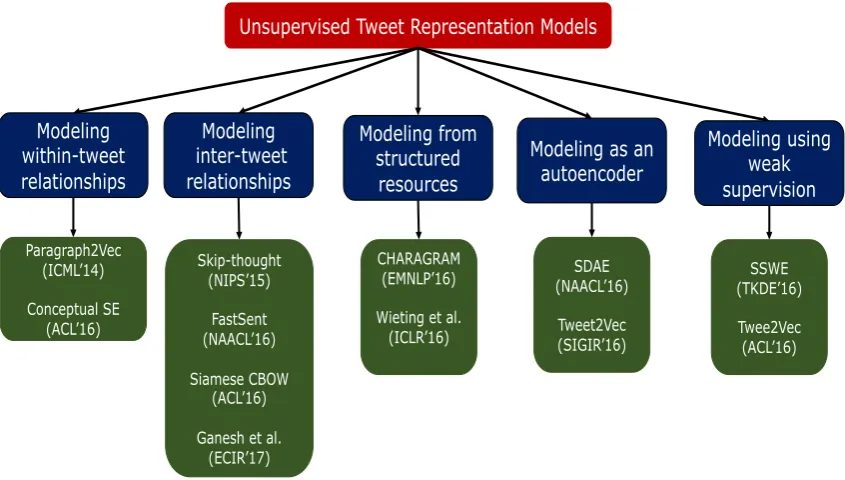
Figure 1: Unsupervised Tweet Representation Models Hierarchy based on Optimized Objective Function
eling from structured resources like paraphrase databases and weak supervision. In this section, we provide the first of its kind survey of the recent tweet-specific unsupervised models in an orga-nized fashion to understand the literature. Specif-ically, we categorize each model based on the op-timized objective function as shown in Figure 1. Next, we study each category one by one.
2.1 Modeling within-tweet relationships Motivation: Every tweet is assumed to have a la-tent topic vector, which influences the distribution of the words in the tweet. For example, though the appearance of the phrasecatch the ballis fre-quent in the corpus, if we know that the topic of a tweet is about “technology”, we can expect words such asbugorexceptionafter the wordcatch (ig-noring the) instead of the word ball since catch the bug/exceptionis more plausible under the topic “technology”. On the other hand, if the topic of the tweet is about “sports”, then we can expect ballaftercatch. These intuitions indicate that the prediction of neighboring words for a given word strongly relies on the tweet also.
Models: (Le and Mikolov,2014)’s work is the first to exploit this idea to compute distributed docu-ment representations that are good at predicting words in the document. They propose two mod-els: PV-DM and PV-DBOW, that are extensions of Continuous Bag Of Words (CBOW) and
2.2 Modeling inter-tweet relationships Motivation: To capture rich tweet semantics, researchers are attempting to exploit a type of sentence-level Distributional Hypothesis (Harris, 1954;Polajnar et al.,2015). The idea is to infer the tweet representation from the content of adjacent tweets in a related stream like users’ Twitter time-line, topical, retweet and conversational stream. This approach significantly alleviates the context insufficiency problem caused due to the ambigu-ous and short nature of tweets (Ren et al., 2016; Ganesh et al.,2017).
Models: Skip-thought vectors (Kiros et al.,2015) (STV) is a widely popular sentence encoder, which is trained to predict adjacent sentences in the book corpus (Zhu et al.,2015). Although the testing is cheap as it involves a cheap forward propagation of the test sentence, STV is very slow to train thanks to its complicated model architec-ture. To combat this computational inefficiency, FastSent (Hill et al., 2016) propose a simple ad-ditive (log-linear) sentence model, which predicts adjacent sentences (represented as BOW) taking the BOW representation of some sentence in con-text. This model can exploit the same signal, but at a much lower computational expense. Paral-lel to this work, Siamase CBOW (Kenter et al., 2016) develop a model which directly compares the BOW representation of two sentence to bring the embeddings of a sentence closer to its adja-cent sentence, away from a randomly occurring sentence in the corpus. For FastSent and Siamese CBOW, the test sentence representation is a sim-ple average of word vectors obtained after train-ing. Both of these models are general purpose sentence representation models trained on book corpus, yet give a competitive performance over previous models on the tweet semantic similarity computation task. (Ganesh et al., 2017)’s model attempt to exploit these signals directly from Twit-ter. With the help of attention technique and learned user representation, this log-linear model is able to capture salient semantic information from chronologically adjacent tweets of a target tweet in users’ Twitter timeline.
2.3 Modeling from structured resources Motivation: In recent times, building represen-tation models based on supervision from richly structured resources such as Paraphrase Database (PPDB) (Ganitkevitch et al., 2013) (containing
noisy phrase pairs) has yielded high quality sen-tence representations. These methods work by maximizing the similarity of the sentences in the learned semantic space.
Models: CHARAGRAM (Wieting et al., 2016a) embeds textual sequences by learning a character-based compositional model that involves addition of the vectors of its character n-grams followed by an elementwise nonlinearity. This simpler archi-tecture trained on PPDB is able to beat models with complex architectures like CNN, LSTM on SemEval 2015 Twitter textual similarity task by a large margin. This result emphasizes the impor-tance of character-level models that address differ-ences due to spelling variation and word choice. The authors in their subsequent work (Wieting et al., 2016b) conduct a comprehensive analysis of models spanning the range of complexity from word averaging to LSTMs for its ability to do transfer and supervised learning after optimizing a margin based loss on PPDB. For transfer learning, they find models based on word averaging perform well on both the in-domain and out-of-domain tex-tual similarity tasks, beating LSTM model by a large margin. On the other hand, the word averag-ing models perform well for both sentence similar-ity and textual entailment tasks, outperforming the LSTM. However, for sentiment classification task, they find LSTM (trained on PPDB) to beat the av-eraging models to establish a new state of the art. The above results suggest that structured resources play a vital role in computing general-purpose em-beddings useful in downstream applications.
2.4 Modeling as an autoencoder
Motivation: The autoencoder based approach learns latent (or compressed) representation by re-constructing its own input. Since textual data like tweets contain discrete input signals, sequence-to-sequence models (Sutskever et al., 2014) like STV can be used to build the solution. The en-coder model which encodes the input tweet can typically be a CNN (Kim,2014), recurrent models like RNN, GRU, LSTM (Karpathy et al.,2015) or memory networks (Sukhbaatar et al.,2015). The decoder model which generates the output tweet can typically be a recurrent model that predicts a output token at every time step.
recover the original data from the corrupted ver-sion. SDAE produces robust representations by learning to represent the data in terms of fea-tures that explain its important factors of varia-tion. Tweet2Vec (Vosoughi et al.,2016) is a recent model which uses a character-level CNN-LSTM encoder-decoder architecture trained to construct the input tweet directly. This model outper-forms competitive models that work on word-level like PV-DM, PV-DBOW on semantic similarity computation and sentiment classification tasks, thereby showing that the character-level nature of Tweet2Vec is best-suited to deal with the noise and idiosyncrasies of tweets. Tweet2Vec controls the generalization error by using a data augmentation technique, wherein tweets are replicated and some of the words in the replicated tweets are replaced with their synonyms. Both SDAE and Tweet2Vec has the advantage that they don’t need a coherent inter-sentence narrative (like STV), which is hard to obtain in Twitter.
2.5 Modeling using weak supervision
Motivation: In a weakly supervised setup, we create labels for a tweet automatically and pre-dict them to learn potentially sophisticated mod-els than those obtained by unsupervised learning alone. Examples of labels include sentiment of the overall tweet, words like hashtag present in the tweet and so on. This technique can create a hugelabeled dataset especially for building data-hungry, sophisticated deep learning models. Models: (Tang et al., 2016) learns sentiment-specific word embedding (SSWE), which encodes the polarity information in the word representa-tions so that words with contrasting polarities and similar syntactic context (like goodandbad) are pushed away from each other in the semantic space that it learns. SSWE utilizes the massive distant-supervised tweets collected by positive and negative emoticons to build a powerful tweet rep-resentation, which are shown to be useful in tasks such as sentiment classification and word simi-larity computation in sentiment lexicon. ( Dhin-gra et al., 2016) observes thathashtags in tweets can be considered as topics and hence tweets with similar hashtags must come closer to each other. Their model predicts the hashtags by using a Bi-GRU layer to embed the tweets from its charac-ters. Due to subword modeling, such character-level models can approximate the representations
for rare words and new words (words not seen dur-ing traindur-ing) in the test tweets really well. This model outperforms the word-level baselines for hashtag prediction task, thereby concluding that exploring character-level models for tweets is a worthy research direction to pursue. Both these works fail to study the model’s generality (Weston et al.,2014), i.e., the ability of the model to trans-fer the learned representations to diverse tasks.
3 Future Directions
In this section we present the future research di-rections which we believe can be worth pursuing to generate high quality tweet embeddings.
• (Ren et al., 2016) propose a supervised
neural network utilizing contextualized fea-tures from conversation, author and topic based context about a target tweet to per-form well in classification of tweet. Apart from (Ganesh et al.,2017)’s work which uti-lizes author context, there is no other work which builds unsupervised tweet representa-tion model on Twitter-specific contexts such as conversation and topical streams. We be-lieve such a solution directly exploits seman-tic signals (or nuances) from Twitter, unlike STV or Siamese CBOW which are trained on books corpus.
• (dos Santos and Gatti,2014) propose a super-vised, hybrid model exploiting both the char-acter and word level information for Twit-ter sentiment analysis task. Since the set-tings when the character level model beats the word level model is not well understood yet, we believe it would be interesting to explore such a hybrid compositional model to build unsupervised tweet representations.
• Twitter provides a platform for the users to
• DSSM (Huang et al.,2013;Shen et al.,2014) propose a family of deep models that are trained to maximize the relevance of clicked documents given a query. Such a ranking loss function helps the model cater to a wide vari-ety of applications1such as web search
rank-ing, ad selection/relevance, question answer-ing, knowledge inference and machine trans-lation. We observe such a loss function has not been explored for building unsupervised tweet representations. We believe employing a ranking loss directly on tweets using a large scale microblog dataset2 can result in
repre-sentations which can be useful to Twitter ap-plications beyond those studied in the tweet representation learning literature.
• Linguists assume that language is best un-derstood as a hierarchical tree of phrases, rather than a flat sequence of words or charac-ters. It’s difficult to get the syntactic trees for tweets as most of them are not grammatically correct. The average of word vectors model has the most simplest compositional archi-tecture with no additional parameters, yet displays a strong performance outperforming complex architectures such as CNN, LSTM and so on for several downstream applica-tions (Wieting et al., 2016a,b). We believe a theoretical understanding of why word av-eraging models perform well can help in em-bracing these models by linguists.
• Models in (Wieting et al., 2016a,b) learn from noisy phrase pairs of PPDB. Note that the source of the underlying texts is com-pletely different from Twitter. It can be inter-esting to see the effectiveness of such mod-els when directly trained on structural re-sources from Twitter like Twitter Paraphrase Corpus (Xu et al.,2014). The main challenge with this approach is the small size of the an-notated Twitter resources, which can encour-age models like (Arora et al.,2017) that work well even when the training data is scarce or nonexistent.
• Tweets mostly have an accompanying
im-age which sometimes has visual correspon-dence with its textual content (Chen et al.,
1https://www.microsoft.com/en-us/
research/project/dssm/
2http://trec.nist.gov/
2013; Wang et al., 2014) (‘visual’ tweet). To the best of our knowledge, there is no work which explores the following question: can we build multimodal representations for tweets accompanying correlated visual con-tent and compare with traditional bench-marks?. We can leverage insights from mul-timodal skip-gram model (Lazaridou et al., 2015) which builds multimodally-enhanced word vectors that perform well in the tradi-tional semantic benchmarks. However, it’s hard to detect visual tweets and learning from a non-visual tweet can degrade its tweet rep-resentation. It would be interesting to see if a dispersion metric (Kiela et al., 2014) for tweets can be explored to overcome this prob-lem of building a nondegradable, improved tweet representation.
• Interpreting the tweet representations to un-earth the encoded features responsible for its performance on a downstream task is an important, but a less studied research area. (Ganesh et al., 2016)’s work is the first to open the blackbox of vector embeddings for tweets. They propose elementary property prediction tasks which predicts the accuracy to which a given tweet representation en-codes the elementary property (like slang words, hashtags, mentions, etc). The main drawback of the work is that they fail to cor-relate their study with downstream applica-tions. We believe performing such a correla-tion study can clearly highlight the set of el-ementary features behind the performance of a particular representation model over other for a given downstream task.
4 Conclusion
References
Sanjeev Arora, Yingyu Liang, and Tengyu Ma. 2017. A simple but tough-to-beat baseline for sentence em-beddings.CoRR.
Yoshua Bengio. 2013a. Deep Learning of Represen-tations: Looking Forward. InProc. of the1st Intl. Conf. on Statistical Language and Speech Process-ing. pages 1–37.
Yoshua Bengio, Aaron C. Courville, and Pascal Vin-cent. 2013b. Representation Learning: A Review and New Perspectives. IEEE Transactions on Pat-tern Analysis and Machine Intelligence35(8):1798– 1828.
David M. Blei, Andrew Y. Ng, and Michael I. Jordan. 2003. Latent Dirichlet Allocation. Journal of Ma-chine Learning Research3:993–1022.
Tao Chen, Dongyuan Lu, Min-Yen Kan, and Peng Cui. 2013. Understanding and classifying image tweets. In ACM Multimedia Conference, MM ’13. pages 781–784.
Bhuwan Dhingra, Zhong Zhou, Dylan Fitzpatrick, Michael Muehl, and William W. Cohen. 2016. Tweet2Vec: Character-Based Distributed Represen-tations for Social Media. In Proc. of the54th An-nual Meeting of the Association for Computational Linguistics.
C´ıcero Nogueira dos Santos and Maira Gatti. 2014. Deep convolutional neural networks for sentiment analysis of short texts. In25thIntl. Conf. on Com-putational Linguistics. pages 69–78.
J Ganesh, Manish Gupta, and Vasudeva Varma. 2016. Interpreting the syntactic and social elements of the tweet representations via elementary property pre-diction tasks. CoRRabs/1611.04887.
J Ganesh, Manish Gupta, and Vasudeva Varma. 2017. Improving tweet representations using temporal and user context. InAdvances in Information Retrieval -39thEuropean Conference on IR Research, ECIR.
pages 575–581.
Juri Ganitkevitch, Benjamin Van Durme, and Chris Callison-Burch. 2013. PPDB: the paraphrase database. In Proc. of conf. of the North American Chapter of the Association of Computational Lin-guistics. pages 758–764.
Anastasia Giachanou and Fabio Crestani. 2016. Like it or not: A Survey of Twitter Sentiment Anal-ysis Methods. ACM Computing Surveys (CSUR)
49(2):28.
Zellig S Harris. 1954. Distributional Structure. Word
10(2-3):146–162.
Felix Hill, Kyunghyun Cho, and Anna Korhonen. 2016. Learning Distributed Representations of Sentences from Unlabelled Data. In Proc. of the Conf. of
the North American Chapter of the Association for Computational Linguistics: Human Language Tech-nologies. pages 1367–1377.
Po-Sen Huang, Xiaodong He, Jianfeng Gao, Li Deng, Alex Acero, and Larry P. Heck. 2013. Learning Deep Structured Semantic Models for Web Search using Clickthrough Data. InProc. of the22ndACM Intl. Conf. on Information and Knowledge Manage-ment. pages 2333–2338.
Andrej Karpathy, Justin Johnson, and Fei-Fei Li. 2015. Visualizing and understanding recurrent networks.
CoRRabs/1506.02078.
Tom Kenter, Alexey Borisov, and Maarten de Rijke. 2016. Siamese CBOW: Optimizing Word Embed-dings for Sentence Representations. InProc. of the
54thAnnual Meeting of the Association for Compu-tational Linguistics.
Douwe Kiela, Felix Hill, Anna Korhonen, and Stephen Clark. 2014. Improving multi-modal representa-tions using image dispersion: Why less is some-times more. In Proc. of the 52nd Annual Meet-ing of the Association for Computational LMeet-inguis- Linguis-tics. pages 835–841.
Yoon Kim. 2014. Convolutional Neural Networks for Sentence Classification. InProc. of the 2014 Conf. on Empirical Methods in Natural Language Pro-cessing. pages 1746–1751.
Ryan Kiros, Yukun Zhu, Ruslan Salakhutdinov, Richard S. Zemel, Raquel Urtasun, Antonio Tor-ralba, and Sanja Fidler. 2015. Skip-Thought Vec-tors. InProc. of the 2015 Intl. Conf. on Advances in Neural Information Processing Systems. pages 3294–3302.
Angeliki Lazaridou, Nghia The Pham, and Marco Ba-roni. 2015. Combining language and vision with a multimodal skip-gram model. InProc. of conf. of the North American Chapter of the Association of Computational Linguistics. pages 153–163.
Quoc V. Le and Tomas Mikolov. 2014. Distributed Representations of Sentences and Documents. In
Proc. of the31st Intl. Conf. on Machine Learning.
pages 1188–1196.
Tomas Mikolov, Ilya Sutskever, Kai Chen, Greg Cor-rado, and Jeffrey Dean. 2013. Distributed Repre-sentations of Words and Phrases and Their Compo-sitionality. InProc. of the26thIntl. Conf. on Neural Information Processing Systems. pages 3111–3119.
Yafeng Ren, Yue Zhang, Meishan Zhang, and Donghong Ji. 2016. Context-sensitive twitter senti-ment classification using neural network. InProc. of the13thAAAI Conference on Artificial Intelligence.
pages 215–221.
Yelong Shen, Xiaodong He, Jianfeng Gao, Li Deng, and Gr´egoire Mesnil. 2014. A Latent Semantic Model with Convolutional-Pooling Structure for In-formation Retrieval. InProc. of the23rdACM Intl. Conf. on Conference on Information and Knowledge Management. pages 101–110.
Sainbayar Sukhbaatar, Arthur Szlam, Jason Weston, and Rob Fergus. 2015. End-to-end memory net-works. InNIPS. pages 2440–2448.
Ilya Sutskever, Oriol Vinyals, and Quoc V. Le. 2014. Sequence to sequence learning with neural net-works. InNIPS. pages 3104–3112.
Duyu Tang, Furu Wei, Bing Qin, Nan Yang, Ting Liu, and Ming Zhou. 2016. Sentiment Embeddings with Applications to Sentiment Analysis. IEEE Transactions on Knowledge and Data Engineering
28(2):496–509.
Soroush Vosoughi, Prashanth Vijayaraghavan, and Deb Roy. 2016. Tweet2Vec: Learning Tweet Embed-dings Using Character-level CNN-LSTM Encoder-Decoder. InProc. of the39thIntl. ACM SIGIR Conf. on Research and Development in Information Re-trieval. pages 1041–1044.
Yashen Wang, Heyan Huang, Chong Feng, Qiang Zhou, Jiahui Gu, and Xiong Gao. 2016. CSE: conceptual sentence embeddings based on attention model. InProc. of the54thAnnual Meeting of the Association for Computational Linguistics.
Zhiyu Wang, Peng Cui, Lexing Xie, Wenwu Zhu, Yong Rui, and Shiqiang Yang. 2014. Bilateral cor-respondence model for words-and-pictures associ-ation in multimedia-rich microblogs. TOMCCAP
10(4):34:1–34:21.
Jason Weston, Sumit Chopra, and Keith Adams. 2014. #tagspace: Semantic embeddings from hashtags. In
Proc. of the 2014 Conf. on Empirical Methods in Natural Language Processing. pages 1822–1827.
John Wieting, Mohit Bansal, Kevin Gimpel, and Karen Livescu. 2016a. Charagram: Embedding words and sentences via character n-grams. In Proc. of the 2016 Conference on Empirical Methods in Natural Language Processing, EMNLP. pages 1504–1515.
John Wieting, Mohit Bansal, Kevin Gimpel, and Karen Livescu. 2016b. Towards universal paraphrastic sentence embeddings. CoRRabs/1511.08198.
Wei Xu, Alan Ritter, Chris Callison-Burch, William B. Dolan, and Yangfeng Ji. 2014. Extracting lexically divergent paraphrases from twitter. TACL 2:435– 448.