Using Confidence Bands for Parallel Texts Alignment
António RIBEIRO
Departamento de Informática Faculdade de Ciências e Tecnologia
Universidade Nova de Lisboa Quinta da Torre P-2825-114 Monte da Caparica
Portugal [email protected]
Gabriel LOPES
Departamento de Informática Faculdade de Ciências e Tecnologia
Universidade Nova de Lisboa Quinta da Torre P-2825-114 Monte da Caparica
Portugal [email protected]
João MEXIA
Departamento de Matemática Faculdade de Ciências e Tecnologia
Universidade Nova de Lisboa Quinta da Torre P-2825-114 Monte da Caparica
Portugal
Abstract
This paper describes a language independent method for alignment of parallel texts that makes use of homograph tokens for each pair of languages. In order to filter out tokens that may cause misalignment, we use confidence bands of linear regression lines instead of heuristics which are not theoreti-cally supported. This method was originally inspired on work done by Pascale Fung and Kathleen McKeown, and Melamed, provid-ing the statistical support those authors could not claim.
Introduction
Human compiled bilingual dictionaries do not cover every term translation, especially when it comes to technical domains. Moreover, we can no longer afford to waste human time and effort building manually these ever changing and in-complete databases or design language specific applications to solve this problem. The need for an automatic language independent task for equivalents extraction becomes clear in multi-lingual regions like Hong Kong, Macao, Quebec, the European Union, where texts must be translated daily into eleven languages, or even in the U.S.A. where Spanish and English speaking communities are intermingled.
Parallel texts (texts that are mutual
transla-tions) are valuable sources of information for bilingual lexicography. However, they are not of much use unless a computational system may find which piece of text in one language corre-sponds to which piece of text in the other lan-guage. In order to achieve this, they must be
aligned first, i.e. the various pieces of text must
be put into correspondence. This makes the translations extraction task easier and more reli-able. Alignment is usually done by finding
correspondence points – sequences of characters
with the same form in both texts (homographs, e.g. numbers, proper names, punctuation marks), similar forms (cognates, like Region and Região in English and Portuguese, respectively) or even previously known translations.
Pascale Fung and Kathleen McKeown (1997) present an alignment algorithm that uses term translations as correspondence points between English and Chinese. Melamed (1999) aligns texts using correspondence points taken either from orthographic cognates (Michel Simard et
al., 1992) or from a seed translation lexicon.
However, although the heuristics both ap-proaches use to filter noisy points may be intui-tively quite acceptable, they are not theoretically supported by Statistics.
The former approach considers a candidate correspondence point reliable as long as, among some other constraints, “[...] it is not too far away from the diagonal [...]” (Pascale Fung and Kathleen McKeown, 1997, p.72) of a rectangle whose sides sizes are proportional to the lengths of the texts in each language (henceforth, ‘the
golden translation diagonal’). The latter
ap-proach uses other filtering parameters: maxi-mum point ambiguity level, point dispersion and angle deviation (Melamed, 1999, pp. 115–116).
In this paper, we will extend this work by de-fining a linear regression line with all points generated from homographs with equal
frequen-cies in parallel texts. We will filter out those
points which lie outside statistically defined
confidence bands (Thomas Wonnacott and
Ronald Wonnacott, 1990). Our method will repeatedly use a standard linear regression line adjustment technique to filter unreliable points until there is no misalignment. Points resulting from this filtration are chosen as correspondence points.
The following section will discuss related work. The method is described in section 2 and we will evaluate and compare the results in sec-tion 3. Finally, we present conclusions and fu-ture work.
1
Background
There have been two mainstreams for parallel text alignment. One assumes that translated texts have proportional sizes; the other tries to use lexical information in parallel texts to generate candidate correspondence points. Both use some notion of correspondence points.
Early work by Peter Brown et al. (1991) and William Gale and Kenneth Church (1991) aligned sentences which had a proportional number of words and characters, respectively. Pairs of sentence delimiters (full stops) were used as candidate correspondence points and they ended up being selected while aligning. However, these algorithms tended to break down when sentence boundaries were not clearly marked. Full stops do not always mark sentence boundaries, they may not even exist due to OCR noise and languages may not share the same punctuation policies.
Using lexical information, Kenneth Church (1993) showed that cheap alignment of text segments was still possible exploiting ortho-graphic cognates (Michel Simard et al., 1992), instead of sentence delimiters. They became the new candidate correspondence points. During the alignment, some were discarded because they lied outside an empirically estimated bounded search space, required for time and space reasons.
Martin Kay and Martin Röscheisen (1993) also needed clearly delimited sentences. Words with similar distributions became the candidate correspondence points. Two sentences were
aligned if the number of correspondence points associating them was greater than an empirically defined threshold: “[...] more than some mini-mum number of times [...]” (Martin Kay and Martin Röscheisen, 1993, p.128). In Ido Dagan
et al. (1993) noisy points were filtered out by
deleting frequent words.
Pascale Fung and Kathleen McKeown (1994) dropped the requirement for sentence boundaries on a case-study for English-Chinese. Instead, they used vectors that stored distances between consecutive occurrences of a word (DK-vec’s). Candidate correspondence points were identified from words with similar distance vectors and noisy points were filtered using some heuristics. Later, in Pascale Fung and Kathleen McKeown (1997), the algorithm used extracted terms to compile a list of reliable pairs of translations. Those pairs whose distribution similarity was above a threshold became candidate correspon-dence points (called potential anchor points). These points were further constrained not to be “too far away” from the ‘translation diagonal’.
Michel Simard and Pierre Plamondon (1998) aligned sentences using isolated cognates as candidate correspondence points, i.e. cognates that were not mistaken for others within a text window. Some were filtered out if they either lied outside an empirically defined search space, named a corridor, or were “not in line” with their neighbours.
Melamed (1999) also filtered candidate corre-spondence points obtained from orthographic cognates. A maximum point ambiguity level filters points outside a search space, a maximum point dispersion filters points too distant from a line formed by candidate correspondence points and a maximum angle deviation filters points that tend to slope this line too much.
Whether the filtering of candidate correspon-dence points is done prior to alignment or during it, we all want to find reliable correspondence points. They provide the basic means for ex-tracting reliable information from parallel texts. However, as far as we learned from the above papers, current methods have repeatedly used
statistically unsupported heuristics to filter out
noisy points. For instance, the ‘golden transla-tion diagonal’ is mentransla-tioned in all of them but none attempts filtering noisy points using
2
Correspondence Points Filters
2.1
Overview
The basic insight is that not all candidate corre-spondence points are reliable. Whatever heuris-tics are taken (similar word distributions, search corridors, point dispersion, angle deviation,...), we want to filter the most reliable points. We assume that reliable points have similar charac-teristics. For instance, they tend to gather some-where near the ‘golden translation diagonal’. Homographs with equal frequencies may be good alignment points.
2.2
Source Parallel Texts
We worked with a mixed parallel corpus con-sisting of texts selected at random from the
Offi-cial Journal of the European Communities1
(ELRA, 1997) and from The Court of Justice of
the European Communities2 in eleven
lan-guages3.
Language Written Questions Debates Judgements Total
da 259k (52k) 2,0M (395k) 16k (3k) 2250k
de 234k (47k) 1,8M (368k) 15k (3k) 2088k
el 272k (54k) 1,9M (387k) 16k (3k) 2222k
en 263k (53k) 2,1M (417k) 16k (3k) 2364k
es 292k (58k) 2,2M (439k) 18k (4k) 2507k
fi --- --- 13k (3k) 13k
fr 310k (62k) 2,2M (447k) 19k (4k) 2564k
it 279k (56k) 1,9M (375k) 17k (3k) 2171k
nl 275k (55k) 2,1M (428k) 16k (3k) 2431k
pt 284k (57k) 2,1M (416k) 17k (3k) 2381k
sv --- --- 15k (3k) 15k
Total 2468k (55k) 18,4M (408k) 177k (3k) 21005k
Sub-corpus
Table 1: Words per sub-corpus (average per text
inside brackets; markups discarded)4.
For each language, we included:
• five texts with Written Questions asked by
members of the European Parliament to the European Commission and their corre-sponding answers (average: about 60k words or 100 pages / text);
1 Danish (da), Dutch (nl), English (en), French (fr),
German (de), Greek (el), Italian (it), Portuguese (pt) and Spanish (es).
2 Webpage address: curia.eu.int
3 The same languages as those in footnote 1 plus
Finnish (fi) and Swedish (sv).
4 No Written Questions and Debates texts for Finnish
and Swedish are available in ELRA (1997) since the texts provided are from the 1992-4 period and it was not until 1995 that the respective countries became part of the European Union.
• five texts with records of Debates in the
European Parliament (average: about 400k words or more than 600 pages / text). These are written transcripts of oral discussions;
• five texts with judgements of The Court of
Justice of the European Communities (aver-age: about 3k words or 5 pages / text).
In order to reduce the number of possible pairs of parallel texts from 110 sets (11 lan-guages×10) to a more manageable size of 10 sets, we decided to take Portuguese as the kernel language of all pairs.
2.3
Generating Candidate
Correspon-dence Points
We generate candidate correspondence points from homographs with equal frequencies in two parallel texts. Homographs, as a naive and par-ticular form of cognate words, are likely transla-tions (e.g. Hong Kong in various European lan-guages). Here is a table with the percentages of occurrences of these words in the used texts:
Pair Written Questions Debates Judgements Average pt-da 2,8k (4,9%) 2,5k (0,6%) 0,3k (8,1%) 2,5k (1,1%) pt-de 2,7k (5,1%) 4,2k (1,0%) 0,4k (7,9%) 4,0k (1,5%) pt-el 2,3k (4,0%) 1,9k (0,5%) 0,3k (6,9%) 1,9k (0,8%) pt-en 2,7k (4,8%) 2,8k (0,7%) 0,3k (6,2%) 2,7k (1,1%) pt-es 4,1k (7,1%) 7,8k (1,9%) 0,7k (15,2%) 7,4k (2,5%)
pt-fi --- --- 0,2k (5,2%) 0,2k (5,2%)
pt-fr 2,9k (5,0%) 5,1k (1,2%) 0,4k (9,4%) 4,8k (1,6%) pt-it 3,1k (5,5%) 5,4k (1,3%) 0,4k (9,6%) 5,2k (1,8%) pt-nl 2,6k (4,5%) 4,9k (1,2%) 0,3k (8,3%) 4,7k (1,6%)
pt-sv --- --- 0,3k (6,9%) 0,3k (6,9%)
Average 2,9k (5,1%) 4,4k (1,1%) 0,4k (8,4%) 4,2k (1,5%) Sub-corpus
Table 2: Average number of homographs with
equal frequencies per pair of parallel texts (aver-age percent(aver-age of homographs inside brackets).
For average size texts (e.g. the Written Ques-tions), these words account for about 5% of the total (about 3k words / text). This number varies according to language similarity. For instance, on average, it is higher for Portuguese–Spanish than for Portuguese–English.
These words end up being mainly numbers and names. Here are a few examples from a parallel Portuguese–English text: 2002 (num-bers, dates), ASEAN (acronyms), Patten (proper names), China (countries), Manila (cities),
apartheid (foreign words), Ltd (abbreviations), habitats (Latin words), ferry (common names), global (common vocabulary).
restricted ourselves to homographs with the same frequencies in both parallel texts. In this way, we are selecting words with similar
distri-butions. Actually, equal frequency words helped
Jean-François Champollion to decipher the Ro-setta Stone for there was a name of a King (Ptolemy V) which occurred the same number of times in the ‘parallel texts’ of the stone.
Each pair of texts provides a set of candidate correspondence points from which we draw a line based on linear regression. Points are de-fined using the co-ordinates of the word posi-tions in each parallel text. For example, if the first occurrence of the homograph word Patten occurs at word position 125545 in the Portuguese text and at 135787 in the English parallel text, then the point co-ordinates are (125545,135787). The generated points may adjust themselves well to a linear regression line or may be dispersed around it. So, firstly, we use a simple filter based on the histogram of the distances between the expected and real posi-tions. After that, we apply a finer-grained filter based on statistically defined confidence bands for linear regression lines.
We will now elaborate on these filters.
2.4
Eliminating Extreme Points
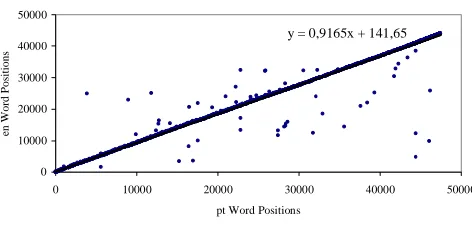
The points obtained from the positions of homo-graphs with equal frequencies are still prone to be noisy. Here is an example:
Noisy Candidate Correspondence Points
y = 0,9165x + 141,65
0 10000 20000 30000 40000 50000
0 10000 20000 30000 40000 50000
pt Word Positions
[image:4.595.300.533.168.275.2]en Word Positions
Figure 1: Noisy versus ‘well-behaved’ (‘in
line’) candidate correspondence points. The linear regression line equation is shown on the top right corner.
The figure above shows noisy points because their respective homographs appear in positions quite apart. We should feel reluctant to accept distant pairings and that is what the first filter does. It filters out those points which are clearly
too far apart from their expected positions to be considered as reliable correspondence points.
We find expected positions building a linear regression line with all points, and then deter-mining the distances between the real and the expected word positions:
pt en Positions
Position Word Real Expected Distance
3877 I 24998 3695 21303
9009 etc 22897 8399 14499
11791 I 25060 10948 14112
15248 As 3398 14117 10719
16965 As 3591 15690 12099
[image:4.595.311.522.479.592.2]22819 volume 32337 21056 11281
Table 3: A sample of the distances between
expected and real positions of noisy points in Figure 1.
Expected positions are computed from the lin-ear regression line equation y = ax + b, where a is the line slope and b is the Y-axis intercept (the value of y when x is 0), substituting x for the Portuguese word position. For Table 3, the ex-pected word position for the word I at pt word position 3877 is 0.9165 × 3877 + 141.65 = 3695 (see the regression line equation in Figure 1) and, thus, the distance between its expected and real positions is | 3695 – 24998 | = 21303.
If we draw a histogram ranging from the smallest to the largest distance, we get:
Histogram of Distances
0 2 4 6 8 10
0
2769 5538 8307 11076 13845 16614 19383 22152 24921 27690 30459 33228 35997 Distances between Real and Expected Word Positions
Number of Points
filtered points 3297
Figure 2: Histogram of the distances between
expected and real word positions.
In order to build this histogram, we use the Sturges rule (see ‘Histograms’ in Samuel Kotz et
al. 1982). The number of classes (bars or bins) is
given by 1 + log2n, where n is the total number
[image:4.595.62.298.501.614.2]35997. Thus, the number of classes is
1 + log23338 ≅ 12.7 → 13 and the size of the
classes is (35997 – 0) / 13 ≅ 2769. In this way, the first class ranges from 0 to 2769, the second class from 2769 to 5538 and so forth.
With this histogram, we are able to identify those words which are too far apart from their expected positions. In Figure 2, the gap in the histogram makes clear that there is a discontinu-ity in the distances between expected and real positions. So, we are confident that all points above 22152 are extreme points. We filter them out of the candidate correspondence points set and proceed to the next filter.
2.5
Confidence Bands of Linear
Regres-sion Lines
Confidence bands of linear regression lines
(Thomas Wonnacott and Ronald Wonnacott, 1990, p. 384) help us to identify reliable points, i.e. points which belong to a regression line with a great confidence level (99.9%). The band is typically wider in the extremes and narrower in the middle of the regression line.
The figure below shows an example of filter-ing usfilter-ing confidence bands:
Linear Regression Line Confidence Bands
8700 8800 8900 9000 9100
9400 9450 9500 9550 9600 9650 9700 9750 9800
pt Word Position
en Word Position
[image:5.595.74.283.425.522.2]Expected y Real y Confidence band
Figure 3: Detail of the filter based on
confi-dence bands. Point A lies outside the conficonfi-dence band. It will be filtered out.
We start from the regression line defined by the points filtered with the Histogram technique, described in the previous section, and then we calculate the confidence band. Points which lie outside this band are filtered out since they are credited as too unreliable for alignment (e.g. Point A in Figure 3). We repeat this step until no pieces of text belong to different translations, i.e. until there is no misalignment.
The confidence band is the error admitted at an x co-ordinate of a linear regression line. A point (x,y) is considered outside a linear regres-sion line with a confidence level of 99.9% if its y
co-ordinate does not lie within the confidence interval [ ax + b – error(x); ax + b + error(x)], where ax + b is the linear regression line equa-tion and error(x) is the error admitted at the x co-ordinate. The upper and lower limits of the confidence interval are given by the following equation (see Thomas Wonnacott & Ronald Wonnacott, 1990, p. 385):
∑
= − − + ± + = n i i X x X x n s t b ax y 1 2 2 005 . 0 ) ( ) ( 1 ) ( where:• t0.005 is the t-statistics value for a 99.9%
con-fidence interval. We will use the z-statistics instead since t0.005 = z0.005 = 3.27 for large
samples of points (above 120); • n is the number of points;
• s is the standard deviation from the expected
value yˆ at co-ordinate x (see Thomas
Won-nacott & Ronald WonWon-nacott, 1990, p. 379):
b ax y n y y s n i i + = − −
=
∑
= ,whereˆ2 ) ˆ (
1
• X is the average value of the various xi:
∑
= = n i i x n X 1 13
Evaluation
We ran our alignment algorithm on the parallel texts of 10 language pairs as described in section 2.2. The table below summarises the results:
Pair Written Questions Debates Judgements Average
pt-da 128 (5%) 56 (2%) 114 (35%) 63 (2%)
pt-de 124 (5%) 99 (2%) 53 (15%) 102 (3%)
pt-el 118 (5%) 115 (6%) 60 (20%) 115 (6%)
pt-en 88 (3%) 102 (4%) 50 (19%) 101 (4%)
pt-es 59 (1%) 55 (1%) 143 (21%) 56 (1%)
pt-fi --- --- 60 (26%) 60 (26%)
pt-fr 148 (5%) 113 (2%) 212 (49%) 117 (2%)
pt-it 117 (4%) 104 (2%) 25 (6%) 105 (2%)
pt-nl 120 (5%) 73 (1%) 53 (15%) 77 (2%)
pt-sv --- --- 74 (23%) 74 (23%)
Average 113 (4%) 90 (2%) 84 (23%) 92 (2%)
[image:5.595.303.530.534.641.2]Sub-corpus
Table 4: Average number of correspondence
points in the first non-misalignment (average ratio of filtered and initial candidate correspon-dence points inside brackets).
for the Debates). An average of just three filtra-tions are needed: the Histogram filter plus two filtrations with the Confidence Bands.
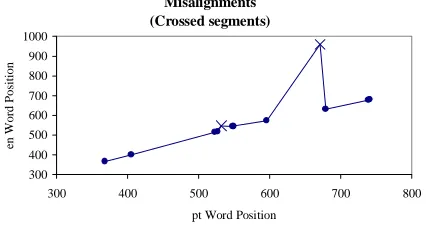
The figure below shows an example of a mis-aligning correspondence point.
Misalignments (Crossed segments)
300 400 500 600 700 800 900 1000
300 400 500 600 700 800
pt Word Position
en Word Position
Figure 4: Bad correspondence points (× –
mis-aligning points; ± FRUUHVSRQGHQFH SRLQWV
Had we restricted ourselves to using homo-graphs which occur only once (hapaxes), we would get about one third of the final points (António Ribeiro et al. 2000a). Hapaxes turn out to be good candidate correspondence points because they work like cognates that are not mistaken for others within the full text scope (Michel Simard and Pierre Plamondon, 1998). When they are in similar positions, they turn out to be reliable correspondence points.
To compare our results, we aligned the BAF Corpus (Michel Simard and Pierre Plamondon, 1998) which consists of a collection of parallel texts (Canadian Parliament Hansards, United Nations, literary, etc.).
Filename # Tokens # Segments Chars / Segment # Segments Chars / Segment Ratio
citi1.fr 17556 49 1860 742 120 6,6%
citi2.fr 33539 48 3360 1393 104 3,4%
cour.fr 49616 101 2217 1377 140 7,3%
hans.fr 82834 45 8932 3059 117 1,5%
ilo.fr 210342 68 15654 7129 137 1,0%
onu.fr 74402 27 14101 2559 132 1,1%
tao1.fr 10506 52 1019 365 95 14,2%
tao2.fr 9825 51 972 305 97 16,7%
tao3.fr 4673 44 531 176 62 25,0%
verne.fr 79858 29 12736 2521 127 1,2%
xerox.fr 66605 114 2917 3454 85 3,3%
Average 111883 60 10271 3924 123 1,5%
[image:6.595.75.288.160.273.2]Equal Frequency Homographs BAF Analysis
Table 5: Comparison with the Jacal alignment
(Michel Simard and Pierre Plamondon, 1998).
The table above shows that, on average, we got about 1.5% of the total segments, resulting in about 10k characters per segment. This num-ber ranges from 25% (average: 500 characters per segment) for a small text (tao3.fr-en) to 1% (average: 15k characters per segment) for a large text (ilo.fr-en). Although these are small
num-bers, we should notice that, in contrast with Mi-chel Simard and Pierre Plamondon (1998), we are not including:
• words defined as cognate “if their four first
characters are identical”;
• an ‘isolation window’ heuristics to reduce the
search space;
• heuristics to define a search corridor to find
candidate correspondence points;
We should stress again that the algorithm ported in this paper is purely statistical and curs to no heuristics. Moreover, we did not re-apply the algorithm to each aligned parallel segment which would result in finding more correspondence points and, consequently, fur-ther segmentation of the parallel texts. Besides, if we use the methodology presented in Joaquim da Silva et al. (1999) for extracting relevant string patterns, we are able to identify more sta-tistically reliable cognates.
António Ribeiro and Gabriel Lopes (1999) re-port a higher number of segments using clusters of points. However, the algorithm does not as-sure 100% alignment precision and discards some good correspondence points which end up in bad clusters.
Our main critique to the use of heuristics is that though they may be intuitively quite accept-able and may significantly improve the results as seen with Jacal alignment for the BAF Corpus, they are just heuristics and cannot be theoreti-cally explained by Statistics.
Conclusions
Confidence bands of linear regression lines help us to identify reliable correspondence points without using empirically found or statistically unsupported heuristics. This paper presents a purely statistical approach to the selection of candidate correspondence points for parallel texts alignment without recurring to heuristics as in previous work. The alignment is not restricted to sentence or paragraph level for which clearly delimited boundaries markers would be needed. It is made at whatever segment size as long as reliable correspondence points are found. This means that alignment can result at paragraph, sentence, phrase, term or word level.
boot-strapped the process using cognates (Michel Simard et al. 1992) or a small bilingual lexicon to identify equivalents of words or expressions (Dekai Wu 1994; Pascale Fung and Kathleen McKeown 1997; Melamed 1999). This is a par-ticularly good strategy when it comes to distant languages like English and Chinese where the number of homographs is reduced. As António Ribeiro et al. (2000b) showed, these tokens ac-count for about 5% for small texts. Aligning languages with such different alphabets requires automatic methods to identify equivalents as Pascale Fung and Kathleen McKeown (1997) presented, increasing the number of candidate correspondence points at the beginning.
Selecting correspondence points improves the quality and reliability of parallel texts alignment. As this alignment algorithm is not restricted to paragraphs or sentences, 100% alignment preci-sion may be degraded by language specific term order policies in small segments. On average, three filtrations proved enough to avoid crossed segments which are a result of misalignments. The method is language and character-set inde-pendent and does not assume any a priori lan-guage knowledge (namely, small bilingual lexi-cons), text tagging, well defined sentence or paragraph boundaries nor one-to-one translation of sentences.
Future Work
At the moment, we are working on alignment of sub-segments of parallel texts in order to find more correspondence points within each aligned segment in a recursive way. We are also plan-ning to apply the method to large parallel Portu-guese–Chinese texts. We believe we may sig-nificantly increase the number of segments we get in the end by using a more dynamic ap-proach to the filtering using linear regression lines, by selecting candidate correspondence points at the same time that parallel texts tokens are input. This approach is similar to Melamed (1999) but, in contrast, it is statistically sup-ported and uses no heuristics.
Another area for future experiments will use relevant strings of characters in parallel texts instead of using just homographs. For this pur-pose, we will apply a methodology described in Joaquim da Silva et al. (1999). This method was used to extract string patterns and it will help us to automatically extract ‘real’ cognates.
Acknowledgements
Our thanks go to the anonymous referees for their valuable comments on the paper. We would also like to thank Michel Simard for pro-viding us the aligned BAF Corpus. This research was partially supported by a grant from Funda-ção para a Ciência e Tecnologia / Praxis XXI.
References
Peter Brown, Jennifer Lai and Robert Mercer (1991)
Aligning Sentences in Parallel Corpora. In
“Pro-ceedings of the 29th Annual Meeting of the Asso-ciation for Computational Linguistics”, Berkeley, California, U.S.A., pp. 169–176.
Kenneth Church (1993) Char_align: A Program for
Aligning Parallel Texts at the Character Level. In
“Proceedings of the 31st Annual Meeting of the Association for Computational Linguistics”, Columbus, Ohio, U.S.A., pp. 1–8.
Ido Dagan, Kenneth Church and William Gale (1993)
Robust Word Alignment for Machine Aided Translation. In “Proceedings of the Workshop on Very Large Corpora: Academic and Industrial Perspectives”, Columbus, Ohio, U.S.A., pp. 1–8. ELRA (European Language Resources Association)
(1997) Multilingual Corpora for Co-operation, Disk 2 of 2. Paris, France.
Pascale Fung and Kathleen McKeown (1994)
Aligning Noisy Parallel Corpora across Language Groups: Word Pair Feature Matching by Dynamic Time Warping. In “Technology Partnerships for
Crossing the Language Barrier: Proceedings of the First Conference of the Association for Machine Translation in the Americas”, Columbia, Maryland, U.S.A., pp. 81–88.
Pascale Fung and Kathleen McKeown (1997) A
Technical Word- and Term-Translation Aid Using Noisy Parallel Corpora across Language Groups.
Machine Translation, 12/1–2 (Special issue), pp. 53–87.
William Gale and Kenneth Church (1991) A
Pro-gram for Aligning Sentences in Bilingual Corpora.
In “Proceedings of the 29th Annual Meeting of the Association for Computational Linguistics”, Berkeley, California, U.S.A., pp. 177–184 (short version). Also (1993) Computational Linguistics, 19/1, pp. 75–102 (long version).
Martin Kay and Martin Röscheisen (1993)
Text-Translation Alignment. Computational Linguistics,
19/1, pp. 121–142.
I. Dan Melamed (1999) Bitext Maps and Alignment
via Pattern Recognition. Computational
Linguis-tics, 25/1, pp. 107–130.
António Ribeiro, Gabriel Lopes and João Mexia (2000a) Using Confidence Bands for Alignment
with Hapaxes. In “Proceedings of the International
Conference on Artificial Intelligence (IC’AI 2000)”, Computer Science Research, Education and Applications Press, U.S.A., volume II, pp. 1089–1095.
António Ribeiro, Gabriel Lopes and João Mexia (2000b, in press) Aligning Portuguese and
Chi-nese Parallel Texts Using Confidence Bands. In
“Proceedings of the Sixth Pacific Rim International Conference on Artificial Intelligence (PRICAI 2000) – Lecture Notes in Artificial Intelligence”, Springer-Verlag.
Joaquim da Silva, Gaël Dias, Sylvie Guilloré, José Lopes (1999) Using Localmaxs Algorithms for the
Extraction of Contiguous and Non-contiguous Multiword Lexical Units. In Pedro Barahona and
José Alferes, eds., “Progress in Artificial Intelli-gence – Lecture Notes in Artificial IntelliIntelli-gence”, number 1695, Springer-Verlag, Berlin, Germany, pp. 113–132.
Michel Simard, George Foster and Pierre Isabelle (1992) Using Cognates to Align Sentences in
Bi-lingual Corpora. In “Proceedings of the Fourth
International Conference on Theoretical and Methodological Issues in Machine Translation TMI-92”, Montreal, Canada, pp. 67–81.
Michel Simard and Pierre Plamondon (1998)
Bilingual Sentence Alignment: Balancing Robust-ness and Accuracy. Machine Translation, 13/1,
pp. 59–80.
Dekai Wu (1994) Aligning a Parallel
English–Chi-nese Corpus Statistically with Lexical Criteria. In
“Proceedings of the 32nd Annual Conference of the Association for Computational Linguistics”, Las Cruces, New Mexico, U.S.A., pp. 80–87. Thomas Wonnacott and Ronald Wonnacott (1990)
Introductory Statistics. 5th edition, John Wiley &