Natural Language Models for Predicting Programming Comments
Dana Movshovitz-Attias Computer Science Department
Carnegie Mellon University [email protected]
William W. Cohen Computer Science Department
Carnegie Mellon University [email protected]
Abstract
Statistical language models have success-fully been used to describe and analyze natural language documents. Recent work applying language models to program-ming languages is focused on the task of predicting code, while mainly ignoring the prediction of programmer comments. In this work, we predict comments from JAVA source files of open source projects, using topic models and n-grams, and we analyze the performance of the models given varying amounts of background data on the project being predicted. We evalu-ate models on their comment-completion capability in a setting similar to code-completion tools built into standard code editors, and show that using a comment completion tool can save up to 47% of the comment typing.
1 Introduction and Related Work
Statistical language models have traditionally been used to describe and analyze natural lan-guage documents. Recently, software engineer-ing researchers have adopted the use of language models for modeling software code. Hindle et al. (2012) observe that, as code is created by humans it is likely to be repetitive and predictable, similar to natural language. NLP models have thus been used for a variety of software development tasks such as code token completion (Han et al., 2009; Jacob and Tairas, 2010), analysis of names in code (Lawrie et al., 2006; Binkley et al., 2011) and min-ing software repositories (Gabel and Su, 2008).
An important part of software programming and maintenance lies in documentation, which may come in the form of tutorials describing the code, or inline comments provided by the programmer. The documentation provides a high level descrip-tion of the task performed by the code, and may
include examples of use-cases for specific code segments or identifiers such as classes, methods and variables. Well documented code is easier to read and maintain in the long-run but writing com-ments is a laborious task that is often overlooked or at least postponed by many programmers.
Code commenting not only provides a summa-rization of the conceptual idea behind the code (Sridhara et al., 2010), but can also be viewed as a form of document expansion where the comment contains significant terms relevant to the described code. Accurately predicted comment words can therefore be used for a variety of linguistic uses including improved search over code bases using natural language queries, code categorization, and locating parts of the code that are relevant to a spe-cific topic or idea (Tseng and Juang, 2003; Wan et al., 2007; Kumar and Carterette, 2013; Shepherd et al., 2007; Rastkar et al., 2011). A related and well studied NLP task is that of predicting natural language caption and commentary for images and videos (Blei and Jordan, 2003; Feng and Lapata, 2010; Feng and Lapata, 2013; Wu and Li, 2011).
In this work, our goal is to apply statistical lan-guage models for predicting class comments. We show that n-gram models are extremely success-ful in this task, and can lead to a saving of up to 47% in comment typing. This is expected as n-grams have been shown as a strong model for language and speech prediction that is hard to im-prove upon (Rosenfeld, 2000). In some cases how-ever, for example in a document expansion task, we wish to extract important terms relevant to the code regardless of local syntactic dependencies. We hence also evaluate the use of LDA (Blei et al., 2003) and link-LDA (Erosheva et al., 2004) topic models, which are more relevant for the term ex-traction scenario. We find that the topic model per-formance can be improved by distinguishingcode andtexttokens in the code.
2 Method
2.1 Models
We trainn-gram models (n= 1,2,3) over source code documents containing sequences of com-bined code and text tokens from multiple training datasets (described below). We use the Berkeley Language Model package (Pauls and Klein, 2011) with absolute discounting (Kneser-Ney smooth-ing; (1995)) which includes a backoff strategy to lower-order n-grams. Next, we use LDA topic models (Blei et al., 2003) trained on the same data, with 1, 5, 10 and 20 topics. The joint distribution of a topic mixtureθ, and a set ofN topicsz, for
a single source code document with N observed
word tokens,d={wi}Ni=1, given the Dirichlet pa-rametersαandβ, is therefore
p(θ, z, w|α, β) = (1)
p(θ|α)Y
w
p(z|θ)p(w|z, β)
Under the models described so far, there is no dis-tinction between text and code tokens.
Finally, we consider documents as having a mixed membership of two entity types, codeand texttokens,d= ({wcode
i }Ci=1n,{witext}Ti=1n ), where the text words are tokens from comment and string literals, and thecodewords include the pro-gramming language syntax tokens (e.g.,public,
private,for, etc’ ) and all identifiers. In this case, we train link-LDA models (Erosheva et al., 2004) with 1, 5, 10 and 20 topics. Under the link-LDA model, the mixed-membership joint distribu-tion of a topic mixture, words and topics is then
p(θ, z, w|α, β) =p(θ|α)· (2) Y
wtext
p(ztext|θ)p(wtext|ztext, β)·
Y
wcode
p(zcode|θ)p(wcode|zcode, β)
whereθis the joint topic distribution,wis the set
of observed document words,ztextis a topic
asso-ciated with a text word, andzcode a topic
associ-ated with a code word.
The LDA and link-LDA models use Gibbs sam-pling (Griffiths and Steyvers, 2004) for topic infer-ence, based on the implementation of Balasubra-manyan and Cohen (2011) with single or multiple entities per document, respectively.
2.2 Testing Methodology
Our goal is to predict the tokens of the JAVA class comment (the one preceding the class definition) in each of the test files. Each of the models de-scribed above assigns a probability to the next comment token. In the case ofn-grams, the
prob-ability of a token wordwiis given by considering
previous words p(wi|wi−1, . . . , w0). This proba-bility is estimated given the previousn−1tokens asp(wi|wi−1, . . . , wi−(n−1)).
For the topic models, we separate the docu-ment tokens into the class definition and the com-ment we wish to predict. The set of tokens of the class comment wc, are all considered as text
tokens. The rest of the tokens in the document
wr, are considered to be the class definition, and
they may contain both code and text tokens (from string literals and other comments in the source file). We then compute the posterior probability of document topics by solving the following infer-ence problem conditioned on thewrtokens
p(θ, zr|wr, α, β) = p(θ, z
r, wr|α, β)
p(wr|α, β) (3)
This gives us an estimate of the document distri-bution,θ, with which we infer the probability of the comment tokens as
p(wc|θ, β) =X
z
p(wc|z, β)p(z|θ) (4)
Following Blei et al. (2003), for the case of a single entity LDA, the inference problem from equation (3) can be solved by considering
p(θ, z, w|α, β), as in equation (1), and by taking the marginal distribution of the document tokens as a continuous mixture distribution for the set
w= wr, by integrating overθand summing over
the set of topicsz
p(w|α, β) = Z
p(θ|α)· (5)
Y
w
X
z
p(z|θ)p(w|z, β) !
dθ
For the case of link-LDA where the document is comprised of two entities, in our case code to-kens andtext tokens, we can consider the mixed-membership joint distributionθ, as in equation (2),
and similarly the marginal distribution p(w|α, β) over both code and text tokens from wr. Since
comment words in wc are all considered as text
tokens they are sampled usingtexttopics, namely
3 Experimental Settings
3.1 Data and Training Methodology
We use source code from nine open source JAVA projects: Ant, Cassandra, Log4j, Maven, Minor-Third, Batik, Lucene, Xalan and Xerces. For each project, we divide the source files into a training and testing dataset. Then, for each project in turn, we consider the following three main training sce-narios, leading to using three training datasets.
To emulate a scenario in which we are predict-ing comments in the middle of project develop-ment, we can use data (documented code) from the same project. In this case, we use the in-project training dataset (IN). Alternatively, if we train a comment prediction model at the beginning of the development, we need to use source files from other, possibly related projects. To analyze this scenario, for each of the projects above we train models using an out-of-project dataset (OUT) con-taining data from the other eight projects.
Typically, source code files contain a greater amount of code versus comment text. Since we are interested in predicting comments, we consider a third training data source which contains more En-glish text as well as some code segments. We use data from the popular Q&A website StackOver-flow (SO) where users ask and answer technical questions about software development, tools, al-gorithms, etc’. We downloaded a dataset of all ac-tions performed on the site since it was launched in August 2008 until August 2012. The data includes 3,453,742 questions and 6,858,133 answers posted by 1,295,620 users. We used only posts that are tagged as JAVA related questions and answers.
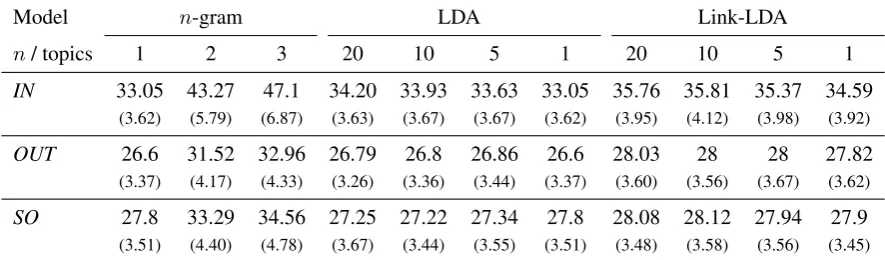
All the models for each project are then tested on the testing set of that project. We report results averaged over all projects in Table 1.
Source files were tokenized using the Eclipse JDT compiler tools, separating code tokens and identifiers. Identifier names (of classes, methods and variables), were further tokenized by camel case notation (e.g., ’minMargin’ was converted to ’min margin’). Non alpha-numeric tokens (e.g., dot, semicolon) were discarded from the code, as well as numeric and single character literals. Text from comments or any string literals within the code were further tokenized with the Mallet sta-tistical natural language processing package (Mc-Callum, 2002). Posts from SO were parsed using
the Apache Tika toolkit1and then tokenized with the Mallet package. We considered as raw code tokens anything labeled using a<code>markup
(as indicated by the SO users who wrote the post).
3.2 Evaluation
Since our models are trained using various data sources the vocabularies used by each of them are different, making the comment likelihood given by each model incomparable due to different sets of out-of-vocabulary tokens. We thus evaluate mod-els using a character saving metric which aims at quantifying the percentage of characters that can be saved by using the model in a word-completion settings, similar to standard code completion tools built into code editors. For a comment word with
ncharacters,w=w1, . . . , wn, we predict the two
most likely words given each model filtered by the first0, . . . , ncharacters ofw. Letkbe the minimal kifor whichwis in the top two predicted word
to-kens where toto-kens are filtered by the firstki
char-acters. Then, the number of saved characters forw
isn−k. In Table 1 we report the average
percent-age of saved characters per comment using each of the above models. The final results are also aver-aged over the nine input projects. As an example, in the predicted comment shown in Table 2, taken from the projectMinor-Third, the token entity is the most likely token according to the modelSO trigram, out of tokens starting with the prefix ’en’. The saved characters in this case are ’tity’.
4 Results
Table 1 displays the average percentage of char-acters saved per class comment using each of the models. Models trained on in-project data (IN) perform significantly better than those trained on another data source, regardless of the model type, with an average saving of 47.1% characters using a trigram model. This is expected, as files from the same project are likely to contain similar ments, and identifier names that appear in the com-ment of one class may appear in the code of an-other class in the same project. Clearly, in-project data should be used when available as it improves comment prediction leading to an average increase of between 6% for the worst model (26.6 forOUT unigram versus 33.05 forIN) and 14% for the best (32.96 forOUT trigram versus 47.1 forIN).
Model n-gram LDA Link-LDA
n/ topics 1 2 3 20 10 5 1 20 10 5 1
IN 33.05 43.27 47.1 34.20 33.93 33.63 33.05 35.76 35.81 35.37 34.59
(3.62) (5.79) (6.87) (3.63) (3.67) (3.67) (3.62) (3.95) (4.12) (3.98) (3.92)
OUT 26.6 31.52 32.96 26.79 26.8 26.86 26.6 28.03 28 28 27.82
(3.37) (4.17) (4.33) (3.26) (3.36) (3.44) (3.37) (3.60) (3.56) (3.67) (3.62)
SO 27.8 33.29 34.56 27.25 27.22 27.34 27.8 28.08 28.12 27.94 27.9
[image:4.595.77.520.64.194.2](3.51) (4.40) (4.78) (3.67) (3.44) (3.55) (3.51) (3.48) (3.58) (3.56) (3.45)
Table 1: Average percentage of characters saved per comment usingn-gram, LDA and link-LDA models
trained on three training sets:IN,OUT, andSO. The results are averaged over nine JAVA projects (with standard deviations in parenthesis).
Model Predicted Comment
INtrigram “Train a named-entity extractor“ INlink-LDA “Train a named-entity extractor“ OUTtrigram “Train a named-entity extractor“ SOtrigram “Train a named-entity extractor“
Table 2: Sample comment from the Minor-Third project predicted using IN, OUT and SO based models. Saved characters are underlined.
Of the out-of-project data sources, models us-ing a greater amount of text (SO) mostly out-performed models based on more code (OUT). This increase in performance, however, comes at a cost of greater run-time due to the larger word dictionary associated with theSOdata. Note that in the scope of this work we did not investigate the contribution of each of the background projects used in OUT, and how their relevance to the tar-get prediction project effects their performance.
The trigram model shows the best performance across all training data sources (47% forIN, 32% for OUT and 34% for SO). Amongst the tested topic models, link-LDA models which distinguish code and text tokens perform consistently better than simple LDA models in which all tokens are considered as text. We did not however find a correlation between the number of latent topics learned by a topic model and its performance. In fact, for each of the data sources, a different num-ber of topics gave the optimal character saving re-sults.
Note that in this work, all topic models are based on unigram tokens, therefore their results are most comparable with that of the unigram in
Dataset n-gram link-LDA
IN 2778.35 574.34 OUT 1865.67 670.34 SO 1898.43 638.55
Table 3: Average words per project for which each tested model completes the word better than the other. This indicates that each of the models is bet-ter at predicting a different set of comment words.
Table 1, which does not benefit from the back-off strategy used by the bigram and trigram mod-els. By this comparison, the link-LDA topic model proves more successful in the comment prediction task than the simpler models which do not distin-guishcodeandtexttokens. Using n-grams without backoff leads to results significantly worse than any of the presented models (not shown).
This can also be seen by the analysis in Table 3 where we compare the average number of words completed better by either the best n-gram or topic model given each training dataset. Again, while n-grams generally complete more words better, a considerable portion of the words is better com-pleted using a topic model, further motivating a hybrid solution.
5 Conclusions
We analyze the use of language models for pre-dicting class comments for source file documents containing a mixture ofcodeandtexttokens. Our experiments demonstrate the effectiveness of us-ing language models for comment completion, showing a saving of up to 47% of the comment characters. When available, using in-project train-ing data proves significantly more successful than using out-of-project data. However, we find that when using out-of-project data, a dataset based on more words than code performs consistently bet-ter. The results also show that different models are better at predicting different comment words, which motivates a hybrid solution combining the advantages of multiple models.
Acknowledgments
This research was supported by the NSF under grant CCF-1247088.
References
Ramnath Balasubramanyan and William W Cohen. 2011. Block-lda: Jointly modeling entity-annotated text and entity-entity links. InProceedings of the 7th SIAM International Conference on Data Mining.
Dave Binkley, Matthew Hearn, and Dawn Lawrie. 2011. Improving identifier informativeness using part of speech information. InProc. of the Working Conference on Mining Software Repositories. ACM.
David M Blei and Michael I Jordan. 2003. Modeling
annotated data. InProceedings of the 26th annual
international ACM SIGIR conference on Research and development in informaion retrieval. ACM.
David M Blei, Andrew Y Ng, and Michael I Jordan.
2003. Latent dirichlet allocation. Journal of
Ma-chine Learning Research.
Elena Erosheva, Stephen Fienberg, and John Lafferty. 2004. Mixed-membership models of scientific
pub-lications. Proceedings of the National Academy of
Sciences of the United States of America.
Yansong Feng and Mirella Lapata. 2010. How many words is a picture worth? automatic caption
gener-ation for news images. InProc. of the 48th Annual
Meeting of the Association for Computational Lin-guistics. Association for Computational Linguistics.
Yansong Feng and Mirella Lapata. 2013. Automatic
caption generation for news images. IEEE
transac-tions on pattern analysis and machine intelligence.
Mark Gabel and Zhendong Su. 2008. Javert: fully au-tomatic mining of general temporal properties from
dynamic traces. In Proceedings of the 16th ACM
SIGSOFT International Symposium on Foundations of software engineering, pages 339–349. ACM.
Thomas L Griffiths and Mark Steyvers. 2004. Finding scientific topics. Proc. of the National Academy of Sciences of the United States of America.
Sangmok Han, David R Wallace, and Robert C Miller. 2009. Code completion from abbreviated input. InAutomated Software Engineering, 2009. ASE’09. 24th IEEE/ACM International Conference on, pages 332–343. IEEE.
Abram Hindle, Earl T Barr, Zhendong Su, Mark Gabel, and Premkumar Devanbu. 2012. On the naturalness
of software. InSoftware Engineering (ICSE), 2012
34th International Conference on. IEEE.
Ferosh Jacob and Robert Tairas. 2010. Code template
inference using language models. In Proceedings
of the 48th Annual Southeast Regional Conference. ACM.
Reinhard Kneser and Hermann Ney. 1995.
Im-proved backing-off for m-gram language modeling. InAcoustics, Speech, and Signal Processing, 1995. ICASSP-95., volume 1, pages 181–184. IEEE.
Naveen Kumar and Benjamin Carterette. 2013. Time based feedback and query expansion for twitter search. InAdvances in Information Retrieval, pages 734–737. Springer.
Dawn Lawrie, Christopher Morrell, Henry Feild, and David Binkley. 2006. Whats in a name? a study
of identifiers. In Program Comprehension, 2006.
ICPC 2006. 14th IEEE International Conference on, pages 3–12. IEEE.
Andrew Kachites McCallum. 2002. Mallet: A ma-chine learning for language toolkit.
Adam Pauls and Dan Klein. 2011. Faster and smaller
n-gram language models. In Proceedings of the
49th annual meeting of the Association for Com-putational Linguistics: Human Language Technolo-gies, volume 1, pages 258–267.
Sarah Rastkar, Gail C Murphy, and Alexander WJ Bradley. 2011. Generating natural language sum-maries for crosscutting source code concerns. In
Ronald Rosenfeld. 2000. Two decades of statistical language modeling: Where do we go from here?
Proceedings of the IEEE, 88(8):1270–1278.
David Shepherd, Zachary P Fry, Emily Hill, Lori Pol-lock, and K Vijay-Shanker. 2007. Using natu-ral language program analysis to locate and
under-stand action-oriented concerns. In Proceedings of
the 6th international conference on Aspect-oriented software development, pages 212–224. ACM.
Giriprasad Sridhara, Emily Hill, Divya Muppaneni, Lori Pollock, and K Vijay-Shanker. 2010. To-wards automatically generating summary comments
for java methods. InProceedings of the IEEE/ACM
international conference on Automated software en-gineering, pages 43–52. ACM.
Yuen-Hsien Tseng and Da-Wei Juang. 2003.
Document-self expansion for text categorization. In
Proceedings of the 26th annual international ACM SIGIR conference on Research and development in informaion retrieval, pages 399–400. ACM. Xiaojun Wan, Jianwu Yang, and Jianguo Xiao. 2007.
Single document summarization with document
ex-pansion. In Proc. of the National Conference on
Artificial Intelligence. Menlo Park, CA; Cambridge, MA; London; AAAI Press; MIT Press; 1999.
Roung-Shiunn Wu and Po-Chun Li. 2011. Video annotation using hierarchical dirichlet process
mix-ture model. Expert Systems with Applications,