Character-Level Chinese Dependency Parsing
Meishan Zhang†, Yue Zhang‡, Wanxiang Che†, Ting Liu†∗†Research Center for Social Computing and Information Retrieval
Harbin Institute of Technology, China
{mszhang, car, tliu}@ir.hit.edu.cn
‡Singapore University of Technology and Design
Abstract
Recent work on Chinese analysis has led to large-scale annotations of the internal structures of words, enabling character-level analysis of Chinese syntactic struc-tures. In this paper, we investigate the problem of character-level Chinese depen-dency parsing, building dependepen-dency trees over characters. Character-level infor-mation can benefit downstream applica-tions by offering flexible granularities for word segmentation while improving word-level dependency parsing accuracies. We present novel adaptations of two ma-jor shift-reduce dependency parsing algo-rithms to character-level parsing. Exper-imental results on the Chinese Treebank demonstrate improved performances over word-based parsing methods.
1 Introduction
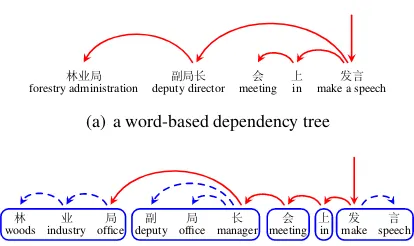
As a light-weight formalism offering syntactic information to downstream applications such as SMT, the dependency grammar has received in-creasing interest in the syntax parsing commu-nity (McDonald et al., 2005; Nivre and Nilsson, 2005; Carreras et al., 2006; Duan et al., 2007; Koo and Collins, 2010; Zhang and Clark, 2008; Nivre, 2008; Bohnet, 2010; Zhang and Nivre, 2011; Choi and McCallum, 2013). Chinese dependency trees were conventionally defined overwords(Chang et al., 2009; Li et al., 2012), requiring word segmen-tation and POS-tagging as pre-processing steps. Recent work on Chinese analysis has embarked on investigating the syntactic roles of characters, leading to large-scale annotations of word internal structures (Li, 2011; Zhang et al., 2013). Such an-notations enable dependency parsing on the char-acter level, building dependency trees over Chi-nesecharacters. Figure 1(c) shows an example of
∗Corresponding author.
林业局 副局长 会 上 发言
forestry administration deputy director meeting in make a speech
(a) a word-based dependency tree
林 业 局 副 局 长 会 上 发 言
woods industry office deputy office manager meeting in make speech
(b) a character-level dependency tree by Zhao (2009) with real intra-word and pseudo inter-word dependencies
林 业 局 副 局 长 会 上 发 言
woods industry office deputy office manager meeting in make speech
[image:1.595.311.518.205.328.2](c) a character-level dependency tree investigated in this pa-per with both real intra- and inter-word dependencies
Figure 1: An example character-level dependency tree. “林业局副局长在大会上发言(The deputy director of forestry administration make a speech in the meeting)”.
a character-level dependency tree, where the leaf nodes are Chinese characters.
Character-level dependency parsing is interest-ing in at least two aspects. First, character-level trees circumvent the issue that no universal stan-dard exists for Chinese word segmentation. In the well-known Chinese word segmentation bakeoff tasks, for example, different segmentation stan-dards have been used by different data sets (Emer-son, 2005). On the other hand, most disagreement on segmentation standards boils down to disagree-ment on segdisagree-mentation granularity. As demon-strated by Zhao (2009), one can extract both fine-grained and coarse-fine-grained words from character-level dependency trees, and hence can adapt to flexible segmentation standards using this formal-ism. In Figure 1(c), for example, “副局长(deputy
director)” can be segmented as both “副(deputy) | 局长 (director)” and “副局长 (deputy
direc-tor)”, but not “副 (deputy)局 (office)|长
(man-ager)”, by dependency coherence. Chinese lan-guage processing tasks, such as machine transla-tion, can benefit from flexible segmentation stan-dards (Zhang et al., 2008; Chang et al., 2008).
Second, word internal structures can also be useful for syntactic parsing. Zhang et al. (2013) have shown the usefulness of word structures in Chinese constituent parsing. Their results on the Chinese Treebank (CTB) showed that character-level constituent parsing can bring increased per-formances even with the pseudo word structures. They further showed that better performances can be achieved when manually annotated word struc-tures are used instead of pseudo strucstruc-tures.
In this paper, we make an investigation of character-level Chinese dependency parsing using Zhang et al. (2013)’s annotations and based on a transition-based parsing framework (Zhang and Clark, 2011). There are two dominant transition-based dependency parsing systems, namely the arc-standard and the arc-eager parsers (Nivre, 2008). We study both algorithms for character-level dependency parsing in order to make a com-prehensive investigation. For direct comparison with word-based parsers, we incorporate the tra-ditional word segmentation, POS-tagging and de-pendency parsing stages in our joint parsing mod-els. We make changes to the original transition systems, and arrive at two novel transition-based character-level parsers.
We conduct experiments on three data sets, in-cluding CTB 5.0, CTB 6.0 and CTB 7.0. Exper-imental results show that the character-level de-pendency parsing models outperform the word-based methods on all the data sets. Moreover, manually annotated intra-word dependencies can give improved word-level dependency accuracies than pseudo intra-word dependencies. These re-sults confirm the usefulness of character-level syntax for Chinese analysis. The source codes are freely available athttp://sourceforge. net/projects/zpar/, version 0.7.
2 Character-Level Dependency Tree
Character-level dependencies were first proposed by Zhao (2009). They show that by annotat-ing character dependencies within words, one can adapt to different segmentation standards. The
dependencies they study are restricted to intra-word characters, as illustrated in Figure 1(b). For inter-word dependencies, they use a pseudo right-headed representation.
In this study, we integrate inter-word syntactic dependencies and intra-word dependencies using large-scale annotations of word internal structures by Zhang et al. (2013), and study their interac-tions. We extract unlabeled dependencies from bracketed word structures according to Zhang et al.’s head annotations. In Figure 1(c), the depen-dencies shown by dashed arcs areintra-word de-pendencies, which reflect the internal word struc-tures, while the dependencies with solid arcs are
inter-worddependencies, which reflect the syntac-tic structures between words.
In this formulation, a character-level depen-dency tree satisfies the same constraints as the traditional word-based dependency tree for Chi-nese, including projectivity. We differentiate intra-word dependencies and inter-intra-word dependencies by the arc type, so that our work can be com-pared with conventional word segmentation, POS-tagging and dependency parsing pipelines under a canonical segmentation standard.
The character-level dependency trees hold to a specific word segmentation standard, but are not limited to it. We can extract finer-grained words of different granulities from a coarse-grained word by taking projective subtrees of different sizes. For example, taking all the intra-word modifier nodes of “长 (manager)” in Figure 1(c) results in the
word “副局长(deputy director)”, while taking the
first modifier node of “长(manager)” results in the
word “局长(director)”. Note that “副局(deputy
office)” cannot be a word because it does not form a projective span without “长(manager)”.
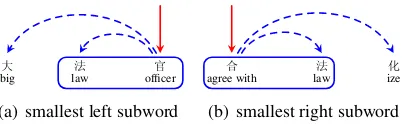
Inner-word dependencies can also bring bene-fits to parsing word-level dependencies. The head character can be a less sparse feature compared to a word. As intra-word dependencies lead to fine-grained subwords, we can also use these sub-words for better parsing. In this work, we use the innermost left/right subwords as atomic fea-tures. To extract the subwords, we find the inner-most left/right modifiers of the head character, re-spectively, and then conjoin them with all their de-scendant characters to form the smallest left/right subwords. Figure 2 shows an example, where the smallest left subword of “大法官(chief lawyer)”
大 法 官 big law officer
(a) smallest left subword
合 法 化
agree with law ize
[image:3.595.81.283.68.130.2](b) smallest right subword
Figure 2: An example to illustrate the innermost left/right subwords.
of “合法化(legalize)” is “合法(legal)”.
3 Character-Level Dependency Parsing
A transition-based framework with global learn-ing and beam search decodlearn-ing (Zhang and Clark, 2011) has been applied to a number of natural lan-guage processing tasks, including word segmen-tation, POS-tagging and syntactic parsing (Zhang and Clark, 2010; Huang and Sagae, 2010; Bohnet and Nivre, 2012; Zhang et al., 2013). It models a task incrementally from a start state to an end state, where each intermediate state during decod-ing can be regarded as a partial output. A num-ber of actions are defined so that the state ad-vances step by step. To learn the model param-eters, it usually uses the online perceptron algo-rithm with early-update under the inexact decod-ing condition (Collins, 2002; Collins and Roark, 2004). Transition-based dependency parsing can be modeled under this framework, where the state consists of a stack and a queue, and the set of ac-tions can be either the arc-eager (Zhang and Clark, 2008) or the arc-standard (Huang et al., 2009) transition systems.
When the internal structures of words are an-notated, character-level dependency parsing can be treated as a special case of word-level depen-dency parsing, with “words” being “characters”. A big weakness of this approach is that full words and POS-tags cannot be used for feature engineer-ing. Both are crucial to well-established features for word segmentation, POS-tagging and syntactic parsing. In this section, we introduce novel exten-sions to the arc-standard and the arc-eager tran-sition systems, so that word-based and character-based features can be used simultaneously for character-level dependency parsing.
3.1 The Arc-Standard Model
The arc-standard model has been applied to joint segmentation, POS-tagging and dependency pars-ing (Hatori et al., 2012), but with pseudo word
structures. For unified processing of annotated word structures and fair comparison between character-level arc-eager and arc-standard sys-tems, we define a different arc-standard transition system, consistent with our character-level arc-eager system.
In the word-based arc-standard model, the tran-sition state includes a stack and a queue, where the stack contains a sequence of partially-parsed dependency trees, and the queue consists of un-processed input words. Four actions are defined for state transition, includingarc-left(AL, which creates a left arc between the top element s0 and
the second top elements1 on the stack),arc-right
(AR, which creates a right arc betweens0ands1), pop-root(PR, which defines the root node of a de-pendency tree when there is only one element on the stack and no element in the queue), and the last
shift (SH, which shifts the first elementq0 of the
queue onto the stack).
For character-level dependency parsing, there are two types of dependencies: inter-word depen-dencies and intra-word dependepen-dencies. To parse them with both character and word features, we extend the original transition actions into two cat-egories, for inter-word dependencies and intra-word dependencies, respectively. The actions for inter-word dependencies include inter-word arc-left (ALw), inter-word arc-right (ARw), pop-root (PR) andinter-word shift(SHw). Their definitions are the same as the word-based model, with one exception that the inter-word shift operation has a parameter denoting the POS-tag of the incoming word, so that POS disambiguation is performed by the SHwaction.
The actions for intra-word dependencies in-clude intra-word arc-left (ALc), intra-word
arc-right(ARc),pop-word(PW) and inter-word shift (SHc). The definitions of ALc, ARc and SHc are the same as the word-based arc-standard model, while PW changes the top element on the stack into a full-word node, which can only take inter-word dependencies. One thing to note is that, due to variable word sizes in character-level parsing, the number of actions can vary between ent sequences of actions corresponding to differ-ent analyses. We use the padding method (Zhu et al., 2013), adding an IDLE action to finished transition action sequences, for better alignments between states in the beam.
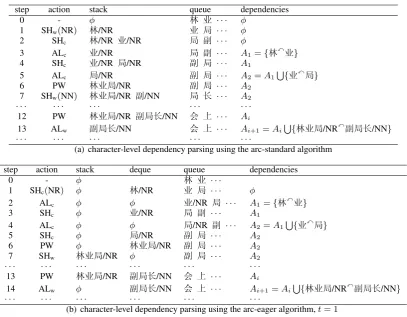
step action stack queue dependencies
0 - φ 林 业 · · · φ
1 SHw(NR) 林/NR 业 局 · · · φ
2 SHc 林/NR 业/NR 局 副 · · · φ
3 ALc 业/NR 局 副 · · · A1={林x业}
4 SHc 业/NR 局/NR 副 局 · · · A1
5 ALc 局/NR 副 局 · · · A2=A1S{业x局}
6 PW 林业局/NR 副 局 · · · A2
7 SHw(NN) 林业局/NR 副/NN 局 长 · · · A2
· · · ·
12 PW 林业局/NR 副局长/NN 会 上 · · · Ai
13 ALw 副局长/NN 会 上 · · · Ai+1=AiS{林业局/NRx副局长/NN}
· · · ·
(a) character-level dependency parsing using the arc-standard algorithm
step action stack deque queue dependencies
0 - φ 林 业 · · ·
1 SHc(NR) φ 林/NR 业 局 · · · φ
2 ALc φ φ 业/NR 局 · · · A1={林x业}
3 SHc φ 业/NR 局 副 · · · A1
4 ALc φ φ 局/NR 副 · · · A2=A1S{业x局}
5 SHc φ 局/NR 副 局 · · · A2
6 PW φ 林业局/NR 副 局 · · · A2
7 SHw 林业局/NR φ 副 局 · · · A2
· · · ·
13 PW 林业局/NR 副局长/NN 会 上 · · · Ai
14 ALw φ 副局长/NN 会 上 · · · Ai+1=AiS{林业局/NRx副局长/NN}
· · · ·
[image:4.595.95.503.58.375.2](b) character-level dependency parsing using the arc-eager algorithm,t= 1
Figure 3: Character-level dependency parsing of the sentence in Figure 1(c).
system, each word is initialized by the action SHw with a POS tag, before being incrementally mod-ified by a sequence of intra-word actions, and fi-nally being completed by the action PW. The inter-word actions can be applied when all the elements on the stack are full-word nodes, while the intra-word actions can be applied when at least the top element on the stack is a partial-word node. For the actions ALc and ARc to be valid, the top two elements on the stack are both partial-word nodes. For the action PW to be valid, only the top ele-ment on the stack is a partial-word node. Figure 3(a) gives an example action sequence.
There are three types of features. The first two types are traditionally established features for the dependency parsing and joint word segmentation and POS-tagging tasks. We use the features pro-posed by Hatori et al. (2012). The word-level dependency parsing features are added when the inter-word actions are applied, and the features for joint word segmentation and POS-tagging are added when the actions PW, SHwand SHcare ap-plied. Following the work of Hatori et al. (2012), we have a parameter α to adjust the weights for joint word segmentation and POS-tagging
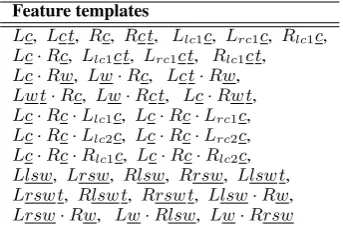
fea-tures. We apply word-based dependency pars-ing features to intra-word dependency parspars-ing as well, by using subwords (the conjunction of char-acters spanning the head node) to replace words in word features. The third type of features is word-structure features. We extract the head charac-ter and the smallest subwords containing the head character from the intra-word dependencies (Sec-tion 2). Table 1 summarizes the features.
3.2 The Arc-Eager Model
Similar to the arc-standard case, the state of a word-based arc-eager model consists of a stack and a queue, where the stack contains a sequence of partial dependency trees, and the queue con-sists of unprocessed input words. Unlike the arc-standard model, which builds dependencies on the top two elements on the stack, the arc-eager model builds dependencies between the top element of the stack and the first element of the queue. Five actions are defined for state transformation: arc-left(AL, which creates a left arc between the top element of the stack s0 and the first element in
Feature templates
Lc, Lct, Rc, Rct, Llc1c, Lrc1c, Rlc1c,
Lc·Rc, Llc1ct, Lrc1ct, Rlc1ct, Lc·Rw, Lw·Rc, Lct·Rw,
Lwt·Rc, Lw·Rct, Lc·Rwt,
Lc·Rc·Llc1c, Lc·Rc·Lrc1c,
Lc·Rc·Llc2c, Lc·Rc·Lrc2c,
Lc·Rc·Rlc1c, Lc·Rc·Rlc2c, Llsw, Lrsw, Rlsw, Rrsw, Llswt,
Lrswt, Rlswt, Rrswt, Llsw·Rw,
[image:5.595.96.268.62.175.2]Lrsw·Rw, Lw·Rlsw, Lw·Rrsw
Table 1: Feature templates encoding intra-word dependencies. L andR denote the two elements over which the dependencies are built; the sub-scriptslc1andrc1denote the left-most and right-most children, respectively; the subscriptslc2and
rc2denote the second left-most and second right-most children, respectively; w denotes the word;
tdenotes the POS tag;cdenotes the head charac-ter;lswandrswdenote the smallest left and right subwords respectively, as shown in Figure 2.
s0 andq0, while shiftingq0 from the queue onto
the stack),pop-root(PR, which defines the ROOT node of the dependency tree when there is only one element on the stack and no element in the queue),reduce(RD, which popss0 off the stack),
andshift(SH, which shiftsq0onto the stack).
There is no previous work that exploits the arc-eager algorithm for jointly performing POS-tagging and dependency parsing. Since the first element of the queue can be shifted onto the stack by either SH or AR, it is more difficult to assign a POS tag to each word by using a single action. In this work, we make a change to the configu-ration state, adding a deque between the stack and the queue to save partial words with intra-word de-pendencies. We divide the transition actions into two categories, one for inter-word dependencies (ARw, ALw, SHw, RDw and PR) and the other for intra-word dependencies (ARc, ALc, SHc, RDc and PW), requiring that the intra-word actions be operated between the deque and the queue, while the inter-word actions be operated between the stack and the deque.
For character-level arc-eager dependency pars-ing, the inter-word actions are the same as the word-based methods. The actions ALc and ARc are the same as ALw and ARw, except that they operate on characters, but the SHcoperation has a parameter to denote the POS tag of a word. The PW action recognizes a full-word. We also have an IDLE action, for the same reason as the
arc-standard model.
In the character-level arc-eager transition sys-tem, a word is formed in a similar way with that of character-level arc-standard algorithm. Each word is initialized by the action SHc with a POS tag, and then incrementally changed a sequence of intra-word actions, before being finalized by the action PW. All these actions operate between the queue and deque. For the action PW, only the first element in the deque (close to the queue) is a partial-word node. For the actions ARc and ALc to be valid, the first element in the deque must be a partial-word node. The action SHc have a POS tag when shifting the first character of a word,but does not have such a parameter when shifting the next characters of a word. For the action SHcwith a POS tag to be valid, the first element in the deque must be a full-word node. Different from the arc-standard model, at any stage we can choose either the action SHc with a POS tag to initialize a new word on the deque, or the inter-word actions on the stack. In order to eliminate the ambiguity, we define a new parametertto limit the max size of the deque. If the deque is full withtwords, inter-word actions are performed; otherwise intra-inter-word actions are performed. All the inter-word actions must be applied on full-word nodes between the stack an the deque. Figure 3(b) gives an example action sequence.
Similar to the arc-standard case, there are three types of features, with the first two types being traditionally established features for dependency parsing and joint word segmentation and POS-tagging. The dependency parsing features are taken from the work of Zhang and Nivre (2011), and the features for joint word segmentation and POS-tagging are taken from Zhang and Clark (2010)1. The word-level dependency parsing fea-tures are triggered when the inter-word actions are applied, while the features of joint word segmenta-tion and POS-tagging are added when the acsegmenta-tions SHc, ARcand PW are applied. Again we use a pa-rameterαto adjust the weights for joint word seg-mentation and POS-tagging features. The word-level features for dependency parsing are applied to intra-word dependency parsing as well, by us-ing subwords to replace words. The third type of features is word-structure features, which are the 1Since Hatori et al. (2012) also use Zhang and Clark
CTB50 CTB60 CTB70 Training #word#sent 494k18k 641k23k 718k31k
Development #word#sent 6.8k350 2.1k60k 237k10k
#oov 553 3.3k 13k
Test #word#sent 8.0k348 2.8k82k 245k10k
[image:6.595.75.288.62.155.2]#oov 278 4.6k 13k
Table 2: Statistics of datasets.
same as those of the character-level arc-standard model, shown in Table 1.
4 Experiments
4.1 Experimental Settings
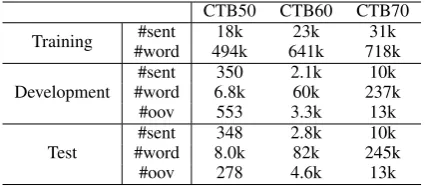
We use the Chinese Penn Treebank 5.0, 6.0 and 7.0 to conduct the experiments, splitting the corpora into training, development and test sets according to previous work. Three different splitting meth-ods are used, namely CTB50 by Zhang and Clark (2010), CTB60 by the official documentation of CTB 6.0, and CTB70 by Wang et al. (2011). The dataset statistics are shown in Table 2. We use the head rules of Zhang and Clark (2008) to con-vert phrase structures into dependency structures. The intra-word dependencies are extracted from the annotations of Zhang et al. (2013)2.
The standard measures of word-level precision, recall and F1 score are used to evaluate word seg-mentation, POS-tagging and dependency parsing, following Hatori et al. (2012). In addition, we use the same measures to evaluate intra-word depen-dencies, which indicate the performance of pre-dicting word structures. A word’s structure is cor-rect only if all the intra-word dependencies are all correctly recognized.
4.2 Baseline and Proposed Models
For the baseline, we have two different pipeline models. The first consists of a joint segmentation and POS-tagging model (Zhang and Clark, 2010) and a word-based dependency parsing model us-ing the arc-standard algorithm (Huang et al., 2009). We name this model STD (pipe). The second consists of the same joint segmentation and POS-tagging model and a word-based depen-dency parsing model using the arc-eager algorithm
2https://github.com/zhangmeishan/
wordstructures; their annotation was conducted on CTB 5.0, while we made annotations of the remainder of the CTB 7.0 words. We also make the annotations publicly available at the same site.
(Zhang and Nivre, 2011). We name this model EAG (pipe). For the pipeline models, we use a beam of size 16 for joint segmentation and POS-tagging, and a beam of size 64 for dependency parsing, according to previous work.
We study the following character-level depen-dency parsing models:
• STD (real, pseudo): the arc-standard model with annotated intra-word dependencies and pseudo inter-word dependencies;
• STD (pseudo, real): the arc-standard model with pseudo intra-word dependencies and real inter-word dependencies;
• STD (real, real): the arc-standard model with annotated intra-word dependencies and real inter-word dependencies;
• EAG (real, pseudo): the arc-eager model with annotated intra-word dependencies and pseudo inter-word dependencies;
• EAG (pseudo, real): the arc-eager model with pseudo intra-word dependencies and real inter-word dependencies;
• EAG (real, real): the arc-eager model with annotated intra-word dependencies and real inter-word dependencies.
The annotated intra-word dependencies refer to the dependencies extracted from annotated word structures, while the pseudo intra-word depen-dencies used in the above models are similar to those of Hatori et al. (2012). For a given word w = c1c2· · ·cm, the intra-word
depen-dency structure iscx
1 cx2 · · ·xcm3. The real
inter-word dependencies refer to the syntactic inter- word-level dependencies by head-finding rules from CTB, while the pseudo inter-word dependencies refer to the word-level dependencies used by Zhao (2009) (wx
1 wx2 · · ·xwn). The character-level
models with annotated intra-word dependencies and pseudo inter-word dependencies are compared with the pipelines on word segmentation and POS-tagging accuracies, and are compared with the character-level models with annotated intra-word dependencies and real inter-word dependencies on word segmentation, POS-tagging and word-structure predicating accuracies. All the proposed 3We also tried similar structures with right arcs, which
STD (real, real) SEG POS DEP WS
α= 1 95.85 91.60 76.96 95.14
α= 2 96.09 91.89 77.28 95.29
α= 3 96.02 91.84 77.22 95.23
α=4 96.10 91.96 77.49 95.29
[image:7.595.97.266.61.137.2]α= 5 96.07 91.90 77.31 95.21 Table 3: Development test results of the character-level arc-standard model on CTB60.
EAG (real, real) SEG POS DEP WS
α= 1
t= 1 96.00 91.66 74.63 95.49
t= 2 95.93 91.75 76.60 95.37 t=3 95.93 91.74 76.94 95.36
t= 4 95.91 91.71 76.82 95.33
t= 5 95.95 91.73 76.84 95.40
t= 3
α= 1 95.93 91.74 76.94 95.36
α= 2 96.11 91.99 77.17 95.56
α=3 96.16 92.01 77.48 95.62
α= 4 96.11 91.93 77.40 95.53
[image:7.595.324.508.61.153.2]α= 5 96.00 91.84 77.10 95.43 Table 4: Development test results of the character-level arc-eager model on CTB60.
models use a beam of size 64 after considering both speeds and accuracies.
4.3 Development Results
Our development tests are designed for two pur-poses: adjusting the parameters for the two pro-posed character-level models and testing the effec-tiveness of the novel word-structure features. Tun-ing is conducted by maximizTun-ing word-level depen-dency accuracies. All the tests are conducted on the CTB60 data set.
4.3.1 Parameter Tuning
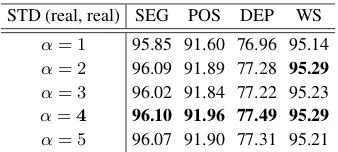
For the arc-standard model, there is only one pa-rameterαthat needs tuning. It adjusts the weights of segmentation and POS-tagging features, be-cause the number of feature templates is much less for the two tasks than for parsing. We set the value ofα to 1· · · 5, respectively. Table 3 shows the accuracies on the CTB60 development set. Ac-cording to the results, we useα = 4for our final character-level arc-standard model.
For the arc-eager model, there are two parame-terstandα. tdenotes the deque size of the arc-eager model, whileαshares the same meaning as the arc-standard model. We take two steps for rameter tuning, first adjusting the more crucial pa-rametertand then adjustingαon the bestt. Both parameters are assigned the values of 1 to 5.
Ta-SEG POS DEP WS STD (real, real) 96.10 91.96 77.49 95.29 STD (real, real)/wo 95.99 91.79 77.19 95.35
∆ -0.11 -0.17 -0.30 +0.06 EAG (real, real) 96.16 92.01 77.48 95.62 EAG (real, real)/wo 96.09 91.82 77.12 95.56
∆ -0.07 -0.19 -0.36 -0.06 Table 5: Feature ablation tests for the novel word-structure features, where “/wo” denotes the corre-sponding models without the novel intra-word de-pendency features.
ble 4 shows the results. According to results, we sett = 3andα = 3for the final character-level arc-eager model, respectively.
4.3.2 Effectiveness of Word-Structure Features
To test the effectiveness of our novel word-structure features, we conduct feature ablation ex-periments on the CTB60 development data set for the proposed arc-standard and arc-eager models, respectively. Table 5 shows the results. We can see that both the two models achieve better accu-racies on word-level dependencies with the novel word-structure features, while the features do not affect word-structure predication significantly.
4.4 Final Results
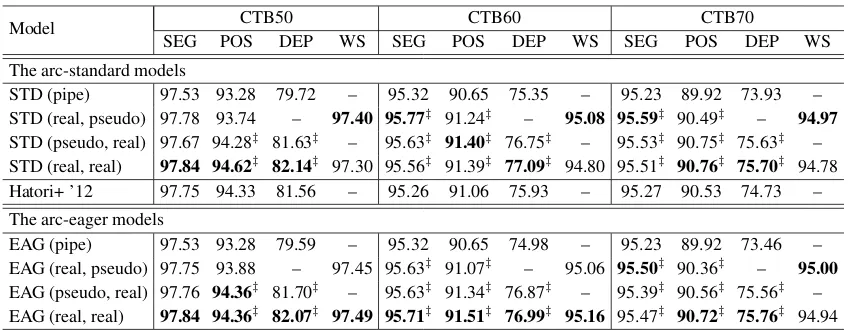
Table 6 shows the final results on the CTB50, CTB60 and CTB70 data sets, respectively. The results demonstrate that the character-level depen-dency parsing models are significantly better than the corresponding word-based pipeline models, for both the arc-standard and arc-eager systems. Similar to the findings of Zhang et al. (2013), we find that the annotated word structures can give better accuracies than pseudo word structures. An-other interesting finding is that, although the arc-eager algorithm achieves lower accuracies in the word-based pipeline models, it obtains compara-tive accuracies in the character-level models.
We also compare our results to those of Hatori et al. (2012), which is comparable to STD (pseudo, real) since similar arc-standard algorithms and features are used. The major difference is the set of transition actions. We rerun their system on the three datasets4. As shown in Table 6, our arc-standard system with pseudo word structures 4http://triplet.cc/. We use a different
[image:7.595.97.266.180.319.2]Model CTB50 CTB60 CTB70
SEG POS DEP WS SEG POS DEP WS SEG POS DEP WS
The arc-standard models
STD (pipe) 97.53 93.28 79.72 – 95.32 90.65 75.35 – 95.23 89.92 73.93 – STD (real, pseudo) 97.78 93.74 – 97.40 95.77‡ 91.24‡ – 95.08 95.59‡ 90.49‡ – 94.97
STD (pseudo, real) 97.67 94.28‡ 81.63‡ – 95.63‡ 91.40‡ 76.75‡ – 95.53‡ 90.75‡ 75.63‡ –
STD (real, real) 97.84 94.62‡ 82.14‡ 97.30 95.56‡ 91.39‡ 77.09‡ 94.80 95.51‡ 90.76‡ 75.70‡ 94.78
Hatori+ ’12 97.75 94.33 81.56 – 95.26 91.06 75.93 – 95.27 90.53 74.73 – The arc-eager models
EAG (pipe) 97.53 93.28 79.59 – 95.32 90.65 74.98 – 95.23 89.92 73.46 – EAG (real, pseudo) 97.75 93.88 – 97.45 95.63‡ 91.07‡ – 95.06 95.50‡ 90.36‡ – 95.00
EAG (pseudo, real) 97.76 94.36‡ 81.70‡ – 95.63‡ 91.34‡ 76.87‡ – 95.39‡ 90.56‡ 75.56‡ –
[image:8.595.87.512.60.225.2]EAG (real, real) 97.84 94.36‡ 82.07‡ 97.49 95.71‡ 91.51‡ 76.99‡ 95.16 95.47‡ 90.72‡ 75.76‡ 94.94
Table 6: Main results, where the results marked with‡denote that the p-value is less than 0.001 compared with the pipeline word-based models using pairwise t-test.
brings consistent better accuracies than their work on all the three data sets.
Both the pipelines and character-level mod-els with pseudo inter-word dependencies perform word segmentation and POS-tagging jointly, with-out using real word-level syntactic information. A comparison between them (STD/EAG (pipe) vs. STD/EAG (real, pseudo)) reflects the effectiveness of annotated intra-word dependencies on segmen-tation and POS-tagging. We can see that both the arc-standard and arc-eager models with annotated intra-word dependencies can improve the segmen-tation accuracies by 0.3% and the POS-tagging ac-curacies by 0.5% on average on the three datasets. Similarly, a comparison between the character-level models with pseudo inter-word dependen-cies and the character-level models with real inter-word dependencies (STD/EAG (real, pseudo) vs. STD/EAG (real, real)) can reflect the effectiveness of annotated inter-word structures on morphology analysis. We can see that improved POS-tagging accuracies are achieved using the real inter-word dependencies when jointly performing inner- and inter-word dependencies. However, we find that the inter-word dependencies do not help the word-structure accuracies.
4.5 Analysis
To better understand the character-level parsing models, we conduct error analysis in this section. All the experiments are conducted on the CTB60 test data sets. The new advantage of the character-level models is that one can parse the internal word structures of intra-word dependencies. Thus we are interested in their capabilities of predict-ing word structures. We study the word-structure
accuracies in two aspects, including OOV, word length, POS tags and the parsing model.
4.5.1 OOV
The word-structure accuracy of OOV words re-flects a model’s ability of handling unknown words. The overall recalls of OOV word structures are 67.98% by STD (real, real) and 69.01% by EAG (real, real), respectively. We find that most errors are caused by failures of word segmenta-tion. We further investigate the accuracies when words are correctly segmented, where the accura-cies of OOV word structures are 87.64% by STD (real, real) and 89.07% by EAG (real, real). The results demonstrate that the structures of Chinese words are not difficult to predict, and confirm the fact that Chinese word structures have some com-mon syntactic patterns.
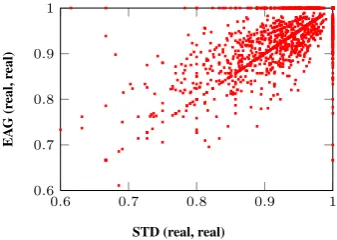
4.5.2 Parsing Model
indicat-0.6 0.7 0.8 0.9 1 0.6
0.7 0.8 0.9 1
STD (real, real)
EA
G
(r
eal,
[image:9.595.96.265.64.184.2]real)
Figure 4: Sentential word-structure accuracies of STD (real, real) and EAG (real, real).
ing that the two parsing models can be comple-mentary in parsing intra-word dependencies.
5 Related Work
Zhao (2009) was the first to study character-level dependencies; they argue that since no consistent word boundaries exist over Chinese word segmen-tation, dependency-based representations of word structures serve as a good alternative for Chinese word segmentation. Thus their main concern is to parse intra-word dependencies. In this work, we extend their formulation, making use of large-scale annotations of Zhang et al. (2013), so that the syntactic word-level dependencies can be parsed together with intra-word dependencies.
Hatori et al. (2012) proposed a joint model for Chinese word segmentation, POS-tagging and dependency parsing, studying the influence of joint model and character features for parsing, Their model is extended from the arc-standard transition-based model, and can be regarded as an alternative to the arc-standard model of our work when pseudo intra-word dependencies are used. Similar work is done by Li and Zhou (2012). Our proposed arc-standard model is more concise while obtaining better performance than Hatori et al. (2012)’s work. With respect to word structures, real intra-word dependencies are often more com-plicated, while pseudo word structures cannot be used to correctly guide segmentation.
Zhao (2009), Hatori et al. (2012) and our work all study character-level dependency pars-ing. While Zhao (2009) focus on word internal structures using pseudo inter-word dependencies, Hatori et al. (2012) investigate a joint model using pseudo intra-word dependencies. We use manual dependencies for both inner- and inter-word struc-tures, studying their influences on each other.
Zhang et al. (2013) was the first to perform Chi-nese syntactic parsing over characters. They ex-tended word-level constituent trees by annotated word structures, and proposed a transition-based approach to parse intra-word structures and word-level constituent structures jointly. For Hebrew, Tsarfaty and Goldberg (2008) investigated joint segmentation and parsing over characters using a graph-based method. Our work is similar in ex-ploiting character-level syntax. We study the de-pendency grammar, another popular syntactic rep-resentation, and propose two novel transition sys-tems for character-level dependency parsing.
Nivre (2008) gave a systematic description of the arc-standard and arc-eager algorithms, cur-rently two popular transition-based parsing meth-ods for word-level dependency parsing. We extend both algorithms to character-level joint word seg-mentation, POS-tagging and dependency parsing. To our knowledge, we are the first to apply the arc-eager system to joint models and achieve compar-ative performances to the arc-standard model.
6 Conclusions
We studied the character-level Chinese depen-dency parsing, by making novel extensions to two commonly-used transition-based dependency parsing algorithms for word-based dependency parsing. With both pseudo and annotated word structures, our character-level models obtained better accuracies than previous work on seg-mentation, POS-tagging and word-level depen-dency parsing. We further analyzed some im-portant factors for intra-word dependencies, and found that two proposed character-level pars-ing models are complementary in parspars-ing intra-word dependencies. We make the source code publicly available at http://sourceforge. net/projects/zpar/, version 0.7.
Acknowledgments
References
Bernd Bohnet and Joakim Nivre. 2012. A transition-based system for joint part-of-speech tagging and la-beled non-projective dependency parsing. In Pro-ceedings of the EMNLP-CONLL, pages 1455–1465, Jeju Island, Korea, July.
Bernd Bohnet. 2010. Very high accuracy and fast de-pendency parsing is not a contradiction. In Proceed-ings of the 23rd COLING, number August, pages 89–97.
Xavier Carreras, Mihai Surdeanu, and Llu´ıs M`arquez. 2006. Projective dependency parsing with per-ceptron. In Proceedings of the Tenth Confer-ence on Computational Natural Language Learning (CoNLL-X), pages 181–185, New York City, June. Pi-Chuan Chang, Michel Galley, and Chris Manning.
2008. Optimizing chinese word segmentation for machine translation performance. InACL Workshop on Statistical Machine Translation.
Pi-Chuan Chang, Huihsin Tseng, Dan Jurafsky, , and Christopher D. Manning. 2009. Discriminative reordering with chinese grammatical relations fea-tures. InProceedings of the Third Workshop on Syn-tax and Structure in Statistical Translation.
Jinho D. Choi and Andrew McCallum. 2013. Transition-based dependency parsing with selec-tional branching. In Proceedings of ACL, pages 1052–1062, August.
Michael Collins and Brian Roark. 2004. Incremen-tal parsing with the perceptron algorithm. In Pro-ceedings of the 42nd Meeting of the Association for Computational Linguistics (ACL’04), Main Volume, pages 111–118, Barcelona, Spain, July.
Michael Collins. 2002. Discriminative training meth-ods for hidden markov models: Theory and exper-iments with perceptron algorithms. InProceedings of the 7th EMNLP.
Xiangyu Duan, Jun Zhao, and Bo Xu. 2007. Proba-bilistic models for action-based chinese dependency parsing. InProceedings of ECML/ECPPKDD, vol-ume 4701 of Lecture Notes in Computer Science, pages 559–566.
Thomas Emerson. 2005. The second international chi-nese word segmentation bakeoff. In Proceedings of the Second SIGHAN Workshop on Chinese Lan-guage Processing, pages 123–133.
Jun Hatori, Takuya Matsuzaki, Yusuke Miyao, and Jun’ichi Tsujii. 2012. Incremental joint approach to word segmentation, pos tagging, and dependency parsing in chinese. InProceedings of the 50th ACL, pages 1045–1053, Jeju Island, Korea, July.
Liang Huang and Kenji Sagae. 2010. Dynamic pro-gramming for linear-time incremental parsing. In
Proceedings of the 48th ACL, pages 1077–1086, Up-psala, Sweden, July.
Liang Huang, Wenbin Jiang, and Qun Liu. 2009. Bilingually-constrained (monolingual) shift-reduce parsing. InProceedings of the 2009 Conference on Empirical Methods in Natural Language Process-ing: Volume 3-Volume 3, pages 1222–1231. Asso-ciation for Computational Linguistics.
Terry Koo and Michael Collins. 2010. Efficient third-order dependency parsers. In Proceedings of the 48th Annual Meeting of the ACL, pages 1–11. Zhongguo Li and Guodong Zhou. 2012. Unified
de-pendency parsing of chinese morphological and syn-tactic structures. InProceedings of the 2012 Joint Conference on Empirical Methods in Natural guage Processing and Computational Natural Lan-guage Learning, pages 1445–1454, Jeju Island, Ko-rea, July.
Zhenghua Li, Ting Liu, and Wanxiang Che. 2012. Ex-ploiting multiple treebanks for parsing with quasi-synchronous grammars. InProceedings of the 50th ACL, pages 675–684, Jeju Island, Korea, July. Zhongguo Li. 2011. Parsing the internal structure of
words: A new paradigm for chinese word segmenta-tion. InProceedings of the 49th ACL, pages 1405– 1414, Portland, Oregon, USA, June.
Ryan McDonald, Koby Crammer, and Fernando Pereira. 2005. Online large-margin training of de-pendency parsers. In Proceedings of ACL, number June, pages 91–98, Morristown, NJ, USA.
Joakim Nivre and Jens Nilsson. 2005. Pseudo-projective dependency parsing. In Proceedings of ACL.
Joakim Nivre. 2008. Algorithms for deterministic in-cremental dependency parsing. Computational Lin-guistics, 34(4):513–553.
Reut Tsarfaty and Yoav Goldberg. 2008. Word-based or morpheme-based? annotation strategies for mod-ern hebrew clitics. InLREC. European Language Resources Association.
Yiou Wang, Jun’ichi Kazama, Yoshimasa Tsuruoka, Wenliang Chen, Yujie Zhang, and Kentaro Tori-sawa. 2011. Improving chinese word segmenta-tion and pos tagging with semi-supervised methods using large auto-analyzed data. In Proceedings of 5th IJCNLP, pages 309–317, Chiang Mai, Thailand, November.
Yue Zhang and Stephen Clark. 2008. A tale of two parsers: Investigating and combining graph-based and transition-graph-based dependency parsing. In
Proceedings of EMNLP, pages 562–571, Honolulu, Hawaii, October.
Yue Zhang and Stephen Clark. 2011. Syntactic pro-cessing using the generalized perceptron and beam search. Computational Linguistics, 37(1):105–151. Yue Zhang and Joakim Nivre. 2011. Transition-based
dependency parsing with rich non-local features. In
Proceedings of the 49th ACL, pages 188–193, Port-land, Oregon, USA, June.
Ruiqiang Zhang, Keiji Yasuda, and Eiichiro Sumita. 2008. Chinese word segmentation and statistical machine translation. IEEE Transactions on Signal Processing, 5(2).
Meishan Zhang, Yue Zhang, Wanxiang Che, and Ting Liu. 2013. Chinese parsing exploiting characters. In Proceedings of the 51st ACL, pages 125–134, Sofia, Bulgaria, August.
Hai Zhao. 2009. Character-level dependencies in chi-nese: Usefulness and learning. In Proceedings of the EACL, pages 879–887, Athens, Greece, March. Muhua Zhu, Yue Zhang, Wenliang Chen, Min Zhang,