EM Decipherment for Large Vocabularies
Malte Nuhn and Hermann Ney
Human Language Technology and Pattern Recognition
Computer Science Department, RWTH Aachen University, Aachen, Germany
<surname>@cs.rwth-aachen.de
Abstract
This paper addresses the problem of EM-based decipherment for large vocabular-ies. Here, decipherment is essentially a tagging problem: Every cipher token is tagged with some plaintext type. As with other tagging problems, this one can be treated as a Hidden Markov Model (HMM), only here, the vocabularies are large, so the usualO(NV2)exact EM
ap-proach is infeasible. When faced with this situation, many people turn to sam-pling. However, we propose to use a type of approximate EM and show that it works well. The basic idea is to collect fractional counts only over a small subset of links in the forward-backward lattice. The sub-set is different for each iteration of EM. One option is to use beam search to do the subsetting. The second method restricts the successor words that are looked at, for each hypothesis. It does this by consulting pre-computed tables of likely n-grams and likely substitutions.
1 Introduction
The decipherment of probabilistic substitution ci-phers (cici-phers in which each plaintext token can be substituted by any cipher token, following a distribution p(f|e), cf. Table 2) can be seen as an important step towards decipherment for MT. This problem has not been studied explicitly be-fore. Scaling to larger vocabularies for proba-bilistic substitution ciphers decipherment is a dif-ficult problem: The algorithms for 1:1 or homo-phonic substitution ciphers are not applicable, and standard algorithms like EM training become in-tractable when vocabulary sizes go beyond a few hundred words. In this paper we present an
effi-cient EM based training procedure for probabilis-tic substitution ciphers which provides high deci-pherment accuracies while having low computa-tional requirements. The proposed approach al-lows using high order n-gram language models, and is scalable to large vocabulary sizes. We show improvements in decipherment accuracy in a va-riety of experiments (including MT) while being computationally more efficient than previous pub-lished work on EM-based decipherment.
2 Related Work
Several methods exist for deciphering 1:1 substi-tution ciphers: Ravi and Knight (2008) solve 1:1 substitution ciphers by formulating the decipher-ment problem as an integer linear program. Cor-lett and Penn (2010) solve the same problem us-ingA∗search. Nuhn et al. (2013) present a beam
search approach that scales to large vocabulary and high order language models. Even though be-ing successful, these algorithms are not applicable to probabilistic substitution ciphers, or any of its extensions as they occur in decipherment for ma-chine translation.
EM training for probabilistic ciphers was first covered in Ravi and Knight (2011). Nuhn et al. (2012) have given an approximation to exact EM training using context vectors, allowing to train-ing models even for larger vocabulary sizes. Ravi (2013) report results on the OPUS subtitle corpus using an elaborate hash sampling technique, based on n-gram language models and context vectors, that is computationally very efficient.
Conventional beam search is a well studied topic: Huang et al. (1992) present beam search for automatic speech recognition, using fine-grained pruning procedures. Similarly, Young and Young (1994) present an HMM toolkit, including pruned forward-backward EM training. Pal et al. (2006) use beam search for training of CRFs.
Method Publications Complexity EM Full (Knight et al., 2006), (Ravi and Knight, 2011) O(NVn)
EM Fixed Candidates (Nuhn et al., 2012) O(N)
EM Beam This Work O(NV)
[image:2.595.75.525.64.144.2]EM Lookahead This Work O(N)
Table 1: Different approximations to exact EM training for decipherment. N is the cipher sequence length,V the size of the target vocabulary, andnthe order of the language model.
The main contribution of this work is the pre-selection beam search that—to the best of our knowledge—was not known in literature before, and serves as an important step to applying EM training to the large vocabulary decipherment problem. Table 1 gives an overview of the EM based methods. More details are given in Sec-tion 3.2.
3 Probabilistic Substitution Ciphers We define probabilistic substitutions ciphers us-ing the followus-ing generative story for ciphertext sequencesfN
1 :
1. Stochastically generate a plaintext sequence
eN
1 according to a bigram1language model.
2. For each plaintext tokenen choose a substi-tutionfnwith probabilityP(fn|en, ϑ). This generative story corresponds to the model
p(eN1 , f1N, ϑ) =p(eN1 )·p(f1N|eN1 , ϑ), (1) with the zero-order membership model
p(f1N|eN1 , ϑ) = N Y
n=1
plex(fn|en, ϑ) (2)
with parametersp(f|e, ϑ) ≡ ϑf|e and normaliza-tion constraints ∀ePfϑf|e = 1, and first-order plaintext sequence model
P(eN
1 ) =
N Y
n=1
pLM(en|en−1). (3)
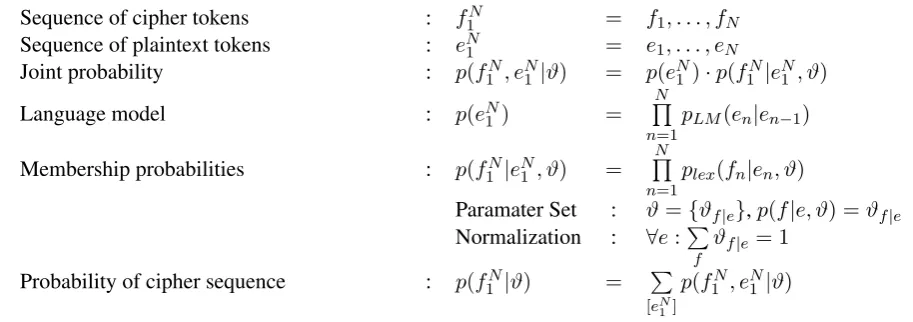
Thus, the probabilistic substitution cipher can be seen as a Hidden Markov Model. Table 2 gives an overview over the model. We want to find those parametersϑthat maximize the marginal distribu-tionp(fN
1 |ϑ):
ϑ = arg max ϑ0
X
[eN 1]
p(f1N, eN1 |ϑ0) (4)
1This can be generalized ton-gram language models.
After we obtained the parameters ϑ we can obtain eN
1 as the Viterbi decoding
arg maxeN 1
p(eN
1 |f1N, ϑ) . 3.1 Exact EM training
In the decipherment setting, we are given the ob-served ciphertextfN
1 and the modelp(f1N|eN1 , ϑ)
that explains how the observed ciphertext has been generated given a latent plaintexteN
1 .
Marginaliz-ing the unknowneN
1 , we would like to obtain the
maximum likelihood estimate ofϑas specified in Equation 4. We iteratively compute the maximum likelihood estimate by applying the EM algorithm (Dempster et al., 1977):
˜
ϑf|e= P n:fn=f
pn(e|f1N, ϑ)
P f
P n:fn=f
pn(e|f1N, ϑ) (5)
with
pn(e|f1N, ϑ) =
X
[eN 1:en=e]
p(eN
1 |f1N, ϑ) (6)
being the posterior probability of observing the plaintext symboleat positionngiven the cipher-text sequence fN
1 and the current parameters ϑ. pn(e|f1N, ϑ)can be efficiently computed using the
forward-backward algorithm.
3.2 Approximations to EM-Training
The computational complexity of EM training stems from the sumP[eN
1:en=e] contained in the posteriorpn(e|f1N, ϑ). However, we can
approx-imate this sum (and hope that the EM training procedure is still working) by only evaluating the dominating terms, i.e. we only evaluate the sum for sequences eN
1 that have the largest
contribu-tions toP[eN
Sequence of cipher tokens : fN
1 = f1, . . . , fN
Sequence of plaintext tokens : eN
1 = e1, . . . , eN
Joint probability : p(fN
1 , eN1 |ϑ) = p(eN1 )·p(f1N|eN1 , ϑ)
Language model : p(eN
1 ) =
N Q
n=1pLM(en|en−1)
Membership probabilities : p(fN
1 |eN1 , ϑ) =
N Q
n=1plex(fn|en, ϑ)
Paramater Set : ϑ={ϑf|e},p(f|e, ϑ) =ϑf|e Normalization : ∀e:P
f ϑf|e= 1 Probability of cipher sequence : p(fN
1 |ϑ) = P
[eN 1]
p(fN
1 , eN1 |ϑ)
Table 2: Definition of the probabilistic substitution cipher model. In contrast to simple or homophonic substitution ciphers, each plaintext token can be substituted by multiple cipher text tokens. The parameter
ϑf|erepresents the probability of substituting tokenewith tokenf.
acquiring zero probability in some early iteration. In order to allow the lexicon to recover from these zeros, we use a smoothed lexicon pˆlex(f|e) =
λplex(f|e) + (1 −λ)/|Vf| with λ = 0.9 when conducting theE-Step.
3.2.1 Beam Search
Instead of evaluating the sum for terms with the
exactlargest contributions, we restrict ourselves to terms that arelikelyto have a large contribution to the sum, dropping any guarantees about the actual contribution of these terms.
Beam search is a well known algorithm related to this idea: We build up sequencesec
1with
grow-ing cardinalityc. For each cardinality, only a set of theBmost promising hypotheses is kept. Then for each active hypothesis of cardinalityc, all pos-sible extensions with substitutions fc+1 → ec+1
are explored. Then in turn only the bestB out of the resultingB·Vemany hypotheses are kept and the algorithm continues with the next cardinality. Reaching the full cardinalityN, the algorithm ex-ploredB·N ·Vemany hypotheses, resulting in a complexity ofO(BNVe).
Even though EM training using beam search works well, it still suffers from exploring all Ve possible extensions for each active hypothesis, and thus scaling linearly with the vocabulary size. Due to that, standard beam search EM training is too slow to be used in the decipherment setting.
3.2.2 Preselection Search
Instead of evaluating all substitutions fc+1 → ec+1 ∈ Ve, this algorithm only expands a fixed
number of candidates: For a hypothesis ending in
a language model state σ, we only look at BLM many successor words ec+1 with the highest LM
probability pLM(ec+1|σ) and at Blex many suc-cessor wordsec+1 with the highest lexical
prob-abilityplex(fc+1|ec+1). Altogether, for each
hy-pothesis we only look at(BLM+Blex)many suc-cessor states. Then, just like in the standard beam search approach, we prune all explored new hy-potheses and continue with the pruned set of B
many hypotheses. Thus, for a cipher of lengthN
we only exploreN ·B·(BLM +Blex)many hy-potheses.2
Intuitively speaking, our approach solves the EM training problem for decipherment using large vocabularies by focusing only on those substitu-tions that either seem likely due to the language model (”What word is likely to follow the cur-rent partial decipherment?”) or due to the lexicon model (”Based on my knowledge about the cur-rent cipher token, what is the most likely substitu-tion?”).
In order to efficiently find the maximizingefor
pLM(e|σ) and plex(f|e), we build a lookup ta-ble that contains for each language model stateσ
the BLM best successor wordse, and a separate lookup table that contains for each source wordf
theBlex highest scoring tokens e. The language model lookup table remains constant during all it-erations, while the lexicon lookup table needs to be updated between each iteration.
Note that the size of the LM lookup table scales linearly with the number of language model states. Thus the memory requirements for the lookup
ta-2We always useB= 100,B
[image:3.595.68.525.64.225.2]f
1f
2f
3f
4f
5e
5e
4e
3e
2e
1Beam Search Preselection Search
Full Search
f
6...
start
V
oc
ab
[image:4.595.85.518.61.202.2]Sentence
Figure 1: Illustration of the search space explored by full search, beam search, and preselection search. Full search keeps all possible hypotheses at cardinalitycand explores all possible substitutions at(c+1). Beam search only keeps theB most promising hypotheses and then selects the best new hypotheses for cardinality(c+ 1)fromallpossible substitutions. Preselection search keeps only theBbest hypotheses for every cardinalitycand only looks at the(Blex+BLM)most promising substitutions for cardinality (c+ 1)based on the current lexicon (Blexdashed lines) and language model (BLM solid lines).
Name Lang. Sent. Words Voc. VERBMOBIL English 27,862 294,902 3,723
OPUS Spanish 13,181 39,185 562
English 19,770 61,835 411
Table 3: Statistics of the copora used in this pa-per: The VERBMOBIL corpus is used to conduct experiments on simple substitution ciphers, while the OPUScorpus is used in our Machine Transla-tion experiments.
ble do not form a practical problem of our ap-proach. Figure 1 illustrates full search, beam search, and our proposed method.
4 Experimental Evaluation
We first show experiments for data in which the underlying model is an actual 1:1 substitution ci-pher. In this case, we report the word accuracy of the final decipherment. We then show experi-ments for a simple machine translation task. Here we report translation quality in BLEU. The cor-pora used in this paper are shown in Table 3.
4.1 Simple Substitution Ciphers
In this set of experiments, we compare the exact EM training to the approximations presented in this paper. We use the English side of the German-English VERBMOBIL corpus (Wahlster, 2000) to construct a word substitution cipher, by substitut-ing every word type with a unique number. In or-der to have a non-parallel setup, we train language
Vocab LM Method Acc.[%] Time[h]
200 2 exact 97.19 224.88
200 2 beam 98.87 9.04
200 2 presel. 98.50 4.14
500 2 beam 92.12 24.27
500 2 presel. 92.16 4.70
3 661 3 beam 91.16 302.81
3 661 3 presel. 90.92 19.68
3 661 4 presel. 92.14 23.72
Table 4: Results for simple substitution ciphers based on the VERBMOBIL corpus using exact, beam, and preselection EM. Exact EM is not tractable for vocabulary sizes above200.
models of order2,3and4on the first half of the corpus and use the second half as ciphertext. Ta-ble 4 shows the results of our experiments.
Model Method BLEU[%] Runtime
2-gram Exact EM(Ravi and Knight, 2011) 15.3 850.0h whole segment lm Exact EM(Ravi and Knight, 2011) 19.3 850.0h
2-gram Preselection EM (This work) 15.7 1.8h
[image:5.595.76.525.65.147.2]3-gram Preselection EM (This work) 19.5 1.9h
Table 5: Comparison of MT performance (BLEU scores) and efficiency (running time in CPU hours) on the Spanish/English OPUS corpus using only non-parallel corpora for training.
the accuracy of the approximations to exact EM training is better than that of the exact EM train-ing. Even though this needs further investigation, it is clear that the pruned versions of EM training find sparser distributionsplex(f|e): This is desir-able in this set of experiments, and could be the reason for improved performance.
For larger vocabularies, exact EM training is not tractable anymore. We thus constrain ourselves to running experiments with beam and preselection EM training only. Here we can see that the runtime of the preselection search is roughly the same as when running on a smaller vocabulary, while the beam search runtime scales almost linearly with the vocabulary size. For the full vocabulary of 3661words, preselection EM using a4-gram LM needs less than7%of the time of beam EM with a 3-gram LM and performs by1% better in symbol accuracy.
To summarize: Beam search EM is an or-der of magnitude faster than exact EM training while even increasing decipherment accuracy. Our new preselection search method is in turn or-ders of magnitudes faster than beam search EM while even being able to outperform exact EM and beam EM by using higher order language mod-els. We were thus able to scale the EM deci-pherment to larger vocabularies of several thou-sand words. The runtime behavior is also consis-tent with the computational complexity discussed in Section 3.2.
4.2 Machine Translation
We show that our algorithm is directly applicable to the decipherment problem for machine transla-tion. We use the same simplified translation model as presented by Ravi and Knight (2011). Because this translation model allows insertions and dele-tions, hypotheses of different cardinalities coex-ist during search. We extend our search approach such that pruning is done for each cardinality
sep-arately. Other than that, we use the same pres-election search procedure as used for the simple substitution cipher task.
We run experiments on the opus corpus as sented in (Tiedemann, 2009). Table 5 shows pre-viously published results using EM together with the results of our new method:
(Ravi and Knight, 2011) is the only publication that reports results using exact EM training and
only n-gram language models on the target side: It has an estimated runtime of 850h. All other published results (using EM training and Bayesian inference) use context vectors as an additional source of information: This might be an explana-tion why Nuhn et al. (2012) and Ravi (2013) are able to outperform exact EM training as reported by Ravi and Knight (2011). (Ravi, 2013) reports the most efficient method so far: It only consumes about3h of computation time. However, as men-tioned before, those results are not directly compa-rable to our work, since they use additional context information on the target side.
Our algorithm clearly outperforms the exact EM training in run time, and even slighlty im-proves performance in BLEU. Similar to the sim-ple substitution case, the improved performance might be caused by inferring a sparser distribution
plex(f|e). However, this requires further investi-gation.
5 Conclusion
References
Eric Corlett and Gerald Penn. 2010. An exact A* method for deciphering letter-substitution ciphers. In Proceedings of the 48th Annual Meeting of the Association for Computational Linguistics (ACL), pages 1040–1047, Uppsala, Sweden, July. The As-sociation for Computer Linguistics.
Arthur P. Dempster, Nan M. Laird, and Donald B. Ru-bin. 1977. Maximum likelihood from incomplete
data via the EM algorithm. Journal of the Royal
Sta-tistical Society, B, 39.
Xuedong Huang, Fileno Alleva, Hsiao wuen Hon, Mei yuh Hwang, and Ronald Rosenfeld. 1992. The sphinx-ii speech recognition system: An overview.
Computer, Speech and Language, 7:137–148. Kevin Knight, Anish Nair, Nishit Rathod, and Kenji
Yamada. 2006. Unsupervised Analysis for
De-cipherment Problems. In Proceedings of the
COLING/ACL on Main conference poster sessions, COLING-ACL ’06, pages 499–506, Stroudsburg, PA, USA. Association for Computational Linguis-tics.
Malte Nuhn, Arne Mauser, and Hermann Ney. 2012. Deciphering foreign language by combining
lan-guage models and context vectors. InProceedings
of the 50th Annual Meeting of the Association for Computational Linguistics (ACL), pages 156–164, Jeju, Republic of Korea, July. Association for Com-putational Linguistics.
Malte Nuhn, Julian Schamper, and Hermann Ney. 2013. Beam search for solving substitution ciphers. InAnnual Meeting of the Assoc. for Computational Linguistics, pages 1569–1576, Sofia, Bulgaria, Au-gust.
Chris Pal, Charles Sutton, and Andrew McCallum. 2006. Sparse forward-backward using minimum di-vergence beams for fast training of conditional
ran-dom fields. In International Conference on
Acous-tics, Speech, and Signal Processing (ICASSP). Sujith Ravi and Kevin Knight. 2008. Attacking
de-cipherment problems optimally with low-order
n-gram models. InProceedings of the Conference on
Empirical Methods in Natural Language Processing (EMNLP), pages 812–819, Honolulu, Hawaii. Asso-ciation for Computational Linguistics.
Sujith Ravi and Kevin Knight. 2011. Deciphering
foreign language. In Proceedings of the 49th
An-nual Meeting of the Association for Computational Linguistics: Human Language Technologies
(ACL-HLT), pages 12–21, Portland, Oregon, USA, June.
Association for Computational Linguistics.
Sujith Ravi. 2013. Scalable decipherment for
ma-chine translation via hash sampling. InProceedings
of the 50th Annual Meeting of the Association for Computational Linguistics (ACL), pages 362–371, Sofia, Bulgaria, August. Association for Computa-tional Linguistics.
J¨org Tiedemann. 2009. News from OPUS - A col-lection of multilingual parallel corpora with tools
and interfaces. In N. Nicolov, K. Bontcheva,
G. Angelova, and R. Mitkov, editors, Recent
Advances in Natural Language Processing, vol-ume V, pages 237–248. John Benjamins, Amster-dam/Philadelphia, Borovets, Bulgaria.
Wolfgang Wahlster, editor. 2000. Verbmobil:
Foun-dations of speech-to-speech translations. Springer-Verlag, Berlin.
S.J. Young and Sj Young. 1994. The htk hidden
markov model toolkit: Design and philosophy.