MT Evaluation: Human-like vs. Human Acceptable
Enrique Amig´o , Jes ´us Gim´enez , Julio Gonzalo , and Llu´ıs M`arquez
Departamento de Lenguajes y Sistemas Inform´aticos Universidad Nacional de Educaci´on a Distancia
Juan del Rosal, 16, E-28040, Madrid
enrique,julio @lsi.uned.es
TALP Research Center, LSI Department
Universitat Polit`ecnica de Catalunya Jordi Girona Salgado, 1–3, E-08034, Barcelona
jgimenez,lluism @lsi.upc.edu
Abstract
We present a comparative study on Ma-chine Translation Evaluation according to two different criteria: Human Likeness and Human Acceptability. We provide empirical evidence that there is a relation-ship between these two kinds of evalu-ation: Human Likeness implies Human Acceptability but the reverse is not true. From the point of view of automatic eval-uation this implies that metrics based on Human Likeness are more reliable for sys-tem tuning.
Our results also show that current evalua-tion metrics are not always able to distin-guish between automatic and human trans-lations. In order to improve the descrip-tive power of current metrics we propose the use of additional syntax-based met-rics, and metric combinations inside the QARLA Framework.
1 Introduction
Current approaches to Automatic Machine Trans-lation (MT) Evaluation are mostly based on met-rics which determine the quality of a given transla-tion according to its similarity to a given set of ref-erence translations. The commonly accepted crite-rion that defines the quality of an evaluation metric is its level of correlation with human evaluators. High levels of correlation (Pearson over 0.9) have been attained at the system level (Eck and Hori, 2005). But this is an average effect: the degree of correlation achieved at the sentence level, crucial for an accurate error analysis, is much lower.
We argue that there is two main reasons that ex-plain this fact:
Firstly, current MT evaluation metrics are based on shallow features. Most metrics work only at the lexical level. However, natural languages are rich and ambiguous, allowing for many possible differ-ent ways of expressing the same idea. In order to capture this flexibility, these metrics would require a combinatorial number of reference translations, when indeed in most cases only a single reference is available. Therefore, metrics with higher de-scriptive power are required.
Secondly, there exists, indeed, two different evaluation criteria: (i) Human Acceptability, i.e., to what extent an automatic translation could be considered acceptable by humans; and (ii) Human Likeness, i.e., to what extent an automatic transla-tion could have been generated by a human trans-lator. Most approaches to automatic MT evalu-ation implicitly assume that both criteria should lead to the same results; but this assumption has not been proved empirically or even discussed.
In this work, we analyze this issue through em-pirical evidence. First, in Section 2, we inves-tigate to what extent current evaluation metrics are able to distinguish between human and auto-matic translations (Human Likeness). As individ-ual metrics do not capture such distinction well, in Section 3 we study how to improve the descrip-tive power of current metrics by means of met-ric combinations inside the QARLA Framework (Amig´o et al., 2005), including a new family of metrics based on syntactic criteria. Second, we claim that the two evaluation criteria (Human Ac-ceptability and Human Likeness) are indeed of a different nature, and may lead to different results (Section 4). However, translations exhibiting a high level of Human Likeness obtain good results in human judges. Therefore, automatic evaluation metrics based on similarity to references should be
optimized
over their capacity to represent Human Likeness. See conclusions in Section 5.
2 Descriptive Power of Standard Metrics
In this section we perform a simple experiment in order to measure the descriptive power of current state-of-the-art metrics, i.e., their ability to capture the features which characterize human translations with respect to automatic ones.
2.1 Experimental Setting
We use the data from the Openlab 2006 Initiative1 promoted by the TC-STAR Consortium2. This test suite is entirely based on European Parlia-ment Proceedings3, covering April 1996 to May 2005. We focus on the Spanish-to-English transla-tion task. For the purpose of evaluatransla-tion we use the development set which consists of 1008 sentences. However, due to lack of available MT outputs for the whole set we used only a subset of 504 sen-tences corresponding to the first half of the devel-opment set. Three human references per sentence are available.
We employ ten system outputs; nine are based on Statistical Machine Translation (SMT) sys-tems (Gim´enez and M`arquez, 2005; Crego et al., 2005), and one is obtained from the free Sys-tran4 on-line rule-based MT engine. Evalua-tion results have been computed by means of the IQMT5 Framework for Automatic MT Evaluation
(Gim´enez and Amig´o, 2006).
We have selected a representative set of 22 met-ric variants corresponding to six different fami-lies: BLEU(Papineni et al., 2001),NIST (Dodding-ton, 2002), GTM (Melamed et al., 2003), mPER (Leusch et al., 2003), mWER(Nießen et al., 2000) andROUGE(Lin and Och, 2004a).
2.2 Measuring Descriptive Power of Evaluation Metrics
Our main assumption is that if an evaluation met-ric is able to characterize human translations, then, human references should be closer to each other than automatic translations to other human refer-ences. Based on this assumption we introduce two measures (ORANGE and KING) which analyze
1http://tc-star.itc.it/openlab2006/ 2http://www.tc-star.org/ 3
http://www.europarl.eu.int/
4
http://www.systransoft.com.
5The IQ
MT Framework may be freely downloaded at
http://www.lsi.upc.edu/˜nlp/IQMT.
the descriptive power of evaluation metrics from diferent points of view.
ORANGE Measure
ORANGE compares automatic and manual translations one-on-one. Let and be the sets
of automatic and reference translations, respec-tively, and an evaluation metric which out-puts the quality of an automatic translation
by comparison to . ORANGE measures the
de-scriptive power as the probability that a human ref-erence is more similar than an automatic
transla-tion to the rest of human references:
!"#$&%
'
#()*+)-,. #/)021354/768 )021354/9
ORANGE was introduced by Lin and Och (2004b)6 for the meta-evaluation of MT evalua-tion metrics. The
measure provides
information about the average behavior of auto-matic and manual translations regarding an eval-uation metric.
KINGMeasure
However, ORANGE does not provide informa-tion about how many manual translainforma-tions are dis-cernible from automatic translations. The:<;=
measure complements the ORANGE, tackling these two issues by universally quantifying on variable :
:>;5< !"#$&%
'
#()*@?$AB,C #/(013D4/E6F (013D4/9
KING represents the probability that, for a given evaluation metric, a human reference is more similar to the rest of human references than
any automatic translation7.
KING does not depend on the distribution of automatic translations, and identifies the cases for
6They defined this measure as the average rank of the
ref-erence translations within the combined machine and refer-ence translations list.
7Originally KING is defined over the evaluation metric
which
G
the given metric has been able to discern human translations from automatic ones. That is, it measures how many manual translations can be used as gold-standard for system evalua-tion/improvement purposes.
[image:3.595.78.287.212.361.2]2.3 Results
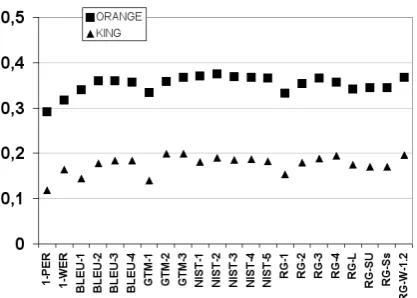
[image:3.595.78.288.429.565.2]Figure 1 shows the descriptive power, in terms of the ORANGE and KING measures, over the test set described in Subsection 2.1.
Figure 1: ORANGE and KING values for standard metrics.
Figure 2: ORANGE and KING behavior.
ORANGEResults
All values of the ORANGE measure are lower than 0.5, which is the ORANGE value that a ran-dom metric would obtain (see central representa-tion in Figure 2). This is a rather counterintu-itive result. A reasonable explanation, however, is that automatic translations behave as centroids with respect to human translations, because they somewhat average the vocabulary distribution in
the manual references; as a result, automatic trans-lations are closer to each manual summary than manual summaries to each other (see leftmost rep-resentation in Figure 2).
In other words, automatic translations tend to share (lexical) features with most of the refer-ences, but not to match exactly any of them. This is a combined effect of:
H
The nature of MT systems, mostly statisti-cal, which compute their estimates based on the number of occurrences of words, tend-ing to rely more on events that occur more often. Consequently, automatic translations typically consist of frequent words, which are likely to appear in most of the references.
H
The shallowness of current metrics, which are not able to identify the common proper-ties of manual translations with regard to au-tomatic translations.
KING Results
KING values, on the other hand, are slightly higher than the value that a random metric would obtain ( I
JK JMLONQPSR ). This means that every
stan-dard metric is able to discriminate a certain num-ber of manual translations from the set of auto-matic translations; for instance, GTM-3 identifies 19% of the manual references. For the remain-ing 81% of the test cases, however,GTM-3 cannot make the distinction, and therefore cannot be used to detect and improve weaknesses of the automatic MT systems.
These results provide an explanation for the low correlation between automatic evaluation met-rics and human judgements at the sentence level. The necessary conclusion is that new metrics with higher descriptive power are required.
3 Improving Descriptive Power
MTquality. The QARLA framework provides a solution for this challenge.
3.1 Similarity Metric Combinations inside QARLA
The QARLA Framework permits to combine sev-eral similarity metrics into a single quality mea-sure (QUEEN). Besides considering the similarity of automatic translations to human references, the QUEEN measure additionally considers the distri-bution of similarities among human references.
The QUEEN measure operates under the as-sumption that a good translation must be similar to human references (U ) according to all
similar-ity metrics. QUEENVWYX is defined as the
probabil-ity, overU[Z<U\Z<U , that for every metric] in a
given metric set ^ the automatic translationW is
more similar to a human reference than two other references to each other:
QUEEN_a`baVWQXdc
e
Vgf]h^Oi.] VWj9k=Xml8]nV#k/o#j9kpooqX9X
whereW is the automatic translation being
eval-uated, r#k/j9k
o
j9k
oogs are three different human
refer-ences inU , and] VWj9k=X stands for the similarity of
k toW .
In the case of Openlab data, we can count only on three human references per sentence. In order to increase the number of samples for QUEEN es-timation we can use reference similarities] V#k
o
j9k
oo
X
between manual translation pairs from other sen-tences, assuming that the distances between man-ual references are relatively stable across exam-ples.
3.2 Similarity Metrics
We begin by defining a set of 22 similarity metrics taken from the list of standard evaluation metrics in Subsection 2.1. Evaluation metrics can be tuned into similarity metrics simply by considering only one reference when computing its value.
Secondly, we explore the possibility of design-ing complementary similarity metrics that exploit linguistic information at levels further than lexi-cal. Inspired in the work by Liu and Gildea (2005), who introduced a series of metrics based on con-stituent/dependency syntactic matching, we have designed three subgroups of syntactic similarity metrics. To compute them, we have used the de-pendency trees provided by the MINIPAR
depen-dency parser (Lin, 1998). These metrics com-pute the level of word overlapping (unigram preci-sion/recall) between dependency trees associated to automatic and reference translations, from three different points of view:
TREE-X overlapping between the words hanging from non-terminal nodes of type ^ of the
tree. For instance, the metricTREE PRED re-flects the proportion of word overlapping be-tween subtrees of type ‘pred’ (predicate of a clause).
GRAM-X overlapping between the words with the grammatical category ^ . For instance,
the metricGRAM Areflects the proportion of word overlapping between terminal nodes of type ‘A’ (Adjective/Adverbs).
LEVEL-X overlapping between the words hang-ing at a certain level^ of the tree, or deeper.
For instance,LEVEL-1 would consider over-lapping between all the words in the sen-tences.
In addition, we also consider three coarser met-rics, namelyTREE,GRAMandLEVEL, which cor-respond to the average value of the finer metrics corresponding to each subfamily.
3.3 Metric Set Selection
We can compute KING over combinations of metrics by directly replacing the similarity met-ric ] VWj9k=X with the QUEEN measure. This
cor-responds exactly to the KING measure used in QARLA:
KINGt `b
V#^X&c
e
V#k(h)U*j@f$WAh)u-i
QUEEN_a`bwvyx{z}| V#k=Xml QUEEN_"`b vyx{z}| VWQX9X
KING represents the probability that, for a given set of human referencesU , and a set of
met-rics^ , the QUEEN quality of a human reference
is greater than the QUEEN quality of any auto-matic translation inu .
perform
~
an approximate search for a local maxi-mum in KING over all the possible metric combi-nations defined by , we have used the following
greedy heuristic:
1. Individual metrics are ranked by their KING value.
2. In decreasing rank order, metrics are individ-ually added to the set of optimal metrics if, and only if, the global KING is increased.
After applying the algorithm we have obtained the optimal metric set:
GTM-1, NIST-2, GRAM A, GRAM N, GRAM AUX, GRAM BE, TREE, TREE AUX, TREE PNMOD, TREE PRED, TREE REL, TREE S andTREE WHN
which has a KING value of 0.29. This is signif-icantly higher than the maximum KING obtained by any individual standard metric (which was 0.19 forGTM-3).
As to the probability ORANGE that a reference translation attains a higher score than an automatic translation, this metric set obtains a value of 0.49 vs. 0.42. This means that still the metrics are, on average, unable to discriminate between human references and automatic translations. However, the proportion of sentences for which the metrics are able to discriminate (KING value) is signifi-cantly higher.
The metric set with highest descriptive power contains metrics at different linguistic levels. For instance, GTM-1 and NIST-2 reward n-gram matches at the lexical level. GRAM A, GRAM N, GRAM AUXandGRAM BEcapture word overlap-ping for nouns, auxiliary verbs, adjectives and adverbs, and auxiliary uses of the verb ‘to be’, respectively. TREE, TREE AUX, TREE PNMOD, TREE PRED, TREE REL, TREE S andTREE WHN reward lexical overlapping over different types of dependency subtrees: surface subjects, relative clauses, predicates, auxiliary verbs, postnominal modifiers, and whn-elements at C-spec positions, respectively.
These results are a clear indication that features from several linguistic levels are useful for the characterization of human translations.
4 Human-like vs. Human Acceptable
In this section we analyze the relationship be-tween the two different kinds of MT evaluation
presented: (i) the ability of MT systems to gen-erate human-like translations, and (ii) the ability of MT systems to generate translations that look acceptable to human judges.
4.1 Experimental Setting
The ideal test set to study this dichotomy inside the QARLA Framework would consist of a large number of human references per sentence, and au-tomatic outputs generated by heterogeneous MT systems.
4.2 Descriptive Power vs. Correlation with Human Judgements
We use the data and results from the IWSLT04 Evaluation Campaign8. We focus on the
evalu-ation of the Chinese-to-English (CE) translevalu-ation task, in which a set of 500 short sentences from the Basic Travel Expressions Corpus (BTEC) were translated (Akiba et al., 2004). For purposes of au-tomatic evaluation, 16 reference translations and outputs by 20 different MT systems are available for each sentence. Moreover, each of these out-puts was evaluated by three judges on the basis of adequacy and fluency (LDC, 2002). In our ex-periments we consider the sum of adequacy and fluency assessments.
However, the BTEC corpus has a serious draw-back: sentences are very short (8 word length in average). In order to consider a sentence adequate we are practically forcing it to match exactly some of the human references. To alleviate this effect we selected sentences consisting of at least ten words. A total of 94 sentences (of 13 words length in average) satisfied this constraint.
Figure 3 shows, for all metrics, the relationship between the power of characterization of human references (KING, horizontal axis) and the corre-lation with human judgements (Pearson correla-tion, vertical axis). Data are plotted in three differ-ent groups: original standard metrics, single met-rics inside QARLA (QUEEN measure), and the optimal metric combination according to KING. The optimal set is:
GRAM N, LEVEL 2, LEVEL 4, NIST-1, NIST -3,NIST-4, and 1-WER
This set suggests that all kinds of n-grams play an important role in the characterization of human
translations.
The metric GRAM Nreflects the im-portance of noun translations. Unlike the Openlab corpus, levels of the dependency tree (LEVEL 2 andLEVEL 4) are descriptive features, but depen-dency relations are not (TREE metrics). This is probably due to the small average sentence length in IWSLT.
Metrics exhibiting a high level of correlation outside QARLA, such as NIST-3, also exhibit a high descriptive power (KING). There is also a tendency for metrics with a KING value around 0.6 to concentrate at a level of Pearson correlation around 0.5.
[image:6.595.78.284.334.501.2]But the main point is the fact that the QUEEN measure obtained by the metric combination with highest KING does not yield the highest level of correlation with human assessments, which is ob-tained by standard metrics outside QARLA (0.5 vs. 0.7).
Figure 3: Human characterization vs. correlation with human judgements for IWSLT’04 CE trans-lation task.
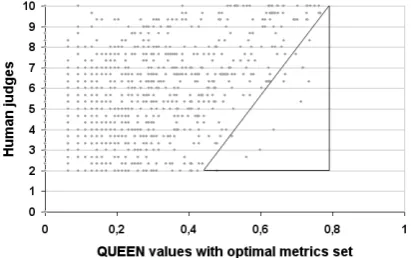
Figure 4: QUEEN values vs. human judgements for IWSLT’04 CE translation task.
4.3 Human Judgements vs. Similarity to References
In order to explain the above results, we have ana-lyzed the relationship between human assessments and the QUEEN values obtained by the best com-bination of metrics for every individual transla-tion.
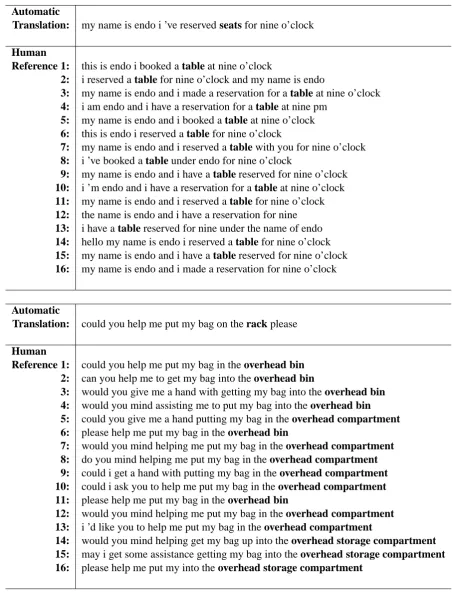
Figure 4 shows that high values of QUEEN (i.e., similarity to references) imply high values of human judgements. But the reverse is not true. There are translations acceptable to a human judge but not similar to human translations according to QUEEN. This fact can be understood by in-specting a few particular cases. Table 1 shows two cases of translations exhibiting a very low QUEEN value and very high human judgment score. The two cases present the same kind of problem: there exists some word or phrase ab-sent from all human references. In the first exam-ple, the automatic translation uses the expression “seats” to make a reservation, where humans in-variably choose “table”. In the second example, the automatic translation users “rack” as the place to put a bag, while humans choose “overhead bin”, “overhead compartment”, but never “rack”.
Therefore, the QUEEN measure discriminates these automatic translations regarding to all hu-man references, thus assigning them a low value. However, human judges find the translation still acceptable and informative, although not strictly human-like.
These results suggest that inside the set of human acceptable translations, which includes human-like translations, there is also a subset of translations unlikely to have been produced by a human translator. This is a drawback of MT eval-uation based on human references when the evalu-ation criteria is Human Acceptability. The good news are that when Human Likeness increases, Human Acceptability increases as well.
5 Conclusions
We have analyzed the ability of current MT eval-uation metrics to characterize human translations (as opposed to automatic translations), and the re-lationship between MT evaluation based on Hu-man Acceptability and HuHu-man Likeness.
[image:6.595.78.284.582.711.2]respect
to human references. This is due, among other reasons, to the combined effect of the shal-lowness of current MT evaluation metrics (mostly lexical), and the fact that the choice of lexical items is mostly based on statistical methods. We suggest two complementary ways of solving this problem. First, we introduce a new family of syntax-based metrics covering partial aspects of MT quality. Second, we use the QARLA Frame-work to combine multiple metrics into a single measure of quality. In the future we will study the design of new metrics working at different lin-guistic levels. For instance, we are currently de-veloping a new family of metrics based on shallow parsing (i.e., part-of-speech, lemma, and chunk in-formation).
Second, our results suggest that there exists a clear relation between the two kinds of MT eval-uation described. While Human Likeness is a sufficient condition to get Human Acceptability, Human Acceptability does not guarantee Human Likeness. Human judges may consider acceptable automatic translations that would never be gener-ated by a human translator.
Considering these results, we claim that im-proving metrics according to their descriptive power (Human Likeness) is more reliable than improving metrics based on correlation with hu-man judges. First, because this correlation is not granted, since automatic metrics are based on sim-ilarity to models. Second, because high Human Likeness ensures high scores from human judges.
References
Yasuhiro Akiba, Marcello Federico, Noriko Kando, Hi-romi Nakaiwa, Michael Paul, and Jun’ichi Tsujii. 2004. Overview of the IWSLT04 Evaluation Cam-paign. In Proceedings of the International Work-shop on Spoken Language Translation, pages 1–12, Kyoto, Japan.
Enrique Amig ´o, Julio Gonzalo, Anselmo Pe˜nas, and Felisa Verdejo. 2005. QARLA: a Framework for the Evaluation of Automatic Sumarization. In Pro-ceedings of the 43th Annual Meeting of the Associa-tion for ComputaAssocia-tional Linguistics, Michigan, June. Association for Computational Linguistics.
J.M. Crego, Costa juss`a M.R., J.B. Mari ˜no, and Fonol-losa J.A.R. 2005. Ngram-based versus Phrase-based Statistical Machine Translation. In Proceed-ings of the International Workshop on Spoken Lan-guage Technology (IWSLT’05).
George Doddington. 2002. Automatic Evaluation
of Machine Translation Quality Using N-gram Co-Occurrence Statistics. In Proceedings of the 2nd In-ternation Conference on Human Language Technol-ogy, pages 138–145.
Matthias Eck and Chiori Hori. 2005. Overview of the IWSLT 2005 Evaluation Campaign. In Proceedings of the International Workshop on Spoken Language Translation, Carnegie Mellon University, Pittsburgh, PA.
Jes´us Gim´enez and Enrique Amig ´o. 2006. IQMT: A Framework for Automatic Machine Translation Evaluation. In Proceedings of the 5th LREC.
Jes´us Gim´enez and Llu´ıs M`arquez. 2005. Combining Linguistic Data Views for Phrase-based SMT. In Proceedings of the Workshop on Building and Using Parallel Texts, ACL.
LDC. 2002. Linguistic Data Annotation Specification: Assessment of Fluency and Adequacy in Chinese-English Translations Revision 1.0. Technical report, Linguistic Data Consortium. http://- www.ldc.upenn.edu/Projects/TIDES/Translation/-TransAssess02.pdf.
G. Leusch, N. Ueffing, and H. Ney. 2003. A Novel String-to-String Distance Measure with Applica-tions to Machine Translation Evaluation. In Pro-ceedings of MT Summit IX.
Chin-Yew Lin and Franz Josef Och. 2004a. Au-tomatic Evaluation of Machine Translation Qual-ity Using Longest Common Subsequence and Skip-Bigram Statics. In Proceedings of ACL.
Chin-Yew Lin and Franz Josef Och. 2004b. OR-ANGE: a Method for Evaluating Automatic Evalu-ation Metrics for Machine TranslEvalu-ation. In Proceed-ings of COLING.
Dekang Lin. 1998. Dependency-based Evaluation of MINIPAR. In Proceedings of the Workshop on the Evaluation of Parsing Systems.
Ding Liu and Daniel Gildea. 2005. Syntactic Fea-tures for Evaluation of Machine Translation. In Pro-ceedings of ACL Workshop on Intrinsic and Extrin-sic Evaluation Measures for Machine Translation and/or Summarization.
I. Dan Melamed, Ryan Green, and Joseph P. Turian. 2003. Precision and Recall of Machine Translation. In Proceedings of HLT/NAACL.
S. Nießen, F.J. Och, G. Leusch, and H. Ney. 2000. Evaluation Tool for Machine Translation: Fast Eval-uation for MT Research. In Proceedings of the 2nd International Conference on Language Resources and Evaluation.
Automatic
Translation: my name is endo i ’ve reserved seats for nine o’clock
Human
Reference 1: this is endo i booked a table at nine o’clock
2: i reserved a table for nine o’clock and my name is endo
3: my name is endo and i made a reservation for a table at nine o’clock
4: i am endo and i have a reservation for a table at nine pm
5: my name is endo and i booked a table at nine o’clock
6: this is endo i reserved a table for nine o’clock
7: my name is endo and i reserved a table with you for nine o’clock
8: i ’ve booked a table under endo for nine o’clock
9: my name is endo and i have a table reserved for nine o’clock
10: i ’m endo and i have a reservation for a table at nine o’clock
11: my name is endo and i reserved a table for nine o’clock
12: the name is endo and i have a reservation for nine
13: i have a table reserved for nine under the name of endo
14: hello my name is endo i reserved a table for nine o’clock
15: my name is endo and i have a table reserved for nine o’clock
16: my name is endo and i made a reservation for nine o’clock
Automatic
Translation: could you help me put my bag on the rack please
Human
Reference 1: could you help me put my bag in the overhead bin
2: can you help me to get my bag into the overhead bin
3: would you give me a hand with getting my bag into the overhead bin
4: would you mind assisting me to put my bag into the overhead bin
5: could you give me a hand putting my bag in the overhead compartment
6: please help me put my bag in the overhead bin
7: would you mind helping me put my bag in the overhead compartment
8: do you mind helping me put my bag in the overhead compartment
9: could i get a hand with putting my bag in the overhead compartment
10: could i ask you to help me put my bag in the overhead compartment
11: please help me put my bag in the overhead bin
12: would you mind helping me put my bag in the overhead compartment
13: i ’d like you to help me put my bag in the overhead compartment
14: would you mind helping get my bag up into the overhead storage compartment
15: may i get some assistance getting my bag into the overhead storage compartment
[image:8.595.70.530.105.702.2]16: please help me put my into the overhead storage compartment