Interpreting Semantic Relations in Noun Compounds via Verb Semantics
Su Nam Kim†and Timothy Baldwin†‡
†Computer Science and Software Engineering University of Melbourne, Victoria 3010 Australia
and
‡NICTA Victoria Research Lab
University of Melbourne, Victoria 3010 Australia
{snkim,tim}@csse.unimelb.edu.au
Abstract
We propose a novel method for automat-ically interpreting compound nouns based on a predefined set of semantic relations. First we map verb tokens in sentential con-texts to a fixed set of seed verbs using
WordNet::Similarity and Moby’s Thesaurus. We then match the sentences with semantic relations based on the se-mantics of the seed verbs and grammatical roles of the head noun and modifier. Based on the semantics of the matched sentences, we then build a classifier using TiMBL. The performance of our final system at in-terpreting NCs is 52.6%.
1 Introduction
The interpretation ofnoun compounds(hereafter, NCs) such as apple pie or family car is a well-established sub-task of language understanding. Conventionally, the NC interpretation task is de-fined in terms of unearthing the underspecified se-mantic relation between the head noun and modi-fier(s), e.g.pieandapple respectively in the case ofapple pie.
NC interpretation has been studied in the con-text of applications including question-answering and machine translation (Moldovan et al., 2004; Cao and Li, 2002; Baldwin and Tanaka, 2004; Lauer, 1995). Recent work on the automatic/semi-automatic interpretation of NCs (e.g., Lapata (2002), Rosario and Marti (2001), Moldovan et al. (2004) and Kim and Baldwin (2005)) has made as-sumptions about the scope of semantic relations or restricted the domain of interpretation. This makes it difficult to gauge the general-purpose utility of the different methods. Our method avoids any such assumptions while outperforming previous methods.
In seminal work on NC interpretation, Finin (1980) tried to interpret NCs based on hand-coded
rules. Vanderwende (1994) attempted the auto-matic interpretation of NCs using hand-written rules, with the obvious cost of manual interven-tion. Fan et al. (2003) estimated the knowledge required to interpret NCs and claimed that perfor-mance was closely tied to the volume of data ac-quired.
In more recent work, Barker and Szpakowicz (1998) used a semi-automatic method for NC in-terpretation in a fixed domain. Lapata (2002) developed a fully automatic method but focused on nominalizations, a proper subclass of NCs.1 Rosario and Marti (2001) classified the nouns in medical texts by tagging hierarchical information using neural networks. Moldovan et al. (2004) used the word senses of nouns based on the do-main or range of interpretation of an NC, leading to questions of scalability and portability to novel domains/NC types. Kim and Baldwin (2005) pro-posed a simplistic general-purpose method based on the lexical similarity of unseen NCs with train-ing instances.
The aim of this paper is to develop an automatic method for interpreting NCs based on semantic re-lations. We interpret semantic relations relative to a fixed set of constructions involving the modifier and head noun and a set of seed verbs for each semantic relation: e.g. (the) family owns (a) car
is taken as evidence for family car being an in-stance of the POSSESSOR relation. We then at-tempt to map all instances of the modifier and head noun as the heads of NPs in a transitive senten-tial context onto our set of constructions via lex-ical similarity over the verb, to arrive at an inter-pretation: e.g. we would hope to predict that pos-sessis sufficiently similar toownthat(the) family possesses (a) carwould be recognised as
support-1With nominalizations, the head noun is deverbal, and in
the case of Lapata (2002), nominalisations are assumed to be interpretable as the modifier being either the subject (e.g.
child behavior) or object (e.g.car lover) of the base verb of the head noun.
ing evidence for thePOSSESSORrelation. We use a supervised classifier to combine together the evi-dence contributed by individual sentential contexts of a given modifier–head noun combination, and arrive at a final interpretation for a given NC.
Mapping the actual verbs in sentences to ap-propriate seed verbs is obviously crucial to the success of our method. This is particularly im-portant as there is no guarantee that we will find large numbers of modifier–head noun pairings in the sorts of sentential contexts required by our method, nor that we will find attested instances based on the seed verbs. Thus an error in map-ping an attested verb to the seed verbs could result in a wrong interpretation or no classification at all. In this paper, we experiment with the use of Word-Net (Fellbaum, 1998) and word clusters (based on Moby’s Thesaurus) in mapping attested verbs to the seed verbs. We also make use of CoreLex in dealing with the semantic relation TIME and the RASP parser (Briscoe and Carroll, 2002) to de-termine the dependency structure of corpus data.
The data source for our set of NCs is binary NCs (i.e. NCs with a single modifier) from the Wall Street Journal component of the Penn Tree-bank. We deliberately choose to ignore NCs with multiple modifiers on the grounds that: (a) 88.4% of NC types in the Wall Street Journal component of the Penn Treebank and 90.6% of NC types in the British National Corpus are binary; and (b) we expect to be able to interpret NCs with multiple modifiers by decomposing them into binary NCs. Another simplifying assumption we make is to re-move NCs incorporating proper nouns since: (a) the lexical resources we employ in this research do not contain them in large numbers; and (b) there is some doubt as to whether the set of seman-tic relations required to interpret NCs incorporat-ing proper nouns is that same as that for common nouns.
The paper is structured as follows. Section 2 takes a brief look at the semantics of NCs and the basic idea behind the work. Section 3 details the set of NC semantic relations that is used in our research, Section 4 presents an extended discus-sion of our approach, Section 5 briefly explains the tools we use, Section 6.1 describes how we gather and process the data, Section 6.2 explains how we map the verbs to seed verbs, and Section 7 and Section 8 present the results and analysis of our approach. Finally we conclude our work in
Sec-tion 9.
2 Motivation
The semantic relation in NCs is the relation be-tween the head noun (denoted “H”) and the mod-ifier(s) (denoted “M”). We can find this semantic relation expressed in certain sentential construc-tions involving the head noun and modifier.
(1) family car
CASE: familyownsthe car.
FORM: H own M
RELATION: POSSESSOR
(2) student protest
CASE: protest isperformedby student.
FORM: M is performed by H
RELATION: AGENT
In the examples above, the semantic relation (e.g. POSSESSOR) provides an interpretation of how the head noun and modifiers relate to each other, and the seed verb (e.g.own) provides a para-phrase evidencing that relation. For example, in the case offamily car, thefamilyis the POSSES-SORof thecar, and instudent protest, student(s)
are theAGENTof theprotest. Note that voice is im-portant in aligning sentential contexts with seman-tic relations. For instance,family carcan be repre-sented ascar is owned by family(passive) and stu-dent protestasstudent performs protest(active).
The exact nature of the sentential context varies with different synonyms of the seed verbs.
(3) family car
CASE: Synonym=have/possess/belong to
FORM: H own M
RELATION: POSSESSOR
(4) student protest
CASE: Synonym=act/execute/do
FORM: M is performed by H
RELATION: AGENT
would mean that thecar belongs to family. Thus, even when the voice of the verb is the same (voice=active), the grammatical role of the head noun and modifier can change.
In our approach we map the actual verbs in sen-tences containing the head noun and modifiers to seed verbs corresponding to the relation forms. The set of seed verbs contains verbs representa-tive of each semantic relation form. We chose two sets of seed verbs of size 57 and 84, to examine how the coverage of actual verbs by seed verbs af-fects the performance of our method. Initially, we manually chose a set of 60 seed verbs. We then added synonyms from Moby’s thesaurus for some of the 60 verbs. Finally, we filtered verbs from the two expanded sets, since these verbs occur very frequently in the corpus (as this might skew the results). The set of seed verbs {have, own, pos-sess, belong to} are in the set of 57 seed verbs, and{acquire, grab, occupy}are added to the set of 84 seed verbs; all correspond to the POSSES-SORrelation.
For each relation, we generate a set of con-structional templates associating a subset of seed verbs with appropriate grammatical relations for the head noun and modifier. Examples for POS-SESSORare:
S({have, own, possess}V, MSUBJ, HOBJ) (5)
S({belong to}V, HSUBJ, MOBJ) (6)
whereV is the set of seed verbs,Mis the modifier andHis the head noun.
Two relations which do not map readily onto seed verbs are TIME (e.g. winter semester) and EQUATIVE (e.g. composer arranger). Here, we rely on an independent set of contextual evidence, as outlined in Section 6.1.
Through matching actual verbs attested in cor-pus data onto seed verbs, we can match sentences with relations (see Section 6.2). Using this method we can identify the matching relation forms of se-mantic relations to decide the sese-mantic relation for NCs.
3 Semantic Relations in Compound
Nouns
While there has been wide recognition of the need for a system of semantic relations with which to classify NCs, there is still active debate as to what the composition of that set should be, or indeed
RASP parser
Raw Sentences
Modified Sentences
Final Sentences
Classifier
Semantic Relation Pre−processing
Collect Subj, Obj, PP, PPN, V, T
Filter sentences Get sentences with H,M
Verb−Mapping
map verbs onto seed verbs
Match modified sentences wrt relation forms
Moby’s Thesaurus WordNet::Similarity
Classifier:Timbl
[image:3.595.313.516.60.224.2]Noun Compound
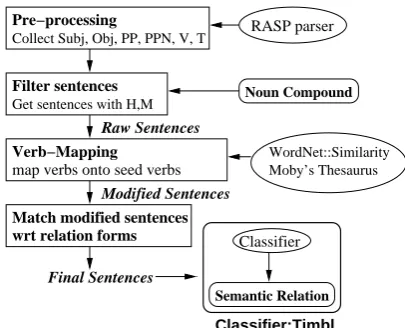
Figure 1: System Architecture
whether it is reasonable to expect that all NCs should be interpretable with a fixed set of semantic relations.
Based on the pioneering work on Levi (1979) and Finin (1980), there have been efforts in com-putational linguistics to arrive at largely task-specific sets of semantic relations, driven by the annotation of a representative sample of NCs from a given corpus type (Vanderwende, 1994; Barker and Szpakowicz, 1998; Rosario and Marti, 2001; Moldovan et al., 2004). In this paper, we use the set of 20 semantic relations defined by Barker and Szpakowicz (1998), rather than defining a new set of relations. The main reasons we chose this set are: (a) that it clearly distinguishes between the head noun and modifiers, and (b) there is clear documentation of each relation, which is vital for NC annotation effort. The one change we make to the original set of 20 semantic relations is to ex-clude thePROPERTYrelation since it is too general and a more general form of several other relations includingMATERIAL(e.g.apple pie).
4 Method
NP (hereafter, PPN). Next, for our test NCs, we identified all verbs for which the modifier and head noun co-occur as subject, object, or PPN. We then mapped these verbs to seed verbs us-ingWordNet::Similarityand Moby’s The-saurus (see Section 5 for details). Finally, we iden-tified the corresponding relation for each seed verb and selected the best-fitting semantic relation us-ing a classifier. To evaluate our approach, we built a classifier usingTiMBL(Daelemans et al., 2004).
5 Resources
In this section, we outline the tools and resources employed in our method.
As our parser, we used RASP, generating a dependency representation for the most probable parse for each sentence. Note that RASP also lem-matises all words in a POS-sensitive manner.
To map actual verbs onto seed verbs, we experimented with two resources:
WordNet::Similarity and Moby’s the-saurus. WordNet::Similarity2 is an open source software package that allows the user to measure the semantic similarity or related-ness between two words (Patwardhan et al., 2003). Of the many methods implemented in
WordNet::Similarity, we report on results for one path-based method (WUP, Wu and Palmer
(1994)), one content-information based method (JCN, Jiang and Conrath (1998)) and two semantic relatedness methods (LESK, Banerjee and Peder-sen (2003), and VECTOR, (Patwardhan, 2003)). We also used a random similarity-generating method as a baseline (RANDOM).
The second semantic resource we use for verb-mapping method is Moby’s thesaurus. Moby’s thesaurus is based on Roget’s thesaurus, and con-tains 30K root words, and 2.5M synonyms and re-lated words. Since the direct synonyms of seed verbs have limited coverage over the set of sen-tences used in our experiment, we also experi-mented with using second-level indirect synonyms of seed verbs.
In order to deal with theTIMErelation, we used CoreLex (Buitelaar, 1998). CoreLex is based on a unified approach to systematic polysemy and the semantic underspecification of nouns, and derives from WordNet 1.5. It contains 45 basic CoreLex types, systematic polysemous classes and 39,937 nouns with tags.
2www.d.umn.edu/ tpederse/similarity.html
As mentioned earlier, we built our supervised classifier usingTiMBL.
6 Data Collection
6.1 Data Processing
To test our method, we extracted 2,166 NC types from the Wall Street Journal (WSJ) component of the Penn Treebank. We additionally extracted sen-tences containing the head noun and modifier in pre-defined constructional contexts from the amal-gam of: (1) the Brown Corpus subset contained in the Penn Treebank, (2) the WSJ portion of the Penn Treebank, and (3) the British National Cor-pus (BNC). Note that while these pre-defined con-structional contexts are based on the contexts in which our seed verbs are predicted to correlate with a given semantic relation, we instances of all verbs occurring in those contexts. For example, based on the construction in Equation 5, we ex-tract all instances ofS(Vi, MjSUBJ, HjOBJ)for all
verbsVi and all instances ofN Cj = (Mj, Hj)in
our dataset.
Two annotators tagged the 2,166 NC types in-dependently at 52.3% inter-annotator agreement, and then met to discus all contentious annotations and arrive at a mutually-acceptable gold-standard annotation for each NC. The Brown, WSJ and BNC data was pre-parsed with RASP, and sen-tences were extracted which contained the head noun and modifier of one of our 2,166 NCs in sub-ject or obsub-ject position, or as (head) noun within the NP of an PP. After extracting these sentences, we counted the frequencies of the different modifier– head noun pairs, and filtered out: (a) all construc-tional contexts not involving a verb contained in WordNet 2.0, and (b) all NCs for which the modi-fier and head noun did not co-occur in at least five sentential contexts. This left us with a total of 453 NCs for training and testing. The combined total number of sentential contexts for our 453 NCs was 7,714, containing 1,165 distinct main verbs.
We next randomly split the NC data into 80% training data and 20% test data. The final number of test NCs is 88; the final number of training NCs varies depending on the verb-mapping method.
occur-ACT BENEFIT HAVE
USE PLAY PERFORM
...
...
Seed verbs
accept
act
agree
..
HOLD...
Verb−Mapping Methods
AGENT BENEFICIARY CONTAINER
OBJECT POSSESSOR INSTRUMENT
...
...
...
Semantic Relations Original verbs
[image:5.595.81.282.62.179.2]accommodate
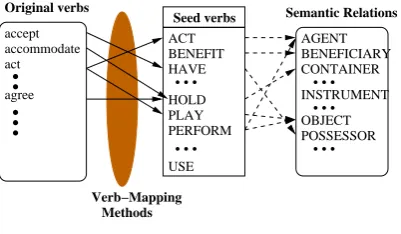
Figure 2: Verb mapping
rences of the modifier and head noun (e.g. coach and player for player coach) as evidence for the relation.3 We thus separately collate statistics from coordinated NPs for each NC, and from this compute a weight for each NC based on mutual information:
T IM E(N Ci) =−log2
freq(coord(Mi, Hi))
freqMi×freq(Hi)
(7)
where Mi and Hi are the modifier and head of
N Ci, respectively, andfreq(coord(Mi, Hi))is the
frequency of occurrence ofMi andHi in
coordi-nated NPs.
Finally, we calculate a normalised weight for each seed verb by determining the proportion of head verbs each seed verb occurs with.
6.2 Verb Mapping
The sentential contexts gathered from corpus data contain a wide range of verbs, not just the seed verbs. To map the verbs onto seed verbs, and hence estimate which semantic rela-tion(s) each is a predictor of, we experimented with two different methods. First we used the
WordNet::Similaritypackage to calculate the similarity between a given verb and each of the seed verbs, experimenting with the 5 methods mentioned in Section 5. Second, we used Moby’s thesaurus to extract both direct syn-onyms (D-SYNONYM) and a combination of direct and second-level indirect synonyms of verbs (I -SYNONYM), and from this, calculate the closest-matching seed verb(s) for a given verb.
Figure 2 depicts the procedure for mapping verbs in constructional contexts onto the seed verbs. Verbs found in the various contexts in the
3Note the order of the modifier and head in coordinated
NPs is considered to be irrelevant, i.e.player and coachand
coach and playerare equally evidence for anEQUATIVE inter-pretation forplayer coach(andcoach player).
accomplish achieve behave conduct
...
ACT
act conduct deadl with function perform play
LEVEL=1
LEVEL=2
synonym in level1 synonym in level2 not found in level1
Figure 3: Expanding synonyms
# of SeedVB D-Synonyms D/I-Synonyms 57 6,755(87.6%) 7,388(95.8%) 84 6,987(90.6%) 7,389(95.8%)
Table 1: Coverage of D and D/I-Synonyms
corpus (on the left side of the figure) map onto one or more seed verbs, which in turn map onto one or more semantic relations.4 We replace all non-seed verbs in the corpus data with the non-seed verb(s) they map onto, potentially increasing the number of corpus instances.
Since direct (i.e. level 1) synonyms from Moby’s thesaurus are not sufficient to map all verbs onto seed verbs, we also include second-level (i.e. second-level 2) synonyms, expanding from di-rect synonyms. Table 1 shows the coverage of sentences for test NCs, in whichDindicates direct synonyms andIindicates indirect synonyms.
7 Evaluation
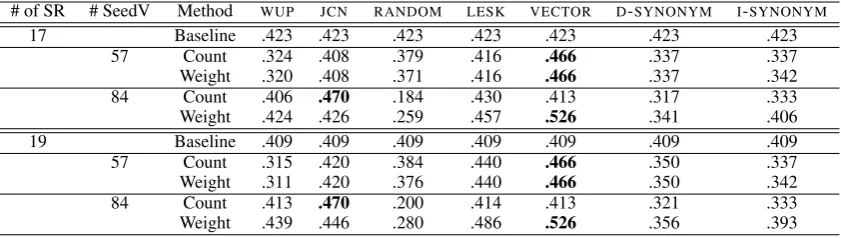
We evaluated our method over both 17 semantic relations (withoutEQUATIVEandTIME) and the full 19 semantic relations, due to the low frequency and lack of verb-based constructional contexts for EQUATIVEandTIME, as indicated in Table 2. Note that the test data set is the same for both sets of semantic relations, but that the training data in the case of 17 semantic relations will not con-tain any instances for theEQUATIVEandTIME re-lations, meaning that all such test instances will be misclassified. The baseline for all verb map-ping methods is a simple majority-class classifier, which leads to an accuracy of 42.4% for theTOPIC relation. In evaluation, we use two different val-ues for our method: Count and Weight. Count
is based on the raw number of corpus instances, while Weight employs the seed verb weight de-scribed in Section 6.1.
4There is only one instance of a seed verb mapping to
[image:5.595.315.515.65.137.2]# of SR # SeedV Method WUP JCN RANDOM LESK VECTOR D-SYNONYM I-SYNONYM
17 Baseline .423 .423 .423 .423 .423 .423 .423
57 Count .324 .408 .379 .416 .466 .337 .337
Weight .320 .408 .371 .416 .466 .337 .342
84 Count .406 .470 .184 .430 .413 .317 .333
Weight .424 .426 .259 .457 .526 .341 .406
19 Baseline .409 .409 .409 .409 .409 .409 .409
57 Count .315 .420 .384 .440 .466 .350 .337
Weight .311 .420 .376 .440 .466 .350 .342
84 Count .413 .470 .200 .414 .413 .321 .333
[image:6.595.89.510.62.181.2]Weight .439 .446 .280 .486 .526 .356 .393
Table 2: Results with 17 relations and with 19 relations
#of SR # SeedVB Method WUP JCN RANDOM LESK VECTOR
17 Baseline .423 .423 .423 .423 .423
57 Count .423 .385 .379 .413 .466
Weight .423 .385 .379 .413 .466
84 Count .325 .439 .420 .484 .466
Weight .281 .393 .317 .476 .466
19 Baseline .409 .409 .409 .409 .409
57 Count .423 .397 .392 .413 .413
Weight .423 .397 .392 .413 .500
84 Count .333 .439 .425 .484 .413
[image:6.595.148.453.213.332.2]Weight .290 .410 .317 .484 .413
Table 3: Results of combining the proposed method and with the method of Kim and Baldwin (2005)
As noted above, we excluded all NCs for which we were unable to find at least 5 instances of the modifier and head noun in an appropriate senten-tial context. This exclusion reduced the original set of 2,166 NCs to only 453, meaning that the proposed method is unable to classify up to 80% of NCs. For real-world applications, a method which is only able to arrive at a classification for 20% of instances is clearly of limited utility, and we need some way of expanding the coverage of the pro-posed method. This is achieved by adapting the similarity method proposed by Kim and Baldwin (2005) to our task, wherein we use lexical simi-larity to identify the nearest-neighbour NC for a given NC, and classify the given NC according to the classification for the nearest-neighbour. The results for the combined method are presented in Table 3.
8 Discussion
For the basic method, as presented in Table 2, the classifier produced similar results over the 17 se-mantic relations to the 19 sese-mantic relations. Us-ing data from Weightand Count for both 17 and 19 semantic relations, the classifier achieved the best performance with VECTOR (context vector-based distributional similarity), followed by JCN
and LESK. The main reason is that VECTOR is
more conservative than the other methods at map-ping (original) verbs onto seed verbs, i.e. the aver-age number of seed verbs a given verb maps onto is small. For the other methods, the semantics of the original sentences are often not preserved un-der verb mapping, introducing noise to the classi-fication task.
Comparing the two sets of semantic relations (17 vs. 19), the set with more semantic rela-tions achieved slightly better performance in most cases. A detailed breakdown of the results re-vealed thatTIME both has an above-average clas-sification accuracy and is associated with a rela-tively large number of test NCs, while EQUATIVE has a below-average classification accuracy but is associated with relatively few instances.
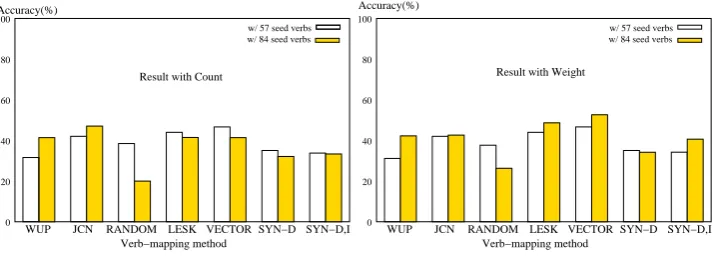
While an increased number of seed verbs gener-ates more training instances under verb mapping, it is imperative that the choice of seed verbs be made carefully so that they not introduce noise into the classifier and reducing overall perfor-mance. Figure 4 is an alternate representation of the numbers from Table 2, with results for each in-dividual method over 57 and 84 seed verbs juxta-posed for each ofCountandWeight. From this, we get the intriguing result thatCountgenerally per-forms better over fewer seed verbs, whileWeight
WUP JCN RANDOM LESK VECTOR SYN−D SYN−D,I Result with Count
Verb−mapping method Accuracy(%)
WUP JCN RANDOM LESK VECTOR SYN−D SYN−D,I Verb−mapping method
Accuracy(%)
Result with Weight
0 20 40 60 80 100
w/ 57 seed verbs w/ 84 seed verbs
0 20 40 60 80 100
w/ 57 seed verbs w/ 84 seed verbs
Figure 4: Performance with 57 vs. 84 seed verbs
#of SR # SeedVB WUP LCH JCN LIN RANDOM LESK VECTOR
17 Baseline .433 .433 .441 .441 .433 .477 .428
57 .449 .421 .415 .337 .409 .469 .344
Baseline .433 .433 .433 .433 .428 .438 .444
84 .476 .416 .409 .349 .226 .465 .333
19 Baseline .418 .418 .430 .430 .418 .477 .413
57 .465 .418 .417 .341 .232 .462 .344
Baseline .413 .413 .418 .418 .413 .438 .426
[image:7.595.122.479.63.192.2]84 .471 .413 .407 .348 .218 .465 .320
Table 4: Results for the method of Kim and Baldwin (2005) over the test set used in this research
For the experiment where we combine our method with that of Kim and Baldwin (2005), as presented in Table 3, we find a similar pattern of results to the proposed method. Namely,VECTOR
andLESKachieve the best performance, with mi-nor variations in the absolute performance relative to the original method but the best results for each relation set actually dropping marginally over the original method. This drop is not surprising when we consider that we use an imperfect method to identify the nearest neighbour for an NC for which we are unable to find corpus instances in sufficient numbers, and then a second imperfect method to classify the instance.
Compared to previous work, our method pro-duces reasonably stable performance when op-erated over the open-domain data with small amounts of training data. Rosario and Marti (2001) achieved about 60% using a neural net-work in a closed domain, Moldovan et al. (2004) achieved 43% using word sense disambiguation of the head noun and modifier over open domain data, and Kim and Baldwin (2005) produced 53% using lexical similarities of the head noun and modifier (using the same relation set, but evaluated over a different dataset). The best result achieved by our system was 52.6% over open-domain data, using a general-purpose relation set.
To get a better understanding of how our
method compares with that of Kim and Baldwin (2005), we evaluated the method of Kim and Bald-win (2005) over the same data set as used in this research, the results of which are presented in Ta-ble 4. The relative results for the different sim-ilarity metrics mirror those reported in Kim and Baldwin (2005). WUP produced the best perfor-mance at 47-48% for the two relation sets, sig-nificantly below the accuracy of our method at 53.3%. Perhaps more encouraging is the result that the combined method—where we classify at-tested instances according to the proposed method, and classify unattested instances according to the nearest-neighbour method of Kim and Baldwin (2005) and the classifications from the proposed method—outperforms the method of Kim and Baldwin (2005). That is, the combined method has the coverage of the method of Kim and Bald-win (2005), but inherits the higher accuracy of the method proposed herein. Having said this, the per-formance of the Kim and Baldwin (2005) method overPRODUCT, TOPIC, LOCATIONandSOURCEis superior to that of our method. In this sense, we believe that alternate methods of hybridisation may lead to even better results.
based on their relative similarity to the original verb. We also use the same weight and frequency for each seed verb relative to a given relation, de-spite seed verbs being more indicative of a given relation and also potentially occurring more often in the corpus. For instance,possessis more related toPOSSESSORthanoccupy. Alsopossessoccurs more often in the corpus thanbelong to. As future work, we intend to investigate whether allowances for these considerations can improve the perfor-mance of our method.
9 Conclusion
In this paper, we proposed a method for au-tomatically interpreting noun compounds based on seed verbs indicative of each semantic re-lation. For a given modifier and head noun, our method extracted corpus instances of the two nouns in a range of constructional contexts, and then mapped the original verbs onto seed verbs based on lexical similarity derived from
WordNet::Similarity, and Moby’s The-saurus. These instances were then fed into the
TiMBL learner to build a classifier. The best-performing method wasVECTOR, which is a
con-text vector distributional similarity method. We also experimented with varying numbers of seed verbs, and found that generally the more seed verbs, the better the performance. Overall, the best-performing system achieved an accuracy of 52.6% with 84 seed verbs and theVECTOR verb-mapping method.
Acknowledgements
We would like to thank the members of the Univer-sity of Melbourne LT group and the three anony-mous reviewers for their valuable input on this re-search.
References
Timothy Baldwin and Takaaki Tanaka. 2004. Transla-tion by machine of compound nominals: Getting it right. InIn Proceedings of the ACL 2004 Workshop on Multi-word Expressions: Integrating Processing, pages 24–31, Barcelona, Spain.
Satanjeev Banerjee and Ted Pedersen. 2003. Extended gloss overlaps as a measure of semantic relatedness. In Pro-ceedings of the Eighteenth International Joint Conference on Artificial Intelligence, pages 805–810, Acapulco, Mex-ico.
Ken Barker and Stan Szpakowicz. 1998. Semi-automatic recognition of noun modifier relationships. In Proceed-ings of the 17th international conference on Computa-tional linguistics, pages 96–102, Quebec, Canada.
Ted Briscoe and John Carroll. 2002. Robust accurate statisti-cal annotation of general text. InProc. of the 3rd Interna-tional Conference on Language Resources and Evaluation (LREC 2002), pages 1499–1504, Las Palmas, Canary Is-lands.
Paul Buitelaar. 1998. CoreLex: Systematic Polysemy and Underspecification. Ph.D. thesis, Brandeis University, USA.
Yunbo Cao and Hang Li. 2002. Base noun phrase translation using web data and the EM algorithm. In19th Interna-tional Conference on ComputaInterna-tional Linguistics, Taipei, Taiwan.
Walter Daelemans, Jakub Zavrel, Ko van der Sloot, and An-tal van den Bosch. 2004. TiMBL: Tilburg Memory Based Learner, version 5.1, Reference Guide. ILK Technical Re-port 04-02.
James Fan, Ken Barker, and Bruce W. Porter. 2003. The knowledge required to interpret noun compounds. In7th International Joint Conference on Artificial Intelligence, pages 1483–1485, Acapulco, Mexico.
Christiane Fellbaum, editor. 1998. WordNet: An Electronic Lexical Database. MIT Press, Cambridge, USA. Timothy W. Finin. 1980. The semantic interpretation of
compound nominals. Ph.D. thesis, University of Illinois, Urbana, Illinois, USA.
Jay Jiang and David Conrath. 1998. Semantic similar-ity based on corpus statistics and lexical taxonomy. In
Proceedings on International Conference on Research in Computational Linguistics, pages 19–33.
Su Nam Kim and Timothy Baldwin. 2005. Automatic in-terpretation of noun compounds using WordNet similar-ity. InSecond International Joint Conference On Natural Language Processing, pages 945–956, JeJu, Korea. Maria Lapata. 2002. The disambiguation of nominalizations.
Computational Linguistics, 28(3):357–388.
Mark Lauer. 1995. Designing Statistical Language Learn-ers: Experiments on Noun Compounds. Ph.D. thesis, Macquarie University.
Judith Levi. 1979. The Syntax and Semantics of Complex Nominals. New York: Academic Press.
Dan Moldovan, Adriana Badulescu, Marta Tatu, Daniel An-tohe, and Roxana Girju. 2004. Models for the seman-tic classification of noun phrases. InHLT-NAACL 2004: Workshop on Computational Lexical Semantics, pages 60– 67, Boston, USA.
Siddharth Patwardhan, Satanjeev Banerjee, and Ted Peder-sen. 2003. Using measures of semantic relatedness for word sense disambiguation. InProceedings of the Fourth International Conference on Intelligent Text Processing and Computational Linguistics.
Siddharth Patwardhan. 2003. Incorporating dictionary and corpus information into a context vector measure of se-mantic relatedness. Master’s thesis, University of Min-nesota, USA.
Barbara Rosario and Hearst Marti. 2001. Classifying the se-mantic relations in noun compounds via a domain-specific lexical hierarchy. InProceedings of the 2001 Conference on Empirical Methods in Natural Language Processing, pages 82–90.