warwick.ac.uk/lib-publications Manuscript version: Submitted Version
The version presented here is the submitted version that may later be published elsewhere. Persistent WRAP URL:
http://wrap.warwick.ac.uk/116105 How to cite:
Please refer to the repository item page, detailed above, for the most recent bibliographic citation information. If a published version is known of, the repository item page linked to above, will contain details on accessing it.
Copyright and reuse:
The Warwick Research Archive Portal (WRAP) makes this work by researchers of the University of Warwick available open access under the following conditions.
Copyright © and all moral rights to the version of the paper presented here belong to the individual author(s) and/or other copyright owners. To the extent reasonable and
practicable the material made available in WRAP has been checked for eligibility before being made available.
Copies of full items can be used for personal research or study, educational, or not-for-profit purposes without prior permission or charge. Provided that the authors, title and full
bibliographic details are credited, a hyperlink and/or URL is given for the original metadata page and the content is not changed in any way.
Publisher’s statement:
Please refer to the repository item page, publisher’s statement section, for further information.
Evaluation of the University of Warwick’s
outreach programme, UniTracks: The Warwick
Young Achievers' Programme:
Report 5:
The Big Deal Enterprise Challenge, 2017
Stephen M. Cullen
Ruth Thomas
21 July, 2017
Centre for Educational Development, Appraisal and Researc h (CEDAR),
Contents
Executive summary ... 2
1. Background and introduction ... 3
1.1 UniTracks and the Big Deal Enterprise Challenge competition ... 3
1.1.1 Details of the ten weeks of The Big Deal ... 4
2 The evaluation... 8
2.1 This evaluation report ... 9
3. The operation and impact of the Big Deal competition 2017 ... 10
3.1 Introduction ... 10
3.2 Business mentors’ views ... 10
3.2.1 Data collection ... 10
3.2.2 Business mentors – backgrounds and motivations ... 11
3.2.3 Induction and preparation ... 12
3.2.4 The business mentors’ perceptions of the Big Deal Launch days ... 13
3.2.5 Using the Brightside Blogs and working with the young people ... 16
3.2.6 Benefits and impact arising for the Big Deal competitors. ... 21
3.2.7 Business mentors’ suggestions for future Big Deal competitions ... 24
3.3 School staff views ... 25
3.3.1 Data collection ... 25
3.3.2 School staff background ... 26
3.3.3 Running the Big Deal in school ... 27
1
3.3.5 School staff views on young people’s work, and role of mentors ... 29
3.3.6 Outcomes and impact of the Big Deal ... 30
3.4 The Brightside Trust ... 32
3.4.1 Brightside Trust interview data ... 32
3.4.2 Big Deal bogs site engagement and skills tracker ... 34
3.5 The UniTracks’ school students’ views ... 37
3.5.1 Big Deal Launch questionnaire ... 38
3.5.2 Big Deal post-competition questionnaire ... 44
3.5.2 Interviews with participating young people ... 51
4. Summary and Recommendations ... 57
4.1 Overview ... 57
4.2 Recommendations ... 57
4.2.1 The role of schools and school staff ... 58
4.2.2 Gender and ethnicity of the Big Deal participants ... 58
Appendices ... 60
Appendix 1: Business Mentor semi-structured interview schedule. ... 60
Appendix 2: Brightside interview schedule: ... 62
Appendix 3: School staff interview schedule: ... 64
2
Executive summary
The Big Deal Enterprise Challenge is a central element of the University of Warwick’s UniTracks programme. The Big Deal offers Y10 school students who are members of UniTracks, and attend one of the partner schools, a ten week programme where school teams create and develop a business or social enterprise idea with the
support of a business mentor. The competition is organised by the Warwick Business School (WBS), in conjunction with the educational charity, the Brightside Trust. For the Big Deal 2017 11 partner schools put forward teams, each of which had a
maximum of five UniTracks members. The competition was a ten week programme, starting with a residential Launch Days at the University of Warwick on Friday 13th January-Saturday, 14th January. This was followed by ten weeks of weekly tasks, mentored via an online resource, and an additional face-to-face mentoring session in the schools, before the Big Deal final, held at the University on Monday, 27th March. The evaluation collected data from the participating young people, using
questionnaires delivered at the Launch Days in January, and after the end of the competition, in addition to telephone interviews with a sample of the participants. Observations were also made at the Launch Days by an evaluation researcher. Evaluation data was also gathered, using interviews, from business mentors, school staff, and the Brightside Trust. Brightside also provided the evaluation with data collected via the blogs platform, relating to engagement levels and self-assessment completed by the participants. Findings are presented here relating to each data source, and two recommendations are made.
The recommendations relate to:
o The role of schools and school staff.
3
1.
Background and introduction
1.1 UniTracks and the Big Deal Enterprise Challenge competition
UniTracks is part of the University of Warwick’s widening participation programme. UniTracks engages between 440-520 school students from Years 10 – 13 (ages 14 – 18 years) in a programme of outreach and widening participation events aimed at
talented/highly able school students (top 10-5% nationally) from 23 schools. The
participating school students all meet strict eligibility requirements relating, for example, to no parental history of higher education, residents of low participation neighbourhoods, and residents of areas of significant socio-economic deprivation. The UniTracks offer is open to Year 10 pupils from the 23 partner schools. The schools nominate some of their most able pupils, who join UniTracks in Year 10, and remain with the programme for the next four years of their education journey. The UniTracks programme aims, in its own words, to ensure that UniTracks members learn:
‘about university life [and] the benefits of pursuing university studies, and how to make an application to the best universities in the country. UniTracks members are supported in this work through events and workshops designed to build their skills, confidence, and academic attainment. […] Our aim is that, by the end of their four-year
commitment to the programme, UniTracks participants will be in a position to make informed choices about their future and have the necessary qualifications, skills, and attributes to achieve the next step in their journey.’1
Each of the UniTracks’ cohorts are offered differing interventions, events and support for each year of their membership. For the Year 10 members, 2016-2017, the three events offered in their first year of UniTracks membership were, the UniTracks Launch Day at the University of Warwick (8th October, 2016), the Big Deal Enterprise Challenge (Big Deal)
4 Competition, and the ‘Shooting the Past’ Competition. Each of these events is the subject of an evaluation report (see 2. ‘The Evaluation’, below), with this report focusing on the Big Deal, 2017.
The Big Deal competition has been an element of Warwick’s widening participation programme for many years, with the competition first being run by the National Academy for Gifted and Talented Youth (NAGTY) in association with the Brightside Trust in 20072. The UniTracks Big Deal offer is a combined UniTracks, Warwick Business School and Brightside Trust project. That offer is described by the University’s ‘Widening Participation and Outreach Team’ as, ‘an enterprise challenge that forms a core part of Warwick’s UniTracks programme in the first year. It is a 10-week programme where school teams create and develop either a business or social enterprise idea with the assistance of a dedicated Business Mentor and Student Mentor,’3. In 2017, 11 partner schools put forward teams, each of which had a maximum of five UniTracks members. The competition was a ten week programme, starting with a residential competition launch at the University on Friday 13th January-Saturday, 14th January. This was followed by ten weeks of weekly tasks, mentored via an online resource, and including an additional face-to-face mentoring session in the schools, before the Big Deal final, held at the University on Monday, 27th March. The Big Deal competitors were supported by their schools, and business mentors. The online mentoring resource was provided by the Brightside Trust.
1.1.1 Details of the ten weeks of The Big Deal
The main elements of the ten week competition were:
The Launch event (the Launch Days), 13-14 January, 2017
2 Cullen, Stephen M., & Lindsay, G, (2007) Evaluation of the The Big Deal National Enterprise Competition, 2007
(CEDAR, University of Warwick),
https://www2.warwick.ac.uk/fac/soc/cedar/projects/completed07/nagtygep/publications/big_deal_rpt_final_ final.pdf
5 The Brightside Blog, focused on a weekly schedule, and supported by the business
mentors
The Big Deal Final, 27 March, 2017
The content of each stage is outlined here.
1.1.1.1 The Launch Event
The Launch Event was held at Warwick Business School (WBS) over two days, Friday, 13th January – Saturday, 14th January. Teams started to arrive from 10:15 am, and the first of a series of presentations about the Big Deal began at 10:45. The presentations covered: ‘The Big Deal – structure and tasks’, ‘The Big Deal portal and Brightside’, ‘Market research skills and presentation skills workshops’, and an ‘Introduction to budgeting’, taking the teams to 4.15 pm. This was followed by teams meeting their business mentors, and dinner with the business mentors. The day’s activities finished with a quiz and social, and the young people were given free time after 8:30pm.
A researcher from CEDAR attended the Friday events, and, in addition to administering the evaluation questionnaires to the young people, also made observations of all the sessions. The researcher made the following overall observations about the first day of the Launch:
‘The children seemed engaged and interested in the project and the workshops and sessions were the right length. They seemed to understand about the differences between a mentor and a friend. It’s difficult to get the event started as I imagine there will always be schools that arrive late. The introduction activity was perhaps not necessary or maybe something else could have been left for them to do that didn’t involve so much upheaval? Some of the children were confused and took their coats and bags with them. I think the teachers needed to be present for the
6 the morning official lecture session ran over. Some children were still eating when it was time to move to their second workshop. Could have done with an hour so they could go outside for a while?’
The second day started at 8:00am with breakfast, then the teams met up with their business mentors again. The day was divided into four sessions which dealt with: ‘Introduction to team activity and weekly tasks’, ‘Getting to grips with the Big Deal: team roles, learning objectives and expectations’, ‘Idea generation and plan of action’, ‘Judging criteria and business plan; walkthrough with head judge’. The day finished at 3:15pm. The business mentors’ and young peoples’ views of the Launch Days are presented in 3.2.4 and 3.5 below.
1.1.1.2 The Brightside Blogs
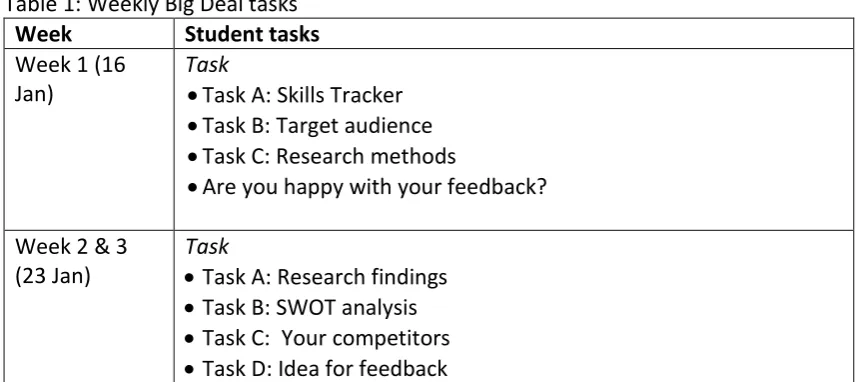
[image:9.595.70.503.577.768.2]The Brightside Trust’s ‘Brightside Blogs’ is an online platform which enables the UniTracks students to receive individually tailored support from the Big Deal business mentors. The platform is a moderated one, designed to ensure safeguarding. Using the Brightside Blogs, the Big Deal teams were given a series of weekly tasks designed to enable them to develop their business or social enterprise idea through to completion. The tasks were designed by the Warwick Business School and are listed in Table 1.
Table 1: Weekly Big Deal tasks
Week Student tasks
Week 1 (16 Jan)
Task
Task A: Skills Tracker Task B: Target audience Task C: Research methods
Are you happy with your feedback?
Week 2 & 3 (23 Jan)
Task
7 Deadline:
Friday 3 Feb
Task D: Final idea
Week 4 (6 Feb) Task
Task A: Operations & resourcing questions
Week 5 (13 Feb)
Task
Task A: Submit ideas for marketing and promotion materials
Actions
Consider applying for funding for prototype or materials Week 6 (20
Feb)
Task
Task A: Submit budget Week 7 (27
Feb)
Actions
Prepare 1st draft of business or social enterprise plan Possible visit from mentors
Task
1st draft of business or social enterprise plan Week 8 (6
Mar)
Task
Update plan using feedback from mentor (submission)
Actions
Think about presentation format Week 9 (14
Mar)
Task
Submit final plan using template (17 Mar - submission)
Week 10 (20 Mar)
Task
Submit final presentation to be used in semi-finals Grand Final
(27 Mar)
Present presentation to judges Find out winners and all celebrate! Afterwards Complete online feedback form
8 1.1.1.3 The Big Deal Final, 27 March, 2017
It had been planned that the teams would work towards participation in a heats event, to determine which teams were to go through to the finals. However, this plan was changed and all the participating teams (10 of the original 11) went through to a final day of
presentations at WBS on Monday, 27th March. The teams had 90 minutes pre-presentation time with their business mentors, then each team had 15 minutes to give their business presentation. The team from Ulverston Victoria High School were judged to be the winners with their ‘Project Pet’ business idea. Details of the competition, and the winning business idea were reported by WBS: https://www.wbs.ac.uk/news/project-pet-wins-the-big-deal-competition-2017/ (accessed, 30th June, 2017).
2 The evaluation
As part of its ongoing independent evaluation of the UniTracks programme, The Centre for Educational Development, Appraisal and Research (CEDAR) carried out an evaluation of the Big Deal competition, 2017. The report of the evaluation is the sixth report in the ongoing evaluation of UniTracks, 2016-2018. Evaluation reports on each aspect of UniTracks during the period will build into a three year picture of the UniTracks’ offer. The evaluation of the UniTracks programme has three key aims:
To track attitudinal change among UniTracks members in relation to higher education and post-higher education choices.
To assess the quality of UniTracks design at pupil, parent and teacher level.
9 The evaluation of the Big Deal competition 2017 focused on the second of the key
evaluation aims, drawing upon the views of the Big Deal business mentors, and the student competitors.
2.1 This evaluation report
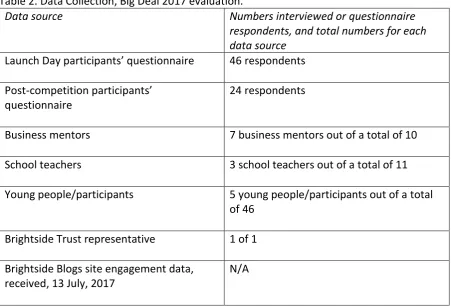
[image:12.595.73.525.413.719.2]This report provides an account of the Big Deal competition over its ten week cycle. Data was collected using a pre-competition, Launch Day, questionnaire, which was completed by 46 participating young people; a post-event questionnaire, completed by 24 participating young people; researcher observations of day 1 of the launch event and the finals; semi-structured interviews with business mentors, teachers, young people, and a representative of the Brightside Trust. The details of the data collection are presented in Table 2.
Table 2. Data Collection, Big Deal 2017 evaluation.
Data source Numbers interviewed or questionnaire respondents, and total numbers for each data source
Launch Day participants’ questionnaire 46 respondents Post-competition participants’
questionnaire
24 respondents
Business mentors 7 business mentors out of a total of 10 School teachers 3 school teachers out of a total of 11 Young people/participants 5 young people/participants out of a total
of 46 Brightside Trust representative 1 of 1 Brightside Blogs site engagement data,
received, 13 July, 2017
10 This report examines the Big Deal Competition 2017 from the perspective of mentors, teachers and school students, using qualitative and quantative data sources. It provides an account of the 2017 offering of the Big Deal competition, and is the sixth report in the ongoing evaluation of UniTracks, 2016-2018.
3.
The operation and impact of the Big Deal competition 2017
3.1 Introduction
Part 3 of this report examines the data gathered from the business mentors, teachers, the Brightside Trust, and the Big Deal participants. The focus is on, firstly, the operation of the Big Deal competition, including features that were seen to have worked well, and those that were seen to have worked less well. Secondly, the views of those involved regarding the impact on the school students of participation in the competition are presented.
3.2 Business mentors’ views
3.2.1 Data collection
The 10 business mentors were all invited to take part in the evaluation. Nine of the business mentors agreed to be interviewed, with seven eventually being interviewed – six by
telephone and one face to face. The interviews were conducted between the 1st – 23rd March, using semi-structured interview schedules (see Appendix 1), and they were all recorded, with informed consent, fully transcribed and analysed. Interviews lasted between 25 and 45 minutes. As with all the interviews conducted for the evaluation, the business mentor interviews were analysed for themes derived from the interview questions (which were based on the evaluation brief), with additional themes which emerged from
interviewee-generated topics. The interviewees were asked about their background and experience, how they came to take on the role of Big Deal mentor, induction and support for that role, their experience of contacts with their school team and teacher, the
11 being part of the Big Deal competition, and suggestions for future developments of the role of Big Deal business mentor.
3.2.2 Business mentors – backgrounds and motivations
The business mentors had a wide range of business, management, and entrepreneurial experience, and had worked with small and medium size businesses, large corporations, at local, national, and international levels. The majority of the mentors also had a link with WBS, as graduates, or having been on the teaching staff, or through a third party.
The business mentors were all strongly supportive of UniTracks, and the Big Deal. An example of what motivated the mentors to volunteer for the role was given by one mentor who explained that there were two main reasons why they joined the project:
12 3.2.3 Induction and preparation
All of the mentors were positive about the induction, training and preparation they received to enable them to fulfill their role. The Brightside blogs presentation was well received, the safe-guarding aspects being seen as important, and the general introduction to the aims and purposes of both UniTracks and the Big Deal was seen as clear and useful. One of the
mentors, who was new to the role, explained that the objectives of the programme were made clear:
‘It was clearly explained in terms of the role of the mentor at that session [first meeting together of the business mentors] as well, to give some signposting and encouragement to open their [the young people] eyes to education and to
encourage them to get as much out of the programme, and give them information for their future essential education and careers.’ (M1).
Two of the mentors who had also carried out the role for earlier presentations of the Big Deal commented on what they saw as improvements and developments in the project. Business mentor M4 said that ‘this year was probably much better than last year. Having come into it last year I didn’t have any guidelines to go on. In this case I can obviously look back at last year and say, well, how did that compare? It was much better’, (M4). The other mentor who talked about change and improvement between presentations of the Big Deal said:
13 that brought a bit more consistency in terms of approach between the mentors. […]. I think this year there has been a bit more focus on the some of the outcomes they expect from the tasks etc. which I think has been useful.’ (M3)
Some suggestions were made regarding possible future changes; these are presented below at 3.2.7.
3.2.4 The business mentors’ perceptions of the Big Deal Launch Days
The Big Deal competition was launched over two days, Friday, 13th- Saturday, 14th January, 2016, and was the first interaction between the business mentors, the student mentors and the Big Deal teams. The evaluation asked the business mentor interviewees about their role during the event, their experience of working with the young people, and school staff. Following a review of the mentors’ overall assessment of the Big Deal launch, each of these aspects is deal with in this section.
3.2.4.1 The mentors’ overall assessment of the Launch Days
The overall assessment of the Launch Days by the mentors was that they were a success, with all the mentors being positive about the two days. The mentors were particularly positive about the time given to meeting the young people on the Friday evening, which they said had helped build a working relationship for the next day’s sessions. Two of the mentors highlighted aspects of the Launch Days which they thought might be changed.
14 ‘It was excellent. I felt, given the fact that it was 2 days, that actually made it really, really good. […] In terms of the information we went through, both on the Friday and the Saturday morning, prior to meeting them, I think it was excellently put together. There was an awful lot for the children to take on board from what I understand from talking to them, and indeed from talking to people [with WBS]. There’s an awful lot of information there. The input that I saw in terms of what was provided by the team here [at WBS] was excellent.’ (M5)
The mentors were particularly pleased about the Friday evening, when they were able to meet the young people, and begin to make a working relationship. One mentor, for
example, said: ‘The evening I thought went very well. There was a bit more of a social get to know you, which is obviously a good thing, bite to eat and some quizzes, which is always a really good thing for that age range. It was good in terms of a get to know you session,’ (M1).
As with the previous year, there was some querying of the business finance lecture session, with one mentor providing some suggestions as to how this might be changed in future. One mentor, M2, made a number of specific points about the presentations. The mentor focused on the finance presentation, and said that ‘it could have done with being refreshed with more modern start-up concepts, like minimum variable product and lean start-up methodology,’ (M2). The mentor also argued that it could be ‘more lively’ in presentational terms. The mentor suggested that the approach to finance could be made more accessible and interactive, and made some specific suggestions which are detailed below (in 3.2.7)
3.2.4.2 Working with school staff on the Launch Days
15 business mentors reported improved teacher engagement at the Launch Days. The related issue of the engagement of schools and school staff across the whole competition is addressed below.
Six of the seven mentors reported that the teacher for the school team was present at the Launch, with one of those teachers being present only on the Friday. The presence of the teachers was valued, particularly those teachers who were able to ‘get that balance of letting me [the business mentor] lead, and encourage and support the young people,’ (M1).
3.2.4.3 Working with the UniTracks’ members on the Launch Days
The business mentors reported a range of preparedness for the Launch Days on the part of the teams. Some of the teams had done a good deal of thinking about possible business projects, others less so, and one team had done no preparation at all. Perhaps
unsurprisingly, the mentors’ accounts of working with the team around developing a business idea was facilitated by the amount of preparation that had been undertaken prior to the Launch Days.
One of the mentors, M7, gave an account of a team’s level of preparation: ‘they were completely prepare. They’d obviously spent time thinking about it the day before, they had an idea in kind, and that’s the idea they are now working on a business case for’ (M7). Being prepared with ideas enabled a teaching and learning process to take place that made best use of the time available. This process was described by another mentor:
16 not criticising the ideas and then trying to work through and evaluate them and I’m afraid I brought some reality to some of the more esoteric, idealistic kind of ideas in terms of that’s not going to work commercially because people don’t behave that way. At the end of which we had a couple of bits of ideas still left, the rest were kind of in tatters, and then they were pretty good at regrouping and saying well in that case why don’t we do this?‘ (M6)
This experience contrasted with that of the one mentor whose team had done no preparation:
‘My lot didn’t have any ideas at all before, and that’s quite a feature of the characteristics of the group. They need a lot of support and encouragement, so I spent most of the time on that Saturday just trying to flush out some thoughts and some creative thinking around what they could do, and I found that really quite hard work.’ (M1)
In this case, the lack of preparation reduced the effectiveness of the mentor session. The school teams should be encouraged to prepare prior to attending the Launch Days.
3.2.5 Using the Brightside Blogs and working with the young people
17 One of the mentors who was new to the Big Deal was, at first, apprehensive about the Brightside Blog platform – ‘when it was explained to me how we were going to do this and use the mentoring tool […] I thought, “how is that going to work? That sounds like a nightmare”, but, it’s been fine,’ (M1). In fact, only one of the mentors indicated that they had experienced any difficulty in using the Brightside Blogs platform, while one other said that they thought it was a little dated, and was a ‘clunky interface’ (M6). More specifically, M3 said that ‘I can’t seem to be able to message the whole team in one go,’ (M3).
Beyond the mechanics of messaging, the mentors gave a range of accounts of their
experiences of interacting with teams around the weekly tasks. Three of the mentors were pleased at the degree of interaction and learning that took place via the Brightside Blogs platform. Two mentors found that their teams had some difficulties, and two experienced interactions with their teams that were less satisfactory, with one team quickly becoming inactive, while another was uncommunicative, but generated their final presentation. In all cases, the mentors noted that the support of teachers and schools could be important to ensuring the weekly engagement of teams.
18 Box 1: Mentoring, the Brightside Blogs, and team engagement.
They [the team] have been very efficient actually, in the sense that one of the things I actually got them to do at the start, we had the time sitting there in the Business School and I said “Look get it sorted out who’s going to deal with either one person has got to be the co-ordinator or you’ve got to take it in turns and do different bits”. And they actually sat down and looked at all their skills and we discussed their skills and discussed their individual strengths and weaknesses and they allocated tasks along with themselves. Nobody complained I don’t want to do this or equally there was nobody saying “me me – ask me to do this”. I was quite impressed with the certainly nice way they did it. I said “That’s fine. If you want to change that as you go along fair enough”. We also agreed when they would send stuff to me and I then agreed with them when I would send stuff back to them so we agreed dates and things like that. Like this week they’re on school half term. I think they’ve got some sort of work experience in a couple of weeks’ time or something like that. We actually planned it all quite well so they’ve stuck to it. The people that said they were going to do Task A or whatever have done it and they’ve been on time. I’ve tended to respond to them within 24 hours of them getting the task and so any follow up queries they’ve had, which I think has only happened once, so I’ve
responded to that. I’ve also tended to send messages through the system just telling them about things coming up and look at this, look at that. I’ve sent some looking at models and planning models and stuff, just to try and keep them focused but yeah it’s working very well actually.
(M4)
It was of interest that Mentor 4 also said that he had developed a good working relationship with this team’s teacher. He had spoken to her at the Launch Days, and found that, unlike his experience in 2016, the teacher had been appointed to stay with the Big Deal
19 expectations’ (M5). M5 explained how the team was proactive in using the knowledge that the mentor had:
‘They had quite a few questions up front in terms of there was a couple of things they didn’t understand or they weren’t quite sure what it meant. So basically could I explain it to them and, more importantly, how was it used? So okay if you explain this to me what is it used for? I thought that was a very, very good approach, and of course that reflects in terms of how they’ve used it because what they’ve done is they’ve targeted their response to how it’s actually going to be used.’ (M5)
This team was also supported by an engaged, effective teacher, who had ‘a realistic view of what was appropriate in terms of she needed to do enough to make sure that they were doing what they should be doing, and encourage and motivate […] without stepping into the space and saying, “If I were you, I’d do this…”’ (M5). Furthermore, the mentor also had a clear sense that the school ‘itself is very, very keen on this particular activity […] they see it as a real enhancement of the curriculum,’ (M5).
20 went to module 3, to module 4, etc.,’ (M2). The mentor did give feedback, and the work was reasonable, but the teaching and learning aspects of the mentoring had been degraded.
The visit that each mentor is expected to make to their team at school is an important element of the process, and one mentor, M3, found that the visit acted as a fillip to the enthusiasm of their team: ‘Initially, I didn’t get much from them so I kept prompting them, and especially after I went down to see them at the school just before half term I then started to get quite a lot more messages coming through where they’d ask questions, and so forth,’ (M3). In this case, the mentor thought that it took a bit more than just contact at the Launch Days to build a good working relationship with the Young People. However, as M1 discovered, even meeting at a team’s school might not provide a team with enough encouragement to fully engage with the competition:
‘I enjoyed going up there, and we had a really good rapport on the day. But once I’m not there, it’s like you have to really chase them, and then they will come back to you and they’ll say, “yeah, we’ve done this”, but you’ve asked them 15 times, and you say, “can you send it to me a couple of days before [the deadline] so I can review it and comment, and give you some constructive feedback, and they just won’t. They’ll just send it on the day, and say, “well, that’s it now”. Then they’ll say, “We’ve got a problem with this, a problem with that”. Well, why didn’t you tell me?’ (M1)
21 3.2.6 Benefits and impact arising for the Big Deal competitors.
The Big Deal competition aims to ensure that young people taking part in the competition benefit in a number of ways. These include benefits relating, firstly, to the business and entrepreneurial focus of the competition; for example, creating a business or social enterprise, and learning about business and enterprise. In addition, it is intended that the young people will also benefit in relation to building their team skills, their confidence and thinking about their futures. The business mentor interviewees were asked what they thought had been the benefits, if any, that the young people had already, before the completion of the competition (when the mentors were interviewed), enjoyed. The immediate benefits of taking part in the competition are presented here, followed by possible longer-term impact with regard to future university and career choices. The mentors were able to identify immediate benefits much more easily than the longer-term impact on the young people of taking part in the Big Deal.
3.2.6.1 The benefits of taking part in the Big Deal
All the mentors were able to give examples of the ways in which young people had benefited from the competition. The mentors were able to point to learning in relation to team working, market research, public speaking, self-confidence, budgeting, planning, and costing. For example, one mentor outlined the learning the young people had benefited from, including learning arising from dealing with new challenges, and gave the example of team working (Box 2).
Box 2: Learning business, learning as a team
22 think that they have had some difficulty in terms of team working, and that’s been a good thing because it’s actually made them think about how they got together, and they have learnt from one another. One particular example, and I’m sure this has happened in a number of ways, was a much quieter member of the team, who I think has clearly got a lot of good ideas, and a lot to offer, you could sense after 15 minutes that they were drowned out by the other three. So I was really trying to get them to listen to each other, because, actually, one person can find the answer. It’s out there. And I really think that they have taken those things on boars, I really do.
(M1)
In a similar fashion, other mentors highlighted learning in relation to specific learning about business, including costs and costings, marketing, sales, cash flow, customer surveys. There was also learning in terms of public speaking, presentation skills, planning, deadlines, and resultant benefits in terms of self-confidence. For example, one mentor commented, ‘I think the whole thing [Big Deal] they cover the whole broad spectrum of skills, which I think is realy, really good’ (M3).
3.2.6.2 Longer term impact of taking part in the Big Deal
The mentors were uncertain about the longer-term impact on the young people in terms of them thinking about future careers and university choices. In part, this was because the focus of the young people (and the mentors) was on the task in hand, and, in part, there was limited scope for mentors to raise the issue. For example, one mentor said, when asked if they thought there was any sense that taking part in the Big Deal had any impact on the young people’s future directions, said:
23 this [the competition], and that’s been good and useful. They haven’t really asked for a lot of help in terms of developing their thinking on careers and education, and what they want to do, but I’m just thinking one of the things I found slightly frustrating, I’d have liked to have done more on a one-on-one basis to help and to understand their individual needs, and what they want to achieve.’ (M1).
A similar account was given by another mentor, when asked if the question of future university options and choices had been addressed:
‘It’s not something that’s really … well, it certainly hasn’t been addressed directly as far as my involvement goes, but I know that they had a pretty heavy dose of that on the Friday [of the Launch event] , and, of course, being a campus university, and being on site for a day was meant to be part of that. […] Inherent in that there’s a thinking about the future elements to all of that, but they certainly haven’t sat me down and said, “What’s it like in the world of employment? “, or, “What was it like going to university?”, or any of that stuff. But then I have a son who is about the same age as these kids, and I don’t have those conversation with him either’. (M6)
In fact, only one of the mentors gave an account of being asked about university:
24 3.2.7 Business mentors’ suggestions for future Big Deal competitions
Five of the mentors made suggestions regarding future offerings of the Big Deal
competition. These ranged from a query regarding the lack of Warwick student mentors (as per the 2016 competition), to detailed suggestions about the content and format of some of the Launch Day presentations. The suggestions were: improved engagement by schools and school staff (mentor 7 and mentor 2); increased opportunities for one-to-one support (mentor 1); the use of skype or a similar platform (mentor 1); a point made in relation to the amount of work needed in a the comparatively short space of time, with a suggestion that less might be required; a request for mentors to receive copies of all the presentation materials before the Launch Days so that they could tailor their own contributions (mentor 6).
One of the mentors gave a detailed response, making some very specific suggestions with regard to the finance and budgeting presentation at the Launch Days:
‘OK, these kids are bright and gifted but they’re still only 14, 15. So I thought it was too kind of … [pause] in there, and what I thought would have worked better, this was my suggestion and the kind of pitch I did to re-write the material, was we’d have more templated things where they could just change a few things. You’d kind of set a spread sheet up for them and they’d just change the variables and see what the effect is; rather than expect them to create it from scratch I thought you could take them halfway down the way. I’ve used that model with teaching students at
25 what their daily rate was, how many days a month they thought they would be working, how much they’d spend on marketing. There was like four or five variables and of course as soon as you changed those it just rippled through. So you were teaching them finance but in a way that meant something to them so it was that kind of model I was thinking of for the finances was to try and make it simple where you were teaching them about finance and maybe you would have three or four versions. You could have one for a shop … Just think ahead what are the most likely things the kids are going to pick on?’ (M2)
3.3School staff views
3.3.1 Data collection
The responsible school staff from the ten Big Deal schools were all invited to be interviewed, by telephone, as part of the evaluation. One of the school staff declined to be interviewed on the grounds that they had taken part in the evaluation of the Big Deal in 2016. Of the remaining nine, only three agreed to be interviewed. This contrasts with the business
mentors, six of whom were willing to be interviewed. This also reflects the situation in 2016, when only three of 14 school staff were interviewed, as opposed to nine of the 14 business mentors in 2016. The school staff were offered times for interviews outside school hours, and during school holidays, as well as during the school day, but there was still a low take-up. As in the 2016 evaluation, the low take-up of school staff in 2017 might be seen as a lack of commitment to the Big Deal offer on the part of responsible staff.
26 school team, the Brightside blog, weekly tasks, working with the mentors; and outcomes and impact. Although the data presented only relates to three interviews, some of the school staff commentary is of interest.
3.3.2 School staff background
All three of the interviews were classroom teachers, with one having a management role as the assistant head of sixth form. One of the schools had introduced UniTracks, and the Big Deal, as part of a school improvement plan when the school received a new senior
27 3.3.3 Running the Big Deal in school
The evaluation of the Big Deal 2016 showed that there were issues concerning the degree of school buy-in and commitment to running the Big Deal4. These concerns were less strongly expressed by business mentors in 2017, but there is still a sense that school commitment and the school role could be strengthened. The three school staff interviewees gave slightly different accounts of their role in relation to their schools’ Big Deal teams. The assistant head of sixth form only had an overall role which largely focused on paperwork and
reporting to the school management team. This interviewee said, ‘I have the job of doing all the paperwork and the risk assessments and everything’, (SS1). The weekly Big Deal tasks were carried out by another teacher in the school who ensured that there was space for the team to meet each week. A more detailed description of the running of a Big Deal team was given by one of the other interviewees:
‘I don’t really do a great deal, it’s providing a space for them and just circulating and making sure they [the young people] on track. So, it’s an hour every week after school I spend with them, and then in terms of when we go up to the university it takes me about half an hour to write the risk assessment and liaise with the various staff I need to. And then, obviously, it’s two Saturdays and two days, I think out of school time to actually go up there and complete the tasks. I don’t get involved in terms of what they’re doing. It’s all their idea, and they work on it independently. It’s just if they’re not sure or something or one of them in the group is not turning up, for example, just basically they use my room as a space for them to complete the weekly tasks and I answer questions if needed. It’s not as if I’m running a club to do it, I’m just facilitating it.’ (SS2)
4 Stephen M. Cullen, Evaluation of the University of Warwick’s outreach programme, UniTracks: The Warwick
28 This account matched well with that of the third interviewee, who said, ‘I’m facilitating a room where they can go to, and any resources they need, like prompting them, or, like, “this is your deadline, you’ve got a few days to meet it, do this”, or just be there for any questions really’, (SS3). The two accounts by SS2 and SS3 represent good descriptions of the type of facilitation, support, encouragement, and commitment needed by responsible teachers in the Big Deal competition.
3.3.4 School staff views of the Big Deal Launch Days
The school staff were very enthusiastic about the Launch Days. They said that the young people were excited and impressed by the University of Warwick, by the chance to be away from their home environment, and the events that were laid on for the teams. The Big Deal presentations, the chance to work with the business mentors and begin to develop a business idea were all welcomed by the young people. Two of the school staff statements about the young people’s views of the Launch Day are presented in Box 3.
Box 3, School staff views of the Big Deal Launch Days
‘They [the young people] really enjoyed it; it was a good opening ceremony to the event. The whole residential side of it was fantastic because a lot of them have never been away so that element was like the most exciting for them. And it was really good. There was a budgeting or finance workshop that they weren’t extremely keen on; I think it was a bit much for them but apart from that they loved it. They loved the activities in the evening, the teamwork. Yeah it was really good.’ (SS3)
29 ‘Some of them had never even left home before, so it was a massive deal for them, and I think they really got something out of it, personally, from that, from meeting new people, staying away from home, I think it’s great for them to have the residential’. (SS1).
One of the teachers also noted that the young people’s reports of their Launch Days’ experience was important for their parents too, helping build confidence among parents regarding the Big Deal, the school’s work, and in future options for their children:
‘We live in an area where they don’t actually leave this area. They don’t travel, they don’t like to go out of the area. I just think it shows them that they can do it, they can leave home and go somewhere else to study. And I think the involvement of the parents is important because it just gives them more confidence, that the launch day and everything I think really shows them how well it’s organised and that the kids are safe and inspires them. I’ve had quite a few parents come up to me afterwards and say “oh my God, it made me want to go”. So it is inspiring definitely for the parents as well.’ (SS1).
3.3.5 School staff views on young people’s work, and role of mentors
30 ‘They [the young people] loved [the mentor]. Last year we had a mentor called [name], who had worked with our school previously, but this year they [Big Deal] decided to give us someone new, which was fine. But the team absolutely got on really, really well [with the mentor]. They weren’t shy to ask questions. The mentor was so professional and really warming to the kids, especially because their business idea was a bit unconventional, but the mentor dealt with it really professionally.’ (SS3).
3.3.6 Outcomes and impact of the Big Deal
The three interviewees gave some interesting examples of the outcomes and impact of the Big Deal competition. In addition to benefits accruing to the young people in areas such as their confidence, social skills, team working, and business knowledge, the teachers gave some good examples of ways in which they were able to use the Big Deal to improve outcomes for individuals and for whole class groups, including pupils who had not taken part in the Big Deal. In terms of impact, the interviewees were less sure about the longer term impact on the young people who took part in the Big Deal. There was a strong sense that attending the residential launch of the Big Deal was valuable in this respect (see 3.3.4 above), but the argument was also made that the young people had been chosen, in part, as members of UniTracks because they were motivated to achieve good post-school outcomes. An example of this view of outcomes and impact was:
31 Two good examples of the use of the Big Deal to improve outcomes were given. In the first example, a boy was chosen to be part of a Big Deal team because it was thought that it might be a valuable opportunity to boost hid self-confidence and skills:
‘We chose one boy this year, just as an example, who doesn’t speak. And I was reluctant to choose him, but the head of Year 10 said that she interviewed him, because we do an interview for them, that he really wanted to try and improve how he was in front of people, to improve his skills. So we gave him a chance, and said, OK, you know you’ve got to stand up in front of a whole room of people and give a presentation. So we’ve used that to try and improve their confidence. So, I think that’s one of the main skills, outcomes, really. […] We specifically chose him because he made a point of saying to us, “I really want to try and improve how I am as a person” – we thought that was lovely, so we chose him.’ (SS1).
In this case, the Big Deal provided an important additional educative tool to the school with which it could meet the specific needs of one pupil.
32 Overall, the teachers were strongly positive about the outcomes and the impact of the Big Deal on their young people; Box 4 presents one teacher’s summary of the competition.
Box 4: Summarising the Big Deal experience
‘I’d say it is challenging, but in a good way, for the young people, and I guess, for me as well, just to try and help them. They’re so keen and excited to do well, it’s to keep them on track, and it is challenging, but in a positive way. And it is inspiring, and it’s realistic, and they develop their skills fantastically.’
(SS3).
3.4 The Brightside Trust
A Brightside Trust staff member with responsibility for the Big Deal blogs was interviewed, face to face, in January, 2017. The interview was recorded, with informed consent, and fully transcribed for analysis. In addition, the Brightside Trust provided details of the blog site engagement figures, both overall, and by team, along with skills tracker data. Findings from both this data and the interview are presented here. The interview focused on the recent background regarding the Brightside Trust’s role in the Big Deal competition, particularly in relation to the continuing development of the blog site; the aims and purposes, from the Brightside Trust’s viewpoint, of involvement with the Big Deal; and the organisation and daily operation of the Big Deal blogs.
3.4.1 Brightside Trust interview data
The 2016 evaluation of the Big Deal reported that the Brightside Trust planned
developments for the 2017 competition5. The plan was to expand the function of the blogs
5 Cullen, Stephen M. (July 2016), Evaluation of the University of Warwick’s outreach programme, UniTracks:
33 platform from being primarily one from which the teams downloaded their weekly tasks, to a platform to maximize the potential of online mentoring. The overall aim was to continually seek ways of adding value to the Big Deal competition by integrating the blogs as completely as possible with the daily operation of the competition, and maximizing team and team member-business mentor contact. However, Brightside reported in the interview
undertaken in January, 2017, that the new electronic platform was still under development and had not been ready in time for the Big Deal 2017. The issues that delayed the roll out of the new platform were technical, and it was hoped that they would be overcome in time for the Big Deal, 2018. The interviewee explained that Brightside were aware of difficulties with the operation of the current platform, and how the future platform would work:
‘Using the group messaging on the new site is going to be much easier, but for this one [the current platform] you have to click Reply All, like e-mails, whereas the new one is like a WhatsApp group. And, also, just because a lot of the mentors that we work with are older and find the tech a little more difficult, I think we sometimes have issues with communication as well […] and because it’s an old site that we’ve updated it can be quite clunky from the coordinator’s end too. […] There are
definitely issues with the site that we are always trying to rectify and update through either technological solutions or communications solutions.’ (B1)
Building the new site has been an 18 month long project, and was informed by informal feedback from mentors in addition to interviews with 20 young people. The expectation was that the new platform would be safe, easy to use, and a more effective tool.
34 ‘From a purely mentoring point of view, and from our charity’s point of view, it’s the soft skills development that we think is really important. It’s something that schools find more difficult to develop in young people, and it’s also something that we think then leads to confident, informed decisions, if they are more self-reflective, if they are more confident, if they’re raising their aspirations, if they’re thinking about their potential […] it’s about confidence, coping and resilience, awareness and self-reflection.’ (B1)
Brightside also places high value on mentoring, and sees the Big Deal as a good example of a mentoring process. The interviewee explained that Brightside see the value of the
mentoring process in terms of the immediate gains relating to the competition, but also the experience of interacting with a mentor, and understanding the importance, and value, of social capital – ‘they are learning how to use their networks for their own gain’ (B1). Overall, the Brightside Trust values its involvement and facilitation of the Big Deal competition, as an initiative that meets its own goals in an effective fashion.
3.4.2 Big Deal bogs site engagement and skills tracker
Data regarding site engagement by the teams was collected with respect to team
35 The Big Deal team were set nine weekly tasks. Of the ten teams, three team completed all the weekly tasks, four completed eight weekly tasks, two completed seven tasks, an one completed only six tasks, giving an average number of 8.8 tasks completed. In addition, the individual log-ins per team member were also recorded (presented in Table 3). The blog engagement figures per individual team member need to be treated with caution, as evidence from business mentors suggests that, in at least one case, team members were logging in using only one team member ID.
Table 3: Big Deal Blogs 2017 individual site engagement
Average number of log ins per team member 22
Average number of log ins per team 105
Average number of messages per team member 8
Average number of messages per team 36
Average number of log ins per business mentor 36
Average number of messages per business mentor 59
These engagement figures are lower than those for the Big Deal 20166, however, in 2016 the 14 teams had 11 weekly activities to complete. Allowing for the difference in the
number of teams and the number of tasks, engagement in 2017 was higher than in 2016 for log ins per team, but lower for messages per team member (which may be explained by the evidence regarding teams using the same log in by all members of the team), and lower for messages per team.
6 Cullen, Stephen M. (July 2016), Evaluation of the University of Warwick’s outreach programme, UniTracks:
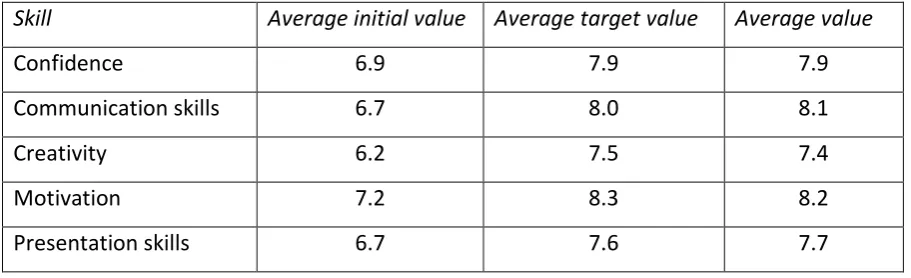
36 The young people who took part in the Big Deal were also able to use the blog site to self-assess their own perceptions of how participating in the competition helped build key skills: confidence, communication skills, creativity, motivation and presentation skills. Data from the self-assessment tool are presented in Table 4 and 5.
Table 4: Skills Tracker data index. Self-assessed skills tracking by participating young people
Skill Average initial value Average target value Average value
Confidence 6.9 7.9 7.9
Communication skills 6.7 8.0 8.1
Creativity 6.2 7.5 7.4
Motivation 7.2 8.3 8.2
Presentation skills 6.7 7.6 7.7
Table 4 shows that for all self-assessed skills development, with the exception of ‘creativity’ and ‘motivation’, the average value was higher than the average target value. In the case of ‘creativity’ and ‘motivation’, the difference was, furthermore, of the order of only 0.1. The average values were, in all case, higher than the initial values, with ‘communication skills’ showing the biggest increase.
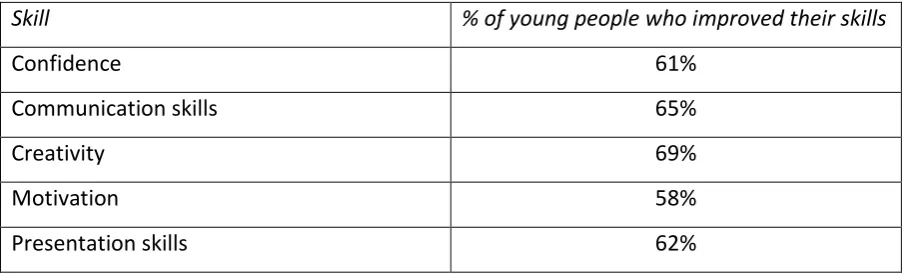
37 Table 5: Skills Tracker data relating to percentage of team members who improved key skills.
Skill % of young people who improved their skills
Confidence 61%
Communication skills 65%
Creativity 69%
Motivation 58%
Presentation skills 62%
As with the data provided by the skills tracker in 20167, it is difficult to interpret the data, but it is reasonable to assume that the explanation for ‘motivation’ having the lowest improvement percentage is a reflection of the already high levels of motivation of the UniTracks’ members.
3.5 The UniTracks’ school students’ views
Data collected from the participating young people came from three sources:
46 Big Deal Launch evaluation questionnaires completed by the young people who attended the Launch, 13-14th January. These were administered by an evaluation team researcher.
24 post-competition evaluation questionnaires. These were administered as online questionnaires by UniTracks, using a questionnaire provided by the evaluation. Five telephone interviews, recorded, with informed consent, and fully transcribed for
analysis. The five young people who were interviewed all attended the same school.
7 Cullen, Stephen M. (July 2016), Evaluation of the University of Warwick’s outreach programme, UniTracks:
38 Eight of the participating schools were asked to take part in the evaluation
interviews, but only one took up the opportunity for their young people to give feedback.
The findings are presented here by data source.
3.5.1 Big Deal Launch questionnaire
3.5.1.1 Gender and ethnicity
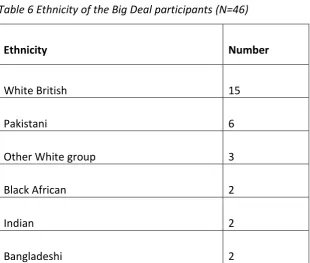
[image:41.595.74.385.466.729.2]At the Big Deal launch students were asked to complete an evaluation questionnaire, and 46 students completed, or partially completed the questionnaire. There were 16 boys and 30 girls, with 26 being aged 14 and 20 being aged 15. A range of ethnicities were represented, as shown in Table 6; respondents were asked to self-describe their ethnicity.
Table 6 Ethnicity of the Big Deal participants (N=46)
Ethnicity Number
White British 15
Pakistani 6
Other White group 3
Black African 2
Indian 2
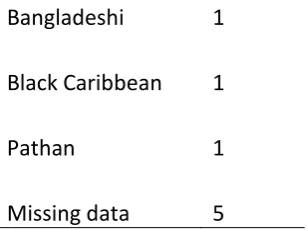
39 African, Asian (other), Black Caribbean,
Chinese, English-Portuguese, European, Ghanaian, Mauritian, Pathan & British, Polish, Romanian
1 each
Missing data 5
The balance of gender and ethnicity for the Big Deal, 2017, is of some interest. Of the 46 respondents, 65% (percentage rounded to nearest whole number) were female, compared to 35% who were male. One of the over-arching goals of the UniTracks programme is to enhance the higher education (HE) futures of under-represented groups in terms of gender, socio economic status (SES), and ethnicity. In this respect, the gender make-up of the 2017 Big Deal competitors suggests that females were over-represented. Figures for
undergraduate students at all English HE institutions in the academic years, 2011-12, 2012-13, and 2013-14, show that male undergraduates only represented 42%, 43% and 43% of the total over those years8. The gender divide is notably different between subject disciplines, but, overall, males are under-represented, though less so than in the Big Deal 2017 competition.
The picture for ethnicity with regard to the 46 Big Deal respondents is less clear. Five of the respondents gave no response to the open question asking them, ‘how would you describe your ethnicity?’. All five were male. Of those who did respond to the ethnicity question, five were males who described themselves as ‘white British’ (four) or ‘white English’ (one). Only one male described himself as ‘black African, Caribbean’. These two groups therefore represented 11% and 2% of the Big Deal 2017 competitors. Given that membership of UniTracks is, in part, dependent on low SES of the young people recruited, the likelihood is that the white British/English and the sole black African, Caribbean males were
8 Higher Education Funding Council for England, HEFCE (May, 2015), Equality and Diversity data tables: Staff
40 representatives of the most disadvantaged groups in relation to education achievement in English schools, and HE institutions. At age 16 (i.e., the next year group for the Big Deal competitors):
‘among low SES students, all ethnic minority groups achieve significantly better than White British students (except Black Caribbean boys who do not differ from White British boys) […] A similar pattern of results [is] apparent in terms of progress age 11-16, with White British low SES students and Black Caribbean boys (particularly the more ale) making the least progress.’9
It may be that in terms of gender and ethnicity, specifically relating to White British and Black African/Caribbean boys, the Big Deal cohort needs, for future offerings, to be adjusted.
3.5.1.2 Expectations of taking part in the Big Deal
The Big Deal launch questionnaire asked respondents to indicate their expectations of working as part of their Big Deal team, using a five point Likert Scale response. The
respondents were asked about four themes: working in a Big Deal team; working with the business mentor and the Big Deal blogs; expectations about support from their school; and their expectations of the overall experience of the competition. The responses are reported here by theme.
9 Strand, Steve (2014), ‘Ethnicity, gender, social class and achievement gaps at age 16: intersectionality and
41 Table 7 Working in a Big Deal Team
Do you think… Totally
Disagree
Disagree Neither agree nor disagree
Agree Totally Agree
q2a. You will have an enjoyable time?
4 4 27 11
q2b. You will put plenty of effort into the competition?
3 21 22
q2c. You will learn new team working skills? *
2 1 4 30 8
q2d. You will learn new planning skills? *
1 1 4 26 13
q2e. You will learn new communications skills? *
1 1 4 26 13
q2f. You will learn new budgeting skills? *
1 4 23 17
q2g. You will learn new presentation skills? *
1 7 23 14
* 1 missing data
42 competition very positive expectations and intentions, with regard to learning and engaging with the Big Deal.
Table 8 Working with the business mentor and the Big Deal blog
Do you think… Totally
Disagree
Disagree Neither
agree nor
disagree
Agree Totally
Agree
q3a. Having an online business mentor is a good idea? *
1 5 24 15
q3b. Your business mentor will be easy to 'talk' to online? *
3 13 24 5
q3c. It will be easy for your team to keep in contact with the business mentor?
1 13 26 6
q3d. Your business mentor will give your team a lot of good advice about the Big Deal?
8 33 5
q3e. Your team will have enough time to complete the weekly tasks?
1 8 20 13 4
* 1 missing data
There were no negative responses to item 3d, regarding the hope that their business
43 item 3a regarding an online business mentor being a good idea, with 39 positive responses and only 1 negative one.
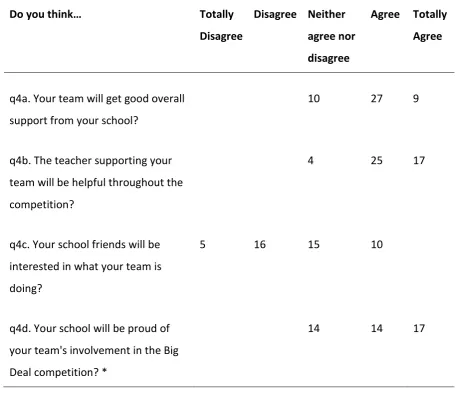
[image:46.595.68.526.248.653.2]The missing data for questions 2 and 3 was the same person.
Table 9 Support from your school for our Big Deal team
Do you think… Totally
Disagree
Disagree Neither
agree nor
disagree
Agree Totally
Agree
q4a. Your team will get good overall support from your school?
10 27 9
q4b. The teacher supporting your team will be helpful throughout the competition?
4 25 17
q4c. Your school friends will be interested in what your team is doing?
5 16 15 10
q4d. Your school will be proud of your team's involvement in the Big Deal competition? *
14 14 17
* 1 missing data
44 from the responsible teacher, and from their schools in general, though less so than their expectation of support from their teachers. Students were most positive for item 4b, regarding the expectation that their teacher would support them through the competition, with 42 positive responses. There were also no negative responses for items 4a (getting good overall support from school) and 4d (school being proud of their team’s involvement with the ‘Big Deal’). Strikingly, the most negative response was for item 4c, regarding their school friends being interested in what they were doing, with 21 negative responses and only 10 positive ones. This may suggest a number of things, from hostility to ‘gifted and talented’ type activity among peers, to schools not celebrating the achievements of a school team.
3.5.2 Big Deal post-competition questionnaire
The Big Deal competition merged the semi-finals and finals day, so the post-event
questionnaire was sent out as an online questionnaire rather than being completed on the day of the finals. It was completed by 24 students; 17 girls and 7 boys. The ethnicity of respondents was quite varied as shown in Table 10.
Table 10: Ethnicities of respondents
Ethnicity Number
White British 8
Pakistani 2
Other White group 2
Black African 2
45 Bangladeshi 1
Black Caribbean 1
Pathan 1
Missing data 5
[image:48.595.74.228.89.204.2]Data is presented as actual numbers rather than percentages due to the low number of respondents. There was only missing data for the ethnicity data, as shown in Table 10, every other question was answered by all respondents. Findings are generally reported as overall positive (‘Agree’ plus ‘Totally Agree’) or overall negative (‘Disagree’ plus ‘Totally disagree’).
Table 11: Working in a Big Deal team
Do you think… Totally
disagree
Disagree Neither agree nor disagree
Agree Totally Agree
2a. you had an enjoyable time? 4 15 5
2b. you put plenty of effort into the competition?
3 11 10
2c. you learnt new team working skills?
1 3 14 6
2d. you learnt new planning skills? 4 14 6
2e. you learnt new communications skills?
4 13 7
46 2g. you learnt new presentation
skills?
1 2 14 7
There was an overall positive response to four of the items: 2a (having an enjoyable time), 2b (putting in plenty of effort), 2d (learnt new planning skills), and 2e (learnt new
communication skills) with 20, 21, 20, and 20 positive responses respectively. The majority were also positive for the other items as there was only one negative response to each (for items 2f and 2g it was the same person). These questions were the post-competition version of the pre-competition questions. However, it was not possible to make direct comparisons as the post-competition respondents as only 24 participants completed it, as opposed to the 46 who completed the pre-competition questionnaire; and the difference in questionnaire administration meant that it was not possible to create matched pairs. Nonetheless, it can be noted that there were four responses in the post-competition questionnaire that showed that the respondents’ pre-competition expectations had not been met. These were: the question relating to learning new presentation skills – in this case whereas only 80% of the pre-completion responses indicated that it was expected that new presentation skills would be learnt, 87% of the post-competition responses showed that new presentation skills had been learnt; and effort put into the competition (93% agree/totally agree in the pre-competition questionnaire, 83% in the post-pre-competition questionnaire), and slight falls (between 1 and 4%) in the questions relating to planning, budgeting and communication skills.
Respondents were positive about their business mentors particularly regarding being easy to talk to online and ease of keeping in contact. Bearing in mind the caveats made about the difficulties in comparing the pre and post questionnaires, the responses to the ‘working with the business mentor and the Big Deal blog’ questions do suggest strongly positive
47 being a good idea were positive in the pre-competition questionnaire, 92% of responses rated the actual experience positively.
Table 12: Working with the business mentor and the Big Deal blogs
Do you think… Totally
disagree
Disagree Neither
agree
nor
disagree
Agree Totally
Agree
3a. having an online business mentor was a good idea?
1 1 16 6
3b. your business mentor was friendly and easy to talk to online?
6 1 17
3c. your team found it easy to keep in contact with the business
mentor; at least once a week?
5 12 7
3d. your business mentor gave your team a lot of good advice about the Big Deal?
2 3 10 9
3e. your team had enough time to complete the weekly tasks?
48 In terms of the young people’s experience of school support for their Big Deal team (Table 13), the item with the most positive response was 4b (the teacher was helpful throughout the competition) with 16 being positive, but this also had a substantial minority of negative responses (4). There were also four negative responses for item 4c, regarding their school friends being interested, with only 13 being positive, which was in line with the expectations indicated in the pre-competition questionnaire.
Table 13: Support from your school for your Big Deal team
Do you think… Totally
disagree
Disagree Neither agree nor disagree
Agree Totally Agree
4a. your team had good overall support from your school?
2 8 9 5
4b. the teacher who supported your team was helpful throughout the competition?
4 4 7 9
4c. your school friends were interested in what your team was doing?
4 6 10 3
4d. your school is proud of what your team has achieved in the Big Deal competition?
1 1 8 11 3