warwick.ac.uk/lib-publications
A Thesis Submitted for the Degree of PhD at the University of Warwick
Permanent WRAP URL:
http://wrap.warwick.ac.uk/95174
Copyright and reuse:
This thesis is made available online and is protected by original copyright. Please scroll down to view the document itself.
Please refer to the repository record for this item for information to help you to cite it. Our policy information is available from the repository home page.
The Institution-building and Changing Processes of Social
Enterprise in South Korea: The Struggles of Multiple
Actors and their Discourses
by
Jieun Ryu
A thesis submitted in partial fulfilment of the requirements for the
degree of
Doctor of Philosophy in Business and Management Studies
Warwick Business School
University of Warwick
Table of Contents
TABLE OF CONTENTS ... I TABLE OF FIGURES ... V TABLE OF TABLES ... V ACKNOWLEDGEMENTS ... VII DECLARATION ... IX ABSTRACT ... X ABBREVIATIONS ... XI
INTRODUCTION ... 1
PERSONAL MOTIVATION ... 1
RESEARCH BACKGROUND AND PROBLEM STATEMENT ... 4
DEFINITION OF SOCIAL ENTERPRISE ... 11
RESEARCH QUESTIONS AND APPROACH ... 12
CONTRIBUTIONS ... 14
RESEARCH STRUCTURE ... 17
1 BACKGROUND ... 20
1.1 INTRODUCTION ... 20
1.2 DEFINITION OF SOCIAL ENTERPRISE IN DIFFERENT CONTEXTS ... 23
1.2.1. DEFINITION OF SOCIAL ENTERPRISE BY COUNTRY ... 23
1.2.2. ORIGINS AND CHARACTERISTICS OF SOCIAL ENTERPRISE BY COUNTRY ... 27
1.3 CONCLUSION ... 32
2 AN APPROACH ON THE EMERGENCE OF NEW ORGANIZATIONAL FORMS ... 33
2.1 INTRODUCTION ... 33
2.2 THE EMERGENCE OF NEW ORGANIZATIONAL FORMS ... 33
2.1.1. INSTITUTIONAL ENTREPRENEURSHIP ... 35
2.1.2. THE INTEGRATION OF SOCIAL MOVEMENTS INTO NEO-INSTITUTIONALISM ... 39
2.1.3. ROLE OF SOCIAL MOVEMENTS IN INSTITUTIONAL FIELDS ... 41
2.3 CONCLUSION ... 44
3 HOW LANGUAGE WORKS IN INSTITUTIONAL PROCESSES - MEANING, DISCOURSE AND INSTITUTIONALIZATION ... 47
3.1 INTRODUCTION ... 47
3.2 DISCOURSE AND DISCOURSE ANALYSIS IN ORGANIZATIONAL STUDIES ... 48
3.3 DISCURSIVE STRATEGIES IN INSTITUTION-BUILDING PROCESSES ... 51
3.4 HOW IDEOLOGY IS REFLECTED IN DISCOURSE ... 53
3.4.1 DISCOURSE, IDEOLOGY AND POWER ... 54
3.5 CONCLUSION ... 60
4 THE HISTORY OF KOREAN SOCIAL ENTERPRISES ... 61
4.2 CERTIFICATION SYSTEM ... 61
4.3 MULTIPLE ACTORS INVOLVED IN THE INSTITUTION-BUILDING PROJECT OF SOCIAL ENTERPRISE IN SOUTH KOREA ... 63
4.3.1 TOP-DOWN ACTORS ... 64
4.3.2 BOTTOM-UP ACTORS ... 66
4.3.3 ACTORS WHO EMERGED AFTER THE SEPA ... 67
4.4 SOCIAL ENTERPRISE DISCOURSE IDENTIFICATION ... 70
4.5 FROM BOTTOM-UP TO TOP-DOWN ... 73
4.5.1 DOMINANT DISCOURSE OF SOCIAL ENTERPRISE: A TOP-DOWN APPROACH ... 74
4.5.2 MINOR DISCOURSES OF SOCIAL ENTERPRISES: A BOTTOM-UP APPROACH .... 78
4.6 THE CURRENT COMPETITION BETWEEN ACTORS OVER THE MEANING OF SOCIAL ENTERPRISE ... 85
4.7 CONCLUSION ... 92
5 METHODOLOGY AND RESEARCH DESIGN ... 93
5.1 INTRODUCTION ... 93
5.1.1 PHILOSOPHICAL APPROACH ... 93
5.2 RESEARCH SITE ... 94
5.2.1 WHY SOCIAL ENTERPRISES IN SOUTH KOREA? ... 94
5.2.2 CURRENT STATE OF SOCIAL ENTERPRISE IN SOUTH KOREA ... 96
5.3 DATA COLLECTION ... 113
5.3.1 GETTING ACCESS ... 113
5.3.2 2-STAGE APPROACH IN LINE WITH GROUNDED THEORY ... 118
5.4 DATA ANALYSIS ... 137
5.4.1 USE OF GROUNDED THEORY ... 137
5.4.2 USE OF DISCOURSE ANALYSIS ... 141
5.5 LIMITATIONS AND REFLECTIONS ... 144
5.5.1 CHALLENGES AS A RESEARCHER IN THE FIELD ... 144
5.5.2 LIMITATIONS OF DATA ANALYSIS ... 145
FOREWORD TO THE FINDING CHAPTERS ... 147
6 INITIAL STAGES OF THE INSTITUTION-BUILDING PROCESS OF SE: LEGISLATION OF THE SEPA ... 148
6.1 INTRODUCTION ... 148
6.2 THE EMERGENCE OF OFFICIAL AND DOMINANT DISCOURSES OF SOCIAL ENTERPRISE ... 149
6.3 CONFLICT IN THE POLICY AREA – BETWEEN GOVERNMENT DEPARTMENTS ... 150
6.3.1 CONTENTS OF THE DEBATE AND REACTIONS TO EACH OTHER ... 150
6.4 CONFLICTS BETWEEN THE GOVERNMENT AND CIVIL SOCIETY ... 153
6.4.1 CONTENTS OF THE DEBATE AND REACTIONS TO EACH OTHER ... 154
6.5 CONFLICT IN THE CIVIL SOCIETY AREA ... 161
6.5.1 THE CSSSED’S INTER-ORGANIZATIONAL COMPETITION OVER THE SEPA .. 161
6.5.2 CONFLICTS BETWEEN DIFFERENT GROUPS IN CIVIL SOCIETY ... 164
6.6 THE STRATEGIES OF ACTORS ... 167
6.6.1 DISCURSIVE STRATEGIES ... 167
6.6.2 PRACTICAL STRATEGIES ... 170
6.7 CONCLUSION ... 176
7 THE EMERGENCE OF OPPOSITIONAL DISCOURSES OF SOCIAL ENTERPRISE ... 178
7.1 INTRODUCTION ... 178
7.3 CHANGES OF SOCIAL POSITION ... 181
7.3.1 FROM OUT-GROUP TO IN-GROUP ACTORS ... 181
7.3.2 FROM IN-GROUP TO OUT-GROUP ACTORS ... 189
7.4 CONFLICT AFTER THE INSTITUTIONALIZATION ... 190
7.4.1 CONTENTS OF THE DEBATE ON THE SEPA ... 190
7.5 INTERACTIONS BETWEEN ACTORS IN THE INSTITUTION-BUILDING PROJECT ... 196
7.5.1 FIRST PHASE: 2005-2007 ... 196
7.5.2 SECOND PHASE: 2008-2010 ... 199
7.5.3 INSTITUTIONAL OUTCOMES ... 200
7.6 STRATEGIES OF ACTORS ... 202
7.6.1 DISCURSIVE STRATEGIES ... 202
7.6.2 PRACTICAL STRATEGIES ... 206
7.7 CONCLUSION ... 209
8 EMERGENCE OF ALTERNATIVE DISCOURSES OF SOCIAL ENTERPRISE 211 8.1 INTRODUCTION ... 211
8.2 EMERGENCE OF ALTERNATIVE DISCOURSES ... 212
8.2.1 SOCIAL VENTURE AND SOCIAL INNOVATION ENTERPRISE ... 212
8.3 BRIEF BACKGROUND OF SOCIAL VENTURE IN SOUTH KOREA ... 215
8.4 SOCIAL INNOVATION AND ENTREPRENEURSHIP DISCOURSES AS ALTERNATIVE DISCOURSE OF SOCIAL ENTERPRISE ... 217
8.4.1 SOCIAL INNOVATION DISCOURSE ... 218
8.4.2 ENTREPRENEURSHIP DISCOURSE ... 219
8.5 CONFLICTS BETWEEN ACTORS PROMOTING ALTERNATIVE AND OFFICIAL DISCOURSES ... 220
8.5.1 CONTENTS OF DEBATE ON THE SEPA ... 220
8.5.2 INTERACTIONS BETWEEN ACTORS ... 228
8.5.3 GOVERNMENT REACTION AND OUTCOMES ... 229
8.6 CONFLICTS WITH ACTORS PROMOTING OPPOSITIONAL DISCOURSES ... 232
8.6.1 CONTENTS OF DEBATE ON OPPOSITIONAL DISCOURSES ... 232
8.6.2 CONTENTS OF DEBATE ON ALTERNATIVE DISCOURSES ... 234
8.6.3 INSTITUTIONAL OUTCOMES ... 236
8.7 STRATEGIES OF ACTORS ... 237
8.7.1 DISCURSIVE STRATEGIES ... 237
8.7.2 PRACTICAL STRATEGIES ... 244
8.8 CONCLUSION ... 246
9 DISCUSSION ... 248
9.1 INTRODUCTION ... 248
9.2 THE CERTIFICATION SYSTEM LEADS TO CONFLICTS ON THE MEANING OF SOCIAL ENTERPRISE ... 251
9.2.1 THE PURPOSE OF SOCIAL ENTREPRENEURIAL ACTIVITIES ... 253
9.2.2 RESISTANCE AGAINST INSTITUTIONAL PRESSURES ... 255
9.3 THE EMPOWERMENT OF FIELD-LEVEL ACTORS TO BE INSTITUTIONAL ENTREPRENEURS ... 256
9.3.1 BECOMING INTRA-INSTITUTIONAL ACTORS ... 257
9.3.2 STAYING AS EXTRA-INSTITUTIONAL ACTORS ... 259
9.4 ALTERNATIVE DISCOURSES PROVIDE THE POSSIBILITY OF DE-INSTITUTIONALIZATION ... 262
CONCLUSION ... 269
CONTRIBUTIONS ... 269
LIMITATIONS ... 274
IMPLICATIONS AND FUTURE RESEARCH ... 276
APPENDIX ... 280
Table of Figures
FIGURE 1-1DIFFERENT PERSPECTIVES ON SOCIAL ENTREPRENEURSHIP AND ITS CHARACTERISTICS ... 21
FIGURE 1-2ANNOTATED ILLUSTRATION OF SOCIAL ENTREPRENEURSHIP RESEARCH ... 23
FIGURE 5-1NUMBER OF SOCIAL VENTURES/SOCIAL INNOVATIVE ENTERPRISES BY FOUNDING YEAR ... 103
FIGURE 9-1.CONCEPTUAL MODEL OF INSTITUTIONALIZATION PROCESS OF A NEW ORGANIZATIONAL FORM IN KOREA ... 268
Table of Tables
TABLE 1-1DEFINITION OF SOCIAL ENTERPRISE BY APPROACH AND REGION/COUNTRY ... 25TABLE 1-2ECONOMIC,POLITICAL AND SOCIAL BACKGROUND OF SOCIAL ENTERPRISE ORIGINS BY REGION/COUNTRY ... 28
TABLE 1-3COMPARATIVE OVERVIEW OF SOCIAL ENTERPRISE BY REGION/COUNTRY ... 31
TABLE 2-1EXTRA AND INTRA-INSTITUTIONAL FORCE APPROACHES ... 43
TABLE 3-1POTTER’S FIVE VERSIONS OF DISCOURSE ANALYSIS (1997) ... 49
TABLE 3-2TWO MAJOR APPROACHES TO DISCOURSE IN ORGANIZATION STUDIES ... 50
TABLE 3-3DESCRIBING/ATTRIBUTING POSITIVE ACTION ... 58
TABLE 3-4THE FRAMEWORK ANALYZING DISCOURSE INFLUENCED BY IDEOLOGIES (VAN DIJK 1995) ... 59
TABLE 4-1DISCOURSE IDENTIFICATION OF KOREAN SOCIAL ENTERPRISE ... 71
TABLE 4-2THE HISTORY OF EMPLOYMENT-RELATED CIVIL SOCIETY ACTIVITIES ... 80
TABLE 4-3ATIMELINE OF KOREAN SOCIAL ENTERPRISE DEVELOPMENT ... 87
TABLE 5-1NUMBER OF SOCIAL ENTERPRISES BY LOCATION ... 97
TABLE 5-2NUMBER OF SOCIAL ENTERPRISES BY SOCIAL SERVICE SECTOR ... 98
TABLE 5-3NUMBER OF SOCIAL ENTERPRISES BY PREVIOUS ORGANIZATIONAL FORM ... 99
TABLE 5-4NUMBER OF SOCIAL ENTERPRISES BY LEGAL ORGANIZATIONAL FORM ... 99
TABLE 5-5NUMBER OF SOCIAL ENTERPRISES BY ORGANIZATIONAL MODEL ... 100
TABLE 5-6NUMBER OF SOCIAL VENTURES AND SOCIAL INNOVATIVE ENTERPRISES ... 102
TABLE 5-7NUMBER OF SOCIAL VENTURES/SOCIAL INNOVATIVE ENTERPRISES BY FOUNDING YEAR 102 TABLE 5-8SOCIAL VENTURES ESTABLISHED BEFORE THE SEPA ... 103
TABLE 5-9NUMBER OF CERTIFIED SOCIAL ENTERPRISES AND PRELIMINARY SOCIAL ENTERPRISES .. 104
TABLE 5-10NUMBER OF SOCIAL VENTURES WHO RECEIVED GOVERNMENT SUPPORT ... 104
TABLE 5-11NUMBER OF SOCIAL VENTURES WHO RECEIVED NON-GOVERNMENTAL SUPPORT ... 105
TABLE 5-12SOCIAL VENTURES WHICH HAVE IMPORTED THEIR BUSINESS MODEL FROM OVERSEAS . 106 TABLE 5-13NUMBER OF SOCIAL VENTURES BY LOCATION ... 106
TABLE 5-14NUMBER OF SOCIAL VENTURES BY BUSINESS SECTOR ... 107
TABLE 5-15MAIN CHARACTERISTICS OF CERTIFIED SOCIAL ENTERPRISES AND REGISTERED SOCIAL COOPERATIVES ... 109
TABLE 5-16NUMBER OF REGISTERED COOPERATIVES BY ORGANIZATIONAL TYPE ... 110
TABLE 5-17NUMBER OF REGISTERED COOPERATIVES BY COMPETENT LOCAL GOVERNMENT ... 111
TABLE 5-18NUMBER OF REGISTERED SOCIAL COOPERATIVES BY RELATED CENTRAL ADMINISTRATIVE AGENCIES ... 112
TABLE 5-19IDENTIFICATION OF THE PILOT STUDY INTERVIEWEES ... 122
TABLE 5-20CORE CATEGORIES AND KEY FACTORS FOR THE EMERGENCE OF KOREAN SOCIAL ENTERPRISES ... 125
TABLE 5-21LIST OF COLLECTED GOVERNMENT DOCUMENTS ... 132
TABLE 5-22LIST OF COLLECTED PUBLIC HEARING, FORUM AND MEETING MINUTES ... 134
TABLE 5-23COMPOSITION OF INTERVIEWEES ... 136
TABLE 5-24RESEARCH METHODOLOGICAL ORDERS ... 137
TABLE 6-3THE CONTENTS OF THE CONFLICT OVER A LEGISLATIVE BILL SUBMITTED BY THE CSSSED
... 163
TABLE 6-4PRACTICAL STRATEGIES OF THE GOVERNMENT TO PROMOTE THE SEPA ... 173
TABLE 7-1CHANGES IN DESCRIBING “INTERMEDIARIES” FROM THE GOVERNMENT PERSPECTIVE ... 184
TABLE 7-2CHANGES IN DESCRIBING “INTERMEDIARIES” FROM THEIR OWN PERSPECTIVE ... 187
TABLE 7-3COMPARING DISCOURSES IN 2006 ... 191
TABLE 7-4THE TIMELINE OF THE SEPA AND CIVIL SOCIETY’S REACTION IN THE FIRST PHASE (2005-2007) ... 198
TABLE 7-5THE TIMELINE OF THE SEPA AND CIVIL SOCIETY’S REACTION IN THE SECOND PHASE (2008-2010) ... 200
TABLE 8-1COMPARISON BETWEEN THE POSITIVE AND NEGATIVE ELEMENTS OF THE SEPA ... 221
TABLE 8-2ALTERNATIVE DISCOURSES EMERGED IN 2006 ... 225
TABLE 8-3COMPARISON OF CERTIFIED SOCIAL ENTERPRISES AND SOCIAL VENTURES ... 228
TABLE 8-4FIRST PHASE OF THE MOVEMENT TO PROMOTE ALTERNATIVE DISCOURSES ... 229
Acknowledgements
First and foremost, I would like to express my sincere appreciation to my supervisor Professor Marianna Fotaki. It was my great honor to be her student. Throughout my Ph.D. studies, she has been enlightening, motivating, and encouraging. Her great intellectuality as well as caring support enabled me to draw a grand picture of my research and make it real, as the completed thesis. Only with her patience, guidance, genuine care and faith in me, could I push myself to go through the process of doing a Ph.D. I also would like to express my great appreciation to my other supervisor Professor Juliane Reinecke. I really appreciate her constant advice to me to develop my understandings of institutional and social movement theories. Her valuable guidance allowed me to connect my research ideas with the theory and present them in my thesis. My Ph.D. would have not been possible without their strong academic and personal support.
I also appreciate the contributions from my examiners, Professor Hari Tsoukas and Dr Stratos Ramoglou, who provided invaluable feedback on my research. I thank them for their direction and advice for my Ph.D. thesis, as well as for my future research.
My research would have not been completed without the immense help of my interviewees, including social entrepreneurs, researchers, activists, policy makers and professors in the social entrepreneurship field in Korea. All of their experiences and knowledge helped me greatly in understanding the social enterprise phenomena and the field deeply. I really appreciate their time and effort in sharing their own experiences and knowledge with me. I also would like to take this opportunity to express my great respect to all the social entrepreneurs who are tirelessly challenging social problems with innovative ideas and creating positive social outcomes for our society.
I would like to thank the International Social Enterprise Research Network (EMES), especially Professor Jacques Defourny and Professor Marthe Nyssens who gave me a great opportunity to meet the Korean research group of the International Comparative Social Enterprise Models (ICSEM) project. I also very much appreciated the members of the Korean research group of the ICSEM – Eric Bidet and Hyungsik Eum who have been engaged in developing a Korean social enterprise typology together during the last three years with constructive discussions on the topic.
Declaration
This thesis is submitted to the University of Warwick in support of my application for the degree of Doctor of Philosophy. It has been composed by myself and has not been submitted in any previous application for any degree.
Abstract
My thesis explores the growing research area of social entrepreneurship by exploring the struggles over the meaning of social enterprise which emerged during the institution-building process of social enterprise as a new organizational form in South Korea. Although the initial idea of social enterprise was self-sustaining and self-financing to pursue their own social agenda, some of them have been integrated into the existing taxonomy of business or public policy system. In my thesis, I aim to reveal how independent bottom-up social enterprise initiatives are integrated or not into public policy through the case of the emergence of Korean social enterprise. In Korea, the government’s attempts to integrate social enterprise activities resulted in struggles over the meaning of social enterprise between top-down and bottom-up actors especially after the legalization of the Social Enterprise Promotion Act in 2006. To explore how each actor is involved in institution-building projects and how their activities influence specific institutional changes in the context of social enterprises in Korea, I present multiple data sources. Collected data includes official documents, meeting and public hearing minutes, newspaper articles, but mainly semi- and in-depth interview data with social entrepreneurs and professionals from different groups working with social entrepreneurship during a fieldwork in Korea between March and August in 2014. I used a macro discourse perspective to explore how actors understand and use discourses of social enterprise differently in changing economic, social and political environments. Then I analyzed how actors take different strategies based on their positions and own interests in order to legitimize the claim they make against the existing discourse. In this process of analysis, I will conclude that a dominant discourse can be contested by relatively powerless bottom-up actors in the institutional field through constant struggles over the meaning of social enterprise and that these struggles can put bottom-up actors in a higher institutional position that can make institutional changes.
Abbreviations
ASH: Anglican Sharing Homes
CACO: Christian Association for Community Organizing CIC: Community Interest Company
COUP: Catholic Organizations for the Urban Poor
CSSSED: Civil Society Solidarity for Social Enterprise Development EBS: Educational Broadcasting System
KBS: Korean Broadcasting System
KCCSE: Korea Central Council of Social Enterprise KDI: Korea Development Institute
KLI: Korea Labor Institute
KOSEA: Korea Social Enterprise Promotion Agency KOSIS: Korean Statistical Information Service KTV: Korea TV
MoEL: Ministry of Employment and Labor
MoGH: Ministry of Government Administration and Home Affairs MoSF: Ministry of Strategy and Finance
MoW: Ministry of Welfare
NBLS: National Basic Livelihood Security
NMCOU: National Movement Committee for Overcoming Unemployment SEN: Social Enterprise Network
Introduction
Personal Motivation
What can we do to live better? This question has been in my mind for a long time and from my personal experiences and research I have learnt that business is an area which can contribute to improving the quality of people’s lives. In particular, as a result of my Chinese literature major, I was able to gain a greater in-depth knowledge concerning the circumstances and lives individuals living in the underdeveloped areas of China. Furthermore, thanks to my background in political science studies, I was also able to observe and analyze the role of several key factors from different perspectives given the complexities of an increasingly globalized world. International organization studies, as my third major, also led me to look at the international efforts put into place to solve problems taking into account the perspective of a globalized world. In this sense, it was inevitable to focus on social enterprises which are dedicated to solving social problems by means of innovative businesses, as my main interest of research.
In my master’s thesis, I emphasized the importance of globalization and of innovation in the case of Korean social enterprises. I mainly adopted the social enterprise typology as defined by Alter (2004) along with the theory of social entrepreneurship to explain the different forms of Korean and global social enterprises. I concluded that global social enterprises can be replicated in other socioeconomic conditions, without losing business opportunities when expanding their business and social missions. I also found that they are relatively free from specific organizational types and are generally more entrepreneurial. Korean social enterprises, on the contrary, tend to emphasize their social missions, rather than an entrepreneurial mindset and activities.
The term “social enterprise” was officially introduced to Korean society when the Korean Ministry of Labor (MoL)1 enacted the Social Enterprise Promotion Act (SEPA) in 2006. Nevertheless, my main academic interest and experiences on
the topic had already started to evolve around the concept of social enterprises some time before that date. It was when I organized the first student fair trade group in Korea that I took my first steps into the social enterprise sector. I discovered the term “fair trade” through a “Human Rights and Justice” class in 2006 and realized that “fair trade” can be an effective business tool to solve the social problems of the world. At that time, my cohort and I made the effort to study fair trade and social enterprise history and their related systems in both underdeveloped and developed countries. We also held seminars, conferences and events to raise public awareness with regard to this topic. Thanks to these activities I learnt that theory can be translated into action and that the realization of an idea and of the concept of social business varies according to the context where an organization emerges originally.
My research interest and prior experiences in student movements led me to work in the research area of social entrepreneurship. More specifically, my previous job experiences at the Entrepreneurship Center of the Sookmyung Women’s University as a Deputy Director have enhanced my understanding on the struggles and conflicts around the meaning of the notion of social enterprise between different groups of people in South Korea. In this occasion, I was able to meet more than 300 social entrepreneurs managing several social entrepreneurs’ academies, such as the “Social Entrepreneurs’ Academy” which was hosted by the Ministry of Employment and Labor, the “Seoul Social Entrepreneurs’ Academy for Chief Executive Officers and Employees” and the “Social Enterprise Course at the Senior Entrepreneurship School”, amongst others especially in 2011. I had the opportunity to observe and communicate with social entrepreneurs very closely and had a clear impression that there is no consensus on the meaning of the concept, even though the government had provided the official meaning of Social Enterprise through the law.
from the perspectives of the government, civil society, business and academia are all seen differently from one another.
Besides these experiences in the field in Korea, I was also able to observe similar phenomena in other countries specifically in the research field of social entrepreneurship before and after I started my Ph.D. research project entitled “how have historical and socio-economic factors affected the top-down and bottom-up emergent processes of social enterprise in South Korea?” Every time I attended conferences and seminars on social enterprises, there was a certain confusion on the definition of social enterprise between researchers, scholars and practitioners. The question I most often heard during many academic events was the following: “are we talking about the same thing? Everyone here is talking about different organizations, although they still use the same term ‘social enterprise’. We really need to have a clear concept of social enterprise to be able to discuss its activities and sustainability.”
Research Background and Problem Statement
It has only been around 25 years since the first social entrepreneurship related article in management and entrepreneurship was published in 1991 (Waddock and Post 1991) according to Short, Moss, and Lumpkin (2009). During the last 25 years, social entrepreneurship and social enterprise are increasingly being recognized as legitimate fields warranting substantial research by diverse disciplines, such as sociology (Hockerts, Mair, and Robinson 2010), entrepreneurship (Chell, Nicolopoulou, and Karatas-Oezkan 2010; Corner and Ho 2010), management (Bagnoli and Megali 2011; Meyskens et al. 2010), ethics (Cornelius et al. 2008),
finance (Austin, Stevenson, and Wei Skillern 2006), psychology and education
(Chand and Misra 2009), and politics and institutions (Hemerijck 2002; Dey and Steyaert 2010).
Nonetheless, it is clear that the diversity in social enterprise research has not led to a common understanding of the definitions and concepts of social enterprise and other related characteristics. Many scholars (Gergen and Thatchenkery 1998; Lehner 2011; Perren and Ram 2004; Short, Moss, and Lumpkin 2009; Weerawardena and Mort 2006) recognize that the social enterprise research field is in a “pre-paradigmatic state.” To date, in that sense, descriptive studies which define key constructs such as social entrepreneurship, and explanatory studies which investigate how and why key constructs are related, have mainly been conducted with a lack of a unified definition and concept of social enterprise (Short, Moss, and Lumpkin 2009).
Still, the mechanisms of integrating bottom-up social enterprise initiatives into public policy to solve social problems, such as unemployment and lack of social welfare services remain unaddressed. Therefore, in my thesis, I used both top-down and bottom-up approaches in order to capture the struggles over the meaning of various forms of social enterprises. The “top-down” approach, which originated from public policy studies basically considers an initial policy decision and the policy-making body which influences the process of policy implementations (Pressman and Wildavsky 1984; Van Meter and Van Horn 1975; Sabatier 1986), whereas the “bottom-up” approach emphasizes the role of “field-level decision-making actors” and individuals’ and organizations’ response to problems (Elmore 1979; Lipsky 2010). Especially when studying the emergence of Korean social enterprise under a strong support of the government with the legalization of the Social Enterprise Promotion Act from 2006 onwards, top-down and bottom-up approaches enabled me to explore the material consequences of discursive struggles in terms of building a shared understanding of social enterprise.
Social enterprises are a new organizational form which prioritize their social objectives instead of the ownership of capital (Laville and Nyssens 2001). They are also in some cases known as grassroots emerged organizations “initiated by groups of citizens who seek to provide an expanded range of services and more openness toward the local community” (Laville and Nyssens 2001: 312). More specifically, social enterprises are considered to be innovative, different and part of the organizational alternatives to the mainstream status quo. According to the literature, social enterprises are not dependent on external funding, unlike NGOs or charity organizations, but they are able to fund their own activities and to pursue their social missions (Chell, Nicolopoulou, and Karatas-Oezkan 2010). Financial self-sustainability and the profitability of social enterprises enable them to push their own agenda more independently (Chell, Nicolopoulou, and Karatas-Oezkan 2010).
enterprises is actually cost-efficient when promoting social enterprise activities which are ‘efficient’ (Defourny 2001; Chell, Nicolopoulou, and Karatas-Oezkan 2010). For example, governments may finance the activities of social enterprises in order to make use of them as alternatives for their own purposes, such as in the case of providing public services. Of course, non-profit organizations and public corporations are often financed by governments, considering that these are types of public-NGO partnerships (Minow 2000; Besley and Ghatak 2001). However, social enterprises differ from non-profit and public corporations due to their higher independency in terms of financing and to the ownership of capital (Laville and Nyssens 2001).
However, the government sponsorship of social enterprises is not without its problems. As a result of the increased government investment in promoting social entrepreneurship to provide public services, many social enterprises compete against each other to receive more government subsidies, procurements and contracts. In particular, the emergent process of Korean social enterprises exemplifies how alternatives can be co-opted by the government. As a matter of fact, in 2006 after the enactment of the Social Enterprise Promotion Act (SEPA), the Ministry of Labor (MoL) provided the subsidies to employ at least one full-time worker for each organization, depending on the size and needs of certified Social Enterprises (Ministry of Employment Labor 2006). When the policy started to be implemented, there were not many organizations that fitted the certification criteria which were necessary. However, the number of certified Social Enterprises increased very soon and currently in December 2016 there were a total 1,672 certified Social Enterprises (Ministry of Employment and Labor 2016).
entrepreneurs have to search for compromises with reality and financial pressures. During this process, they take on the risk of being shaped by powerful actors and losing their original ideologies which had been constructed when starting social enterprises as alternative movements against the conventional business system.
Once the government institutionalizes a new organizational form by establishing a new regulation for the existing field-level activities, this easily spreads throughout the country especially when policy networks, societal groups, and resources are centralized, as in a state like Korea (Spencer, Murtha, and Lenway 2005). In this way, without any exceptions, in 2006 the meaning and organizational forms of social enterprises became dominant across the country after the Social Enterprise Promotion Act (SEPA). However, there are still some groups of actors who maintain the original motivations of social enterprises, by creating the economic and social value of social enterprise independently. These independent initiatives created alternative terms to Social Enterprise – social venture and social innovative enterprise which will be mainly presented in Chapter Eight. Although some of these have been co-opted by the government, they still have created organizations which reflect their motivations and views in practice and interact with other actors which have different views on social enterprises.
In short, the institutionalization process of social enterprises as a new organizational form in the Korean context can contribute to explaining how powerful actors keep their power and social positions at high levels while neglecting powerless actors.
Unlike many other contexts, in Korea the meaning of social enterprise is predominantly defined by political authorities. However, other field-level bottom-up actors, including social enterprise support organizations, networks of social enterprises and individual social entrepreneurs, show a certain resistance against this meaning and instead they choose to provide their own definition(s)2. As a result of the constant interactions between different top-down and bottom-up actors who promote different discourses based on their experiences, knowledge and values, the meaning and criteria of social enterprise in the SEPA have been changed, as I presented in Chapter Seven. Therefore, this active involvement of bottom-up actors who are relatively powerless in developing a shared understanding of the meaning of social enterprise provides a new approach to the emergence of social enterprises, which has been considered to date as a top-down process.
In my thesis, top-down and bottom-up approaches and/or actors have been identified during data collection and data analysis as I described in Chapter Four. First, the top-down approach is a governmental approach that considers social enterprise as a concept which emerges from the formal legalization, the SEPA. Accordingly, top-down actors are those who share this approach, including government institutions, big business groups, research institutions and intermediaries funded by the government. Second, the bottom-up approach is an oppositional or alternative approach that partly or fully rejects the governmental approach concerning the definition of social enterprises. Bottom-up actors are, therefore, field-level individuals and organizations, such as civil movement organizations, social entrepreneurs’ networks and individual social entrepreneurs, who react to field-level, as well as institutional problems. Therefore, top-down actors tend to perceive social enterprises as an organization delivering public services instead of the government, while bottom-up actors perceive social enterprises as independent and alternative organizations solving economic, social and political problems which the government and traditional businesses are incapable of solving. The identification of top-down
and bottom-up actors and their discourses will be provided in greater detail in Chapter Four.
The top-down actors, the government, members of the National Assembly, and some intermediary organizations subsidized by the government, took the main role in the process of institutionalizing the meaning and concept of social enterprise by establishing the law known as the SEPA in 2006. In the last six years, after the SEPA, the number of Social Enterprises increased dramatically along with strong government support and policy. The government has also invested about £ 76.8 million (1.4 billion Korean Won) from 2006 to 2011 to support Social Enterprise creation and its sustainable management under the act (Lee 2011). In addition, in 2012, the government decided to run an approximately £ 96.5 Million (176 billion Korean Won) budget in support of Social Enterprises (Ministry of Strategy and Finance 2011).
In the meanwhile, bottom-up actors also have pushed their own discourses so that they can widen the government’s definition of Social Enterprise to gain institutional recognition and legitimacy. Bottom-up actors, who initially invented the concept of social enterprise using different names, such as workers’ cooperatives in the Korean context, have been constantly involved in the institutional-building project of Social Enterprise resorting to their own discourses with various strategies. The involvement of bottom-up actors in the institutional-building process of Social Enterprise has influenced top-down actors to change the institutional meaning of Social Enterprise and the existing institutional setting of Social Enterprise promotion policies.
enterprise, nor at the way in which an idea is adopted in one geographical context. Instead, my focus lies on how different actors actively engage in an institution-building project of Social Enterprise, in terms of developing a shared understanding of social enterprise and how social enterprise as a new organizational form is institutionalized through the interactions between actors, even though they interpret the meaning of social enterprise differently according to their accumulated experiences, knowledge, and values. Throughout this meaning making process which is part of the institution-building process, my research reveals the positive outcomes of conflict that causes top-down and bottom-up actors to gain a greater understanding of each other’s ideologies and to empower themselves by gaining a higher institutional position that enables them to define social enterprises.
Definition of Social Enterprise
One of the key recurring themes in my data sources, which are mostly given by interviews, is represented by the confusion over the official meaning of social enterprise. During the interviews, in order to prevent any confusion between the different discourses of social enterprise provided by each actor, I described the institutionalized meaning of social enterprise as “Social Enterprise defined by the SEPA.” I described the other forms of social enterprise as “uncertified social enterprises”, “social enterprises in broad”, “organizations which are supposed to be social enterprise”, or “bottom-up social enterprises.” This confusion on the meaning of social enterprise is due to the disagreement with the official definition of Social Enterprise by different actors.
For the sake of clarity, in my thesis I identify any uncertified social enterprises as “social enterprises”, and certified Social Enterprises as “Social Enterprises.” The number of certified Social Enterprises overwhelmingly dominates the social entrepreneurship field, as shown in the brief statistics provided in Chapter Five. Social Enterprise, starting with capital letters “S” and “E”, is an institutionalized organizational form of social enterprise in South Korea. In 2006, the Ministry of Labor (MoL) established the law “Social Enterprise Promotion Act (SEPA)” which certifies Social Enterprises according to specific criteria such as objectives, legal forms, governance and activities. In South Korea, only those Social Enterprises certified by the government are legally allowed to be called social enterprises, while uncertified social enterprises are legally prohibited from using the name of social enterprise. The Korean government has led to the institutionalization of the concept of social enterprise by means of a legalization at the national level. The concept and meaning of certified Social Enterprises has spread over the country and has become the dominant and official discourse of social enterprise from the moment in which they were institutionalized.
other actors such as NGOs and individual social entrepreneurs show resistance against the dominant discourse of Social Enterprise by conducting their own social enterprise activities and strategies continuously. In short, “social enterprise” with lower case letters “s” and “e” includes existing organizations which are self-perceived as social enterprises since they have both social and economic objectives at the basis of their business activities.
Research Questions and Approach
Given the historical background and present circumstances of social enterprises, the following overarching research question has been drawn:
“how do interactions between different groups of social actors shape the emergence of new organizational forms?”
Here, interactions refers to the discursive interactions which shape social reality through language (Alvesson and Karreman 2000). In my thesis, discourse is a system of texts that brings an object into being (Parker 2014) and the foundation of the process of social construction upon which social reality depends (Berger and Luckmann 1991). Therefore, organizational forms are the results of continuous discursive interactions between actors who constantly produce discourses in order to influence in the institutional structuring process. I introduced the role of discourse and discursive interactions in my research in Chapter Three more specifically.
This research question is further specified on the basis of the research context of the emergence of social enterprises in South Korea:
“how do the interactions between top-down and bottom-up actors shape the emergence of social enterprises as a new organizational form in South Korea?”
approach which views the institutional field as consisting of multiple logics, indeterminacy, ambiguities or contradictions (Scott et al. 2000; Stryker 1994; Seo and Creed 2002; Schneiberg 2007; Lounsbury and Crumley 2007; Marquis and Lounsbury 2007). In other words, I use the institutional approach with Greenwood and Suddaby (2006: 30) defining an organizational form as “an archetypal configuration of structures and practices given coherence by underlying values regarded as appropriate within an institutional context.” Accordingly, a new organizational form will gain legitimacy when social actors realize that it corresponds to their interests and values within an institutional context (Rao, Morrill, and Zald 2000; Tracey, Phillips, and Jarvis 2011). Therefore, organizational emergence, change, and its structure cannot help being influenced by existing institutions and institutional logics (Lawrence 2008).
Given the above considerations, a set of specific research questions is drawn as follows.
First, how do distinct social actors interpret the meaning of a new organizational form differently? How are the dominant discourses of social enterprise which emerged in government policies interpreted differently by social entrepreneurs?
Second, how do social actors push their own discourse of a new organizational form to be accepted by powerful actors who can influence institutional changes? What are their discursive and practical strategies used to influence the emergence of a new organizational form?
Third, how do tensions in defining social enterprise between different social actors influence the institution-building process of social enterprise?
can provide answers to the research questions raised will be explained in Chapter One.
Contributions
This thesis aims to contribute to the growing research area of social entrepreneurship by exploring the struggles over meaning which emerged during the institution-building process of social enterprises as a new organizational form.
The first contribution of this thesis is to emphasize that seemingly and relatively powerless bottom-up actors can accomplish institutional changes. Mainstream organizational theories have not paid enough attention to those less powerful actors who are also interested in adjusting existing institutional arrangements (Seo and Creed 2002). Interestingly, Dionysiou and Tsoukas (2013) also found in previous research that powerless actors depend on powerful actors and their “interpretation, expectations, and actions”, instead of using their own in order to be influential (Edmondson, Bohmer, and Pisano 2001; Metiu 2006; Dionysiou and Tsoukas 2013). In other words, the definitions promoted by powerful actors are more likely to be accepted by other actors in meaning-making processes (Cast 2003). Howard-Grenville (2005) also show that powerful actors can make changes in organizational routines. Nonetheless, powerless actors in a certain context or social structure are possibly using powerful actors’ interpretations and intentions on purpose, such as to seek accurate information in order to “increase their influence or interests” (Fligstein 2001).
are different. Thus, the main contribution of my thesis is that powerless actors do not always depend on other powerful actors. Instead, some are able to empower themselves enough to be influential in the institutional fields. In addition to these considerations, it is important to note that the strategies used to react to powerful actors’ interpretations vary depending on the actors. For example, during this empowerment process, bottom-up actors who promote local development, cooperatives and self-sufficiency discourses position themselves as nascent actors who initially developed the concept of social enterprise and actual organizational forms. Instead, other bottom-up actors who promote social innovation discourses framed themselves as different from those actors who can achieve financial sustainability and gain a winning position in the capitalized market system.
Second, my thesis claims that conflicts between actors actually lead to the emergence of new institutions or institutional changes. As stated in a review by Seo and Creed (2002), prior research in the area of institutional studies mainly focused on how organizations and individuals conform to powerful actors, rather than contradicting them. However, institutional building or change processes are never easy but challenging, because each social actors’ interests differ based on their social positions and the context where they are located (Seo and Creed 2002).
The third contribution of this thesis is to conceptualize the various forms of emerging social enterprises. There have been some attempts to combine the two different approaches, namely institutional entrepreneurship and social movement perspective in post-institutionalism (McCarthy and Zald 1977; McAdam, McCarthy, and Zald 1996; Rao, Morrill, and Zald 2000), but not many studies have addressed the relationship and the interactions between multiple actors. My research contributes to advancing the understanding of institutional processes at the field level from a multi-level perspective, by identifying multiple actors and discourses in the field and how they interact with each other (Schneiberg and Lounsbury 2008). In my thesis, I uncover the co-existence of multiple forms of new organizations using the same name “social enterprise”, by shedding light on the history of social enterprise from a bottom-up perspective in the Korean context. As a matter of fact, the history of Korean social enterprises used to be written from a top-down perspective. Grassroots activities of conceptualizing and building social enterprises in practice are often mentioned in this history but always from the top-down perspective. However, the history of bottom-up movements of social enterprises has been to date oversimplified. It is important to note that neglecting or simplifying the history of bottom-up social enterprise movements introduces blind spots to the cumulative process of the construction of the meaning of social enterprise. For this reason, this work retraces the progress of the development of the idea of social enterprise from both a top-down and a bottom-up perspective, thus illuminating the concept that social enterprise emerges from dynamic and complicated circumstances which are apart from the top-down policy implementation. This finding is novel because the emergence of social enterprises is assumed in general to be a bottom-up process. In particular, this thesis shows that this assumption does not hold in South Korea. The institutionalization of Korean social enterprises is considered as the result of the privatization of policy, rather than of bottom-up movements. In spite of the top-down led processes of institutionalization, bottom-up actors who initially introduced the concept of social enterprise continued to promote their understandings of social enterprise. Furthermore, bottom-up and top-down actors continue to interact with each other to achieve a shared understanding of social enterprise.
Morley (2008) who emphasize the importance of theory development with regard to geographical diversity, which has been regarded as one of the limitations of the social entrepreneurship research field. Furthermore, this thesis also contributes to explaining the general phenomena of the broad spectrum of social enterprise. Also, I provide some practical insights for (potential) actors in the social entrepreneurship field. As a matter of fact, findings show that the lack of understanding of other actors’ discourses and activities can cause misunderstandings in relation to intents or purposes. Especially from the policymaker’s perspective, gaining a greater knowledge of the field more closely will help to reduce the costs of policy implementation and the frequent amendment of laws. It will also help keep policies stable and effective, given that policies undergo comprehensive debate before their implementation.
Research Structure
The remainder of this thesis is organized as follows. Chapter One provides a review of the literature and identifies the various definitions of social enterprise in different contexts. This Chapter will therefore provide a further understanding of the spectrum of definitions of social enterprise, which are key to analyzing how different actors interpret and practice a variety of social enterprise discourses.
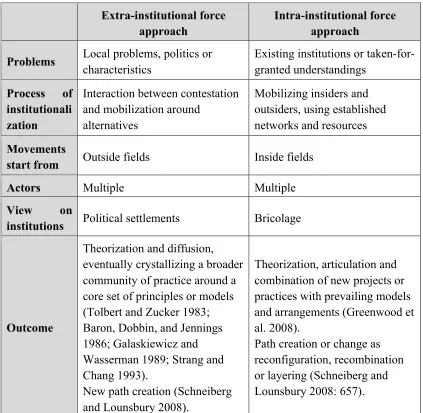
Chapter Two outlines the approaches on the emergence of new organizational forms, which are related to institutional entrepreneurship and social movement approaches from the neo-institutional perspective that can in turn uncover the co-existence of multiple actors and their interpretations of institutional logics. I will address the research gap of understanding institutional processes at the field-level in a multi-level perspective by emphasizing how different actors as political forces mobilize strategies to create political contexts to obtain favorable outcomes in the institutional fields. In this Chapter, I suggest the combination of both institutional entrepreneurship and social movement theories to fill the existing research gap.
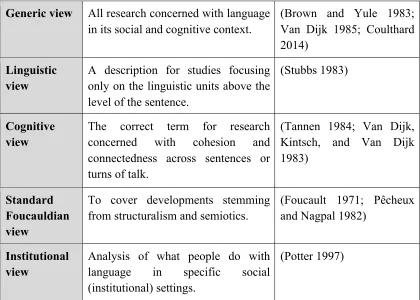
relevance in the analysis of the emergent processes of a new organizational form as a result of interactions between different social actors.
A brief history of Korean social enterprises according to both top-down and bottom-up perspectives is offered in Chapter Four. In this Chapter, I will outline the respective discourses of multiple actors in the institutional field of social entrepreneurship in South Korea.
Chapter Five moves on to consider the grounded theory approach as a research method used to address the research questions of this project and the management of the research process. This Chapter also re-emphasizes discourse analysis as a research tool to analyze and frame my dataset. I then describe my data sources and the process of collecting data during the 6 months of fieldwork in South Korea.
In Chapter Six I describe the initial stage of the institution-building process of Social Enterprises in Korea between 2006 and 2010. This Chapter will unpack the conflicting processes of meaning making between social actors who are located in different social positions. Three instances of conflict between actors in the policy and civil society area, and between the government and civil society illustrate the political struggle for the institutionalization of the concept of social enterprise and its institutional setting. This Chapter outlines how the powerful top-down actors create and take the leading role in an institution-building project and how bottom-up actors instantly react to contribute to the project.
Chapter Seven focuses on the emergence of oppositional discourses as a reaction to the emergence of official and dominant discourses of social enterprise. Two instances of emerging oppositional discourses from intra and extra-institutional entrepreneurs illustrate how the two different groups of actors react differently even though they promote a similar discourse in order to conceptualize the different meanings and activities of social enterprise.
Chapter Nine discusses these findings by revisiting the theoretical background and with the empirical findings. In this Chapter, I demonstrate that new organizational forms can be understood in different ways by actors who occupy different positions of power. By generating greater inclusivity for multiple actors and discourses, we can see the positive outcomes of conflict, given that top-down and bottom-up actors start to further understand each other’s ideologies and empower themselves by gaining a higher institutional position that enables them to define social enterprise. I argue that these seemingly powerless bottom-up actors are empowered by promoting their discourses and institutional logics in the complex process of institution-building. I then provide another instance of bottom-up alternative reactions to the top-down institution-building process of Social Enterprise, which takes different positions and strategies from other actors who promote official and oppositional discourses.
1
Background
1.1
Introduction
Despite having a relatively short history, social enterprise and social entrepreneurship are increasingly being acknowledged as legitimate fields, warranting substantial research on the topic, as discussed in the Introduction Chapter. However, given the diversity of social enterprise research there is no shared understanding of definitions, concepts of social enterprise and other related notions. As a matter of fact, several scholars (Gergen and Thatchenkery 1998; Lehner 2011; Perren and Ram 2004; Short, Moss, and Lumpkin 2009; Weerawardena and Mort 2006) recognize that the social enterprise research field is currently in a “pre-paradigmatic state.” The criteria for a successful and sustainable social enterprise, in that sense, have barely been discussed, even though the identification of such criteria might provide practitioners with suggestions as to which strategies are likely to lead to greater success.
Besides the variety of definitions, it is important to recall that the nature of social enterprises requires their success to be measured differently from the cases of big corporations or small-medium-sized enterprises in the traditional business sector. Johnson (2001) and Stevenson (2011) claim that a social enterprise entails two different concepts of sustainability: social and economic as shown in Figure 1-1. These concepts are derived from the characteristics of a social enterprise, which includes financial and social objectives at the same time – also known as a “double bottom line” (Emerson and Twersky 1996; Johnson 2001; Alter 2004). According to Alter (2004: 16), “social objectives aimed at mission accomplishment (social value creation) vary widely depending the organization’s mission and sector and financial objectives focused on financial sustainability (economic value creation) vary according to funding needs and business model.”
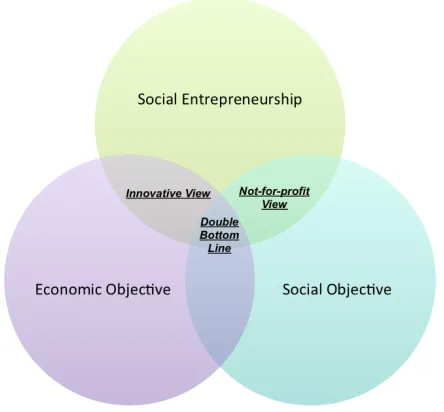
according to innovative views of social entrepreneurship, economic objectives are nevertheless prioritized, and therefore firms focus on making profits, rather than on meeting social objectives. This is the contrary of the view of not-for-profit social entrepreneurship, where the establishment and achievement of social objectives are considered to be the most important. To illustrate these three perspectives on social entrepreneurship better, I have presented a Venn diagram as Figure 1-1. As shown here, not only are financial gains to be considered as indicators of success in the field of social enterprises but there are also non-financial, or social factors, which imply an important and fundamental differentiation from traditional entrepreneurship.
[image:34.595.209.431.332.538.2]
Figure 1-1 Different Perspectives on Social Entrepreneurship and Its Characteristics
According to Desa (2007: 6), three are the research objectives which emerge in the field of social entrepreneurship:
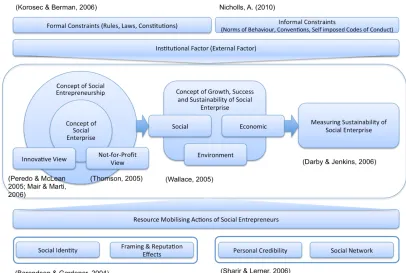
On the basis of an analysis of the existing literatures (Bornstein 2007b; Anderson, Dana, and Dana 2006; Barendsen and Gardner 2004; Thompson 2002; Pastakia 1998; Lasprogata and Cotten 2003; Shaw and Carter 2007), Desa (2007: 8) also clarified that “resource-mobilizing actions can form, sustain or grow a social venture base.” The ability of social entrepreneurs to undertake such actions can also be supported by external factors, such as government laws and constitutions, or behavioral norms developed within certain socioeconomic and cultural environments.
In summary, existing literatures show that there are two factors that determine concepts, definitions and performance measures of social enterprises: external and internal factors. Institutional effects viewed as external factors of social enterprise emergence can be divided into two groups: formal and informal constraints. Formal constraints include rules, laws and constitutions, while informal constraints include norms of behavior, conventions, and self-imposed codes of conduct (Desa 2007). Given these considerations, Korean social enterprises can be discussed from the view of institutional effects given that they have actively flourished after the establishment of the Social Enterprise Promotion Act in 2006.
Another primary research issue in the field is the measurement of the performance of social enterprises. The relevance of this problem is central, given that funders such as governments, foundations, and venture capitals need to know and analyze the effectiveness of their economic and social investments. Also, the picture may be quite complex given that external actors have different objectives and intentions which can be achieved through social enterprise activities. Besides this, it is also important to remember that the level of social enterprise sustainability is not highly developed yet. For this reason, shaping the concept of sustainability in terms of social entrepreneurship and social enterprises is especially important at this time in history in order to analyze and identify the success factors of social enterprises which contribute to the development of more sustainable social enterprises in the near future.
Figure 1-2 Annotated Illustration of Social Entrepreneurship Research
To conclude, different concepts, origins, and socioeconomic factors of social enterprises are influential in the measurement of the performance, growth, success and sustainability of social enterprises. Substantial factors of growth, success, and sustainability of social enterprise may vary in different countries characterized by different socioeconomic and cultural environments. Understanding social enterprise in different socioeconomic and cultural perspectives, in that sense, is necessary in order to identify the factors or criteria of success social enterprises.
1.2
Definition of Social Enterprise in Different Contexts
1.2.1. Definition of Social Enterprise by Country
the second is the so-called “non-profit approach” (Defourny and Nyssens 2012; Kerlin 2006). More specifically, innovative approaches place major emphasis on new combinations in at least one of the following ways: new services, new quality of services, new methods of production, new production factors, new forms of organizations or new markets (Defourny and Nyssens 2012). The non-profit approach is on the other hand regarded as a “mission-driven business approach” since it embraces all forms of business initiatives with social purposes or missions (Austin, Stevenson, and Wei Skillern 2006).
25
Table 1-1 Definition of Social Enterprise by Approach and Region/Country
Approach on SE
Region/
Country Definition
Innovative Approach
Europe
Firms who seek to enhance the social impact of their productive activities (Kerlin 2006).
Tackling social needs that are developed as businesses are fostered (Grenier 2003), mainly through nonprofit organizations but also in the for-profit sectors (Nicholls 2006).
UK An enterprise ran by a social entrepreneur, an individual who is committed to providing an innovative lasting solution to an unmet social need (UnLtd 2012).
US
Playing the role of change agents in the social sector by adopting a mission to create and sustain social value, recognizing and relentlessly pursuing new opportunities to serve that mission, engaging in a process of continuous innovation, adaptation and learning, acting boldly without being limited by resources currently in hand, and finally exhibiting a heightened sense of accountability to the constituencies served and for the outcomes created (Dees 1998: 4).
South Korea
26
Non-profit Approach
Europe
Organizations with an explicit aim to benefit the community, initiated by a group of citizens and in which the material interest of capital investors is subject to limits. They place a high value on their independence and on economic risk-taking related to ongoing socio-economic activity (EMES 2012).
UK
A business with primarily social objectives whose surpluses are principally reinvested for that purpose in the business or in the community, rather than being driven by the need to maximize profit for shareholders and owners (Department of Trade and Industry 2012).
US
Mission oriented revenue or job creating projects undertaken by individual social entrepreneurs, nonprofit organizations, or nonprofits in association with for-profits (Social Enterprise Magazine Online 2012).
Any earned income business or strategy undertaken by a nonprofit to generate revenue in support of its charitable mission (Social Enterprise Alliance 2012).
South Korea
1.2.2. Origins and Characteristics of Social Enterprise by Country
The exploration of the origins of social enterprises can explain why the definitions and characteristics of social enterprises are so different in each socioeconomic background. Table 1-2 shows the divergences in the economic, political and social backgrounds of social enterprises by region and country. The term social enterprise mainly appeared during the 1990s in Europe and the UK. Alter (2002), however, argues that the term social enterprise was first developed in the 1970s in the US to define those nonprofit business activities which had been started as a way to create job opportunities for disadvantaged groups.
Social enterprises have been supported by government policies in Europe, the UK and South Korea. More specifically, governments adopted policies or acts in order to promote social enterprises because economic growth and employment rates had decreased during this time. Nevertheless, specific strategies and the response of civil societies still differed from country to country. For instance, in the U.S., the social enterprise movement has been promoted by civil society and not by the government.
More specifically, a first notable divergence among countries is given by the amount of public expenditure devoted to promoting social enterprises. Only the Korean government increased its public expenditure to reinforce the social services market in 2006, while in the UK and the US cutbacks were carried out (Department for Work and Pensions 2004; Kerlin 2006). Consequently, social enterprises in South Korea have been hugely developed by the government since 2006. In other countries civil society and voluntary sectors have promoted its emergence, instead. The history of social enterprise from the point of view of governments and civil society will be explained in greater detail in Chapter Four.
28
Table 1-2 Economic, Political and Social Background of Social Enterprise Origins by Region/Country
Europe UK US South Korea
Time Period 1990s 1990s 1970s~1990s Late 1990s~2000s
Main Advocate EU Government Civil Society Government
Former Organizational
Structure Co-operative
Voluntary Organizations
Non-profit Organizations
1. One-stop Service Center for the Unemployed 2. Self-sufficiency Assistance Policy
Purpose of Promoting SE
Providing 1. Employment 2. Specific Care Services
1. Neighborhood Regeneration 2. Reducing
Dependency on state welfare (Department for Work and Pensions 2004)
Revenue Generation by Nonprofit
Organizations
Job Creation
Economic Influences
Economic
Growth Decreased Unemployment
29 Political Influences Key Government Initiative/ Policy European Social Fund (Nyssens 2006)
1. Third Way Policy Initiative (1997)
2. Enterprise & Exclusion (1999)
3. Charity Law (2002)
-
1. National Basic Livelihood Security Act (1999)
2. Social Enterprises for Self-sufficiency (SEsS) Initiatives 3. SEPA (2006)
Legal Body EU, European Commission
Department of Trade and Industry, Social Enterprise Coalition, Social
Enterprise Unit (2002)
- Ministry of Employment and Labor Social Influences Public Expenditure of Government Various by
Country Decreased in the late 1990s
Large cutbacks in federal funding for non-profits in the 1980s
Increased to enforce the social services market in 2006
Civil Society
EMES Research Network
Establishment of Social Enterprise London (1998)
Private foundation supported development of SE in the
1980s and 1990s Role of civil society was limited
Longer tradition of
voluntary action (Borzaga 2004)
Table 1-3 Comparative Overview of Social Enterprise by Region/Country (Revised from a Table in Kerlin (2006: 259))
Characteristics Europe UK US South Korea
Emphasis Social Benefit Social
Benefit
Revenue
Generation Job Creation
Common Organizational Type
Cooperative Association
All Kinds of Organizations
Nonprofit
(501(c)(3)) Nonprofit
Focus Human Services All Nonprofit
Activities All Nonprofit Activities Human Services
Types of SE Few Many Many
1. Employment Model 2. Social Service Model 3. Local Community Model 4. Combination Model 5. etc Recipient
Involvement Common Common Limited Common
Strategic Development EU Government Voluntary Sectors Government Foundations Government
Context Social Economy Market
Economy Market Economy Market Economy Legal Framework Underdeveloped
but Improving Developed Lacking
1.3
Conclusion
2
An Approach on the Emergence of New Organizational
Forms
2.1
Introduction
This chapter will first explore the theoretical backgrounds of the emergence of an organizational form and of the institutional field by relying on a neo-institutional perspective. I will review how previous research tried to integrate social movement theories into an institutional approach in order to study the emergence of a new organizational form through the interactions between different social actors in a changing environment.
In this chapter, I discuss how social actors are influenced by the contexts they are embedded in and compete against each other with their own discourses on the meaning of a specific organizational form in the institution-building process. According to the integrated view of institutional entrepreneurship and social movement theories, institution-building processes are political (Beckert 1999; Levy and Scully 2007). More specifically, the political sides of institution-building processes are explained by focusing on the roles and activities of different social actors, who locate their social positions differently according to their ideology which is in turn influenced by the social conditions they are embedded in. Building on these considerations, I suggest that the integrated view of the institutional entrepreneurship and social movement theories according to a neo-institutional perspective offers an opportunity to analyze institution-building processes which contain multiple socially constructed views, positions and strategies of each actor in the institutional field.
2.2
The Emergence of New Organizational Forms
the focus of this thesis relies on institutional approaches, as suggested by Jepperson (1991: 145) who saw institutions as “patterns of social practices for which departures from the pattern are counteracted in a regulated fashion, by repetitively activated, socially constructed, controls – that is by some set of rewards and sanctions.”
Greenwood and Suddaby (2006: 30) referred to the institutional approach to define an organizational form as “an archetypal configuration of structures and practices given coherence by underlying values regarded as appropriate within an institutional context.” This definition implies that an organizational form emerges or is created by institutional logics (Tracey, Phillips, and Jarvis 2011). Accordingly, a new organizational form will gain legitimacy when social actors realize that it corresponds to their interest and values within an institutional context (Rao, Morrill, and Zald 2000; Tracey, Phillips, and Jarvis 2011). Therefore, organizational emergence, change, and organizational structures cannot avoid being influenced by existing institutions and institutional logics (Lawrence 2008). Then, this begs the following question: “why and how do institutions emerge and change? And how are they related to organizations?”
Previous studies have reported that the origins of institutions or the way in which they emerge have not been fully studied. According to Powell, Packalen, and Whittington (2010), even traditional approaches to institutional studies – such as the economic and sociological literature – have not focused on the origins of institutions or the way of organizing institutions. Kreps (1990: 530) states that even though the economic literature has investigated the effects of institutions, it still “leaves open the question, where did institutions come from?” Similarly, Barley and Tolbert (1997) mention that the sociological literature has not looked at how institutional arrangements are created. Moreover, in a comprehensive review of organization research, Greenwood et al. (2008: 26) conclude that “institutional studies have not been overly concerned with how institutions arise.”