http://wrap.warwick.ac.uk
Original citation:Hutchinson, L.M., Hastings, Richard P., Hunt, P.H., Bowler, C.L., Banks, M.E. and Totsika, Vasiliki. (2014) Who's challenging who? Changing attitudes towards those whose behaviour challenges. Journal of Intellectual Disability Research, Volume 58 (Number 2). pp. 99-109. ISSN 0964-2633
Permanent WRAP url:
http://wrap.warwick.ac.uk/62136
Copyright and reuse:
The Warwick Research Archive Portal (WRAP) makes this work by researchers of the University of Warwick available open access under the following conditions. Copyright © and all moral rights to the version of the paper presented here belong to the individual author(s) and/or other copyright owners. To the extent reasonable and practicable the material made available in WRAP has been checked for eligibility before being made available.
Copies of full items can be used for personal research or study, educational, or not-for profit purposes without prior permission or charge. Provided that the authors, title and full bibliographic details are credited, a hyperlink and/or URL is given for the original metadata page and the content is not changed in any way.
Publisher’s statement:
This is the accepted version of the following article: Hutchinson, L.M., Hastings, Richard P., Hunt, P.H., Bowler, C.L., Banks, M.E. and Totsika, Vasiliki. (2014) Who's challenging who? Changing attitudes towards those whose behaviour challenges. Journal of
Intellectual Disability Research, Volume 58 (Number 2). pp. 99-109. ISSN 0964-2633, which has been published in final form at
http://dx.doi.org/10.1111/j.1365-2788.2012.01630.x
A note on versions:
The version presented here may differ from the published version or, version of record, if you wish to cite this item you are advised to consult the publisher’s version. Please see the ‘permanent WRAP url’ above for details on accessing the published version and note that access may require a subscription.
This is a pre-print version of a paper published as follows:
Hutchinson, L. M., Hastings, R. P., Hunt, P. H., Bowler, C. L., Banks, M, E., &
Totsika, V. (2014). Who’s Challenging Who? Changing attitudes towards those
whose behaviour challenges. Journal of Intellectual Disability Research, 58, 99-109.
Who’s Challenging Who? Changing attitudes towards those whose behaviour
challenges
Lisa M. Hutchinson1, 2, Richard P. Hastings1, Paul H. Hunt2, Claire L. Bowler2,
Martin E. Banks2 & Vasiliki Totsika1
1
School of Psychology, Bangor University, UK
2
Mencap Cymru, Cardiff, UK
Running head: WHO’S CHALLENGING WHO?
Address for correspondence:
Richard P. Hastings PhD., CEDAR, University of Warwick.
Who’s Challenging Who? Changing attitudes towards those whose behaviour
challenges
Abstract
Background. Although staff attitudes towards individuals with intellectual disability
whose behaviour challenges may be an important part of a positive support culture,
very little research has focused on the development of training designed to change
staff attitudes. Positive contact is hypothesised to be an effective way to change
attitudes toward stigmatised groups.
Methods. We designed and developed a half day training package about the
experiences of individuals whose behaviour challenges – Who’s Challenging Who
(WCW). The WCW package was delivered according to a manual by a trainer with
intellectual disability and a professional without disability. Seventy six staff
participated in one of 10 WCW training sessions and provided data on their attitudes
and empathy towards individuals whose behaviour challenges prior to the WCW
training and immediately at the end of training. Staff also completed a post-training
evaluation questionnaire.
Results. A training package was successfully developed collaboratively with
individuals whose behaviour challenges, and received very positive evaluations from
staff participants. Short term positive change was shown for empowerment and
similarity attitudes, and staff empathy and self-efficacy. These outcomes were
associated with small to moderate effect sizes.
Conclusions. Meaningful short term positive staff attitude changes were found and the
WCW training model achieved proof of concept. More robust research designs are
intervention such as WCW within organisations’ training strategies requires further
development.
Introduction
Individuals with intellectual disability whose behaviour challenges have been
shown in research over several decades to be at risk of exposure to less than optimal
care. For example, support staff may interact less with those whose behaviour
challenges and apportion the relatively scarce resource of their attention towards
times when challenging behaviours occur, resulting in a counter-habilitative support
context (Hastings & Remington, 1994a, b). Potentially abusive and restrictive
practices have also been associated with challenging behaviour (Cambridge et al.,
2011; Sturmey, 2009).
Hastings and colleagues’ framework (Emerson et al., 1994; Hastings &
Remington, 1994a; Hastings, 1997, 1999, 2002, 2005, 2010) for understanding the
factors associated with support staff responses relating to challenging behaviour
identifies a number of variables: a lack of staff behavioural knowledge and skills,
their negative emotional responses, their beliefs/attitudes, and aspects of the informal
and formal culture of services (see Figure1). Either implicitly or explicitly, the first
three of these have been targeted in staff training. Training staff in behavioural
knowledge and positive behaviour support skills can lead to increased knowledge
and/or successful reductions in challenging behaviours (e.g., Dowey et al., 2007;
McClean et al., 2005). Using psychological interventions can also lead to reduced
staff stress (Gardner et al., 2005; Noone & Hastings, 2009, 2010; Rose et al., 1998),
although only rarely has the associated impact on challenging behaviour of
psychological intervention focused on staff been measured directly (Singh et al.,
2006).
Meanwhile, policy developments focus on the evidence based practices,
recommended infrastructure (including staffing), and location (i.e., a move towards
community-based supports) that should determine the formal culture of services (e.g.,
in the UK: Banks & Bush, 2007; Department of Health, 2007). As is represented in
Figure 1, these policy developments are several steps removed from the individuals
who provide day-to-day support within services for those whose behaviour
challenges. Researchers have not directly and consistently addressed the filtering
through of policy level perspectives, values, and attitudes to frontline workers.
Values-based training has formed a part of many services’ induction and ongoing
training programmes for several decades. However, much of the research on the
impact of values-based training is historical (e.g., Breedlove, 2000). Even less
research has focused on values-based training specifically for staff working with
individuals whose behaviour challenges, although Positive Behaviour Support can be
viewed as a marriage of behavioural analysis and intervention technology with strong
values related primarily to broad quality of life outcomes (Carr et al., 2002).
Engendering positive values and attitudes among staff working with individuals
whose behaviour challenges is a priority for policy and practice. This prioritisation is
in many senses independent of direct research evidence that might suggest staff
positive values and attitudes are a good thing for individuals whose behaviour
challenges and for staff themselves. In terms of staff, positive values and attitudes
relating to service users with intellectual disability have been found to be associated
with work-related well-being in staff supporting individuals whose behaviour
challenges (Hastings & Horne, 2004; Noone & Hastings, 2011). In terms of staff
positive attitudes translating into positive interactions with individuals with
Despite a careful literature search, we could find no existing research reporting
outcomes from attitude change interventions focused on staff who work with, or may
work with, individuals whose behaviour challenges. Therefore, a training course
(Who’s Challenging Who?) was designed and co-developed and co-delivered by
individuals who currently or in the past attracted the label of “challenging”.
Who’s Challenging Who? programme theory
Contemporary theory in attitude change towards stigmatised groups has its roots
in the Contact Hypothesis (Allport, 1954). This hypothesis states that positive attitude
change requires contact/interaction with the stigmatised group. These ideas have been
used successfully in the mental health field in training delivered by service users
alongside professionals (Corrigan & O’Shaughnessy, 2007). Data within the
intellectual disability field also suggest that those individuals who have had more
contact with disabled children or adults report more positive attitudes (e.g., Siperstein
et al., 2007; Tracy & Iacono, 2008).
Who’s Challenging Who (WCW) was designed to incorporate two levels of
contact with those whose behaviour challenges. First, an adult with intellectual
disability who currently, or in the past, had been identified as presenting with
“challenging behaviour” acted as a co-trainer. Thus, participants in WCW training
spent the whole event in contact with this person and also saw them in a valued role
(acting as a trainer of others). Second, the materials and group exercises used in
WCW focus entirely on understanding the perspective of individuals whose behaviour
challenges. Staff are asked on multiple occasions to put themselves in the position of
individuals whose behaviour challenges, and to hear directly about their experiences
and their perspectives on how services could be improved. These opportunities for
maximise the chances of attitude change: equal/valued status contact (co-trainer
status), community sanctioned (staff attended with the support/encouragement of their
organisation), co-operative (active exercises were used so that the training group were
working towards a common goal), and intimate (this was a small group setting with
multiple, genuine opportunities for contact).
Offering multiple, and appropriate, opportunities for contact/exposure was the
mechanism proposed to affect staff attitude change. More specifically, the whole
training event was focused on increasing staff empathy towards those whose
behaviour challenges. Ultimately, increased empathy would be hypothesised to affect
the quality (and potentially the quantity) of staff interactions with service users and to
reduce the potential for abusive and restrictive practices. By training whole staff
groups, WCW is designed to engender a more positive and empathic informal staff
culture within service settings. Such a change in culture should also provide a context
in which abusive/restrictive practices are not tolerated by other staff. Therefore, there
may be a mechanism to protect against abusive/restrictive practice – assuming that
changes in attitudes/empathy as a part of the informal staff culture can be maintained
over time.
In the present paper, we describe the WCW training course and the results from
a pilot research evaluation.
Method
Participants
Seventy six staff from services for adults with intellectual disabilities and/or
autism participated in one of 10 WCW training courses. Thirty six staff were male,
and 40 female. On average, the staff were 39 years of age (SD = 12 years) and had
months). Forty seven staff were support workers, and 29 staff worked in a
managerial, technical or specialist role. Staff were asked to state their highest
educational qualification. Three staff had no formal educational qualifications, 48
staff held pre-University level qualifications, and 25 had a bachelors, masters or
doctoral degree. On average, each staff member regularly supported or cared for 13
people with intellectual disability and/or autism, six of whom had behaviour that
challenged.
Measures
In addition to a questionnaire to collect basic demographic information about
training participants, five measurement tools were used for the research evaluation.
Two measures were used to directly test the hypothesised effect of WCW on staff
empathy and empathic attitudes (similarity attitudes, and the Staff Empathy towards
individuals whose Behaviour Challenges Questionnaire [SEBCQ]). Two additional
measures were used to assess other dimensions that may have changed as a result of
exposure to WCW. If staff were to empathise more with individuals whose behaviour
challenges, they may also feel more confident working with these service users
(Challenging Behaviour Self-Efficacy Questionnaire). In addition, we hoped that by
direct exposure to an individual whose behaviour challenges in a valued role (as a
co-trainer) staff empowerment attitudes might also change positively. Finally, at
post-training only, a WCW evaluation questionnaire was used.
‘Empowerment’ and ‘Similarity’ attitude sub-scales of the Community Living
Attitudes Scale (CLAS) – Mental Retardation Version: Form A (Henry et al., 1996)
were used to measure staff attitudes. With the permission of the CLAS authors, we
amended the attitude items to refer to “people with learning (intellectual) disability
the items were anglicised so that terminology referring to services and legal and
political systems was of direct relevance to the UK. Otherwise, the original attitude
items were used.
The CLAS ‘Empowerment’ subscale consisted of 13 questions that measured
staff beliefs about the degree to which people with intellectual disability and
challenging behaviour should be empowered to make decisions about their lives,
regardless of the nature of their disability (e.g., ‘People with intellectual disability and
challenging behaviour should be encouraged to lobby politicians on their own’;
‘Organisations that serve people with intellectual disability and challenging behaviour
should have them on their boards/management committees’). Staff were asked to
indicate the extent to which they agreed with each of these questions using a six-point
rating scale (from 1 = ‘Disagree strongly’ to 6 = ‘Agree strongly’).
The ‘Similarity’ sub-scale consisted of 12 questions that measured staff beliefs
about how similar they perceive people with intellectual disability and challenging
behaviour to be to other members of society (e.g., ‘People with intellectual disability
and challenging behaviour can have close personal relationships just like everyone
else’; ‘People with intellectual disability and challenging behaviour have goals for
their lives just like other people’). Staff indicated the extent to which they agreed
with each of these questions using a six-point rating scale (from 1 = ‘Disagree
strongly’ to 6 = ‘Agree strongly’).
To assess internal consistency, Cronbach’s alpha for the two attitude scales was
calculated and was found to be good for ‘Empowerment’ ( = .78) and acceptable for
‘Similarity’ ( = .67) using data from staff pre-training scores.
We could find no existing measure of staff empathy towards those whose
research. The SEBCQ is a five item measure (e.g., ‘I can relate to the everyday
problems faced by people with intellectual disability/autism and challenging
behaviour’) with a six-point rating scale for each item (from 1 = ‘Disagree strongly’
to 6 = ‘Agree strongly’). The Cronbach’s alpha for this new scale, based on staff
pre-training ratings, was good ( = .72).
Staff self-efficacy when working with individuals whose behaviour challenges
was measured using the Challenging Behaviour Self-Efficacy Scale (CBSE; Hastings
& Brown, 2002). This scale includes five efficacy items: feelings of confidence,
control and satisfaction in dealing with challenging behaviours, a perception that staff
have a positive impact on the challenging behaviours they deal with, and a rating of
how difficult they find it to work with challenging behaviours. Each item is rated on a
seven-point scale, and summing the ratings on the five items derives a total score.
This scale was found to have a good level of internal consistency ( = .81) for the
present sample at pre-training.
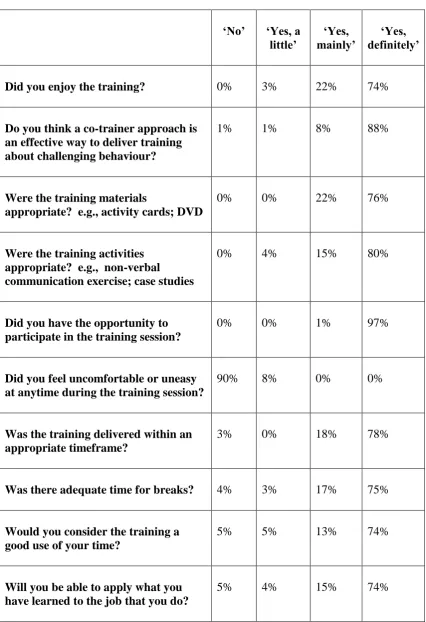
The WCW post-training evaluation questionnaire was developed to examine the
first level (‘Reaction’) of Kirkpatrick’s (1994) model of training evaluation. This
10-item questionnaire was designed to gain participants’ personal views about the WCW
training session (see Table 3 for items). Each item was rated using a four-point rating
scale (from 1 = ‘No’ to 4 = ‘Yes, definitely’). Staff were also given the opportunity
to make any additional comments about each of the 10 items in addition to any overall
comments about the training session.
Structure of the “Who’s Challenging Who?” training
WCW is co-delivered by an individual who has an intellectual disability and a
professional without disability. Group sizes in the pilot evaluation research varied
designed is 10 people. WCW is a three hours and 20 minute training course delivered
to groups of staff who work in intellectual disability and/or autism services, with
accompanying detailed manuals and materials.
The outline of the training course, along with typical timings, is shown in Table
1. Seven themes are explored in the WCW training, each drawn from an analysis of
the results from qualitative research reporting either the experiences of individuals
with intellectual disability in challenging behaviour services or receiving challenging
behaviour interventions (e.g., Clarkson et al., 2009; Hawkins et al., 2005; Ruef &
Turnbull, 2002), or the experiences of carers (e.g., Elford et al., 2010; Ruef et al.,
1999; Turnbull & Ruef, 1997). Each of the seven themes is introduced, an exercise is
used to explore the issue, and the theme section ends with a summary of what service
users would like to see change. A variety of presentation formats are used: verbal
presentation supported by Powerpoint slides, audio recordings, group tasks and
feedback, and video presentation.
---Insert Table 1 about here---
To help the reader develop a flavour of the training, we will describe one of
the training themes in some detail as an example. Each of the themes was presented
using a similar format. The following text describes the section of WCW that focuses
on what people with an intellectual disability and/or autism say it is like to be the
recipient of a physical restraint procedure, and how they would like to be treated if
they have to be restrained. The co-trainer without a disability began by introducing
the theme to be discussed. Both trainers then engaged in a pre-prepared conversation
that supports the co-trainer with an intellectual disability to share his/her experiences
of physical restraint in one or more of the following scenarios: (a) being the recipient
and/or (c) if the co-trainer has never been restrained, imagining what this might be
like. Staff were invited to ask the co-trainer with an intellectual disability questions
about his/her experiences.
Staff were then divided into groups of three by the co-trainer without a
disability and given instructions as to what the next learning exercise would involve
whilst the co-trainer with a disability gave each group a case study (one from: David;
Susan; and Joe), flipchart paper and pens. An excerpt from one of the case studies is
included below:
“They restrained me, and I’m not sure why they did that. They didn’t ask what was wrong or tried to calm me down, they just restrained me. I think it’s their way of saying “I’m in charge!” I was really frightened and it hurt. Afterwards, I felt worn out and exhausted. I felt sad.”(Excerpt from
David’s story)
These case studies were fictitious, however the content was informed by
findings from a systematic review of the qualitative research literature on the
experiences of individuals with intellectual disability and/or carers. Each case study
was based on what real people have said it is like to be physically restrained. Staff
were asked to work together in their groups to identify what they thought: (a)
triggered the challenging behaviour, (b) the person was thinking during the procedure,
and (c) the person was feeling during the procedure. Staff were given 10 minutes to
complete this activity during which time both trainers spent some time with each
group to offer assistance and/or answer any questions. After 10 minutes, the trainer
without a disability prompted staff to stop working on the activity. David’s story was
played first via audio-media equipment to the whole group. One volunteer from
written on flipchart paper to the front of the room, and to read these out loud to the
rest of the group. Responses were then compared to the “answers” on the WCW
Powerpoint presentation.
The co-trainer with a disability asked staff to consider whether they thought
that carrying out a physical restraint procedure was necessary in this case and what
alternative interventions could have been considered by David’s support staff. The
trainer without a disability wrote these suggestions on flip chart paper. The
co-trainer with a disability also offered some suggestions as to how David’s challenging
behaviour could have been reduced or avoided (by reading a pre-prepared WCW
Powerpoint slide). This procedure was repeated for groups working on Susan and
Joe’s stories. Finally, the co-trainer with an intellectual disability informed staff how
people whose behaviour challenges would like to be treated if they have to be
restrained (e.g., “Not hit or abused”; “Treated with respect”). Before completing this
theme, both trainers answered any further questions staff had about the theme topic.
Structure of the Co-Trainer Training (CoTT) Course
A three day training course (CoTT) was developed to provide two people with
intellectual disability with the skills and knowledge required to co-deliver the WCW
training session. The CoTT model was developed by: (a) reviewing the academic
literature to identify existing models used to train people with intellectual disability to
deliver learning to others, (b) carrying out an audit of current best practice within the
organisations involved in the research as well as other external organisations (using
an internet search for information, and direct contacts with leads for training within a
number of UK organisations), and (c) members of the research team contributing their
A number of learning objectives were identified for each day of the CoTT
course. On day one, co-trainers learned: (a) what the WCW is about and why the
training session is important, (b) what challenging behaviour is and why it might
happen, (c) what the function of training is and what the role of a co-trainer entails,
(d) how people learn new information or skills and the variables that enhance
learning, and (e) a variety of teaching/learning activities. On day two, through a
variety of practical exercises, co-trainers learned how to: (a) manage nerves and
increase confidence in dealing with training and people problems, (b) increase their
ability to communicate effectively in a training environment using a variety of
verbal/non-verbal communication and listening skills, and (c) start and end a training
session effectively. Co-trainers also gained an understanding of the importance of
confidentiality and the function of a training evaluation. Finally, on day three
co-trainers experienced presenting the whole WCW training session. Co-co-trainers were
given the opportunity to reflect on their performance and receive feedback from tutors
and peers. On day 1 of the CoTT each co-trainer was provided with a CoTT manual
that included information about the topics and activities covered during this three day
course. Co-trainers were encouraged to refer to this manual and practice skills in their
own time with support from carers.
Although the WCW training session manual had the same content for each of
the trainers, to fully support the co-trainer’s role an individualised set of presentation
materials was produced for each of the co-trainers and these individualised materials
were used in the third day of the CoTT training. Each co-trainer actively participated
in developing their own training materials by selecting preferred pictorial prompts
and/or language. These unique materials offered co-trainers the opportunity to learn
presentations were amended to suit the individual needs of co-trainers, and a detailed
WCW lesson plan was produced clarifying exactly which sections the co-trainer
would present.
Procedure
Once the study had been granted ethical approval by the School of Psychology
ethics committee, email contacts were used to distribute information about the 10
training courses available and the dates and times at which the courses would be held.
Organisations and individuals booked places on each of the training courses by
contacting the research team directly. Of a total 100 places available, 97 were booked,
and 76 staff attended the training sessions. Attendance at each training course was
free of charge. Staff were asked to complete the outcome measures before the training
course, and again at the end of the day. Thus, immediate post-training outcomes only
were assessed in the present research. Staff were also asked to complete the post
training evaluation questionnaire at the end of the event.
Results
Pre and post training scores on each of the four measures for all staff were
compared using paired samples t tests. In addition to testing for statistical significance
of the changes, we calculated an effect size for each pre-post training comparison.
The effect size estimates (d) were adjusted to take account of correlation over time in
a one sample pre-post test design using the formula recommended by Dunlap,
Cortina, Vaslow and Burke (1996). The means and SDs for the staff sample at pre and
post training, along with the results of the t test comparisons and the effect sizes, are
displayed in Table 2.
Overall, there was a statistically significant positive change for each of the four
outcomes indicating immediate post-training impact on attitudes, empathy, and
self-efficacy. These effects were small (for similarity attitudes and staff self-efficacy) to
moderate (empowerment attitudes and empathy) in size. Correlates of outcome were
also explored by using correlations between continuous demographic variables (e.g.,
staff age, length of experience in health/social care) and pre-post change scores, and
independent t test comparisons for dichotomous demographic variables (e.g., staff
gender, direct support staff vs. other roles). All of the key demographic variables
described in the Participants section were examined in this way. Few associations
were found. Larger changes in empathy were found for older staff (r = .231, p = .047)
and staff who had been working in health and social care for longer (r = .235, p =
.045). The more service users the staff members worked with regularly, the smaller
the changes in their attitudes (Similarity r = -.305, p = .011; Empowerment r = -.293,
p = .016). Female staff had larger positive changes in both empathy (marginally) (t
(72) = 1.95, p = .055) and self-efficacy (t (70) = 2.01, p = .049). Male staff had
marginally larger positive changes in similarity attitudes (t (72) = 2.04, p = .055).
The post-training evaluation responses of the staff attending WCW courses are
summarised in Table 3. Overall, WCW was evaluated very positively.
---Insert Table 3 about here---
Discussion
The WCW training course was associated with immediate positive changes in
attitudinal dimensions, as hypothesised in the under-pinning contact theory. Staff
participants also evaluated their experience of participation in the training positively.
Although the changes observed on each of the main four outcome scales were
suggesting potentially meaningful short term change was achieved. Exploratory
analyses of the correlates of change suggested that older staff, who had been working
in the care system for longer, and staff working with a larger number of people
(perhaps in larger congregate settings) reported the largest changes.
Turning to more practical considerations, the author team were successful in
developing a short and coherent training course that staff valued. The course was
successfully delivered to small groups of staff with full participation of the co-trainers
with intellectual disability. Successful delivery was supported by a three day course
for the co-trainers and preparation of bespoke training materials (i.e., a personalised
version of the WCW training manual for each co-trainer with intellectual disability)
This combination of training and support as co-trainer preparation also appeared to
have been successful. Reasonable numbers of staff were also recruited for the training
over a short period of time, suggesting that demand/interest was strong. The outcome
measures chosen for their theoretical significance also demonstrated short term
change. Thus, the WCW training appeared to achieve its hypothesised effects and the
outcome measures were fit for purpose. In summary, the experience of delivering
WCW and achieving short term change represents proof of concept.
Despite encouraging outcome and feedback data, there are clearly considerable
limitations with the current research design. In particular, no longer term changes
were evaluated, and the range of outcome measures was limited to staff reports of
their attitudes. Future research evaluation should include a control group who
received no training, or a comparison intervention without the contact components
(e.g., perhaps reading the materials and watching video covering the same ground).
The latter design is especially relevant since the main mechanism of change was
further step for research evaluation would be to explore whether the quality and
quantity of staff interactions with individuals with an intellectual disability in the
work setting (observed and/or via the reports of individuals with intellectual
disability) change positively as a result of WCW. Finally, the WCW format evaluated
in the present study included the direct experiences of the two co-trainers but was not
bespoke for a particular service. A practical question would be whether effects for
staff groups who work together would be greatest with an external pair of trainers or
focused on the specific experiences of those whose behaviour challenges supported
within the particular service. The latter model would of course be considerably more
resource intensive.
If further research supports the effectiveness of the WCW training, a key
question will be to consider its role within services. For example, WCW could be
used as a preparatory/motivational training for more technical training in the skills
required to intervene effectively with challenging behaviour. Values and attitudes
form an important context for skills-based training but separate data on the utility of
values components to broader training are rarely available. The maintenance of
attitude change also requires some consideration. Following Allport’s theoretical
position, and research data from other intellectual disability staff training (e.g.,
Totsika et al., 2008), the commitment of the organisation is likely to be important.
Thus, training a whole staff group, in an effort to change culture, may be crucial.
Similarly, ongoing commitment to the day-to-day enactment of positive attitudes may
References
Allport, G. W. (1954). The nature of prejudice. Reading, MA: Addison-Wesley.
Banks, R., & Bush, A. (Eds.) (2007). Challenging behaviour: A unified
approach (Joint report of the Royal College of Psychiatrists, British Psychological
Society and Royal College of Speech and Language Therapists). London: Royal
College of Psychiatrists.
Breedlove, L. (2000). A quarter-century of normalization and social role
valorization: Evolution and impact. Mental Retardation, 38, 180-183.
Cambridge, P., Beadle-Brown, J., Milne, A., Mansell, J., & Whelton, B. (2011).
Adult protection: The processes and outcomes of adult protection referrals in two
English local authorities. Journal of Social Work, 11, 247-267.
Carr, E.G., Dunlap, G., Horner, R.H., Koegel, R.L., Turnbull, A.P., Sailor, W.,
Anderson, J., Albin, R.W., Koegel, L.K., & Fox, L. (2002). Positive Behavior
Support: Evolution of an Applied Science. Journal of Positive Behavior Interventions,
4(1), 4-16.
Clarkson, R., Murphy, G. H., Coldwell, J. B., & Dawson, D. L. (2009). What
characteristics do service users with intellectual disability value in direct support staff
within residential forensic services? Journal of Intellectual and Developmental
Disability, 34, 283–289.
Corrigan, P. W., & O’Shaughnessy, J. R. (2007). Changing mental illness
stigma as it exists in the real world. Australian Psychologist, 42(2), 90-97.
Department of Health (2007). Services for people with learning disabilities and
challenging behaviour or mental health needs: Report of a project group (Chair J. L.
Dowey, A., Toogood, A., Hastings, R. P., & Nash, S. (2007). Can brief
workshop interventions change care staff understanding of challenging behaviours?
Journal of Applied Research in Intellectual Disabilities, 20, 52-57.
Dunlap, W. P., Cortina, J. M., Vaslow, J. B., & Burke, M. J. (1996).
Meta-analysis of experiments with matched groups or repeated measures designs.
Psychological Methods, 1, 170-177.
Elford, H., Beail, N., & Clarke, Z. (2010). ‘A very fine line’: Parents’
experiences of using restraint with their adult son/daughter with intellectual
disabilities. Journal of Applied Research in Intellectual Disabilities, 23, 75-84.
Emerson, E., Hastings, R., & McGill, P. (1994). Values, attitudes and service
ideology. In E. Emerson, P. McGill, & J. Mansell. (Eds). Severe learning disabilities
and challenging behaviours: Designing high quality services (pp. 209-231). London:
Chapman and Hall.
Gardner, B., Rose, J., Mason, O., Tyler, P., & Cushway, D. (2005). Cognitive
therapy and behavioural coping in the management of work-related stress: An
intervention study. Work and Stress, 19, 137-152.
Hastings, R. P. (1997). Staff beliefs about the challenging behaviors of children
and adults with mental retardation. Clinical Psychology Review, 17, 775-790.
Hastings, R. P. (1999). The dialogue between research and application: A focus
on practical issues in Behavioural intervention. In J. R. Scotti, & L. H. Meyer (Eds).
Behavioral intervention: Principles, models, and practices (pp. 433-448). Baltimore:
Paul H. Brookes.
Hastings, R. P. (2002). Do challenging behaviors affect staff psychological
well-being?: Issues of causality and mechanism. American Journal on Mental
Hastings, R. P. (2005). Staff in special education settings and behaviour
problems: Towards a framework for research and practice. Educational Psychology,
25, 205-219.
Hastings, R. P. (2010). Support staff working in intellectual disability services:
The importance of relationships and positive experiences Journal of Intellectual and
Developmental Disability, 35, 207-210.
Hastings, R. P., & Brown, T. (2002). Behavioural knowledge, causal beliefs,
and self-efficacy as predictors of special educators’ emotional reactions to
challenging behaviours. Journal of Intellectual Disability Research, 46, 144-150.
Hastings, R., & Horne, S. (2004). Positive perceptions held by support staff in
community mental retardation services. American Journal on Mental Retardation,
109, 53-62.
Hastings, R. P., & Remington, B. (1994a). Rules of Engagement: Toward an
analysis of staff responses to challenging behavior. Research in Developmental
Disabilities,15, 279-298.
Hastings, R. P., & Remington, B. (1994b). Staff behaviour and its implications
for people with learning disabilities and challenging behaviours. British Journal of
Clinical Psychology,33, 423-438.
Hawkins, S., Allen, D., & Jenkins, R. (2005). The use of physical interventions
with people with intellectual disabilities and challenging behaviour – the experiences
of service users and staff members. Journal of Applied Research in Intellectual
Disabilities, 18, 19-34.
Henry, D., Keys, C., Jopp, D., & Balcazar, F. (1996). The Community Living
Attitudes Scale, Mental Retardation form: Development and psychometric properties.
Kirkpatrick, D. L. (1994). Evaluating training programs: The four levels. San
Francisco: Berrett-Koehler.
McClean, B., Dench, C., Grey, I., Hendler, J., Fitzsimons, E. & Corrigan, M.
(2005). Outcomes of Person focused Training: A model for delivering behavioural
supports to individuals with challenging behaviours. Journal of Intellectual disability
Research, 49, 340-353.
Noone, S. J., & Hastings, R. P. (2009). Building psychological resilience in
support staff caring for people with intellectual disabilities: Pilot evaluation of an
acceptance-based intervention. Journal of Intellectual Disabilities, 13, 43-53.
Noone, S. J., & Hastings, R. P. (2010). Using acceptance and mindfulness-based
workshops with support staff caring for adults with intellectual disabilities.
Mindfulness, 1, 67-73.
Noone, S. J., & Hastings, R. P. (2011). Values and psychological acceptance as
correlates of burnout in support staff working with adults with Intellectual
Disabilities. Journal of Mental Health Research in Intellectual Disabilities, 4, 79-89.
Rose, J., Jones, F., & Fletcher, C. B. (1998). The impact of a stress management
programme on staff well-being and performance at work. Work and Stress, 12,
112-124.
Ruef, M. B., & Turnbull, A. P. (2002). The perspectives of individuals with
cognitive disabilities and/or autism about their lives and their problem behavior.
Research and Practice for Persons with Severe Disabilities, 27, 125-140.
Ruef, M. B., Turnbull, A. P., Turnbull, H. R., & Poston, D (1999). Perspectives
of five stakeholder groups: Challenging behaviour of individuals with mental
Singh, N. N., Lancioni, G. E., Winton, A. S. W., Curtis, W. J., Wahler, R. G.,
Sabaawi, M., Singh, J., & McAleavey, K. (2006). Mindful staff increase learning and
reduce aggression in adults with developmental disabilities. Research in
Developmental Disabilities, 27, 545-558.
Siperstein, G. N., Norins, J., & Mohler, A. (2007). Social acceptance and
attitude change: Fifty years of research. In J. W. Jacobson, J. A. Mulick, & J. Rojahn
(Eds.), Handbook of intellectual and developmental disabilities (pp. 133-154). New
York, NY: Springer.
Sturmey, P. (2009). Restraint, seclusion and PRN medication in English services
for people with learning disabilities administered by the National Health Service: An
analysis of the 2007 National Audit Survey. Journal of Applied Research in
Intellectual Disabilities, 22, 140-144.
Totsika, V., Toogood, S., Hastings, R. P., & Nash, S. (2008). Interactive
Training for Active Support: Perspectives from staff. Journal of Intellectual and
Developmental Disability, 33, 225-238.
Tracy, J., & Iacono, T. (2008). People with developmental disabilities teaching
medical students—Does it make a difference? Journal of Intellectual and
Developmental Disability, 33, 345-348.
Turnbull, A. P., & Ruef, M. (1997). Family perspectives on inclusive lifestyle
Table 1. Outline of the WCW training
Timing Theme title Outline of theme
10.30 N/A Registration; pre-evaluation; refreshments
11.00 Welcome and introduction
Welcome and trainer introductions; outline of training timetable; session rules and health and safety considerations; staff ice-breaker activity; a summary of behaviours that can challenge;what people whose behaviour challenges think about how other people perceive them; training aims.
11.10 “If they had taken the time to listen, I wouldn’t have got so angry?”
People with an intellectual disability and/or autism talk about the problems they have experienced with regards communication and how they perceive these problems relate to their challenging behaviour. This includes communicating with others and being communicated with by support staff and/or other professionals involved in their care. This section of the training ends with recommendations made by people with an intellectual disability and/or autism, which focus on what can be done to make communication easier.
12.00 N/A Lunch
12.30 “Home sweet home? Or is It?”
People with an intellectual disability and/or autism share their experiences of what it is like to live in a variety of healthcare settings and describe aspects of their environment they perceive to be triggers for their
12.50 “I’m upset, I’m frightened and it hurts!”
During this section of the training session, people with an intellectual disability and/or autism describe their thoughts and feelings about being physically restrained. If physical restraint is necessary people with an intellectual disability and/or autism suggest how they would like to be treated.
13.20 “It’s time for your
medication”
Staff are exposed to a role play which depicts a conversation Jill is having with her support worker about medication she has been prescribed to help manage her challenging behaviour. Staff are asked to identify the problems they think are affecting Jill. Jill is a fictional character but the problems identified in the film are real problems experienced by some people whose behaviour can challenge. The support needed to deal with medication problems is expressed by people with intellectual disability and/or autism.
13.30 “I wanted to go to the party, but I wasn’t
invited”
‘Think about a time you were not included. How did this make you feel?’ (Example of learning exercise). Being excluded is a real problem experienced by some people whose behaviour challenges. This part of the training session focuses on issues around participating in day activities and programmes, and gives people whose behaviour challenges the opportunity to express their desire and need to be valued equally, listened to and included just like everyone else.
13.50 N/A Refreshment break
14.00 “I hope Sarah is on duty today. She’s really kind”
14.20 “My Side of the Story”
(Claire) “The only thing I don’t like sometimes if I’m moody, and I dunno why, they (staff) stop my activities and I don’t like that then.” (Interviewer) “So how do you get back to doing activities … what’s gotta
change?” (Claire) “Bein’ happy. But, I can’t be happy all the time. See what I’m sayin’, you see?” This is an excerpt from Claire’s story. Claire co-authored and co-delivered the WCW training session. Claire talks about some of the problems she has experienced in her life and how she perceives these problems relate to her “challenging behaviour”.
14.40 “What we want. What we need”
To end the training session, people whose behaviour challenges express some general wants and needs (e.g., “Understand my intellectual disability”; “Treat me equally as a human being”)
14.50 My “WCW?”
Action Plan
Staff are asked to think about the various topics discussed during the session and write down two things they could take away and apply to the work that they do. Each member of the group is asked to share their proposed actions, and feedback is offered by peers and trainers.
Table 2. Pre- and post-training scores for the outcome measures
Concept
Mean (Pre)
SD (Pre)
Mean (Post)
SD (Post)
t p Effect Size (d)
Empowerment 56.59 8.64 62.71 8.20 7.53 <.001 .56
Similarity 64.73 5.32 66.76 5.20 3.34 .001 .25
Self-efficacy 25.85 4.57 27.53 4.01 5.81 <.001 .43
Table 3. Results from the post-training evaluation questionnaire
‘No’ ‘Yes, a little’
‘Yes, mainly’
‘Yes, definitely’
Did you enjoy the training? 0% 3% 22% 74%
Do you think a co-trainer approach is an effective way to deliver training about challenging behaviour?
1% 1% 8% 88%
Were the training materials
appropriate? e.g., activity cards; DVD
0% 0% 22% 76%
Were the training activities appropriate? e.g., non-verbal
communication exercise; case studies
0% 4% 15% 80%
Did you have the opportunity to participate in the training session?
0% 0% 1% 97%
Did you feel uncomfortable or uneasy at anytime during the training session?
90% 8% 0% 0%
Was the training delivered within an appropriate timeframe?
3% 0% 18% 78%
Was there adequate time for breaks? 4% 3% 17% 75%
Would you consider the training a good use of your time?
5% 5% 13% 74%
Will you be able to apply what you have learned to the job that you do?
Figure 1. Influences on paid carers working with individuals whose behaviour challenges