EXPLORING PATTERNS OF USING LEARNING RESOURCES AS A
GUIDELINE TO IMPROVE SELF-REVISION
P. Sajjacholapunt, M.S. Joy
Department of Computer Science,
University of Warwick (United Kingdom)
E-mails [email protected], [email protected]
Abstract
An examination is a tool to measure a student’s performance and their level of understanding. Many universities provide general revision guides for students to prepare them for examinations, and this guidance aims to increase the students’ awareness of strategies for revision and for understanding material before an examination. In fact, each individual student is more likely to have their own form of understanding and to operate differently in terms of organising materials and seeking information. In order to succeed in preparing materials before examinations, students need to understand the course materials that are provided by lecturers in the form of lecture slides, lecture notes and references, as well as their own notes. However, students sometimes suffer from a short period of time for revision, excessive amounts of learning resources provided, or poor quality of learning resources. These can lead to ineffective revision processes, some of which are time-consuming or lead to a low level of understanding.
In order to provide technologies to address these issues, we need to understand how an individual student uses learning resources and which resources or strategies work well for them. The result of a student’s engagement in learning resources is of interest from both educational and technological perspectives. From an educational perspective, different ways of using of learning resources may affect the performance of a student – for example, students who spend more time on past exam papers may have better results than students who spent more time on textbooks.
This paper, therefore, explores the use of learning resources of postgraduate students at the authors’ university in the UK. A questionnaire survey was used to identify patterns of student participation in the use of learning resources, their revision strategies, and difficulties students may have during revision.
From a technological perspective, we have gained an insight into what kind of tools students need to support their use of learning resources – for example, organisation tools are available to support students during revision, and students may gain benefits in term of rapid comprehension from having different points of view on learning content. This research also reveals strategies for using learning resources for revision as well as potential issues that need to be addressed. Additionally we propose potential ideas for designing presentation and organisation tools that may support a student’s revision. Keywords: self-regulated learning, revision strategy, e-learning resources, cognitive tools.
1 INTRODUCTION
Revision for examinations is part of the learning process, and one that cannot be isolated. What students do when they begin their preparation also depends on what they have done previously in class. There is evidence that ‘forms of understanding’ are developed personally based on what individual students believe [1].
Several authors have specified different approaches to study. Bloom [2] classified activities relating to
the development of knowledge into 6 categories, which are: knowledge, comprehension, application,
analysis, synthesis and evaluation. Undergraduate students are only concerned with the first four activities during the examination period, because they are rarely required to use synthesis and evaluation of any new knowledge in examinations.
relates to the knowledge category in Bloom’s classification and may simply be called learning by memorization. A deep learning approach is a way in which a student tries to examine and evaluate
knowledge before memorizing and linking these facts together. This approach conforms to the
comprehension category in Bloom’s classification, where students actually understand knowledge and are able to re-state it in their own words.
Entwistle [3] later expands upon Marton and Saljo’s idea [4] regarding these two approaches. He
elaborates these ideas by proposing a third form of understanding, known as a strategic approach,
where a student focuses on a high level of achievement. The strategic learning approach appears to happen during the revision stage before an exam. A student is required to plan their time and make sure that the material they are going to read is appropriate. The student would then apply a deep approach or a surface approach, depending on what they think is necessary. Later, Biggs proposed a similar learning approach to that of Entwistle, when he referred to the strategic approach as one of
achieving [5]. The application and analysis processes in Boom’s category seem to correspond to the
strategic approach, where students can apply concepts or knowledge in a new situation. These theories are now commonly accepted. All students, however, want to attain the highest grade possible, whereby the use of the strategic learning approach during the revision period might lead them to achieve this aim.
We are interested in the strategic approach, in which a student performs revision before an examination. There are a number of studies with regards to development of students’ comprehension, where students were interviewed about their strategy during the revision period [1, 3, 6]. The results supported and confirmed their proposed forms of understanding, and produced further information with regards to a common process of revision, including how memorization and understanding were used. The revision steps proposed by Entwistle and Entwistle are as follows [6]:
• Topic selected for revision that is interesting and could be in examination;
• Note/article read for overall understanding;
• A logical structure developed to frame understanding;
• Understanding adapted to exam/teacher demands;
• Understanding committed to memory;
• Details memorised to be triggered by mnemonic.
Learning materials also affect revision strategies. Wade [7] identified 7 kinds of learning resources in order to measure the usage of each type of learning material: course text, notes, instructor, previous test copies or homework, current semester quiz, workbooks and study groups.
While Wade’s classification concerns human subjects as learning resources (e.g. teachers and colleagues), we only focus on actual resources which are paper-based and electronic resources such as textbooks, videos and voiced recordings. We then propose a redesigned list of currently available learning resources by eliminating human subjects and adding more electronic resources. The complete extended list of 9 learning materials is as follows:
• Lecture notes;
• Lecture slides (read directly from the PowerPoint file);
• Lecture slide hand-outs (printed from PowerPoint slides);
• Textbooks;
• E-Books;
• E-learning websites, both formal and informal (e.g. Udacity, Wikipedia, Blog);
• VDO streaming (e.g. YouTube, course website);
• Assignment/ essay the student was working on during the course;
• Past exam papers.
their revision as well as their difficulties. This research therefore aims to investigate common steps of using learning resources and endeavours to identify a revision framework as a guideline to address the issues. We state here two hypothesizes which are students should have common steps of using learning resources for revision and when it come to revision, students often have issue with reviewing a large amount of learning material in a short period of time.
2 METHOD
2.1 Participants
In this study, a representative sample of 68 Masters degree students from the University of Warwick was collected from five departments; 30 students studied at Warwick Business School (WBS), 23 at the Warwick Manufacturing Group, and the remaining 15 students in three other departments – the Finance and Economic department, the Computer Science department and the Mathematics Institute. These five departments were selected because they had examination and they also allowed us to perform the survey.
2.2 Instrument
The research study was descriptive in nature. The questionnaire instrument was the selected tool to conduct this survey. The reason is because the questionnaire method allows us to reach a certain number of students from different departments simply and efficiently, compared to the Interview method [8]. The sample was randomly selected using two methods to eliminate voluntary response bias. First, a link to an online questionnaire was mailed to all the students in each department and 49 students responded. Secondly, 20 students in the Library were approached at random and asked to fill in a paper questionnaire (only one questionnaire was not completed).
The 6-item multiple choice survey examined student attitudes to the following elements with regards to the use of learning resources for revision: (1) student difficulties during revision; (2) common resources used during revision; (3) the initial resources that students use; (4) common strategies performed during revision, (5) activities and resources used when content is not understood; and (6) student preference for an e-learning system. Five items were multiple choice questions, in which students can select more than one answer, and item (3) was a single answer question.
2.3 Procedure
Students from the five departments completed the surveys during August 2013 after their final exams. They were asked to think about their past experience during their course in general, rather than focus on their experience in terms of a particular module. Ethical consent was obtained through the University’s BSREC committee (approval REGO-2013-413).
3 DATA ANALYSIS AND RESULTS
In this section, the results of the data analysis are presented. The data were collected and then processed in response to the problems posed at the end of section 1. Two underlying goals were to develop a fundamental revision framework to support the common steps of using learning resources during the revision period, and to understand how cognitive tools can be applied within the framework. These objectives were accomplished.
The following subsections present the analysed results, and describe students’ difficulties, commonly used resources, patterns of learning strategies, activities undertaken by students when they do not understand the material, and their preferred supporting systems. The results in each subsection are later used to construct a revision framework, which will demonstrate the potential for improving a student’s revision process by applying appropriate tools.
3.1 What are the difficulties?
It can be seen that the most pressing issue that students were worried about was the large amount of learning materials for review that the lecturer provided (54/79%). The results also supported our hypothesis pertaining to revision problems. This may be a sign that students need a good technique to
help them organise the materials. The subsequent difficulties that concerned students were the short
period of time for revision (38/55%) and that content is difficult to understand (35/51%). The other remaining difficulties are of concern to less than half of the respondents.
54#
38#
21#
31# 35#
23#
0# 10# 20# 30# 40# 50# 60#
#A#large#amount# #of#learning# material#to#review#
#A#short#period# #of#=me#for#
revision#
#It#has#been#too# #long#that#you# learnt#this#module##
#Not#enough# informa=on# #in#the#revision#
materials##
#Content#is#difficult#
[image:4.595.142.455.163.324.2]#to#understand# #Structure#of#content# is#difficult#to# follow#
Fig. 1: Issues or difficulties that might prevent students from carrying out effective revision
3.2 What are the commonly used resources?
Data on types of learning resources come from extending the list of common learning materials
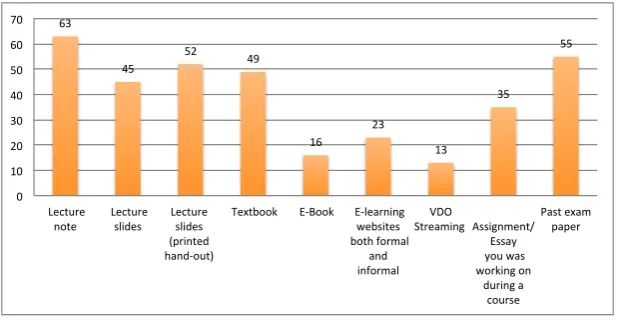
classified by Wade [7]. The pattern of using learning resources in Fig. 2 illustrated that lecture notes
are the most commonly picked materials for revision, in that they were selected by 63 students
(92.5%). It also indicates that students frequently review past exam papers (55/80%), printed lecture
slides (52/76%), and textbooks (49/72%)as part of their revision. However, the interesting thing here
is the very low usage of E-books (16/23%), VDO streaming (13/19%) and e-learning websites (23/33%). In this regard, most universities provide relevant materials on their course websites. These results suggest that typical resources used by students are physical materials, not online materials. Although occasionally lecturers provide resources, such as past exam papers or exercises in electronic form (e.g. PDFs), students often print them out to complete.
63#
45#
52# 49#
16# 23#
13# 35#
55#
0# 10# 20# 30# 40# 50# 60# 70#
#Lecture#
note# #Lecture#slides# Lecture#slides## (printed# hand;out)##
#Textbook# #E;Book# #E;learning# websites# #both#formal#
and# informal###
#VDO#
Streaming##Assignment/# Essay# #you#was# working#on#
during#a# course##
Past#exam# paper#
Fig. 2: Commonly used learning resources for revision
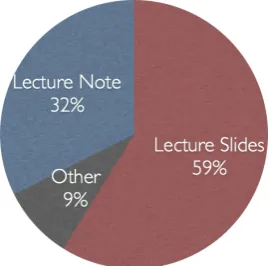
[image:4.595.144.454.511.673.2]Fig. 3: Percentage of first resources to be used when starting revision
3.3 What actions do students take?
When it comes to the revision period, Fig. 4 indicates that the main revision activities that students
generally perform are to organize all learning materials (50/73%) and to do exercises from a past
exam paper (47/69%). The remaining activities still appear to be popular on the part of students, as
noted by the high number of responses. However, there is a very low response on listening to a
lecture from a voice recorder or VDO lecture streaming (6/8%). This confirms the result illustrated in
Fig. 2, which suggests that students make relatively little use of VDO streaming resources. We can therefore conclude that students prefer not to use VDO or audio recordings of lectures for revision purposes.
50#
40#
37#
6#
22#
38#
47#
0# 10# 20# 30# 40# 50# 60#
#Organize#all# learning# materials##
#Read#and#try# to# #define# poten=al#parts#
that#could#be# in#examina=on#
#Read#and#try# #to#link# between# relevant#topics#
of#a#course#
#Listen#to#a# lecture# #from#voice# recorder/#vdo#
streaming#
#Make#new# summary#
notes#by# copying#from#
available# learning# material#
#Make#new# #summary# notes#in#your#
own#words#
#Do#exercise# #from#a#past# exam#paper#or#
[image:5.595.142.457.388.569.2]old# assignments##
Fig. 4: The common strategies that students adopt during revision
3.4 What do they do when they do not understand?
This research is also concerned with the activities and resources that individual students use when they do not understand content during revision. Fig. 5 shows the number of activities when students do not understand a lecture or the content of learning materials. The result reveals that the three most
common activities which students perform when they do not understand is to search for more
information on the Internet (53/77%), to ask a classmate a specific question (49/72%) and to search
for more information in relevant textbooks (34/50%). This suggests that the majority of students prefer
34# 53# 19# 49# 17# 29# 0# 10# 20# 30# 40# 50# 60# Search#for#more## informa6on#in# relevant# textbooks# Search#for#more## informa6on#on## the#Internet# Borrow#a# classmate’s## lecture#notes# Ask#a#classmate## a#specific# ques6on# Ask#a#classmate## to#give#you#a# tutorial# Ask#a#lecturer#or# #teacher#for# assistance#
Fig. 5: The common activities that students perform when they do not understand content
3.5 What do they need?
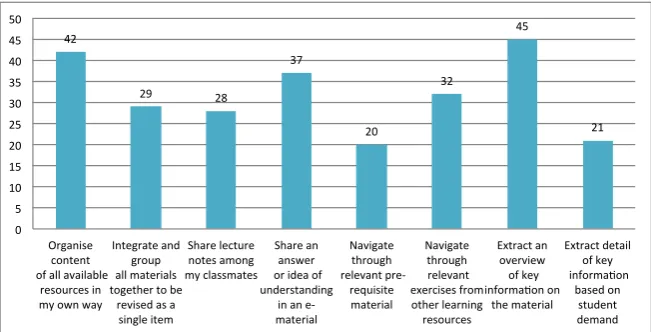
Students were asked in the survey to specify needs of a system to support their revision. Fig. 6 illustrates students’ preferences on supporting functions with regard to e-learning systems that could support their revision. From the figure, we can see that the two highest responses are functions to
extract an overview of key information with regard to the learning material (45/66%) and to help them
to organise content of all available resources in their own way (42/61%). The third ranked item also
had a reasonably high number of responses. This was the function to share an answer or idea of
understanding in an e-material during the revision period (37/54%). The remaining functions had low
responses, supported by fewer than 50% of the sample.
42# 29# 28# 37# 20# 32# 45# 21# 0# 5# 10# 15# 20# 25# 30# 35# 40# 45# 50# Organise# content# #of#all#available# resources#in# my#own#way# Integrate#and# group# all#materials# together#to#be# revised#as#a# single#item# Share#lecture# notes#among# my#classmates# Share#an# answer# #or#idea#of# understanding# in#an#eC material# Navigate# through# #relevant#preC requisite# material## Navigate# through# #relevant# exercises#from# other#learning# resources# Extract#an# overview# #of#key# informaIon#on# the#material# Extract#detail# of#key# #informaIon# based#on# student# demand#
Fig. 6: Students' requirements with regards to functions to support their revision
4 REVISION FRAMEWORK
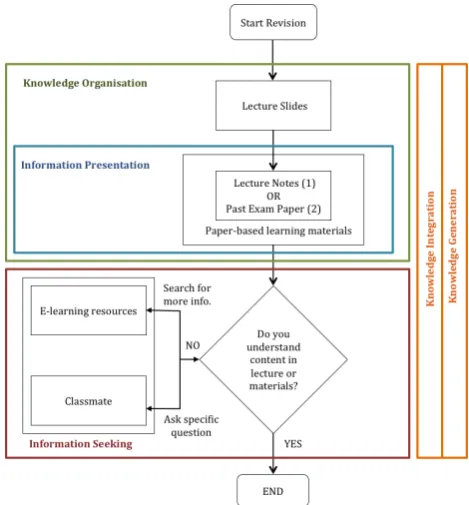
The proposed revision framework in Fig. 7 depicts a common process of revision, pertaining to a use of learning resources by postgraduate students. The framework is derived from the analyses in section 3.
It starts with an initial common resource that students prefer to use during revision, which is Lecture Slides, as discussed in subsection 3.2. A second process is then about gaining further detailed information. Two common resources that students are more likely to use in this process are their own lecture notes and past exam papers. Their own lecture notes were the highest selected resource, as students believed in their own summary, while they also considered practising past exam papers to predict what will be in an examination. It was also evident that students are more likely to use paper-based materials. The results from section 3.4, regarding the strategy and learning resource that students use when they do not understand content, are present in the next process of the revision
[image:6.595.135.461.397.563.2]understand the content, they, first of all, commonly seek more information on the Internet. Secondly, they will ask their friends a specific question and not ask about the whole tutorial.
Fig. 7: Framework for a common process of using learning resources for revision
Currently, there are many tools available to support student learning. Cognitive tools have emerged to help students with cognitive learning activities, which help students to construct knowledge themselves. Cognitive tools are considered as tools to support reflective thinking in self-study learning. When using such tools it is important that they are easy-to-use and that their use helps to manage and does not increase the cognitive load. The five functions of cognitive tools designed by Iiyoshi and Hannafin [9] are mapped into our revision framework, with regard with the definitions below.
• Knowledge Organisation: allows a student to be able to identify a conceptual relationship
between information. In a revision process, this tool would be helpful to a student who always memorises things without understanding (surface learning approach). This tool can help them perceive relevant knowledge. For example, semantic network tools can support student cognition by allowing them to reorganise knowledge, explore conceptual relationships and perform other cognitive activities [10]. This type of tool, therefore, should cover two main processes, which are: (1) acquiring an overview of the course subject from lecture slides and (2) acquiring detailed information from other materials. This is because these two processes are required to understand conceptual relationships of knowledge.
• Information Presentation: allows a student to represent the data in different forms, such as
presenting only relevant data and ignoring irrelevant data. This tool, therefore, allows the student to select relevant attributes and details while ignoring the irrelevant information. Students sometimes have problems with difficulties relating to understanding of content. This tool may help support them by representing data in different forms that may be easier for the student. For example, Nardoo [11] is a system for learning general ecology, which provides information in which students can view, evaluate and compare the same ideas represented in different forms (e.g. graphics, video and audio). This kind of tool is very useful and appropriate with regard to a lot of information that needs to be filtered out [9]. It is supposed to support students when they have to go through a plethora of information in second processes.
• Information Seeking: allows a student to locate and retrieve information relevant to a query
• Knowledge Integration: allows a student to simply identify or connect new knowledge with
existing knowledge. This tool is appropriate when a student learns something new and cannot relate it to existing knowledge. For example, the WISE tool [12] allows students to organise their ideas about evidence collected from the web and integrate them with their existing knowledge. A process of knowledge integration can be used at any stage during revision.
• Knowledge Generation: allows a student to simply present their new ideas or knowledge
meaningfully. This tool is appropriate for students who have difficulty with generating ideas. For example, Presentation Maker [13] is a human body tool which allows students to generate individual artifacts of understanding by blending existing resources, such as graphics and information screens, with personal notes and audio commentary. A process of knowledge generation can also be used at any stage during revision, as with the knowledge integration process.
Two important aspects addressed by this framework are: (1) to made lecturers aware of what kind of existing cognitive tools should be applied or developed for their students, and (2) to allow researchers to use it as a guideline for designing a system to address difficulties that students come across in their revision. It is important to note that some tools can be assigned to more than one category in the framework.
5 CONCLUSION
The main aim of this study is to understand a pattern of student participation in the use of learning resources, and construct a revision framework for both lecturers as well as developers to use as a guideline to apply or develop cognitive tools to support student revision. The findings provide answers with regard to the aims, and also present students preferences that could be used to design a system for the revision process.
From the analysed results, we can see that students commonly use all the materials provided to study. However, the low response with regard to the use of VDO streaming, e-books and e-learning websites came as something of a surprise, because these learning materials are commonly provided on many university course websites. The results suggest that these materials might need to be improved in order to satisfy student needs.
The most common issue that students faced during the revision period is the large amount of learning material to be reviewed. This is consistent with the results in section 3.3 regarding the most common revision strategies, i.e. students attempt to organize all the learning materials before revision. Besides that, many students responded to the need for a system to support them, which extracts an overview of the key information from the learning resources provided by the lecturer and helps them organise the content of all available resources in their own way. This suggests that extracting key information from a large amount of learning resources is one important issue for students. When students find that content was too difficult for them, they prefer to search for more information and figure out a way of understanding difficult content by themselves. They would ask a classmate only with regard to a specific question, and would not ask for the whole tutorial.
This study also indicated that, although individual students use learning resources in different ways, they have a similar order for selecting learning resources for revision. Fig. 7 presents the revision framework constructed from the analysed results discussed in section 3. The framework demonstrates one common pattern of student participation in the use of learning resources, including five types of cognitive tools that were mapped into each process in the framework based on their definition. According to the survey result, knowledge organisation tools and information presentation tools should be considered for use in the revision process. Information-seeking tools, such as Google and Yahoo
search engines, also seem to be significant for supporting a student.
6 FUTURE PLAN
REFERENCES
[1] Entwistle, N. J., & Entwistle, A. (1991). Contrasting forms of understanding for degree
examinations: the student experience and its implications. Higher education, 22(3), pp.205-227.
[2] Bloom B. S. (1956). Taxonomy of educational objectives, Handbook I: The cognitive domain.
New York: David McKay Co Inc.
[3] Entwistle, A., & Entwistle, N. (1992). Experiences of understanding in revising for degree
examinations. Learning and instruction, 2(1), pp.1-22.
[4] Marton, F., & Säaljö, R. (1976). On qualitative differences in learning - II outcome as a function
of the learner’s conception of the task. British Journal of Educational Psychology, 46(2),
pp.115-127.
[5] Biggs, J. (1979). Individual differences in study processes and the quality of learning outcomes.
Higher Education, 8(4), pp.381-394.
[6] Entwistle, N., & Entwistle, D. (2003). Preparing for examinations: The interplay of memorising
and understanding, and the development of knowledge objects. Higher Education Research
and Development, 22(1), pp.19-41.
[7] Wade, B. M. (2012). Adjusting student test preparation through their own self-assessment.
Master’s thesis.
[8] Oppenheim, A. N. (2000). Questionnaire design, interviewing and attitude measurement.
Continuum International Publishing Group.
[9] Iiyoshi, T., Hannafin, M. J., & Wang, F. (2005). Cognitive tools and student‐centred learning:
rethinking tools, functions and applications. Educational Media International, 42(4), pp.281-296.
[10] Jonassen, D. H. & Carr, C. S. (2000) Mindtools: affording multiple knowledge representations for learning, in S. P. Lajoie (Ed.) Computers as cognitive tools: no more walls, Vol. 2 (Mahwah, NJ, Lawrence Erlbaum Associates), pp.165–196.
[11] Harper, B., Hedberg, J., Corderoy, B. & Wright, R. (2000) Employing cognitive tools within interactive multimedia applications, in: S. Lajoie (Ed.), Computers as cognitive tools: no more walls (Mahwah, NJ, Lawrence Erlbaum Associates).
[12] Slotta, J. D. & Linn, M. C. (1999) The knowledge integration environment: helping students use
the internet effectively, in: M. Jacobson & R. Kozma (Eds) Innovations in science and mathematics education (Mahwah, NJ, Lawrence Erlbaum Associates).