http://go.warwick.ac.uk/lib-publications
Original citation:MacDonald, Malcolm, 1953- and Hunter, Duncan. (2013) The discourse of Olympic security 2012 : London 2012. Discourse and Society, Volume 24 (Number 1). pp. 66-88. ISSN 1460-3624
Permanent WRAP url:
http://wrap.warwick.ac.uk/50309
Copyright and reuse:
The Warwick Research Archive Portal (WRAP) makes the work of researchers of the University of Warwick available open access under the following conditions. Copyright © and all moral rights to the version of the paper presented here belong to the individual author(s) and/or other copyright owners. To the extent reasonable and practicable the material made available in WRAP has been checked for eligibility before being made available.
Copies of full items can be used for personal research or study, educational, or not-for-profit purposes without prior permission or charge. Provided that the authors, title and full bibliographic details are credited, a hyperlink and/or URL is given for the original metadata page and the content is not changed in any way.
Publisher’s statement:
http://dx.doi.org/10.1177/0957926512474148
A note on versions:
The version presented here may differ from the published version or, version of record, if you wish to cite this item you are advised to consult the publisher’s version. Please see the ‘permanent WRAP url’ above for details on accessing the published version and note that access may require a subscription.
0 Paper for DISCOURSE & SOCIETY
The Discourse of Olympic Security: London 2012
Malcolm N. MacDonald1 and Duncan Hunter2
Version 2: Friday, 03 August 2012
Centre for Applied Linguistics,
Social Sciences Building
University of Warwick,
Coventry,
CV7 2LA
+44(0)24-76-5-24250
Running head: ‘Discourse of Olympic Security’
Size of paper: ten thousand words
1University of Warwick
1
Abstract
This paper uses a combination of CDA and CL to investigate the discursive realization of
the security operation for the 2012 London Olympic Games. Drawing on Didier Bigo’s
(2008) conceptualisation of the ‘banopticon’, it address two questions: what distinctive
linguistic features are used in documents relating to security for London 2012; and, how is
Olympic security realized as a discursive practice in these documents? Findings suggest that
the documents indeed realized key banoptic features of the banopticon: exceptionalism,
exclusion and prediction, as well as what we call ‘pedagogisation’. Claims were made for the
exceptional scale of the Olympic events; predictive technologies were proposed to assess the
threat from terrorism; and documentary evidence suggests that access to Olympic venues
was being constituted to resemble transit through national boundaries.
Keywords: CDA, corpus analysis, discourse, security, ban-opticon, Olympics, games, sport
2
1. Introduction
Twenty hours after winning a bid to host the 2012 Olympic Games, London sustained a
terrorist attack on its transport system, which killed 52 people and injured over 770. This
combined with memories of the 1972 Munich attack by the Black September Group and the
9/11 Islamist attacks on the Twin Towers to intensify the preoccupation of Games organisers
with security for London 2012 (Coaffee, Fussey and Moore, 2011; Giulianotti and Klauser,
2011; Tsoukala, 2006).
Summer Olympic Games have been called ‘sport mega-events’ because of their scale
(Roche, 2009); these are highly visible, ‘deeply symbolic’ occasions that take place in large
cities, combining intensive media coverage with astringent security and surveillance
strategies (Boyle and Haggerty, 2009: 257). Their ‘exceptional’ nature can be used to justify
the temporary mounting of extensive surveillance technologies for the duration of the Games.
These intensified measures then often become legitimized in perpetuity as part of the ‘legacy’
of a particular Games (Coafee et al., 2011: 3314; Boyle and Haggerty, 2009: 266). Similarly,
sport mega-events can be used to test and develop surveillance technologies that are not only
handed down from one Games to another, but also subsequently deployed across large
swathes of the population (Boyle and Haggerty, 2009).
The two Summer Olympics which took place in the decade following 9/11 - Athens 2004 and
Beijing 2008 - utilized both conventional, human security systems as well as large-scale,
computerised, electronic surveillance technologies. The security operation for Athens 2004
involved 70,000 security personnel (Samatas, 2011; Tsoukala, 2006), 35,000 soldiers
(Coaffee et al., 2011), AWACS aircraft (Brianas, in Samatas, 2011: 3352), Patriot
ground-to-air missiles, police helicopters, fighter jets, minesweepers and a surveillance ground-to-airship, or
‘blimp’ (Coafee et al., 2011). Athens also purchased an ill-fated C4I (Command, Control,
3
surveillance cameras, mobile surveillance vans and chemical detectors (Coafee et al., 2011;
Samatas, 2011; Tsoukala, 2006). In turn, China invited Greece along with experts from 74
other countries to work with them towards the Beijing Olympics (Yu, Klauser and Chan,
2009: 396). This led to the design and implementation of the massive surveillance system
‘Golden Shield’ (Samatas, 2011: 3354), featuring 24/7 monitoring of citizens by CCTV
cameras, Olympic RFID tickets and second generation national ID cards; phone call
monitoring by digital voice recognition technologies; and the ‘Great Firewall’ system of
online censorship and filtering (Klein, 2008). More traditional elements of the security
apparatus included 150,000 security personnel, a 100,000 strong anti-terrorist force equipped
with the latest anti-riot gear, as well as hundreds of thousands of unpaid volunteers who
patrolled as guards and operated as community informants (Samatas, 2011: 3354; Yu et al.,
2009: 399).
This paper will investigate the discursive realization of the security operation for London
2012, drawing on features of Didier Bigo’s (2008) conceptualisation of the ‘banopticon’. It
will analyse a corpus of documents drawn up by UK government departments, Games
organisers and security agencies in the planning for the 2012 Olympics in order to address
two questions: first, what distinctive linguistic features are used in documents relating to
security for London 2012; second, how is Olympic security realized as a discursive practice
in these documents?
2. Literature review
Relatively few previous studies have undertaken a systematic analysis of the discourse of
sport mega-events. Employing a semiotic approach Price (2008) analysed the dramatic
4
installation of US Patriot missiles on the airport’s perimeter in 2004 as the representation of
‘a calculated reaction to internal political dissent or other forms of domestic disorder’.
Focusing on the Athens Olympics, Tsoukala (2006) carried out a content analysis of relevant
articles carried by two prominent US newspapers in the run-up to the 2004 Olympics. Data
reveals an assessment of security measures which feature two attributes: ‘Greek dilatoriness’
and criticism of Greek officials and law enforcement agents; and the ‘potentially limitless and
unpredictable’ nature of the terrorist threat (p. 51). It is therefore necessary first, to situate our
paper within a wider ranging review of studies which drawn on security as discourse; we will
then set out Bigo’s (2008) post-Foucaultian conceptualisation of the banopticon, which will
operate as the theoretical framework for this study.
2.1. Discourse of Security
Early forays into security discourse focused on analysing the role of metaphor (e.g. Chilton
1995: Chilton and Ilyin 1993; Thornborrow, 1993); and this has been taken up more recently
in security studies (e.g. Hülsse and Spencer, 2008; Stump, 2009). Thornborrow analyses a
corpus of press reports on defence summits to compare representations of European defence
in English and French. Although Europe is represented as a person in both datasets, more
metaphors of architecture and structure are used to conceptualize security in English; and
more system metaphors were used to conceptualise security in French (116). Chilton and
Illyn then take up one specific structural metaphor, comparing the uses of ‘house’ as a
metaphor for Europe in English, French, German and Russian. Working with a relatively
unsystematic corpus of ‘public utterances and texts of principal leaders’(27), they also
conclude that metaphors are not transferrable from one language to another, but are processed
in accordance with local institutional and discursive interests. Metaphor has also been
analyzed in the speeches of EU policy makers to uncover the discursive construction of
5
‘crossroads’ and ‘gate’ were used to highlight Turkey’s position at the intersection of
different continents. Relating more specifically to terrorism discourse, Hülsse and Spencer
(2008) analyse a diachronic corpus of articles taken from Das Bild between 2001 and 2005 in
order to consider how Al-Quaeda was constituted metaphorically over the period between
9/11 and 7/7. Principal findings indicate that there was a shift from the use of military
metaphors to those of criminality, transforming Al-Qaeda ‘from an external into an internal
enemy, and from a legitimate into an illegitimate actor’ (585).
In recent years a constructivist, discourse-based approach has been taken up by research in
international relations, political geography and security studies. Many studies have adopted
the ‘linguistic turn’ in order to reject realist conceptualizations of security. From a realist
perspective the term ‘security’ is conceived of as object and language as its means of its
representation; from a constructivist perspective security is constituted through language and
discourse (Aradau, 2010: 493). This linguistic turn originated in the conceptualization of
security as a speech act (e.g. Buzan, Wæver and de Wilde, 1989; Wæver, 1995). On this
argument, security is realized when a particular issue is placed beyond normal political
conventions, thereby eliminating liberal obligations for democratic debate or attention to
individual rights. This is achieved when a politician says it is so: ‘the utterance itself is the act
. . . by uttering “security”, a state-representative moves a particular development into a
specific area, and thereby claims a special right to use whatever means necessary to block it’
(Wæver, 1995: 55). The illocutionary force of a successful securitizing speech act is to bring
about ‘intersubjective understanding…within a political community’ of the need for
exceptional measures to tackle a particular threat (Buzan and Wæver, 2003: 491; Stritzel,
2007: 358-361). Examples of security discourse which have been analyzed using this
approach include: documents relating to the positioning of Turkey’s security policy as it
6
Solomon Islands, Papua New Guinea and East Timor as ‘failed states' (Lambach, 2006) ; and
discourses of Australian environmental security in relation to that of Asian countries
(Chaturvedi and Doyle, 2010). However, despite later attempts to broaden securitization
theory beyond the momentary intentionality of a single actor (e.g. Wæver, 2001),
securitization theory has been criticized for underdeveloping the role of social context, and in
particular for prioritizing the role of the actor over the audience in the linguistic act
(McDonald, 2008; Stritzel, 2007).
In stating that they are ‘moving away from a focus on intent’ (226), Sovlacool and Halfon
(2007) appear to position themselves over against the Copenhagen School, defining discourse
as “a historically emergent system of objects, concepts, categories and theories that mutually
reinforce each other, thereby stabilising meaning and identity”(225). In order to explore the
discursive construction of the post-conflict reconstruction of Iraq, they analyse documents
from strategic reports, presidential speeches and press briefings, identifying four ‘narratives’
relating to: “the evilness of Saddam Hussein, the helplessness of the Iraqi population,
America as protector, and the international legitimacy of Iraqi reconstruction” (238).
However, these are ultimately over-determined by the ‘historical erasure’ of the US sanctions
on Iraq in the run-up to Gulf War II. Taking both a retrospective and prospective view,
Krebs and Lobasz (2007) assess how the dominant discourse which the US Republican
administration established in the run-up to the invasion of Iraq became ‘hegemonic’,
unassailable by the Democratic party. Finally, Morrissey (2011) uses one particular
institutional site, the Center for Strategic and Budgetary Assessments, as the unifying element
in his exploration of the ‘discursive tactics’ used in calling for a long-term commitment of
US forces to oversee American political and economic interests in the Middle East (442). In
so doing, he reveals the role of the “military-strategic studies complex” in advancing the
7
Foucaultian approaches of different hues have also been adopted in the analysis of security
discourse. Drawing on the thesis that that ‘the production of a truth, or the creation of
knowledge through a discourse, is an exercise of power (2005: 164, after Foucault, 1980:
93-4), Ibrahim examines the 1999 portrayal of the ‘Chinese boat people’ in a corpus derived
from six principal English language newspapers. Evidence indicates that these newspapers
constituted the migrants as a security threat and imputed them with criminal status, due to
their ‘undocumented and illicit arrival ’ (180). Within the context of European security,
Mälksoo (2006) analyses a wide ranging corpus drawn from speeches, interventions, remarks
and articles by the foreign policy ‘establishments’ of three Baltic countries - Estonia, Latvia
and Lithuania (276) - to reveal perceptions of their relationship with the EU. Here, discourse
is understood as ‘a relational system of signification that constructs social realities and is
productive/reproductive of things defined by it’ (277). In the event, it appears that the ‘Baltic
Three’ remain positioned on the margins of Europe, as ‘the embodiment of the liminality in
the European self-image, in the course of a perpetual politics of becoming “more European”’
(288). Applying a later Foucaultian epistemology (2008) of ‘governmental rationality’ to
peace-building in post-conflict societies, Chandler (2010) examines how the role of civil
society has been constituted in three different discourses which have been subject to
‘transformation and inversion’ through modernity (Foucault, 2008: 118). Neither the
discourse of race which embedded the ‘external intervention and regulation of non-western
countries’ in a eugenicist ideology or the discourse of culture which superseded it as an
‘essentialising discourse of inequality’ are now sustainable as constituting grounds for
peace-building in post-conflict societies. However, a discourse of civil society which privileges
liberal notions of autonomy and conceives of intervention as enabling the individual can
8
political problems, while vindicating a judgemental and moralistic position towards them
(387).
The studies of security discourse carried out in the social sciences and reviewed above all
yield valuable insights into the phenomena which they are investigating. However, from the
perspective of discourse analysis they often use corpora which are either relatively small
scale or ad hoc, and their approach to the actual analysis of discourse at times appears
relatively underdeveloped. Often, they appear to be drawing on documentary evidence in
order to glean more generalized qualitative data rather than actually analysing distinctive
linguistic forms, the impact of specific speech acts, or the contours of discourse. And to us, it
would often appear that these approaches are used more as a warrant for adopting a more
broadly constructivist stance towards security issues, rather than undertaking a detailed
analysis of the texts in questions.
2.2. Banopticon
Foucault’s well-known description of the Panopticon (1977: 195-230) has long done service
in critical discourse studies as a metonym for the economical and systematic surveillance of
modern populations. By analogy, Didier Bigo has proposed that a contemporary episteme of
‘(in)security’ has led to the establishment of a ‘banoptic dispositif’ within late capitalist
societies, and particularly those countries within the European Union (2008: 10).
This formulation of the ban-opticon allows us to understand how a network of heterogeneous and transversal practices functions and makes sense as a form of (in)security at the transnational level. It allows us to analyse the collection of heterogeneous bodies of discourses…, of institutions…, of architectural structures, …of laws…, and of administrative measures…. It allows us to understand that the surveillance of everyone is not on the current agenda, but the surveillance of a small number of people, who are trapped into the imperative of mobility while the majority is normalised … (Bigo, 2008: 32).
One periodic crystallization of this banoptic trend is the quadrennial mounting of the Summer
9
‘militarised fortresses’ or ‘super-panopticons’ (Samatas, 2011: 3359-3360). In this paper we
consider how key features of the banopticon are constituted within a corpus of official
documents relating to the London 2012 security operation.
There are three ‘dimensions‘ of the ban-opticon: exceptionalism, exclusion and normalisation
(Bigo, 2008: 31-36). Shortly after 9/11, the US and the UK put in place exceptional legal
measures through the Patriot Act (2001) and the Prevention of Terrorism Act (2005), which
limited the juridical rights of both temporary residents and citizens. However, for Bigo
‘exceptionalism’ refers not only to the continuing maintenance and enforcement of ‘special’
laws in the period after the attack, but also to the ways in which “the ‘dominated’ of a
specific time and place are socialised by their rulers to believe that they are deciding what
kind of dominating powers are acceptable or not” (Bigo, 2008: 33). The second dimension is
the identification and exclusion of individuals who appear to constitute a threat. To do this,
modern computer technologies are used to collate and analyse data from a wide range of
public, private and police sources in order to detect possible offences that might be carried
out by potentially risky individuals or groups. This entails the normalisation of people’s
behaviour through pro-active analysis and prediction. This ‘criterion’ of normalization arises
principally from the ‘imperative of free movement’ within modern, globalised societies. For
Bigo, this imperative does not arise from a dichotomy between those who are permitted
access to mobility and those who are not permitted; rather it becomes a touchstone for the
normalization of the majority of the population, and a focus for the surveillance of a minority
10
3. Methodology
This paper combines techniques of critical discourse analysis (CDA) and corpus linguistics
(CL) to analyse a collection of texts in the public sphere (c.f. Baker, 2010; Baker and
McEnery, 2005; Baker, Gabrielatos, Khosravinik, Krzyzanowski, McEnery and Wodak,
2008; Gabrielatos and Baker, 2008). Eleven UK institutional sites were identified as
pertinent to the security operation for the 2012 London Olympic Games including UK
government departments, UK security forces, games officials and private security companies
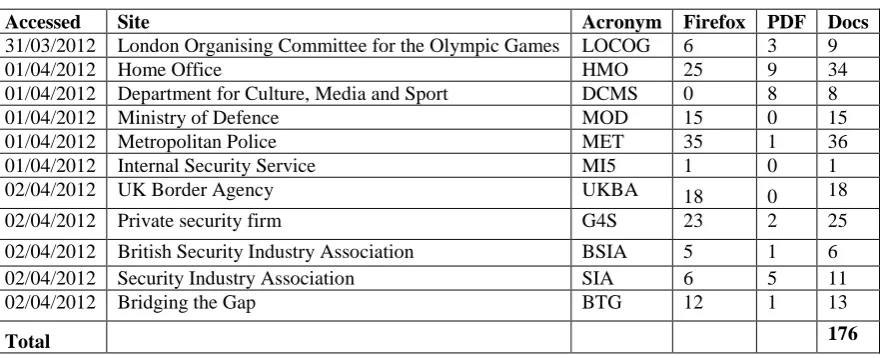
(Table 1). Their websites were searched between 30 March and 3 April, 2012 for documents
yielded by the term ‘Olympic security’. Searching continued until hits for candidate
documents were exhausted, and the corpus amounted to a near-total population of 176 online
documents relating to our search term. The corpus was comprised of a range of genres
(including departmental reports and webpages), and formats (including PDF files, Word
documents and WebPages saved in Firefox format). The entire corpus was then
machine-searched using Wordsmith Tools Version 5 (Scott, 2008) for preliminary statistical data such
[image:12.595.75.519.529.708.2]as keywords, key-keywords and collocations of significant lexical items.
Table 1: Documents relating to Olympic Security (2010-2012) (n=176)
Accessed Site Acronym Firefox PDF Docs
31/03/2012 London Organising Committee for the Olympic Games LOCOG 6 3 9
01/04/2012 Home Office HMO 25 9 34
01/04/2012 Department for Culture, Media and Sport DCMS 0 8 8
01/04/2012 Ministry of Defence MOD 15 0 15
01/04/2012 Metropolitan Police MET 35 1 36
01/04/2012 Internal Security Service MI5 1 0 1
02/04/2012 UK Border Agency UKBA 18 0 18
02/04/2012 Private security firm G4S 23 2 25
02/04/2012 British Security Industry Association BSIA 5 1 6 02/04/2012 Security Industry Association SIA 6 5 11
02/04/2012 Bridging the Gap BTG 12 1 13
11
An innovative, mixed-methods approach was then devised, which prioritised qualitative
analysis (QAL) and quantitative analysis (QAN) differently in each of two phases. Phase 1
prioritised qualitative analysis (QAL+qan). Here, a combination of interpretive reading and
key-keyword analysis was carried out to identify a core sample of 12 texts in which corpus
themes were most densely concentrated. Then, documents were intensively treated and coded
for linguistic features and preliminary themes. Phase 2 prioritised quantitative analysis
(QAN+qal). Here, corpus tools were again applied intensively using a combination of
concordance, collocation, and cluster data to reveal cross-corpus variations in linguistic
phenomena identified previously in the sample. Selections made were also cross-checked via
themes suggested by the keyword and keyword distribution data.
4. Results
In the analysis that follows, we examine some of the linguistic features through which the
security operation surrounding the 2012 Olympic Games is discursively realized, and map
these on to the three key features of the banopticon (after Bigo, 2008): exceptionalism,
exclusion and prediction; as well as what we will call ‘pedagogisation’.
4.1.Exceptionalism
A qualitative reading of core texts revealed a number of linguistic devices which were
deployed to assert the exceptional nature of the Games. In the following examples,
superlative and limit adjectives are repeatedly used to refer to the Games, in order to
communicate a sense of their remarkable size and ‘scale’.
12
The Government has made safety and security at the Games a top priority to ensure that everyone can enjoy the celebrations peacefully. This is important, as the sheer scale of London 2012 will place many demands on policing, the emergency services and security (HMO, 2011a: 5).
Across the corpus, ‘biggest’ (n=38 times), ‘greatest’ (n= 16) and ‘largest’ (n=48) are
deployed for a similar hyperbolic purpose, e.g.:
I am proud to be leading what will be the Police Service's biggest ever peacetime safety and security operation (MOD, 2011).
The Government is completely behind the London 2012 ticketing strategy, which will give spectators from all walks of life the chance to see the greatest sporting event in the world (DCMS, 2010: 3). Another recurrent theme realized through such language associated with the scale of the
Games, is the impact they will have on different security sectors.
The Olympics are the biggest peacetime operation that the Police Service will have had to undertake and it has to be expected that there will be an impact on policing during 2012 (LOCOG, 2012). This unprecedented call on private security across the UK could affect your business or organization (SIA, 2012a:1).
There are also a number of references to the simultaneity of the Games with other sizeable
British events. These suggest that arrangements for the Olympics form only one part of a
larger, contiguous security enterprise:
In addition, World Pride, the Notting Hill Carnival and the Queen’s Diamond Jubilee celebrations are due to take place across the same time period (London Assembly Health and Public Services Committee, 2010: 7).
Also taking place in 2012 are regular events such as Wimbledon and the Notting Hill Carnival, as well as the celebrations for Her Majesty The Queen’s Diamond Jubilee (HMO, 2011a: 1).
This phenomenon occurs particularly densely in the core texts , but can also be identified
across the whole corpus. In the following, non-core text, the sense of scale and simultaneity
are combined.
13
These linguistic features realise three different sets of exceptional circumstances surrounding
the Games, and provide grounds for the mounting of a correspondingly extensive security
operation.
One phrase in particular is used emblematically (132 times in just 12 texts) to constitute the
over-arching goal of this endeavour, e.g.:
The Government has made safety and security at the Games a top priority to ensure that everyone can enjoy the celebrations peacefully (HMO, 2011a:5).
We are creating a sporting environment that has safety and security built in, leaving a groundbreaking legacy that will last beyond the Games (HMO, 2011a: 10).
These extracts from core texts, exemplify the way in which the phrase ‘safety and security’
becomes reified as a formula which occurs 254 times across the whole corpus. While the
individual nouns, SECURITY and SAFETY, are high ranking keywords(n=1908, LL 11616;
n=397, LL 1607), the entire phrase ‘safety and security’ is also remarkably salient in
statistical terms (LL=2871). Lexical collocates of the combined phrase are: strategy (n= 57),
programme (n=30), delivery (n=27), operation (n=24), plans (n=16), operations (n=13),
assessment (n=13), disrupt (n=6); and ensure (n=27). Investigating these, further evidence of
nominalisation and reification appear, e.g.:
Assurance of Games-wide readiness: is the delivery of Games safety and security compatible with the broader Games operation (HMO, 2011b:22).
The Centre will support Police and other Services officers delivering safety and security operations to the Olympic Park (HMO, 2010: 7).
Here ‘safety and security’ is again formulated linguistically as a pre-established notion no
longer amenable to scrutiny or justification.
The dual adjectival phrase ‘safe and secure’ is also used within the corpus, frequently
premodifying ‘Games’, and now presented as being coterminous with the Olympic ethos. In
this example, the two properties are accorded a positive evaluation in the form of a mission
14
To deliver a safe and secure Games, in keeping with the Olympic culture and spirit. In the context of this Strategy, safe means the protection of people and property from hazards caused by non-malicious incidents. Secure means the protection of people and property from threats, caused by incidents and attacks of a malicious nature (HMO, 2011b: 7).
The positive semantic prosody of the expression can be perceived most easily by
investigating its adjectival counterpart. The form SECURE emerges as the 55th strongest
lexical keyword (LL 817), with SAFE ranked 97th (LL 553); the combination ‘safe and
secure’ occurs 110 times in 51 texts. A concord analysis reveals that the most frequently
occurring verbal collocates of the combined phrase are ensuring (n=14), planning (n=13),
ensure (n=13), disrupt (n=6) and delivering (n=6). The strong positive semantic prosody lent
by these verbs is can be seen in the following:
Our experiences show that access to the ‘window of world intelligence’ is vital to ensure a safe and secure Games (London 2012, 2012).
Looking outside the corpus, the positive prosody of ‘safe and secure’ is exposed by its
collocation (in the British National Corpus, 2007) with top ten items such as ‘feel’,
‘children’ and ‘home’.
4.2.Exclusion
Through the Schengen Agreement, 26 EU and non-EU countries have agreed to allow free
movement across their borders. However, some agencies and technologies restrict free
movement and operate ‘exclusion zones’ even within the Schengen Zone. Examples of these
include the large numbers of interviewing rooms used for detention at airports, as well as
more extreme cases such as the concealment of detainees in police kennels near Charles De
Gaulle airport (Bigo, 2008, p. 37). Despite the lapse of passport controls, Bigo goes on to
suggest that the EU borders are still being policed, but now clandestinely by ever more
dispersed, and heterogeneous agencies which include not just national and local police forces
15
The UK still has not signed up to the Schengen Agreement and maintains passport controls
at its national borders. Within our core documents, we find public assertions by the UK
Border Agency (UKBA) of an intensified regulation of access through controls on UK
national boundaries during the Games period, e.g.:
When you arrive at the UK border, you will need to show the following items to a UK Border Agency officer: A valid travel document (for example your passport); A valid visa (if required); A completed landing card … You must satisfy a UK Border Agency officer that you meet the requirements of the Immigration Rules, so even if you do not need a visa you may need to show the officer certain documents to support your request to enter the UK. Your passport will be scanned and your landing card and visa will be checked. The officer may ask you for more information about your visit before allowing you to enter. If you hold a visa, your fingerprints will also be verified (UKBA, 2012a: 3).
In this extract, the prospective ‘visitor’ is addressed directly and insistently through 12
instances of the second person pronoun and possessive adjective, and positioned in a deficit
of power, subservient to the ‘officer’ empowered by the ‘UK Border Agency’ (UKBA).
Moreover, the repeated modalization of the lexical verb forms - ‘show’ , ‘satisfy’, ‘meet’,
‘scanned’, ‘checked’, ‘ask’, ‘allow’, ‘verified’ – demonstrate the multiplicity of minutely
detailed moves through which the securitised subject must yield to the ‘gaze’ of the UKBA
agent (after Foucault, 1973; 1977).
In addition to this regulation of national borders, quasi-border mechanisms also appear to be
discursively constituted in our texts in order to control access and egress from each of the 34
Olympic venues within national boundaries. This core document addresses the ‘spectator’
directly, constructing her as a compliant, sentient agent realised by the non-agentive mental
process ‘see’, while the security agents are positioned as active participants who ‘have a role’
and ‘use…methods’, exemplified by the harsh materiality of ‘bag searches’, ‘screening
machines’, ‘CCTV’, ‘metal detectors’:
16
Looking at the whole corpus, this construction of the visitor’s role is achieved via a number
of linguistic devices. In fact, documentary evidence suggests that through a process of
systemic mimesis, Olympic sites are being modelled to reproduce the mechanisms of
exclusion found on national borders. Paradigmatically, each venue's webpage carries the
invocation:
When you get to the Olympic Park, you’ll be asked to go through airport-style security screening. With so much going on and thousands of people arriving at the same time, you should expect to wait. This is followed by another minute specification of the proposed timetable of travel to each
of the Olympic venues:
Aim to arrive at the Olympic Park around two hours before your session starts so you have plenty of time to go through airport-style security screening and get to the Millennium Stadium… You should be at the Millennium Stadium 90 minutes before your session starts. Make sure you’re in your seat at least 30 minutes before the start time on your ticket for the build-up to competition.
Here a combination of imperative and strongly modalised verb forms convey a sense of
urgency to ‘spectators’ and ‘visitors’. This passage continues with a list of bizarrely specific
items which spectators are prohibited from bringing into the venues: ‘liquids, aerosols or gels
in quantities larger than 100ml’, ‘alcohol’, ‘glass bottles larger than 100ml …’, ‘excessive
amounts of food’, ‘large flags, oversized hats and large umbrellas’. All-in-all the behavioural
semiotics of access and exclusion from the Olympic venues appears to be homologous with
that found at airports on national borders. Through breaking down the technologies of
movement into minutely specified 30 minute segments, the micro-populations who
temporarily come to inhabit each of the 34 Olympic sites are constituted as legitimate
‘spectators’, (c.f. Foucault, 1977: 135-170).
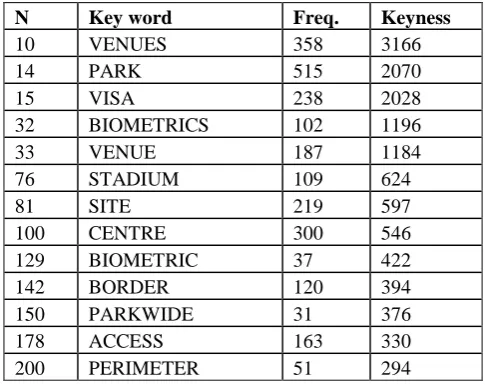
Through qualitative examination, thirteen of the 200 strongest keywords emerged as
constitutive of the banoptic strategy of exclusion (Table 2). Of these, VENUES is by far and
17
The design and construction of the Olympic Park is based on ‘Secured by Design’ best practice and has sought to design out vulnerabilities. Additional security measures at Games venues relating to infrastructure and people will be proportionate to the risk and delivered in the most cost-effective way possible (HMO, 2011b: 11).
Throughout, ‘venues’ are constructed as sites where security efforts which entail the potential
exclusion of spectators are concentrated. Security is also the third most frequent lexical
collocate of VENUE/ VENUES with, predictably, only Olympic and Games being more
frequent, e.g.:
LOCOG will use a private security company to deliver a venue based security operation, which will include searching and screening everyone entering the competition venues (MET, 2012).
Here the longer nominalised phrase, ‘venue based security operation’, serves to emphasise
the focus of security upon the Olympic sites themselves. Additionally, the importance of the
legacy of Games both in terms of structure and security is evidenced by its most frequently
[image:19.595.176.419.437.631.2]occurring cluster: venues and infrastructure (n=35).
Table 2 Lexis within the strongest 200 keywords relating to exclusion
Also, within one of our core texts (SIA, 2012a: 2), circumstantial adverb phrases are used
(after Halliday and Matthiessen, 2006) to designate the security operation as being
widespread, extending beyond the Olympic venues themselves, e.g.:
N Key word Freq. Keyness
10 VENUES 358 3166
14 PARK 515 2070
15 VISA 238 2028
32 BIOMETRICS 102 1196
33 VENUE 187 1184
76 STADIUM 109 624
81 SITE 219 597
100 CENTRE 300 546
129 BIOMETRIC 37 422
142 BORDER 120 394
150 PARKWIDE 31 376
178 ACCESS 163 330
18
The Olympic and Paralympic Games will be far more than just a London event . The need for security stretches far beyond the Olympic Park.
Here, the repeated use of the emphatic premodifier ‘far’ conveys rhetorically the sense of the
scope and urgency which the SIA, the security arm of the Home Office, asserts surrounds the
London 2012 security operation.
4.3.Prediction
Prediction has become a principal role of the security services, with modern police forces
being increasingly organised around ‘a few highly qualified people…[who]… make
prospective analyses based on statistical knowledge, hypothetical correlations and supposed
trends’ (Bigo, 2008: 35). Distinctive statements emerge within our corpus relating to the
identification and assessment of possible dangers facing the 2012 Games. For example, the
following passage from a core text includes several closely packed linguistic indicators of
the strategy of prediction, embedded within a wider ranging language of contemporary
‘governance’ (Mulderigg, 2011a; 2011b) .
A key element of our strategy is to identify any threats to the Games accurately and at an early stage. This enables us to take appropriate action to ensure that they are disrupted before they can have any impact on safety and security (HMO, 2011a: 11).
The transition of this sequence of clauses from a mental process (‘identify’) to a material
process (‘disrupt’) (after Halliday and Matthiessen, 2006) is suggestive of a causal link
between the semiotic processes of surveillance and the materiality of intervention; while the
adverbial phrases in the first sentence - ‘accurately’ and ‘at an early stage’ – specify the
technical parameters of the security operation. The logical transition between the first and
second sentence is realized by the insertion of the less easily classifiable verbs ‘enable’ and
‘ensure’. However, on Mulderigg’s description, these verbs realize a process type specialized
19
this contemporary modality of discourse, the use of first person pronominal forms - ‘our’,
‘us’ – also creates a sense of proactive engagement on the part of the government department
though a discursive process of ‘personalisation’ (Mulderigg, 2011b: 565-569).
The strategy of prediction is also realized in a number of the strongest 200 keywords in our
corpus. Those, which on detailed qualitative examination, appear to be strongly consistent
with this strategy are: EMERGENCY (ranked 43rd, LL 941), PLANNING (ranked 89th, LL
575), RISKS (ranked 96th, LL 553), STRATEGY (ranked 102th, LL 530), RISK (ranked
144th, LL 393), FORECAST (ranked 163rd, LL 353), and DETECTION (ranked 196th, LL
299). While the prominence of EMERGENCY can be partly accounted for by the frequent
occurrence of the phrase ‘emergency services’ (n=115), some instances nevertheless clearly
realize this strategy, e.g.:
Challenges during Games time include public order, crowd control, transport, road traffic, serious crime, emergency planning and counter-terrorism measures (London Assembly, 2012: 14).
PLANNING also collocates strongly with ‘security’, which emerges as its most frequent
lexical collocate (n=47), e.g.:
Intelligence will remain critical to the understanding of threats and the evaluation of risk. Safety and security planning and delivery will be intelligence-led and risk-based (HMO, 2011b: 11).
Here, the collocation ‘security planning’ appears within a co-text saturated with linguistic
forms suggestive of prediction: the nominal phrases ‘understanding of threats’ and
‘evaluation of risk’, as well as the compound adjective ‘risk-based’ - which appears to have
more of a rhetorical than a substantive function. An investigation of RISK and RISKS yields
language thus deployed :
And our Olympic Security plans take into account the need to cope with the risk of either planned or spontaneous disorder and to ensure the police have the resources they need to deal with it (May, 2011). This example is notable for its euphemistic labelling of potential attacks. Many incidences of
20
fifth, n=27), are accounted for by documents’ reference to one specific policy - the Olympic
and Paralympic Safety and Security Strategic Risk Assessment: initialised as ‘OSSRA’. This
policy is described as containing:
[…] assessments of the relative severity of a wide range of major accidents or natural events
(collectively known as hazards) and malicious attacks (known as threats), as well as assessments of the potential risks that serious and organised crime, public disorder and domestic extremism may pose to safety and security during the Games (HMO, 2011d: 2).
Here, OSSRA divides risks taxonomically into ‘hazards’ and ‘threats’. Of these, THREAT
(ranked 220th, LL 233) emerges as the more salient across the corpus and evidence that it
realizes the strategy of prediction can be found in the following:
We know we face a real and enduring threat from terrorism and we know that the games – as an iconic event – will represent a target for terrorist groups(May, 2012).
The most frequent collocate for THREAT is level (n=25). This relates closely to OSSSRA’s
rating system, which describes perceived dangers from terrorism:
The threat level represents the likelihood of an attack in the near future. The five levels are: CRITICAL - an attack is expected imminently
SEVERE - an attack is highly likely
SUBSTANTIAL - an attack is a strong possibility MODERATE - an attack is possible but not likely LOW - an attack is unlikely (HMO, 2012)
The same document designates the current threat level to the UK as ‘SUBSTANTIAL’. This
example would therefore suggest that the predictive function of the banopticon is not only to
identify a generic threat, but also to rank it.
In contradistinction to these precise assertions of the likelihood of an attack, an examination
of threat as acollocateof TERRORISM indicates that the perpetrators are hardly ever
specified, and where they are, only anachronistically (Fig. 1). This concordance data reveals
only two attributions of terrorism, to the ‘Northern Irish’ (l.2), and ‘related to Northern
21
origins of a terrorist threat within these policy documents. TERRORISM also emerges in its
own right as a strong keyword across our corpus (ranked 54th, LL 820). In a core document
relating to the security strategy for the Games, the Home Office states boldly:
The greatest threat to the security of the 2012 Olympic and Paralympic Games is terrorism (HMO, 2011b: 12).
However, it is notable that the concept occurs only as an abstraction and, again, the noun
‘terrorist’ does not appear anywhere to attribute agency to ‘terror’.
Fig 1: concordance for terrorism+ threat
4.4. Pedagogisation
In order to provide security, LOGOC required that tens of thousands of specially recruited
staff be trained for the 2012 Games. Our core texts reveal an intense concern with the
provision and monitoring of this process. For example, this extract includes the following
series of instructions:
We have published guidance on our website advising people of the circumstances in which they can and cannot work legally … Security operatives must comply with the law which we and our partners will continue to enforce during this period (SIA, 2012b: 1).
N Concordance
1 any given time. Threat from international terrorism The current threat level is 2 possibility. Threat from Northern Irish terrorism The current threat level is set 3 for setting the threat level from terrorism related to Northern Ireland, 4 the level of threat the UK faces from terrorism at any given time. This system 5 the UK’s work to counter the threat from terrorism. Our primary objective is to 6 Terrorism The threat from terrorism to the United Kingdom is real 7 we face a real and enduring threat from terrorism and we know that the games – 8 our plans on the basis of a national terrorism threat level of SEVERE; • the 9 The uK faces a sustained threat from terrorism. Beyond traditional methods of 10 basis that the national threat level from terrorism will be SEVERE and requires 11 in place to combat the threat of global terrorism. 12.2 Activist minorities Alert 12 an increase in the threat level from terrorism to CRITICAL. 52. All delivery 13 setting the threat level from international terrorism. To do this, they consider 14 the level of threat the UK faces from terrorism at any given time. Threat from 15 to this effort. Whether the threat is from terrorism, serious crime and fraud,
16 Terrorism The threat from terrorism to
22
Here the addressers, ‘we’, are positioned in the text as both the authors of the document and
the enforcers of prohibitions relating to the integrity of the security operation. This
insistence upon the need for legislative control of security operatives recurs elsewhere in this
text and throughout the corpus, e.g.:
It is a legal requirement that an individual who provides defined manned guarding services in the UK holds the appropriate licence (SIA, 2012c: 1).
…it is a criminal offence to work in a licensable security role without the relevant SIA licence. (SIA, 2012a: 3).
In different documents, the repeated impersonal formula ‘it is...’ combines with opposing
articulations of the same phrase, ‘legal requirement’ and ’criminal offence’, to construct a
‘doxa’ (after Bourdieu, 1991), stipulating the presence of a ‘licence’ as the authoritative
signifier of identity. A further stipulation attempts to eliminate the arbitrary relationship
between the ‘title’ on the licence (signifier) and the actual ‘job’ enacted by its holder
(signified) in order to delineate stable, and strongly specified, categories of subject.
It is important to note that it is not what your job title is, but what you do that defines if you need a licence. For example, you may be referred to as a personal trainer, or a coach, or maybe a chauffeur, but if you provide any of the licensable services defined in this guidance … without a licence you will be committing an offence and be liable to criminal prosecution (SIA, 2012a: 6).
Here, we have the now customary emphasis introduced by the clause ‘It is important’, the
insistent, direct address of the operative repeating the personal pronouns ‘you’ and ‘yours’,
and the conclusion of this extract with a double threat specified by the unmodalised future
auxiliary ‘will’.
The precise nature of the security provision is further specified through its pedagogic
programming. In order to get a licence, 'operatives' either have to show evidence of previous
experience or undergo a proscribed training programme, e.g.:.
Close protection training takes 146 hours, door supervision 30 hours and security guarding 26 hours. This training can only be delivered by training providers who have been approved by SIA endorsed
23
Moreover, it is not just ‘security operatives’ who are specified in this document, but also
‘training providers’. Therefore, a clearly demarcated hierarchy of disciplinary subjects
appears to be constituted in these documents: ‘we and our partners’ (government agents and
their proxies); ‘training providers’ (pedagogues); and, by implication, their trainees.
TRAINING, a keyword in the corpus (ranked 220th, LL 332), is frequently deployed within
passages realising this strategy. Less than 5% of incidences of the term, analysed in a
randomised sample, appear to relate to athletic training (as one might perhaps expect in a
corpus of documents relating to the Olympic Games). Overwhelmingly, it refers to the
pedagogic process via which personnel are prepared to assume security roles. In the
following, the application of training as a ‘disciplinary’ technology can be glimpsed (c.f.
Foucault, 1977) :
Bridging the Gap is made of up to four short training units dependent on your role. You’ll need to complete the training units required for your role as well as pass an interview and be 18 years old by 1st July before you can start employment:
Level 2 Award in Door Supervision – 38 hours or four days Skills for Security training (Including Argus Briefing)
X-Ray operator training (If required for Games Time Role)
Role specific training (Bridging the Gap, 2012)
The concern which is realised within our corpus around the regulation of security operatives
is also reflected in the relative strength of ACCREDITATION and ACCREDITED as
keywords (respectively ranked 45th, LL 912; ranked 118th, LL 460). Lexical collocates of
ACCREDITATION are card (n =34), identity (n =23 ) and, intriguingly, category (n =16 ).
Even the ‘indexical’ text of this card (after Pierce, 1998) becomes tightly proscribed by the
documents, e.g.
24
as is the nature of its articulation upon the securitised subject of the 2012 Games:
Many of the people attending the 2012 Olympic and Paralympic Games venues for official or work purposes will need to be accredited…Accreditation is the process of identifying and issuing a pass to those individuals who will need access to Olympic and Paralympic venues in an official capacity during the Games… Accreditation passes are used to identify people and their roles at the Games and to allow access to relevant sites … (HMO, 2011c).
This is confirmed by the word’s regularly associated clusters: identity and accreditation
(n=12) and accreditation card (n=12).
5. Discussion
Recent empirical work in international relations and sociology has suggested that a new
modality of (in)security has been brought into play within advanced capitalist societies. In
particular, it has been proposed that the contemporary ‘management of unease’ establishes a
‘ban-optic dispositif’ in UK, France and other countries in the EU (Bigo, 2008: 10). The
range of distinctive linguistic features set out above have been mapped onto three key
features of this banopticon: exceptionalism, exclusion and prediction, as well as what we
have called ‘pedagogisation’.
Previous research carried out in the fields of sociology, criminology, urban studies and sports
science (e.g. Boyle et al., 2009; Coaffee et al., 2011; Fussey, 2012; Giulianotti and Klauser,
2011; Samatas, 2011; Yu et al, 2009) has suggested the Summer Olympic Games generate
localised conditions under which exceptional legal, military and policiary measures are put in
place which often remain indefinitely after the Games have ended. Exceptionalism is also for
Bigo, a principal ‘dimension’ of the banoptic ‘dispositif’ (2008: 31-36). Our analysis suggests
that a range of linguistic devices were deployed to give the impression that London 2012
constituted an exceptional set of circumstances: the use of superlative and limit adjectives,
regular references to the impact of the Games on different security sectors and regular
25
2006) the function of these hyperbolic descriptions was to create a set of imaginary relations
between the Games and its wider context, which could be used as a logical pretext to justify
the scale and extent of the security operation for London 2012. This security operation was
dubbed insistently in the corpus with the noun phrase ‘safety and security’ in order to yoke
the positive connotations the word ‘safety’ with the more problematic concept of 'security',
and imbue it with greater positivity. The combination of nouns was also used so repetitiously,
and in a manner which became so devoid of context, that it appeared to become a ‘reified’
concept across the corpus (after Lukacs, 1923/1967).
The second ‘defining trait’ of the banopticon is its ‘ability to construct categories of excluded
people connected to the management of life’. This practice of exclusion is closely linked to a
contemporary principle of normalisation which ‘occurs primarily through …the imperative of
free movement of people’ (Bigo, 2008: 35-36). In short, the banopticon operates through
maintaining the free movement of ‘normal’ populations within and across borders; while
identifying and restricting the movement of those identified as constituting a ‘threat’ to
society, usually being classified along a cline which runs from ‘immigrant’ to ‘terrorist’.
There appeared little doubt on our reading of core texts and subsequent corpus analysis, that
control of mobility was a principal tactic whereby power was articulated upon the Olympic
subject, whether constituted as ‘visitors’, ‘spectators' or ‘Olympic Games Family Members’
(‘OGFMs’). Not only did we find linguistic assertions of an intensified regulation of
movement across national borders but - most strikingly - a distinctive form of site specialised
to the Games, the ‘Venue’, appeared to be discursively constituted with a set of minutely
specified controls on the movement of micro-populations into and out of each event. In this
respect, the principle of control, surveillance and regulation, which within the Schengen
26
subject to a process of discursive multiplication and mimesis actually within the borders of
the UK.
However, while we discovered evidence of the principle of exclusion as a general discursive
strategy, we found fewer signs of a one key related component of the banopticon: the
identification and expulsion of particular groups of subjects. While a range of lexis relating to
the strategy of prediction emerged from our analysis - with THREAT being a particularly
salient keyword - attribution of the ‘threat’ to the Games to any particular individual, group
or movement appeared to be absent; and the only two instances of attribution - to the
'Northern Irish' - were bizarrely anachronistic. This refusal to identify oppositional groups as
enemy – and noticeably from the point of view of recent history the total absence of the terms
‘Al Qaeda’, Islamist’ or ‘Muslim’ from the corpus – was found even more compellingly in
another corpus of documents which related to UK government security between 2001 and
2011 (MacDonald, Hunter and O’Regan, forthcoming). We infer therefore that this elision
would appear to be a widespread political tactic articulated within security discourse, at least
of the UK government. Instead, the attribution of main threat to the Games was restricted to
the abstract notion of TERRORISM; this emerged not only as a strong keyword within our
corpus, but also collocated frequently with threat.
In his description of ‘the field of professional of the management of unease’, Bigo
distinguishes between ‘two types of policing [that] appear within the parameters of the
national police institutions’:
27
The polarisation between the technologies of prediction and our final set of linguistic
features, relating to what we call ‘pedagogisation’, confirms this dichotomy within
contemporary policing and gave rise to two key areas of problematisation within our texts.
The first relates to the identification and regulation of these ‘unqualified or minimally
qualified personnel’. And the second relates to the ad hoc recruitment and training that was
provided for additional security operatives for the Games; hence the relative strength of the
keyword ACCREDITATION within our corpus. In the event, it was precisely this which
gave rise to the greatest source of concern in the public sphere in the final few days before
the start of the Games. With just over two weeks to go before the opening ceremony for the
Games, it emerged that the security firm G4S - 25 of whose documents were included in our
corpus - might have fallen as many as 9,000 security personnel short of its promised quota,
resulting in the military being required to provide 3,500 extra troops to patrol the Games
(Taylor, 2012).
To conclude, this sample of documents would appear to share the same paradox as the
discursive formation surrounding Victorian pederasty which Michel Foucault described in the
History of Sexuality Vol. 1 (1984). While it is undeniable that the North-Western reaches of
Europe and their transatlantic ally have experienced five terrorist attacks between 2001 and
2011, in the attempt to allay further major incidents, a massive discursive effort has been
expended which - rather than dispelling the phenomenon of terrorism - actually constitutes
terrorism as a chimera within each ensuing panoply of official documentation. The mantra,
‘[t]he Olympic and Paralympic Games … are sporting and entertainment events, not security
events’ (SIA, 2012b), is now transmitted across successive Games, via the ‘Secure by
Design’ template constructed in the wake of 9/11 (Coaffee et al., 2011: 3318; Fussey, 2012:
87). However the ‘discursive formation’ relating to security, sampled, above indicates that
28
appears to provide a quadrennial platform for the talking into being of a hypostatised
‘terrorist threat’ in order to create a pretext for the implementation of periodic massive
security operations in major cities around the world. Whilst in less democratic societies such
as China, the development and implementation of a surveillance complex does nothing for
the democratisation of the state (Samatas, 2011: 3358-60); in purportedly democratic
societies such as Greece and Britain, the undemocratic tendencies of such pervasive and
potentially permanent surveillance appear to militate against the foundational ideal of the
Olympic Games themselves (Tsoukala, 2006: 53).
References
Aradau, C. (2010) ‘Security that Matters: Critical Infrastructure and Objects of Protection,’
Security Dialogue, 41: 491-514.
Baker, P. and McEnery, T. (2005) ‘A corpus-based approach to discourses of refugees and
asylum seekers in UN and newspaper texts’, Journal of Language and Politics 4:
197-226.
Baker, P., Gabrielatos, C., Khosravinik, M., Krzyzanowski, M., McEnery, T. and Wodak, R.
(2008) ‘A useful methodological synergy? Combining critical discourse analysis and
corpus linguistics to examine discourses of refugees and asylum seekers in the UK
press’ Discourse and Society 19: 273-306.
Baker, P. (2010) ‘Representations of Islam in British broadsheet and tabloid newspapers’,
Journal of Language and Politics 9: 310-338.
Bigo D. (2008) ‘Globalised (in)security: the field and the ban-opticon’. In D. Bigo and A.
Tsoukala (Eds.) Terror, insecurity and liberty : illiberal practices of liberal regimes
29
Bilgin, P. (2005) ‘Turkey's Changing Security Discourses: The Challenge of Globalisation’,
European Journal of Political Research, 44: 175-201.
Bourdieu, P (1991) Language and Symbolic Power. Cambridge: Polity.
Boyle, P. and Haggerty, K. D. (2009) ‘Spectacular Security: Mega-Events and the Security
Complex’, International Political Sociology 3: 257–274.
Bridging the Gap (2012) Training - preparing you for the Games. Available at
http://www.bridging-the-gap.co.uk/Training.aspx.
Buzan, B., Wæver, O. and de Wilde, J. (1998) Security: A New Framework of Analysis.
London: Lynne Rienner.
Buzan, B. and Wæver, O. (2003) Regions and Powers. Cambridge: Cambridge University
Press.
Chandler, D. (2010) ‘Race, culture and civil society: Peacebuilding discourse and the
understanding of difference’, Security Dialogue 41: 369-390.
Chaturvedi, S. and Doyle, T. (2010) ‘Geopolitics of Climate Change and Australia's
'Re-engagement' with Asia: Discourses of Fear and Cartographic Anxieties’, Australian
Journal of Political Science 45: 95-115.
Chilton, P. A. (1995) Security metaphors. Cold War Discourse from Containment to
Common House. New York: Lang.
Chilton, P. and Ilyin, M. (1993) ‘Metaphor in Political Discourse: The Case of the `Common
30
Coaffee, J., Fussey, P. and Moore, C. (2011) ‘Laminated Security for London 2012:
Enhancing Security Infrastructures to Defend Mega Sporting Events’. Urban Studies
48: 3311- 3327.
Dalby, S. (1996) ‘Continent Adrift: Dissident Security Discourse and the Australian
Geopolitical Imagination’, Australian Journal of International Affairs 50: 59-75.
Department of Culture Media and Sport (2010) London 2012 Olympic and Paralympic
Games Quarterly Report. November.
Foucault, M. (1973) The Birth of the Clinic. London: Tavistock.
Foucault, M. (1977) Discipline and Punish. Harmondsworth: Penguin.
Foucault, M. (1980) Power/Knowledge: Selected Interviews and Other Writings, Michel
Foucault, 1972-1977 (Colin Gordon, Ed.). The Harvester Press, Brighton.
Foucault, M. (1984) The History of Sexuality Vol. 1: an introduction. Harmondsworth:
Penguin.
Foucault, M. (2008) The Birth of Biopolitics: Lectures at the Collège de France 1978–1979.
Basingstoke: Palgrave.
Gabrielatos, C. and Baker, P. (2008) ‘Fleeing, sneaking, flooding: a corpus analysis of
discursive constructions of refugees and asylum seekers in the UK Press 1996-2005’,
Journal of English Linguistics 36: 5-38.
Giulianotti, R. and Klauser., F. (2011) ‘Introduction: Security and Surveillance at Sport Mega
Events’. Urban Studies 48: 3157- 3161.
Ha G. and Caffrey, K. (2009) ‘Olympian Ghosts: Apprehensions and Apparitions of the
31
Halliday, M.A.K. and Matthiessen, C.M.I.M. (2006) Construing experience through
meaning: a language-based approach to cognition. London: Continuum.
Home Office (2010) A consultation paper on the proposed use of a legislative reform order
to permit a temporary police muster, briefing and deployment centre on Wanstead
Flats to support the 2012 Olympic Games. 16 September. London: Home Office.
Home Office (2011a) London 2012: A Safe and Secure Games for All. London: Home
Office.
Home Office (2011b) London 2012 Olympic and Paralympic Safety and Security Strategy.
London: Home Office.
Home Office (2011c) London 2012 accreditation. Available at:
http://www.homeoffice.gov.uk/counter-terrorism/securing-2012-olympic-games/safe-and-secure-games/olympics-accreditation-process/.
Home Office (2011d) London 2012 Olympic Safety and Security Strategic Risk Assessment
(OSSSRA) and Risk Mitigation Process, Summary Version 2. January.
Home Office (2012) Current threat level. Available at http://www.homeoffice.gov.uk/
counter-terrorism/current-threat-level/.
Hulsse, R. and Spencer, A. (2008) ‘The Metaphor of Terror: Terrorism Studies and the
Constructivist Turn’, Security Dialogue 39: 571-592.
Ibrahim, M. (2005) The Securitization of Migration: A Racial Discourse’, International
Migration 43: 163-187.
Klein, N. (2008) ‘The Olympics: unveiling police state 2.0’, The Huffington Post. Available
at http://www.
32
Krebs, R. R. and Lobasz, J. K. (2007) Fixing the Meaning of 9/11 - Hegemony, Coercion,
and the Road to War in Iraq, Security Studies 16: 409-451.
Lakoff, G. and Johnson, M. (1980) Metaphors We Live By. Chicago, IL: University of
Chicago Press.
Lambach, D. (2006) ‘Security, development and the Australian security discourse about
failed states’, Australian Journal of Political Science, 41: 407-418.
London 2012. (2012) Security. Available at:
http://www.london2012.com/mm%5CDocument%5CPublications%5CCandidateFile
%5C01%5C24%5C08%5C01%5Ctheme-12-security.pdf
London Assembly Health and Public Services Committee (2010) Business as usual?
London’s emergency and health services’ preparations for the 2012 Olympic and
Paralympic Games. London: Greater London Authority. October.
London Organising Committee of the Olympic and Paralympic Games (2012) Business as
Usual Final Report. London: LOCOG.
Lukacs, George, 1923/1967. History and Class Consciousness. Merlin Press.
MacDonald, M. N., D. Hunter and J. P. O’Regan (Forthcoming) ‘Security, citizenship and
governmentality: UK discourse of counter-terrorism and social cohesion
(2001-2011)’, Journal of Language and Politics.
Mälksoo, M. (2006) ‘From Existential Politics towards Normal Politics? The Baltic States in
the Enlarged Europe’, Security Dialogue 37: 275-297.
May, Theresa. (2011) Olympic security conference speech. Monday, 21 November.
33
Metropolitan Police (2012) Delivering the Games. Available at
http://content.met.police.uk/Site/safeandsecuregames.
McDonald, M. (2008) ‘Securitization and the Construction of Security’, European Journal of
International Relations 14: 563-587.
Ministry of Defence (2011) Military support to 2012 Olympic Games announced. 15
December.
Minksy, M. (1977) ‘Scripts, Plans and Knowledge’, in P.N. Johnson-Laird and P.C. Wason
(Eds.) Thinking: Readings in Cognitive Science, pp. 355-376. Cambridge: Cambridge
University Press.
Morrissey, J. (2011) ‘Architects of Empire: The Military-Strategic Studies Complex and the
Scripting of US National Security’, Antipode 43: 435-470.
Mulderrig, J. (2011a) ‘The grammar of governance’, Critical Discourse Studies 8: 45-68.
Mulderrig, J. (2011b) ‘Manufacturing consent: A corpus-based critical discourse analysis of
New Labour’s educational governance’, Journal of Educational Philosophy and
Theory 43: 562-578.
Peirce, C. S. (1998) The Essential Writings (Ed. Edward C. Moore). New York: Prometheus.
Price, S. (2008) ‘Missiles in Athens and tanks at Heathrow: urban security and the
materialisation of “global” threat’, Social Semiotics 18: 1-16.
Roche, J. (2009) ‘Mega-Events and Micro-Modernization: On the sociology of the new urban