University of Warwick institutional repository: http://go.warwick.ac.uk/wrap
A Thesis Submitted for the Degree of PhD at the University of Warwick
http://go.warwick.ac.uk/wrap/59642
This thesis is made available online and is protected by original copyright. Please scroll down to view the document itself.
Optimizing Performance of Workflow
Executions Under Authorization
Control
by
Nadeem Chaudhary
Thesis
Submitted to the University of Warwick for the Degree of
Doctor of Philosophy
Department of Computer Science University of Warwick
Contents
List of Tables ……… v
List of Figures ……… vi
Acknowledgement ……… ix
Declaration ……… xi
Research context and results ……… xii
Abstract ……… xiv
Glossary ……… xviii
Chapter 1: Introduction ……… 1
Chapter 2: Literature review ……… 14
2.1 Workflow Management ……… 14
2.1.1 Workflow Modelling ……… 14
2.1.2 Automation of workflow executions ……… 17
2.1.3 Human activities ……… 18
2.3. Security and Authorization for Workflow
Executions ……… 26
2.3.1. Enforcement of security and authorization policies ……… 26
2.3.2. Feasibility checking of authorization constraints ……… 29
2.3.3. Analysis of performance impact of security and authorization policies ……… 32
Chapter 3: Analyzing the impact of authorization constraints ……… 35
3.1. Checking Feasibility of Role, SoD And BoD Constraints ……… 37
3.2 Analyzing the Coverage of authorization Constraints for Workflow Executions ……… 40
3.3 Case Study ……… 44
3.4 Summary ……… 53
Chapter 4: Optimizing the authorization methods for workflows ……… 54
4.1 The EAF authorization method ……… 55
4.2 The GAA authorization method ……… 56
4.3 Experimental Studies ……… 62
4.3.1 Experimental Settings ……… 62
4.3.2 Temporal Constraints ……… 65
4.3.4 Execution times of the workflow tasks ……… 68
4.4 Summary ……… 70
Chapter 5: Allocating resources for workflows running under authorization control ……… 72
5.1 Calculating the arrival rate under authorization control ……… 74
5.1.1. Calculating the arrival rates for services ……… 75
5.1.2. Calculating the arrival rates for roles …… 76
5.1.2.1. Arrival rates under role constraints … 76 5.1.2.2. Arrival rates under both role constraints and temporal constraints ……… 77
5.1.2.3. Arrival rates under both role constraints and cardinality constraints ……… 80
5.1.2.4. Arrival rates under role, temporal and cardinality constraints ……… 82
5.2. Allocating resources for human tasks ……… 82
5.3. Allocating resources for computing tasks ……… 84
5.4. Experimental Studies ……… 87
5.4.1. Experimental settings ……… 87
5.4.2. Experimental results ……… 89
5.5 Summary ……… 97
6.1 Conclusions ……… 99
6.2 Future work ……… 101
List of Tables
Table 1.1. Execution times of the workflow tasks in
the case study ……… 4
Table 1.2. Temporal constraints of the roles in the
case study ……… 5
Table 3.1. Notations used in this thesis ……… 36
List Of Figures
Figure 1.1 Workflow in the case study ……… 5
Figure 1.2 The temporal constraints of the roles …… 6
Figure 1.3 An exemplar scheduling solution of the
workflow under the authorization
constraints in the case study ……… 7
Figure 1.4 A case study for feasibility checking …… 9
Figure 3.1 The workflow in the case study ……… 45
Figure 3.2 The temporal constraints in the case
study, the shaded areas in the timelines
are the time durations when the roles are
not activated ……… 46
Figure 4.1 td under different TEMP ……… 64
Figure 4.2 rt under different TEMP ……… 65
Figure 4.3 td under different workflow arrival times
Figure 4.4 rt under different workflow arrival times
[image:9.595.106.509.96.742.2]……… 67
Figure 4.5 CTC under different average execution
times of workflow tasks ……… 68
Figure 4.6 The coverage of temporal constraints (CTC)
under different average execution times of
workflow tasks ……… 69
Figure 4.7 rt under different average execution times
of workflow tasks ……… 70
Figure 5.1 An Example of the temporal constraints of
roles ……… 79
Figure 5.2 The function of the number of activated
roles for the example in Figure 5.1.
……… 80
Figure 5.3 Comparing average response time of human
tasks between our strategy and the
traditional allocation strategy for human
resources ……… 90
Figure 5.4 Comparing resource utilization between our
strategy and the traditional allocation
strategy for human resources ……… 92
Figure 5.5 Comparison of performance in terms of
average response time between our
allocation strategy and traditional
Figure 5.6 Comparing resource utilization between our
strategy and the traditional allocation
strategy for computing resources ……… 95
Figure 5.7 Comparing the schedule lengths of
workflows achieved by our strategy and the
traditional strategy ……… 96
Figure 5.8 Comparing average resource utilization
achieved by our strategy and the
Acknowledgements
I am very thankful to my supervisor Dr. Ligang He, for offering me the opportunity to work with him at the University of Warwick under his kind supervision. His invaluable guidance and help supported me to complete this research. He further encouraged me to continue from the Masters degree to the PhD degree programme and provided me partial financial support for my studies as well, this was very helpful for me to continue and keep focussing on my research.
I am also very thankful to my advisor Dr. Stephen A. Jarvis who helped a lot towards the partial financial
Leigh for her kind support and help in administrative and financial affairs during the period.
Declaration
This thesis is presented in accordance with the regulations for the degree of Doctor of Philosophy. It has been composed by myself and has not been submitted in any previous application for any degree. The work in this thesis has been undertaken by myself except where otherwise stated.
Research Context And Results
University of Warwick and the Department of Computer Science sponsored the research work presented in this thesis partially.
The work presented in this thesis is also supported by the Leverhulme Trust (grant number RPG-101). The research work has resulted in the following one journal and two conferences publications.
Journal Publications
• Ligang He, Nadeem Chaudhary and Stephen A. Jarvis “Developing Resource Allocation Strategies for workflows comprising both human and computing tasks”, Future Generation Computer Systems, 2013, DOI: 10.1016/j.future.2013.09.030
Conference Publications
running under authorization control”. Proceedings of the 13th IEEE/ACM International Conference on Grid Computing (Grid 2012), pp. 58-65, September 2012
Abstract
“Business processes or workflows are often used to model enterprise or scientific applications. It has received considerable attention to automate workflow executions on computing resources. However, many workflow scenarios still involve human activities and consist of a mixture of human tasks and computing tasks.
Human involvement introduces security and authorization concerns, requiring restrictions on who is allowed to perform which tasks at what time. Role-Based Access Control (RBAC) is a popular authorization mechanism. In RBAC, the authorization concepts such as roles and permissions are defined, and various authorization constraints are supported, including separation of duty, temporal constraints, etc. Under RBAC, users are assigned to certain roles, while the roles are associated with prescribed permissions.
available. However, when the authorization policies are taken into account,” this assumption may not be true and the situation becomes more complex. For example, when a task arrives, a valid and activated role has to be assigned to a task before the task can start execution. The deployed authorization constraints may delay the workflow execution due to the roles’ availability, or other restrictions on the role assignments, which will consequently have negative impact on application performance.
When the authorization constraints are present to restrict the workflow executions, it entails new research issues that have not been studied yet in conventional workflow management. This thesis aims to investigate these new research issues.
First, it is important to know whether a feasible authorization solution can be found to enable the executions of all tasks in a workflow, i.e., check the feasibility of the deployed authorization constraints. This thesis studies the issue of the feasibility checking and models the feasibility checking problem as a constraints satisfaction problem.
Second, it is useful to know when the performance of workflow executions will not be affected by the given authorization constraints. This thesis proposes the methods to determine the time durations when the given authorization constraints do not have impact.
multiple choices to assign the roles to the tasks, will different choices lead to the different performance impact? If so, can we find an optimal way to conduct the task-role assignments so that the performance impact is minimized? This thesis proposes the method to analyze the delay caused by the authorization constraints if the workflow arrives beyond the non-impact time duration calculated above. Through the analysis of the delay, we realize that the authorization method, i.e., the method to select the roles to assign to the tasks affects the length of the delay caused by the authorization constraints. Based on this finding, we propose an optimal authorization method, called the Global Authorization Aware (GAA) method.
Fourth, a key reason why authorization constraints may have impact on performance is because the authorization control directs the tasks to some particular roles. Then how to determine the level of workload directed to each role given a set of authorization constraints? This thesis conducts the theoretical analysis about how the authorization constraints direct the workload to the roles, and proposes the methods to calculate the arriving rate of the requests directed to each role under the role, temporal and cardinality constraints.
Glossary
RBAC DAG ABAC PU CARD TD CP CT HT ACT HCT SoD BoD EST EFT CTPN PN CSP FCP CTC EAF GAA TEMP rtRole Based Authorization Control Directed Acyclic Graph
Attribute Based Access Control Processing Unit Cardinality Constraint Time Domain Critical Parent Computing Task Human Tasks
Automated Computed Task Human-Aided Computing Task Separation of Duty
Binding of Duty Earliest Start Time Earliest Finish Time Color Timed Petri Nets Petri-Net
Constraint Satisfaction Problem Feasibility Checking Problem
Coverage of the Temporal Constraints Earliest Activation First
Global Authorization Aware Temporal Constraints
1
Introduction
“Business processes or workflows are often used to
model enterprise or scientific applications [Deelman2009] [He2006a] [Hsu2011] [WebBusinessProcess]. A workflow
consists of multiple tasks with the order of execution,
i.e., a task can only start execution after another task
in the workflow is completed (the former task is called
the latter’s child). It has received considerable attention to automate workflow executions on computing
resources, which has lead in part to BPEL being proposed
as a standard for specifying and executing workflows
[WebBusinessProcess]. However, many workflow scenarios
still involve human activities and are comprised of a mixture of human tasks and computing tasks [Gaaloul2008]
[Hara2009] [Schall2010] [Zhao2010] [VideoWorkflow]. For
example, in IT-based video production workflows
[VideoWorkflow], human interactions are still required
for decision-making and artistic choices (e.g., video
editing decisions). In mortgage business processes in banks [WebHumanTask], various human tasks (e.g., a manual
approval step is required if the mortgage value exceeds
some amount) could be involved in order to make the final
decisions. Indeed, in many application domains, the
if not possible, to use computers to completely replace
human being in the foreseeable future.
In traditional workflow management systems, human
interactions in a workflow are not well supported, and
therefore a workflow with human involvement can be
regarded as a semi-automated workflow [WS-BPEL]. Motivated by the requirements of integrating human
interactions into business processes, research exists to
support human tasks in workflow contexts. WS-HumanTask
and BPEL4People, which have been proposed to overcome the
lack of support for human activities in BPEL [WS-BPEL]
[WebHumanTask], are the exemplar products of these research efforts. WS-HumanTask and BPEL4Peopl enables the
integration of human tasks in business processes, and
therefore the executions of the workflows containing
human tasks can also be automated [WS-BPEL]
[WebHumanTask].
Human involvement introduces security and authorization
concerns, requiring restrictions on who is allowed to
perform which tasks at what time. Research has been
conducted to attach authorization information (such as roles and permissions) to activities, and to impose
authorization constraints (such as separation of duty) on
workflow executions [Ahn2000] [Bertino2006]
[Crampton2012] [Joshi2005] [Lu2009] [Zhao2008] [zou2009].
For example, in BPEL4People, authorization concepts such
as roles and permissions are defined, and various authorization constraints are supported, including
cardinality constraints, separation of duty, binding of
duty, etc. The authorization specified in BPEL4People can
be categorized as Role-based Authorization Control
while the roles themselves are associated with prescribed
permissions.
When we assess resource capacities, or evaluate the
performance of workflow executions on supporting
platforms, it is often assumed that when a task is
allocated to a resource, the resource will accept the task and start the execution once a processor becomes
available. However, when human activities and
authorization constraints are taken into account, the
issue can become complex. The following example
illustrates such a situation”.
A bank will need both human activities and
computing-based activities to support its business. A workflow will
typically contain both Human Tasks (HT) and Computing
Tasks (CT): A human task may consist of a person (or a
user in the RBAC terminology) with an official position (or a role in RBAC, e.g., a branch manager) signing a
document; a computing task may involve running an
application on a computing resource to assess risk for an
investment. Further, the computing applications may be
hosted in a central resource pool (e.g. a cluster), and the invocation of an application may be automated without
human intervention, which we term an Automated Computing
Task (ACT), or for security reasons, can only be
initiated by a user with a certain role and be executed
under that role/user, which we term a Human-aided
Computing Task (HCT). The following authorization constraints are often encountered in such scenarios
[Zhao2008]: 1) Role constraints: A human task may only be
performed by a particular role; a computing application
may only be invoked by assuming a particular role; 2)
during certain time intervals (e.g., a staff only works
in morning hours); 3) Cardinality constraints: The maximum number of tasks (computing or other) running
simultaneously under a role is N; 4) “Separation of Duty
constraints: If Task A (HT or CT) is run by a role (or a
user), then Task B must not be run by the same role (or
user); 5) Binding of Duty constraints: If Task A is run by a role (or user), then Task B must be run by the same
role” (or user).
Since a valid and activated role has to be assigned to
a task before the task can start execution (to put
security, tasks are assigned to rolls first), these authorization constraints may delay the workflow
execution and consequently have negative impact on
application performance. The following case study
[image:24.595.168.471.499.673.2]illustrates the situation.
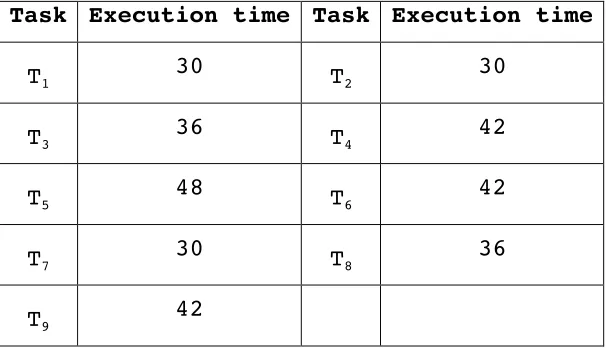
Table 1.1 Execution times of the workflow tasks in the
case study
Task Execution time Task Execution time
T1 30 T2 30
T3 36 T4 42
T5 48 T6 42
T7 30 T8 36
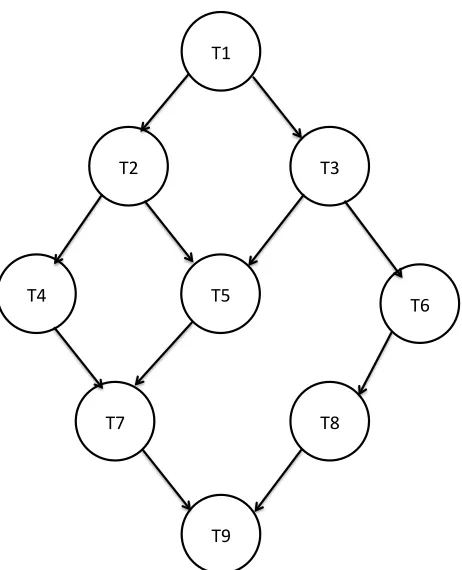
Assume a workflow consists of 9 tasks, T1-T9 as shown
[image:25.595.120.526.86.508.2]in Fig.1.1. The execution time of each task in the workflow is shown in Table 1.1.
Figure 1.1. The workflow in the case study
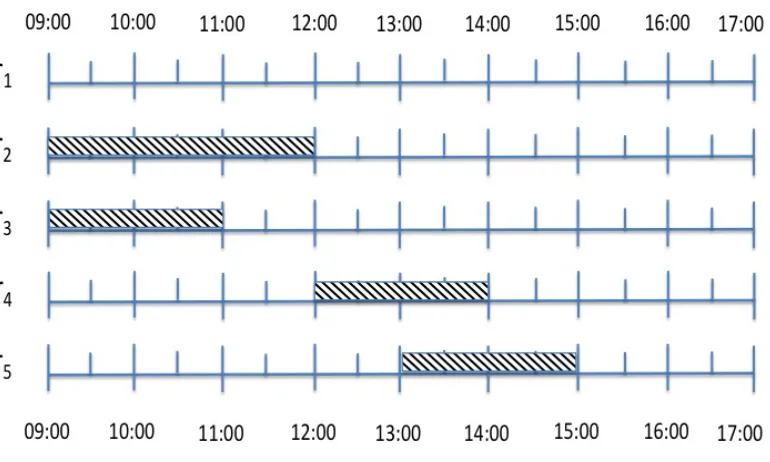
There are 5 roles in the system. The temporal
constraints of these roles are specified in Table 1.2,
and illustrated in Figure 1.2, where the shaded area is
[image:25.595.106.537.652.731.2]the time duration when the roles are not activated.
Table 1.2 Temporal constraints of the roles in the case
study
Role Temporal Constraint Role Temporal Constraint
r1 {[09:00, 17:00]} r2 {[12:00, 17:00]}
r3 {[11:00, 17:00]} r4
{[09:00, 12:00], [14:00, 17:00]}
T
1#T
3#T
2#T
5#T
4#T
6#
T
7#T
8#Figure 1.2. The temporal constraints of the roles
Assume the role constraints of the tasks are as follows.
T1 -> {r1}
T2 -> {r2, r3}
T3 -> {r2, r3}
T4 -> {r2, r3} T5 -> {r2, r4}
T6 -> {r4}
T7 -> {r2, r3}
T8 -> {r2, r3}
T9 -> {r2, r5}
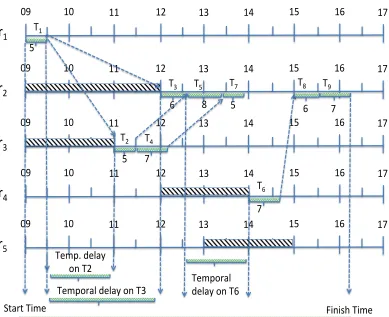
When the first task of the workflow of figure 1.3
(i.e., T1) arrives, it can be run under role r1 according
to the role constraints, and r1 is always activated
according to the temporal constraints. Therefore, T1 starts execution immediately. After T1 is completed, T2
r3. But when T1 is completed, r2 and r3 are not activated.
So the executions of T2 and T3 will be delayed by the authorization constraints. Similarly, when T6 is ready to
run, r4, which is the role that T6 has to assume, is not
activated. Consequently, the execution of T6 will also be
delayed.
Figure 1.3. An exemplar scheduling solution of the
workflow under the authorization constraints in the case
study.
“It is common to find such authorization constraints
and interaction between human and automated activities;
our domains of interests include healthcare systems
[Stuit2011], video management domain [VideoWorkflow] and
r
1#11# 10#
09# 12# 13# 14# 15# 16# 17#
r
3#11# 10#
09# 12# 13# 14# 15# 16# 17#
r
5#11# 10#
09# 12# 13# 14# 15# 16# 17#
r
2#11# 10#
09# 12# 13# 14# 15# 16# 17#
r
4#11# 10#
09# 12# 13# 14# 15# 16# 17# T1#
T2#
5#
5# 7#
6# 8# 5# T3# T5# T7#
7# T6# 6# T8# 7# T9# T4# Start#Time# Finish#Time# Temp.#delay# on#T2#
[image:27.595.130.519.237.554.2]the manufacturing community [Hara2009] [Jin2003]. Human
intervention and associated authorization clearly affects the processing of tasks and impacts on both
application-oriented performance (e.g. mean response time of
workflows) and system-oriented performance (e.g.
utilization of the computing resource pool). Obtaining
these performance data will be critical in capacity planning, designing authorization policies and developing
workflow management strategies”.
When the authorization constraints are present to
restrict the workflow executions, it entails new research
issues that have not been investigated yet in conventional workflow management.
First, it is important to know whether a feasible
authorization solution can be found to enable the
executions of all tasks in a workflow, i.e., check the feasibility of the deployed authorization constraints.
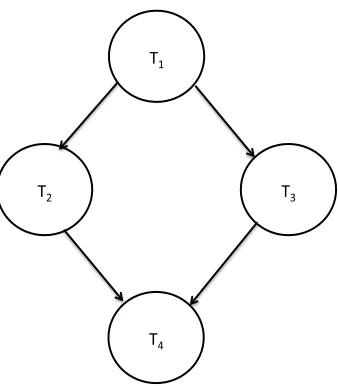
The following example illustrates the situation. Assume a
workflow consisting of 4 tasks as shown in Figure 1.4.
Assume that the SoD (Separation of Duty) constraint is
r(T2)≠r(T3), which means that the role assigned to task T2 must be different from the role assigned to T3, and that
the BoD (Binding of Duty) constraints are r(T1)=r(T2) and
r(T1)=r(T3). We cannot consider the roles only without
mentioning the tasks to be involved and SoD and BoD
Figure 1.4. A case study for feasibility checking
In this situation the feasible solution is not possible as if task T1 can run under role r1 then according to the
BoD constraints tasks T2 and T3 should run under r1 as
well. However, according to SoD constraint tasks T2 and
T3 cannot run under the same role, which is the
contradiction. Therefore, the feasible solution under these constraints is not possible.
Feasibility checking is important because if there are
some tasks in a workflow that cannot be authorized
subject to the deployed authorization constraints, there is no point to start the execution of the workflow at
all. The request of the workflow execution should be
rejected in the first place. Checking the feasibility of
authorization constraints can help us design the
authorization policy so that it will not cause the
unnecessary rejections of the execution requests.
Second, the existence of the feasible authorization
solutions for a workflow only means that the workflow can
run to completion. Its execution performance may still be
T1#
T3#
T2#
negatively affected by the deployed authorization
constraints. For example, roles may have temporal constraints, i.e., roles may only be activated during
certain periods. When a task in a workflow is authorized
to run under a particular role, but the role is not
activated yet, the task may have to wait and consequently
increase the execution time of the whole workflow. Therefore, it is useful to know when the performance of
workflow executions will not be affected by the given
authorization constraints. The first and second research
issues are the focuses of Chapter 3 in this thesis.
Third, knowing the time durations when the authorization constraints will not have negative impact
on performance is one way of shedding light into the
impact of the authorization constraints. Another aspect
of the impact is that when the authorization constraints
have the performance impact, how to quantitatively determine the impact. For example, if the authorization
constraints will cause the delay for the workflow
execution, how can the delay be calculated? Chapter 4 in
this thesis analyses the performance impact of the given
authorization constraints. Further, based on the analyses, an optimal authorization method is proposed to select the
authorization solution that can minimize the performance
impact caused by the authorization constraints.
Fourth, a key reason why authorization constraints may
have impact on performance is because the authorization control directs the tasks to some particular roles (i.e.,
the role assignment process). The authorization policy
may specify the constraints on the roles, for example,
role constraints or temporal constraints. Also, the
be different. For example, the number of the bank
managers in a bank is normally different from the number of cashiers. This may cause the tasks assigned to
different roles to have different response time, and
consequently affect the execution performance of the
workflow as a whole. Therefore, in order to examine the
impact of the authorization constraints, it is desired to know the rate of the tasks arriving at each role, given
the deployed authorization constraints.
Finally, after knowing the rate of the request arriving
at each role, an important issue is to determine the
amount of resources that need to be allocated to support the executions of the tasks assuming a particular role,
so as to satisfy the desired Quality-of-Service. A
workflow may consist of human tasks and computing tasks.
Human resources and computing resources have different
features and therefore require different considerations when determining the resource quantities.
Chapter 5 focuses on investigating the fourth and fifth
research issues discussed above. The methods are proposed
in Chapter 5 to calculate the rate of the tasks arriving at each role given a set of authorization constraints.
Moreover, the resource allocation strategies are
developed for both human resources and computing resource,
aiming to optimize the performance under the current
constraints.
To date, little attention has been paid to investigate
the issues discussed above. This thesis aims to tackle
these new research issues. The main contributions of this
- Proposing a method to check the feasibility of the
authorization constraints, i.e., given a set of authorization constraints, checking whether there
is a feasible authorization solution to enable the
workflow execution (Chapter 3)
- Proposing a method to determine the time durations when the temporal constraints do not have negative
impact on the performance of workflow executions
(Chapter 3)
- Proposing the methods to conduct quantitative
analyses about the delay caused by the authorization constraints for workflow executions
(Chapter 4)
- Developing an optimal authorization method. The
method is optimal in the sense that it can select the authorization solution that minimizes the delay
caused by the authorization constraints
- Proposing a method to conduct theoretical analysis
about the level of workloads assigned to individual roles, given the deployed authorization constraints
(Chapter 5)
- Proposing the methods to determine the suitable
amount of resources so that the performance of
workflow executions is maximized, given the deployed authorization constraints and the resource
- Conducting the experimental studies to verify the
effectiveness of the proposed methods in this thesis.
The rest of the thesis is organized as follows. Chapter
2 conducts the literature review relevant to the work in
this thesis. Chapter 3 presents the methods to conduct the feasibility checking for the deployed authorization
constraints and to calculate the time duration when the
workflow executions will not be affected by the
authorization constraints. Chapter 4 analyses the delay
caused by the authorization constraints and further
proposes an optimal authorization method. Chapter 5 present the methods to calculate the level of the
workload directed to each role due to the deployed
authorization constraints. Further, Chapter 5 presents
the resource allocation strategies for both human and
2
Literature Review
This chapter will discuss the work related to workflow management, workflow scheduling and resource allocation, and security and authorization.
2.1 Workflow Management
2.1.1 Workflow Modeling
task. In a workflow, the execution of tasks has to follow the specified dependency, i.e., the acceptable relative orders of tasks executions. The typical elements of dependency are sequential execution and parallel execution of tasks.
However, the study in [Kim2003] has analyzed in more detail the dependency of workflows and its implications on distributed workflow systems. The authors have identified four types of workflow dependencies that could be useful in designing a distributed workflow system. These different types of dependencies are:
1) Data Dependency – used for modeling the effects of data flow on the behavioral aspects of different activities in a considered workflow. This modeling is further used for generating data-transition conditions associated with each activity along with the data-dependence information between the activities;
2) Activity (Control) Dependency – relates to the “control flows in a workflow procedure and is particularly used for modeling the effects of conditional and parallel branches” on the behavioral aspects of different activities in a considered workflow; For example, an activity in a workflow “can only start execution after another activity in the workflow has completed (the former activity is called the latter’s child”, and the latter is called the parent of the former).
mapping the control flow part to the role assignment part in a workflow;
4) Actor Dependency – used to model the correspondent work-cases of the component jobs in the workflow; the dependency concepts are further embodied as objects in a distributed workflow architecture. While designing a workflow based on these four dependencies, the “actor-based workflow model and the role-“actor-based workflow model require actor-transition, activity-transition and data-transition conditions while activity-based workflow model and workcase-based workflow model only use the activity-transition conditions and data-activity-transition conditions”.
A task in a workflow is either processed by a computing resource or human being, which is called the actor of a task. Which actor will perform a task is typically decided by the workflow management system. However, when the security and authorization mechanisms are present, which actors, especially which human being actors, can perform a task may also be specified by the security and authorization mechanisms, which will be discussed in the later part (section 2.1.3) of this chapter.
2.1.2. Automation of Workflow Executions
A lot of research studies have been conducted to enable the automation of workflow executions, which lead to the proposal of “Web Services Business Process Execution Language (WS-BPEL). WS-BPEL is a language to specify the behavior of the business processes that are based on the Web Services”. WS-BPEL’s processes use the interface of the Web Service to import and export the functionality.
The business process “can be applied in one of the two ways: Abstract or Executable. The abstract process is partially specified”. It is descriptive and cannot be executed. It is declared as an “abstract” process. The executable process is fully specified and can be executed as well. The abstract process can hide some operational details while the executable process shows all the details. Abstract processes are descriptive in role. BPEL defines both abstract and executable processes. WS-BPEL defines a model and the grammar describing the behaviors for the business process, which bases on interactions between the process and its partners.
The WS-BPEL provides the language to specify the Executable and the Abstract processes. In this way it extends the Web Services interaction model and enables it to support business transactions. In order to support and facilitate the expansion of the automated process integration in both within the corporation and business-to-business spaces, WS-BPEL defines an interoperable integration model.
workflows spanning multiple organizations. The study in [Chakraborty2007] has designed and implemented a so-called Heterogeneous Event Management Middleware (HEMM) to integrate the events across multiple siloed workflow management systems (WFMS). They have focused on the problem wherein a high-level change in workflow requires the running workflow (WF) instances in the WFM to handle external events necessitated by the high-level change. They argued that the existing solutions to handle such type of problems are cost-intensive mainly in terms of back-end downtime from an enterprise’s viewpoint, as they require changing of either the workflow process definition or the workflow engine. The authors used their proposed HEMM to address this issue by: 1) the introduction of an overlay on the top of a WFMS; and 2) the abstraction of unforeseen event handlings from the workflow executions. Further, to adapt to new events whose process definitions could not be handled in a workflow execution, the event transformation is employed for mapping of events to event handlers associated with running workflow instances. The authors further demonstrated their prototype implementation by considering an example prevalent in the telecom industry.
2.1.3 Human Activities
BPEL4People, “which has been proposed to overcome the lack of support for human activities in BPEL”.
BPEL4People introduces an extension to BPEL to support the human involvement in the business processes by adding the set of new elements in the standard BPEL [WS-BPEL]. The specification introduces human as a new basic activity, which supports human interaction in processes directly. In the language design, the extension in BPEL for people is defined in such a way that it makes a top layer on BPEL. This extension introduces the new elements and attributes to cover complex human interactions. The generic human roles are process initiator, process stakeholder and business administrators. The new basic activity elements use human tasks as an implementation and it allows the specification of the tasks for the processes.
The study in [Zhao2008] has proposed a formal model that adds support for human task support to Business Process Execution Language (BPEL) and have named it as BPEL4People. BPEL, which has been described as a standard for specifying and executing workflow of Web service composition invocation, has an inherent limitation of not providing any support for human workflow. The authors have used CSP process algebra to present a formal model of human workflow.
medical disciplines and departments. The existing workflow-based process modelling tools for healthcare process management” focus on defining task sequences rather than modelling the graphical description of human interactions in a HCP. The authors have considered a care pathway HCP performed by the head and neck oncology team for the evaluation of their interaction-centric process modelling method. The evaluation of the method has highlighted three significant results: 1) collection and formalization of the tacit domain knowledge of the interviewed healthcare workers in individual interaction diagrams; 2) support provided by the method for automatic integration of individual interaction diagrams into a global interaction diagram capable of reflecting the consolidated domain knowledge; and 3) utilizing a graphical modeling language to describe interactions between methods, their composition and routing relations, and their roles using an effective tree-based description; The proposed method showed good support for improving the healthcare collaborations.
2.2 Workflow Scheduling
Automating the execution of the tasks in a workflow is one of the main focuses in a workflow management system. Anther focus is to enhance the performance of workflow executions. In this aspect, the scheduling strategies employed by the workflow management system play a critical role.
stages in DAG scheduling. In the first stage, the scheduling order of the tasks in a DAG is determined, while the second stage decides which resource should be used to run a task. Most DAG scheduling algorithms is based on list scheduling, in which all tasks are prioritized and the scheduling order of the tasks follows their priorities. Two basic techniques to determine the scheduling order of the tasks are to calculate the t-level (top t-level) and b-t-level (bottom t-level) of the tasks in a DAG and use them to prioritize the scheduling order of the tasks. The t-level of task ti is the length of the
longest path from the first task (also called the entry task) in the DAG to ti. The b-level of a task is the
length of the longest path from the last task (also called the exit task) to the task. The t-level of a task correlates with the earliest start time of the task, while the b-level of a task correlates with the latest start time of a task if a deadline is set for the completion time of the whole DAG. Other list scheduling algorithms just use different approaches to determine the scheduling order of the DAG.
After the tasks’ scheduling order is determined, the scheduling algorithm further performs resource selection for all tasks, i.e., decides among all resources which resource should be used to run each of the tasks. A basic method is to select the resource, which can offer the least finish time.
scheduling length, i.e., the duration between the time when the first task in the DAG starts execution and the time when the last task completes execution.
The study in [van der Aalst2002] has characterized the scheduling principle for utilizing available computational resources. They have suggested that a scheduling principle should match each atomic task for proper resource management, which could finally lead to matching an atomic task to a corresponding suitable resource. Two decisions should be supported by the scheduling principle: firstly tasks should have some defined order for execution; and secondly, task assignment to the available resources should represent the most suitable match from the available set of resources. In nutshell, scheduling a workflow typically consists of two stages: 1) determining the execution order of the tasks in a workflow and 2) determining the resources that should be used to run each task. Numerous scheduling strategies have been proposed in literature.
favorite predecessor task of a given task (fpred) and favorite processor of a given task (fproc). TDS runs in four steps, namely: 1) top-down traversal of the DAG to compute EST, ECT, fpred, fproc1 to fprocn and level of each task; 2) bottom-up traversal of DAG for calculating LACT and LAST for each node; 3) “an initial set of task clusters is generated using a reasonably small number of processors”; and 4) involves duplication of tasks and message forwarding, which represents forwarding of the results from that processor that has minimum completion time of a task amongst the available processors. The authors used three inputs: 1) Cholesky decomposition DAG; 2) Diamond DAG; and 3) the DAG for Gaussian elimination code; for their proposed algorithm, TDS, and compared the results with a similar scheduling algorithm, called Best Imaginary level scheduling (BIL). The comparison results showed better communication-to-computation cost ratios (CCR) of 0.2 as compared to 1 obtained using BIL and gave far more superior results than BIL for the scheduling time.
by authors has been found to be suitable for a single workflow involving mixed parallel applications, which combine task parallelism and data parallelism, on heterogeneous platforms.
The study in [N’takpe’2008] also extended their work in [N’takpe’2007] to develop a scheduling mechanism for dealing with concurrent mixed parallel applications. In general, there are two steps involved in concurrent scheduling for mixed parallel applications namely: 1) constrained resource allocation – to determine an optimal allocation for each task while determining the number of processors available; and 2) concurrent mapping – involving prioritizing of tasks of workflows for their execution. The authors have restricted the applicability of their scheduling mechanism to concurrent workflows submitted at the same time. Their scheduling mechanism does not deal with the online workflows submitted at different times.
The study in [Tarumi1997] has addressed the resource conflict problem by considering a resolution strategy at the runtime rather than at the build time. They associated agents with the resources and allowed mutual communication between agents for reserving office resources and checking their availability.
The study in [Doulamis2011] has examined the resource allocation problem together with task scheduling. In a Workflow Management System (WfMS), resource allocation and task scheduling are two important issues that impose mutual constraints. Thus, optimizing resource allocation is subject to task scheduling and vice versa. They have highlighted the characteristics of an ideal algorithm for solving these fundamental issues in WfMS, which mainly include: “performance metrics of the infrastructure e.g., the number of resources and their utilization; and quality criteria” such as under temporal restrictions percentage of tasks undergoing violations. The authors have proposed an algorithm called Resource Conflicts Joint Optimization (Re.Co.Jo.Op), which aims at jointly optimizing resource allocation and task scheduling by minimizing resource conflicts subject to temporal constraints while simultaneously optimizing throughput or utilization subject to resource constraints. They used matrix for representing the two factors and applied the concepts of the generalized eigen value analysis for finding the optimal solution of the problem. They further proposed an agent-based architecture for integrating their proposed algorithm into a functional WfMS. The experimental results have established the superiority of their proposed strategy on the conventional approaches.
2.3.
Security
and
Authorization
for
Workflow Executions
The workflow security and authorization constraints have been researched a lot in the literature and well documented in [Atluri2000] [Crampton2012] [He2011] [ManolacheThesis] [Wang2010] [Lu2009]. But different works have different focuses.
2.3.1. Enforcement of Security and Authorization
Policies
Some studies focus on developing the methods to guarantee that in the processing of the workflows in the system, the authorization policies can be enforced properly.
component to manage authorization constraints. PDP is a component to evaluate and issue authorization decisions. PEP intercepts a user’s access request to a resource and make sure that the request can only use the resources in the way consistent with the decision made by PDP.
The study in [Dagdee2011] has conducted a study to enhance the XACML standard so that it can support credential based hybrid access control. The standard XACML only supports attribute based access control mechanism. This work proposes credential based hybrid access in which any unknown user can have easy and immediate access to open access environment. The main extensions in the XACML policy specification are 1) addition of new element <Credential> for the representation of credentials 2) addition of the new element <CredentialRequirements> for logical combination of credentials 3) inclusion of CredentialId attribute in the <CredentialAttributeDesignator> to support conditions involving credential attributes 4) addition of <Credentials> in the XACML request context to get the credentials from the user. The extension in the XACML architecture is proposed in the form of credential manager in the context handler, which extracts the credential information submitted by the user. The access policy contains various conditions over credentials and the attributes associated with the credentials.
issue. Liu proposes a new XEngine, an efficient request processing schema. The XEngine follows the following steps: 1) it converts a textual policy into a numerical policy 2) it converts a numerical policy with complex structures to a numerical policy with normalized structures 3) it converts the numerical normalized structures to a tree structure for improved performance. To verify the effectiveness of the technique experiments have been conducted on both real life and synthetic XACML policies. The results verify the claim of improving the performance by orders of magnitude. The performance improves linearly with the number of policies. For small number of policies the XEnging is faster in one to two order of magnitude while for larger policies the XEngine is faster by three to four orders of magnitude than the Sun PDP.
authorization systems to investigate if a workflow could be completed when a number of users are absent. The authors further defined three resiliency levels in workflow systems and studied the associated computational problems.
The study in [Zou2009] combined the advantages of role-based access control (RBAC) and attribute-role-based access control (ABAC) mechanisms to propose a new access control model (CRBAC), which integrates all kinds of constraints into the RBAC model. The authors have analyzed the generic properties of the attribute constraints and have presented them into two constraint templates: a) authorization mapping constraint; and b) behavior constraint; for automating the user-role and role-permission mapping as well as restricting the behaviors of the authorization entities respectively. The authors have further introduced a state mechanism for building up the constraints in a group of statuses of the entities as well as reflecting the authorization control outcomes. They, based on the proposed constraint templates and the introduced state mechanism, have developed an execution model. Moreover, use cases have been proposed to describe the authorization process taking place in the proposed access control model (CRBAC). The authors have further analyzed the correctness, complexity, flexibility and compatibility of CRBAC to compare the multi-grained constraints of CRBAC with other models.
2.3.2. Feasibility Checking of Authorization
Constraints
[Crampton2005][Atluri1999][Wang2010][Lu2009]. The work in [Crampton2005] conducted the theoretical analysis about the satisfiability of the authorization constraints for a workflow. The work conducted the theoretical analysis and found out that in order to check whether there is a valid the workflow authorization, it only needs to consider a single linear extension (i.e., a linear ordering) of the tasks in the workflow. There exists a valid workflow authorization if and only if there is also a valid authorization solution for the linear extension. However, the work cannot obtain all feasible authorization solutions. The modeling approach presented in Chapter 3 is able to obtain all feasible authorization solutions. Based on this, our work further develops the authorization methods, aiming to reduce the negative impact imposed by the authorization constraints.
Petri-net is a popular methodology in the literature to achieve this, partly because petri-nets is capable of capturing and modeling the dynamic behaviors in a system, and partly because there are well established techniques to conduct the theoretical and simulation analysis for the constructed Petri-nets models.
solutions. However, this modelling approach is heavy since it needs to construct the CPTN model, covert the CPTN model to ordinary PN models, and analyze the PN models. In this thesis, we model the feasiblity checking problem concisely as a Constraint Satisfaction Problem (CSP).
The study in [Li2004] has proposed an extension to Petri Nets and have named that as the Time Constraint Workflow Nets. Their extension helps in identification and removal of conflicts associated with resources occurring in workflow specifications. They have added a notion of time to the Petri Nets for allowing the temporal validation of the conflicts associated with the resources. The method exhaustively searches for all tasks and has been found to be non-scalable.
The study in [Zhong2005] has extended the approach of [Li2004] and have proposed a new mechanism for identification of conflicts associated with resources under concurrent workflow settings and have also found their approach having scalability problems.
on the correspondingly mapped computational resources. The calculation of sufficient amount of resources helps eliminate the resource conflicts on one hand but also results in wasteful architecture in the design process of the information system.
The study in [Lu2009] has used Colored Petri nets (CPN) for modelling and analyzing workflow with Separation of Duty (SoD) constraints. SoD represents the security principle wherein frauds and errors are prevented in collaborative environments. As the organizations achieve their business goals by interacting and collaborating between users through workflow, thus, during workflow design with SoD constraints, the correctness and consistency of workflow becomes crucial to verify and ensure. Keeping this problem in mind, the authors have combined control flow, authorization rules and SoD constraints in a single workflow and have used an integrated CPN model for representing this combination of constraints to a workflow. They used reachability tree analysis for deriving the execution paths of the integrated CPN model. The analysis of the derived execution paths resulted in identification of some latent deadlocks, which in turn were the results of the inconsistency between authorization rules and SoD constraints.
2.3.3.
Analysis
of
Performance
Impact
of
Security and Authorization Policies
He develop a security overhead model to measure the security overhead [xie2006]. Xie also developed resource allocation strategies TAPADS and SHARP by taking into account the security and precedence constraints for homogeneous clusters and heterogeneous cluster [xie2008]. Qiu used Security-Aware Task (SEAT) graph model to denote the constraints and relationship of tasks and on the basis of SEAT graph, he proposed an algorithm ILP-SOP and for special structures he proposed DPSOP-path/tree algorithm for security generation for tasks [Qiu2013]. However, these studies do not consider the impact of the authorization policies.
There are also the studies using Petri-nets to model and analyze the impact of authorization constraints.
The work in [He2009] “applied Generalized Stochastic Petri-Net (GSPN) theory to model workflow executions under Role-based Authorization Control, and then used standard Petri-net analysis techniques to theoretically calculate performance metrics from the constructed models. Although GSPNs are adequate for the scenarios investigated in [He2009], the work did not model the workflows consisting of both human tasks and computing tasks. Also, since GSPNs cannot express the temporal attributes associated with tokens, they cannot analyze the authorization overhead caused by temporal constraints. Moreover, the work in [He2009] did not investigate authorization methods to improve performance, given the specified authorization constraints”.
Access Control (RBAC) scheme, which assigns certain roles to users and each role has an associated set of permissions. The authors have modeled various authorization constraint types including: 1) role constraints; 2) temporal constraints; 3) cardinality constraints; 4) Binding of Duty constraints; and 5) Separation of Duty constraints; using Coloured Timed Petri-Nets. The modelling scheme also captures the interaction between workflow authorization and workflow execution. The authors highlight the in-built automation support for their modelling scheme for workflow execution.
Generally, the Petri-net modeling approach is heavy and susceptible to state explosion problems.
3
Analyzing the Impa
ct of
Authorization Constraints
This chapter analyzes the impact of the deployed
authorization constraints. More specifically, this
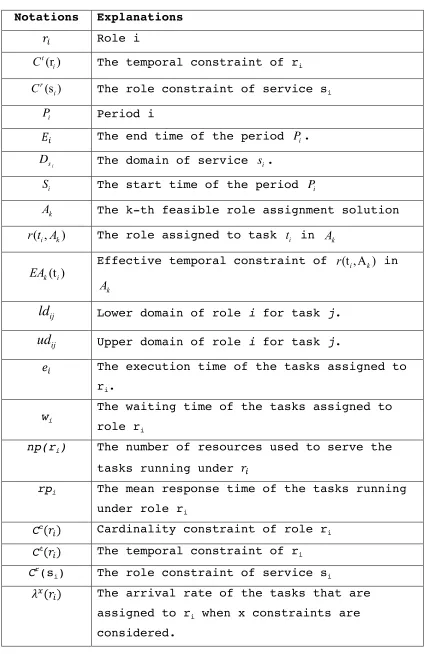
chapter 1) checks whether all tasks in a workflow can be authorized so that the authorization constraints deployed in the system can be satisfied, and 2) determines such time durations in which the authorization constraints will not have negative impact on the performance of workflow executions. The notations used in this chapter are summarized in Table 3.1.
Table 3.1 Notations used in this thesis
Notations Explanations
𝑟! Role i
The temporal constraint of ri
The role constraint of service si
Pi Period i
𝐸! The end time of the period Pi.
Dsi The domain of service si.
Si The start time of the period Pi
The k-th feasible role assignment solution
The role assigned to task in
Effective temporal constraint of in
ld
ij Lower domain of role i for task j.ud
ij Upper domain of role i for task j.𝑒! The execution time of the tasks assigned to
ri.
wi
The waiting time of the tasks assigned to
role ri
np(ri) The number of resources used to serve the
tasks running under 𝑟!
rpi The mean response time of the tasks running
under role ri
Cc(𝑟
!) Cardinality constraint of role ri
Ct(𝑟
!) The temporal constraint of ri
Cr
(si) The role constraint of service si
𝜆!(𝑟
!) The arrival rate of the tasks that are
assigned to ri when x constraints are
considered. (r ) t i C (s ) r i C k A
( ,i k)
r t A ti Ak
(t )
k i
EA r(t , A )i k
Cs(𝑟
!) The set of services that role ri can invoke
rp(𝑟!, 𝑠!)
The mean response time of the tasks that
assume ri to invoke sj
𝜆!(𝑟
!) The arrival rate of all service requests
allocated to rj
hi The number of the human resources allocated
for role ri
Di The time duration when ri is activated in
the period Pi
𝛼!" The proportion of processing capability
allocated to run the requests that assume
role rj
𝑂(! × !) L services cross M rolls matrix.
3.1. Checking Feasibility of Role, SoD And
BoD Constraints
S={s1,...,sL} denotes the set of services running on the
resource pool.
F=(T,E) denotes a workflow, in which T ={ ,..., }t1 tN is a
set of tasks in the workflow and E={( , ) | ,t ti j t ti j∈T} is a
set of directed edges linking task ti to tj . A task
invokes one of the services in S.
R={r1,...,rM} denotes the set of roles defined in the
authorisation control system. The role constraint specifies the set of roles that are permitted to run a
particular service. Cr
(si) denotes the role constraint
applied to service
s
i.
r s( )i denotes the role that isBinding of Duty (BoD) constraint between si and sj are
represented as r s( )i ≠r s( )j and r s( )i =r s( )j , respectively.
The problem of checking feasibility of role, SoD and
BoD constraints is formulated as a Constraint
Satisfaction Problem (CSP) [Brailsford1999] in this thesis.
A CSP consists of a triple<V D C, , >, where
1 2
{ , ,..., }n
V = v v v is a set of variables,
1 2
{ v, v ,..., vn}
D= D D D , and Dvi is the domain of the value of
vi,
and
C is a set of constraints restricting the valuesthat the variables can take.
The Feasibility Checking Problem (FCP) in this chapter is modelled as a CSP in the following way. The services in FCP are regarded as the variables in CSP. The role constraint of a service is regarded as the domain of the value of the service. The BoD and SoD constraints are regarded as the constraints restricting the values that the service variables can take. An example is given below to illustrate the modelling.
Assume the tasks in a workflow invoke 7 services,s1−s7,
and there are 6 roles, r r1− 6 in the authorization system.
The role constraints are:
1 { }1
s = r ,
2 { , , }2 3 4 s = r r r ,
3 { , , }2 3 5
s = r r r ,
4 { , , }2 3 5
s = r r r ,
5 { , , }2 3 5
6 { , }2 4
s = r r ,
7 { , }4 6
s = r r .
The SoD constraints are:
2 5
( ) ( )
r t ≠r t ,
2 7
( ) ( ) r t ≠r t ,
6 7
( ) ( )
r t ≠r t .
The BoD constraints are:
2 4
( ) ( )
r t =r t ,
3 5
( ) ( ) r t =r t .
Then the FCP can be formulated as CSP as follows.
, ,
CSP=<V D C> ,
1 2 3 4 5 6 7
{ , , , , , , }
V = s s s s s s s ,
1 2 7
{ s, s ,..., s }
D= D D D , where
1 { }1
s
D = r ,
2 { , , }2 3 4
s
D = r r r ,
3 { , , }2 3 5
s
D = r r r ,
4 { , , }2 3 5 s
D = r r r ,
5 { , , }2 3 5 s
D = r r r ,
6 { , }2 4 s
D = r r ,
7 { , }4 6
s
D = r r .
1 2 3 4 5
{ , , , , }
C= C C C C C , where
1: ( 2) ( 4)
2: ( 2) ( 5) C r t ≠r t ,
3: ( 2) ( 7)
C r t ≠r t ,
4: ( 6) ( 7)
C r t ≠r t ,
5: ( 3) ( 5)
C r t =r t .
There are the existing solvers to solve the CSP problem [Brailsford1999]. Some solvers only check whether a solution can be found to satisfy the problem, and if so, return one solution. Some solvers can return all solutions to the problem, i.e., all feasible role assignments to the tasks so that the specified SoD, BoD
and role constraints are satisfied.
3.2.
Analyzing
the
Coverage
of
Authorization Constraints for Workflow
Executions
Roles have temporal constraints, i.e., when the roles are activated and can be assigned to tasks. It is useful to check the coverage of roles' temporal constraints in a given security setting for workflow executions. If the temporal constraints of the relevant roles cover the execution period of a workflow, then the temporal constraints will not delay the task executions in the workflow, and therefore will not have negative impact on the performance of the workflow.
According to the discussions in section 3.1, we can use the CSP solver to obtain all feasible role assignment
solutions for the tasks in a workflow. denotes the set
of all feasible role assignments for the workflow, and
denotes the -th feasible role assignment, in which is
a task in the workflow and is the role assigned to .
In most cases, a role is activated periodically. For example, the role of bank manager is only activated from 9am to 12pm, and from 2pm to 4pm in a day. Therefore, the
temporal constraint of role , denoted as , can be
expressed as below,
=(Pi, Di, Si, Ei) (3.1)
Where is the period, is the time
duration when is activated in the period , and and
are the start and end time points when this period
pattern begins and ends. can be , meaning the
periodic pattern continues indefinitely.
Assume that the execution times of the tasks in a workflow and the scheduling algorithm used to schedule the tasks is known. Therefore, if we know the arrival time of the entry task in the DAG, we can calculate the
start time of every task in the DAG. denotes the
start time of task , denotes the role assigned to
task in . Assume is the entry task. Assume
. represents the temporal constraint of
role rp. =(Pp, Dp, Sp, Ep) as shown in Equation (3.1).
Assume (i≠0). denotes the time durations
{( , ) | } k i j i A = t r t ∈T
k ti
j
r ti
i
r t( )
i r C ( ) t i r C i
P Di={[ldij,udij] |i∈}
i
r Pi Si
i E i E ∞ i st i
t r t A( ,i k)
i
t Ak t0
0
( , k) p
r t A =r t( ) p r C ( ) t p r C
( ,i k) q