Faculty of Electrical Engineering,
Mathematics & Computer Science
Towards
Systematic Black-Box Testing
for Exploitable Race Conditions
in Web Apps
Rob J. van Emous
[email protected] Master Thesis
June 2019
Supervisors:
As web applications get more complicated and more integrated into our daily lives, securing them against known cyber attacks is of great importance. Performing se-curity tests is the primary way to discover the current risks and act accordingly. In order to perform these test in a systematic way, testers create and use numer-ous vulnerability lists and testing guidelines. Often, dedicated security institutions like Escal Institute of Advanced Technologies (SANS), MITRE, Certified Secure, and the Open Web Application Security Project (OWASP) create these guidelines. These lists are not meant to be exhaustive, but as the introduction in the Common Weakness Enumeration (CWE) of MITRE and SANS by Martin et al. (2011) puts it: they "(..) evaluated each weakness based on prevalence, importance, and the likelihood of exploit". This seems like a reasonable way of thinking, but as we have shown in this research, it can also lead to oversight of essential, but stealthy security issues.
In this research, we will focus on one such stealthy issue in web apps called a race condition. Race conditions are known for a very long time as research by Abbott et al. (1976) shows. Still, they are a type of security vulnerability that is often not included in these lists as it is challenging to test for and also is not often exploited. Based on the lack of research in this field, we argue that especially in the web-environment, it has resulted in an underestimation of the risks involved. The races continue to show up in web apps and when exploited, could have a significant impact as a recent security blog by Jadon (2018) shows. This impact ranges from circumventing any limited-usage functionality like coupon redemption to enabling other types of security vulnerabilities like privilege escalation or a Denial of Service (DoS).
That is why, in this research, we developed the first systematic method to test for race conditions in web apps from a black-box perspective. We also built a tool to support the exploitation and evaluated both in comparison with related tools.
1. Methodology- we have devised the first method for systematically testing for race conditions in web apps from a black-box perspective. Most importantly,
this method contains a list of common race condition vulnerabilities in web apps and a detailed strategy of how to test for these items.
2. Toolset - Next to this, we have developed the toolset called CompuRacer to support the tester in the execution of this systematic test. It supports the gath-ering of HTTP requests of interest, the parallel sending of these requests and guided evaluation of responses.
3. Evaluation - toolset - Subsequently, we have evaluated both the toolset and method. In order to do this, we compared the toolset to three related toolsets on a functional-, usability- and performance-level. For the performance evalu-ation, we used the tools in a real-life setup on a self-developed web app that is vulnerable to race conditions. In this evaluation, we tested the raw speed of sending parallel requests and the ability to exploit race conditions using the ap-propriate statistical tests. Regarding all of these metrics, the toolset is shown to be equal or better than all other tools.
4. Evaluation - method - Finally, the method and toolset are evaluated together on seven web apps ranging from e-commerce platforms to blogs and wikis. We were able to find much minor race condition related issues in these platforms, but more importantly, for two e-commerce platforms, a severe vulnerability has been found and reported which has a significant financial impact.
In my heart, I am both a meticulous software developer and a curious seeker of truth. In academics, but also in other aspects of life, I experience that this goes hand in hand perfectly. I remember that often when a professor teaching calculus would make a remark about the computational complexity of a function, I would instantly be prompted to write some code to verify his claims. They were always right.
Likewise, when creating software for other reasons like the automation of processes and exploration of ideas, it feels like both an amazing privilege and a significant responsibility. That is why I pursue to develop and encourage well written and secure software. This often requires countless hours of designing, building, testing, and building some more, but the end result is worth it. So it has been with my thesis. "Failures, repeated failures, are finger posts on the road to achievement. One fails forward toward success." as C.S. Lewis would cleverly put it. The research was challenging but practical enough to fulfil my creative desire while hopefully still being a truthful enrichment to the academic world.
There would be no way I could have achieved this result on my own. Firstly, I would like to thank my parents, brother and girlfriend for their loving support. Secondly, my committee members, each of whom has been patient with me in times of doubt and provided me with the necessary guidance throughout the process. Finally, as a follower of Christ, I would like to thank God for the love and support I believe He provides for me in life, but especially during this intense final period of my studies.
"For I can do everything through Christ, who gives me strength." Philippians 4:13 - The Holy Bible (NLT)
List of Figures xiv
List of Tables xv
List of Listings xv
List of Acronyms xvii
1 Introduction 1
1.1 Problem description & motivation . . . 1
1.1.1 Importance of secure web apps . . . 1
1.1.2 Danger of race conditions explained . . . 2
1.1.3 Difficulties in testing for race conditions . . . 6
1.1.4 Overview of current web app testing methods . . . 7
1.1.5 Classical race conditions tests for single-tier applications . . . 8
1.2 Research questions and methodology . . . 10
1.3 Contributions . . . 11
1.4 Commissioner . . . 12
1.5 Structure of the work . . . 13
2 Background 15 2.1 Race conditions . . . 15
2.2 Web applications . . . 17
2.2.1 Structure . . . 17
2.2.2 Communication . . . 19
2.2.3 Technologies . . . 20
2.3 Software testing . . . 22
2.3.1 Essential software testing dimensions . . . 23
2.3.2 Security testing . . . 27
2.3.3 Location of race condition testing . . . 28
3 State of the art 29
3.1 Client-side race conditions . . . 29
3.2 Detection of server-side race conditions . . . 33
3.2.1 Published work . . . 33
3.2.2 Articles and blogs . . . 35
3.2.3 Open source tools . . . 39
3.2.4 Testing the open source tools . . . 40
4 Creating a systematic method for web app testing 43 4.1 Definition of a race condition . . . 43
4.2 Development of methodology . . . 45
4.2.1 Map website functionality . . . 47
4.2.2 Functionality to race conditions . . . 47
4.2.3 Select HTTP requests . . . 55
4.2.4 Send HTTP requests . . . 57
4.2.5 Evaluate attack . . . 61
4.3 Conclusions . . . 62
5 Developing the CompuRacer toolset 63 5.1 Requirements . . . 63
5.1.1 Gathering of HTTP requests . . . 64
5.1.2 Composing and sending of HTTP requests . . . 64
5.1.3 Handling of HTTP responses . . . 66
5.2 Design . . . 67
5.2.1 Core . . . 68
5.2.2 Extensions . . . 71
5.3 Implementation . . . 73
5.3.1 Core - Main class . . . 73
5.3.2 Core - REST server . . . 74
5.3.3 Core - Command Line Interface (CLI) . . . 75
5.3.4 Core - Batch . . . 78
5.3.5 Core - Async Batch sender . . . 78
5.3.6 Burp extension . . . 81
5.3.7 Browser extensions . . . 82
5.4 Conclusions . . . 82
6 Evaluation of toolset and testing methodology 83 6.1 Evaluation - Toolset functionality & usability . . . 84
6.1.1 Definition of metrics and scores . . . 84
6.1.2 Rating the tools according to metrics . . . 88
6.2 Evaluation - Toolset performance . . . 94
6.2.1 Definition of metrics and scores . . . 94
6.2.2 Performance test setup . . . 96
6.2.3 Results . . . 101
6.2.4 Conclusions . . . 117
6.3 Evaluation - Testing methodology . . . 118
6.3.1 Tested web apps . . . 118
6.3.2 Test results . . . 122
6.3.3 Conclusions . . . 130
7 Conclusions 133 8 Future work 135 8.1 Methodology improvements . . . 135
8.2 Toolset improvements . . . 136
8.2.1 Scientific research challenges . . . 136
8.2.2 Engineering improvements . . . 138
8.3 Evaluation improvements . . . 141
8.3.1 Performance evaluation . . . 142
8.3.2 Practical evaluation . . . 143
References 145 Appendices 155 A Race condition testing tools sources 157 B CompuRacer toolset – README 159 C CompuRacer toolset – Manual 163 C.1 How to add HTTP requests of interest to the tool? . . . 164
C.1.1 Send it from the browser using the Firefox extension . . . 164
C.1.2 Send it from the Burp Suite using the Burp extension . . . 165
C.1.3 Add it manually using the correct JSON format . . . 167
C.2 How to compose a batch of HTTP requests? . . . 167
C.2.1 Creating it manually and adding requests . . . 168
C.2.2 Creating a batch using the automated modes . . . 170
C.2.3 Add it manually using the correct JSON format . . . 170
C.2.4 Import an exported batch . . . 171
C.3 How to send a batch and interpret the results? . . . 172
C.3.2 Grouped responses . . . 174
D Toolset performance result histograms 179 D.1 Metric 1 - Test 1 - Local time-difference . . . 179
D.2 Metric 1 - Test 2 - Application time-difference . . . 182
D.3 Metric 2 - Test 1 - Voucher usage ratio . . . 184
D.4 Metric 2 - Test 2 - Number of success codes . . . 187
1.1 Simple two-thread race condition . . . 3
1.2 Duplicate account creation race condition . . . 4
1.3 Session puzzling race condition . . . 5
2.1 Web app network and communication . . . 18
2.2 Webapp structure and software components . . . 21
2.3 Software testing methodologies . . . 23
3.1 Race condition testing tools . . . 30
3.2 Flask testing web app . . . 41
4.1 Race condition series . . . 45
4.2 Race condition testing method flow . . . 46
4.3 Race condition testing checklist . . . 49
5.1 CompuRacer toolset general design . . . 68
5.2 CompuRacer toolset Core design . . . 69
5.3 Lifecycle design of the Burp and browser extensions . . . 72
5.4 Sakurity Racer timings . . . 79
5.5 CompuRacer multi-process timings . . . 80
5.6 CompuRacer async timings . . . 80
6.1 Evaluation performance test setup . . . 96
6.2 Evaluation performance script output . . . 100
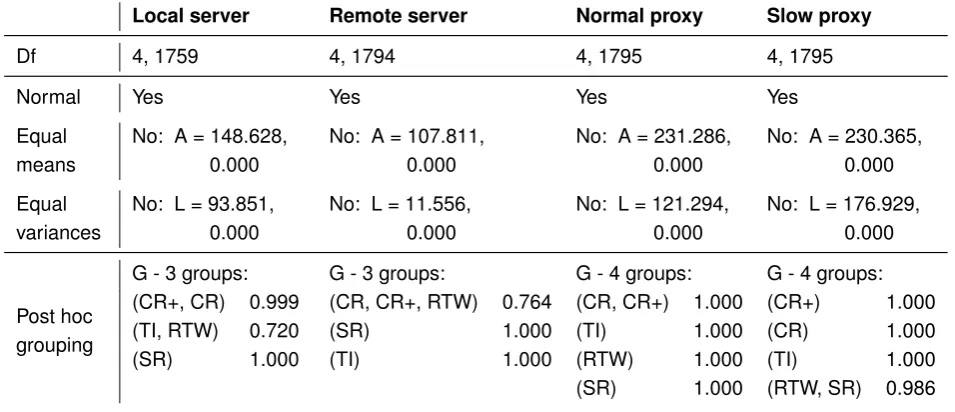
6.3 Evaluation performance statistical tests . . . 102
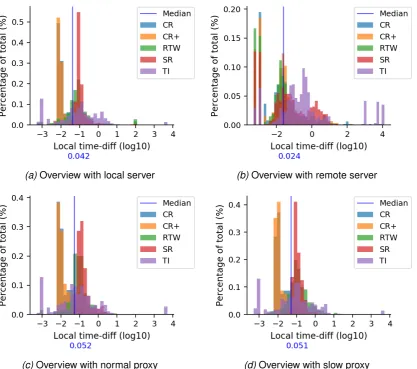
6.4 Overview of the local time-diff . . . 105
6.5 Overview of the application time-diff . . . 109
6.6 Overview of the voucher redeem ratio . . . 111
6.7 Overview of the number of success codes . . . 114
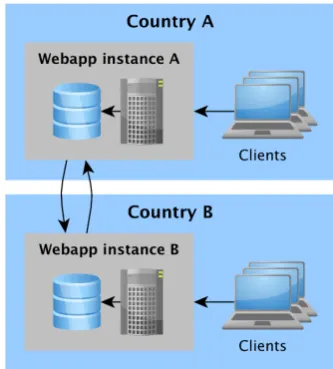
8.1 Geographical load balancing races . . . 137
8.2 Geographical DNS test Facebook . . . 139
C.1 Adding request via Firefox extension . . . 165
C.2 The CompuRacer Core output for a new request . . . 165
C.3 Adding request via Burp extension . . . 166
C.4 The output for a comparison of requests . . . 166
C.5 The Core output for a duplicate request . . . 167
C.6 Adding batch via CLI . . . 169
C.7 Exporting and importing batch . . . 173
C.8 Sending a batch . . . 177
C.9 The output when comparing two result groups . . . 178
D.1 Local time-diff no proxy . . . 180
D.2 Local time-diff remote server . . . 180
D.3 Local time-diff normal proxy . . . 181
D.4 Local time-diff slow proxy . . . 181
D.5 Application time-diff no proxy . . . 182
D.6 Application time-diff remote server . . . 183
D.7 Application time-diff normal proxy . . . 183
D.8 Application time-diff slow proxy . . . 184
D.9 Voucher usage ratio no proxy . . . 185
D.10 Voucher usage ratio remote server . . . 185
D.11 Voucher usage ratio normal proxy . . . 186
D.12 Voucher usage ratio slow proxy . . . 186
D.13 Number of success codes no proxy . . . 187
D.14 Number of success codes remote server . . . 188
D.15 Number of success codes normal proxy . . . 188
4.1 A listing of common HTTP methods and whether they are idempotent or safe. A star indicates that this protocol requirement is often violated
in practice. . . 55
6.1 Functionality & usability metrics and scores . . . 87
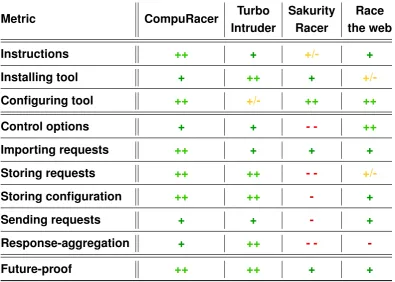
6.2 Functionality & usability metrics applied to tools . . . 88
6.3 Performance test results local time-differences . . . 107
6.4 Performance test results app time-differences . . . 110
6.5 Performance test results voucher redeem ratio . . . 113
6.6 Performance test results success codes . . . 116
6.7 Rated items in race condition security test . . . 123
A.1 Race condition testing tools sources . . . 157
List of Listings
1 Practical test result WebGoat item 4 . . . 52 Dockerfile for setting up osCommerce . . . 121
3 Practical test result WebGoat item 22a . . . 125
4 Practical test result WebGoat item 22b . . . 125
5 Manually adding a request to the Core . . . 168
6 JavaScript Object Notation (JSON) file of a CompuRacer batch . . . . 171
AJAX Asynchronous JavaScript And XML
API Application Programming Interface
CI Continuous Integration
CIA confidentiality, integrity and availability
CLI Command Line Interface
CMS Content Management System
CSS Cascading Style Sheets
CWE Common Weakness Enumeration
DBMS DataBase Management System
DOM Document Object Model
DoS Denial of Service
GUI Graphical User Interface
HTML Hypertext Markup Language
HTTP Hypertext Transfer Protocol (OSI level 7)
HTTP/1.x HTTP version 1.0 or 1.1
HTTP/2 HTTP version 2
HTTPS HTTP over TLS
IP Internet Protocol
JSON JavaScript Object Notation
MitM Man-in-the-Middle
OSI Open Systems Interconnection (model)
OWASP Open Web Application Security Project
PHP Hypertext Preprocessor
RFC Request For Comments
ROI Return On Investment
SANS Escal Institute of Advanced Technologies
SIGSEGV Signal Segmentation Violation
SQL Structured Query Language
SSRC Server-Side Race Condition
SSRCs Server-Side Race Conditions
TCP Transmission Control Protocol (OSI level 6)
TOCTOU time of check to time of use
UDP User Datagram Protocol
WebRTC Web Real-Time Communication
WS WebSocket (OSI level 7)
WSS WS over TLS
XHR XMLHttpRequest
Introduction
1.1 Problem description & motivation
1.1.1 Importance of secure web apps
In modern society, we have fully integrated web applications into our everyday life. They are used in all parts of life, including education, entertainment, taxes, shopping and banking. As we trust these applications with our most important data, it is essential that these applications are secure and available at all times. Both when normal users use the web app (during peak hours), but especially when a malicious user tries to attack it. Preferably, it should not be feasible for an attacker to extract or destroy private information, act on our behalf, or disturb the availability of these applications. In other words, the software quality should be at an appropriate level. The question is, how do we make sure that is the case?
As we know from very early research regarding software testing, finding all flaws in software is undecidable (Howden, 1976). To our best knowledge, this statement still holds today. The best possible alternative can be found in a level of software quality and maturity that is sufficient given the risks involved. In this case, ’risk’ is defined by (McGraw, 2006, pp. 144-146) as the probability that an asset will suffer an event of a given negative impact. High risk can, therefore, result from both a high probability of the adverse event and also from a potentially catastrophic impact.
For example, if the application is a single page web app that only displays static information, exploitation is not deemed to result in much negative impact and is also not very likely to be interesting for attackers. Thus, low risks are involved, and the level of software quality is allowed to be on the lower end of the spectrum. On the contrary, for a high-valued banking application, it is very interesting for attackers,
and the financial impact could be significant. Therefore, this poses high risks and requires an equally high-security standard.
In order to create such a secure software system, it should be designed and im-plemented with security in mind. Even this is not enough as people are known to make mistakes which could lead to security bugs. Next to this, developers often ex-pect educated and benign users to use their application. Not all users are educated users, or benign. Any user might be an attacker that tries to penetrate the applica-tion’s safety measures and wreck havoc. Therefore, during and after development, we also need to perform a variety of automated and manual testing to make sure we meet our functional and security requirements.
In this thesis, the focus is on the security testing of web applications in order to im-prove software quality. More concretely, it first points out a lack of knowledge regard-ing security testregard-ing in one specific area. Many manuals exist on how to perform a black-box security test in a systematic way. However, we will show that an important issue is consistently lacking in attention both in theory and in practice. This issue is called a race condition. We will show that exploitation of this issue can significantly impact the security of a modern web application, but that testers also often neglect it. Historically, testing for race conditions has received attention, but we show that this effort is far from mature and cannot easily be applied to the complex multi-part web applications of today. That is why we will investigate how systematic testing of this specific issue can be introduced into the skillset of a security tester.
1.1.2 Danger of race conditions explained
Race conditions are a family of bugs that is timing-related. The Common Weakness Enumeration regarding software systems by the SANS Institute and the MITRE Cor-poration (2019) lists this issue in the’time and state’ category (CWE-361) under the specific item:’Concurrent Execution using Shared Resource with Improper Synchro-nisation’ (CWE-362). In other words, it is an issue that can occur when accesses to a common variable for multiple processes are not properly managed. Providing several examples might be the easiest way to show how this issue occurs in practice and how it can have a significant impact on web app security.
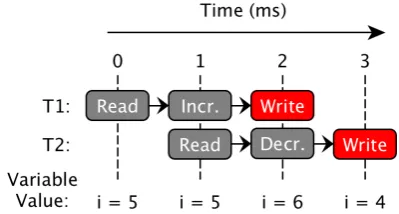
race condition between two threads in figure 1.1. In this case, the outcome of the incrementing process (T1) gets overwritten by the decrementing process (T2).
Figure 1.1: The figure illustrates two threads T1 and T2 that perform an update action to variablei. T1 increments the value by one and T2 decre-ments the value by one. As both threads read the same value ofi = 5, the result of the race condi-tion is that T2 overwrites the result of T1.
The example does not sound too dan-gerous, but what if the affected value is the available money on a bank ac-count? Alternatively, what if the true/-false value that indicates whether a user has access to some secret information? Instead, what if it might push the sys-tem in an unexpected state after which it crashes? These are severe conse-quences to the integrity, confidentiality and availability of the application. If one or both of the involved concurrent pro-cesses are controllable by an attacker, it poses a real security threat. Next, we give two examples of a race condition
bug and its consequences in order to show that these theoretical issues also occur in practice.
Example 1 - Duplicate account creation
We found a concrete example of an unexpected state that crashed web app func-tionality during the exploration phase of this research. In this phase, we performed a test for race conditions on the OWASP WebGoat, which is a deliberately insecure e-learning web application based on the Spring MVC framework. It is supposed to be insecure in some aspects, but not regarding race conditions, and that made it an attractive target.
We found two root issues:
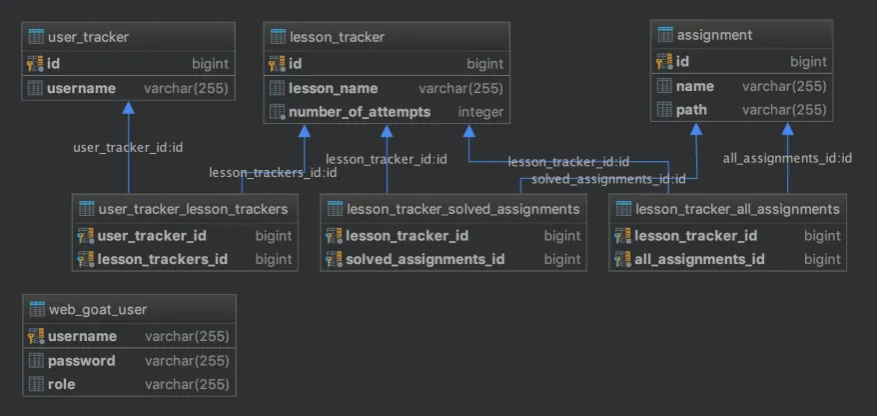
1. The first issue is the fact that the developers did not mark the username as a ’unique’ field in the ’user_tracker’ table in the database. This is shown in the WebGoat database diagram in figure 1.2.
2. The second issue is found in a TOCTOU or RCA - race condition (see defi-nitions in section 4.1) in the app server with regards to the check to add only
unique users. In listing 1 a non-synchronised method in theRegistrationController
class is shown that is responsible for adding new users to the database. At line 4, both the ’Read’ and ’Check’ acts are performed to validate whether this is a new user and at line 8, the ’Act’ is performed by adding the new user. The time between executing line 4 and line 8 is the race window.
These issues made it possible to successfully add two accounts with the same user-name in parallel. The ’user_tracker’ table is often read using a Spring function that expects only one result. As it would get two (or more) results when loading any user-based functionality, this function would throw the error: javax persistence NonUniqueResultException with the explanatory text: result returns more than one elementsand the functionality would fail to load. The issue described here is a
[image:22.595.65.505.448.656.2]clear case of an exploited race condition that impacts the availability of the applica-tion as a whole.
1 @PostMapping("/register.mvc") 2 @SneakyThrows
3 public String registration(@ModelAttribute("userForm") @Valid UserForm userForm, BindingResult bindingResult, HttpServletRequest request) { ,→
4 userValidator.validate(userForm, bindingResult); 5 if (bindingResult.hasErrors()) {
6 return "registration";
7 }
8 userService.addUser(userForm.getUsername(), userForm.getPassword()); 9 request.login(userForm.getUsername(), userForm.getPassword()); 10 return "redirect:/attack";
11 }
Listing 1: The listing shows to method that is called when a new WebGoat user tries to register.
[image:23.595.316.530.372.640.2]Example 2 - Session puzzling
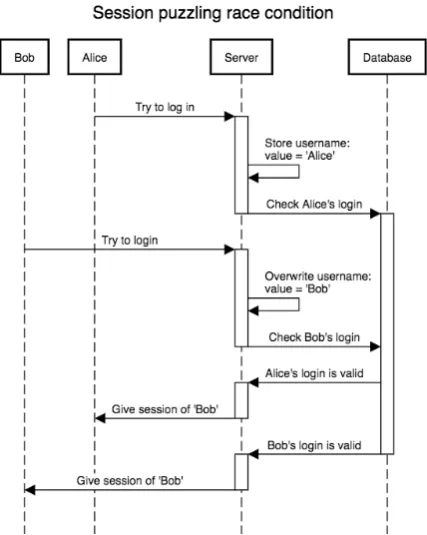
Figure 1.3: A sequence diagram showing interac-tion with a server vulnerable to session puzzling that triggers the race condition.
To further motivate the difficulty in test-ing for race conditions in web apps, let us provide a second illustrative exam-ple of a race condition vulnerability in a web app. Imagine a web application that provides access to public and pri-vate forums about all kinds of subjects. The user has created an account and is using the forum now for some time. One day when he logs in and the appli-cation redirects him to the profile page; he receives the information of someone else. All details are there, and he can view the contents of all private forums that this user has access to. Being a nice person, he decides not to abuse the issue and log out. Later, when he logs in again, he is back to his own page. How is this possible?
The issue described above is not just a hypothetical situation, but it is a real
the authors had personally run into this specific issue. In that instance, the login process required several steps. This is normal in, for instance, multi-factor authenti-cation. During the process, the server locally stored the username of the user that was logging in. This username would be used in the end to send the correct session information to the client of the user. When two users would log in at roughly the same time, thus within the race condition window, one would occasionally get the session information for the account of the other. Thus, the sessions would be mixed up or puzzled.
Even when a login consists of just a single request by a user and the server stores the username while verifying the credentials using the database, this issue is still possible. The sequence diagram in figure 1.3 illustrates this issue. Between the moment Alice’s username is stored at the server and the response of the server with her session information, Bob could also try to log in, accidentally overwrite the username and unintendedly give Alice full access to his account.
1.1.3 Difficulties in testing for race conditions
As both attackers and testers do not seem to have a systematic method of finding these issues, their discovery and exploitation remain rare for now. That, in turn, justifies only limited time and resources to improve on this situation and thus the problem remains. As we have shown in the examples, incidental findings do show that race conditions are prevalent in web apps, and therefore the current lack of systematic exploitation is not a good indicator that this will remain the case in the future. The MITRE Corporation (2019) page for race conditions also confirms this by stating"Race conditions in web applications are studied and probably under-reported (..)". That is why the addressing of issue is very important so that testers will develop systematic testing for race conditions before the attackers do.
Despite the lack of systematic testing for race conditions in web apps, after con-ducting a thorough search, we could find some effort in this direction in testing manuals of security organisations and academic writing. We discuss these efforts below.
1.1.4 Overview of current web app testing methods
For the reasons mentioned before, race conditions have never been a central part of the main security test manuals of the most renowned security institutions. More specifically, it is not included in the OWASP top ten lists of 2010, 2013 or 2017 (OWASP community, 2017, p. 6), or the Certified Secure (2018) checklists for server and client testing. Only the extended weaknesses list of the MITRE Corporation (2011) contains race conditions on position 33. However, when we dive into the most elaborate security testing guides for web apps, some pages devoted to race conditions can be found.
There does exist some effort in the literature and in practice to resolve this lack of systematic testing for race conditions in web apps. However, most of these efforts are only focused on functional or visual issues that occur on the client- or server-side due to races. Research that seems to focus on exploitable race conditions in web app logic or database interactions is minimal. The rarely found, related blogs of security testers seem to be the only recent evidence that people are looking into the security implications of race conditions in web apps. We will discuss all of these efforts will in more detail in chapter 3 on state of the art.
Although several tools do exist like Sakurity racer, Race the web, Turbo Intruder and netCloneFuzzer that target precisely this, in later sections, we will show these have significant limitations. For instance, these tools only make the exploitation of a known simple attack surface, like an account creation page, easier. As already explained, duplicate accounts can often be created due to race conditions. Without the knowledge of where to look for race conditions issues in web apps, the tools have only minimal use. Next to this, they are only able to send a single request in parallel. The lack of support for different requests or send delays is insufficient when complex configurations of requests are required to trigger a race. Finally, they provide insufficient help in interpreting the server responses. When a tester has to verify issues or classify the associated risks, (semi)automated interpretation of responses is essential. We discuss these tools more in-depth in section 3.2.3 on related work and will also compare them to our product in chapter 6 on the evaluation of the testing method and the toolset.
1.1.5 Classical race conditions tests for single-tier applications
In order to solve this lack of expertise, one might be tempted to look at methods of development and testing that people have used historically. It used to be much more common to create a monolithic or single-tier application. As Smith et al. (1998) state, a single-tier application is a system in which the user interface, program logic and storage interface is all contained in one place and often in one language. In these rather simple software applications, we can see that Abbott et al. (1976) al-ready mention concurrency issues and that makes it one of the oldest security prob-lems.
in the total client-server system as an active entity, the system could also be re-garded as a two-tier application like (Tanenbaum and Van Steen, 2007, pp. 549-551) does.
Many tools like (Flanagan and Freund, 2009, 2010; Wilcox et al., 2018) have been designed over the years to help the developer of single-tier applications to deal with race conditions. Some of these tools are discussed here. These tools started as static checks that just looked at the source code without running the application. They verified the correctness of the application: that the application used proper synchronisation functions like fork-join pairs, locks, semaphores and mutexes (mu-tually exclusive access). Later, developers also built dynamic tools that looked at the application when it was actively running. For instance, FastTrack developed by Flanagan and Freund (2009) and VerifiedFT developed by Wilcox et al. (2018) were designed to verify that all concurrent sections either affect each other only temporar-ily or when they do share some memory or other logic, that they are serializable. In other words, whether these concurrent statements can be converted to a single se-ries of non-concurrent statements. These tools have an excellent performance, even in complex single-tier applications, but when the topology of the system increases to a multi-tier system with many involved technologies and languages, they are no longer applicable.
Unfortunately, web applications of today also fall in the category of multi-tier appli-cations. At least three tiers can be distinguished:
1. App server – This is the heart of the application. It receives and processes all user requests, communicates with the database, and provides response pages to the user. A plethora of frameworks, languages and database types are available to create the app server logic.
2. Web server– This is the entry point of the application for the user and securely forwards all traffic between the app server and the user.
3. Browser– This shows the web page, but also contains the logic to respond to user actions, interact with the server and to update the interface.
security testers often only access a web app from a grey- or black-box perspective, this approach is incompatible with the full source code access that most non-web app tools require. Based on all this, we must devise entirely different methods to test for race conditions in web apps.
1.2 Research questions and methodology
It is clear that race conditions can pose a serious threat to the security of modern web applications and exploitation can have a big (financial) impact. At the same time, there is both a lack of awareness of these issues and a lack of capability to efficiently test for them. Existing knowledge on how to test for race conditions is shown to be not directly applicable as it mostly targets single-tier applications. When it does focus on web applications, it does not look at the security of the application as a whole. The handful of tools that does exist appears to be too simple to fit the current strategy of security testers.
At the beginning of the chapter, it was stated that the thesis would investigate how systematic testing of this specific issue can be introduced into the skillset of a secu-rity tester. We can now conclude that at least two hurdles have to be taken to make this possible: 1) Find out in what places race conditions could occur in web apps, and 2) explore how these places can be systematically detected and exploited from a black-box perspective. With this in mind, we propose the following main question for this research:
How can we perform systematic black-box testing for exploitable race conditions in web apps?
In order to answer this question, we need an appropriate methodology. We found a similar type of security testing research, and this inspired our methodology. The research was done by Kuosmanen et al. (2016) with regards to automated security testing of WebSocket implementations. They first tried to understand the technology and common security vulnerabilities. Then, they investigated how to test for these issues and finally, they created an automated testing tool.
We can rewrite this procedure as three research questions:
• RQ1- In what parts of web app functionality do SSRC vulnerabilities occur?
• RQ2- How can we make SSRCs more likely to happen from a black-box per-spective?
• RQ3 - How can we develop an effective tool to help find and exploit SSRCs from a black-box perspective?
Chronologically, we will start by investigating RQ1 and RQ2, but this will overlap with the creation and testing process of the tool of RQ3. The reason behind this is the fact that the knowledge of race conditions in web apps is currently rather poor. Therefore, we will gain much information about where to find these issues and how to exploit them by applying the tool in practice. Subsequently, this knowledge can be used to add information to RQ1 and RQ2. Based on a combination of the knowledge about how to test for race conditions in a systematic way and the usability and performance of the final tool, we can answer the main research question.
The value of the research is significant because, to the best of our knowledge, no research exists that looks into systematic black-box testing for exploitable race con-ditions. If the results are positive, our research makes a significant leap in closing this gap of knowledge. If we would have to answer the main question in the negative, the gained knowledge about the location, impact and exploitation of race conditions in web apps is still a valuable addition to the current lack of research about this subject.
1.3 Contributions
Concretely, the following contributions of the thesis can be discerned:
1. Methodology development - A preliminary systematic methodology for test-ing a web app regardtest-ing race conditions from a black-box perspective. The method includes an answer to the questions of how to discover race condi-tions (RQ1), how to combine requests to trigger race condicondi-tions, and how to evaluate whether the race happened (RQ2). This methodology both includes a general solution to these issues and an answer specific to particular web app types like blogs, wikis and e-learning platforms.
tools. Next to this, it is capable of supporting complex combinations of re-quests that can be sent in parallel to trigger race conditions. Last, it supports the tester in evaluating whether the exploitation was successful.
3. Evaluation of methodology and toolset- The existence of a testing method and a toolset are already an improvement upon the current situation, but with-out any evaluation regarding the effectiveness of the proposed method and tool, the validity of the answers to all research questions diminishes greatly. Therefore, an evaluation of the effectiveness of these contributions is added as well (RQ1, RQ2, RQ3). This evaluation covers the functionality, usability and performance of the toolset as compared to similar tools put forward by related work. Next to this, it contains a practical application of the method and the toolset to test for race conditions in several web apps. After this application, we can easily evaluate the effectiveness of the method and toolset combined.
When we obtain the results regarding all research questions, this should lead to a satisfying answer to the main research question as well. Thus, having the first ver-sion of a systematic way to perform black-box testing for exploitable race conditions in web apps.
1.4 Commissioner
As ready indicated in the motivation, during security assessments, testers often run into a range of particularities of web applications that seemed to be timing-related. Some of these issues were shown to be exploitable, but a systematic way to find them was not yet employed. Some research showed that not only Computest, but most of the companies in this field do not systematically test for race conditions in the web apps they test. With the knowledge of the possible impact of race conditions on the security of web apps, Computest decided that this was a perfect topic for a master thesis.
in-frastructures work as well as possible (Computest, 2019). This end-goal of software quality improvement perfectly matches the general goal we have also stated at the beginning of this chapter.
1.5 Structure of the work
Next, we give an in-depth background of race conditions, web applications and the testing of software systems in chapter 2. The information should give the reader enough knowledge of the context to understand the actuality and difficulty of the problem and the importance of the solution that this thesis tries to provide. In chap-ter 3, the state of the art research in the detection and exploitation of race conditions in web apps is given.
Chapter 4 starts with a continuance of our earlier treatment of race conditions based on our findings. Then it addresses the creation of the first systematic method to test for race conditions in web apps. Then, in chapter 5, we discuss the requirements, design and implementation of CompuRacer. This is a software toolset we created to accompany the systematic method. In chapter 6 the effectiveness of the toolset and systematic method are evaluated based on their functionality, usability and per-formance.
Background
In the introduction, we have only briefly introduced several important concepts. More in-depth knowledge is deemed necessary for the reader to understand the reason behind different steps that we will take in the thesis. In this chapter, we set out to do this.
First, we will give a more detailed description of what is already known about race conditions in general section 2.1. Thus, how they can occur and what types of impact are expected for web applications. At the beginning of the section 4.1, we will continue this explanation of race conditions with our definitions and findings regarding race conditions in web apps. Next, in section 2.2, the essential elements that web apps most commonly consist of are explained for the reader to get a better grasp of where race conditions could occur in these web apps. Finally, a background on software testing, in general, is given in section 2.3. In this section, in line with the central questions of the thesis, we will pay special attention to how security assessments and penetration testing of web apps is performed from a black-box perspective.
2.1 Race conditions
In this research, we will focus on a family of bugs called race conditions. These bugs are caused by an unpredictable ordering of (atomic) events in which at least one sequence results in unwanted behaviour of the application. The unpredictable order is caused by any form of concurrent execution without proper synchronisation techniques. More specifically, most races are either caused by TOCTOU bugs or by read-and-then-write bugs, as Northcutt (2007) explains.
Root of the issue Most software is based on assumptions of a happens-before relation between events like creating a file before writing to it (TOCTOU), storing the settings of a user before closing the application, or reading from and writing to a database entry without any other concurrent reads or writes to this entry (read-and-then-write) (Dean and Hu, 2004). The program will often fail when these as-sumptions are violated. As already mentioned in the introduction, these bugs are notoriously hard to debug as they are timing related. Thus, any change to the ex-ecution order or speed of the program to pinpoint the bug could also influence or temporarily mask the bug itself. As we have shown in chapter 1, these bugs occur both in single-tier applications but also in more complex web apps (at client- and server-side).
Impact of exploitation We can divide the impact of race conditions in web apps, when there is any impact, into three main types: ’visual’, ’functional’ and ’security.’ The overarching consequences can also be expressed financially or as reputational damage. Reputational damage or distrust by the clients is often only of concern because of the financial impact. For this thesis, we are primarily interested in race conditions that result in security issues, but to clearly be able to identify this kind of impact, we will also discuss the other types of impact:
1. Financial - The total impact can also be measured financially, but as this requires a lot more knowledge about the (specific) involved business pro-cesses, we do not concern ourselves with this measure in this thesis. How-ever, as the actions of most businesses revolve around the financial Return On Investment (ROI), a financial incentive for investing in cybersecurity is very important in practice. Unfortunately, often, companies only see the value of these types of investments after a catastrophic failure. For reasons behind this largely ignorance-based issue and appropriate solutions, we refer the reader to the research on the economics of cybersecurity by Moore (2010).
2. Visual- Visual consequences are about any change in the visual appearance of a webpage (at the client-side) that is not desired or intended by the devel-opers, but also does not affect the functionality or security of the application (Mutlu et al., 2014). This issue can sometimes be observed when a webpage loads without any styling because the Cascading Style Sheets (CSS) fails to download or parse in a reasonable amount of time.
not, the issues could still cause unwanted behaviour or crashes. For instance, multiple background cleanup job of a web server might race and as a con-sequence, leave the database in an inconsistent state. This issue does not seem to be influenceable by an attacker, but could still cause crashes in the application.
4. Security - If, however, the erratic behaviour can be exploited by an attacker resulting in significant impact, it can be considered a security vulnerability. Ex-amples of this kind of impact are shown in the introduction chapter (multiple account creation and session puzzling). The impact of security vulnerabili-ties can be further subdivided in confidentiality, integrity and availability (CIA) (Techrepublic, 2019). We will further explain these types of security impact in section 4.2.
In section 4.1, we will continue with our findings regarding race condition types in web apps. We will mainly focus on explaining how race conditions start at interleav-ings of single actions in source code and how these issues propagate to a series of actions that can eventually also impact the application as a whole.
2.2 Web applications
To discover in what functional parts of a web app certain race conditions could occur and what kind of impact is expected, it is essential to have a basic knowledge of how a web app is designed. We will first elaborate on the network setup of a web app. Then, the communication techniques between client and server are discussed. Fi-nally, the specific technologies, libraries and tools are discussed that are commonly used for developing web applications. For all aspects, we will briefly discuss the im-pact of certain design choices on the expected prevalence of race conditions.
2.2.1 Structure
As you can see in figure 2.1a, a multi-tier web app can be divided in a client-side and a server-side. The client-side is comprised of the Hypertext Markup Language (HTML), CSS and JavaScript files rendered in a browser (Tanenbaum and Van Steen, 2007, chap. 12.1-12.2). The HTML files describe the general structure and static content of the web app, the CSS describes the look and feel of the application and the JavaScript files control the dynamic behaviour. The server side can just be a single web server, application (app) server and a database, but in every medium-to-large web app, the network structure is much more complex.
(a)The network components involved in hosting
a typical web app
(b)The client-server communication techniques
often used in web apps
Figure 2.1:Web app network components and communication techniques
Often, a load balancer distributes the traffic between multiple servers at multiple locations. The web server receives the client-requests, responds with the static content and forwards requests for dynamic content to the application server. The app server then fetches information from a database or (internal) cache, creates a response and sends it back to the client via the web server. Web apps are not limited to one database which can only scale ’vertically’ by using better hardware but also scale ’horizontally’ by adding more database replica’s.
As both the number of components of web apps and the performance is increased, we also expect more options to be available for race conditions to occur. Within single-tier applications, traditional types of race conditions occur between multiple processes. In multiple duplicated components or separate services, these race con-ditions could also occur between these components during the mutual usage, editing and synchronisation of data. In chapter 4, we will further elaborate on the potential race conditions between web app components.
2.2.2 Communication
Next to the network setup of a web app, the communication protocols between client and server also differ per web app, and most web apps use a combination of tech-niques for different parts of functionality. From the black-box testing perspective, having in-depth knowledge about these communication techniques is very impor-tant as these are the only means by which race conditions might be triggered at the server from the client. In this thesis, only the request-response type of com-munication is taken into account, but in the section 8.2.1 on the future work we will also discuss race condition exploitation options using the other two techniques. In figure 2.1b, the three main types of communication are listed. We will explain these techniques below.
1. Request-response- the client initiates the request for data. In normal Hypertext Transfer Protocol (OSI level 7) (HTTP), a client first creates a TCP connec-tion to the server and then (re)loads a full page via several HTTP requests (Tanenbaum and Van Steen, 2007, chap. 12.3). In contrast, in Asynchronous JavaScript And XML (AJAX) or Comet, this behaviour is changed. These tech-niques still rely on the creation of a TCP request but are much more versatile.
AJAX is the name of all techniques that allow the client (via JavaScript XML-HttpRequests) to ask the server asynchronously for an update to a part of the webpage without a page-reload (Woychowsky, 2007). Comet or long-polling is a specific type of AJAX in which the asynchronous request blocks until there actually is an update (Carbou, 2019). This avoids some of the unnecessary polling by temporarily moving the initiative to the server.
client until she unsubscribes. Server-Sent Events (SSE) can be sent using the Comet technique (Pohja, 2009).
Officially, SSE are part of the HTTP version 2 (HTTP/2) specification and are one of the most distinguishing new features. HTTP/2 is an update to the old HTTP version 1.0 or 1.1 (HTTP/1.x) Standard in which Transmission Control Protocol (OSI level 6) (TCP) streams can be shared between HTTP requests (speedup), binary data is transferred instead of text strings, some headers are made optional, and headers can be compressed. SSE also allows for the server to send several files like scripts, pictures or CSS alongside an HTTP response page. It already knows that the client requires them eventually and therefore avoids multiple request-response cycles to load a single page.
3. Bi-directional- Especially, for live chats, web-based games, media streaming, live statistics of sports or stock prices, long polling techniques or SSE might still not be sufficiently flexible. Also, the overhead per request is still significant. Improvement is found in using a real-time web protocol like WebSocket. Web-sockets are part of the HTML5 specification and were fully supported by most browsers at around 2011.
It is a protocol at the same Open Systems Interconnection (model) (OSI) level as HTTP and HTTP over TLS (HTTPS) called WebSocket (OSI level 7) (WS) and WS over TLS (WSS) respectively, and therefore the initial HTTP proto-col needs to be upgraded (changed) when a client wants to communicate to a server using this technology. As the final Request For Comments (RFC) by Fette and Melnikov (2011) shows, WebSockets allow for full-duplex real-time communication between the client and server side of web apps. Thus, the server, as well as the client, can push updated data to each other at any moment in time with a minimal overhead compared to HTTP.
2.2.3 Technologies
be equivalent to all web apps built using these systems. The middle ground is cov-ered by web apps supported by (elaborate) frameworks like Python Django.
The listing of commonly used web app technologies in figure 2.2 is based on the popularity of the languages and techniques as indicated by the global survey of Stack overflow (2018), the popularity ranking of databases by DB-Engines (2018), the suggestions of blogs by web development companies like B. and V. (2018) of RubyGarage and Lozinsky (2017) of WebiNerds, and the advice of security testers at Computest. Both SQL and NoSQL databases are included.
Figure 2.2:A listing of some of the most common web app structure and software components.
As race conditions are explained above to require parallelly accessed storage, the way the database copes with parallel transactions greatly influences the existence and exploitability of race conditions in the web app as a whole. The way a database can deal with this is described in its ACID compliance. The ACIDity of databases is as (Özsu and Valduriez, 2011, pp 21-23) explains, the extent to which different parallel transactions are capable of influencing each other. As you might expect, complying to the ACID standards becomes more complicated when databases are also allowed to be (partially) replicated and distributed geographically. Especially now that more NoSQL databases like MongoDB become at least document-level ACID compliant and stable at massive scales, as Vial (2018) shows, there is a move from traditional relational databases to NoSQL databases. Still, both types are used in practice and therefore are included in the figure.
called Memcached. The server-side logic is shown as a programming language + web development framework because these components are often inseparable. However, for some languages, more framework options are available like the Py-lons Project (2019) which is web framework for Python or the Meteor framework for JavaScript (Vanian, 2019).
The reader should now have a more in-depth idea of how web apps are developed nowadays. In this thesis, we will not focus on researching race conditions in specific technologies, but rather on the user-faced functionality (of any technology) that a tester can actually influence from a black-box perspective. However, during the selection of web apps for practical testing in section 6.3, we have tried to find a set of web apps that, when combined, use most of the technologies discussed here.
2.3 Software testing
Companies that build web app software are focused on delivering fast, feature-packed and high-quality software. For about 20 years, companies are no longer using static ’waterfall’ methods of design, development and testing, but are using various methods of Agile development and Continuous Integration (CI) (Kurapati et al., 2012). This results in a development process in which every day (or week) a slightly improved (nightly) version of the system is built and tested.
It is clear that the methods of testing have considerably evolved, but the statement by Hetzel (1984) still holds: "Software testing is any activity aimed at evaluating an attribute or capability of a program or system and determining that it meets its re-quired results.". Next to this, the goal of the most mature type of testing is defined by Beizer (2003) to be to create a serious mental discipline to ensure software quality. This idea is a significant improvement over the novice mindset: ’debug it until it com-piles’ and is a more foundational goal than: ’test software to reduce failure-related risks’. At the same time, it is something that is known to be very hard to realise in practice.
2.3.1 Essential software testing dimensions
In this section, we will discuss four major dimensions (or axis) of software testing, as shown in figure 2.3. We would like to stress that not every option along every axis is compatible with every option along a different axis. That is why, for every axis, the compatibility with the other axis is discussed. For instance, static performance testing or black-box functional testing are not feasible options.
Figure 2.3: The figure shows all aspects of the four major dimensions of software testing that are discussed in this section.
The first axis is based on the three different aspects of software quality that could be tested: functional, performance or security (Moilanen et al., 2015). You could also consider adding the legal requirements to software quality as a fourth aspect, but we do not know of any legal requirements to software quality that cannot be assigned to either of the three aspects already mentioned.
• Functional - Whether every aspect of the system is implemented correctly according to the requirements. This results in a system that works as expected during a typical run.
• Performance - Whether the system is robust enough to be able to reliably support the expected (peak) load without failure.
• Security- Whether the risk that the system can be made to function in a not-intended way resulting in a negative impact is of an acceptable level.
is that the testers need to adopt an adversary mindset for most security testers. In other words, he needs to think like a hacker who wants to get in using any possible method (outside of the exact specification and design) instead of a developer who tends to only check conventional methods.
Although functional and performance tests do require manual labour to set up, after this phase, it can often be run automatically. For security testing, we can automati-cally check for most known vulnerabilities in software and dependencies, but these checks are neither durable nor conclusive. On the one hand, this is because new security bugs are found, and any listing of potential vulnerabilities quickly becomes outdated. It is also due to the very versatile and creative interaction with the system that is required to perform thorough security testing. Any determined hacker would perform such manual labour as well, and he would only need one way in. On the contrary, a security tester often tries to discover every way in – the whole attack surface.
The second axis corresponds to the five software development levels where test-ing could take place: unit, module, i, system and acceptance as (Ammann and Offutt, 2016, chap. 1.1) show. One might be tempted to include regression testing as well, but this is not an additional level. It is the act of comparing the software product as a whole between different versions as a part of maintenance. The in-depth explanation of every level is shown below and is adapted from (Ammann and Offutt, 2016, chap. 1.1):
• Unit testing - This often targets the smallest amount of code at the level of functions and methods. The method is tested with different kinds of expected and not expected input data to confirm a correct implementation.
• Module testing - This level targets a combination of methods and functions with the same purpose. In Object-Oriented (OO) programming, this is a class. Else, it could refer to a single file. The test assesses whether the methods within the class work together to abide by the detailed design of the application properly.
• Integration testing- This encompasses testing a combination of classes that form a single subsystem of an application. Based on the subsystem design, the tester assesses whether the structure and behaviour of this part match the design.
the system matches the requirements to the system as a whole. This is the ’architectural design’.
• Acceptance testing- This highest level of testing is also about the complete system. However, now, the tester determines whether the actor-needs as de-scribed in the requirements are fulfilled. It requires users with the appropriate domain knowledge as it evaluates whether the system does what the users themselves want.
Both the functional and the security aspects of software quality, as mentioned above, can be tested at all levels. Performance tests, however, are often based on specific user-activity based requirements and can, therefore, only be performed as system or acceptance testing.
The third axis is the access and knowledge level of the tester regarding the inter-nal working of the system under test: black-box,white-boxorgrey-box (Acharya and Pandya, 2012). The exact definition of these terms does not seem to be used con-sistently throughout literature. We have used the most common way to explain them. In most cases, regardless of this level, the tester does know the user-requirements of system or how it should behave.
1. Black-box - The tester known next to nothing about the internal workings of the system (like statements and branches) and cannot view the source code. He does know how the system should behave according to its requirements, he can run the system, and interact with it from the outside to evaluate the consistency of this expected behaviour. In this case, the tester does not have significantly more information than a typical user or attacker of a system has. Thus, a manual and a compiled version of a piece of software or the Internet Protocol (IP) addresses of the web app servers.
2. White-box - Next to the abilities and knowledge of the black-box tester, this tester also has full knowledge of the design and internal workings of the system and can view the source code and any related documentation. The test can, therefore, be executed from the inside of the application either by a developer or an independent tester. The advantage of this technique is that a tester can reliably test almost all execution paths of a system. This allows for the most thorough testing.
documentation or source code. Both the advantages and the disadvantages of the other types could apply to this technique dependant on the specific case.
Interestingly, in contrast to the other work by Acharya and Pandya cited earlier, (Am-mann and Offutt, 2016, chap. 1.4) claim that the test distinctions made above have become obsolete as several new types of abstract software models are a more pow-erful way to describe this aspect of testing. However, to the best of our knowledge, these distinctions are still in common use, and we also deem them sufficient for explaining the topic of this thesis. That is why we have decided to stick by these terms.
Regarding the first axis, functional tests are often executed from a white-box per-spective, while performance and security tests can be performed both from a black-or grey-box perspective. Any part of the second axis, as described befblack-ore, can be tested using the white-box approach. Contrarily, only system and acceptance test-ing seem to be possible ustest-ing a black-box method. A grey-box approach might be able to target all levels depending on the specific case.
The fourth axis is the testing method: static, symbolic or dynamic (Godefroid et al., 2008). This indicates how the software is analysed to perform the tests. This analysis could be purely based on the source code itself, or it could require the tester to execute the software.
1. Static- This method could be considered the oldest form of testing. It requires access to the source code of the application and at least verifies whether the code abides by the syntax of the language itself. Any other checks that do not require knowledge of the value of variables or other execution-related be-haviours can also be considered static testing. Often, these kinds of checkers are already built into Integrated Development Environments (IDEs) to quickly spot errors while developing an application.
3. Symbolic - Just like dynamic testing, this method tries to infer the run-time behaviour of the application. However, it does not do this by simply running the application itself, but by also assigning a symbolic value to each variable. Based on the requirements of the system, it can then calculate what ranges of different variable values will occur during program execution. It does not require knowledge of valid inputs like dynamic testing does. Unfortunately, ex-haustive testing in large systems is often not possible due to ’path explosion’. This is the name for an exponentially large number of paths through the pro-gram, or states, due to branches (like if, while, for, fork statements) that have to be explored. Concolic testing tries to resolve this issue by combining sym-bolic analysis with concrete (dynamic) testing using actual inputs to a running program to quickly rule out (prune) unfeasible paths and thereby resulting in a more manageable state-space (Sen et al., 2005).
Regarding the first and second axes, we estimate that they are compatible with all testing methods described above. However, with regards to the third axis, only the dynamic method seems to apply to black- and grey-box testing. Static and symbolic testing requires full access to the source code that is only possible when the access and knowledge of the tester are of the white-box level.
2.3.2 Security testing
As mentioned before, only the security aspect of software quality is targetted in the thesis. That is why we will explain particular types of security testing and some available tools in more detail.
Security testing types Security testing can be divided into three main types: pen-etration testing, vulnerability assessments and security auditing. The first type is similar to what a malicious hacker would do. Without much knowledge about the internal workings of the completed system (black- or grey-box), the tester tries to find a way into the application and continue as far as possible. The final target is an essential asset like a particular company document, passwords, or other secret information.
vulnerability assessment, the findings can also be used for a subsequent penetration test as Goel and Mehtre (2015) indicate.
Security auditing is a white-box testing method in which the security tester has ac-cess to the entire source code of the running system while, just like with a vulnera-bility assessment, he tries to cover the whole attack surface.
Security testing tools Although most security testing is done manually, there are still a large number of tools available to support the testing. We will not go into tools that are designed to exploit a specific vulnerability. Instead, two general toolsets will be discussed that support web app security testing. The first tool is the Zed Attack Proxy (ZAP) by OWASP (2018). It is free, open-source and actively maintained by hundreds of developers. The second tool is called Burp Suite and is paid proprietary software made by Portswigger (2018a).
Both tools act as a Man-in-the-Middle (MitM) proxy to capture all internet traffic of interest and then allow for active and passive scanning to build a sitemap (graph of functionality: attack surface) of the web app. Next to this, HTTP requests can be replayed with (automated) alterations to headers, tokens, passwords and other data. Finally, they can both actively test the web app for common security bugs that can be found in the testing lists mentioned before.
2.3.3 Location of race condition testing
Based on the definition of the four dimensions of software testing, we can now locate the testing goal of this thesis on these axes. For web apps, we test 1) the security aspect (race conditions) 2) on the level of system and acceptance (and regression) 3) from a black-box perspective 4) using dynamic analysis. Next to this, based on the security testing types as defined above, black-box race condition testing seems to fit best into vulnerability assessments. Finally, regarding the available general testing tools, both are applicable, but we will only use the Burp Suite.
State of the art
The most crucial requirement to be able to place the research and its added value in context is by looking at state of the art. State of the art comprises all research that looks at the testing for race conditions regarding the detection, repair and exploita-tion of these vulnerabilities. We can differentiate between client-side and server-side races. For every category, we evaluate the maturity of the state of the art research regarding race condition testing. Next to this, we discuss the differences and simi-larities between the existing work and the thesis.
3.1 Client-side race conditions
Although this research is not about the functional or visual testing of web applica-tions, for several reasons, research about client-side race conditions is still included. As the field of race condition testing in web apps is dominated by tools to detect the races that happen at the client-side, and this is still a very closely related topic, it is still considered a valuable source from which to learn.
Figure 3.1:An overview of a number of race condition testing tools over time and their relations.
In figure 3.1, we have listed all tools for client- and server-side detection, repara-tion and exploitarepara-tion that were considered. When a tool was not named, we have listed the authors instead. Most tools target the client-side detection or reparation of races, and only four tools try to exploit races at the server-side. We will present the exploitation tools Sakurity racer, Race the web, Turbo Intruder and netCloneFuzzer in the next section on server-side race conditions. In order to properly understand the workings of the client-side tools, and to what extent they target exploitable race conditions, we tried to acquire the source code.
For every tool displayed in blue and dark grey, this proved to be successful, and we include the links to the sources in appendix A. For the dark grey tools, however, we either did not manage to successfully install and run the tool after several days or weeks of effort, or we did not use it for other reasons. R4 was too difficult to set up due to software incompatibilities and old age. RClassify was never meant to be open-source, was scarcely documented and even after significant effort, it did not fully work in the end. We decided not to use ARROW by Wang et al. (2016) and
EventRace-Commander by Adamsen et al. (2017a), because they are race-repair tools and therefore not comparable to the other tools.
For the light grey tools, acquiring the source code was not possible. We discuss these tools below.
• WebRacerby Petrov et al. (2012) - This is the first dynamic race detector for web apps. The research does not point to any sources, and this is also con-firmed by a Computer Science reproducibility research led by Collberg (2014) in which the authors of the tool respond that the sources are not available. Its techniques will be discussed later in comparison to its successor: EventRacer.
• WAVEby Hong et al. (2014) - This performs simple event handler inference of client-side JavaScript to detect races. It, however, cannot point to the primary cause of race conditions like, for instance, R4 does. The paper contains a link to the sources, but these are no longer available at this website.
• Mutlu et al. (2014) - The tool by these authors focuses entirely on visually observable race conditions. By randomly changing the order and adding delay to XMLHttpRequest (XHR) requests and responses, the tool tries to trigger race conditions at the client-side. The authors do not mention the sources of their tools.
• Mutlu et al. (2015) - In an extension to their research as cited above, these authors use the same delay techniques, but the focus is shifted entirely to find-ing race conditions that affect the persistent client state. The paper provides a link to the source code, but we cannot resolve this link.
Therefore, we are left with three detection tools that we could successfully use, and they will be explained more in-depth: EventRacer, InitRacer, AJAXRacer. Next to this, we will explain R4 and RClassify to more accurately show the improvements of the race condition detection tools over time.
• EventRacerby Petrov et al. (2012), is based on WebRacer which uses an in-strumented version of the WebKit browser to track and record most Document Object Model (DOM) load/update and JavaScript events that happen during the (automated) exploration of a webpage. This recording is then used to cre-ate the happens-before graph of events. Events that access similar memory parts and are not in a specific order (thus not included in the happens-before graph) are expected to be prone to race conditions. By using heuristics about where races can and cannot take place at the client, EventRacer improves on WebRacer and filters out a significant number of false positives.