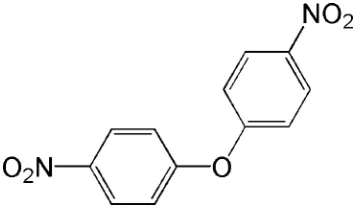
1-Nitro-4-(4-nitrophenoxy)benzene: a
second monoclinic polymorph
Mehwish Naz,aZareen Akhter,a* Vickie McKeeband Arif Nadeema
aDepartment of Chemistry, Quaid-i-Azam University, Islamabad, Pakistan, and bChemistry Department, Loughborough University, Loughborough, LE11 3TU,
England
Correspondence e-mail: [email protected]
Received 14 September 2013; accepted 24 October 2013
Key indicators: single-crystal X-ray study;T= 150 K; mean(C–C) = 0.002 A˚; Rfactor = 0.039;wRfactor = 0.104; data-to-parameter ratio = 15.4.
In the title compound, C12H8N2O5, the aromatic rings are
inclined to one another by 56.14 (7). The nitro groups are
inclined by to the benzene rings to which they are attached by 3.86 (17) and 9.65 (15). In the crystal, molecules are linked by
C—H O hydrogen bonds, forming a three-dimensional structure. The title compound is a new monoclinic polymorph, crystallizing in space group P21/c. The first polymorph
crystallized in space group C2/c and the molecule possesses twofold rotation symmetry. Two low-temperature structures of this polymorph (150 K and 100 K, respectively) have been reported [Meciarova et al. (2004). Private Communication (refcode IXOGAD). CCDC, Cambridge, England, and Dey & Desiraju (2005).Chem. Commun.pp. 2486–2488].
Related literature
For the crystal structure of the monoclinicC2/cpolymorph of the title compound, see: Meciarova et al. (2004); Dey & Desiraju (2005).
Crystal data
C12H8N2O5
Mr= 260.20
Monoclinic,P21=c
a= 8.1114 (5) A˚
b= 11.8942 (7) A˚
c= 12.3970 (7) A˚
= 106.402 (1)
V= 1147.37 (12) A˚3
Z= 4
MoKradiation
= 0.12 mm1
T= 150 K
0.360.350.25 mm
Data collection
Bruker APEXII CCD diffractometer
Absorption correction: multi-scan (SADABS; Sheldrick, 2012)
Tmin= 0.794,Tmax= 0.862
10808 measured reflections 2641 independent reflections 2149 reflections withI> 2(I)
Rint= 0.026
Refinement
R[F2> 2(F2)] = 0.039
wR(F2) = 0.104
S= 1.06 2641 reflections
172 parameters
H-atom parameters constrained
[image:1.610.82.263.577.687.2]max= 0.23 e A˚3 min=0.26 e A˚3
Table 1
Hydrogen-bond geometry (A˚ ,).
D—H A D—H H A D A D—H A
C13—H13 O21i
0.95 2.56 3.4413 (18) 153 C23—H23 O11ii
0.95 2.31 3.1933 (18) 154 C26—H26 O12iii
0.95 2.42 3.227 (2) 143
Symmetry codes: (i)x;y1;z; (ii)xþ1;yþ1 2;zþ
1
2; (iii)x;y;z.
Data collection:APEX2(Bruker 1998); cell refinement:SAINT
(Bruker 1998); data reduction: SAINT; program(s) used to solve structure:SHELXS97(Sheldrick, 2008); program(s) used to refine structure: SHELXL2012 (Sheldrick, 2008); molecular graphics:
SHELXTL(Sheldrick, 2008) andPLATON(Spek, 2009); software used to prepare material for publication:SHELXTL.
The authors are grateful to the Department of Chemistry, Quaid-i-Azam University, Islamabad, Pakistan, and the Chemistry Department, Loughborough University, Lough-borough, UK, for providing laboratory and analytical facilities.
Supplementary data and figures for this paper are available from the IUCr electronic archives (Reference: DS2235).
References
Bruker (1998).APEX2andSAINT. Bruker AXS Inc., Madison, Wisconsin, USA.
Dey, A. & Desiraju, G. R. (2005).Chem. Commun.pp. 2486–2488.
Meciarova, M., Toma, S., Podlesna, J., Kiripolsky, M. & Cisarova, I. (2004). Private Communication (refcode IXOGAD). CCDC, Cambridge, England. Sheldrick, G. M. (2008).Acta Cryst.A64, 112–122.
Sheldrick, G. M. (2012).SADABS. University of Go¨ttingen, Germany. Spek, A. L. (2009).Acta Cryst.D65, 148–155.
Structure Reports
Online
supporting information
Acta Cryst. (2013). E69, o1747 [doi:10.1107/S1600536813029346]
1-Nitro-4-(4-nitrophenoxy)benzene: a second monoclinic polymorph
Mehwish Naz, Zareen Akhter, Vickie McKee and Arif Nadeem
S1. Comment
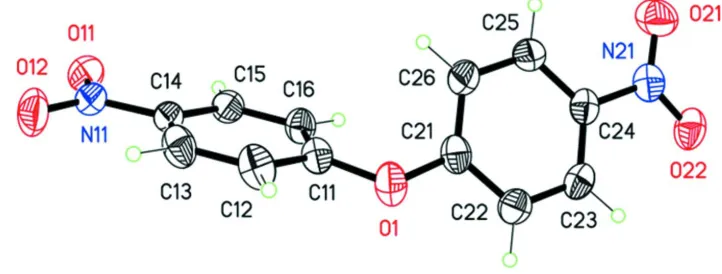
The molecular structure of the title molecule is illustrated in Fig. 1. The molecule has a a twisted V-shape with the two
nitrophenyl rings being inclined to one another by 56.14 (7) °. The nitro group N11/O11/O12 is inclined to the benzene
ring C11-C16, to which it is attached, by 3.86 (17) °, while the nitro group N21/O21/O22 is inclined to benzene ring
C21-C26 by 9.65 (15) °.
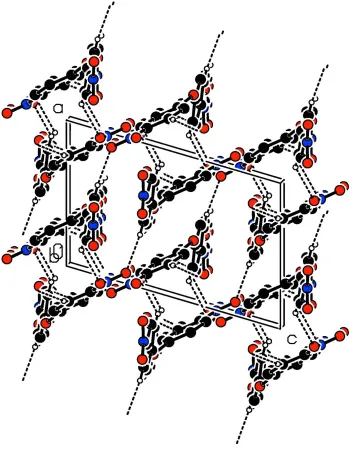
In the crystal, molecules are linked by C-H···O hydrogen bonds forming a three-dimensional structure (Table 1 and Fig.
2).
The title compound is a new monoclinic polymorph, crystallizing in space group P21/c. The first polymorph crystallized
in space group C2/c and the the molecule possesses fold rotation symmetry with the ether O atom lying on the
two-fold rotation axis. The 150 K structure was reported on by (Meciarova et al., 2004), while the 100 K structure was
reported on by (Dey & Desiraju, 2005). Taking the 100 K structure as reference it can be seen that the molecular structure
is slightly different to that of the present polymorph with the two nitrophenyl rings being inclined to one another by
66.75 (6) ° and the nitro group being inclined to the benzene ring by 12.97 (13) °. In the crystal, molecules are also linked
by C—H···O hydrogen bonds forming a three-dimensional structure.
S2. Experimental
A mixture of 4-nitrochlorobenzene (38.2 mmol), 1,6-hexan-diol (19.1 mmol) and anhydrous potassium carbonate (38.2
mmol) in 50 ml of THF was placed in a three necked prebaked round bottom flask fitted with a reflux condenser, a
nitro-gen inlet and a magnetic stirrer. After refluxing for 18 h in an inert atmosphere, the mixture was cooled to room
temperature and poured into 400 ml of water, yielding a yellow solid. The product was filtered, dried and recrystallized
from ethanol. The title compound was obtained as a by-product in the form of block-like yellow crystals [yield 10%;
M.p. = 416 K].
S3. Refinement
C-bound H atoms were included in calculated positions and refined as riding atoms: C-H = 0.95 Å with Uiso(H) =
Figure 1
Figure 2
A view along the b axis of the crystal packing of the title compound. The C-H···O hydrogen bonds are shown as dashed
lines (see Table 1 for details).
1-Nitro-4-(4-nitrophenoxy)benzene
Crystal data
C12H8N2O5
Mr = 260.20
Monoclinic, P21/c
Hall symbol: -P 2ybc
a = 8.1114 (5) Å
b = 11.8942 (7) Å
c = 12.3970 (7) Å
β = 106.402 (1)°
V = 1147.37 (12) Å3
Z = 4
F(000) = 536
Dx = 1.506 Mg m−3
Melting point: 416 K
Mo Kα radiation, λ = 0.71073 Å Cell parameters from 3529 reflections
T = 150 K 0.36 × 0.35 × 0.25 mm
Data collection
Bruker APEXII CCD diffractometer
Radiation source: fine-focus sealed tube
ω rotation with narrow frames scans Absorption correction: multi-scan
(SADABS; Sheldrick, 2012)
Tmin = 0.794, Tmax = 0.862
10808 measured reflections
2641 independent reflections 2149 reflections with I > 2σ(I)
Rint = 0.026
θmax = 27.5°, θmin = 2.4°
h = −10→10
k = −15→15
l = −16→16
Refinement
Refinement on F2
Least-squares matrix: full
R[F2 > 2σ(F2)] = 0.039
wR(F2) = 0.104
S = 1.06 2641 reflections 172 parameters 0 restraints
Hydrogen site location: inferred from neighbouring sites
H-atom parameters constrained
w = 1/[σ2(F
o2) + (0.0456P)2 + 0.2844P]
where P = (Fo2 + 2Fc2)/3
(Δ/σ)max < 0.001
Δρmax = 0.23 e Å−3
Δρmin = −0.26 e Å−3
Special details
Geometry. All e.s.d.'s (except the e.s.d. in the dihedral angle between two l.s. planes) are estimated using the full covariance matrix. The cell e.s.d.'s are taken into account individually in the estimation of e.s.d.'s in distances, angles and torsion angles; correlations between e.s.d.'s in cell parameters are only used when they are defined by crystal symmetry. An approximate (isotropic) treatment of cell e.s.d.'s is used for estimating e.s.d.'s involving l.s. planes.
Fractional atomic coordinates and isotropic or equivalent isotropic displacement parameters (Å2)
x y z Uiso*/Ueq
O1 0.44094 (13) 0.19652 (8) 0.09931 (8) 0.0438 (3) C11 0.32514 (17) 0.12641 (11) 0.02667 (11) 0.0346 (3) C12 0.3348 (2) 0.01415 (11) 0.05873 (12) 0.0427 (3)
H12 0.4100 −0.0082 0.1290 0.051*
C13 0.2350 (2) −0.06452 (11) −0.01166 (12) 0.0414 (3)
H13 0.2406 −0.1416 0.0092 0.050*
C14 0.12673 (16) −0.02940 (10) −0.11323 (11) 0.0341 (3) N11 0.02465 (15) −0.11328 (10) −0.18957 (11) 0.0427 (3) O11 −0.07448 (13) −0.08066 (10) −0.27901 (11) 0.0564 (3) O12 0.04440 (16) −0.21295 (9) −0.16171 (11) 0.0581 (3) C15 0.11403 (17) 0.08250 (11) −0.14550 (12) 0.0361 (3)
H15 0.0368 0.1048 −0.2151 0.043*
C16 0.21520 (17) 0.16134 (10) −0.07512 (11) 0.0349 (3)
H16 0.2095 0.2384 −0.0961 0.042*
C21 0.41096 (18) 0.31038 (11) 0.10392 (11) 0.0353 (3) C22 0.55556 (17) 0.37841 (12) 0.12879 (11) 0.0369 (3)
H22 0.6661 0.3464 0.1384 0.044*
C23 0.53798 (17) 0.49294 (11) 0.13949 (10) 0.0359 (3)
C24 0.37637 (17) 0.53685 (11) 0.12704 (10) 0.0329 (3) N21 0.35664 (16) 0.65877 (9) 0.13676 (9) 0.0388 (3) O21 0.21649 (15) 0.69525 (9) 0.13919 (11) 0.0592 (3) O22 0.48044 (14) 0.71924 (8) 0.14138 (9) 0.0477 (3) C25 0.23130 (18) 0.46974 (12) 0.10442 (12) 0.0394 (3)
H25 0.1215 0.5018 0.0975 0.047*
C26 0.24867 (18) 0.35511 (12) 0.09212 (13) 0.0420 (3)
H26 0.1507 0.3075 0.0758 0.050*
Atomic displacement parameters (Å2)
U11 U22 U33 U12 U13 U23
O1 0.0519 (6) 0.0328 (5) 0.0393 (5) 0.0013 (4) 0.0010 (4) −0.0048 (4) C11 0.0417 (7) 0.0300 (6) 0.0332 (6) −0.0018 (5) 0.0122 (5) −0.0024 (5) C12 0.0603 (9) 0.0338 (7) 0.0329 (7) 0.0052 (6) 0.0115 (6) 0.0050 (5) C13 0.0597 (9) 0.0258 (6) 0.0430 (8) 0.0006 (6) 0.0217 (7) 0.0047 (5) C14 0.0336 (6) 0.0294 (6) 0.0435 (7) −0.0040 (5) 0.0176 (6) −0.0047 (5) N11 0.0383 (6) 0.0374 (6) 0.0580 (8) −0.0086 (5) 0.0227 (6) −0.0107 (6) O11 0.0338 (5) 0.0551 (7) 0.0719 (8) −0.0026 (5) 0.0012 (5) −0.0181 (6) O12 0.0775 (8) 0.0332 (6) 0.0725 (8) −0.0187 (5) 0.0357 (7) −0.0101 (5) C15 0.0343 (7) 0.0336 (7) 0.0393 (7) 0.0009 (5) 0.0084 (5) 0.0012 (5) C16 0.0406 (7) 0.0254 (6) 0.0381 (7) −0.0007 (5) 0.0102 (5) 0.0035 (5) C21 0.0466 (7) 0.0309 (6) 0.0280 (6) −0.0022 (5) 0.0098 (5) −0.0016 (5) C22 0.0358 (7) 0.0425 (7) 0.0290 (6) 0.0004 (6) 0.0035 (5) −0.0008 (5) C23 0.0371 (7) 0.0388 (7) 0.0294 (6) −0.0090 (5) 0.0055 (5) −0.0011 (5) C24 0.0433 (7) 0.0308 (6) 0.0253 (6) −0.0057 (5) 0.0106 (5) 0.0002 (5) N21 0.0512 (7) 0.0340 (6) 0.0327 (6) −0.0057 (5) 0.0142 (5) 0.0016 (5) O21 0.0606 (7) 0.0381 (6) 0.0882 (9) 0.0030 (5) 0.0362 (7) 0.0020 (6) O22 0.0576 (6) 0.0370 (5) 0.0488 (6) −0.0158 (5) 0.0153 (5) −0.0031 (4) C25 0.0384 (7) 0.0375 (7) 0.0458 (8) −0.0033 (6) 0.0174 (6) −0.0044 (6) C26 0.0420 (7) 0.0370 (7) 0.0511 (8) −0.0107 (6) 0.0196 (6) −0.0085 (6)
Geometric parameters (Å, º)
O1—C21 1.3799 (16) C16—H16 0.9500
O1—C11 1.3824 (16) C21—C22 1.3861 (19)
C11—C16 1.3873 (18) C21—C26 1.389 (2)
C11—C12 1.3890 (19) C22—C23 1.3801 (19)
C12—C13 1.376 (2) C22—H22 0.9500
C12—H12 0.9500 C23—C24 1.3787 (19)
C13—C14 1.381 (2) C23—H23 0.9500
C13—H13 0.9500 C24—C25 1.3835 (18)
C14—C15 1.3852 (18) C24—N21 1.4677 (17)
C14—N11 1.4608 (17) N21—O22 1.2233 (15)
N11—O12 1.2325 (16) N21—O21 1.2251 (16)
N11—O11 1.2340 (17) C25—C26 1.384 (2)
C15—C16 1.3819 (18) C25—H25 0.9500
C21—O1—C11 121.58 (10) O1—C21—C22 115.73 (12)
O1—C11—C16 123.77 (12) O1—C21—C26 122.99 (12)
O1—C11—C12 114.87 (12) C22—C21—C26 121.14 (12)
C16—C11—C12 121.19 (12) C23—C22—C21 119.58 (13)
C13—C12—C11 119.79 (13) C23—C22—H22 120.2
C13—C12—H12 120.1 C21—C22—H22 120.2
C11—C12—H12 120.1 C24—C23—C22 118.95 (12)
C12—C13—C14 118.77 (12) C24—C23—H23 120.5
C12—C13—H13 120.6 C22—C23—H23 120.5
C14—C13—H13 120.6 C23—C24—C25 122.11 (12)
C13—C14—C15 122.02 (12) C23—C24—N21 119.17 (11)
C13—C14—N11 118.84 (12) C25—C24—N21 118.72 (12)
C15—C14—N11 119.13 (12) O22—N21—O21 123.08 (12)
O12—N11—O11 123.66 (13) O22—N21—C24 118.53 (12)
O12—N11—C14 118.06 (13) O21—N21—C24 118.38 (11)
O11—N11—C14 118.27 (12) C24—C25—C26 118.92 (13)
C16—C15—C14 119.16 (12) C24—C25—H25 120.5
C16—C15—H15 120.4 C26—C25—H25 120.5
C14—C15—H15 120.4 C25—C26—C21 119.27 (12)
C15—C16—C11 119.06 (12) C25—C26—H26 120.4
C15—C16—H16 120.5 C21—C26—H26 120.4
C11—C16—H16 120.5
Hydrogen-bond geometry (Å, º)
D—H···A D—H H···A D···A D—H···A
C13—H13···O21i 0.95 2.56 3.4413 (18) 153
C23—H23···O11ii 0.95 2.31 3.1933 (18) 154
C26—H26···O12iii 0.95 2.42 3.227 (2) 143