Debiasing Reasoning:
A Signal Detection Analysis
Nicola Marie Crane MRes
Thesis submitted to for the degree of
Doctor of Philosophy
Department of Mathematics and Statistics
Lancaster University
Abstract
This thesis focuses on deductive reasoning and how the belief bias effect can be reduced or ameliorated. Belief bias is a phenomenon whereby the evaluation of the logical validity of an argument is skewed by the degree to which the reasoner believes the conclusion. There has been little research examining ways of reducing such bias and whether there is some sort of effective intervention which makes people reason more on the basis of logic. Traditional analyses of this data has focussed on simple measures of accuracy, typically deducting the number of incorrect answers from the number of correct answers to give an accuracy score. However, recent theoretical developments have shown that this approach fails to separate reasoning biases and response biases. A reasoning bias, is one which affects individuals’ ability to discriminate between valid and invalid arguments, whereas a response bias is simply the individual’s tendency to give a particular answer, independent of reasoning. A Signal Detection Theory (SDT) approach is used to calculate measures of reasoning accuracy and response bias. These measures are then analysed using mixed effects models. Chapter 1 gives a general introduction to the topic, and outlines the content of subsequent chapters. In Chapter 2, I review the psychological literature around belief bias, the growth of the use of SDT models, and approaches to reducing bias. Chapter 3 covers the methodology, and includes a a thorough description of the calculation of the SDT measures, and an explanation of the mixed effects models I used to analyse these. Chapter 4 presents an experiment in which the effects of feedback on reducing belief bias is examined. In Chapter 5, the focus shifts in the direction of individual differences, and looks at the effect of different instructions given to participants, and Chapter 6 examines the effects of both feedback and specific training. Chapter 7 provides a general discussion of the implications of the previous three chapters.
Acknowledgements
I would like to thank my former supervisor, Professor Linden Ball, for often having more faith in my work than I did myself. Another former supervisor, Professor Tom Ormerod, for your enthusiasm and creativity, even if I did wonder what I’d said when you left a year after Linden did. A huge thank you to Professor Padraic Monaghan for taking over as my third supervisor in as many years. And finally, Dr David Lucy, for all the good advice, statistical and otherwise.
Thanks to Lacey, without whom none of the Amazon Mechanical Turk research would have happened.
I also need to thank Preston Roller Girls; although our relationship was a com-plicated one, I wouldn’t have been submitting this thesis if it wasn’t for the lessons you taught me in sheer bloody-minded determination and stress management.
Allie at The Yorkshire House, for keeping me grounded.
All my friends in Lancaster, too many to name, for keeping me (relatively!) sane during the past 4 years, or at least being there for a beer when sanity wasn’t quite so forthcoming.
Barry, for being the best Dad ever, and for paying for my masters.
Mum, because “it doesn’t matter what you do, as long as you’re happy” helped me keep everything in perspective.
Padraic. For all the great ideas, feedback, and reassuring me that despite my worrying, everything was in fact, not on fire.
Declaration
This thesis is my own work and no portion of the work referred to in this thesis has been submitted in support of an application for another degree or qualification at this or any other institute of learning.
Contents
Abstract i
1 Introduction 1
2 Literature Review 9
2.1 Belief Bias and Syllogistic Reasoning Tasks . . . 9
2.2 Properties of Syllogisms . . . 14
2.3 Theories of Syllogistic Reasoning . . . 16
2.4 Theories of Belief Bias . . . 25
2.4.1 Separating Reasoning and Response Bias . . . 33
2.5 Debiasing . . . 42
2.5.1 External Factors . . . 43
2.5.2 Prior Instruction Interventions . . . 44
2.5.3 Online Processing Interventions . . . 45
2.6 Conclusion . . . 49
3 Methodology 50 3.1 Traditional Approaches . . . 51
3.2 Signal Detection Theory . . . 51
3.2.1 Response Types . . . 52
3.2.2 SDT conceptualisation as distributions . . . 52
3.2.3 Comparison to traditional approach . . . 54
3.2.4 ROC Curves . . . 57
3.2.5 Empty cell adjustments . . . 60
3.2.6 Confidence Rating ROCs . . . 61
3.3 Mixed Effects Models . . . 64
3.3.1 Assumptions . . . 66
3.3.2 Multicollinearity . . . 67
3.3.3 Model Comparison . . . 67
3.3.4 Selection of Fixed Effects . . . 69
3.4 Summary . . . 69
4 Experiment 1 74 4.1 Method . . . 78
4.2 Results . . . 82
4.3 Discussion . . . 91
5 Experiment 2 97 5.1 Method . . . 110
5.2 Results . . . 112
5.3 Discussion . . . 120
6 Experiment 3 125 6.1 Method . . . 130
6.2 Results . . . 133
6.3 Discussion . . . 145
7 General Discussion 150 7.1 Theoretical Implications . . . 153
7.2 Methodology . . . 156
7.2.1 Online Testing . . . 156
7.2.2 Analyses . . . 157
7.3 Debiasing . . . 158
7.4 Conclusion . . . 160
Appendices 162
A One Complete Set of Syllogisms 163
B SDT measures code in R 165
C Slow Bootstrap 167
D Training 168
List of Figures
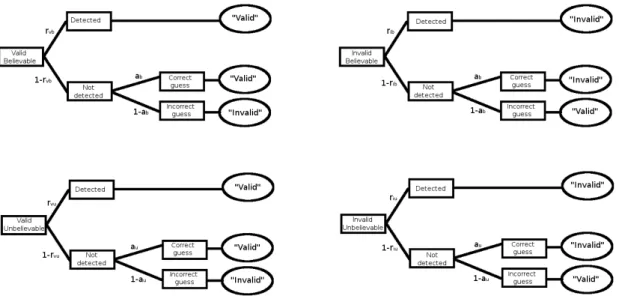
2.1 Diagrammatic representation of Klauer et al’s MPT model of belief
bias . . . 34
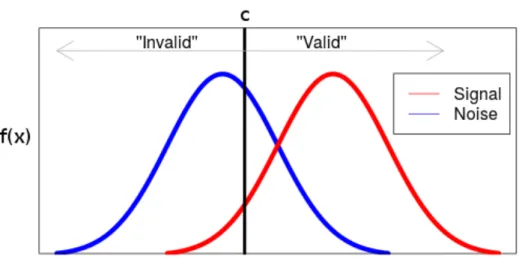
2.2 Plot showing SDT model of belief bias . . . 36
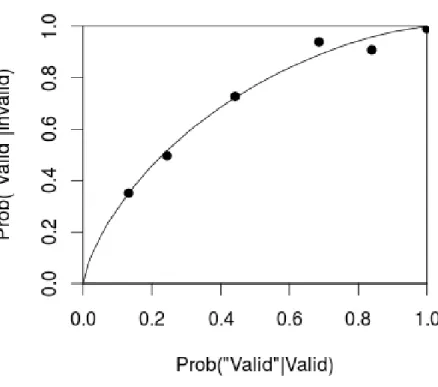
2.3 Example of a ROC Curve . . . 38
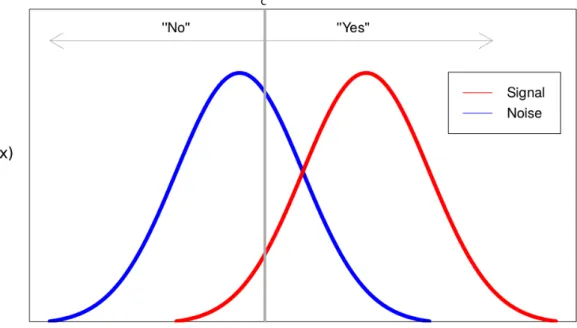
3.1 Plot showing example signal and noise distributions . . . 53
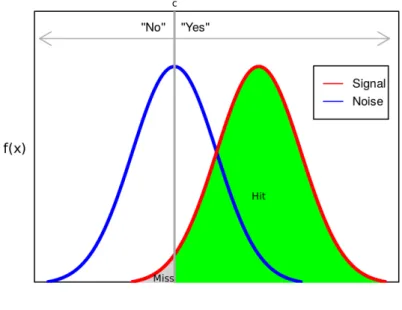
3.2 Plots demonstrating a) hits vs. misses and b) correct rejections vs. false alarms . . . 55
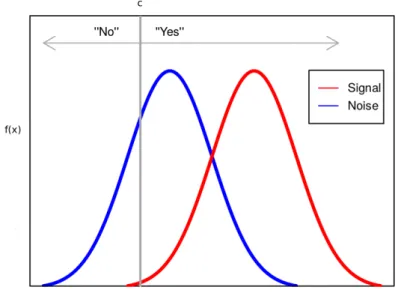
3.3 Plot showing example signal and noise distributions where the re-sponse criterion sets hits to 99% and false alarms to 70% . . . 56
3.4 Plot showing example signal and noise distributions where the re-sponse criterion sets hits to 96% and false alarms to 50% . . . 57
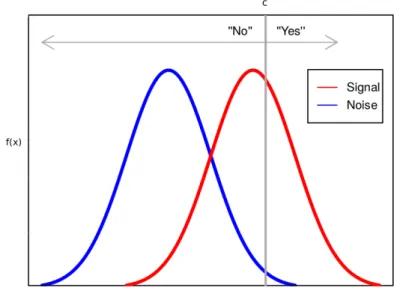
3.5 Plot showing example signal and noise distributions where the re-sponse criterion sets hits to 40% and false alarms to 5% . . . 57
3.6 Plot of example ROC curve . . . 58
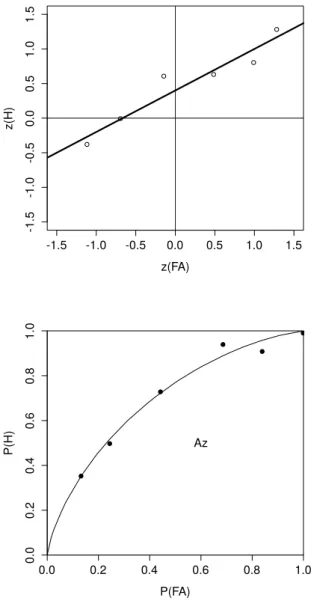
3.7 Plot showing example of a ROC and an equivalent zROC . . . 72
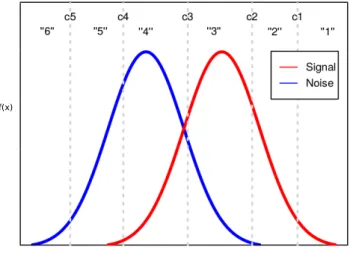
3.8 Plot showing example confidence rating ROC; c1...c5 are the various response criteria. . . 73
4.1 Plot of mean endorsement rates by session number, problem type, and feedback status . . . 82
4.2 ROC curves by session and believability for feedback condition . . . 84
4.3 ROC curves by session and believability for no feedback condition . 85 4.4 Mean accuracy scores by believability and feedback group status . . 85
4.5 Mean response bias scores by believability and feedback condition . 86 4.6 Response times by problem type . . . 87
4.7 Confidence ratings by problem type and feedback condition . . . 89
5.1 ROC curves for online and lab participants by believability . . . 117
6.1 ROC curves for unadjusted analysis by problem type and believability142 6.2 ROC curves for the adjusted analysis by problem type and believability143
List of Tables
2.1 Valid Syllogisms: Aristotelian definition . . . 15
2.2 Valid syllogisms, Johnson-Laird & Bara (1984) * =valid only in AC mood ˆ=valid only in CA mood . . . 16
3.1 SDT response classifications . . . 52
4.1 Parameter Values for Main Task Endorsement Rate Model . . . 82
4.2 Parameter Values for Main Task Accuracy Model . . . 84
4.3 Parameter Values for Main Task SDT Response Bias Model . . . . 86
4.4 Parameter Values for Main Task Response Times Model . . . 87
4.5 Parameter Values for Main Task Confidence Model . . . 88
5.1 Correlations between measures *𝑝 <0.05, **𝑝 <0.01, ***𝑝 < 0.001 114 5.2 Parameter Values for Endorsement Rate Model . . . 115
5.3 Parameter Values for SDT Accuracy Model . . . 116
5.4 Parameter Values for SDT Response Bias Model . . . 117
5.5 Parameter Values for Response Time Model . . . 118
5.6 Parameter Values for Confidence Model . . . 119
6.1 Parameter Values for Necessary vs. Possible Strong - Accuracy Model135 6.2 Parameter Values for Necessary vs. Possible Strong - Response Bias Model . . . 136
6.3 Parameter Values for Necessary vs. Possible Weak - Accuracy Model 136 6.4 Parameter Values for Necessary vs. Possible Weak - Response Bias Model . . . 137
6.5 Parameter Values for Necessary vs. Impossible Accuracy Model . . 137
6.6 Parameter Values for Necessary vs. Impossible Response Bias Model 138 6.7 Parameter Values for Necessary vs. Possible Strong Accuracy Model - Adjusted . . . 139
6.8 Parameter Values for Necessary vs. Possible Strong Response Bias Model - Adjusted . . . 140
6.9 Parameter Values for Necessary vs. Possible Weak Accuracy Model - Adjusted . . . 140
6.10 Parameter Values for Necessary vs. Possible Weak Response Bias Model - Adjusted . . . 141
6.11 Parameter Values for Necessary vs. Impossible Accuracy Model -Adjusted . . . 141 6.12 Parameter Values for Necessary vs. Impossible Response Bias Model
Chapter 1
Introduction
We come across vast amounts of information in everyday life, and even more
so as the near-ubiquitous availability of internet access is becoming increasingly
commonplace. According to Hilbert and L´opez (2011), in 2008, people encountered
five times as much information every day than they did in 1986, with this quantity
continuously increasing. Given the amount of information which we process daily,
the ability to distinguish what is true and relevant from what is not is an important
skill if we are to make sense of an increasingly complex world.
This can have serious consequences; for example, the anti-vaccination movement
gained a lot of support as the result of a now discredited paper published in 1998
which linked the MMR vaccine to autism spectrum disorders (Wakefield et al.,
1998). This led to a drop in uptake of the MMR vaccine, despite numerous studies
and large scale meta-analyses showing no evidence of a link between the vaccine
and autism (e.g. Jefferson, Price, Demicheli, & Bianco, 2003; Doja & Roberts, 2006;
DeStefano, 2007; Taylor, Swerdfeger, & Eslick, 2014). One of the consequences of
this was a large outbreak of measles in Swansea in 2013, which led to over 1200
people falling ill and one death. A little knowledge is a dangerous thing.
Clearly, the ability to assess the veracity of ideas and arguments is important,
and examining the reasoning process in order to evaluate how it works and
po-tentially even improve it is a worthwhile research pursuit. Lilienfeld, Ammirati,
and Landfield (2009) even go as far as to discuss the potential of debiasing as an
important tool in the reduction of idelogical extremism and conflict on a much
larger scale. Modern reasoning research really picked up speed with the publication
of an influential paper, “Judgement Under Uncertainty: Heuristics and Biases”
(Tversky & Kahneman, 1974) and a subsequent volume of the same name a few
years later containing the original paper and a collection of other similar research by
a variety of authors (Kahneman, Slovic, & Tverky, 1982). This research suggested
that many of the judgements made by humans are influenced by systematic biases,
which can lead to illogicality. These biases are caused by the use of heuristics;
quick and automatic processes which tend to be association-based and require little
cognitive effort.
One such bias is the belief bias effect - whereby people tend to subject
informa-tion which disagrees with their pre-existing beliefs to a higher degree of scrutiny
compared to information that conforms with pre-existing beliefs. For example, Lord,
Ross, and Lepper (1979) presented participants, who had completed prior surveys
about their opinions regarding the death penalty, with information from fictional
studies focussed on the use of the death penalty as a deterrent against crime. Both
the pro- and anti- death penalty groups showed a tendency to argue that the
study which corresponded with their personal belief had greater methodological
and empirical validity.
Much of the subsequent research on belief bias has used syllogistic reasoning
problems. Syllogisms are simple three statement arguments, containing two premises
and a conclusion. They are a useful form of stimuli as they are short, so multiple
syllogisms can be evaluated by a single participant in an experiment, and their
structure is easy to replicate across multiple studies.
A syllogism might have a believable, unbelievable, or neutral conclusion. An
example of each is shown below.
Believable:
No soft things are steel
Therefore, some metals are not steel
Unbelievable:
No animals are reptiles
Some reptiles are cats
Therefore, some cats are not animals
Neutral:
Some junarics are lizards
All lizards are panphids
Therefore, some panphids are junarics
Earlier theories of syllogistic reasoning were predominantlysingle process
theo-ries; that is, they explained differences in syllogistic reasoning performance as either
due to the use of heuristics, quick “rules of thumb”, which people apply
automati-cally, or due to analytic processes involving rules and slower more effortful thinking.
However, trends in more recent research on belief bias in syllogistic reasoning
began with a study by Evans, Barston, and Pollard (1983) who found that, despite
the brevity of syllogistic reasoning problems, the belief bias effect still affected
participants’ reasoning. Participants were asked to evaluate a number of syllogisms
as either ‘valid’ or ‘invalid’. Half of these syllogisms were valid - the conclusion
did logically lead on from the premises, and half were invalid - the conclusion did
not logically lead on from the premises. Within the valid and invalid conclusions,
believability was also manipulated - half of the conclusions were believable and the
other half unbelievable. The results of this study constitute one of the key findings
in belief bias research - an interaction between validity and believability; whilst
the evaluation of invalid problems. For invalid problems, participants were much
more likely to deem the conclusion as “valid” if it was believable. This finding
of a believability by validity interaction sparked over two decades of research and
theoretical development to explain the basis of the phenomenon, as well as the
application of dual-process theory to belief bias research. Rather than focus on
single-processes; dual-process theories suggest that this interaction is driven by a
conflict between heuristic (quick and automatic) and analytic (slower and effortful)
processes, although accounts differ in their explanations of exactly how this conflict
is detected and resolved. A major methodological shift in this research began in
2010 when Dube, Rotello, and Heit (2010) provided evidence to show that the way
in which indices of accuracy and bias had been calculated was flawed. Previously,
accuracy and belief bias were measured by simply testing for the effects of validity,
believability, and an interaction between the two, often examined through the
use of a number of indices. These were linear in nature, calculated by adding
and subtracting the number of problems of different types that had been deemed
‘valid’ by participants. Although theoretical accounts differed in their details, there
was a broad agreement that the belief bias effect was due to superior reasoning
on unbelievable problems. However, Dube et al. (2010) argued that belief bias
primarily manifests as a response bias - participants’ tendency to choose the option
‘valid’ or ‘invalid’ is independent of any reasoning. They argue that the traditional
method of calculation fails to separate reasoning and response bias and instead
posited that the use of Signal Detection Theory (SDT) based analyses led to a
more accurate model of belief bias as they can properly distinguish these two forms
of bias. Subsequent research (e.g. Trippas, Handley, & Verde, 2013) has extended
this view, demonstrating that when complex reasoning takes place, for example
in participants of a higher cognitive ability or when there are no time constraints,
belief bias also has an effect upon reasoning. This constituted a major shift in
focus and highlighted the importance of considering individual differences between
that of Trippas, Verde, and Handley (2015) also examined the role of cognitive
style; that is, whether individuals have the tendency to rely on heuristic or analytic
processing, regardless of their actual ability to do so.
As discussed earlier, debiasing reasoning is an important research aim, and
Stupple and Ball (2014) emphasise that understanding and improving reasoning
are not mutually exclusive research goals. Thus, debiasing has two roles to play
-primarily in identifying methods of reducing or eliminating the extent to which bias
affects reasoning, but also to simply aid in further developing theoretical knowledge
of the nature of the reasoning process itself. Given that individual differences affect
the way in which belief bias affects reasoning, and that even strategy change can
be affected by individual differences (e.g. Roberts & Newton, 2003), it is clear that
such differences should be accounted for when developing debiasing strategies.
Little research has focussed on debiasing reasoning; the findings of earlier
research which aimed to reduce belief bias (e.g. Evans, Newstead, & Allen, 1994;
Newstead, Pollard, Evans, & Allen, 1992) has been disputed by more recent work
such as Heit and Rotello (2014) who found that SDT analyses show that attempts
to reduce reasoning bias only affected response bias. Although Ball (2013) found
an effect of feedback on reducing belief bias, once again, the lack of SDT analyses
makes these results unclear.
The limited amount of previous research on debiasing that exists has
predomi-nantly used traditional indices, making interpretation of these results problematic.
The only empirical work which uses SDT is that of Heit and Rotello (2014), which
does not examine individual differences. Thus, this thesis provides a novel
con-tribution to the belief bias literature by using SDT analyses to explore potential
methods of debiasing reasoning whilst accounting for individual differences.
In Chapter 2, I review a range of literature related to belief bias and syllogistic
reasoning experiments. Firstly, belief bias is described in more detail and the
structural components of syllogisms are explained, followed by a discussion of
belief bias effect and compare the different theories which have been suggested to
explain this phenomenon, leading into more recent debates regarding the importance
of SDT analyses in accurately analysing belief bias data. After summarising the
main points in this ongoing debate, Chapter 2 concludes with an overview of
debiasing techniques which have been used in the past in order to attempt to
improve thinking and reasoning, and reduce or eliminate the effects of bias.
In Chapter 3, I present a detailed discussion of the statistical methodology used
to analyse the data in this thesis. Previous approaches to analysing belief bias data
are outlined first, followed by an in-depth discussion of SDT models, beginning
with theoretical background and moving on to how the various SDT measures are
calculated. I explain the importance of using unequal-variance SDT models when
they are warranted, along with the use of confidence rating Receiver Operating
Characteristic (ROC) curves. Furthermore, I discuss the benefits conferred through
use of mixed effects regression models and include formulae for the models contained
in this thesis. This is followed by an explanation of the model selection techniques
used.
Chapter 4 presents an experimental investigation as to whether the provision of
feedback across multiple testing sessions is an effective intervention for debiasing
reasoning. This chapter constitutes a novel contribution to the literature, in using
an SDT approach to track changes in bias across time.
Chapter 5 is another empirical chapter, and provides a novel contribution by
testing the hypothesis that individual differences between participants are
cru-cial to consider when examining debiasing. Here, the effect of differing sets of
instructions as a debiasing technique was investigated. This chapter also compares
lab-based testing and online testing, and makes a case for the wider use of
on-line experimentation, whilst considering the advantages and drawbacks of both
methodologies.
Chapter 6 is the final experimental chapter and investigates the use of specific
individual differences are considered. Also examined here is participants’ ability to
correctly discriminate between different types of syllogism.
Chapter 7 summarises the conclusions to the research questions presented
throughout the thesis, and discusses the possible implications these findings have
when considered in the wider context of the underlying theoretical assumptions
surrounding the mechanisms underlying belief bias.
An examination of human reasoning cannot be without mention of normativism,
the idea that reasoning either does or should conform to rules of logic. This topic
is not without controversy and there has been recent debate as to whether it
is appropriate to apply normative standards to human reasoning. For example,
Elqayam and Evans (2011) argue that when examining human reasoning, using
normative standards not only narrows the research questions which are to be asked
but also makes unnecessary assumptions, whereas a descriptivist approach, which
simply describes the system, could instead be taken. They do concede, however, that
when the intention is to improve reasoning, some standard against which reasoning
can be measured is necessary. Stupple and Ball (2014) provide a more reasonable
middle ground between normativism and descriptivism, which they term “soft
normativism”, which allows for a normative approach as long as the problems which
can be caused by normativism are accounted for, and individual differences between
individuals are taken into account. Stupple and Ball (2014) also argue that accounts
of reasoning can be strengthened by the use of triangulation; examining multiple
measures simultaneously in order to better capture the finer nuances of responses.
Question responses alone are an overly simplistic measure of reasoning; given that
there is a wealth of evidence showing differences between individuals’ strategies,
we need to be able to distinguish between a rapid, automatic normatively incorrect
response, and one which is slow and effortful yet still incorrect. Although both of
these responses may appear identical if only individual responses are examined,
the underlying processes behind each of them are likely to be quite different, and
also examined. In summary, belief bias and debiasing are both methodologically
and theoretically complex topics. In the next chapter, I will review the relevant
Chapter 2
Literature Review
Although the focus of this thesis is removing bias from reasoning, we first must
examine the nature of belief bias and the theories of the cognitive processes thought
to underlie the belief bias phenomenon. In addition, it is important to consider the
ways in which belief bias is investigated and potential influencing factors which must
be controlled for in any empirical investigation of the topic. In this chapter, I first
outline the belief bias effect and discuss tasks which have been used to investigate it,
focussing upon syllogistic reasoning tasks. This leads on to an in-depth discussion
of these tasks, including properties of syllogisms, general theories of syllogistic
reasoning, and then goes on to explore theories of the way in which belief bias
affects syllogistic reasoning and how methods based around Signal Detection Theory
(SDT) have added extra dimensions to the syllogistic reasoning debate. Finally I
examine ways in which previous studies have attempted to reduce the effects of
bias on reasoning, and categorise and compare the differing approaches.
2.1
Belief Bias and Syllogistic Reasoning Tasks
It has been widely demonstrated that when individuals engage in deductive
reason-ing, their competence in both forming and evaluating logically valid conclusions
can be affected by a number of cognitive biases and errors. When these errors are
systematic in nature, that is, common across multiple individuals and settings,
their examination allows us insight into the particulars of the underlying process
behind them. One of these potential biases is known as belief bias, defined as
when an individual’s prior beliefs affects their ability to make an accurate logical
judgement about facts that they have been presented with (Evans et al., 1983).
The predominant methodology used to investigate this phenomenon involves
syllo-gistic reasoning tasks; individuals are shown an argument containing two premises
followed by a conclusion and are asked to evaluate whether the conclusion logically
follows on from the premises. When logic and belief are in conflict, individuals’
logical judgements are often impeded by the believability of the argument’s
con-clusion (Ball, Phillips, Wade, & Quayle, 2006; Evans, 1989; Newstead et al., 1992;
Stanovich & West, 1997; Stupple, Ball, Evans, & Kamal-Smith, 2011). This effect
has been shown to be stronger with invalid content, with individuals typically
being equally likely to accept valid conclusions whether believable or unbelievable,
but more likely to incorrectly accept invalid believable than invalid unbelievable
conclusions.
A number of different tasks have been used to investigate belief bias. One such
example is an adaptation of the base-rate neglect problem (Kahneman & Tversky,
1973) used by De Neys and Franssens (2009). In this task, participants are given a
short description of an individual person chosen at random from a pool of people.
A number of characteristics of the person are described, and paint a picture which
conforms to various stereotypes. Participants are then asked if the individual being
described is more likely to be a member of a group coherent with these stereotypes
or another group which differs. Participants are also told that the pool of people
which the individual has been selected from contains a certain number of member
of each group. An example of such a problem from De Neys and Franssens (2009)
is shown below.
“In a study 100 people were tested. Jo is a randomly chosen participant
women. Jo is 23 years old and is finishing a degree in engineering. On
Friday nights, Jo likes to go out cruising with friends while listening to
loud music and drinking beer. What is most likely?
A. Jo is a man
B. Jo is a woman.”
It has widely been shown that even when it is stated that the pool contains 5%
stereotype-conforming and 95% stereotype-opposing individuals, participants will
tend to ignore this information and be influenced by their prior beliefs rather than
logical probability when choosing which group the individual is likely to be from.
Base-rate neglect problems are more commonly used in judgement and
decision-making research, and deductive reasoning studies commonly use categorical
syllo-gistic reasoning tasks. These tasks typically use a conclusion-evaluation paradigm;
participants evaluate whether the conclusion to a categorical syllogism logically
follows on from the two preceding premises, and are told to accept that the
infor-mation contained in premises is true (e.g. Evans et al., 1983). This task is known
as the conclusion-evaluation task, and the number of conclusions accepted for each
of the different combinations of conclusion believability (believable/unbelievable)
and validity (valid/invalid) are then submitted to statistical analysis. This gives
us four different problem types; valid-believable (VB), valid-unbelievable (VU),
invalid-believable (IB) and invalid-unbelievable (IU). Examples of all four types of
categorical syllogism using the same content are shown below.
Valid-believable:
Some metals are soft
No soft things are steel
Therefore, some metals are not steel
Valid-unbelievable:
No soft things are metal
Some steel is soft
Invalid-believable:
No metals are soft
Some soft things are steel
Therefore, some metals are not steel
Invalid-unbelievable:
Some soft things are metal
No steel is soft
Therefore, some steel is not metal
VB and IU problems are often referred to as ’non-conflict’ problems (Stupple et
al., 2011). This means that for these problems, whether responding on the basis of
logic or on the basis of belief, the same response is likely to be given. However, on VU
and IB problems, which can be termed ’conflict’ problems, there is a clash between
logic and belief, or rather, a belief-based response is incongruent with a logic-based
response. Research has found that individuals find conflict problems more difficult
than non-conflict problems, and are more likely to respond non-normatively to such
stimuli (e.g De Neys, 2013). This effect is stronger for IB than VU problems, with
many theoretical perspectives on belief bias arguing that is because these problem
types are inherently different to each other. Whilst valid problems are determinately
valid (i.e. the conclusion is necessitated by the premises), typically, invalid problems
which are used in such studies are indeterminately invalid. However, the belief
bias effect has also been demonstrated on determinately invalid problems (Klauer,
Musch, & Naumer, 2000); this will be discussed in more detail later in this chapter.
A slightly different methodology, the conclusion-production paradigm, requires
participants to generate their own conclusions; however, it has been shown that
the belief bias effect persists regardless (Oakhill & Johnson-Laird, 1985; Markovits
& Nantel, 1989; Oakhill & Johnson-Laird, 1989). Belief bias has also been
demon-strated on relational reasoning tasks; in such tasks, participants are given a number
of premises which are related on a temporal or spatial basis, and must evaluate the
2003):
The Pharaohs ruled after the Romans
The Pharaohs ruled before the Normans
The Pyramids were built at the time of the Romans
At the time of the Normans, William the Conqueror was king Therefore,
William the Conqueror was king after the Pyramids were built
Despite the difference in overall structure, Roberts and Sykes (2003) found that
participants showed similar patterns of results on relational reasoning tasks to
those typically found on categorical syllogistic reasoning tasks. In addition, the
effect of belief on conditional reasoning has been investigated. There are a number
of variants of conditional reasoning problems. For example, Thompson, Prowse,
and Pennycook (2011) used the following format:
If the TV is plugged in, then it works The TV works, therefore, it is
plugged in
However, Santamar´ıa, Garc´ıa-Madruga, and Johnson-Laird (1998) used double
conditionals, which bear more similarities to categorical syllogisms e.g.:
If Pablo is at home, then he watches the news. If Pablo is at home, then
he turns on the television. Therefore, if Pablo turns on the television,
then he watches the news.
In both cases, regardless of the specific nature of the task completed, belief bias
effect was still found to have an effect upon responses, providing further evidence
for the generality of the belief bias effect. The widespread use of categorical
syllogistic reasoning tasks can be attributed to the fact that categorical syllogisms
are unambiguously valid or invalid, and their properties can be described in a
standardised way, thus making different studies by different authors easily directly
experience of deductive reasoning, the empirical benefits mentioned above along
with the generality of the belief bias phenomenon to a variety of different contexts
lead many to argue that, for these reasons, syllogistic reasoning tasks are an
invaluable tool for investigating the underlying processes behind deductive reasoning
(e.g. Oakhill & Johnson-Laird, 1985).
2.2
Properties of Syllogisms
Syllogisms are logical arguments which, typically, contain two premises followed
by a conclusion. Depending on the structure and content of the premises, the
conclusion may or may not be valid. The structure of a syllogism can be described
in terms of figure and mood (Evans et al., 1983). The figure is the order in which the
individual terms within the syllogism are presented. An example of a syllogism is:
“some metals are soft; no soft things are steel; therefore, some metals are not steel”.
Here, ‘metals’ are the predicate of the conclusion, ‘soft things’ are the middle term,
and ‘steel’ is the subject of the conclusion. For the purpose of simplicity, these
terms are often denoted as ‘A’ (predicate of the conclusion), ‘B’ (the middle term),
and ‘C’ (subject of the conclusion). The predicate and subject of the conclusion
each appear once in either the first or second premise, but not together, whereas
the middle term appears once in both. The different combinations of the terms
results in four possible figures for the premises; ABBC (Figure 1), BACB (Figure
2), ABCB (Figure 3), and BABC (Figure 4). These pairs of premises then will
be followed by a conclusion of either AC or CA figure. In the example above, the
premises are in the ABBC figure, and the conclusion is in the AC figure.
The use of the phrasing ‘some...are...’ in the first premise of the example
syllogism above is termed the affirmative existential mood. There are four different
possible moods, which are commonly denoted by the letters A, E, I and O (Evans
et al., 1983); affirmative universal (‘all X are Y’ - A), negative universal (‘no X
are Y’ - E), affirmative existential (‘some X are Y’ - I), and negative existential (
The combination of the possible different moods and figures gives a total of 512
different potential structures for a syllogism, with 64 different pairs of premises.
However, out of these 64, not all have a valid conclusion that logically leads on from
the premises. The traditional Aristotelian approach identifies 24 valid categorical
syllogisms, as shown in Table 2.1.
Figure
1 2 3 4
AAI AAA AEE AAI
AEE AAI AEO AII
AEO AII AOO EAO
EAO EAE EAE EIO
EIO EAO EAO IAI
IAI EIO EIO OAO
Table 2.1: Valid Syllogisms: Aristotelian definition
It should be noted that the enumeration of syllogistic figure in Aristotelian
terms differs from the convention used in the modern syllogistic reasoning literature
(Johnson-Laird & Byrne, 1991). For the sake of simplicity, the modern enumeration
has been used. The syllogisms in italics are ones which, if a category they mention
is empty, are invalid. In other words, if any of the categories mentioned in a premise
don’t actually contain any members, the conclusion drawn is no longer valid. The
syllogisms in bold italics in Table 1 are ones which can be said to be containing
weakened moods, i.e. a more definite conclusion can be drawn. For example, given
an AA premise pair with a valid A conclusion, one could argue that an I conclusion
could technically be also correct as it is a subset of A.
Johnson-Laird and Bara (1984), however, identify 27 possible valid premise
pairs, but 29 valid premise and conclusion combinations as some premises have
more than one valid conclusion. This number is not taking into account the order in
which the terms in the conclusion are presented; whether in AC order or CA order.
The difference from the Aristotelian total comes from the fact that Johnson-Laird
and Bara (1984) exclude syllogisms which can have weakened moods, and include
only includes those which can be concluded in CA order). These syllogisms can
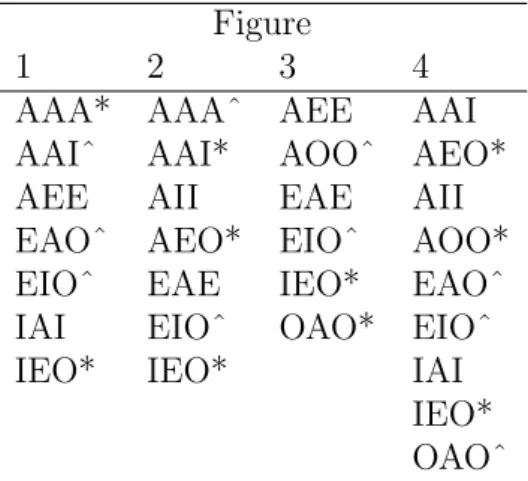
be found in Table 2.2. Nine of these syllogisms are valid in both AC and CA
conclusion order, leading to a total of 48 unique valid syllogisms when mood and
figure for the premises and conclusion order are taken into account.
Figure
1 2 3 4
AAA* AAAˆ AEE AAI AAIˆ AAI* AOOˆ AEO* AEE AII EAE AII EAOˆ AEO* EIOˆ AOO* EIOˆ EAE IEO* EAOˆ IAI EIOˆ OAO* EIOˆ IEO* IEO* IAI
IEO* OAOˆ
Table 2.2: Valid syllogisms, Johnson-Laird & Bara (1984) * =valid only in AC mood ˆ=valid only in CA mood
2.3
Theories of Syllogistic Reasoning
Before discussing theories of belief bias in syllogistic reasoning, we must first
examine the more general theories of syllogistic reasoning. There are a number
of consistent effects and patterns of responses in terms of typical errors which
reasoners make which have been shown to occur in both conclusion generation and
conclusion evaluation paradigms. These errors appear routinely across numerous
studies, and some categorical syllogisms are easily solved or evaluated whereas
others have been found repeatedly to be difficult. A number of theories outline
typical errors, and give an account of potential underlying causes.
It has been shown that figural effects can have an impact upon individuals’
competence at assessing whether or not a syllogism has a valid conclusion or not.
Research has demonstrated that individuals find some figures easier to reason
with than others (e.g. Johnson-Laird, 1975; Johnson-Laird & Steedman, 1978).
CA for Figure 2 premises, with a smaller preference for AC conclusions for Figures
3 and 4 (Khemlani & Johnson-Laird, 2012). Johnson-Laird and Bara (1984) argue
that this is because reasoning is simplest when the middle ‘B’ terms are contiguous
(i.e. adjacent to one another). Therefore, Figure 1 is the easiest, with Figure 2
being slightly more complex, requiring reordering of the premises to bring the
middle terms together. Figures 3 and 4 are more difficult still, with reordering of
the terms within one of the premises also being required in order for the middle
terms to become contiguous. If a valid conclusion requires the terms to be given in
an order which goes against the direction of this effect, participants find it difficult
to produce a correct answer.
The atmosphere account of syllogistic reasoning (Woodworth & Sells, 1935;
Revlis, 1975) argues that individuals’ perceptions of the validity of the conclusion
of a syllogism depends heavily upon the mood of the premises. If the two premises
are in the same mood as each other, the conclusion drawn is likely to also be in that
mood. When different moods are present, if a negative mood (i.e. E or O) is used
in one or more of the premises, reasoners are more likely to accept a conclusion
which also has a negative mood. In addition, if an existential mood (i.e. I or O) is
used in one or more of the premises, the most likely conclusion to be drawn will be
in the existential mood.
Similarly, the matching account (Wetherick & Gilhooly, 1995) agrees that the
mood of a syllogism will influence individuals’ selection of conclusion. However,
this account argues that the atmosphere account is flawed due to problems with the
methodology used by Sells (1936) on which much of this theory is based. Instead,
Wetherick and Gilhooly (1995) argue that it is the number of category members that
the mood describes which is important in determining variation in reasoners ability
to correctly deduce valid conclusions. Wetherick and Gilhooly (1995) argue that the
individuals will tend to match the conclusion to the most conservative premise (i.e.
the one which makes inferences about the smallest number of category members).
the negative existential (“some X are not Y”) and affirmative existential (“some
X are not Y”) moods, which are equally conservative, and then the affirmative
universal mood (“all X are Y”), which is the least conservative. Wetherick and
Gilhooly (1995) do not argue that matching is the only way in which individuals
engage in syllogistic reasoning, but rather clarify that this is just one of many
possible strategies (Khemlani & Johnson-Laird, 2012).
Theconversion account (Chapman & Chapman, 1959; Revlis, 1975) postulates
that errors in syllogistic reasoning can be accounted for by illicit conversion. The
terms in premises in moods E (“no X are Y”) and I (“some X are Y”) can
legitimately be reordered as they are logically equivalent and so terms X and Y are
interchangeable here. However, this is not the case for moods A (“All X are Y”)
and O (“Some X are not Y”); for example, in the case of the former, although all
instances of X must also be Y, this does not preclude the existence of instances of
Y which are not X. Thus, erroneous conversion of premises can lead to incorrect
conclusions being drawn. Although evidence has shown that when participants
are given instructions explaining that this sort of conversion can lead to errors
then their performance improves (Dicksten, 1975), it has also been highlighted by
Johnson-Laird and Byrne (1991) that if conversion was a universal error which
all reasoners engaged in on all syllogisms then there should be no evidence for
figural effects. To illustrate this point, take the example of a syllogism in Figure 1
(ABBC), with the second premise in the O (“some X are not Y”) mood, and the
first premise in a legitimately convertible mood. If universal conversion were the
case, there should be no difference between whether this syllogism is presented in
Figure 1 (ABBC) or Figure 3 (ABCB), given that conversion will occur anyway.
However, systematic differences in correct solution rate dispute this.
Chater and Oaksford’s (1999) Probability Heuristics Model has a few similarities
to the matching account in that it ranks moods in terms of informativeness. The
term “informativeness” comes from Information Theory (Shannon & Weaver, 1949)
probability, and is related to how often a statement is likely to be true in natural
language. Unlike the matching account, however, Chater and Oaksford (1999)
employ a different ranking, with “all X are Y” premises ranked as the most
informative, followed by “some X are Y”, then “no X are Y”, and finally “some X
are not Y”. This model has a greater number of complexities than other
heuristics-based models of syllogistic reasoning. Chater & Oaksford discuss a number of
heuristics which reasoners use, which predict how likely a conclusion is to be chosen.
Firstly, the min-heuristic leads to reasoners drawing conclusions in moods which are
the same as the premise with the least amount of information contained within them.
The p-entailment heuristic means that the conclusion which is probabilistically
entailed by the conclusion, for example, conclusions in mood A entail those in
mood I as “some” is entailed by “all”, and so the conclusion next most likely to
be selected by reasoners is the one which is p-entailed by the min-heuristic. The
attachment heuristic determines the ordering of terms in the conclusion; if the
min-premise, that is, the premise which is least informative, has term A or C as the
subject of the sentence, then this term will appear as the subject in the conclusion.
If it does not appear as the subject of the min-premise, then the A or C term
which is the subject of the max-premise (most informative premise) becomes the
subject of the conclusion. Chater & Oaksford also discuss a further two heuristics
which are suggested to aid reasoners in assessing how accurate the conclusion
generated according to the above principles is. The max-heuristic leads to higher
confidence for conclusions with more informative premises and lower confidence for
premises with less informative premises. The O-heuristic leads reasoners to be less
likely to choose a conclusion in the O mood, as this is the least informative mood.
The probability heuristics model has been lauded by Khemlani and Johnson-Laird
(2012) as it is a detailed explanation of syllogistic reasoning, which accounts for
figural effects, and can be extend further than simply problems with A, E, I and O
moods to describe reasoning about problems which contain more specific quantifiers
authors for not fully explaining the role of logic when participants give normative
answers that diverge from these heuristics, and cannot account for improvements
in performance over time. If reasoners are mainly employing a particular heuristic,
one would expect their performance to remain stable over time, and to generally
show low levels of normative responding.
Some theories of syllogistic reasoning places much more emphasis on the role
of logic rather than heuristics in reasoning. Such theories argue that logical
reasoning is an innate human ability, and Rips (1994) argues that reasoners reason
in accordance with formal inferential rules including those such as modus ponens
and modus tollens. Modus ponens is a rule, whereby, if the statement “if A, then
B” is given, then if the existence or truth of A is stated, the existence or truth
of B must logically follow. The same statement, but with the non-existence of B,
logically A cannot exist either. Some rules operate in a forwards direction, linking
premises to conclusions, others operate in a backwards direction, linking conclusions
back to their premises, and others can work in either direction. Errors in syllogistic
reasoning are argued to stem from improper or non-existent application of the
relevant rule, and difficulty is said to be based upon the number of rules which are
needed to be used. This theory has been used to construct a computational model
PSYCOP which simulates these tendencies.
Many of the theories discussed above focus mainly on how people reason
about syllogisms. However, other theories place more emphasis on examining
how syllogisms are mentally represented in order to make inferences about the
specific nature of the reasoning process. Johnson-Laird & Byrne (1991) argue
that convincing theories explaining syllogistic reasoning rely upon the individual
constructing mental models or representations of the premises in order to assess
whether the associated conclusion is valid, or to generate their own conclusion. They
cite previous research which has posited that these representations are in the form
or Euler circles or Venn diagrams. Johnson-Laird & Byrne argue that these theories
Euler circles, should generate a larger number of possible representations are not
necessarily those found to be most difficult, and individuals struggle with some
premise pairs which have a very small number of valid diagrammatic representations.
Johnson-Laird & Byrne (1991) give the example of the premises “Some A are B,
All B are C” and “All B are A, No C are B”. They argue that to fully map out
all the possible conclusions for these examples with Euler circles would require
16 combinations for the former and 6 for the latter, and so the second premise
pairs should be simpler to solve. However, in fact, they cite evidence which shows
that 88% of people correctly solve the first syllogism, but only 8% correctly solve
the second, and conclude that this seriously undermines the credibility of these
representations.
Johnson-Laird & Byrne (1991) argue that the commonalities of most
model-based theories are that they all generally agree that reasoners begin by generating
models representing the premises in the simplest possible way. They then go on
to draw a conclusion based on this information, and then add in further complex
details to these representations during a search for counterexamples, in an attempt
to falsify the conclusion they are testing out. If the conclusion is still found to
hold true after such comparisons, it is deemed to be valid. Johnson-Laird & Byrne
(1991) discuss their mental models theory of syllogistic reasoning and argue that
individuals use symbolic representations of instances of category members described
in the premises in order to assess or construct a conclusion. These representations
denote members of the categories mentioned in the premises and aim to represent
various possible combinations of group membership or exclusion. Extra premises
are incorporated by simply adding them on to the representation of the existing
premises in any way as long as it does not invalidate them. Johnson-Laird &
Byrne argue that their theory better accounts for difficulty than those dependent
on Euler circle or Venn diagrams, as in their theory, difficulty is related to the
number of possible models that can be used to represent the premises. Additionally,
the multiple representations.
In their verbal reasoning theory, Polk and Newell (1995) argue that, given the
relative sophistication of humans’ linguistic processing ability, reasoning is more
verbally based than alternative theories suggest. Deductive reasoning relies on
the use of syntactic rules, and re-encoding of the premises a number of times,
until a conclusion can be generated or verified. If the conclusion is consistent
with the model generated by the encoding of the premises, it is accepted as valid.
Computational models VR1-VR3 were constructed to explain this process. Model
VR1 is the simplest; any information which cannot be inferred indirectly from the
premises is not included. Because of this, this model has been found to lead to a
large proportion of “no valid conclusion” responses. VR2 extends VR1 by allowing
the legitimate conversions of “some X are Y” to “some Y are X” and “no X are
Y” to “no Y are X”. VR3 allows more of what is termed “indirect knowledge”, for
example, if we were to state that “all Y are Y”, then we can infer that “no things
that are not X are Y”. This theory has some aspects in common with mental models
theory, discussed below; however, it explicitly rejects the possibility of reasoners
constructing counterexamples to falsify potential conclusions. A later version of
this theory,modified verbal reasoning theory (Thompson, Striemer, Reikoff, Gunter,
& Campbell, 2003), also adds in further conditions, for example, that reasoners
allocate a finite amount of time to the encoding and re-encoding process before
giving up. However, these theories differ from mental models theory, as it does not
account for the possibility that individuals may construct counterexamples.
Although mental rules and logic based theories have been criticised for
under-playing the role of heuristic processes (Khemlani & Johnson-Laird, 2012), it is not
necessarily the case that such theories argue that it is reliance on mental rules
alone that influence reasoning (Braine & OBrien, 1991). There is, however, some
evidence that reasoners, to some extent, use rules-based techniques in reasoning.
Ford (1995) found support for this theory using protocols in which participants
engaged in verbal substitutions, in which terms were interrelated or substituted
from one premise to another. Errors occur when reasoners use substitutions which
are not logically consistent with the ways in which the terms in the premises are
interrelated. Revising earlier ideas dismissed by mental models theorists, Ford
(1995) has argued that other reasoners may use a different version of Euler circles
to those described by Johnson-Laird and Byrne (1991). This version does not
suffer the problem of the number of possible representations differing from the
perceived difficulty. Johnson-Laird (2005) argues that this theory is
indistinguish-able from their mental models theory. However, Ford (1995), makes a few key
distinctions. Firstly, Ford criticises the way in which Johnson-Laird & Byrne (1991)
categorise syllogisms as single or multiple-model syllogisms, arguing that there are
inconsistencies between their definitions and those in earlier work, such as that of
Johnson-Laird & Bara (1984). Ford specifically highlights the example of a model
which is originally classed as a single model syllogism, but in later work, reclassified
as a multiple model syllogism. Ford argues that Johnson-Laird & Byrne (1991) give
an explanation for model construction for this syllogism which is inconsistent with
explanations they give for other similar examples, and implies that this explanation
has been given as the authors are unable to explain participants relatively low
accuracy rates on what should be a simple single model syllogism. Ford goes on to
detail how this syllogism is the only single-model syllogism in which the conclusion
is not in the same mood as either of its premises, and given that reasoners have
a tendency to produce or select conclusions with a mood matching one of the
premises, this would explain the low accuracy rate on this particular problem,
which is in line with accuracy rates for multiple-model problems, all of which are
only valid with moods which do not correspond to one of the premises.
Ford also argues that despite very little evidence to support it, mental models
theory suggests that individuals’ mental representations are of individual members
of a group, whereas alternative theories which posit individuals constructing
this claim from an experiment in which the conclusion generation paradigm was
used. Participants were shown the 27 premise pairs which led to a valid conclusion,
and were instructed to derive a conclusion for each. They were instructed to think
out loud as they completed the problems, and were also given a pen and paper
with which they were allowed to make notes. Once they had completed all 27
problems, participants gave a written explanation of their answers. Ford found that
some participants, whom she termed ‘spatial reasoners’ reasoned using
diagram-matic representations, many similar to Euler circles, which tended to represent
entire sets rather than particular members of a set. Other participants, labelled
‘verbal reasoners’, used verbal substitution techniques which Ford argues worked
on algebraic and rules-based techniques, with some using a fairly basic version of
this, and others employing more complicated techniques. The distinction between
these two types of reasoners also accounted for differences in solution rates for
different types of syllogisms, with spatial and verbal reasoners showing wide gulfs
in proficiency on differing syllogisms. Ford argues that these results show that
the differences between spatial and verbal reasoners must be accounted for when
examining syllogistic reasoning data. However, others such as Rips (2002) suggests
that people only use diagrammatic methods like those used by the spatial reasoners
if they have been taught how to use them in the past. In addition, (Stenning &
Oberlander, 1997) highlight how it can be shown that Euler circles can be seen to
be equivalent to mental models theory in terms of how people use representations
to reason about syllogisms at a computational level. A similar inference is made
by Stenning and Yule (1997) comparing Euler circles and mental rules.
There are a large number of current theories which attempt to account for
difference in reasoners’ performance on different syllogisms, which seem in part to
explore different aspects of syllogistic reasoning, for example, what drives normative
responding and what drives erroneous responses. This may appear to make
comparison between some of these theories somewhat difficult. A meta-analysis
theories of syllogistic reasoning, and also greater support for mental-models based
theories than rules-based theories. Thus, they concluded that syllogistic reasoning is
likely to operate under the constraint of a number of heuristics which determines the
content of what is mentally represented, but the mental representations themselves
deliberated between and reasoned about using some sort of set or model. They
also highlight how, as strategies may vary between different individuals, that it
may not be as simple as a single one of the current theories being able to account
for all syllogistic reasoning. Research on the belief bias effect seems to tie these
two areas together, and shifts the focus away from the specific nature of heuristics
and analytic processes, and towards the interplay between the two in providing a
response. I will now go on to consider theories of belief bias, including dual-process
theories, and the extra insight which they give us into the deductive reasoning
process.
2.4
Theories of Belief Bias
Some earlier theories of belief bias adapt more general theories of syllogistic
reasoning to explain this phenomenon. Revlin, Leirer, Yopp, and Yopp (1980)
argues that belief bias can be beneficial to reasoning, as it can prevent conversion
of the premises from occurring. Individuals are much more likely to erroneously
convert the terms in premises containing abstract terms than make the same
mistake with sentences containing increased semantic content such as “all cats are
animals” and “all animals are cats”. However, subsequent research (e.g. Evans
et al., 1983; Oakhill & Johnson-Laird, 1985) controlled for conversion by using
premises in mood E (i.e. “some X are y”) and mood I (i.e. “no X are Y”), for
which conversion does not alter the validity of potential conclusions to be drawn.
The belief bias effect was found to persist under such conditions, indicating that
the conversion account was not an adequate explanation.
Khemlani and Johnson-Laird (2012) highlight how, in other areas of human
process, and later theories of belief bias predominantly fall within this dual-process
framework. These theories stipulate that the belief bias effect arises from the
interplay between two different types of processes. The terminology used to describe
these processes varies from one account to another, with Type 1 processes also
being labelled as heuristic, implicit, associative, impulsive, automatic, experiential,
non-conscious, intuitive, or reflexive, and Type 2 processes being described as
logical, explicit, rule-based, reflective, controlled, rational, conscious, analytic, or
reflective (Evans & Stanovich, 2013). It must be noted that some theorists draw a
distinction between accounts which characterise these different sorts of cognitions
as belonging to different systems, and those which describe them as simply being
the result of separate processes. Evans and Stanovich (2013) caution against the
’system’ designation, given that there is some evidence to suggest overlap between
multiple systems and multiple systems contributing towards output. In addition,
they argue that it is crucial not to confuse the concept of features which are defining
properties of a system with features that are often correlated but do not necessitate
cognition being due to one specific process or the other. Evans & Stanovich argue
that the most important defining feature of Type 1 processing is its autonomous
nature. Whether or not a Type 1 response is given, Type 1 processing will always
be engaged in, given the relevant stimuli. A further feature of Type 1 processing is
the lack of demands it places on working memory resources. On the other hand,
Type 2 processing is characterised by its higher working memory demands, and
its use in “cognitive decoupling”, which will be discussed in more detail below.
Longer response latencies on problems have been thought to be indicative of Type
2 processing, although this assumption has been challenged. For example, Handley,
Newstead, and Trippas (2011) found that when participants were asked to respond
on the basis of believability, they took longer to make such judgements than
judgements made on the basis of logical validity. Dual-process theories differ to
each other in terms of the point at which belief bias is thought to affect a reasoner’s
such as conversion (Revlin et al., 1980) argue believability affects the encoding of
problems, other accounts place it in the reasoning stage, response stage or both.
Although traditional analyses cannot easily make this distinction, SDT analyses
allow us to get insight into where in the reasoning process is affected by belief bias.
In addition, accounts differ in that some theories argue that believability affects
amount of Type 2 processing which occurs, whereas others argue that it has a
strong effect on the type of strategy employed by participants. I will now review
the a number of theories of belief bias, and the empirical evidence for and against
them.
Dual process theories of belief bias began with work by Evans et al. (1983).
They criticised earlier accounts of belief bias, such as that of Revlin et al. (1980),
for using inappropriate methodology and insufficiently exploring or controlling for
other things thought to have an impact on reasoning, such as conversion of the
premises, figural bias, atmosphere, and validity or determinacy. In their empirical
work, Evans and colleagues accounted for these shortcomings, and their data led
them to develop the selective scrutiny account, which suggests that individuals
adopt different strategies on the basis of conclusion believability. If a conclusion
is believable, it is accepted, with no further analysis. However, in the case of an
unbelievable conclusion, the problem is analysed logically, with valid problems
being accepted and invalid-believable problems being rejected. Evans et al. (1983)
support this theory by highlighting qualitative findings from their reasoning-aloud
protocol. Participants who were incorrectly endorsing invalid problems tended to
make more reference to information not relevant to the task, whereas those who
were reasoning normatively discussed the premises of the syllogism, suggesting a
difference in the degree to which analytic processing was engaged. However, the
selective scrutiny account has been challenged by more recent work examining
response latencies, that has shown that participants show longer response times,
which is associated with Type 2 processing, on invalid-believable problems (Ball et
believable conclusions were simple accepted without any further analysis.
An alternative explanation of these results, also proposed by Evans et al. (1983),
has been termed the misinterpreted necessity model. In this explanation, it is
argued that reasoning operates prior to the effect of logic. Reasoners first assess
whether the conclusion falsifies the premises (i.e. if it is determinately invalid). If it
does, it is rejected outright. However, if not, the reasoner then goes on to attempt
to decide if the conclusion is determined by the premises (i.e. if it is determinately
valid). If this is the case, the conclusion is accepted as valid. However, if it is
not determinately valid, then the conclusion believability is used to resolve this
ambiguity, with believable conclusions being accepted and unbelievable conclusions
being rejected. As valid syllogisms are determinately valid, they cannot be falsified,
and thus have a generally high acceptance rate. However, the invalid syllogisms used
in the study were indeterminately invalid; their conclusion is possible, but is not
necessitated by the premises, and therefore the use of believability to guide reasoning
on invalid problems leads to higher numbers of invalid-believable conclusions and
low number of invalid-unbelievable conclusions being accepted. Support for this
theory comes from evidence to show that when participants are given instructions
that emphasise the importance of logical necessity, the belief by validity interaction
is diminished (Evans et al., 1983, Experiment 3). However, it has been criticised
as it cannot explain the presence of the belief bias effect on determinately invalid
syllogisms (Newstead et al, 1992).
Themental models account (Oakhill, Johnson-Laird & Garnham, 1989) extends
the earlier mental models theory of syllogistic reasoning to incorporate belief bias.
This theory argues that individuals construct a single mental model incorporating
the premises of a syllogism. If the mental model they have constructed is inconsistent
with the given conclusion, the conclusion is deemed to be invalid. However, if is
consistent, then believability is examined. At this stage in the reasoning process,
believable conclusions are accepted as valid, whereas unbelievable conclusions are
possible model of the premises. If the given conclusion is true in all models, it is
accepted, otherwise it is rejected. This theory explains the difference in difficulty
found between single-model and multiple-model syllogisms as being a consequence
of the increased demands on working-memory memory resources for multiple-model
syllogisms. However, Ball et al (2006) found that response latencies did not support
the claim that unbelievable problems result in a greater degree of logical analysis.
Ball and colleagues got participants to respond to categorical syllogisms whilst
attached to equipment which tracked the direction of their gaze. This methodology
allowed the timing of attention paid to specific parts of the syllogism. Whilst
mental models theory would have predicted longer processing times for unbelievable
problems, due to the extra effort spent on model construction for such problems.
However, the data showed that participants actually spent longer responding to
believable problems, in direct opposition to this prediction.
Themetacognitive uncertainty account (Quayle & Ball, 2000) is similar to both
the misinterpreted necessity and mental models accounts, in that it agrees that
reasoners construct mental models of syllogisms, and that belief operates after
some reasoning has taken place. However, it differs in that it argues that when
the reasoner’s working-memory capacity is exhausted, due to a larger number of
generated models for invalid conclusions, a state of uncertainty in induced. If
their confidence is below a certain threshold, this will prompt them to rely on
conclusion believability to guide their response. This is reflected in lower confidence
ratings given by participants when responding to invalid than to valid syllogisms
(Experiment 1), and participants with lower scores on a working memory test being
more influenced by belief bias than higher scoring participants (Experiment 3).
However, eye tracking data provided by Ball et al (2006) was inconsistent with
predictions of this theory, regarding time spent examining premises and conclusions.
Whilst metacognitive uncertainty theory would have predicted longer premise
inspection times for invalid problems, Ball and colleagues found that problem
Many of the aforementioned accounts suggest that belief bias affects the amount
of logical reasoning that occurs. In these theories, the interplay between heuristic
and analytic systems is determined by whether Type 2 processing occurs at all,
or whether the output of Type 2 processing is deemed sufficient information for a
response to be given. On the other hand, selective processing theory (Evans, 2000;
Klauer et al., 2000) argues that all individuals engage in Type 2 processing, but do
it in qualitatively different ways depending upon conclusion believability. Selective
processing theory is somewhat in agreement with mental models theory in that
individuals are thought to construct a single model of the premises. However, it
posits that qualitatively different models are constructed on the basis of believability;
a confirming model is constructed for believable conclusions, and a disconfirming
model is constructed for unbelievable conclusions. Empirical evidence involving
response latencies (Ball et al., 2006; Stupple & Ball, 2008; Thompson et al., 2003)
and time-limited responses (Evans & Curtis-Holmes, 2005) support this theory.
For example, Ball et al (2006), using an eye-tracking methodology were able to
analyse how much time was spent examining the separate parts of a syllogism.
They found no evidence for any differences in response times before the conclusion
was viewed, and differences only arose subsequently. This led to the conclusion
that, at least in a conclusion evaluation paradigm, this provides strong support
for conclusion-to-premises theories such as selective processing theory, but refutes
premises-to-conclusion theories, such as mental-models theory.
Nevertheless, this version of selective processing theory cannot account for
instances in which a smaller subset of participants show almost perfectly normative
responses. Thus, Stupple et al (2011) posit an extended version of the theory. The
key distinction between the original model and the revised model is that the latter
allows analytical reasoning, if heuristic responding is suppressed, to go down one
of two pathways. Individuals either perform an exhaustive search or asatisficing
search. The word ‘satisficing’ is a portmanteau of ‘satisfying and ‘sufficing’ and this