CD
o
~N
«
a
0 _
l : u _ u. , C'"
f-u.
.
«
If.(
-) .
A
ugus
t;
196
4
4 WAYS TO IMPROVE COMPUTER TAPE
(And how Memore){ did it!)
Exercise greater quality control.
The Memorex-designed Vibrating-Sample Magnetom-eter (VSM) tests basic characteristics of oxide raw material and precise concentration of oxide particles in the tape coating. Extra tests of this kind guaran-tee the improved performance and reel-to-reel uni-formity of Memorex computer tape.
Use a superior production facility.
A conspicuous aspect of the Memorex plant is the complex system of air filtration, humidification, dehumidificatiorT, heating and cooling. The unusual high-purity system, equal to that used in pharma-ceutical processing, provides a contaminant-free environment - prerequisite to production of ini-proved error-free tape.
Memorex tape is premium tape. No need to pre-check it. You can place Memorex computer tape directly in service-reel after service-reel.
Memorex certification means what it says: Memorex com-puter tape ~ error-free. Extra care, extra steps and scrupu-lous attention to every detail make it that way. We know the importance to you of having a tape you can depend on.
Circle No. 6 on Readers Service Card
Employ advanced production techniques.
Specially constructed equipment - used to slit Memorex computer tape from jumbo rolls - pro-auces tape with clean, straight edges free from rip-ples and ridges. A new slitting technique is but one of seventeen manufacturing improvements made to insure superior performance of Memorex tape.
Apply research in depth.
Research in oxide, coating materials, and tape-making processes has equipped Memorex with a fund of new technology. Combined with manufac-turing competence, this fundamental knowledge is manifest in Memorex computer tape by freedom from dropouts, longer life, and improved uniformity and reliability of performance.
Are you on our mailing list .to receive the Memorex Monograph Series of informative technical literature? Write 1176 Shulman Avenue, Santa Clara, California.
MEMOREX
It
isn't
the heat
... it's the
uniformity
That word "uniformity" is the key to the
unsur-passed performance of Fabri-Tek
temperature-controlled core memory stacks.
A unique system developed by Fabri-Tek insures
evenly distributed heat throughout every plane.
The optimum temperature is maintained within
narrow limits through the entire stack. The result
is complete elimination of output drift, outstanding
stability even in rapidly changing ambients.
The photographs on this page show part of the
range of Fabri-Tek temperature-controlled stacks.
Those illustrated run from a 4096 x 12 stack to an
8192 x 32 stack. Temperature (and performance)
is uniformly stabilized in any size.
Normal production stacks are rugged, too,
with-standing high level shock and vibration.
Planes used in the temperature-controlled
stacks are, of course, of traditional Fabri-Tek
quality. Electrical characteristics are exactly
matched to customer system requirements. An
active product assurance group constantly
moni-tors all facmoni-tors affecting product quality.
What's your memory problem? All of the above
solutions to temperature control of memory stacks
were solved by Fabri-Tek-using a common method
in various configurations. We have more than 450
people whose sole business is developing and
pro-ducing highest quality magnetic memory
compo-nents and systems. May we help you?
Fabri-Tek, I ncorporated, Amery, Wisconsin
Telephone: COngress 8-7155 • TWX: Amery 8931
Circle No. 7 on Readers Service Card
COMPUTERS and AUTOMATION for August, 1964
Used in Polaris pro-gram by Hughes Aircraft Co. and Con-trol Data Corporation
In the 8400 Series computer by Collins Radio
In AN/UYK-l com-puters by Thompson Ramo Wooldridge
In the RCA 4100 series computers by Radio Corporation of America.
4
AN OFF-BIT HISTORY OF MAGNETIC TAPE ... one of a series
by
Computape
As most any student of history will tell you, credit for developing the first successful technique for magnetiz-ing computer tape must go to Pulchritudinous Paula Piltdown, whose sure-fire method is exhibited here. Merely by adjusting her seams she exerted sufficient di-rectional magnetic force to turn a man's head at 56 paces - and permanently magnetize all the tape h.e was carrying at the same time.
In the 546,312 years since, no one has devised a method for magnetizing tape that's half as much fun.
But Computape has one that's even surer-fire. First, we clean the Mylar backing of the tape itself. Then, we apply a primer coat. Carefully. (To just less
·DuPont trademark
than one one-millionth of an inch, to be exact.)
Then we apply Computape's exclusive, extra-heavy duty magnetic coating. Carefully. (To a tolerance of
25 millionths of an inch to be exact.)
Then we test. Every inch of every reel - whether it's 7,8,9,10,16 channel or full-width. Carefully. (Any defect
large enough to cause even a 50% drop in signal of a
single bit is cause for rejection, in fact.)
The result: Computape - computer tape so carefully made it gives you 556, or 800, or (if you want it) 1000 bits per inch. For the life of the tape.
Now. If Computape can write that kind of computer tape history, shouldn't you be using it?
CCMPUTRCN INC.
122 Car •• ,y Street, Waltham, Massachusetts
COMPUTAPE - product of the first company to manufacture magnetic tape for computers and instrumentation, exclusively.
-The winner of our Annual Computer Art Contest is again the
u.s.
Army Ballistic Research Laboratories, Aberdeen, Maryland, using an Electronic Associates' Dataplotter. The front cover drawing shows trajectories of a ricocheting projectile (range vs. altitude).©CQ)Uln)CQ)(1dJC0~~~
(EJ
[fQ@ [[)
(1.l]'l[; CQ)
u-lRl
{EJ'\.G
0
@
!rU
AUGUST, 1964 Vol. XIII, No.8
editor and publisher EDMUND C. BERKELEY
assistant editors MOSES M. BERLIN NEIL D. MACDONALD LINDA LADD LOVETT
contributing editors ANDREW D. BOOTH NED CHAPIN JOHN W. CARR, III ALSTON S. HOUSEHOLDER
PETER KUGEL
advisory committee T. E. CHEATHAM, JR. GEORGE E. FORSYTHE RICHARD W. HAMMING ALSTON S. HOUSEHOLDER HERBERT F. MITCHELL, JR.
associate publisher PATRICK J. MCGOVERN
production manager ANN B. BAKER
art director RAY W. HASS
circulation manager VIRGINIA A. NELSON, 815 Washington St. Newtonville, Mass. 02160, 617-DEcatur 2-5453
advertising representatives New York 18, BERNARD LANE 37 West 39 St., 212-BRyant 9-7281
Chicago 11, COLE, MASON AND DEMING 737 N. Michigan Ave., 312-SU 7-6558
Los Angeles 5, WENTWORTH F. GREEN 300 S. Kenmore Ave., 213-DUnkirk 7-8135
San Francisco 5, A. S. BABCOCK 605 Market St., 415-YUkon 2-3954
Elsewhere, THE PUBLISHER 815 Washington St., 617-DEcatur 2-5453 Newtonville, Mass. 02160
computers and data processors: the design, applications, and implications of
information processing systems.
111
This Issue
. 12 ARTISTIC DESIGN BY COMPUTER
by L. Mezei
16
20
22
THE COMPOSER OF MUSIC AND THE COMPUTER
by Albert Seay
A COMPUTER SHARING PLAN AT WORK
by Patrick A. McKeown
THE COMPUTER PERSONNEL REVOLUTION
by Dick H. Brandon
26 GE COMPATIBLES·GOO
by Patrick J. McGovern
111
Every Issue
31
7
8
9
I I
9
18
45
46 50
50
48
across the editor's desk
COMPUTING AND DATA PROCESSING NEWSLETTER
editorial
PEOPLE WHO DO HOT WORK
forum on the social implications of computers and automation
Computers, Automation, and Society - the Responsibilities of People, by R. W. Retterer
Decisions That limit Resources, by U. Thant
edit-o-l"S scratchpad
Who Will Take the "Ultra-Computer Builder" Title?
readers' and editor's fortt1J1,
Job Displacement Computerized Commencement Calendar of Coming Events
reference informati01l
Computer Census
New Patents, by Raymond R. Skolnick
index of notices
Advertising Index
Who's Who in the Computer Field
COMPUTERS AND AUTOMATION IS PUBLISHED MONTHLY AT 815 WASHINGTON ST., NEWTONVILLE 60, MASS., BY BERKELEY ENTERPRISES, INC. PRINTED IN U.S.A. SUBSCRIPTION RATES. UNITED STATES, $15.00 fOR 1 YEAR, $29.00 fOR 2 YEARS, INCLUDING THE JUNE DIRECTORY ISSUE; CANADA, ADD SOc A YEAR fOR POSTAGE; fOREIGN, ADD $1.50 A YEAR fOR POSTAGE. ADDRESS All EDITORiAl AND SUBSCRIPTION MAIL TO BERKELEY ENTERPRISES, INC., 815 WASHINGTON ST .. NEWTONVILLE, MASS .• 02160. SECOND CLASS POSTAGE PAID AT BOSTON, MASS.
POSTMASTER: PLEASE SEND ALL fORMS 3579 TO BERKELEY ENTERPRISES, INC., 815 WASHINGTON ST., NEWTONVILLE, MASS., 02160. © COPYRIGHT, 1964, BY BERKELEY ENTERPRISES, INC. CHANGE OF ADDRESS: IF YOUR ADDRESS CHANGES, PLEASE SEND US BOTH YOUR NEW ADDRESS AND YOUR OLD ADDRESS (AS IT APPEARS ON THE MAGAZINE ADDRESS IMPRINT), AND ALLPW THREE WEEKS FOR THE CHANGE TO BE MADE.
When reliability counts,
count on
MYLAR®!
When you are recording or processing data, you
want to be able to depend on your tape without
worrying about it. If your tape is on a base of
"Mylar"*-you can! "Mylar" is strong (a
ten-sile strength of 20,000 psi). "Mylar" is stable
(unaffected by temperature or humidity
changes). "Mylar" is durable (no plasticizer to
dry out or become brittle with age). "Mylar" is
proven in use (a ten-year record of successful
performance). When reliability counts, count
on "Mylar".
·Du Pont's registered trademark for Its polyester film.@DlOHJ)
MYLAR®
POLYESTER FILM
-' •. U.S,"".Of'·
BETTER THINGS FOR BETTER LIVING ..• THROUGH CHEMISTRY
People Who
I had a discussion the other evening with a friend of mine about receiving income and not working. I said to him:
"Do you think that children under 16 should work in order to support themselves?" He said, No, their families should support them.
"Do you think that a person who is seriously ill with crippling rheumatism should earn his own living?" He said, No, his savings or his insurance or his family should support him.
"Do you think that people who are 65 and over, who are becoming feeble, should earn their own living?" He said, No, their pension plans or social security should support them.
"Do you think that intellectually able young men and women, who intend to become doctors, physicists, lawyers, etc., and who need to study full time in graduate schools, medical schools, etc., should support themselves by work while they :ire studying?" He said, No, they get scholar-ships and grants; and many of them marry, and their wives . support them until they get their degrees.
"Here is a man who has spent 15 years of his life becom-ing a good typesetter on a newspaper linotype-and along comes an invention whereby linotype setting for all news service dispatches can be done once and for all by a punched tape produced by impulses over long distance tele-phone-and the newspaper cuts the number of its type-setters from 8 to 3, and this man is fired, and his skill is no longer marketable. Do you think that he should have an income until he is trained for other work?" 'VeIl, my friend hemmed and hawed, and finally he said, Yes.
"Here is a young man, age 26, with IQ about 85, he can't read well, he was never able to learn very much, he used to run an elevator but an automated elevator displaced him-and no employer will give him a job now, because there are plenty of better men available. Do you think that this man should have a minimum decent income he could live on-or do you think that he should live in poverty, on the borderline of starvation, punished for no reason he can con trol?,'
We agreed there were a great many kinds of people in society who for one reason or another could not earn their own living. Yet how could we insist that they live in poverty in a society as wealthy as ours?
Just how extensive is work and non-work in the United States?
Table 1, below, shows some figures for the United States in 1960, based on information in "The Statistical Abstract of the United States" for 1961.
In other words, about 38 percent of the people of the United States by their work support all the people of the United States.
And we have hardly seen anything yet. The industrial system of the United States-with its computers and its automation-is extraordinarily productive, and in a few more years will be fantastically productive. It is like a fairy
COMPUTERS and AUTOMATION for August, 1964
Do
c&a
EDITORIAL
Not
Work
TABLE 1
Distribution of Work in the United States
Number
(in millions of people) Percent Not Not Working Working Working Working
14 years of age and over: In the labor force:
Working: 69 38%
Unemployed: 4 2%
Not in the labor force:
Keeping house: 35 20%
In school: 8 4%
Other: 10 6%
13 years of age and under: 53 29%
In institutions: 2 1%
TOTAL: 69 112 38% 62%
tale. It is as if we were making a magical machine which each year will more and more automatically provide all the food, clothing, shelter, and other goods needed for millions of people----but each year a smaller fraction of all these peo· pIe will be needed to operate the machine: one in three nowadays, one in five in the next few years, possibly one in twenty or fifty in the future. What will the other po-tential workers do? Nothing? Is there nuthing for them but boredom, and relief on a poverty level?
We have invented an industrial system which can pro-duce wealth and abundance for everY1body-and then we choke the system by providing that the only sharers in the abundance it produces are (a) people who have appropri-ate training and actually find and perform jobs, and (b) people who are owners.
The time has come to take a good hard look at the "people who do not work" and to change' the patchwork quilt of their patterns of receiving income into something much more rational, and consistent with the industrial power to produce a'bundance. Might it not make sense to provide a decent minimum standard of living for every-body because he is a human being? And then in order to keep incentive for working, provide a considerCl!ble jump in income for anyone doing useful work? For example, many years ago in the United States it was decided to pro-vide a standard of public education for every young person because he was a human being, and then provide higher education on the basis of merit and other factors.
And just incidentally, the increase in demand for goods by adding millions of effective consumers to the market for business's products would be likely to produce fan-tastic prosperity easily able to pay for the change. It
ought to be good businf'ss~
~c.~
EDITOR
FORUM ON THE SOCIAL IMPLICATIONS
OF COMPUTERS AND AUTOMATION
COMPUTERS, AUTOMATION, AND SOCIETY
-THE RESPONSIBILITIES OF PEOPLE
R. W. Retterer
Senior Vice President, Marketing Univac Division of Sperry Rand Corporation
New York 19, N. Y.
Automation has been called the salvation-and the curse of society; the redeemer-and the oppressor of the indi-vidual; the pinnacle-and the pitfall of mankind. Auto-mation and computers, alone, are, it seems to me, none of these. Man has conceived them, has constructed them, has converted these powerful tools to his own needs, and will, in the final analysis, control-or fail to control-the ulti-mate effect of computers and automation on society.
The benefits of automation are not achieved automati-cally; nor are the problems created by automation solved automatically. It is the diligent application by human beings of their own talents that will gain the benefits and resolve the problems.
Contrary to certain defeatist outcries-that automation is mechanizing human beings, eliminating responsibilities, and destroying the individual, I believe we possess, as a country and as individuals, perhaps the greatest responsi-bility in the history of mankind.
The oiggest danger lies, it seems to me, in not recogniz-ing-and not accepting-this responsibility; in not under-standing that the benefits, although they are made possible by an elite group of engineers and technicians, are achieved not by them but by society at large, by people in all walks of life, who have the responsibilities of understanding arid guiding the changes.
In devising uses for our electronic assistants, in choosing them and adapting them, in integrating computing sys-tems, and in introducing them in a way that creates mini-mum hardship, we as persons must exercise the greatest ingenuity, imagination, foresight, and intelligence.
In an interview conducted shortly before his death, Nor-bert Wiener, answering the question "Are computers being
used intelligently today?", replied "in 10 per cent of the cases, yes."
8
Asked to explain this appallingly low figure, he went on: " . . . it takes intelligence to know what to give to the machine. And in many cases the machine is used to buy intelligence that isn't there.
"The computer is only as valuable as the man using it.
It can allow him to cover more ground in the same time. But he's got to have the ideas. And in the early stage of testing the ideas, you shouldn't be dependent on using computers."
Wiener summarized his own approach to the problem: " . . . we can no longer value a man by the jobs he does. We've got to value him as a man." ,
This is why a vocational education geared to one com-mercial skill-a potentially obsolete skill-is dangerous. Any education or institution which attempts to pressure a human being Procrustes-like into one of society's vacant beds rather than adjust to the individual's needs and abili-ties is a narrowing, mechanizing, and crippling force.
The question, it seems to me, is not how to adapt society
to automation, but how to adapt automation to society.
The problem is not to teach human beings to speak com-puter language, but to teach comcom-puters how to speak our language.
In those minority instances of successful computer in-stallations (in the McKinsey survey the one-third of com-panies which had recovered the start-up as well as the current operating costs of computing systems) it was the
ideas, the innovations, of the men involved, that were in each case the reason for success.
In the McKinsey study, the 9 successful companies' (out of 27 surveyed) were utilizing the computer for a wide variety of applications besides the routine office and ac-counting functions. The other 18 systems were restricted almost exclusively to routine record-keeping activities. Moreover, neither the success of the 9 nor the failure of the 18 could be attributed in any way to the inherent merits or defects of equipment. The outcome was wholly determined by th~ initiative-or indolence-of the persons making decisions.
Moreover, while a great deal of the success of a com-puter installation depends on top executive leadership, especially at the beginning, the truly integrated data proc-essing system demands familiarity with the equipment, and awareness, on the part of all employees concerned, of its possibilities.
In the "total systems" concept, operating on a manage-ment-by-exception principle, information from every depart-ment-inventory, sales, etc., is processed regularly by a central computer. Deviations from an expected pattern are indicated so that immediate corrective action may be taken. The efficien9 of such a system-often run on a real-time basis-depends not only on top management's ability to deal with the information and make the right
decisions, but relies on the possession by each department head of a thorough knowledge of his immediate area and
a sufficient understanding of the computer-integrated oper-ation to relate the. particular to the general and to organize departmental data in a new and meaningful way. Again, it is management men-not engineers and technologists-who are the 'essential inaugurators and creative members of the age of computers and automation.
In advertising, for example, factors which determine media selection were for years considered too indefinable or volatile for translation into specific computer language. Yet they have been successfully quantified by six progres-sive advertising agencies, and their media decisions are being made on more valid principles, on the basis of greater evidence, and with definite assurance instead of indefinite hunches.
In manufacturing, the decision is usually more obvious. Automation means increased efficiency and, in many cases, the key to survival (against domestic or foreign competi-tion). It is economically s?und and profitable to automate, to invest thousands of dollars in equipment to eliminate superfluous labor and paperwork, only if this will insure higher productivity and expansion, in a dynamic economy, and for a market healthy enough to respond. The desire to create jobs (at good wages) is not a disinterested and altruistic one, but a sound and important economic f.actor. This parallel growth is dramatically reflected in business forecasts for the next four years. The McGraw-Hil1 Annual Survey for 1964-67 predicts that industry will increase its
1963 total of $7 billion expenditure for automated ma-chinery and equipment to $8 billion annually over the next four years-a 14% increase. Employment in industry, the survey indicates, is expected to increase by 8% from the end of 1963 through 1967.
Interestingly enough, electrical manufacturers, who among the manufacturing industries spent the highest pro-portion of 1963 investment (one third) on automation and will raise this to 38% between 1964 and 1967, also expect the largest increase in employment, 11
%.
While, the transitional period has had its share of prob-'lems, I am convinced that the correlation between auto-mation and increased employment will become even more striking in the months and years ahead. There are at the moment 4 to 5 million persons unemployed-yet there are job openings for 4 million skilled workers. The statistic speaks for itself. But who is going to speak for and edu-cate these people?
Gradually we are awakening to the enormity of the change-but too gradually. Slowly we are realizing a col-lective and individual responsibility-but too slowly. The challenge is not only to adjust to change, or even to be abreast of change, but to anticipate and be ahead of it.
Automation and computers-our most powerful tools-are not by themselves divining rods or philosopher's stones. Man is the alchemist, who can turn a gray electronic box into an instrument of profit, prosperity, leisure, and per-haps-if he is an individual-his own happiness.
DECISIONS THAT LIMIT RESOURCES
U. 'rhant
Secretary Ceneral of the United Nations, United Nations, N. Y.
(From a recent publication "World Wide Trade for Peace")
"It is no longer resources that limit decisions. It is deci· sions that limit resources. This is the fundamental revolu-tionary change-perhaps the most revolurevolu-tionary that man-kind has ever known. . . . Those old and dreadful tyran-nies of shortage are being overcome. . . ."
COMPUTERS and AUTOMATION for August, 1964
SUCCESS
CAREER SUCCESS
1"]i'QiteIdilJM?I~ii1E'BI~~lif1F.
JOB SUCCESS
FOR PROGRAMMERS/SCIENTISTS
DOLLAR SUCCESS
FOR PROGRAMMERS/SCIENTISTS
.-STARTS WITH
CROSS COUNTRY CONSULTANTS
NATIONWIDE PERSONNEL SEARCH
CONSULT/SEND RESUME TO
·.cij9$§".~;.~{Q.~.~.I~Y""""'''j%:"';'''''C~'':0A;;'''{XL'",;,
~O.NSUL
T ANTS
•
16 W. 25th St. Balto., Md./Phone 889-2994
Circle No. lOon Readers Service Card
JOB DISPLACEMENT
lilt's the only logical alternative - after all - you did terribly on the Management Decision Making Simulator."
"In the mad, mad, mad, mad world of movies,
Computer Audiotape plays an important role,"
says Mr. John Fitzgerald, Data Processing Manager for United Artists Corporation
UA
In the colorful motion picture business even accounting is unique.
For example, here at United Artists we use an IBM 1401
Com-puter for the sole purpose of processing producers' settlement statements.
United Artists circulates as many as 1,000 films throughout the world at any
given time. Our computer prepares detailed financial statements for each of
these films. To do this job, we use Computer Audiotape. We first tried it two
years ago, and it worked out so well we've often recommended it
to other companies. As a matter of fact, we now use it exclusively.
United Artists Corporation is another prominent firm that consist-ently specifies Computer Audiotape. You can "test run" Computer Audiotape on your computer. "Test run" it on your own equipment,
Circle No. 15 on Readers Service Card
at no cost and at your convenience. For complete details write to Audio Devices, Dept. CA.
WHO WILL TAKE
THE "ULTRA-COMPUTER BUILDER" TITLE?
The face of IBM Chairman Thomas Watson, Jr. flushed slightly when a stockholder put the question dir-ectly at the recent Annual Meeting: "Does the Control Data 6600 system stand alone as the world's most power-ful computer?" After a pause, Chairman Watson replied, "I think it fair to say that viewed from certain aspects -such as the kinds of equipment about to be installed or already working for a customer - the 6600 is, at the moment, the fastest computer. "
Watson clearly wished the answer was otherwise ... and he is hoping the answer will change by 1967. As the leading manufacturer of computers, IBM realizes the publicity and prestige associated with being the de-signer and builder of the "world's' fastest computer". They invested millions of dollars of their own funds in Project STRETCH during the late '50's in an attempt to gain continuing possession of the title "maker of the world's fastest computer". However STRETCH fell far short of original performance specifications, and produc-tion was terminated on the computer after only a handful of installations.
IBM's current entry in the "most powerful com-puter-to-be" competition is the model 90 of the System/ 360. This computer offers a 64-bit word length with 64K words of internal core memory (512K characters). Speeds range up in the three million additions/sec., one million floating point multiplications/sec. area ... about twice as fast as the model 70. Cost of the model 90 with a half million words of 8usec. bulk core storage is about $4.5 million. In a typical configuration with the model 50 as a satellite processor, costs are in the area of $7 million. Delivery date on the model 90 is currently quoted as the summer, 1967. The only bulk storage devices currently being quoted on the model 90 are those already announced for the System/360 line ... the 2361 bulk core storage unit, the 2321 data cell, and an assort-ment of magnetic disks and drums.
Control Data is not unmindful of the competition from the model 90. They have already lowered the lease cost on the 6600 by 40%, and have designed a new computer, the 6800, reputed to be four to five times faster than the 6600. CDC is currently pro-posing this machine to several AEC installations and is hoping to acquire a contract to build the first unit by this fall.
One of the problems CDC faces with their ultra-large computer program is that it appears to be singul-arly dependent on their engineering genius, V -P Seymour Cray. Cray is doing the pioneering design work on both the hardware and software for the 6000 family and many people feel that only he understands the full complexities of the system well enough to complete the job. At least
COMPUTERS and AUTOMATION for August, 1964
EDITOR'S
SCRATCHPAD
one prominent prospect for a 6600 has expressed to us his reluctance to order a $4-6 million computer that is dependent on one man for the completion of key parts of the system. Should anything happen to Cray, they feel, Control Data is unlikely to be able to deliver on schedule and/or to specifications.
Other computer builders are also competing for contracts for development of ultra-large computer sys-tems. Burroughs has been proposing a 9000 computer to sever~ large installations. We understand that this unit is an extension of the firm's B5000 computer into the $50,000 per month range with an eight-to-ten times increase in processing power. Its entire memory is thin film. Philco has been proposing an extension of their 2000 line, believed to be called the 1700, and leasing in the $80, 000 per month range. Both machines are believed to operate in the two to three million opera-tions per second range, with a heavy emphasis on multi-processing capability (executing several instructions Simultaneously) .
The market for ultra-fast computers has in the past been limited to scientific research institutes doing calculations for nuclear research or weather forecast-ing, and to the military for command and control systems. The demands of both problem areas require greatly in-creased fast-access storage capacity as well as greater computing power. The first demand will probably be met in the next eighteen months by the developments of photo-optical memories, ultra-fast magnetic drums, and continuous plane ferrite or thin-film memories. The second demand is not likely to be met by computers with an internal organization similar to those in the field today. For these complex problem areas possess a common mathematical characteristic, the calculation of a matrix of numerical values ... values which can be determined by mutually independent calculations within the computer. A computer with a highly parallel comput-ing structure, where these values can be determined by simultaneous and independent computing operations, could solve such problems much more quickly than possible today.
Westinghouse's SOLOMON (Simultaneous Opera-tion Linked Ordinal Modular Network) computer provides such a network of mutually independent memories and co;mputing elements. However, it is unlikely that West-inghouse will venture into the computer manufacturing area with this computer. Mindful of the experiences of IBM on STRE TCH, and UNIVAC on LARC, Westinghouse realizes that the development of a super-scale computer is a very costly and speculative operation. However, the AEC group at Livermore, Calif. is holding technical briefings this summer with selected computer builders to invite bids for the development of a SOLOMON-type computer. The initial contract for this computer develop-ment may be awarded this fall. The selected contractor will probably be able to lay claim to "the maker of the most powerful computer-to-be" title from that point on.
ARTISTIC DESIGN BY COMPUTER
(Based on a paper presented at the meeting of the
L. Mezei
Associate Manager, Systems Programming Department Confederation Life Association
Toronto, Canada
Computing and Data Processing Society of Canada, Ottawa, May 11-12, 1964)
Computers have been made use of in many novel ways: writing serious music and popular tunes; composing poetry; and even writing mediocre drama for produotion on tele-vision. One unusual field, however, where little work has been done so far is the field of artistic design by the use of a computer. In these days of abstract art supposedly even a chimpanazee can produce paintings which are acceptable to art juries-why not the computer? Besides the challenge of breaking new ground, one might be able to learn some-thing significant about pattern and design, about order and disorder, about general laws of aesthetics.
A brief review of some of the work which has already been done in this field is shown in Chart 1.
Reasons for Research
What are the reasons for seeking to design pleasing pat-terns by computer program? First, perhaps is intellectual curiosity, the lure of the unknown. Throughout the ages man has used his tools for artistic purposes. The computer
12
is merely another tool in his hands. After all, it will not really be the com'puter making the design, but the pro-grammer using the computer as a tool-much like the painter's brush. Second, the question of what is aesthetic and what is not can be explored, as well as the nature of pleasing patterns. What is order, and what is chaos? Can one develop a scale from complete chaos to complete order, much as probability goes from complete uncertainty to certainty?
Resources for Computer Art
In computer-produced art, we can use mathematical equations in various comhina'tions, and in addition intro-duce randomness at will. Generating pseudo-random num-bers by program is relatively easy; since these are. pseudo-random numbers, one can repeat the same experiment using the same pseudo-random numbers as often as desired; this has some advantages, particularly while testing a pro-posed program. The amount of randomness which is ap-plied to a particular design can be controlled. I t would
be interesting to see what happens when, given a pattern, various modifications and distortions are applied to it. Of course, by varying these elements we would hope that eventually some designs of subMalltial artistic merit would be produced. \t\Te could give a test (like Turing's test) by placing a number of computer-produced designs among a number of man-made ones (as long as they are executed in the same medium, such as black and white abstracts) aHc! then ask a group of people to try to distinguish which ones were made using the computer and which ones· were made without it.
\t\Te could make movies by changing the pattern continu-ously and photographing the result periodically. In fact, one of the papers presented to the Spring Joint Computer Conference 1964 was "A Computer Technique for Pro-ducing Animated Movies." This paper by K. C. Knowlton of Bell Telephone Laboratories describes a highly developed language for producing movies directly from the computer.
\t\Te could design textile fabrics, wall papers, tile, linoleum patterns, and what not.
What is Artistic Merit?
The crucial problem remains-what has artistic merit in a design and what docs not? This problem is perhaps the main reason why so few attempts have been made at com-puter design, compared to comcom-puter music. Music has a limited number of elements, namely 12 discrete tones, and some well defined laws of harmony, etc.; poetry has rhyme and meter; but there are not many rules and laws of design. Exploring this problem and experimenting with proposed theories might be of value.
Birkhoff's Aesthetic Measure
One very interesting approach which could be explored on the computer is described in a book "Aesthetic Measure," by Dr. G. D. Birkhoff, a former professor of mathematics at Harvard University, was published in 1933. Birkhoff sought to assign an aethetic measure or value to any work of art-be it two-dimensional shapes, Grecian urns, music, poetry, etc. If such a measure could be found, aesthetic design by· computer would be much easier. We could calculate the aesthetic measure for many related designs and select automatically the one with the highest aesthetic measure, by varying parameters. Birkhoff's formula is a rather simple one: the aesthetic measure is a function of the order in the design and of the complexity of the design. The various elements of order and of complexity which enter depend on the particular medium being considered. Birkhoff adopted the simple rule that the aesthetic measure is the order divided by the complexity; this is the expression of a well known definition of art by the 18th Century Dutch philosopher Hemsterhuis: "Beautiful is that which gives us the greatest number of ideas in the shortest space of time." In other words, it is the density of order relations in the aesthetic object.
This proposed formula is clearly too SImple. Although useful in limited cases, it leads to rather artificial manipula-tions, such as negative corrections for faults, to make it work. To modify the formula, we could find elements of order, such as repetition, similarity, contrast, equality, symmetry, balance, sequence, center of interest, etc., and as-sign scores to these elements, and combine them with weighting functions. We could then test out various formulas, using the computer, and grade various shapes according to the formulas. Then a number of art experts would be asked to judge them independently, and we would find which formula-if any-came nearest to their judge-ment.
COMPUTERS and AUTOMATION for August, 1964
Chart 1
Artistic Design by Computer-Some Events and References
1958-Program written by Dr. A. P. Rich of the Applied Physics Laboratory, Johns Hopkins University, to print out weaving designs for a loom. He has also experi-mented with random-walk patterns with various repe-titions and symmetries:
1963-Computer-aided design systems, being developed at Mass. Inst. of Technology, reported in the proceedings of the 1963 Spring Joint Computer Conference. 1963-"Computers and Automation," January, 1963, front
cover showed a design produced at Mass. Inst. of Tech-nology, by feeding images from a TV camera to a com-puter controlling representation of the data on an oscil-loscope.
1963~"Computers and Automation," August, 1963, front cover showed a plot of the radial and tangential distor-tions of a camera lens, produced by a computer pro-gram developed at the Ballistic Research Laboratories, Aberdeen, Maryland, and graphed on an Electronic Associates Inc. Dataplotter.
1963-Experiments in design using a computer conducted by a A. M. Noll, Bell Telephone Laboratories: micro-film printing used in conjunction with a digital com-puter.
1963-Maps obtained from large-scale digital computers, displayed on a cathode-ray tube of General Dynamics Electronics.
1963-Benson-Lehner's electric plotter associated with a computer produced finished art, such as company trade-marks and cartoons to various scales.
1964-"The Many Phases of Digital Plotting," a booklet distributed by California Computer Products, included examples of pictures which, once coded, can be ob-tained to any desired scale.
1964-Article in Jan., 1964, "Computers and Data Process-ing" by N. J. Ream discussed certain problems of visual display systems.
1964-An advertisement for Stromberg Carlson S-C 4020 explains the advantages of visual display powers to transform numbers into picture on graphic form, 1964-"Adding Motion to Computer Output," article by
N. E. Franley, in "Data Processing for Science Engi-neering," March-April, 1964: visualizing of computer output.
Polygons
For example, for polygons, the elements of order are vertical symmetry, stability, rotational symmetry, and the existence of a horizontal-vertical network. The complexity is measured by the number of distinct lines containing at least one side of the polygon. Birkhoff rated some ninety polygons; the square received the highest score, 1.5; some complex polygonal figures had a negative score.
Urns
The next field to which Birkhoff applied "aesthetic mea-sure" was the design of urns. He analyzed them according to relationships beween various aspects, such as the widths at the base, at the top, and at the widest point; the height, the characteristic tangents, etc. The next step he took is of
particular interest: he actually designed experimental vase' forms based purely on geometric considerations, using uni-form relationships to aohieve a high value of the aesthetic measure. The results speak for themselves; see the figures.
If such handsom~ vases can be designed according to simple rules like these, surely they can be designed by computers in great numbers, with the more aesthetic ones selected either automatically based on their aesthetic measure, or visually by an artist.
D
D
1. 50 1. 25 .1.16
o
1. 00 0.90 0.90
o
0.62 0.62 0.58
II
0.33 0.33 0.33
0.29 0.00 0.00
D
0.00 0.00 0.00
It would be interesting to extend this kind of search for aesthetic measure to more complex designs by evaluating the relationships between the elements which they contain. This might be tedious by hand, but could easily be done by a computer.
Present Project
We shall now describe a present spare-time project, which has the cooperation of a graphic designer, Mr. Arnold Rock-man. The plan is to experiment on avai'lable equipment
o
1. 00
1. 00
0.75 0.'63
o
0.37 0.37
0.29 0.29
0.00 0.00
- 0.11 - 0.17
Aesthetic measure computed for polygonal for.:ns (from II Aesthetic Measurell by George D. Birkhoff)
Aesthetic Measure of Vases (from !tAesthetic Measure!'
by
George D.
Bj.~khoff)(an IBM 705 with line printer) using the FORTRAN lan-guage and put out displays using a simple technique of x's, O's and blanks. Initially the circle was chosen as the basic starting pattern. We read in the circle from punch cards, placing it into a section of memory corresponding to an area in the output of 120 lines by 120 digits in each line. We then operate on this by a program producing an experimental design, write it out in the 120 lines on the printer, and then proceed to the next programmed experi-men tal des-ign.
The first problem which appears is building up a lan-guage of generalized sub-routines, not only applicable to the initial circle, but also to be useful later on for other figures. Some of the subroutines which need to be defined are: shifting left or right, up or down, or diagonarlly; rota-tions and reversals; changing scale to enlarge or reduce the figure in whole or on part.
For an 'initial experiment, we could divide the circle into its four quadrants, and then obtain a variety of possible patterns by moving them relative to each other, superimpos-ing them on each other, addsuperimpos-ing textural interest by print-ing some as plus signs, others as minus signs, etc.
Randomness
The next step might be to apply various distortions to a pattern. Applying strictly random fluctuations might give us chaos and might not be very "interesting" or "aesthetic." Randomness must be controlled and continuity maintained,
COMPUTERS and AUTOMATION for August, 1964
which is achieved automatically in nature. One way to do this might be to use random numbers distributed expon-entially, so that small distortions would be more frequent than large ones. Furthermore, we could impose a maximum for the deviation of any point relative to its neighbors. This could be done more easily using angular co-ordinates, varying the radius and angle and imposing limitations on the derivatives of the curve, but that is a more appropriate system for line drawings.
By applying distortions which include random numbers we would be able to control the amount of disorder we in-troduce and to observe the effect of various manipulations, depending on how tight or loose is the control we keep over the variations and distortions.
In the system reported at M.LT. called Sketchpad the form to be manipulated could be drawn on a display scope with an electronic pencil; then programmed manipulations could be produced at the console of the computer; and the result was immediately seen on the output screen. 'bhe process could then be repeated and modified according to the desire of the experimenter. If a large parallel~processing
computer with interrupt features were available, then each designer sitting at his own console could work with a dis-play screen and keys for controlling his designs.
We have mentioned several avenues of exploration of the uses of computers in artistic design. It is hoped that this article may stir interest by some researchers in experimen-tation in artistic design by computer.
[image:15.618.29.606.42.413.2]THE COMPOSER OF MUSIC
AND THE COMPUTER
The history of music is the record of the search for new means of musical expression, experimentation with new ways of arranging sounds, and exploration .of new methods of producing -those sounds. All these means have the end goal of satisfying the esthetic demands of changing genera-tions. In the past, one has seen the predominance, at one time or another, of the mass and motet, the opera, the sym-phony; there have been ages where the principle generator of sound has been the voice, the violin family, the wind in-struments. Each age has found its own individual artistic. means of musical expression, one that fulfilled its esthetic needs, and one that characterized its approach toward the musical art. Our time is no different.
Electronic Means
For this reason primary interest on the part of many com-posers of late has been directed toward the exploration and f;xploitation of electronic means to make music. Not only does the world of electronics provide new ways of organizing sound on more complex bases than in the past, but it also provides new ways of producing those sounds, methods which give a more immediate communication from creator to audience. With the present-day ability of the composer to create directly in sound, without the intermediary of the performer or the interpretor, the composer can have a pri-mary relationship with his public and transmit his artistic thought. undistorted by a third party.
This aspect of electronic utilization is that which seems to interest most· composers at the present time: the ability to insure that his musical ideas, no matter how complex, can be concretely realized and without misunderstanding of meaning.
Like any musical novelty of the past, the full comprehen-sion of the potential of these new paths opened by discover-ies in the electronic world has heen slow and laborious. As
16
Albert Seay Paris} France
in previous periods, the first attempts to use this medium were primarily in utilizing the new within the framework of the old. To give but one example, in the nineteenth century the invention of the saxophone was followed by a long period in which its employment was primarly as a louder substitute for the oboe and clarinet. We have seen this trend in the earliest use of electronic means, with the development of the electronic organ, the "Solovox," the "Theremin." All these more or less entered the musical scene as imitators of and replacements for the conventiomrl, used conventionally. The initial efforts, indeed, of early experimenters with the capabilities of the vacuum tube were directed toward imitation of that which already existed, not the exploration of the new. Elaborate analyses of all kinds
oC
tones were made, with the general goal of reproduction of these tones by other than the normal methods of the past, by blowing, plucking, pounding, or scraping.Tape Recorder
With the development of the tape recorder and the varie-ties of electronic means of sound reproduction available to the artist, the change toward a concept of new forms of tonal experience as valuable in themselves and without reference to imitative procedures has beeen accelerated. Combined with the expansion of serial technique to all the elements of music and not simply the arrangement of pitches within specified series of mutations, the new re-sources were rapidly explored as ways of exerting more complete control over the final product and the individual elements within it.
True, the first products of the tape recorder as a musical instrument were primarily somewhat mechanical perversions of the original material, gained by such comparatively sim-ple procedures as speeding up, slowing down, reversing, filtering, etc. In some cases, the basic tape took its- starting
point from a recording of natural sound, humanly pro-. duced, leading to what has since been labeled as "musique
concrete"; in others, where the sound was artifically gen-erated by electronic means, it was later subjected to the same manipulations. While of interest to many composers, these procedures could not completely satisfy in degree of control, particularly due to an ever increasing desire to rely upon mathematical mutations as the determinant of the forward motion of the musical work. As a producer of con-trolled sound, the tape recorder and its accessories could show new tonal horizons to the composer, but could not give him as complete a control as he might desire; the basic tone subjected to mutation was outside his hands.
What was needed was a method whereby the composer could build his tones from the foundations, subjecting them to his desires completely, without the need to reshape what had been done previously. Even in those cases where he could build electronically what he wished, the mechanical processes of cutting, splicing, rerecording and editing of tapes required an outlay of energy not always congenial or rewarding.
Analog Computer
The initial introduction of the analog computer as an aid to the serialization of music met with some response, par-ticularly in France, where,. under the name "musique cybernetique," it gained some prominence for a time, par-ticularly around 1958-1959. Here, programming was done for sequence of tones, their length and their concurrent production. The resultant series of numbers was then transformed into a conventional musical score, to be per-formed by conventional instruments. Compositions so de-rived found their principal place as background music, the greater part for films. While electronic methods of tone production could have been used, too much labor in taping processes would have been demanded and was thus not resorted to. Certain demands for control of serialization was easily satisfied, but control of tonal production did not enter into the situation nor was it possible to eliminate the in terpreter, the performer.
With an underiitanding of the difficulties involved in the coordination and merging of the two basic approaches outlined above, it is easy to see why the place of electronic music was, until recently; a comparatively small one. While it was easy enough to arrive at new tonal sensations or to develop, with electronic help, complicated patterns of sound, it was not so simple to combine the two factors without what seemed to many musicians to be excessive time and effort. For the average composer, it was far easier to utilize either technique within an already established framework of tradition, where the ratio of music produced to hours spent in creation was not intolerable. Attempts to program computers to write music from stored directions were, to the composer, a waste of effort, for the results had little or no artistic value, serving as little more than musical curiosities; only where such experiments led to increased understand-ing of electronic capabilities and applications to the prob-lems of the composer were they considered useful.
Digital. Computer
The addition of the high-~eed digital computer to the electronic resources available to the musician has been of almost revolutionary impact. It has shown a way to solve the question of control over all the elements within a musical composition. Not only is there now a higher degree of precision in the final product, but the onerous processes of mixing, splicing, etc., are avoided; no manual manipula-tions are required. True, there is a time lag between the composer's actions and the audible results, but this is no different from the older situation, where the realization of
COMPUTERS and AUTOMATION for August, 1964
an, orchestral work coulc;l not and did not immediately follow the conception .
The Digital Computer Musical Process
In an article in the Journal of Music Theory, Spring 1963, James C. Tenney, an associate member of the -techni-cal staff of the Bell Telephone Company Laboratories at Murray Hill, New Jersey, has given a thorough technical description of the processes involved in adding the digital computer to the tools available to the composer. The com-prehensiveness of this article for the interested reader, makes it basic to an understanding of what composers can do with the latest in electronic circuitry. It is possible, however, to summarize here the broad process by which the final work is achieved; from these, it will be seen exactly why the innovations discussed are of such importance in the history of electronic music. .
Tenney outlines four broad steps that must be taken: (1) the "transformation from musical conception to numerical specification" (the digital computer); (2) this "score," to use a normal musical term, made of numbers which define the parameters of sound, duration, frequency, amplitude, wave-form, etc., are then transformed again to a new set of num-bers, these defining the successive instantaneous amplitudes of the sound waves themselves (analogue computer); (3) the conversion of these numbers to sound signals is recorded on tape; (4) the tape is finally played back on convention(ll equipment.
The stages involved here are in many ways analagous to compositional methods of the past, using normal instru-ments of the conventional type. First is the initial con-ception of the work within the mind of the composer; than its transformation to schematized drafts; next, the actual writing of the score; and, finally, its performance. The major difference lies in the area of control by the composer, for the definition of the various elements is much more pre-cise. In the preparation of compositions in the past, the probabilities of unclear definition of desired results were quite high, for the composer might well notate his music incorrectly, or misunderstand the problems of the instru-mentalist, and then he would be faced with personal rein-terpretations on the part of each successive performer. Further, the initial conception might well have been con-ditioned by a standardization of musical means, that is, the standard groupings of tone-producing elements derived from custom. Simply put, why write for a string quartet? The answer often was that such a combination existed, needed repertoire and would perform new works, while a composition for, let us say, saxophone, xylophone, tympani and viola, could never be presented without special effort and without extra expense.
Supremacy of the Composer
To the music historian, the advent of electronic means and methods asa medium for musical expression is not surprising. The path of music in our Western civilization, unlike that of others, has been a steady advance toward the supremacy of the composer over the performer. Be-ginning with improvisational techniques, directed exclu-sively by the performer, there has been a steadily rising demand on the part of the composer that the performer occupy himself with the reproduction of the composer's desires and not the expression of the performer's personality as reflected in the work at hand. The limitation of the performer's role to that of reproducer has been a slow but certain one; the ever-increasing definition of the composer's desires has been a characteristic of our musical history for many centuries.
It is obvious that one cannot say exactly what the future of electronic music produced through the help of computers
I
Gle
Circle No. 11 on Readers Service Card
18
will be. It can be, like any valid means of artistic expres-sion, anything that the creative mind behind it wants i,t to be. It 'can be used to provide new paths in sound sensation, in tonal organization, in intellectural abstraction, in sensual pleasure; all of this will depend upon the goal of the in-dividual artist. What is certain, however, is that we are facing a new musical age which, like other ages before it, is now developing its own means of musical expression, in tune with the esthetic demands of its own time and reflect-ing the innate artistic drives of the present day.
Electronic Music Laboratories
All this is apparent to most musicians of today, as may be seen in the steady growth of electronic laboratories in our universities and schools of music, for it is in these si,tuations that tomorrow's composers are being educated. Where only a few years ago, such laboratories were most often adjuncts to radio and television systems, today we find them in in-creasing number as part of the educational scene. In North America alone, there ·are now school laboratories and, what is more important, organized courses in electronic techniques as pertinent to the composer. These courses have the 'same functions as previously in curricula that in-cluded orchestration and· conducting. Yale, Columbia, Illinois, Toronto-these four universities come imme.diately to mind; but even the smallest of colleges today has some sort of introductory course that gives the embryo composer some idea of the new musical means which he may have at his disposal.
The use of computers in music is thus· not a passing novelty, but a logical step forward in the historical process. So far as the musician is concerned, it is a way to express his thoughts and to communicate with his audience. While newer techniques in the preparation of the raw material and its refinement are still in the future, it is now evident that, just as the development of the orchestra in the eighteenth century led to a Beethoven, a Berlioz, a Wagner, and a Richard Strauss, so will the growth of computer capabilities lead to equally great artists of the future. There is still great music to be composed; the computer will be one of the tools.
COMPUTERIZED COMMENCEMENT
"Congratulations., - and remember
do not bend, fold or mutilate your diploma. "
COMPUTERS and AUTOMATION for August, 1964Here's the short story about
SDS'two new computers:
1. 50S 92: 1.75 IJsec x 12 bits
=
$29,000
2. 50S 925: 1.75 IJsec x 24 bits
=
$81,000
For the complete report, use this coupon:
r---~---
____ ,
~ Scientific Data Systems 1649 Seventeenth Street. Santa Monica, California Please- send me data bulletins on SOS' two new computers:
o
SOS 92: 1.75 p.sec x 12 bits = $29,000 The low-cost compact computer that's three times as fast and twice as reliable as any-thing near its price ($29,000) for data com-munication systems, format conversion, pulse height analysis, peripheral processing, statis-tical analysis, direct digital control, etc_ Memory cycle time is 1.75 p.sec. Word length is 12 bits plus parity bit. Memory is expand-able to 32,768 words, all directly addressexpand-able. Add or subtract tirl)e is 3.5 p.sec. With optional hardware, multiply time is 12.25 p.sec. Char-acter transfer rate is in excess of 500,000 per second, fully buffered. Indexing and multi-level indirect addressing are standard.o
SOS 925: 1.75 p.sec x 24 bits = $81,000 A medium priced computer ($81,000) that processes large blocks of data at very high speeds and handles system control functions in real time applications. The 925's memory cycle time is 1.75 p.sec. Word length is 24 bits plus parity. Memory is expandable to 16,384 words. Addition, including indexing, requires 3.5 p.sec. Input/output transfer rates are in excess of two million characters per second. The 925 is fully compatible with all other SOS 900 Series computers and comes with a com-plete set of field-proven software. All SOS standard peripheral equipment is available for the 925.Name ______________________________________________________________________ _
Company ____________________________________
---Address ____________________________________________________________________ __
---..1
A COMPUTER SHARING PLAN AT WORK
Patrick A. McKeown
Assistant Director, Data Processing Division
U.
S.Navy Aviation Supply Office
Philadelphia, Pa., 19111
Computer sharing has worked very successfully among the government agencies in the Philadelphia area. The U. S. Navy Aviation Supply Office (ASO) in Philadelphia, Pa., has contributed heavily of its data processing talent, time, and equipment in helping to make computer know-how and equipment sharing pay benefits to both the con-tributor and the receiver of services. By contributing its
s~rvices ASO has been able to fill in the valleys in its machine loading schedules, and to provide needed services at minimal cost to other gove.rnment agencies on an out-of-pocket cost reimbursable basis. To ASO, this has had the added advantage of helping .to reduce equipment operating costs while helping fellow agencies to accomplish their mis,sion. But, we are getting ahead of our story. Let's back
it up to the beginning.
Experimental Plan
The U. S. Bureau of the Budget, after about a year of study in 1961 by the Computer Sharing Plan Working Group, initiated its Experimental Regional Sharing Plan for Electronic Computers in June of 1962. The Phila-delphia Region was picked to implement this experimental plan and to establish the first Computer Sharing Exchange on ·a test basis to check its feasibility. The test period was set for 6 months to 1 year. On completion of the test. the Bureau of .the Budget would evaluate the plan, and, if it were found successful, would extend it to other Gov-crnmen t Regional areas.
Objective
The objective of the plan was to promote and facilitate arrangements for the cooperative sharing of available
un-used eleotronic digital computer equipment time and ser-vices, among. and for the mutual benefit of, the Federal Government Agencies in the Philadelphia Regional area.
20
This area includes parts of Pennsylvania, Delaware, and New Jersey.
The objective was in direct consonance with PresideI1t John F. Kennedy's memorandum of November 1961 issued to the heads of government departments and agencies. This memorandum established Regional Executive Boards to provide means for closer coordination among field agencies in regional areas to improve management in common areas of administration, and to pool resources wherever possible in the interest of economy in government operations.
ASO's Data Processing Division, as well 'as other govern-ment data processing installations in the, area, started shar-ing their talent, time, and equipment in August 1962. A government activity in need of computer services may enter into the program by means of a reque.st either in verbal or written form. These requests are funnelled through the Computer Sharing Exchange and forwarded to the agency capable of performing the desired service, i.e., Analysis, Programming, Computer Equipment time, peripheral equipment time, and clerical services incidental to the completion of the end product.
Register
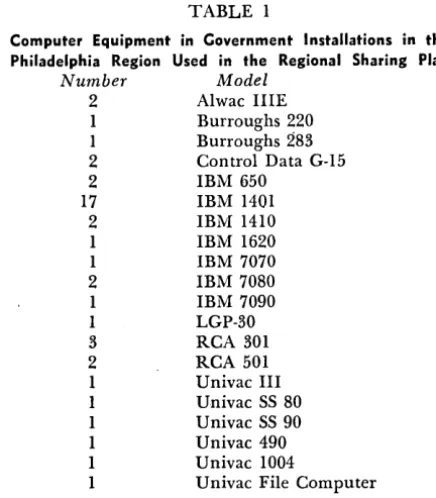
The Exchange has a register of all equipments in use in government agencies in the Area. When requests for ser-vices are received they are applied against this register for an appropriate installation and then forwarded to that installation. Contact is then made directly between the contributor and receiver of the desired services.
Equipment
The Data Processing Division in ASO has a large installa-tionand staff in operation and is in a position where it can help other agencies who have, little. or no equipment. It has in operation: two IBM 1410s, with two 1301 Random