ROLAND L ¨OTSCHER AND MARK MACDONALD
Abstract. The notion of a (G, N)-slice of aG-variety was introduced by P.I. Katsylo in the early 80’s for an algebraically closed base field of characteristic 0. Slices (also known under the name of relative sections) have ever since provided a fundamental tool in invariant theory, allowing reduction of rational or regular invariants of an algebraic groupGto invariants of a “simpler” group. We refine this notion for aG-scheme over an arbitrary field, and use it to get reduction of structure group results forG-torsors. Namely we show that any (G, N )-slice of aversal G-scheme gives surjective mapsH1(L, N)→H1(L, G) in fppf-cohomology for infinite fields LcontainingF. We show that every stabilizer in general positionH for a geometrically irreducibleG-varietyV gives rise to a (G, NG(H))-slice in our sense. The combination of these two results is applied in particular to obtain a striking new upper bound on the essential dimension of the simply connected split algebraic group of typeE7.
1. Introduction
In [Ka83] P.I. Katsylo introduced the notion of a slice (or section) for a regular action of a connected algebraic groupGon a varietyX over the fieldCof complex numbers as follows: A (G, N)-slice ofX, for a subgroupN ofG, is a (locally closed) subvarietySofX satisfying the following two conditions:
(1) G·S=X
(2) Ifs∈S andg∈Gthengs∈S if and only ifg∈N.
This definition was inspired by Seshadri’s work [Se62] from the early sixties. Katsylo observed that any (G, N)-slice induces an isomorphismC(X)G'
C(S)N through restriction of rational functions. Applying this observation to the case G = SL2 and X = Vd an irreducible G
-representation, he showed that the fieldsC(Vd)SL2 are projectively rational, i.e., generated by
algebraically independent homomogeneous rational functions.
A closely related notion is the one of aChevalley relative section. This is a subvarietyS of
X such that restriction of regular functions induces an isomorphism C[X]G ' C[S]N, where
N = {g ∈ G| gS =S} is the normalizer of S. Existence of Chevalley relative sections and (G, N)-slices as defined by Katsylo simplify the calculation of regular resp. rational invariants of an algebraic groupG.
Notions of slices and sections are widespread in the literature, not only forming an important technical tool in invariant theory, but also studied in their own right. In disguised form these concepts were already present in the 19th century, for instance in the work of Weierstrass and Hesse on normal forms of plane cubic curves. We refer to [Po94] for a systematic treatment and survey of this topic, all over an algebraically closed base field of characteristic 0.
Our interest in slices and sections has slightly different origins. It comes from the desire to classify torsors of an algebraic groupGover an arbitrary field, or equivalently, to describe the setsH1
f ppf(L, G) for an algebraic group Gover F and field extension L of F. Torsors of
algebraic groups often describe interesting algebraic objects like central simple algebras (for
2000Mathematics Subject Classification. 20G15, 11E72, 14L24.
Key words and phrases.G-torsor, slice, relative section, reduction of structure group, essential dimension, E7, stabilizer in general position.
The first author was supported by the Deutsche Forschungsgemeinschaft, GI 706/2-1.
projective linear groups), quadratic forms (for orthogonal groups) or Cayley algebras (for the exceptional simple groupG2).
By getting information on the structure of torsors we also wish to improve the known upper bounds on the essential dimension of various algebraic groups. The essential dimension of an algebraic groupGis a measure of how many algebraically independent parameters are needed to describe any of its torsors up to isomorphism. For example, isomorphism classes ofOn-torsors
correspond bijectively to isometry classes of non-degenerate quadratic forms of dimensionn. It is known that such quadratic forms can always be diagonalized (provided charF 6= 2), which translates to the fact thatH1(L, µn
2)→H1(L,On) is surjective for all field extensions L/F.
This implies ed(On)≤ed(µn2) =n. Indeed, diagonalization should mean that a quadratic form
“is described by at mostnparameters”.
LetN be a subgroup of an algebraic group over a fieldF. We will define a (G, N)-slice for a
G-schemeXas anN-stable (locally closed) subschemeSofX such that the induced morphism (G×S)/N →X of algebraic spaces is an open embedding. HereN acts onG×Sthrough the formulan·(g, s) = (gn−1, ns). This action is free. The fppf-quotient sheaf (G×S)/N is known to be an algebraic space.
We prefer to use the term “slice” rather than “section”, following [CT88]. This is motivated by the analogy with the ´etale slices from Luna’s theorem [Lu73] and the analogy with the notion of a slice from differential geometry, see e.g. [Pa60, Definition 2.11]. Our definition of a (G, N)-slice can be seen as a version of Katsylo’s definition, which works well for arbitrary base fieldsF. See Corollary 3.5 and Proposition 5.1, which highlight the close connection between the two different definitions.
In Theorem 3.7 we show that existence of a (G, N)-slice of a versal G-scheme implies sur-jectivity of the mapsH1
f ppf(L, N)→Hf ppf1 (L, G) for infinite fieldsLcontainingF. Examples
of versal G-schemes include linear representations and their associated projective spaces, as well as connected reductive groups on which G acts by group automorphisms; see Example 2.7. Every such reduction of structure group result implies the inequality ed(G)≤ed(N). The hope is that this will provide improved upper bounds for the essential dimension ofG. Indeed in the case ofEs.c.
7 , we obtain a much better upper bound on the essential dimension than was
previously known.
Our principal method to construct slices of (geometrically irreducible) G-varieties comes from stabilizers in general position (SGP’s). Namely Theorem 4.1 shows that for an SGPH of a geometrically irreducibleG-varietyV, there exists a (G, NG(H))-slice, which is open in the fixed schemeVH. The concept of an SGP has its origin in invariant theory over an algebraically closed field of characteristic 0. It has only recently become a tool used for arbitrary base fields. We will give another construction of slices for smooth algebraic groups in section 5. Proposi-tion 5.1 shows in particular, that in characteristic 0 every (G, N)-slice in Katsylo’s sense gives a (G, N)-slice with our definition.
Theorem 3.7 could be considered a generalization of two existing results. Firstly, it gen-eralizes to fields of characteristic other than zero an early result of Reichstein, which used (G, N)-sections (in the sense of [Re00, Definition 2.9]) of linear representations to give the inequality ed(G)≤ed(N); see Remark 3.9. Secondly, in [Ga09] Garibaldi, inspired by Rost’s unpublished preprint [Ro99], considered the situation when there is a zero-dimensional slice of P(V) (consisting of a single point), where V is a linear representation of G, and proved the surjectivity of Theorem 3.7 whenGis smooth. The surjectivities proved in Garibaldi’s paper were fruitfully applied to describe cohomological invariants of various exceptional groups and Spin groups. So our Theorem might also be considered as a generalization of this result to a much wider class of slices.
given Cartan subalgebra form a slice of the adjoint representation, see [SGA3, XIII, Theorem 6.1(d)] (cf. Example 5.3). IfT ⊂Gis a split maximal torus inG, and Aut(G)∼=G, then the existence of a maximal torus in ¯F /F-forms of G is equivalent to the surjectivity of the map
H1(F, NG(T))→H1(F, G); in this situation, that surjectivity will now follow from Theorem 3.7.
Our results are also related to work of Chernousov, Gille and Reichstein [CGR08], who showed that every reductive algebraic group G has a finite subgroup S (contained in the normalizer of a maximal torus) for which the mapH1(L, S)→H1(L, G) is surjective for every
field extensionL/F. However in practice these finite subgroups are usually not ideal for proving interesting new upper bounds on ed(G).
The rest of this paper is structured as follows: In section 2 we will fix conventions, recall some basics on algebraic spaces, torsors, twists, versalG-schemes, stabilizers in general position and essential dimension and prove some useful lemmas used later on. In section 3 we discuss (G, N)-slices of a G-scheme for an algebraic group G and subgroup N. Theorem 3.7 shows that every (G, N)-slice of a versalG-scheme (for instance a linear representation) gives rise to surjectionsH1(L, N)→H1(L, G) in fppf-cohomology for infinite fieldsLcontaining the base
field. We proceed to construct slices of geometrically irreducibleG-varieties out of stabilizers in general position in section 4 and give another construction for smooth algebraic groups in section 5. A simple application of the former result is given in section 6, which provides a new proof of Risman’s Theorem in the theory of central simple algebras. Finally in section 7 we take the SGP on two copies of the 56-dimensional representation of E7s.c to prove the upper
bound ed(Es.c7 )≤11.
2. Preliminaries
2.1. Definitions and conventions. Unless otherwise specified, F will denote an arbitrary field, and ¯F an algebraic closure. Analgebraic groupGwill be a (not necessarily smooth) affine group scheme of finite type over a field (usually F). For an algebraic groupG, the symbols
NG(H) or NormG(Y) will denote the scheme-theoretic normalizer of G which preserves a
subgroupH or closed subschemeY respectively [Ja03]; the normalizer subgroup need not be smooth, even if Gis smooth (for example, if G=Gm acts on A1 byx.v :=xpv, andY is a non-zero closed point, then the normalizer isµp). Avariety will be a reduced scheme which is
separated and of finite type over a field.
We will frequently use the notion of algebraic spaces, as defined in [Stacks, 025Y]. Algebraic spaces are a generalization of schemes, that behave better under descent and appear naturally when working with quotients of free algebraic group actions on schemes. The category of schemes overF will be furnished with the big fppf (finitely presented faithfully flat) topology. Thus analgebraic space overF is a sheafX: (Sch/F)opf ppf →Sets such that
(1) For all schemes U, V over F and sheaf maps U → X, V → X the fiber product of sheavesU×XV is representable by a scheme.
(2) There exists a schemeU overF and a surjective ´etale sheaf mapU →X (this means that for every schemeV overF and sheaf mapV →X the morphismU×XV →V of
schemes is surjective and ´etale).
A morphism of algebraic spaces is a natural transformation of functors. Every scheme gives rise to an algebraic space and the association X 7→ X defines a fully faithful embedding of the category (Sch/F) to the category of algebraic spaces over F. Thus we will identify every scheme overF with the algebraic space over F which it defines. IfGis an algebraic group, a
G-scheme will be a scheme with an actionG×X →X ofG.
(g, x) 7→ (gx, x) is an isomorphism. A pseudo G-torsor π is called an (fppf ) G-torsor if the morphismπ:X →Y is fppf. Equivalently (cf. [Mi80, III, Proposition 4.1]) there exists an fppf covering{Yi → Y}i∈I such that for every i the pull-back X ×Y Yi → Yi is G-equivariantly
isomorphic to G×Yi → Yi, where G acts trivially on Yi and by left multiplication on G. If
X→SpecF is aG-torsor, whereF is a field, then we will also callX aG-torsor overF. If an algebraic groupGacts on an algebraic spaceX the fppf quotient sheafX/Gis defined as the sheafification of the presheafT 7→X(T)/G(T) on (Sch/F)f ppf in the sense of [Stacks,
00WG]. By the universal property of sheafification every G-invariant morphism X → Y of algebraic spaces factors through the quotient mapX → X/G. Moreover, if X → Y is a G -torsor, then the induced morphismX/G→Y is an isomorphism by [Stacks, 044M].
2.2. Free actions, twists and versal G-schemes. Recall that an action of an algebraic groupGon an algebraic spaceX is called free, if for every schemeT overF the action of the groupG(T) on the setX(T) is free.
Lemma 2.2. Let Gbe an algebraic group over F acting freely on an algebraic spaceX over F. Let Y :=X/Gdenote the fppf quotient sheaf. Then the sheaf Y is an algebraic space and the canonical morphism π: X →Y is an fppf G-torsor. Moreover for any algebraically closed fieldL/F we have Y(L) =X(L)/G(L).
Proof. By [Stacks, 06PH] Y is an algebraic space and π: X → Y is fppf. It remains to show that the mapG×X→X×Y X, (g, x)7→(gx, x) is an isomorphism. Since the action ofGon X is free, for schemesT overF, the maps
G(T)×X(T)→X(T)×X(T)/G(T)X(T), (g, x)7→(gx, x)
are bijective. Thus it suffices to show that the maps X(T)/G(T) → Y(T) = (X/G)(T) are injective. SinceG acts freely on X, the morphism G×X → X×X, (g, x) 7→ (gx, x) is a monomorphism (by [Stacks, 07S2]), hence an equivalence relation. Therefore [Sk09, Proposition 1.13] (cf. [Ja03,§5.5]) implies that the presheaf quotient (X/G)preis separated. Thus [Stacks,
00WB] implies the claim. For the last claim see [DG70, III,§1, 1.15].
Remark 2.3. Under some assumptions onX andGthe quotientX/Gin Lemma 2.2 will be a scheme. This is for example the case whenGis finite andX is quasi-projective [Stacks, 07S7]. However for us it will be of no relevance, ifX/Gis a scheme, or only an algebraic space.
Lemma 2.4. SupposeGacts freely on an algebraic spaceX andf:X →Z is aG-invariant morphism. Letz: Spec(R)→Z be another morphism of algebraic spaces overF, whereRis a commutativeF-algebra. ThenGR acts freely on the algebraic spaceXz:=X×ZSpec(R)over Rand induces an isomorphism Xz/GR'(X/G)z of algebraic spaces overR.
Proof. It is clear that GR acts on Xz and that this action is free. Moreover we have a GR -equivariant isomorphism Xz ' X ×X/G (X/G)z. Since the projection X ×X/G (X/G)z →
(X/G)z is aGR-torsor the claim follows.
An important example of quotients by free actions is given by the twist construction as follows:
Definition 2.5. LetX be aG-scheme andEaG-torsor (both defined overF). EndowE×X
with the (free) diagonalG-action. Then the quotient EX := (E×X)/Gis called thetwist of X byE.
Note that for aG-torsor E anyG-equivariant morphism of schemesX →Y gives rise to a morphismEX →EY of algebraic spaces. Moreover if E 'G is the trivial torsor the action
morphismG×X→X induces an isomorphismEX 'X.
For smooth algebraic groups acting on quasi-projective varieties, the notions of versal and
is calledp-special if all of its finite extensions have degree a power of p. Everyp-special field is infinite. An algebraic group Gover F is said to be special, if it only has the trivial torsor over fields containingF. It is said to bep-special, if it only has the trivial torsor overp-special fields containingF.
Definition 2.6. LetG be an algebraic group and V a G-scheme over F. Let pbe a prime. ThenV is called versal (resp. p-versal), if for every field extensionL/F withL infinite (resp.
p-special), everyG-torsorEoverLand every non-emptyG-stable open subschemeU ofV, the twistEU contains anL-rational point.
Clearly any versal G-scheme is p-versal for any prime p. The following examples of versal andp-versal G-varieties are listed in [DR15]:
Example 2.7. (1) For V a linearG-representation bothV andP(V) are versal.
(2) IfV is a connected reductive group and Gacts on V by group automorphisms, then
V is versal.
(3) Let V = A/B be a homogeneous space with A reductive and B a subgroup. Let G
be a subgroup ofAacting onV by left-translations. Suppose thatV is geometrically irreducible and the image ofH1
f ppf(L, G)→Hf ppf1 (L, A) is contained in the image of H1
f ppf(L, B)→Hf ppf1 (L, A) for every infinite fieldL/F. ThenV is versal.
(4) LetX be a geometrically irreducible quasi-projectiveG-variety with a smoothF-point
xhaving finite G-orbit G·xwhose associated 0-cycle [G·x] is of degree prime to p. ThenX isp-versal.
In [DR15]Gis assumed to be smooth, but we will show that examples (1), (2), and (3) remain valid for non-smooth groupsGas well. Later we will need that every linear representationV
and its associated projective spaceP(V) are versal for general G. For this purpose we prove the following Lemma:
Lemma 2.8. Let G → G0 and H → G0 be homomorphisms of algebraic groups over F and X be aG0-scheme overF. We viewX as a G-scheme andH-scheme through the given homo-morphisms toG0. Let pbe a prime.
(1) IfE is a G-torsor over some field extensionL/F andE0= (E×G0)/Gis the induced G0-torsor overL, then EX'E0X as algebraic spaces overL.
(2) Suppose that for every infinite (resp.p-special) field extensionL/F the image of the map H1
f ppf(L, G)→Hf ppf1 (L, G0)is contained in the image ofHf ppf1 (L, H)→Hf ppf1 (L, G0) and for every H-torsor T over L the twist TX has a dense set of L-rational points. ThenX considered as a G-scheme is versal (resp. p-versal).
(3) Suppose that G0 is special (resp. p-special) and X is a unirational variety, then X is versal (resp.p-versal) as a G-scheme.
Proof. (1) This is well known and follows e.g. from [Gi71, Proposition 1.3.5].
(2) LetEbe aG-torsor over some infinite (resp. somep-special) field extensionL/F. LetE0
denote the inducedG0-torsor. By assumption there exists anH-torsorT which induces the sameG0-torsor asE. Hence EX 'E0X 'TX, which by assumption has a dense
set ofL-rational points. Hence EU contains an L-rational point for every non-empty G-stable open subschemeU ofX.
(3) Take forH the trivial group. SinceX is unirationalXL has a dense set of L-rational points for every infinite fieldL/F, so (2) applies.
Remark 2.9. It follows from [DR15, Theorem 1.1 and Lemma 8.2] that for H smooth and X
Corollary 2.10. No smoothness assumption is needed in Example 2.7 (1), (2) and (3). Proof. In (1) we take G0 = GL(V), which is special.
In (2) we takeG=G0 =H and note that for everyG-torsorE over a field extensionL/F
the twistEV is a connected reductive group overL, hence by Chevalley’s Theorem (see [Bo91,
Theorem 18.2(ii)]) contains a dense set of rational points.
In (3) if E0 is an A-torsor induced from a B-torsor over L, then E0V = E0(A/B) has a
rational point, by [DG70, p. 373, Prop. III.4.4.6b]. Hence it is dominated by the reductive group Aut(E0) overL. ThereforeE0V contains a dense set of rational points. This is simply a
rephrasing of the argument in [DR15].
Remark 2.11. We do not know if Example 2.7 (4) holds for non-smooth groups, but we will not need this kind of example in this paper.
In Example 2.7 (2) and (3), if the algebraic groupV resp.Ais not necessarily reductive, but only connected and smooth, then the corresponding varietyV will still be versal (resp.p-versal) if char(F) = 0 (resp. char(F)6=p). This comes from the fact that Chevalley’s unirationality Theorem holds for smooth connected algebraic groups whenever the base field is perfect. This was also observed in [DR15].
2.3. SGP’s and generic freeness. Astabilizer in general position(SGP) for an action of an algebraic groupGon a geometrically irreducible varietyX (defined overF) is a subgroup H
ofGsuch that for some dense open subschemeU ofX everyu∈U( ¯F) has (scheme-theoretic) stabilizer conjugate to HF¯. The G-action on X is said to be generically free, if the trivial
subgroup ofG is an SGP for that action. For a subgroupH of Gthe condition thatH is an SGP for theG-action on a geometrically irreducible varietyX can always be checked over an algebraic closure. Moreover we have the following Lemma
Lemma 2.12. SupposeGacts on a geometrically irreducibleF-varietyX, for whichF-rational points are dense. Assume theGF¯-action onXF¯ has an SGP H. Then the˜ G-action onX has
an SGP, sayH, as well, andHF¯ is conjugate toH˜.
Proof. Let ˜U ⊂ XF¯ be a dense open subscheme such that every rational point of ˜U has
stabilizer conjugate to ˜H. First note that ˜U has only finitely many Galois conjugates. Indeed to prove this claim, we may assume without loss of generality thatX is affine, so that ˜U is the complement of the zero set of finitely many polynomials. Since every of these polynomials has only finitely many non-zero coefficients and every coefficient has only finitely many Galois-conjugates, the claim follows. Now the intersection of the Galois conjugates of ˜U is dense open in ˜U and, by [Sp98, Proposition 11.2.8], descends to a dense open subschemeU of X. Taking forH the stabilizer of anF-rational point inU we get the desired result. By a Theorem of Richardson [Ric72] an SGP exists for any reductive algebraic group action on an irreducible smooth affine variety over an algebraically closed field in characteristic 0. Hence by Lemma 2.12 it also exists, in characteristic 0, for reductive group actions on geo-metrically irreducible smooth affine varieties with a dense set of rational points. This includes the case of linear reductive group actions. Moreover for linear actions of connected semisimple algebraic groups in characteristic 0 a lot of information about their SGP’s is available in the literature, see e.g. [PV89, Section 7].
We will repeatedly make use of the following Lemma, which is due to Popov.
Lemma 2.13([Po89, Prop. 8]). LetGact on geometrically irreducible varietiesX andY. Let H2⊂H1⊂Gbe subgroups such thatH1 is an SGP for theG-action onX andH2 is an SGP
for theH1-action on Y. ThenH2 is an SGP for the G-action onX×Y.
works for arbitrary base fields. This also corrects the proof of [Mac13, Prop.1.2], which is
mistaken.
Let Gact on a scheme X over F. For any commutative F-algebra R and x ∈ X(R) the functorR0 7→ {g ∈G(R0)|gxR0 =xR0} from the category of commutativeR-algebras to the category of groups is representable by a subgroup scheme ofGR, see [SGA3, I, 2.3.3] or [DG70,
III, §2.2], which we denote by (GR)x and call the stabilizer R-group scheme of x. We have
(GR)gx =g(GR)xg−1 for anyg ∈ G(R), x∈X(R). When X is separated we will denote by XG the closed subscheme of X which is fixed byG.
Lemma 2.14. Suppose H is an SGP for the G-action on a geometrically irreducible variety X andU is a dense open subscheme as in the definition of an SGP. Then
(1) The subscheme U contains a dense open subscheme U0 which isG-stable. (2) Suppose U is G-stable. Then S :=U ∩XH is a non-empty Norm
G(XH)-stable open subscheme ofXH such that for every commutativeF-algebraR and everys∈S(R)⊂ X(R) we have(GR)s=HR.
Proof. (1) This is well known. See e.g. [L¨o15,§2, before Lemma 2.3].
(2) ClearlySis non-empty and NormG(XH)-stable. For any commutativeF-algebraRand s∈S(R) we want to show that (GR)s=HR. Note that the inclusion (GR)s⊃HR is
obvious. IfR= ¯F, by the definition of an SGP, (GF¯)sis conjugate toHF¯and contains
HF¯. The endomorphism (GF¯)s 'HF¯ ,→(GF¯)s is a monomorphism of schemes. It is
in fact an automorphism by [EGAIV, Proposition 17.9.6] since (GF¯)s is of finite type
over ¯F. This implies (GF¯)s=HF¯ as claimed.
To prove this equality for arbitrary commutative F-algebras R we consider the inertia schemeXT = (G×X)×X×XX for theG-action on X. Here the morphism X → X×X is the diagonal and G×X →X ×X is given by (g, x) 7→ (gx, x). By [DG70, III,§2.2] the fiber of the morphismXT →X over anyx∈X(R) is isomorphic
to the stabilizerR-group scheme (GR)x.
Now letST =XT ×
XS= (G×X)×X×XS. TheH-action onG×X×S through h·(g, x, s) = (gh−1, hx, s) induces a freeH-action on ST. The morphism ST →S is H-invariant. By Lemma 2.4 the fiber (ST/H)
sof the induced morphismf: ST/H→S
over s ∈ S(R) is isomorphic to (ST)s/HR ' (GR)s/HR. In particular for everys ∈ S( ¯F) the morphism (ST/H)
s→Spec( ¯F) is an isomorphism.
Note thatST/His in fact a scheme of finite type overF, sinceST '(G×S)× X×SS,
henceST/H'(G/H×S)×
X×SS andG/H is a finite type scheme overF by [DG70,
III,§3, 5.4]. Thus by [DG70, III§2.2, Lemme] we conclude thatf is a monomorphism. Since f has a section, it follows that f is an isomorphism. Hence for s ∈ S(R) the morphism (GR)s/HR → Spec(R) is an isomorphism too. So (GR)s →Spec(R) is an HR-torsor. The existence of the identity section shows that (GR)s=HRas claimed.
2.4. Essential dimension. For the definition of essential dimension and essentialp-dimension of an algebraic group G, see [Me09]; it is the essential dimension (resp. p-dimension) of the fppf cohomology functorL7→H1
f ppf(L, G). The setH
1
f ppf(L, G) classifies fppfG-torsors over L(i.e. over Spec(L)).
WhenGis smooth every fppfG-torsor is locally trivial in the ´etale topology and these sets can be identified with the Galois cohomology set:
Hf ppf1 (L, G) =H´et1(L, G) =H1(Gal(Lsep/L), G(Lsep)).
So whenGis smooth, we may simply write H1(L, G) for any of these sets.
Lemma 2.15. Let H → G be a homomorphism of algebraic groups (e.g. the inclusion of a subgroup) andpa prime. If the mapH1
f ppf(L, H)→H
1
Proof. For (absolute) essential dimension this is shown as in the proof of [Me09, Proposi-tion 1.3]. Note that elements of Hf ppf1 (L, G) withL finite do not contribute to the essential dimension of G, since all such elements have essential dimension zero over F. For essential
p-dimension, see [LMMR13, Proposition 2.4].
Lemma 2.16. [Me09, Corollary 4.2] If an algebraic group G acts on an F-vector space V linearly and generically freely thened(G)≤dim(V)−dim(G).
3. Reduction of structure group from slices of versal G-schemes
Given aG-scheme V and a (locally closed) subschemeS0⊂V stable under the action of a
subgroupN ofGwe have a free action ofNonG×S0via the formulan·(g, s0) = (gn−1, ns0).
The action morphism
G×S0→V, (g, s0)7→gs0
isN-invariant. Hence it gives rise to a morphism (G×S0)/N →V of algebraic spaces, which is
G-equivariant. Here we equip (G×S0)/Nwith theG-action induced fromg·(g0, s0) = (gg0, s0).
Definition 3.1. LetN be a subgroup of an algebraic groupG. For us a (G, N)-slice of aG -schemeV will be a non-emptyN-stable subschemeS0⊂V such that the inducedG-equivariant
morphism (G×S0)/N→V of algebraic spaces is an open immersion.
Example 3.2. Suppose aG-schemeV contains anF-rational pointxwith an open orbit in
V. ThenS0 ={x} is a (G, N)-slice ofV, where N is the stabilizer of xin G. Indeed, in this
case the morphism (G×S0)/N →V is given by the inclusion of the open orbit inV.
Lemma 3.3. Let N be a subgroup of G. The following conditions on a non-empty N-stable subschemeS0 of aG-schemeV are equivalent:
(1) S0 is a(G, N)-slice.
(2) The morphism m:G×S0 →V is open and for V0=m(G×S0) =G·S0 the induced
morphismG×S0→V0 is an N-torsor.
(3) The morphism m:G×S0→V is flat and locally of finite presentation, and for every
commutative F-algebraR, every g ∈ G(R) with gS0(R)∩S0(R) 6=∅ is contained in
N(R).
Proof. If (1) holds, then bothG×S0→(G×S0)/N and (G×S0)/N →V are flat and locally
of finite presentation, hence so ism:G×S0→V. Moreover forg∈G(R),s0, s00∈S0(R) such
that gs0 =s00 the elements (g, s0) and (e, s00) of (G×S0)(R) have the same image in V(R),
hence also in ((G×S0)/N)(R). Therefore there exists n ∈N(R) with (e, s00) = (gn− 1, ns
0).
Henceg=n∈N(R), and (3) follows.
If (3) holds, then m: G×S0 → V is open (by [Stacks, 01UA]). The induced morphism
G×S0 → V0 is fppf, so it suffices to show that for every commutative F-algebra R and
g, g0 ∈ G(R), s
0, s00 ∈ S0(R) with gs0 = g0s00 there exists a unique n ∈ N(R) such that
(g0, s00) = (gn−1, ns
0). Uniqueness is clear and existence follows from (g0)−1gS0(R)∩S0(R)6=∅.
So (2) follows.
If (2) holds then (G×S0)/N ' V0 and the morphism (G×S0)/N → V is given by the
inclusion ofV0in V.
Remark 3.4. LetS0be a (G, N)-slice of aG-schemeV overF.
(1) IfV andN are smooth thenGandS0 are smooth as well, since the composite
G×S0→(G×S0)/N→V →SpecF
of smooth morphisms is smooth.
(2) Let S := S0 be the scheme-theoretic image ofS0 in V. If V is of finite type over F
and NormG(S) is smooth thenN = NormG(S). To show this, noticeN normalizesS0,
in S0 andN×S0 =N×S0 in N×V), from which we getN ⊂NormG(S). Now let g∈NormG(S)( ¯F). SincegS( ¯F) =S( ¯F) andS0( ¯F) is dense and open inS( ¯F) we have
gS0( ¯F)∩S0( ¯F)=6 ∅. Hence g∈N( ¯F) by Lemma 3.3. Since NormG(S) is smooth we
get the desired result by [KMRT98, 22.3].
Corollary 3.5. LetN be a subgroup of an algebraic groupGandV be a reducedG-scheme of finite type overF. LetS be a non-emptyN-stable subscheme ofV. Suppose that the morphism m: G×S→V, (g, s)→gsis dominant overF¯, and that for every commutativeF-algebraR, everyg ∈G(R) with gS(R)∩S(R)6=∅ lies inN(R). Then the flat locus of mis of the form G×S0 for someN-stable non-empty open subschemeS0 ofS andS0 is a(G, N)-slice of V.
Proof. By [Stacks, 052B and 0399] the flat locus ofm:G×S →V is non-empty and open in
G×S. Note thatmis equivariant for theG×N-action onG×SandV through (g, n)·(g0, s) = (gg0n−1, ns) and (g, n)·v =gv, respectively. Since the formation of the flat locus commutes with flat base change [Stacks, 047C], the flat locus of m is of the form G×S0 for some N
-stable non-empty open subschemeS0 of S. MoreoverG×S0 →V is flat and locally of finite
presentation. Applying Lemma 3.3 we get thatS0is a (G, N)-slice ofV.
The following observation will be useful for non-faithfulG-actions:
Lemma 3.6. Let π:G→G0 be a surjective homomorphism of algebraic groups and N0 be a subgroup ofG0. Set N =π−1(N0). LetV be a G0-scheme and S
0⊂V aN0-stable subscheme.
ThenS0 is a(G0, N0)-slice of V if and only if it is a(G, N)-slice of V.
Proof. The composition G×S0 → G0×S0 →(G0×S0)/N0 is N-invariant, hence it induces
a morphism (G×S0)/N →(G0×S0)/N0. We claim it is an isomorphism. Since ker(π) acts
trivially on S0 the morphism (G×S0) → (G×S0)/N factors through G0×S0. We get an
N0-invariant morphism G0×S0 → (G×S0)/N, which is easily seen to induce an inverse of
(G×S0)/N →(G0×S0)/N0.
Now we conclude the proof by observing that the morphism (G×S0)/N →V is the
com-position of the above isomorphism with the canonical morphism (G0×S0)/N0 →V.
The definition of a (G, N)-slice was designed in order to make the following result work. Its usefulness will be seen in the following sections.
Theorem 3.7. Let S0 be a (G, N)-slice of a G-schemeV and letpbe a prime. Then if V is
versal (resp.p-versal), then the mapH1
f ppf(L, N)→Hf ppf1 (L, G)is surjective for every infinite (resp.p-special) fieldL/F. In particular,ed(G)≤ed(N)(resp.edp(G)≤edp(N)).
Proof. Let L be an infinite (resp. p-special) field containing F and E a G-torsor over L. By [DG70, p. 373, Prop. III.4.4.6b] in order to show that the class ofEinH1
f ppf(L, G) comes from H1
f ppf(L, N) it suffices to show that the twist
E(G/N) has anL-rational point. By definition of
a slice the fppf quotient (G×S0)/Nis representable by aG-stable non-empty open subscheme
ofV, which we callU. The morphismG×S0
π1
→G→G/N induces aG-equivariant morphism
U → G/N. We get an induced morphism EU →E(G/N). Since V is versal (resp.p-versal), EU contains an L-rational point. Its image under EU → E(G/N) is an L-rational point of E(G/N).
Remark 3.8. Saying that the mapHf ppf1 (L, N)→Hf ppf1 (L, G) is surjective for everyp-special fieldL/F is equivalent to saying that for every field K/F andG-torsorE overK there exists a finite extensionK0/K of degree prime top such that the class ofEK0 in H1(K0, G) lies in the image of the mapHf ppf1 (K0, N)→Hf ppf1 (K0, G). This follows from the continuity of the functorsH1
f ppf(−, N),H
1
f ppf(−, G) and the existence of ap-special closure ofK, see [LMMR13,
§2].
IfGis connected then for any finite field L/F the mapH1
f ppf(L, N)→H
1
f ppf(L, G) is also
Remark 3.9. If charF = 0, and there is a linear subspace S0 of a linear representation V,
which is a (G, N)-section, in the terminology of [Re00], then one can also show the existence of a (G, N)-slice ofV, and so by Theorem 3.7 we have ed(N)≤ed(G). But in this case, this inequality on essential dimensions already follows from [Re00, Lemma 4.1] (notice that for characteristic zero, Reichstein’s original definition of essential dimension is equivalent to the one above [BF03,§6]). To see this, if W is a generically freeG-representation, thenS0×W is
a (G, N)-section ofV ×W, so the Lemma applies. Therefore, Theorem 3.7 is a generalization of this result to fields of arbitrary characteristic, non-smooth groups, and non-linear actions.
4. Producing slices from SGP’s
In this section we will describe a technique to produce a slice of a geometrically irreducibleG -varietyV admitting an SGP. Moreover we apply Theorem 3.7 to versalG-varietiesV to obtain reduction of structure forG-torsors. This will in particular apply to linear representations of
G. The following Theorem is a variant of [Po94, 1.7.8], where relative sections are replaced by slices in our sense.
Theorem 4.1. LetV be a geometrically irreducibleG-variety. Suppose thatH is an SGP for the G-action on V (in particular an SGP exists). Let N :=NG(H) be its normalizer. Then there exists an openN-stable subschemeS0 of VH, which is a(G, N)-slice ofV.
Proof. By Lemma 2.14 there is a G-stable non-empty open subschemeU ofV such thatS :=
U∩VH is aN-stable non-empty open subscheme inVH and for every commutativeF-algebra Rands∈S(R) the stabilizerR-group scheme (GR)sofsis equal toHR. In particular for any g ∈ G(R) ands ∈ S(R) withgS(R)∩S(R) 6=∅, comparision of stabilizer R-group schemes yieldsgHRg−1=HR, henceg∈N(R). Therefore the claim follows from Corollary 3.5.
Corollary 4.2. Let V be a geometrically irreducible G-variety which admits an SGP H. Let N :=NG(H)and pbe a prime. IfV is versal (resp. p-versal), then the map H1
f ppf(L, N)→ H1
f ppf(L, G)is surjective for every infinite (resp.p-special) fieldL/F. In particular,ed(G)≤
ed(N)(resp.edp(G)≤edp(N)).
Proof. This follows immediately from Theorems 4.1 and 3.7.
Example 4.3. LetGbe a connected reductive algebraic group overF and letV =G, which we view as a G-scheme through the conjugation action. By Example 2.7,V is versal. Let T
be a maximal torus ofG. We claim thatT is an SGP for theG-action onV. So Corollary 4.2 shows the well known surjectionH1(L, NG(T))→H1(L, G) for any field extensionL/F.
In order to prove the claim we may assume without loss of generality thatF = ¯F. First note that there is a dense open subschemeT0 ofT, such that the centralizer of everyt∈T0(F) is
equal toT. In fact, this can be seen by embeddingG in some GLn, whereT is diagonalized:
letχ1, . . . , χndenote the standard characters of the diagonal torus of GLn and take forT0 the
intersection of the open subschemesD(χi/χj)|T, where (i, j) runs over all pairs with (χi)|T 6=
(χj)|T. The morphism G×T0 → G, (g, t) 7→ gtg−1 is dominant, hence contains an open
subschemeU in its image. The stabilizer of everyu∈U(F) is conjugate toT. This shows the claim.
Remark 4.4. The result of Example 4.3 can also be obtained by considering the adjoint repre-sentation ofG. We will show this in more generality in section 5.
Corollary 4.5. Let V be a linear representation of Gwhich admits an SGP H. WriteN :=
NG(H). Then the map Hf ppf1 (L, N)→H
1
f ppf(L, G) is surjective for every infinite fieldL/F. Moreovered(G)≤ed(N)andedp(G)≤edp(N)for every primep.
Proof. Since V is versal (hence alsop-versal for every prime p), this is only a special case of
5. Slices for smooth algebraic groups G
In section 4 we saw how to construct a slice of a geometrically irreducibleG-variety, when an SGP exists. This may not always be the case, especially for actions of non-reductive groups. So we give another construction similar to the one in Corollary 3.5, but with the flat locus replaced by the smooth locus. This will allows us to check the conditiongS(R)∩S(R)6=∅ ⇒
g∈N(R) only for algebraically closed field extensionsRofF instead of arbitrary commutative
F-algebras. Our goal consists of proving the following result:
Proposition 5.1. Let N be a subgroup of G. Let V be a G-scheme over F andS be a non-emptyN-stable subscheme ofV. Suppose that for every algebraically closed field extensionL/F andg∈G(L)with gS(L)∩S(L)6=∅ we haveg∈N(L).
(1) Ifm:G×S→V, (g, s)7→gsis smooth, then S is a(G, N)-slice of V.
(2) SupposeGis smooth,S andV are geometrically integral and of finite type overF, and mF¯ is dominant and separable (in the sense of[Sp98, §8]). Then the smooth locus of
mis of the form G×S0 for a (non-empty) N-stable open subscheme S0 ofS andS0
is a(G, N)-slice of V.
In order to prove Proposition 5.1 we will need the following Lemma:
Lemma 5.2. Letφ:X →Y andψ:Y →Z be morphism of algebraic spaces overF such that (1) Z is a scheme,
(2) ψ◦φ:X→Z is smooth, (3) φ:X →Y is fppf,
(4) Y(L)→Z(L)is injective for every algebraically closed field LcontainingF. Thenψ:Y →Z is an open embedding.
Proof. First ψ is universally injective by the proof of [Stacks, 040X]. Since every universally injective ´etale morphism of algebraic spaces is an open immersion (by [Stacks, 05W5]), it remains to show ψ is ´etale, i.e., for every ´etale morphism α: U → Y with U a scheme, the compositionψ◦α:U →Z is ´etale. By [Stacks, 0AHE]ψ is smooth, and in particular locally of finite type [Stacks, 06MH]. Hence ψ◦α is smooth as well, so by [Stacks, 0397] it suffices to show thatψ◦αis locally quasi-finite. Now bothψ(universally injective) andα(´etale) are locally quasi-finite by [Stacks, 06RW], hence so is their composition.
Proof of Proposition 5.1. (1) Let φ: G×S → (G×S)/N and ψ: (G×S)/N → V be the canonical morphisms, so thatψ◦φ=m:G×S → V. ForL/F an algebraically closed field ((G×S)/N)(L) = (G(L)×S(L))/N(L) and the injectivity ofψonL-points translates to the condition gS(L)∩S(L)6=∅ ⇒ g ∈N(L), which we have assumed. Therefore Lemma 5.2 implies thatψ is an open immersion, hence S is a (G, N)-slice ofV.
(2) First of all by Corollary 3.5, the flat locus ofmis of the formG×S0 for a non-empty (hence dense) N-stable open subscheme S0 of S. It contains the smooth locus ofm. Thus after replacingS byS0 we may assume that mis flat. By [Sp98, Theorem 17.3] and [EGAIV, (4) 17.11.1] the smooth locus ofmF¯is non-empty open. Hence by [Stacks,
047C] the smooth locus ofm is non-empty open as well and (byG×N-equivariance ofmas in the proof of Corollary 3.5) of the form G×S0 for a (non-empty)N-stable
subschemeS0 ofS. Now the claim follows from part (1).
Example 5.3. LetGbe a smooth (not necessarily reductive) algebraic group overF, acting ong= Lie(G) through the adjoint representation. Let c be a Cartan subalgebra ofg. LetS
denote the open subscheme ofc formed by the regular elements. By [SGA3, XIII, Corollaire 5.4] the morphism G×S → g, (g, s)7→ Ad(g)(s) is smooth. LetN := NormG(c). For L/F
in bothcLand Ad(g)cL. Since every regular element is only contained in one Cartan-subalgebra
[SGA3, XIII, Proposition 4.6], we getg∈N(L). Hence by Proposition 5.1,S is a (G, N)-slice ofg. This is also directly proven in [SGA3, XIII, Theorem 6.1].
Example 5.4. LetGbe a connected reductive algebraic group over a fieldF. Letζbe a root of unity inF and letmdenote its order. Supposeθis an automorphism ofGof orderm. Then
G(0) := (Gθ)0 is connected reductive andG(0) preserves g(1) := {x ∈g | dθ(x) = ζx} ⊂ g
under the adjoint action, whereg= Lie(G). This is the setting of Vinberg’sθ-groups, introduced by E.B. Vinberg in the 70’s [Vi76].
From now on (in this example) assume thatF is perfect and either char(F) = 0 or p = char(F) > 2 and p is good for G (this is in particular the case for any p ≥ 7). Let c be a Cartan subspace ofg(1), i.e., a maximal commutative subspace ofg(1) consisting of semisimple elements. We assume thatcremains maximal over ¯F. Let
zg(1)(c) ={z∈g(1)|[z, c] = 0∀c∈c}.
By [Le09, Lemma 1.12] zg(1)(c) = c⊕ufor a subspace uconsisting of nilpotent elements. In
particular NormG(0)(c) = NormG(0)(zg(1)(c)), which we will denote by N. We claim that there
is a (G(0), N)-sliceS0 ofg(1), which is an open subscheme ofzg(1)(c).
Let creg denote the open subscheme of regular elements in c and by R(c) = creg⊕u its
preimage in zg(1)(c). It is N-stable as well. Let m:G(0)×R(c) → g(1), (g, x)7→ Ad(g)(x).
By [Le09, Corollary 2.4] the morphism mF¯ is dominant and separable. Moreover for L/F
algebraically closed, g ∈ G(0)(L) and x, x0 ∈ R(c)(L) with Ad(g)(x) = x0, and xs, x0s their
semisimple parts, we have
zgL(xs) =zgL(cL) =zgL(x
0
s) =zgL(Ad(g)xs) = Ad(g)zgL(xs).
Intersecting both sides withg(1)L yields g∈N(L). Therefore Proposition 5.1 applies and we
get a (G(0), N)-sliceS0 ofg(1), which is open inR(c), as claimed.
Note that this slice is related to, but different from, the Kostant-Weierstrauss slice ofg(1) constructed by Levy.
Corollary 5.5. Let (H,c, V) be a triple consisting either of a smooth algebraic groupH over F and a Cartan subalgebrac ofV = Lie(H), or of a θ-groupH =G(0) overF as in Example 5.4 (with the same assumptions on the reductive groupGand the base field F) and a Cartan subspacec of V =g(1). Let K be a normal subgroup of H contained in the kernel of theH -action onV. Then the map H1
f ppf(L,NormH/K(c))→Hf ppf1 (L, H/K)is surjective for every infinite fieldL containingF.
Proof. In view of Theorem 3.7 and Lemma 3.6 this follows straight from the existence of (H,NormH(c))-slices inV as shown in Examples 5.3 and 5.4.
6. Common maximal ´etale subalgebras
In this section we give an application of Corollary 4.5 to prove that central simple algebras of the same degree, whose tensor product is of index ≤ 2, have a common maximal ´etale subalgebra; see Corollary 6.3.
We start with the groupG= GLn×GLn acting on two copies of Mn(F) via the formula
(b, c)·a=bacT. The following easy result was shown in [L¨o15, Proposition 2.4]. For convenience
of the reader we include a proof.
Lemma 6.1. The image H of the homomorphism Gnm →G, t7→(t, t−1) is an SGP for the G-action on Mn⊕Mn with Lie algebra h={(d,−d)∈ Mn×Mn |d∈D}, whereD are the diagonal matrices.
Proof. Since G has an open orbit on Mn given by the invertible matrices, the image of the
this group acts on Mn throughb·a =bab−1. Hence for any semisimple regular a ∈ VF¯ the
stabilizer is a maximal torus of (GLn)F¯. Since these are all conjugate the claim follows by
Lemma 2.13.
We now consider the following twisted version of the above representation. Let A1 and
A2 be central simple algebras of the same degree such that A1⊗F A2 has index ≤ 2. Set
G= GL1(A1)×GL1(A2) and letV be a left ideal ofA1⊗FA2 of reduced dimension 2. The
representation
G→GL1(A1⊗F A2),→GL(V),
where the first map takes (a1, a2) toa1⊗a2, decomposes into two irreducible copies over any
splitting field ofA1 andA2 as previously. Writeg= Lie(G) =A1×A2.
Corollary 6.2. TheG-action onV has an SGP H. Leth= Lie(H). The compositions fi:h,→g=A1×A2→Ai
are injective and their images are ´etale subalgebrasEi⊂Ai withE1'E2 asF-algebras.
Proof. When F is infinite, the F-rational points are dense in V, hence the existence of H
follows from Lemmas 2.12 and 6.1. Otherwise, ifF is finite, thenA1andA2 are split, and the
existence follows directly from Lemma 6.1. The statement on Lie algebras obviously holds over ¯
F, hence it follows overF by descent.
Corollary 6.3(Risman’s Theorem). (1) LetA1 andA2 be central simple algebras of the
same degree such thatind(A1⊗FA2)≤2. ThenA1andA2contain a common maximal
´etale subalgebra.
(2) Let D be a division algebra and Qa quaternion algebra over F such that D⊗F Q is not a division algebra. ThenD contains a separable subfield which splitsQ.
Proof. (1) This follows immediately from Corollary 6.2
(2) The assumption implies that there exists a central simple algebraB of degree deg(D) Brauer-equivalent to (D⊗F Q)op. Then ind(D⊗F B) = ind(Q) ≤ 2. So in view of
part (1)D andB share a common maximal ´etale subalgebraL. SinceD is a division algebra,Lis a field. MoreoverLsplitsQ.
Remark 6.4. Corollary 6.3 is the well known common slot theorem in caseA1andA2(resp.D)
are quaternion algebras. We refer to [Kn93] for an elegant proof of that theorem and references to a variety of other proofs (all of a different flavor than ours). For arbitrary 2-primary degree, the following weaker result has been proven by D. Krashen in [Kr10, Corollary 4.4]: There exists an ´etaleF-algebra of degree 2nmwithm≥1 odd, which splits bothA
1 andA2.
Part (2) of Corollary 6.3 is Risman’s Theorem [Ris75, Theorem 1] for finite dimensional division algebras. In fact the two parts are equivalent. The link between part (1) and part (2) was brought to our attention by Z. Reichstein. The proof of the reverse implication goes as follows: We may assume that ind(A2) ≤ind(A1). Let Q be a quaternion algebra Brauer
equivalent toA1⊗FA2and letDa division algebra Brauer equivalent toAop1 . ThenD⊗FQis
Brauer equivalent toA2 which has index≤ind(A1) = deg(D). HenceD⊗FQis not a division
algebra. Now by part (2)Dcontains a splitting fieldLofQ. We letL0be a maximal separable subfield ofDcontainingLand letE= (L0)r⊂A
1=Mr(D). Since Esplits D andQ, it does
also splitA2. As dim(E) = deg(A1) = deg(A2) it follows thatA2 containsEas well.
Proposition 6.5. LetH be the SGP for theG-action onV from Corollary 6.2. It is the image of the homomorphism
GL1(E)→GL1(E)×GL1(E) ,→GL1(A1)×GL1(A2) =G,
for some common maximal ´etale subalgebra E of A1, A2, where the first map is given by e7→
(e, e−1). We have
NG(H) =NGL1(A1)(GL1(E))×Aut(E)NGL1(A2)(GL1(E)).
Proof. The inclusionNG(H)⊃NGL1(A1)(GL1(E))×Aut(E)NGL1(A2)(GL1(E)) is obvious, so it
remains to show the reverse containment. Fori= 1,2 the image ofNG(H) in GL1(Ai) under the
projection homomorphism normalizes the image ofH in GL1(Ai), which is GL1(E). Therefore
NG(H)⊂NGL1(A1)(GL1(E))×NGL1(A2)(GL1(E)). Moreover letRbe a commutativeR-algebra
and (a1, a2) ∈ NG(H)(R). Then for all e ∈ ER we have a1ea1−1 = (a2e−1a−21)−1 = a2ea−21,
hencea1 anda2have the same image in Aut(E)(R). This shows the claim.
Corollary 6.6. Letn∈Nand letA1 andA2be central simple algebras of degreencontaining
a common maximal ´etale subalgebraE, such thatind(A1⊗FA2)≤2. Let
G= GL1(A1)×GL1(A2)G¯ :=NGL1(A1⊗FA2)(GL1(A1))⊂GL1(A1⊗FA2)
and letN be the image ofNGL1(A1)(GL1(E))×Aut(E)NGL1(A2)(GL1(E))inG. Then for every field extensionL/F the natural mapH1(L, N)→H1(L, G)is surjective.
Moreover we have natural correspondences
L-isomorphism classes of quintuples
(A01, A02, E01, E20, φ)with A01, A02 central simple of degreen,E10 ⊂A01,E02⊂A02 maximal ´etale and φ:E10 →∼ E20 such that A01⊗LA02'(A1⊗F A2)L
←→ H1(L, N)
L-isomorphism classes of pairs of central simple L-algebras(A01, A02)of degreen such that
A0
1⊗LA02'(A1⊗FA2)L
←→ H1(L, G).
Under these identifications the map H1(L, N)→H1(L, G)takes the isomorphism class of
(A01, A02, E01, E20, φ0) to the isomorphism class of(A01, A02).
Proof. First of all the surjectivity of the mapsH1(L, N)→H1(L, G) follows from Proposition
6.5, Corollary 4.5 and Lemma 3.6.
LetG= AutF(A1)×AutF(A2) andN = AutF(A1, E)×Aut(E)AutF(A2, E) the image of
N in G. Note that N is the automorphism group scheme of the quintuple (A1, A2, E, E,idE)
and G is the automorphism group scheme of the pair (A1, A2). Therefore we have natural
correspondences:
L-isomorphism classes of quintuples (A01, A02, E10, E20, φ) withA01, A02central simple of
degreen,E10 ⊂A01,E20 ⊂A02maximal ´etale and
φ:E10 →∼ E20
←→ H1(L, N)
L-isomorphism classes of pairs of central simple
L-algebras (A0
1, A02) of degreen
The mapH1(L, N)→H1(L, G) is the natural forgetful map. Moreover we have a
commu-tative diagram with exact rows:
1 //Gm //N _ //
N _ //
1
1 //Gm //G //G //1
withGmcentral in N and G. The induced connecting map H1(L, G)→H2(L,Gm) = Br(L)
takes the pair (A0
1, A02) to the Brauer class [A01] + [A02]−[(A1)L]−[(A2)L]. Hence the claim
follows from the exact sequences in cohomology.
7. Essential dimension of Es.c.
7
In this section E7 will denote the split simply connected algebraic group of type E7. The
best published bounds on the essential dimension of this group are 7≤ ed(E7) ≤29, where
the lower bound is valid for fields of characteristic not 2 [CS06], and the upper bound is valid for fields of characteristic not 2 or 3 [Mac13]. We will show that ed(E7)≤11 for all fields of
characteristic not 2 or 3.
Let V56 denote the smallest non-trivial linear representation of E7 := E7s.c.; it is unique
and 56-dimensional, and we will give a construction below. The following three linear rep-resentations of E7 are not generically free, and have no trivial subrepresentations. Over the
complex numbers these are the only ones [El72a], [Po86], but for the rest of this section we will allow arbitrary base fields of characteristic not 2 or 3. Firstly, the adjoint representation has a 7-dimensional slice which gives a reduction of structure to the normalizer of a maxi-mal torus. Secondly,V56 has SGPE6, so by Theorem 4.1 there is a 1-dimensional slice which
gives a reduction of structure to NormE7(E6); also the 0-dimensional slice of the versalP(V56)
gives a reduction toE6oµ4, which was considered in [Ga09] and [Mac13]. Thirdly, we have
V :=V56⊕V56, which we consider below.
We will use Theorem 4.1 to obtain a 16-dimensional slice of V, whose closure has a 37-dimensional normalizerN. Then we will show thatNacts generically freely on a 48-dimensional subrepresentation ofV56, and hence ed(E7)≤edN≤48−37 = 11.
7.1. Coordinates for the E8 root system. We choose to describe theE8 root system as
follows, because it will make the relevantE7 action easier to understand, since the slice will
take a particularly simple form in these coordinates. The following are elements of the lattice
Z8, which we equip with the standard bilinear form scaled by a factor of 1/2.
α1= (0,−1,1,0|0,−1,−1,0) α5= (0,0,0,1|1,1,−1,0)
α2= (0,0,0,1|1,−1,1,0) α6= (−1,1,0,0| −1,−1,0,0)
α3= (0,0,0,1| −1,1,1,0) α7= (2,0,0,0|0,0,0,0)
α4= (0,0,0,−2|0,0,0,0) α8= (−1,−1,−1,0|0,0,0,1)
This defines a system of simple roots of typeE8, using numbering as in Bourbaki, and we
will denote the associated set of roots by ΛE8. So the freeZ-module generated by these simple
roots, together with the set of roots ΛE8, defines a root datum. Given any field F we can
construct an algebraic group E8 over F together with a split maximal torus T8 whose root
datum is as above [Co14, 6]. Furthermore, below we describe subroot systems of types (A1)3,
D4, andE7, which correspond to subgroups (SL2)3,Spin8,andE7 ofE8.
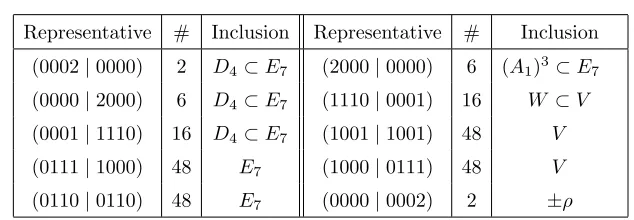
To describe these subroot systems, we find it convenient to consider the orbits of ΛE8 under
Representative # Inclusion Representative # Inclusion
(0002|0000) 2 D4⊂E7 (2000|0000) 6 (A1)3⊂E7
(0000|2000) 6 D4⊂E7 (1110|0001) 16 W ⊂V
(0001|1110) 16 D4⊂E7 (1001|1001) 48 V
(0111|1000) 48 E7 (1000|0111) 48 V
[image:16.612.144.461.89.199.2](0110|0110) 48 E7 (0000|0002) 2 ±ρ
Table 1. Orbits of the 240E8 roots
operation of order 3 on the roots:
(a1, a2, a3, b|c1, c2, c3, d)7→(a2, a3, a1, b|c2, c3, c1, d).
In [Wi14] this operation is referred to as triality, but here we have rearranged the coordinates to make the symmetry more transparent. The generated group is (Z/2)8oZ/3, and its 10 orbits among the 240E8 roots are listed in Table 1, where # is the orbit size.
The 126 roots labelled in Table 1 asE7form a root system of typeE7with system of simple
roots given byα1,· · ·, α7; they are the roots whose 8th coordinate is zero. This is a modified
version of the description ofE7roots given in [Wi14]. The 24 roots labelled asD4form a root
system of typeD4, with system of simple rootsα2, α3, α4, α5.
The 112 roots labelled in Table 1 as V correspond to weights of the E7 representation
V = V56+⊕V56−, described below, with each copy being distinguished by the sign of the 8th coordinate. The symbol ρdenotes the highest root ofE8 with respect to the given system of
simple roots.
The Lie algebra e8 decomposes into root spaces, with respect to the Cartan subalgebra
t := Lie(T8). For each simple root we will define the αi-height as the coefficient of αi when
expressed as a sum of simple roots. We can define aZ-grading on e8 by defining e8(i) to be
the sum over root spaces whose α8-height is i, with the exception of e8(0), which will also
contain t. This grading has dimensions 1,56,134,56,1 in degrees −2,−1,0,1,2 respectively. Now we can define V56+ := e8(1) and V56− := e8(−1). The algebraic group E8 acts on e8 via
the adjoint representation. The subgroup E7 preserves both V56+ and V
−
56, since this holds on
the Lie algebra level. AsE7 representations,V56+ and V
−
56 are isomorphic (we will sometimes
also writeV56:=V56+). The span of the weight spaces for the weights (±1,±1,±1|0|0,0,0|d) is
8-dimensional whendis either +1 or−1, and we will denote these subspaces byV8+⊂V56+and
V8−⊂V56−, respectively (we will also writeV8:=V8+). Below we will writeW :=V +
8 ⊕V
−
8 .
So our E7 representation of interest will be V := V56+ ⊕V
−
56. Choose a Chevalley basis
{Xα, hi} ofe8, where α runs through the roots ofE8 and h1, . . . , h8 are the elements of the
Cartan subalgebra ofe8 corresponding to the simple rootsα1, . . . , α8.
Proposition 7.1. The subgroupSpin8ofE7described above is an SGP for theE7-action onV.
MoreoverVSpin8 is equal toW =V+
8 ⊕V
−
8 andnW :={x∈e7|[x, W]⊂W}=spin8⊕(sl2)3.
Proof. Let ΛE7 denote the roots of E7, ΛD4 the roots of Spin8, ΛV the weights of V and ΛW
the weights ofW. Forα∈ΛE7 andµ∈ΛV we have
[Xα, Xµ] =
(
±Xα+µ, ifα+µ∈ΛV
0, otherwise.
Hence VSpin8 = Vspin8 is the subspace of V generated by all Xµ, with µ ∈ ΛV, such that α+µ /∈ ΛV for all α ∈ ΛD4. Similarly nW is the subspace of e7 generated by all Xα, with α∈ΛE7, such that for allµ ∈ΛW either α+µ∈ΛW or α+µ /∈ ΛV. Hence the assertions VSpin8 =W andn
The split simply connected groupE6is an SGP of the action ofE7onV56, by [Ga01, Example
3.5], and as anE6 representation, we have the decompositionV56=F⊕F⊕V26⊕V26∗. Also,
Spin8is an SGP ofE6acting onV56, by [Mac13, Prop.1.3] together with Lemma 2.13. Therefore,
Spin8is an SGP of the action ofE7 onV. This also follows from [El72a] whenF =C.
7.2. Pinning ofE8. For eachE8-rootα, we fix an isomorphismpα:Ga→Uαto the unipotent
root subgroup; this is known as apinning. This choice defines constantscλ,αfor eachλ, α∈ΛE8
by the formula (the adjoint representation) pα(t)Xλ = Xλ+cλ,αtXλ+α. Since E8 is
simply-laced, ifλandλ+αare both weights, then cλ,α =±1. But in what follows, and in particular to prove generic freeness, it is not enough to only know the structure constants up to sign. So we will choose our Chevalley basis in such a way that for everyα=±αi, plus or minus a simple root ofE7, andλ, λ+α∈ΛV we have cλ,α= 1; this is possible by [Va00, §2].
We will use the notation wi := pαi(1)p−αi(−1)pαi(1) ∈ E7(F) for i = 1, . . . ,7. These
elements generate the extended Weyl group ofE7and normalize the given split maximal torus
ofE7 (and also ofE8). The elementwi has the effect of swapping the coordinates of weights
that are connected by an edge labellediin the associated weight diagram (see Figure 1 below; also [Va00, Fig.2]), and negating any coordinate that was moved rightwards; we follow the convention that positive roots act in a leftwards direction.
In the following Lemma, the subgroups Spin8 and (SL2)3 of E7 are those generated by
the root subgroups (images ofpα) for the roots in Table 1 which are labelled as D4 andA31
respectively. The subgroupS3is the subgroup generated by the following two elements:
w(12) :=w6w5w4w3w2w4w5w6, w(23):=w1w3w4w5w2w4w3w1.
The choice of names for w(12) and w(23) are motivated by the fact that these two elements
act on the vectors (a1, a2, a3, b|c1, c2, c3, d) by simultaneous swapping of the 1,2 (resp. 2,
3)-coordinates. Although we don’t include the details, it is enough to check that this is howw(12)
andw(23)act on the 8 simple rootsαi, which span the space. Therefore, together these elements
generate the symmetric group on three letters.
Any root ofE8can be written asPciαifor integersci, and we will arrange these coefficients
as in the Dynkin diagram. For example 00010000 refers to the rootα
2, and the highest root of
E8isρ= 24635432.
7.3. Reduction of structure group to the normalizer of Spin8. Lemma 7.2. N := NormE7(V8) =NE7(Spin8)∼= ((SL2)3×Spin8)/µ22)oS3.
Proof. We have an inclusion NE7(Spin8) ⊂ NormE7(V
Spin8
56 ) = N. Moreover all of the
sub-groups Spin8, (SL2)3, and S3 normalize Spin8, hence are contained inNE7(Spin8). We know
(SL2)3and Spin8commute. To describe the intersection of their centres, we will view the three
copies of SL2 as the root groups of±βi, where
β1:= (2,0,0,0|0,0,0,0), β2:= (0,2,0,0|0,0,0,0) and β3:= (0,0,2,0|0,0,0,0).
AsE8roots, these are β1= 00000010,β2= 01212210, andβ3= 23423210.
Now observe that β1∨(−1)β2∨(−1) = α2∨(−1)α∨3(−1) and β1∨(−1)β3∨(−1) = α∨3(−1)α∨5(−1) lie in the group ofF-points of the centres of both (SL2)3and Spin8. In fact it can be checked
that these two elements generate the group ofF-points of the intersection of the centres, and hence that the intersection is'(µ2)2.
The subgroup of E7 generated by Spin8 and (SL2)3 is normalized by S3 and intersects
trivially withS3, since the non-trivial elements ofS3induce non-trivial automorphisms of based
root systems (D4,{α2, α3, α4, α5}). So the subgroup ofE7generated by Spin8, (SL2)3andS3
is isomorphic to ((SL2)3×Spin8)/µ22)oS3, yielding an inclusion ((SL2)3×Spin8)/µ22)oS3⊂
NE7(Spin8)⊂N. In order to show the reverse containment we may pass to an algebraic closure.
By [KMRT98, 21.5 (10)] Lie(N) = nW and by Proposition 7.1 this is equal tospin8⊕sl 3 2.
Therefore the connected component N0 is smooth, 37-dimensional, and generated by (SL2)3
and Spin8.
Assume g ∈ (N\(N0oS3))(F). Since all maximal tori of N0 are conjugate over F = ¯F,
by multiplyingg with a suitable element ofN0(F) we can assumeg preserves the given split
torus. Then we can consider the image ¯g∈W(E7) in the Weyl group. Since conjugation byg
preservesN0, ¯g preserves the root systemD
4. Since all automorphisms of the Dynkin diagram
ofD4 are realized by elements ofS3, all possible automorphisms of the root system ofD4are
induced from a torus-preserving element ofN0
oS3. Therefore we can assume our ¯g fixes the
D4 root system. In other words, ¯g fixes all but the first three coordinates of theE8 roots. To
see how it acts on the first three coordinates, consider:
¯
g(2000|0000) = ¯g(1000|0111)−g¯(−1000|0111) = (±1000|0111)−(±1000|0111) = (±2000|0000).
Here we have used that the only roots of the form (∗ ∗ ∗0|0111) ofE8 (as listed in Table 1)
are the roots (±1000|0111). A similar argument applies to the 2nd and 3rd coordinates. But this means ¯g acts in the same way as an element of W(A31). Since the Weyl group ofE7 acts
faithfully on the set of weights ofV56, this contradicts the assumption thatg /∈(N0oS3)(F).
Therefore,N∼=N0oS3, which concludes the proof.
Theorem 7.3. Let N :=NE7(Spin8). For every field L/F the mapH1(L, N)→H1(L, E7)is
surjective.
Proof. When L is infinite the result follows from Proposition 7.1 and Corollary 4.5. If L is finite, then Lang’s Theorem assertsH1(L, E
7) = 1 [La56].
7.4. Generic freeness of V48.
Theorem 7.4. The action ofN on the 48-dimensional irreducible subrepresentation ofV56=
V48⊕V8 is generically free.
Proof. Figure 1 is the weight diagram ofV56, theE7-representation (see [PSV96, Fig.21]), which
can be used as a visual aid. Each node corresponds to a weight (and hence a 1-dimensional weight space), and two nodes are joined by an edge labelledi if their difference is the simple root αi. The diagram is presented in such a way that adding a positive simple root move weights from right to left, so that the highest weight of the representation (ρ−α8) is the node
in the top left corner. The node in the lower right is the weightα8. Nodes connected by the
simple roots ofD4are solid, while the others are dotted.
By Figure 1, as a Spin8representation,V56decomposes into an 8-dimensional trivial
repre-sentation (the isolated nodes), and 6 irreducible reprerepre-sentations, each of dimension 8. These 8 dimensional spaces pair up, and when decomposed as an ((SL2)3×Spin8)/µ22representation,V48
decomposes into 3 representations each of dimension 16, and we will writeV48=V1⊕V2⊕V3.
HereVi has highest weightλ1:= 13423221,λ2:= 13534321, and λ3:= 24635321 fori= 1,2,3
respectively. In the coordinates of 7.1 these are:
λ1= (1,0,0,0|0,1,1,1), λ2= (0,1,0,0|1,0,1,1), λ3= (0,0,1,0|1,1,0,1).
First we will show it is enough to check that the connected component of the identityN0
acts generically freely. Namely we have a homogeneousN-invariant polynomial onV56which is
non-zero on theVi, given by theE7-invariant quarticqonV56; see for example [He12, Lemma
6] for a proof thatqis non-zero on each 2-dimensional spaceVλ⊕Vρ−λ, whereρis the highest
root ofE8, andλis any weight ofV48(eachViis a direct sum of such subspaces). The morphism V48=V1⊕V2⊕V3→A3, (u1, u2, u3)7→(q(u1), q(u2), q(u3))
is surjective on ¯F-points andN-equivariant if we endowA3 with the natural (faithful)
permu-tation action ofN/N0 =S3. So any u= (u
• • • • • • • • • • • • • • • • • • • • • • • • • • • • • • • • • • • • • • • • • • • • • • • • • • • • • 7 6 1 5 6 3 4 3 5 4 2 2 3 4 3 4 5 4 1 4 5 2 5 3 2 6 1 7 1
3 2 1
[image:19.612.119.501.99.273.2]4 2 6 4 3 2 3 5 2 4 5 4 3 4 5 3 4 2 5 1 5 6 7 6 7
Figure 1. Weight diagram of theE7representationV56. The vertices marked
are, from left to right, the weightsλ3, λ2, λ1.
contained in the preimage of the open dense subset {(a1, a2, a3)| a1 =6 a2 6=a3 6=a1} ⊂ A3, must have trivial stabilizer inN. This shows the claim.
We will label the three copies of SL2 inN byLifori= 1,2,3, whereLiacts trivially onVj
fori6=j. In other wordsLi is generated by the root groups of±βi, from the proof of Lemma 7.2.
To finish the proof of Theorem 7.4 we will need the following Lemmas. Recall that Spin6∼=
SL4 and SO2∼=Gm.
Lemma 7.5. TheSpin8×L1orbit of anyv∈V1such thatq(v)6= 0contains an element which
is a non-zero scalar multiple of Xλ1+Xρ−λ1. The stabilizer of Xλ1+Xρ−λ1 inSpin8×L1 is
isomorphic toSpin6×Gm.
Proof. One can see from the weight diagram thatV1is the tensor product of an 8-dimensional
irreducible Spin8-representation with the natural 2-dimensional vectorL1-representation. The
action may be viewed as (a, b)∈SO8×SL2 acting on 8×2 matrices byX 7→aXbT. Here we
are viewingF-points of SO8 as a ∈ SL8 such that ata =I8. So by the argument in [SK77,
p.109], this action has an SGP isomorphic to SO6×SO2, and hence the SGP in Spin8×L1
is as required. In fact, [SK77, p.109-110] considers the action of SO8×GL2 instead, and they
show that there is an open orbit in F8⊗F2 (due to a dimension count), and the function
f(X) = det(XTX) is a relative invariant. Since the SGP is reductive, the open orbit is affine,
and so its complement is a hypersurface. Sincef is the only irreducible relative invariant [SK77, p.110] (see also [BGL14, Example 6.5]), the hypersurface is irreducible and defined byf [SK77, p.60]. Although [SK77] assumes the field isC, the arguments needed here work in characteristic not 2.
Nowq(Xλ1+Xρ−λ1)6= 0, andqrestricted toV1is a Spin8×L1-invariant function of degree
4, so the invariant ringF[V1]Spin8×L1 =F[q] by [BGL14, Example 6.5]. In particular,qmust
be a scalar multiple off, and hence any non-zerov ∈ V1 such thatq(v)6= 0 must be the in
open (SO8×GL2)-orbit. The result follows.
Lemma 7.6.LetH'SL4be the subgroup ofE7generated by the root groups for±α2,±α4,±α5,
and letT1'Gm denote the image of the corootα∨2+α∨5 + 2(α∨4 +α∨3 −α∨7) :Gm→E7. Then
the subgroups H and T1 commute and intersect in the image of µ2 ,→ E7, t 7→ α2∨(t)α∨5(t).
Moreover the subgroup generated by H and T1 is the stabilizer of Xλ1 +Xρ−λ1 ∈ V1 in