warwick.ac.uk/lib-publications
Original citation:
Curto-Millet, Daniel and Shaikh, Maha. (2017) The emergence of openness in open source projects : the case of openEHR. Journal of Information Technology.
Permanent WRAP URL:
http://wrap.warwick.ac.uk/87891
Copyright and reuse:
The Warwick Research Archive Portal (WRAP) makes this work by researchers of the University of Warwick available open access under the following conditions. Copyright © and all moral rights to the version of the paper presented here belong to the individual author(s) and/or other copyright owners. To the extent reasonable and practicable the material made available in WRAP has been checked for eligibility before being made available.
Copies of full items can be used for personal research or study, educational, or not-for profit purposes without prior permission or charge. Provided that the authors, title and full bibliographic details are credited, a hyperlink and/or URL is given for the original metadata page and the content is not changed in any way.
Publisher’s statement:
“The final publication is available at Springer via http://doi.org/10.1057/s41265-017-0042-x A note on versions:
The version presented here may differ from the published version or, version of record, if you wish to cite this item you are advised to consult the publisher’s version. Please see the ‘permanent WRAP url’ above for details on accessing the published version and note that access may require a subscription.
1
The Emergence of Openness in Open Source Projects:
The Case of openEHR
Daniel Curto-Millet
UAM-Accenture Chair
School of Economics and Business Studies Universidad Autónoma de Madrid
Ctra. Colmenar Viejo, Km. 15 28049, Madrid, Spain
Maha Shaikh
Warwick Business School University of Warwick
Coventry CV4 7AL United Kingdom
Abstract
The meaning of openness in open source is both intrinsically unstable and dynamic, and tends to fluctuate with time and context. We draw on a very particular open source project primarily concerned with building rigorous clinical concepts to be used in electronic health records called openEHR. openEHR explains how openness is a concept that is purposely engaged with, and how, in this process of engagement, the very meaning of open matures and evolves within the project. Drawing on rich longitudinal data related to openEHR we theorize the evolving nature of openness and how this idea emerges through two intertwined processes of maturation and metamorphosis. While metamorphosis allows us to trace and interrogate the mutational evolution in openness, maturation analyses the small, careful changes crafted to build a very particular understanding of openness. Metamorphosis is less managed and controlled, whereas maturation is representative of highly precise work carried out in controlled form. Both processes work together in open source projects and reinforce each other. Our study reveals that openness emerges and evolves in open source projects where it can be understood to mean rigour; ability to participate; open implementation; and an open process. Our work contributes to a deepening in the theorization of what it means to be an open source project. The multiple and co-existing meanings of ‘open’ imply that open source projects evolve in non-linear ways where each critical meaning of openness causes a reflective questioning by the community of its continued status and existence.
2
The Emergence of Openness in Open Source Projects:
The Case of openEHR
Introduction
The notion of openness is far removed from the binary condition that the idea of open versus
closed implies. We have grown to appreciate how openness is a case of degree or intensity. The question
posed by West (2003) of "how open is open enough?" still remains very relevant today. Some studies
put great stock into defining the openness of software by explaining its adherence to an OSI approved
licence (Stallman, 2009; Stewart et al., 2006), while others see openness in relation to its capacity to
create innovation (Boudreau and Lakhani, 2015; Chesbrough, 2007). As such, different interpretations
of 'open' perform different functions, for example, ensuring the continued existence of an alternative
mode of production (Kelty, 2008). The interpretation of what is 'open' can cover multiple meanings so
to reduce open source to a binary conception in information systems and socio-technical objects doesn’t
do justice to the complexity of it. Thus, literature has attempted to treat 'openness' and its various forms
by considering how open the process of development is (Shaikh and Vaast 2016); the changing
governance of the project (O’Mahony and Ferraro 2007); openness of the tools used in the larger
development project (Cornford et al. 2010); access to metadata of the code (Cornford et al. 2010); how
developers become a part of the community (Fitzgerald and Agerfalk 2005); and even the level of
aggression shown towards fellow community members during debates (Nafus 2012). Additionally, the
meaning of openness is not necessarily antonymic to that of closed. As Shaikh and Vaast (2016) suggest,
there are privileged folds where work is carried out in enclaves that allow participants to participate
more freely than they would have been able if they had been under public scrutiny.
Questions of openness are not restricted to the open source world. Research in areas of
crowdsourcing (Afuah and Tucci 2012; Boudreau and Lakhani 2013; Feller et al. 2012; Piezunka and
Dahlander 2014), crowdfunding (Beaulieu and Sarker 2015; Belleflamme et al. 2014; Davidson and
Poor 2016; Gleasure 2015), and open innovation (Alexy et al. 2013; Felin and Zenger 2014; West 2003;
West 2006) more generally reveal that we have yet to understand the optimum conditions of
participation and inclusiveness. What further motivates our study is that the world of practice is only
beginning to negotiate how crowds and contests function, and there are more failures than success
stories (Schenk and Guittard 2011; Ye and Kankanhalli 2013). Part of this stems from managers still
being unable to grasp how to formulate the problem of open participation, but it also has much to do
3
and Zenger 2014; Piezunka and Dahlander 2014). Which crowd should be trusted, how open to make
the contest, when to make it open, and how to manage the crowd without showing too much control,
are all questions linked to the openness of the process. These questions are far from easy to answer for
practitioners and scholars alike, which encourages us in this work to make better sense of openness and
how it is articulated in the field.
Specific to the open source domain, the idea of openness has developed over time. The Free
Software and Open Source Software (FOSS) movements have evolved over time, and moved apart from
each other (Raymond, 1999; Stallman, 2009). These works accentuated openness as an essential way
to improve software quality, and as an existential necessity of sharing knowledge between programmers
(Kelty, 2008). Some of these original works have gained a mythical status in the open source world
(Coleman, 2012), but almost three decades later FOSS has changed greatly and triggered change in
other domains. In this work we want to engage with ideas of openness where we are keen to make sense
of how an open source project evolves over time and reinterprets the meaning of openness as a
community (the latter of which also undergoes considerable change over time). The research question
that drives our study is: How is openness understood in open source projects and why does it evolve?
The nature of our research question has led us to conduct a single, in-depth qualitative case
analysis. Our findings reveal that openness is a multiple idea which evolves across the span of a project.
The main contribution of this paper is an understanding of the two different processes – maturation and
metamorphosis – that we found to give rise to multiple interpretation of openness within the same
project. Both processes are separate yet entangled, and become visible through the crises that the
openEHR project experiences.
In the next section we trace ideas of openness through literature; we then describe our
methodology and move onto a description of our case study, openEHR. This is followed by our findings,
after which we provide our conceptualization of how an evolved understanding of openness emerges
within a project. We end with a section on our implications for literature and conclusion.
Literature Review
For the purpose of this research we define openness of open source as the (evolving) underlying
shared philosophy of inclusive and transparency-inducing characteristics of license, governance,
process, practices and membership. The aim of our paper is to understand if and how the idea of
openness mutates within one specific open source project and why such change happens. Studies at a
more macro level have reflected on how there have been shifts in free software towards open source
ideas and how this is related to a need for pragmatism rather than ideology (Barrett et al. 2013). There
4
and Magnusson 2008; Deodhar et al. 2012; Morgan and Finnegan 2014; Spaeth et al. 2015; Tullio and
Staples 2014; von Krogh et al. 2012; West and O'Mahony 2008), and how this has led to an enriched
mutual understanding between companies and communities (Dahlander and Frederiksen 2012;
Dahlander and O'Mahony 2011; Dahlander and Wallin 2006; von Hippel and von Krogh 2003). What
has yet to be explored is how a community mutates over time where different influences – both internal
and external – build a new understanding of the evolving nature of openness and its implications for the
project.
Open source, and the multiple ideas of openness that it conjures up have seen substantial
research. These studies span multiple projects in search of overlapping characteristics of openness
(Capiluppi et al. 2003; Gacek and Arief 2004; Krishnamurthy 2002). Some have focused on the legal
aspects of what it means to be open (Fitzgerald and Bassett 2003) while others have a mostly technical
understanding of openness (Wang and Wang 2001). These studies belong to an earlier period of research
that looked for stable characteristics that implied openness across multiple projects or within specific
projects; the goal being to understand how open source development was done and how projects
legitimated openness by being a rational choice that could objectively lead to higher quality software.
An exemplar of this early concern to define openness as a stable notion is Gacek and Arief's (2004)
study that created a taxonomy of open source features. The study suggested that the two common factors
across 80 open source projects were the need for an OSI-approved licence and that the developers also
be users. Although such taxonomical studies are useful to set a basis for further discussion, authors have
shown how variable the interpretation of openness in open source projects can really be (Coleman,
2012; Kelty, 2008).
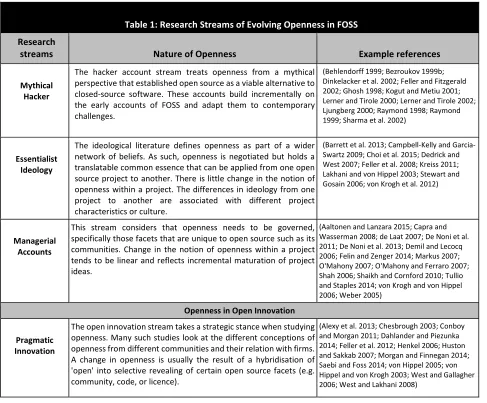
As a basis for our paper, we identify four streams that tackle the idea of openness in different
ways (see Table 1): mythical hacker accounts, essentialist ideology, managerial accounts, and pragmatic
innovation involving forms of co-production. Three of these belong specifically to FOSS, while the last
one discusses how openness has been understood within open innovation.
Mythical hacker accounts of openness form a unique stream in open source because they were
for the most part written by hackers themselves, and became the trigger for FOSS movements some
decades ago (Raymond, 1999; Stallman, 2009). They were vital in building our understanding of open
source development and methodologies in practice (Feller and Fitzgerald 2002). These initial accounts
were positioned as a stark comparison point to traditional software development where a project was
either open or not, but degrees of openness were not questioned (Kogut and Metiu 2001; Ljungberg
2000; von Hippel 2001). Other mythical hacker accounts of openness have also looked at the historical
evolution of the economics of FOSS (Ghosh 1998; Lerner and Tirole 2002), license changes (Edwards
5
Conlon 2007). A common theme throughout these accounts is the need to legitimise openness as a
viable form of software production and a competing alternative to closed-source software. As such, the
view taken on openness often gains a mythical status that echoes their early articulation that
socio-technological objects should be open. Hacker accounts have become a historical reference that gives
FOSS a way to evolve from its rich past and adapt to tackle contemporary issues such as access to
[image:6.595.66.553.184.587.2]infrastructure (Corsin-Jimenez, 2014).
Table 1: Research Streams of Evolving Openness in FOSS
Research
streams Nature of Openness Example references
Mythical Hacker
The hacker account stream treats openness from a mythical perspective that established open source as a viable alternative to closed-source software. These accounts build incrementally on the early accounts of FOSS and adapt them to contemporary challenges.
(Behlendorff 1999; Bezroukov 1999b; Dinkelacker et al. 2002; Feller and Fitzgerald 2002; Ghosh 1998; Kogut and Metiu 2001; Lerner and Tirole 2000; Lerner and Tirole 2002; Ljungberg 2000; Raymond 1998; Raymond 1999; Sharma et al. 2002)
Essentialist Ideology
The ideological literature defines openness as part of a wider network of beliefs. As such, openness is negotiated but holds a translatable common essence that can be applied from one open source project to another. There is little change in the notion of openness within a project. The differences in ideology from one project to another are associated with different project characteristics or culture.
(Barrett et al. 2013; Campbell-Kelly and Garcia-Swartz 2009; Choi et al. 2015; Dedrick and West 2007; Feller et al. 2008; Kreiss 2011; Lakhani and von Hippel 2003; Stewart and Gosain 2006; von Krogh et al. 2012)
Managerial Accounts
This stream considers that openness needs to be governed, specifically those facets that are unique to open source such as its communities. Change in the notion of openness within a project tends to be linear and reflects incremental maturation of project ideas.
(Aaltonen and Lanzara 2015; Capra and Wasserman 2008; de Laat 2007; De Noni et al. 2011; De Noni et al. 2013; Demil and Lecocq 2006; Felin and Zenger 2014; Markus 2007; O'Mahony 2007; O'Mahony and Ferraro 2007; Shah 2006; Shaikh and Cornford 2010; Tullio and Staples 2014; von Krogh and von Hippel 2006; Weber 2005)
Openness in Open Innovation
Pragmatic Innovation
The open innovation stream takes a strategic stance when studying openness. Many such studies look at the different conceptions of openness from different communities and their relation with firms. A change in openness is usually the result of a hybridisation of 'open' into selective revealing of certain open source facets (e.g. community, code, or licence).
(Alexy et al. 2013; Chesbrough 2003; Conboy and Morgan 2011; Dahlander and Piezunka 2014; Feller et al. 2012; Henkel 2006; Huston and Sakkab 2007; Morgan and Finnegan 2014; Saebi and Foss 2014; von Hippel 2005; von Hippel and von Krogh 2003; West and Gallagher 2006; West and Lakhani 2008)
Essentialist ideological accounts of openness move beyond a mythological view and instead
probe the essence of open source; in other words, what is it that makes open source 'open'? As such,
openness is viewed from the lens of an underlying belief system (Barrett et al., 2013), which can be
negotiated (Choi et al. 2015; Stewart and Gosain 2006). The level of detail provided on different aspects
of ideology like norms, beliefs, and values (Stewart and Gosain 2006) and their relationship to team
6
cognitive trust. In this stream, openness is part of a wider framework that gives it meaning (e.g. forking
is discouraged but not denied) (Stewart and Gosain, 2006). To find such 'essence', these studies tend to
look for openness and its’ meaning across a number of cases and derive categories of ideologies that
can be measured against different cultural and psychological user and developer characteristics
(Campbell-Kelly and Garcia-Swartz 2009; Choi et al. 2015, Dedrick and West 2007).
Managerial accounts examine openness to find better ways to build and govern communities.
Managing open source communities is becoming more crucial so research has addressed this issue by
looking to within community governance (O'Mahony and Ferraro 2007) but also to how value is created
between companies and communities through better governance (Morgan et al., 2013). A small but
growing body of work also questions just how much openness is needed to create an optimal governance
model for different forms of joint problem-solving domains (Dahlander and Gann 2010; Felin and
Zenger 2014). This stream tends to focus on communities, with a specific analysis of changes in
governance, and thus deals with the idea of openness only indirectly through authority structures and
their evolution (O'Mahony and Ferraro 2007). The evolution tends to be linear, often looking at the
incremental maturation of governance structures and the tensions that characterize such a change.
Openness in such instances is one amongst a number of issues rather than the only or key concern being
traced.
A large body of literature that speaks to the idea of openness comes from open innovation
studies (Chesbrough, 2003). Though not specifically open source the work in the area of open
innovation often draws on cases and examples that are FOSS related (von Hippel, 2005). Indeed, the
private-collective innovation model (von Hippel and von Krogh, 2003) theorizes the relationship
between open source (collective) work and that of (private) companies engaged with software
development and more generally with idea grab from beyond company employees. This specific angle
has seen a dramatic rise in interest over the last decade, and it is characterized by strongly pragmatic
ideas guiding open source adoption. Critical work in this area directly confronts the question of
openness (West 2003), however, it does so in relation to platform strategies of openness and the role of
heterogeneous communities (Majchrzak and Malhotra 2013). Discussion of openness moves beyond
hacker accounts of openness to firm-sponsored strategies to control, direct, or benefit from openness
(Dahlander and Magnusson, 2005, West and Lakhani 2008). Change in the notion of openness is usually
strategic in nature and emphasizes hybrid open/closed strategies often adopted by companies (Alexy et
al., 2013). The consequence of the hybridisation of openness is that open source development can be
done through selecting particular facets (e.g. code, community, licence) that hold shades of 'open'
depending on particular managerial needs (Shaikh, 2016). Concerns over the appropriability of returns
7
research questioning when disclosures should take place (Boudreau and Lakhani, 2015). As such, open
source is a particular take on wider issues tackled by the open innovation stream.
All four streams of literature examine openness in different ways. This scholarly body of work
has helped to establish open source, and open innovation as relevant research phenomena that have
clear bearing on other related phenomenon such as crowdsourcing, crowdfunding, open government,
open data and beyond. However, as noted above we have yet to establish strength of understanding in
how openness as a concept and idea evolves and matures over time within a project where outside
interaction is controlled (to a degree). Our study focuses on this idea through an in-depth revelatory
case study.
Methodology
To study the evolving interpretation of open source, we chose a revelatory case study—
openEHR—an example of the transformed understanding of open source projects (Fitzgerald et al.
2006) where there is an increased hybridization of licences, business models, and community. In health
care, the use of open source has only increased recently, because many providers and adopters prefer to
remain with proprietary models (Marsan and Paré, 2013). As a late-comer to the adoption of open
source, as well as the degree of separation that exists between the software world and clinicians, we
propose the study of openEHR as a revelatory case from which to theorise the interpretation and
articulation of ‘openness’.
Case Background
openEHR (open Electronic Health Records) is an open source project that aims to create
electronic health records, a key part of health IT systems (Dünnebeil et al. 2012) with interoperable
EHRs (Lezcano et al. 2011). The interoperability of EHRs is one of the most challenging goals in health
IT (Martínez Costa et al. 2011) featuring high on governmental agendas (Roy-Byrne et al. 2004;
Salzberg et al. 2012). openEHR’s solution is to create multi-dimensional ontological layers to
semantically describe clinical concepts (Wollersheim et al. 2009). These descriptions participate in the
technological organisation and diffusion of knowledge within health information systems (Nickerson
et al., 2012). Since they define and classify semantic knowledge, such systems can contribute to the
interoperable exchange of information by developing compatible model representations of information
as abstracted concepts, which can later be exchanged and interpreted by machines (Soguero-Ruiz et al.,
2013), even if the machines follow different standards (Berges et al., 2012). Following from increased
8
to complex queries (González-Beltrán et al., 2012), along the patient’s medical history (McMurray et
al., 2015), and become less susceptible to change (Wang et al., 2014). In other words, descriptions that
need to hold clinical meaning and are not fixed to terminological descriptions of pathologies, which is
especially important in the health domain where the changing interpretation of concepts is
commonplace (Mol 2002).
The way openEHR is able to create semantically-valid clinical concepts is by assembling layers
of blocks of information together. openEHR provides the building blocks to define a meaningful
concept such as ‘blood pressure’. An archetype is such an assembled block and is responsible for
maximising the expressiveness of the clinical concept (Atalag et al. 2011). An archetype is assembled
from elements belonging to a lower level of abstraction (called the reference layer) which defines, for
example, the systolic or diastolic measurements of arterial blood pressure alongside contextual data
(e.g. sitting down, laying with left-tilting). These values and data are themselves blocks of assembled
information that define the measurements they can provide to higher-level concepts (e.g. defining
pressure units in the range of 0.0 to 1000.0 mm[Hg]). It is hoped that this multi-layered approach will
allow EHR systems to be interoperable (Isern and Moreno 2016), where other approaches resulted in
mitigated results (Wollersheim et al. 2009). The blood pressure archetype is designed to represent a
coherent unit of observation that will, when put together with other archetypes, come to form a patient’s
medical history. The consultation of a pregnancy, for example, will lead to the observation and
recording of several other archetypes such as past pregnancies, vaccine, blood type, or fetal movements
(Pahl et al., 2015). These building blocks provide different scales of abstraction that ultimately form
concepts that map with world entities that would allow clinicians and health researchers to link
otherwise disparate knowledge bases (e.g. biology, pathology, genomics, clinical practice) to allow
global queries (González-Beltrán, 2012, Nickerson et al., 2015).
By and large, openEHR is a requirements project since it aims to map world entities into
machine specifications (Jackson and Zave, 1995). In addition to requirements and specifications,
however, openEHR also develops software that parses and validates the use and definition of its clinical
concepts. In this sense, openEHR bridges pure implementation software by 3rd parties by providing
open source implementable clinical concepts that are computationally-validated. The choices taken by
openEHR will thus influence other open source projects down the line (Christensen and Ellingsen,
2015). For the sake of simplicity, the term ‘clinical concept’ and ‘requirements’ will be used as a
replacement of the term archetype, an equivalence that health IT practitioners commonly make (Atalag,
2010; Pahl et al., 2015), when referring to artefacts that will define the purpose of the information
9
computer scientists alike (van Lamsweerde, 2000). Such an abstraction is valid since an archetype
represents the ideal and generalised embodiment of an abstracted clinical concept.
The openEHR Foundation was created as a non-profit in 1999 when the core members
entertained the idea of an organisation that would develop the notion of interoperable health IT systems,
a domain in which all the core members had already dedicated several years. Its principal goal would
be to create rigorous clinical concepts that they saw as the necessary condition for EHR interoperability.
The core members decided, early on, contrary to the landscape then-dominated by proprietary solutions,
to make the project open source. The direction of the project would be under the aegis of a Foundation
Board composed of core members whose objective would be to set the first organisational structures in
place. The first mailing lists, the announcement mailing list (AML), the clinical mailing list (CML), and
the technical mailing list (TML) went online in 2002, on servers provided by University College
London, the Foundation’s parent organisation. The following years, and in line with its primordial goal
of creating rigorous clinical concepts, the Foundation worked towards the creation of formal processes
of definition and review under the control of two other boards. These would guarantee the quality and
the soundness of clinical concepts, and thus legitimise them.
We argue that openEHR is a revelatory case (Yin, 2003), the study of which presents novel
aspects regarding the development of open source projects. First, in contrast to many open source
projects that tend to fail after their first iteration (Schweik and English 2012), openEHR is successful.
It is currently being implemented by Australia and Brazil (at the federal level across the country), and
holds close ties to the NHS in the UK, as well as grassroots movements worldwide (e.g. the NHS
hackday). Second, the project is also extremely formal with a great emphasis on rules, planning and
hierarchy in its approach to development, resembling characteristics seen in literature (Fitzgerald,
1999). Third, openEHR also crosses the domains of health care and software development, which
creates a novel mix of clinicians with software engineers – two widely heterogeneous groups with
different agendas. Fourth, the project’s core is not a software system, but an open source specification
using a custom open source language and its interpreter. The clinical concepts described in the custom
language form the kernel around which possible implementations may create different, albeit
interoperable, interpretations. Implementations exist in Eiffel, .NET, Java, Ruby, and Python. In this
sense, more than anything else, openEHR is a requirements project first, and a software project second.
Data Collection and Analysis
In this section we describe the very iterative process of data collection with data analysis that
we undertook. Data collection started as an exploration into the use of requirements in open source
10
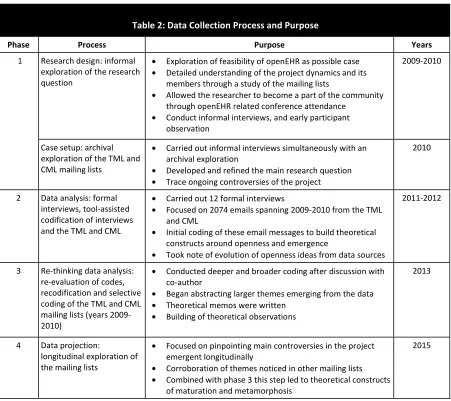
formality has come to exist did not seem settled. The data collection process happened along four phases
(see Table 2), which reflects the iterative nature of the data collection process (Eisenhardt, 1989). The
four phases were: (1) informal exploration of the research question through conferences attendance and
informal interviews; (2) exploration and initial coding of the mailing lists (2009-2010) and formal
interviews; (3) selective coding of the mailing lists (2009-2010); and (4) longitudinal exploration of the
mailing lists (2002-2015).
Phase 1: Starting in 2009, the first phase of the research was used to confirm openEHR as a
promising study with which to analyse ideas of openness, given the institutional backdrop that requires
health IS to offer guarantees on safety. After the exchange of a few emails with a top-member of the
project that showed interest in our study, a meeting was set up in 2010 in which an interview protocol
was presented to him explaining the kind of data we required. The researchers followed a snowball
approach and asked to be put in contact with key project members. Additionally, the researchers were
granted a full disclosure of internal documents and the liberty to contact anyone to carry out interviews
(including invitations to attend internal meetings); opportunities that were pursued as often as possible.
Phase 2: This phase consisted of formalising the interview guide. Questions were drafted and
key members of the project were interviewed (see Table 3), some through snowballing, while others
were contacted directly by us. At the same time, a first-attempt at tool-supported codification took place
of two of the mailing lists, CML and TML, covering the years 2009 and 2010, and we conducted
semi-structured interviews. Systematic coding was carried out using grounded theory methods (Charmaz
2006; Urquhart 2012) (more details below). This specific coding was limited to the years 2009—2010
of both the TML and CML (2074 emails). These two mailing lists are openEHR’s main working
platform where people ask questions, coordinate, discuss project progress, argue for change, call on the
board for specific queries, etc. The TML is specific to the technical organisation of the project and how
clinical concepts should be described (e.g. the processes of development) are discussed.
The CML deals with the more clinically-oriented aspects of clinical concepts, such as invitation
for review rounds. In both these lists, core, active, and potential new members participate, but a vast
majority of the emails written come from core and active participants. Both core and active participants
may be individuals, or part of an organisation (e.g. Linköping University). While core members have a
formal relation to the openEHR Foundation, they may not necessarily be active in the mailing lists.
Active members have no formal ties, but are recurrent participants to the discussions throughout the
years so that they may be considered to have achieved a certain status, evident in the way they guide
newcomers who are in need of help. The participants are generally highly educated (e.g. software
engineers, doctors, PhDs, researchers). It is also possible for core people to become active members and
11
various participation rights to the boards. Mailing lists however remain open to all. The data collected
from these two mailing lists is precise, argumentative (especially after 2009), and open. This phase drew
upon the themes that arose during codification. During this phase all the key project members and the
community at large were formally introduced to the first author through the community news website.
Twelve interviews were carried out (2010-2011). Of these, 9 were semi-structured and 3
unstructured, with 7 unique participants (active, core, or both). The 9 semi-structured interviews were
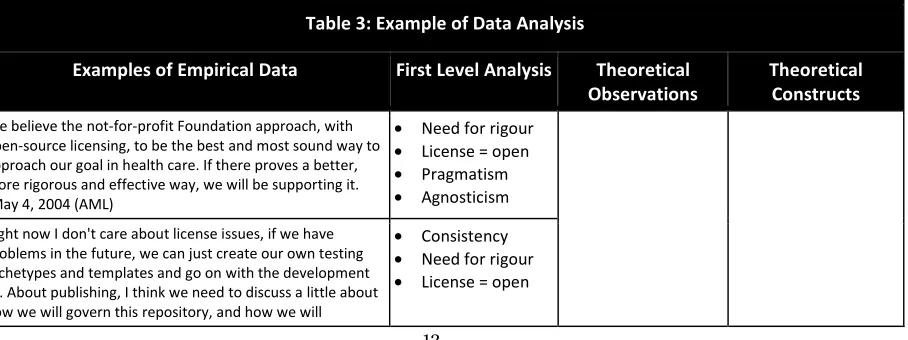
coded systematically (see Table 3 for an illustrative example of coded data) and provided a reflective
exposition of the members’ understanding of the notion of open source.
[image:12.595.74.525.239.640.2]
Table 2: Data Collection Process and Purpose
Phase Process Purpose Years
1 Research design: informal
exploration of the research question
• Exploration of feasibility of openEHR as possible case
• Detailed understanding of the project dynamics and its members through a study of the mailing lists
• Allowed the researcher to become a part of the community through openEHR related conference attendance
• Conduct informal interviews, and early participant observation
2009-2010
Case setup: archival exploration of the TML and CML mailing lists
• Carried out informal interviews simultaneously with an archival exploration
• Developed and refined the main research question
• Trace ongoing controversies of the project
2010
2 Data analysis: formal
interviews, tool-assisted codification of interviews and the TML and CML
• Carried out 12 formal interviews
• Focused on 2074 emails spanning 2009-2010 from the TML and CML
• Initial coding of these email messages to build theoretical constructs around openness and emergence
• Took note of evolution of openness ideas from data sources
2011-2012
3 Re-thinking data analysis:
re-evaluation of codes, recodification and selective coding of the TML and CML mailing lists (years 2009-2010)
• Conducted deeper and broader coding after discussion with co-author
• Began abstracting larger themes emerging from the data
• Theoretical memos were written
• Building of theoretical observations
2013
4 Data projection:
longitudinal exploration of the mailing lists
• Focused on pinpointing main controversies in the project emergent longitudinally
• Corroboration of themes noticed in other mailing lists
• Combined with phase 3 this step led to theoretical constructs of maturation and metamorphosis
2015
Phase 3: The themes that arose during the coding were discussed between the researchers. This
process led to the emergence of agreed theoretical constructs that took into account unsettled
12
It is also at this point that a decision was taken by the researchers to primarily focus on analysing the
years 2009 and 2010. Two reasons motivated this choice: first, theoretical saturation and a desire to see
any overlap/difference between the interviews and our analysis of the mailing lists. Second, the project
members corroborated that these years represented a crucial period of change for the project, and thus,
of controversies (Latour, 2005). Such triangulation of data strengthened our confidence (Yin, 2003).
Phase 4: In this phase we looked for additional data around particularly controversial
phenomena. The programme used to parse every email and catalogue the 15 most controversial threads
per year provided a holistic view of the increase of controversies and their subjects. The customised
programme was coded by the first author to parse all the emails 2002-2015. This allowed us to have an
overarching view of the TML and the main controversies that took place. The programme counted the
number of emails per year, listed the 15 most controversial threads (by parsing and counting the subject
of each email), and for every controversial thread, to output the number of exchanged emails (see
appendix Tables 4 and 5). This gave us a quick feel of the position that open source took within the
project and its evolution over time. Used in conjunction with the holistic search, we could compare the
threads that discussed open source and ‘openness’ with the list of controversial threads to gain an
overview of the evolving interpretation of open source. A controversy for this research was defined as
any thread of conversation that created a sharp and large flurry of replies with regard to organizational
and development issues.
A more holistic reading of the Announcements Mailing List (AML) (193 emails), for the period
2002-2015 was also carried out. These emails provided insights regarding the objectives and thoughts
of the official, core members of the project, as well as contextual information (e.g. the launch of review
boards). Some of the announcements represented turning points for the project and were reflective in
nature (e.g. re-focus of the Foundation Boards’ attention to the community). We specifically looked if
they were corroborated by the TML and CML, and whether their perspective on ‘openness’ was shared
[image:13.595.82.536.547.717.2]by other members.
Table 3: Example of Data Analysis
Examples of Empirical Data First Level Analysis Theoretical Observations
Theoretical Constructs
We believe the not-for-profit Foundation approach, with open-source licensing, to be the best and most sound way to approach our goal in health care. If there proves a better, more rigorous and effective way, we will be supporting it. (May 4, 2004 (AML)
• Need for rigour
• License = open
• Pragmatism
• Agnosticism
Right now I don't care about license issues, if we have problems in the future, we can just create our own testing archetypes and templates and go on with the development :D. About publishing, I think we need to discuss a little about how we will govern this repository, and how we will
• Consistency
• Need for rigour
13 converge to a common and consistent set of artifacts for
testing. •
Primordial concerns
• Pragmatism
• Agnosticism
•Openness and pragmatism
•Openness and rigour
•Open license
•Establishing core ideas
Maturation of primordial concerns The licencing that I think will occur will be as follows: ADL
language definition document [the language to define clinical concepts] + language production rules (a bit more precisely produced than the ones I have included in this package) -copyright to openEHR. The conditions of use are included below (and are very open as you can see). This copyright description was developed by the legal group of University College London; hopefully it is acceptable to all prospective users. (September 26, 2003 (TML)
• License = open
• Primordial concerns
• Pragmatism
Do you mean that your main worry is that you are afraid that somebody will take CC-BY-licensed archetypes from the openEHR-hosted repository, modify them a bit, and then redistribute under a less free license and start charging for it? Or do you have any other concerns that you can clarify? Won't your feared modified redistribution only be a problem to interoperability if, all the following comes true:
a) If users will really consider the "commercial" versions to be a lot better than the openEHR-hosted versions and are willing to pay for something they used to get for free. b) If the adaptations, if found useful by openEHR, are of such innovation height that the modifying company can claim copyright/patent on the changes and somehow block openEHR from incorporating similar features in their revised archetype versions. (October 13, 2009 (TML)
• License = open
• Primordial concerns
• Consistency
• Need for rigour
• Pragmatism
• Questioning and
engaging with open
Let’s say there are ten emergency departments in ten different countries, and they all want to use [clinical concepts], are you going to say that they can’t make changes until the international organisation say they can make changes? That’s not going to work, so you’re going to have to allow some peer to peer sharing of good quality [clinical concepts]. (December 2009 (interview)
• License = open
• Consistency
• Pragmatism
• Need for
stabilization
• Local and global
• Questioning and
engaging with open
•Openness versus pragmatism
•Open process
•Local stabilization for global reach
Metamorphosis of openness through implementation [W]e must support and encourage regional OpenEHR
communities, specs translation, and "open source multilingual up-to-date tools" (most tools available are: or not multilingual or the translations are horrible, or not open source, or not updated recently).I think regional communities can create courses, resources, materials, etc... and share them with other communities, through OpenEHR foundation. Guidelines to do this must be set from the OpenEHR Foundation Boards (I think they are there to lead the community, to encourage the spread and adoption of the standard, I can't remember the last time I saw an email of the OpenEHR Boards in the mailing lists). (November 4, 2010 (TML)
• Open source
software = open
• Consistency
• Need for
stabilization
• Local and global
Premature artefact repository CKM [Clinical Knowledge Manager, the openEHR repository for clinical concepts] provides us well-considered archetypes and templates. This is a great knowledge resource for mankind. However, to incubate archetype [a clinical concept] as a common concept takes long time like vintage wine. (September 7, 2011 /TML)
• Open source
software = open
• Consistency
• Need for
stabilization
14 The Foundation wishes to acknowledge that the future
success of/open/EHR now clearly lies in the hands on the /open/EHR community itself. The Foundation is therefore seeking support for an international meeting to define and establish a new way of working. The meeting will discuss ideas about how to progress the work of /open/EHR and ensure that more people benefit from it. We would like to invite initial discussions on organising this meeting on the /open/EHR lists, which Sam Heard will moderate. [...] 1. The potential for a new Consortium that owns and provides suitable governance for the oversight, IP and other assets of the Foundation -- this might comprise professional organisations, universities and industry; [...]
3. A collaborative 'refresh' and focussing of the aims and ambitions of the /open/EHR community; [...]
6. Alignment of the efforts of academia and industry around production of open source software tooling to support greater international collaboration and increased uptake of /open/EHR; […]. (December 21, 2010 (AML)
• Emerging
concerns of outreach
•Openness through increased participation
•Openness through implementation
Analysis across the email messages and interviews was carried out over various periods of data
collection. At every stage of coding both authors made it a point to work together and on certain key
occasions and controversies in the data set both authors coded separately and in parallel. The aim was
to share notes and test the strength of conceptual development (Miles and Huberman, 1994). Subsequent
meetings between the authors happened when the first author had also begun to notice certain patterns
and relationships between the codes and themes (Urquhart, 2012). The authors met for a full day of
joint coding and discussion to tease out the very intriguing ideas of openness, and its fluctuation over
the project. What was noticeable at this point was our different yet equally valid interpretation of
openness. Whereas the first researcher highlighted the conceptual building of rigour and the small
accretions of change in openness, the second researcher could not ignore the more mutative leaps in
openness that were evident on the implementation side. This led us to build our analysis around the
evidence of two processes where we traced through association the ideas of openness that bound both
processes together. These ideas of openness were written up as detailed memos (Glaser and Strauss,
1967) and became our theoretical observations (see Table 3).
Findings: Openness and its Concretisation
openEHR, as an open source project, began with an abstract understanding of ‘openness’ and
development of its meaning remained, for a long time, a background concern. There was little mention
of open source or openness at the start of the project. In fact, in the technical mailing list (TML), between
2002 and 2009, the threads which discuss open source are few: however, in only two years the issue of
open source in threads was above the average for the period of data collection (2002-2015). In addition,
15
from 2009. From 2009 onwards, we interpret a change in open source as a discussion topic to something
that grows in controversy. The consequence of the detailed (and increasingly controversial) meaning of
open source is that it begins to become a driver of change within the project. There are four particular
themes that are representative of the evolving trend. First, the project consistently considers primordial
goals (e.g. rigour of clinical concepts) to be paramount where rigour is conflated with openness. These
goals may evolve and change slowly over time into maturity but they are of persistent relevance in
openEHR. Second, till around 2009 ‘openness’ is considered unproblematic because the project’s
perspective is that openness is something that relates to a choice of license. Third, the metamorphosis
of the understanding of ‘openness’ is increasingly fractured and creates new project dynamics, such as
growing project participation by encouraging local actors to contribute (this is particularly important
for some core and active members). Fourth, coinciding with a push for more ‘open’ participation, the
absence of an external actor that would help scale the project sets it off into a reflection on the
importance of the community and its role.
Primordial goals do not explicitly include openness: openEHR is not only an open source project.
First and foremost, its goal is to create rigorous clinical descriptions to allow for health systems to be
interoperable. This partly explains why initially a clear idea of openness is not used or defined in the
project, and instead developers are more attentive to establishing primordial aims where the latter almost
reflect a modicum of agnosticism towards any ideological leanings. On the rare occasions that
‘openness’ is discussed, it is in the context of their primordial goals. This suggests that open source is,
instead of an ideological way of life, a ‘tool’ that is used to achieve rigour, and not as a way to
understand the realities of health IT or de-centralised collaboration. A Foundation Board member, for
example, writes in May 2004 on the announcement list that open source licences are only one way to
enable openEHR’s goals in health care and help provide (perhaps non-exclusively to other means) a
rigorous way to achieve them:
We believe the not-for-profit Foundation approach, with open-source licensing, to be the best and most sound way to approach our goal in health care. If there proves a better, more rigorous and effective way, we will be supporting it.
This message is representative of the discussions on the meaning of open source and the greater
importance that other goals have throughout the life-time of the project. The TML repeatedly ties
‘openness’ to rigour, even when traditional concepts of open source are discussed in detail in the later
years. The persistent and on-going maturation of such ideas means that they constantly appear and
16
in 2012, for example, brushes off the minute description of possible licence choice, superimposing the
idea of consistency and rigour in the development of clinical concepts:
Right now I don't care about license issues, if we have problems in the future, we can just create our own testing archetypes and templates and go on with the development :D. About publishing, I think we need to discuss a little about how we will govern this repository, and how we will converge to a common and consistent set of artifacts for testing.
The interviews conducted confirm this representation of ‘openness’ in the service of other goals. The
interviews explained in more detail that openness was not irrelevant to them, but was just not as central
as ideas of rigour. However when these developers were asked to explain rigour their description
included words such as ‘consistent’, ‘clear’, ‘scientific’ but when pressed to explain how this could be
achieved they would often return to principles of openness. What was emerging was a conflation of
rigour with openness where newly formed interpretations of openness were put in relation to the
matured primordial goals.
Openness is equivalent to an open license: In the first years of the project, open source seems to
be understood as a simple fact that does not hold much complexity. When, for example, a question of
open source does emerge the developers black box the issue by pointing to the chosen license. The
mailing list provides clear examples of core members discussing ‘openness’ as a matter-of-fact that
does not need unpacking. There is a cavalier presentation of the project’s licence by a core member
which suggests that discussion is not even needed (i.e. “will occur... will be as follows... very open as
you can see”) where open source seems to be understood as a tool, thus it could not have complex
interpretations. There is an evident change in early 2009 when a flurry of threads began to hotly debate
the various licence choices and insisted that the Board offer an opinion on this matter. Openness can no
longer be taken for granted and must be discussed. Active members of the project initiated a debate
where openness began to take new shape. The “ board of directors” were to weigh options between the
specific licences of CC-BY and CC-BY-SA and to consider the impact of each to the community and
potential users, especially with regard to the worry shared among core members of a hi-jacking of their
prized, rigorous clinical concepts should they be promiscuously ‘open’:
Do you mean that your main worry is that you are afraid that somebody will take CC-BY-licensed archetypes from the openEHR-hosted repository, modify them a bit, and then redistribute under a less free license and start charging for it? Or do you have any other concerns that you can clarify? Won't your feared modified redistribution only be a problem to interoperability if, all the following comes true:
17
b) If the adaptations, if found useful by openEHR, are of such innovation height that the modifying company can claim copyright/patent on the changes and somehow block openEHR from incorporating similar features in their revised archetype versions.
License discussions 2009 onwards span all the key mailing lists such as the TML, CML, AML, but also
the wiki itself, with evidence of further discussion conducted over private channels, repeatedly
summarising arguments made, outcomes of formal enquiries conducted by experienced lawyers,
recounting personal experiences, and analysing differences with other actors. At the moment of writing,
this discussion still arouses much interest from the community and core members alike in the TML.
This increased questioning of open source suggests that it has grown in importance to become detailed
and discussed, even if it remains as a support to the project’s primordial goals.
New and complex interpretations of ‘openness’ create novel project dynamics: The growing
treatment of ‘openness’ as a complex notion pushes participants to give more attention to new and
emerging dynamics, particularly a wider participation and the use of local movements to advance
openEHR further. Something larger than openEHR is taking place here and is pushing the project into
a more radical form of mutation – a metamorphosis of sorts. This push for a greater participant uptake
is made approximately at the same time that the meaning of open source started gathering more scrutiny
and interest by core and active members alike (2009 onwards). This put the evolving interpretation of
open source in potential conflict with the primordial goals of rigour and discipline. One of the core
members interviewed in 2010 problematized the situation in the following way:
Let’s say there are ten emergency departments in ten different countries, and they all want to use [clinical concepts], are you going to say that they can’t make changes until the international organisation say they can make changes? That’s not going to work, so you’re going to have to allow some peer to peer sharing of good quality [clinical concepts].
The wording is particularly interesting: “allow some peer to peer sharing” shows the tight grip
and importance given to primordial goals and yet some slack is essential and even inevitable. The
consequences of the potential conflict with rigour is visible here; if the matured ideas of rigorous clinical
statements are fully engaged (e.g. complete central control of clinical statements), without
accommodating some openness then the project as a whole could be at risk. At the same time, the core
member uses an imperative “have to allow”, otherwise the project will not work. This palpable tension
summarises the predicament of the project that sees the intricacies of the meaning of open source and
‘openness’ become more complex, while at the same time, make the new meaning of open source
accommodate the project’s primordial goals that it has developed so carefully. The need to interrogate
18
world development and implementation of software built upon the primordial goals, indeed an
implementation that is beginning to give real shape to openEHR but also its fault lines.
Understandably, development and implementation needs created an imperative to encourage
participation in the project. In November 2010 a thread called ‘Why is openEHR adoption so slow?’
initiated by a recurrent contributor asks the community and the board to take a pro-active role in the
creation of local communities. This question follows from an increasing concern to attract peer
participation and encourage local community engagement. It coincides with increasing prospects of
implementation in hospitals and governments (these are local environments in relation to the
international core of the project which, itself, is not situated concretely). This active contributor
discusses open source in terms of local, grounded needs:
[W]e must support and encourage regional OpenEHR communities, specs translation, and "open source multilingual up-to-date tools" (most tools available are: or not multilingual or the translations are horrible, or not open source, or not updated recently). I think regional communities can create courses, resources, materials, etc... and share them with other communities, through OpenEHR foundation.
In this sense, discussions around the concrete meaning of open source (e.g. ‘openness’ means
increased local participation) become a driver to further the development of the project, which in turn
drives changes in the organizing of the project. New, and bolder interpretations of open source and
‘openness’ can be seen to emerge. One such interpretation even proposes a new type of clinical concept,
an ‘alpha’ that may not hold as much rigour as the published, official ones. These would be developed
in a different space from the rigorous, disciplined clinical concepts. The spatial separation indicates
how the project articulates the metamorphic interpretation of openness stimulated by increased
participation in a way that simultaneously fits with or even feeds the maturing goal of rigour. In 2011
talk of “incubators” of clinical concepts begin to appear. These incubators provide an entry level for
quick Wikipedia-style drafts of clinical concepts where reviewers would give less stringent scrutiny.
The hope is that a more accessible platform would allow participants with less modelling skills to write
a ‘stub’ that could later be written in more detail.
The idea of an incubator is suggestive of a concept closely aligned with ‘open source-time’,
‘opened to collaborations’ and “light” governance models. openEHR was now more than a rigorous
concept, it had been converted into a concrete and tangible object for the members of openEHR to play
with where ‘openness’ was questioned, interpreted and re-interpreted until solidified into code.
19
Realization that openness must develop further with external support: A year after
acknowledging the importance of openness in openEHR a possible partnership deal with a relevant
player in the field of health systems fell through1. openEHR needed this player’s support because the
latter was a large established actor in the health systems world and could help scale openEHR quickly.
As a consequence, the board, via the AML, announced an important shift in direction. It was established
that the community needed to re-focus its efforts on building strength and numbers to ensure its future:
The Foundation wishes to acknowledge that the future success of/open/EHR now clearly lies in the hands of the /open/EHR community itself. The Foundation is therefore seeking support for an international meeting to define and establish a new way of working. The meeting will discuss ideas about how to progress the work of /open/EHR and ensure that more people benefit from it.
From then on, and in conjunction with the increasingly intricate interpretation of ‘openness’ (e.g. the
creation of local communities), a more complex understanding of the role of the community and its
relation to the project began to take shape. A plethora of emails in the TML and AML in the following
years (notably in 2012 and 2014) discuss the meaning of an ‘open’ community and the variety of
members needed to build a more stable shared understanding of openness. The community morphed
from a homogeneous body into a complex tangle of “professional organisations, universities, and
industry”, where each had their own needs and views about IP and other Foundation assets. A
“collaborative refresh” is called for where the entire community needs to participate in order to
re-evaluate the direction of the Foundation. Efforts and goals of academia and industry must somehow
become aligned around the use of open source tooling to attract yet more participation and better
implementation of the project. Openness is now understood more as an openness of the entire process.
The change of focus from the absence of an external partner reinforces the need to rethink ideas
of openness and make openEHR more flexible to mitigate differences within and across the community.
Different voting rights were now offered depending on the financial capability of each member. A
fee-paying individual (15€) could be a member of programme committees (responsible for various aspects
of the construction of clinical concepts) and vote in them, while other types of member could not. An
industry partner with a fee based on annual gross revenue has the ability to participate in the elaboration
of certification criteria. Nonetheless, all of openEHR’s IP remain accessible under a variety of open
source licences, and anybody is free to participate in the community’s collaboration tools. The meaning
of open source has been given a complex, but concrete interpretation regarding various levels of
participation and the rights and duties that these necessitate.
20
Emergence of Openness: The Intertwined Nature of Metamorphosis and
Maturation
These findings offer two clear explanations of the intertwined evolution of the meaning of open
source. On the one hand, a mutational process can be identified – the metamorphosis of openness; and
on the other hand the data shows a more deliberate and gradual refinement of the qualities of clinical
concepts – the maturation of primordial concerns.
Maturation of Primordial Concerns
Maturation is a process that involves small changes that are similar in nature and accrue slowly
to create a stabilising form. This idea of maturation signifies the existence of a stable ‘deep-structure’
(Barrett et al. 2013) that changes slowly over time. This type of change is strikingly different to
metamorphic evolution that alters the original form to an unrecognisable degree. Maturation, instead,
invites change that seemingly improves or refines the original form, and does not transform the meaning
intrinsic to that form. In openEHR, maturation takes place throughout the life-time of the project, but is
particularly evident in the formative period because it triggers metamorphic evolution in the
interpretation of ‘openness’. During the formative period maturation reflects a focus on ideas such as
clarity in aims and need for rigour and discipline. The elaboration of these concerns is almost at the
expense of developing a deeper understanding of openness of open source and the various consequences
that different interpretations of openness can have. The refinement of the ideas of rigour in the project
is supported by the serial creation of formal review boards to ensure the consistency of clinical concept
designs, while the meaning of open source held in a generic and abstract form and not allowed to
percolate within the community at large. The findings suggest that the project is somewhat wary of the
unknown capacity of open source and how it may conflict with its primordial, purpose-giving goals
(von Krogh et al. 2012).
As such, the refinement of the meaning of ‘rigour’ over time builds a ‘deep-structure’ that helps
to frame the debate according to demanding interpretations, including early attempts to understand open
source. The primacy of other goals and their maturation might have been motivated (consciously or
otherwise) by an essential desire: the framing of a ‘deep structure’ that could either reign-in the excesses
of possible interpretations of open source and ‘openness’, or mould them into participating with the
primordial goal of rigorous description of clinical concepts. In this sense, openness is interpreted as an
‘invited guest’ (Ciborra 1999) which has to accommodate itself within the rules of the host’s house,
even if these are in flux. The meaning of open source and how ‘openness’ should be interpreted are thus
21
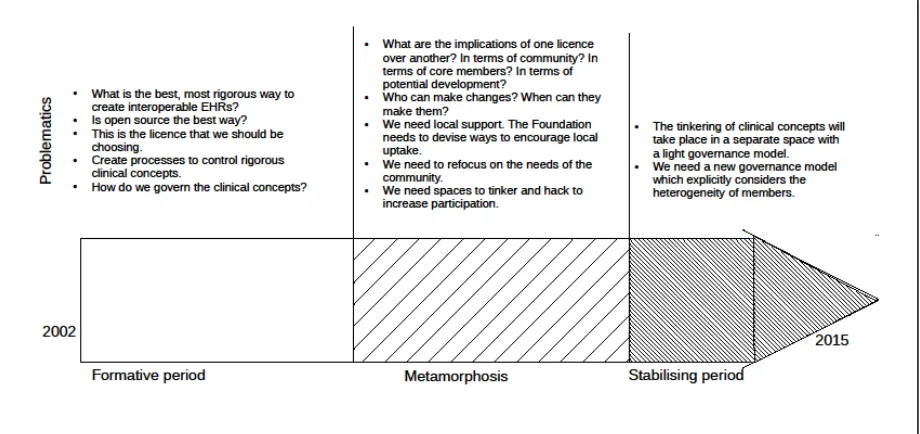
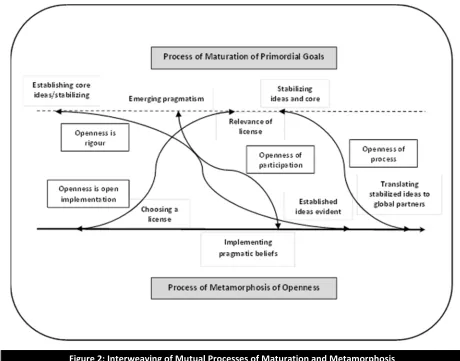
Figure 1: The Process of Metamorphosis seen alongside Key Controversies
Our analysis of the mailing lists provides evidence that openness was discussed at various
stages with varying degrees of emphasis thus defying a linear explanation. The size of the controversies
in which open source is involved, although part of an overall increase, do actually wax and wane over
the years of the project (2012 and 2014 in particular). The qualitative analysis of discussions shows that
the project frequently looks backwards and re-interprets it’s understanding (Venters et al. 2014) and the
decisions it has taken. For example, the issue of licence is constantly discussed and its role relative to
how it supports or deters openEHR to be a ‘true’ open source project. Another example is the curious
questioning of the project’s confidence or detachment from the various local communities that emerged
when openEHR considered partnerships to become an international body. The desire to internationalise
sprung a move to localise and revise its internal governance. In this sense, it is unfair to qualify the
movements as linear because they eschew much of the difficulty; the going forwards and backwards
that the project and its participants underwent when significant changes took place, even though a broad
direction may be largely visible.
Metamorphosis of Openness
The metamorphic process frames the project’s turn from the formative to the problematizing period.
We understand the metamorphosis to be broadly three phases of mutation (which is still on-going), the
agnostic pragmatic phase, the engaging with openness phase, and lastly, the stabilizing openness phase.
Each phase is indicative of a sharp mutation triggered by internal and external controversies (see Figure
22
Agnostic pragmatism dominates the formative time period of 2002-early 2009. What is evident
here is how certain organizations that adopt open source ideas do so with little thought or perhaps even
patience for openness, ideology, or any rulebook. The aim for openEHR was simply to get the project
afloat and create something useful together and open source was an uncomplicated way of doing it. The
license was not seen as problematic, made explicit or discussed in detail. In some places contradictory
information on the coverage of IP was evident. However, 2009 saw a sharp change as openEHR became
an increasingly visible project and gained traction. Open source became an explicitly problematic force
put in relation with governance, IP, process, technical contributions and objectives (implementations,
requirements, connection to local realities, and primordial goals). It was not gradual and it created a
very different sense within the project – and yet it remained the same functionally. The project had the
same goals but the metamorphosis of openness gave it potential to explore and achieve those goals.
Openness was suddenly thrust into centre stage and the community was forced to engage with it because
ignoring it jeopardized the existence of the project.
This fundamental moment of metamorphosis where mutation became blindingly evident and
vital was the engaged openness phase. First, an essential mutation took place which was visible (a
morphology of form), for example, the interpretation of open source became a key driver for the
community and its heterogeneity became an explicit and constituted body. This newly constituted body
held a new potential and a varied capacity of action: different members had specific voting rights; new
spaces were created for the tinkering of ‘alpha’ versions of clinical concepts; various open source
licences were studied repeatedly and their consequences for the project and participants were evaluated.
That the two forms, the early and the problematizing one, hold little resemblance does not imply
discontinuity: just as the butterfly is the continuation of the larva, openEHR still cares deeply of its
primary goal of defining rigorous clinical concepts2. So it is with openEHR, only that the new evolution
of the interpretation of ‘open source’ and what it means in terms of ‘openness’ has made the project
aware of novel possibilities around the expressions of concrete articulation of openness.
Stabilizing openness involved the late 2009-2015 time period when what was meant by open,
what needed to be open, and how open openEHR intended to be was made concrete in relation to its
primordial goals and how they matured through actual code implementation. In other words the
metamorphosis was being explored and accommodated within the project’s main goals, and evaluated
through different implementations. Rules had to be structured as did those who would enforce them,
what sanctions would be involved, and most importantly, how would different engagement partners
2 Similarly to Kafka’s novel, The Metamorphosis, the son and sibling remains kin to the family members despite