FORMULATION OF A SECURE COMMUNICATION PROTOCOL AND ITS
IMPLEMENTATION
M. Ranjith Kumar
Department of Mathematics, Jeppiaar Institute of Technology, Sriperumbudur, Chennai – 631 604.
---***---Abstract -
The main objective of this paper is to develop a
two-party mutual authentication protocol providing secure communications, focusing on those using a symmetric techniques. In this paper a cryptosystem with authentication and data integrity, using the Goldbach conjecture and the decimal expansion of an irrational number is obtained.
Key Words: Hill cipher, RSA algorithm, Pseudo inverse of a rectangular matrix, Goldbach conjecture and Chen’s theorem.
1.
INTRODUCTION
In our information age, the need for protecting information is more pronounced than ever. Secure communication for the sensitive information is not only compelling for military of government sectors but also for the business and private individuals. As the world becomes more connected, the dependency on electronic services has become more pronounced. In order to protect valuable data in communication systems from unauthorized disclosure ad modification, reliable non-interceptable means for data storage and transmission must be adopted.
In a communications[14], an intruder can see all the exchanged messages, can delete, alter, inject and redirect messages, can initiate the communications with another party, and can re-use messages from past communications. Hence the two communicating parties, exchanging a number of messages at the end of which they have assurances of each other’s identities. In an authenticated key exchange, there is the additional goal that the two parties end up sharing a common key known only to them. This secret key can then be used for some time thereafter to provide privacy, data integrity or both.
We demonstrate in this paper how the above capabilities are incorporated in the communication system developed here using an idea proposed in [22]. However, some of the techniques that we use are quite different from the usual ones and make use of Goldbach conjecture [3, 4, 17] and new variants of RSA problem [15]. This resulting system provide relatively small block size, high speed and high security. Mainly, this paper surveys the development of symmetric key cryptosystem form their inception to present day implementations. Readers familiar with Hill Cipher, Pseudo inverse of a rectangular matrix, RSA algorithm and Goldbach conjecture may directly go to section seven for the working of our algorithm. Finally, the paper is finished of a
small illustration, security analysis and the conclusion of the proposed system.
2.
HILL n-CIPHER
Hill cipher was first introduced by Lester S. Hill in 1929 in the journal The American Mathematical Monthly [5, 8]. Hill cipher is the first polygraphic cipher. A polygraphic cipher is a cipher where the plaintext is divided into blocks of adjacent letters of the same fixed length n, and then each such block is transformed into a different block of n-letters. This polygraphic feature increased the speed and the efficiency of the Hill cipher. Besides, it has some other advantages in data encryption such as its resistance to frequency analysis. The core of Hill cipher is matrix multiplication. It is a linear algebraic equation
mod
C
KP
N
, whereC
represent the ciphertext block,P
represent the plaintext block,K
is the key matrix andN
is the number of alphabets used. The keyK
is an n
matrix and what is needed for decryption, is the inverse key matrix 1K
.3.
Digital Signature
A digital signature is an electronic signature that can be used to authenticate the identity of the sender or the signer of a document, and to ensure the original content of the message or document that has been sent are unchanged [9]. The digital signature provides the following three features:
3.1 Authentication
Digital signatures are used to authenticate the source of messages. The ownership of a digital signature key is bound to a specific user and thus a valid signature shows that the message was sent by that user.
3.2 Integrity
In many cases, the sender and the receiver of a message need assurance that the message has not been altered during transmission. Digital signatures provide this feature by using cryptographic message digest functions.
3.3 Non-Repudiation
4.
RSA ALGORITHM
RSA is a public key algorithm which generates two keys and allow data encrypted with one of them to be decrypted with the other. It was created by Ron Rivest, Adi Shamir and Leonard Adleman [15], hence the name RSA. The algorithm is based on the difficulty of factoring large numbers. Public and private keys are functions of a pair of large prime numbers. To generate the two keys
i. Choose two random large primes p and q. ii. Generate the modulus n=p.q
iii. Choose a random encryption key, e such that e and
n
p
1
q
1
are relatively primes. iv. To compute the decryption key d such that
1 mod
e d
n
. v. Discard p and q.To encrypt a message, divide it into numerical blocks smaller than n, encryption of each chunk Mi is:
mod
e
i i
C
M
n
. Decrypting a chunk requires performing the same operation using the key d:M
i
C
id
mod
n
.5.
THE GOLDBACH CONJECTURE
In a letter to Euler dated 7 June of 1742, Goldbach stated the following conjectures [12]:
“If N is an integer such that N p1p2 , with p1 and p2
are primes, then for every
2
k
N
,1 2 k
Np p p with p1, p2, ,pk are primes.”
We have to keep in mind that in Goldbach’s time the number 1 was considered to be a prime, in contrast with the modern definition. In the margin of the same letter, Goldbach stated another conjecture,
“If N is an integer greater than 2, then Np1p2p3, with p1, p2 and p3 are primes.”
In this reply letter, dated 30 June of the same year, Euler wrote a third conjecture which is ascribed to Goldbach.
“If N is a positive even integer, then N p1p2with p1
and p2 are primes.”
Today, these three conjecture are known to be equivalent, while the modern version of the third conjecture is the famous Goldbach conjecture [12].
Although Goldbach conjecture is still an open conjecture to show that all even numbers are expressible as a sum of two primes, the case for odd numbers is easier.
5.1 Chen’s theorem
In 1996 Chen Jing Run [3] made a considerable progress in the research of the binary Goldbach conjecture; in [4] he proved the well-known Chen’s theorem:
“Let N be a sufficiently large even integer then the equation N p P is solvable, where p is a prime and P is an
almost prime with atmost two prime factors.”
Chen’s theorem is a giant step towards the Goldbach conjecture, and a remarkable result of the Sieve methods.
6.
CONSTRUCTION
OF
THE
PROPOSED
CRYPTOSYSTEM
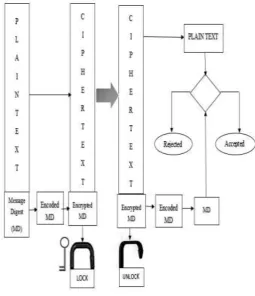
The main objective of this paper is to develop a two party mutual authentication protocol using Goldbach conjecture and the decimal expansion of an irrational number, which provide confidentiality, integrity and authenticity of the informatics shared over a public channel. This work is a novel method of developing a two party communication protocol which prevents from all the known attacks. The protocol is as follows:
Bob and Alice chooses two large numbers (even) and exchanges it over a secure channel. The above Chen’s theorem guarantee the existence of two primes P and Q from the numbers N and M (say) exchange over secure channel. We exploit the theorem of J.R.Chen, obtaining the primes P and Q where integers N and M are given. Suppose N is even, then choose the largest prime P such that N Pr s1 1 where r1 and s1 are suitable primes. As N and M are
exchanged over a secure channel only. Bob and Alice are aware of it for example if N=100, then 100=79+7.3.
After ascertaining Alice’s identity, Bob asks Alice to send him a largest even number Ni. Then by Chen’s theorem
Alice sends the even number Ni to Bob, Ni can be expressed
as N1P1r s1. 1 where r1<s1. Then Bob chooses a suitable even number Mi such that Qi is the largest prime that satisfies
1 1 2. 2
M Q r s and r2>s2 and s1=s2. Bob sends this number Mi
to Alice. Thus both the users Bob and Alice have the numbers Ni and Mi and both compute
P r s
1, ,
1 1
and
Q r s
1, ,
2 2
. They keep this three tuples with them respectively. Bob and Alice chooses an irrational numberI
which has a decimal expansion upto more than million places of decimals.6.1 Plaintext encryption protocol:
a. Alice computes 1 1
.
1
1.
1mod
1
j
N M
r s
P
and 1 1
.
1
2.
2
mod
1
j
N M
r s
Q
. Shechooses an integer
randomly. Here j denotes the number of messages exchanged between Alice and Bob. The keys
and j are security parameters.b. She computes r s1 1 sequence of decimal places from the position
i in the expansion of the irrational number I and forms the r1s1 rectangular matrixA
K .
c. Similarly she computes the rectangular matrix KB using Bob’s numberMi . where KBis a
2 2
r s rectangular matrix and the entries of KBare the r s2 2 consecutive decimal places picked from
i
in the decimal expansion ofI
.d. She arranges the plaintext P in blocks of length r1 with its numerical equivalents and the ciphertext C is obtained by #
B A
CK K P .
6.2 Encryption protocol for integrity
Alice computes the product niP Qi i and finds
n
1P
11
Q
11
. Alice chooses a numbere
such that
e
, ( ) 1
n
1
. The integrity of the message is maintained byconsidering the words occurring in the r1th place and s1th place of the first sentence in P and considering the words occurring in the appropriate places of the second sentence using the number Mi. The compilation of words in the exact order is taken as a message digest. If wi is a word in the message digest then she encrypts wi as
m
i
w
ie
mod
n
1
. She sends the encrypted and the password protected message pair
C m m m m
,
1 2 3 4,
to Bob along with the keypair
e l
,
. The one time password (OTP) used forprotection by Alice is
el t t t t
1 2 3 4
where t1 and t2 are thenumbers occurring in the decimal expansion of I in the r1th and s1th place of
irespectively, and t3 and t4 are the numbers occurring in the r2th and s2th place fromi
respectively. This is a dynamic passwords as we usei
and
iare only once for encryption. Similarly when Bob sends a reply with the OTP is
d l t t t t
' ' ' ' '
4 3 2 1
where t’1and t’2 are the numbers occurring in the decimal expansion of
I
in the r1th and s1th place of
irespectively, and t’3 and t’4 are the numbers occurring in the r2th and s2th place fromi
respectively. Herel
denotes the length of the ciphertext.6.3 Ciphertext decryption protocol:
a. Once Bob receives the password protected message pair
C m m m m
,
1 2 3 4,
along with the key pair
e l
,
, he first unlock it with the respective OTP
e t t t t l
1 2 3 4
.b. He checks the length of ciphertext C and confirms whetherC l .
c. Bob knows
iand
i, and so he can computes both the keys KA and KB.d. He applies the key #
A B
K K to C, obtaining the original plaintext by #
A B
PK K C.
e.
6.4 Decryption protocol for integrity:
Bob computes the multiplication inverse d of e such that
1
1 mod (n )
ed
. He then computes
1mod
1
d
m
n
which gives him wi . Bob checks the appearance of w1, w2, w3 and w4 in the appropriate places in the plaintext P and can confirm the validity of the ciphertext obtained. Bob can reply to Alice by using the prime numbers occurring immediately after Pi and Qi . Since the prime numbers are changing the
Ni and Mi , keys KA and KB changes rapidly and thus way one can contact each other continuously without providing any additional information. The cryptosystem developed here is a secure communication protocol satisfying all the requirements of a good cryptosystem.
[image:3.595.310.566.469.766.2]7.
ILLUSTRATION
Assume that the system uses a 29-letter alphabet
...
_
.
!
...
0
1
2
3
...
24
25
26
27 28
a
b
c
d
y
z
Consider the case the irrational number
I
, e=17,
4
,1
98
N
andM
1
1002
then
P r s
1, ,
1 1
83, 3, 5
and
Q r s
1, ,
2 2
967,7,5
Encryption:
Assume Alice contacts Bob for first time,
therefore
j
1
. Then
1
4 1
1
N M
1 1r s
1 198 1002
3 5
15 mod 83
1
4 1
1
N M
1 1r s
2 298 1002
7 5
766 mod 967
Alice finds the two sequences of decimal places from the positions of 115 and
1766, and choosesr s
1.
1
15
and
r s
2.
2
35
consecutive decimals say
and
respectively from this position in the decimal expansion of
. In this cases the sequence of decimals are693993751058209
44592307816406286208998628034825342
. Shegenerates the two rectangular matrices KA and KB of order
3 5 and 7 5 respectively from
and
.4
7
2
9
4
4
8
8
8
8
6
9
7
0
2
5
1
6
6
2
9
9
5
5
0
9
6
2
2
5
3
3
1
8
9
2
4
0
8
3
3
0
8
0
4
0
6
9
3
2
A B
K
K
Then she computes # A
K easily,
#
1
23 27
22
4
0
19
mod 29
16
11 12
5
16
7
17
11
24
T T
A A A A
K
K
K K
Alice encrypts the secret plaintext P=“Enemy will attack tomorrow, hit the target tonight.” Then the plaintext is divided into blocks of length three with the numerical
equivalent and apply the plaintext encryption process
#
mod 29
B A
C K K P
which gives the ciphertext C,“yisausybtkyrhqazb,ntssvylxoy,kxfdfefenbbej,g,tgffoiuibmhbt tmsrximrofsmmncoskbvhk.trnwlcszwlalqxhz,rsowuwdkiyg.d
n,isuvb”.
Note that
P
51 119
C
.For message integrity, Alice chooses 3rd and 5th words in the plaintext are “attack hit” and she can encode two letters per block, substituting a two digit numerical value for each letter. Thus the message “(at)(ta)(ck)(_h)(it)” is encoded: (0019)(1900)(0210)(2607)(0819). Since e=17, the blocks are enciphered withn1P Q1 180261 ,
n
1P
11
Q
11
79212
.
17 1 1 17 2 2 17 3 3 17 4 4 17 5 50019
7018
mod 80261 ,
1900
2344
mod 80261 ,
0210
6219
mod 80261 ,
2607
0952
mod 80261 ,
0819
1058
mod 80261 .
e e e e e
m
w
m
w
m
w
m
w
m
w
The whole message enciphered as
(7018)(2344)(6219)(0952)(1058).
Now the encrypted plaintext and message digest pair
protected by the password
e t
1
t
2t
3t l
4
17
3 9 2
119
2109242
is sent to Bob for decryption along with the key tuple
e l
, ,
17,119,4
.Decryption:
First Bob unlocks the message pair using the prearranged password 28322 and finds the rectangular matrices KA and KB using
1 and
1 in the decimal expansion ofI
. Then he obtains #B
K as follows:
1
#
5
24 18 19 12
2
24
21 25 22
0
26 20 18
mod 29
25 14 15 19 20 17 14
28 22 18 11
8
10 25
24 26 13 17 12 17
2
T T
B B B B
K
K K
K
original plaintext P: “Enemy will attach tomorrow, Hit the target tonight.”
The decryption of the message digest, Bob finds the multiplication inverse d=849 of e=17 such that
1 mod 7018
ed
. Then he decrypts the entire messagedigest by computing
w
i
m
i 849mod 80261
, which gives the decrypted original message digest “attack hit”.8.
CONCLUSIONS
We have proposed a method for implementing a cryptosystem whose security rests in part on the difficulty of finding the encryption/decryption keys. The security of our method proves to be adequate, it permits secure communication to be established without the use of couriers to carry the actual keys, as the keys and password used are dynamic and it also permits authentication, non-repudiation and message integrity of digitized documents.
The security of this system needs to be examined in more detail. In particular, the use of integers appearing in the decimal expansion of
in the encryption will make the decryption difficult by the usual methods of cryptography. The encryption/decryption keys known only to both Bob and Alice, it is not possible for any intruder to break this system. Also since N and M changes each time during an encryption, and also the encryption/decryption keys KA and KB are dynamic, hence the system is secure against known-plaintext attack. The proposed data encryption scheme given above has advantages of large key space, high level security and is mathematically and computationally simple, unlike the existing cryptosystems.The proposed system also takes care of data integrity and authentication. Even if an intruder pretends as Alice and sends Bob a message, Bob can send a standard message to the intruder for encryption along with the key
e l
, ,
different form the one already used. The ciphertext of the standard message form the intruder will en able Bob to determine the authenticity of the intruder. This system is very secure against Brute-force attacks, since the number of possible keys are very large. Length of the plaintext and ciphertext are nor equal, hence does this system prevent from frequency attack. And also this system is secure against all possible known attacks.REFERENCES
1) M. Bellare, R. Canetti and H. Krawczyk, Keying hash functions for message Authentication. In N. Koblitz, editor, CRYPTO’96, vol.1109 of LNCS, Pages 1-15, Springer-Verlag, 1996.
2) T.L. Boullion and P.L. Odell, Generalized Inverse Matrices. Wiley, Newyork, pages 41-62, 1971.
3) J.R. Chen, On the representation of a large even integer as the sum of a prime and the product of atmost two primes, Kexue Tongbao (Chinese), (17), 1966, 365-386.
4) J.R. Chen, On the representation of a large even integer as the sum of a prime and the product of atmost two primes, Sci. Sinica, 16, 1973, 157-176. Ibid, 21, 1978, 477-494 (Chinese).
5) M. Eisenberg, Hill ciphers and Modular Linear Algebra. Mimeographed Notes, University of Massachusetts, 1998.
6) Howard Anton and Rorres chris, Elementary Linear Algebra. 8th edition, Newyork: John-Wiley & Sons Inc., pages 678-688, 2000.
7) I.A. Ismail, M. Amin and H. Diab, How to repair the Hill cipher. Journal of Zhejiang University Science vol.7, no.12, 2006.
8) S. Lester Hill, Cryptography in an algebraic alphabet. Amer. Math., pages 306-312, 1929.
9) A.J. Menezes, P.C. Van Oorchot and S.A. Vanstone, Handbook of Applied Cryptography. CRC Press, 2000.
10) Neal Koblitz, A course in Number Theory and Cryptography, Springer, 2nd edition, 1994.
11) R. Penrose, A generalized Inverse for matrices. Communicated by J.A. Todd Received 26 July 1954.
12) J. Pintz and I.Z. Puzsa, On Linnik’s approximation to Goldbach’s problem, I. Acta Arithmatica, 109(2), 2003, 169-194.
13) Predrag Stanimirovic and Miomir Stankovic, Determinants of rectangular matrices and Moore-Penrose inverse. Novi sad J.Math., Vol.27, No.1, pages 53-69, 1997.
14) Rhee and Man Young, Cryptography and Secure Communications. McGraw - Hill co., 1994.
15) R.L. Rivest, A. Shamir and L. Adleman, A method for obtaining digital signatures and public key cryptosystems. Communications of the ACM, vol.21, No.2 pages 120-126, 1978.
16) A. Selberg, An elementary proof of the Prime-number theorem, Ann. Of Math, (2), 50, 1949, 305-313.
18) M.K. Viswanath, Transcendental Numbers and Cryptography. Applied Mathematical Sciences, Vol. 8, no. 174, pages 8675 – 8677, 2014.
19) M.K. Viswanath and A.R. Deepti, An improvised version of Hill’s Cipher. Journal of Discrete Mathematical Sciences and Cryptography, volume 11, No.2, India, 2008.
20) M.K. Viswanath and A.R. Deepti, A New Approach to a Secure Cryptosystem using the Microcontroller, Journal of Information Assurance Security, Volume 1, Issue 4, USA, 2006.
21) M.K. Viswanath and M. Ranjithkumar, A Public Key Cryptosystem Using Hill’s Cipher. Journal of Discrete Mathematical Sciences & Cryptography, Vol. 18, No. 1 & 2, pages. 129– 138, 2015.