warwick.ac.uk/lib-publications
Manuscript version: Author’s Accepted ManuscriptThe version presented in WRAP is the author’s accepted manuscript and may differ from the published version or, Version of Record.
Persistent WRAP URL:
http://wrap.warwick.ac.uk/109413
How to cite:
Please refer to published version for the most recent bibliographic citation information. If a published version is known of, the repository item page linked to above, will contain details on accessing it.
Copyright and reuse:
The Warwick Research Archive Portal (WRAP) makes this work of researchers of the University of Warwick available open access under the following conditions.
This article is made available under the Attribution-NonCommercial-NoDerivatives 4.0 International (CC BY-NC-ND 4.0) and may be reused according to the conditions of the license. For more details see: https://creativecommons.org/licenses/by-nc-nd/4.0/
Publisher’s statement:
Please refer to the repository item page, publisher’s statement section, for further information.
Spatial practices in digital work: calling for a spatial turn in information
systems research
Kamaran Sheikh Warwick Business School The University of Warwick [email protected]
João Baptista Warwick Business School The University of Warwick
João Porto de Albuquerque Centre for Interdisciplinary
Methodologies The University of Warwick
Abstract
The growing use of digital media in the workplace is shifting work to digital platforms, this study explores the role of the physical office space in modern organisations where digital work is the norm. We capture the way in which digital media modulates the production of space by tracing the physical and digital interactions of a software development team in a global IT company. Taking a performative and ontogenetic view of space we conceptualise two types of spatial practices that form distinct modulations and assemblages of features of the physical and digital environment. The first spatial practice modulates space to support recurrent work activities, while the second spatial practice modulates space to support ephemeral and focused work activities. This study contributes to the IS literature with a conceptual basis to study the interconnected nature of physical space in digital work in modern workplace settings. It calls for greater attention to space as a performative and constitutive element of digital work in information systems research.
1. Introduction
The growing adoption of digital media in the workplace is shifting work activities and interactions to various digital tools and collaborative platforms in organisations [1]. Work activity is increasingly embedded in digital platforms leading organisations to rethink the role of the physical office space in supporting work. A response from many organisations has been to close physical office buildings, while other organisations have made the opposite move by reconfiguring physical office spaces to reflect these new ways of working and better integrating them in the dynamics of activity and interactions of modern workplaces. These are two valid positions but reveal very different conceptualisations of spaces of work, or workspaces, and different underlying views of “where
work happens”. Our study focuses precisely on capturing the role of physical spaces in digital working practices in modern organisations.
The importance of physical environments in the organisation of work has been acknowledged at least since Ford’s production line, but has since evolved as a concept in various fields including by recent a calls for a spatial turn in organisational studies [2]–[5]. This reflects a progressive shift in the thinking and understanding of space as explained by Kitchin and Dodge [6]. They suggest that space was seen as a static and inert background in the 1950s and 60s but this notion was challenged in the 1970s with a relational conceptualisation of space based on the work of Lefebvre who developed the “social production of space” [7] as a significant shift in the thinking about space. However, more recently, a performative view of space has emerged where “space achieves its form,
function, and meaning through practice; space emerges as a process of ontogenesis” [6, p. 68]. This distinct “ontogenetic” conceptualisation of space is significant because it sees space as a dynamic concept which is continuously remodelled, reaffirmed and changed by sociospatial practices.
granted, the constitutive role of physical environments in the use and adoption of digital media in the workplace [22]. We contend that this marginalisation of the role of space as co-constituted and performative is particularly limiting in studying digital work practices in information systems research.
The role of space in digital work is particularly significant. Work activities in modern workplace settings transcend and blend physical and digital spaces. This requires new forms of theorising and studying the relationship between physical spaces, digital technologies and work practices. It is with the aim to address this gap in mind that we set the following research question: what is the role of physical space in the use and adoption of digital media in the workplace?
We take a performative view of space [6], [23] to propose a new theoretical perspective of space centred on the concept of spatial practices. Our analysis of the practices of digital working in an office environment of a large IT company reveals that the spatial practices used by modern software development teams involve the forming of assemblages of both physical and digital features. These software development teams appropriate digital tools as part of activities in the office, which we say that modulate the production of workspaces. We identify two types of spatial practices. One that corresponds to ongoing and recurring patterns of work, and one that supports ephemeral activities. The rest of the paper is organised as follows. We present the main theoretical concepts used in the study drawing in particular on the ideas of the human geographers Kitchin and Dodge [6], [24], and the philosopher de Certeau [23]. We then describe methods and some of the unique approaches to capturing the use of space in digital work. Finally, we discuss and analyse the findings, by showing the forming of digital-physical assemblages and spatial practices. We then review the contribution and provide an overview of the study in the conclusion.
2. Theoretical Framework
To capture the role of physical spaces in digital working practices in organisations we adopt a theoretical view of space that we previously identified as “ontogenetic”, drawing particularly on the work of de Certeau [23] and Kitchin and Dodge [6]. An ontogenetic conceptualisation of space makes a distinction between ‘place’ and ‘space’. For de Certeau [23, p. 117] place (lieu) is “an instantaneous configuration of positions”, which implies an indication of stability. In this way, when we refer to a place (e.g. a room, an office, a city) as we usually think of a set of relatively positioned elements, or a snapshot of dynamic relations. In
contrast, “space is composed of intersections of mobile
elements (…) In short, space is a practiced place” [23]. This means that instead of considering space as an inert and absolute container that is detached from social relationships, our conceptualisation of space corresponds to what de Certeau calls “experienced space”, i.e. it reflects the fact that “spatial usage creates the determining conditions of social life” [23].
This conceptualisation of space is therefore a performative perspective, i.e. spaces emerge out of the enactment of places. De Certeau uses as a central metaphor, the act of walking in the city as a spatial practice, which he puts into contrast with the static view given by the traces of a map. Spatial practices work analogously to how “speech acts” relate to language and fulfil a threefold function: (a) they appropriate a topographic system; (b) they perform a spatial realization of the site; (c) they establish relationships between different positions” [23, p. 108]. For de Certeau, these spatial practices also have a tactical
character, which he distinguishes from strategies that
“elaborate theoretical places (systems, totalizing discourses) capable of articulating an environment of physical places in which forces are distributed” [23, p. 38]. Thus, the sanctioned and official perspective of
strategies (which try to establish a structure, an order and define other elements of the environment in relation to them) is put in contrast with the tactical character of practices of appropriation, which are “ways of operating” those structures in everyday practices. We contend that de Certeau’s distinction between strategies
and tactics is of great importance for the analysis of organisational space. This allows us to distinguish between places as official versions and their disciplining
strategies (e.g. office layouts and plans of the physical environment, intended managerial usages of rooms and digital tools) and the tactical everyday appropriation of these features that “bring to light the clandestine forms
taken by the dispersed, tactical, and makeshift creativity of groups or individuals already caught in the nets of ‘discipline’” [23, p. xiv].
We take this performative view of organisational spaces to develop and propose a central construct of
operating” them, which, analogously to the “enunciation” of physical places proposed by de Certeau, also appropriate particular features of the digital to create tactical trajectories. Therefore, to understand what kind of space and spatial relations emerge from the use of digital tools in organisations we reconstitute the “walks” of team members through the physical and digital environments, i.e. the spatial practices of appropriating both physical and digital features of workplaces.
Further, to capture the effects that digital tools engender in the usage of space, we use the work of Kitchin and Dodge on the “transduction of space” [6]. Kitchin and Dodge draw on the works of McKenzie [25] and Simondon [26] to propose the term ‘code/space’ to explain how spaces emerge from spatial practices that are intrinsically co-constituted through software. They say that “code/space is quite literally constituted
through software-mediated practices, wherein code is essential to the form, function, and meaning of space”
[7, p. 71]. For instance, an airport is lived as a space only if all its supporting software is working (otherwise it will turn into a large waiting room). For this reason, an airport forms a ‘code/space’, i.e. a space that is modulated by the use of software and which can only exist if the corresponding software is working.
We also conceptualise modern workspaces as ‘code/spaces’ which are an outcome of spatial practices that intertwine features of physical environments (e.g. rooms, walls, furniture) and digital technology (e.g. instant messaging, project management and collaborative platforms). However, we depart from Kitchin and Dodge and avoid the terms “software”/”code” because in contrast to the more rigid technologies explored by them, the digital tools used in organisations today are much more plastic and malleable, or in other words they can be configured, combined, tweaked, extended by other pieces of software. Equally important, these systems can also be deactivated, hacked, bypassed and ignored in organisational practice. We build upon previous research in information systems that shows how technology is appropriated and takes shape in practice [27], in a process that may result into what we call
digital and physical assemblages.
Our theoretical framework is therefore composed of two central elements: (a) spatial practices, are based on an ontogenitic view of space as presented by de Certeau and represent the appropriation and usages of features of digital tools and physical places; (b) digital and physical assemblages, which intertwine elements from the physical environment and digital technologies, a view grounded in the notion of ‘code/space’ by Kitchin and Dodge. These two theoretical concepts provide useful analytical tools to explore the role of space in the
work practices of a software development team in a large global IT company.
3. Methodology
To capture the spatial practices and the emergence of workspaces across digital and physical environments of work we followed a qualitative in-depth case study research strategy. This approach is consistent with studies of technology use in the workplace [18], [28] which also employ qualitative methods for thick descriptions of practices within organisations [29]. The research followed the interpretive tradition and used qualitative approach [30] using multiple data collection methods for triangulation of data [31].
The empirical setting was the IBM Studio in London, UK which opened in 2015 as part of a $100M global investment by IBM into modernizing its workspaces and changing ways of working [32]. The studio was designed to facilitate collocated team-based working using Agile project management methodologies, which are intended to improve collaboration and accelerate work activities. This setting was ideal to study the role of physical space in the use and adoption of digital media in the workplace, as the studio hosts collocated software development teams that rely on physical and digital spaces to do their work.
We focused on tracing work activities, which within the agile methodology are labelled as ‘stories’ from inception to completion. We traced the interactions which occurred within the collocated studio teams that operate across digital and physical environments.
Data collection began with a pilot study performed over a two-week period in April 2016 which explored the dimensions of time and space using themes of collaboration, creativity and distractions [28]. The preliminary findings from this pilot study were subsequently used to inform the latter stages. Within the second stage which commenced in January 2017, informants included 40 employees which were selected using a purposeful sampling approach [33] for representativeness of the setting. This included members from the software development project teams (business analysts, designers, developers), agile coaches, management (first-line and executive), and IBM corporate level involvement from the real estate and IT strategy departments. Three forms of data collection were used over an eighteen-month period:
captured in real-time including screenshots, notes, sounds, pictures and video. These were supported with added context and insight through supplementary questioning [36] for probing events within ongoing cycles of data collection and analysis. The work activities were captured as vignettes using a crafted research instrument. This enabled discrete units of analysis for tracing digital-physical interactions with consideration of their temporal and ontogenetic nature.
2. Recorded time-lapses. We installed a modern smartphone in the office to take photos on a regular basis and capture movement and activity within the office. This allowed us to observe the practices of utilisation of various aspects of the office. 3. Semi-structured interviews: a draft interview guide
focused on the main concepts and theoretical background of the study was developed using the seven stages framework [37] and suitable interview preparation guidelines [38], [39]. Interviews with over 40 participants from project teams lasted between 30 minutes to 1 hour, considered valuable enough to capture the required data and optimise the numbers of persons willing to participate in interviews without placing unreasonable demands on busy interviewees and leading to participation bias [39]. All interviews were recorded with permission and subsequently transcribed and coded for data analysis.
Data collected include the nature, location and duration of activities. This method provided a rich and detailed thick description of events within a natural and meaningful context [40]. The data analysis was based on 1st and 2nd cycle coding [41]. We initially coded for features, properties, behaviours, practices, and the implied and expressed creation of spaces for the various work activities studied. In a subsequent cycle we coded for spatial practices and the emergence of digital-physical assemblages.
4. Findings and Analysis
The IBM Studio was designed as a new type of office with specific features to increase collaboration and social interaction in a team-based working environment using agile methods [42], with the intention to attract employees back to working based in an office environment. IBM more generally was shifting towards collocation and the Studio was perceived internally to be a pioneer of a model to be adopted more widely, this meant that the teams would be the first to try new tools and structures of work. The purpose of the Studio was to develop “design led solutions for clients and business partners” and help client organisations
with digital transformation projects. Examples of projects included managing the web presence of Audi UK and Selfridges studio. This meant that the Studio needed to be different and operate more like a start-up to attract and retain employees that were typically interested in joining more dynamic, agile and modern organisations. The Studio was therefore created as a “workspace that move and shift as teams need to… with comfy couches for quiet concentration… and spaces built for co-creation, our designers lead, practice and teach new ways of thinking about user-centred design.” (internal IBM document). The Studio occupies the northern wing of the IBM building in Southbank London on the 1st floor, which is a landmark building in central London housing the head office of IBM UK. The Studio is an enclosed area that featured IBM design-themed branding but projected its distinctive identity through colourful walls and furniture on the approach into the Studio area. The contrast between the Studio and the remainder of the IBM building was apparent and intentional to signify the unique type of work, way of working and culture. The workspaces in the remainder of the building generally featured low partitioned cubicles within an open-plan style layout with a considerably more conservative approach to its design. The employee profile of the Studio was also noticeably different, employees within the Studio were typically younger and a higher ratio of recent graduates and external professional hires with experience in design thinking and agile methods. This was intended to be a way to capture methods and tools used in other cutting-edge organisations. Studio employees dressed more casually. Wearing jeans and casual shoes was a common place. This was in contrast to the much more formal business attire adorned by employees throughout the remainder of the building.
We structure our findings in two sections. The first describes the work environment within the Studio, by describing the features of the physical environment, and then reviewing the digital tools and services used by the teams. We also trace activities that crossed these two environments and relied on integrating elements of both into digital and physical assemblages to perform certain tasks. This is important to capture the types of entanglements that we observed. We then conceptualise this material using the theoretical ideas of Kitchin and Dodge and de Certeau’s concepts of spatial practices covered in the theory section.
4.1 Workspace environment: digital and physical assemblages
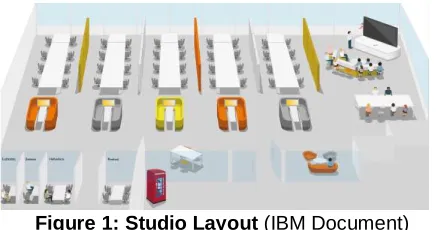
semi-independently with their own project and structures and could have around 8-10 members. The team areas were segregated by rolling whiteboards which provided a degree of visible and audible separation between the teams, but also allowed the teams to use the areas on the boards to display updates and progress updates relevant for each team. The generic layout of the Studio is represented in Figure 1.
Figure 1: Studio Layout (IBM Document)
In terms of the work within each team, it was primarily done in shared desks with no dividers between team members. Each team member would use a laptop and often a secondary monitor display, whilst the desk included communal access to USB sockets and power points. Team members would typically occupy the same desk location for the duration of a project, but adjustments happened regularly too. Due to the physical proximity between team members, noise-cancelling headphones were used for concentration. Alternatively, employees would exclude themselves to work in more private and protected spaces for individual work. Alongside each desk, each team also had access to a large (and colourful) soft-furnished high-backed booth which comprised a fixed digital display and a potential seating for up to 6 team members as shown in Figure 2.
Figure 2: Team Booth
These booths provided a degree of physical separation and sound proofing from other team members, and were regular locations for activities that required discussion and brainstorming. Beyond this, the
Studio also featured several other features and in the communal areas including:
• Four frosted glass meeting rooms designed for meetings with increased privacy
• Two small break-out areas for sharing of ideas and group-based discussion, one featured an arrangement of sofas, whilst the second was based around a high-top table and 4 stools
• A large high-top table with 10 stools (so-called ‘Titanic table’) with mounted smart board display • An auditorium style seating area (so-called
‘Mediascape’) which could accommodate 18 people facing toward a cinema style display • The “wall of work” is an area of the main wall used
as a dashboard to display status updates to be easily visible to the whole team. The information is displayed as drawings and comments based on a template that replicated the information on some of the digital tools used
• Ping-pong table and leisure area adjacent to the entrance of the Studio
Although the teams were collocated to enable personal communication and collaboration, most of their work was software development through a wide range of tools and digital services. The following quote from an Interaction Manager highlights the integration between physical and digital environments of work
“Work happens in the space we are physically present, but also through writing code, delivering stories and in conversations. Work happens over email, slack, video. Work also happens through the wall of work.”
As stated the main digital tools used by the teams were: Jira - as a project management tool; GitHub - as a software version control service; and Slack - as a collaboration and communication platform. They also used other IBM products and also some specialised applications available through an employee ‘App Store’. The selection of tools was not mandated by IBM, it was driven by the teams based on their needs and skill set and also reflecting external industry wide choices. The way these tools were appropriated and configured was also entirely the choice of the teams based on their needs, so not prescribed by senior management within IBM. This flexibility in selecting tools is captured in the following quote by a business analyst:
“There’s a suite of digital tools available to us and we have a degree of freedom to choose the ones which are most suited to the job.”
[image:6.612.73.296.497.643.2]overall layout of the physical studio environment remained stable, the teams would adjust and reconfigure particular features when needed. There was a culture that anything could be changed if it helped the teams work better, and this applied to both digital tools and the physical environment.This high degree of flexibility in the adoption and use of both digital tools and physical environment increased the integration between these two work environments. This meant that certain assemblages and entanglements integrating features of both environments emerged. This was visible for example in the way that Slack channels were configured to reflect arrangements in the layout of the Studio. These #channels on Slack played an important role and functioned tightly connected to activities and communication within the Studio. Teams relied on communication through these dedicated #channels within Slack to create open, closed or private spaces and used them similarly to physical break-out areas and private meeting rooms in the Studio (as seen in Figure 1). This integration seemed to be natural and expected, for example one of the developers said that “The digital
tools tie together the physical spaces because you have more opportunities to interact.”
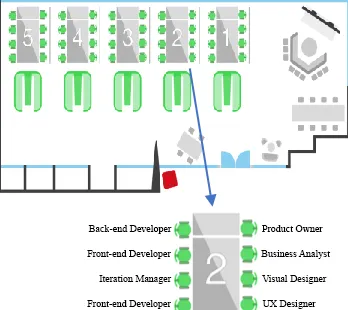
The intertwining between physical and digital was also visible by tracing work activities that were performed across both spaces. For example, the positioning in team desks used allowed communication to flow between team members in a manner consistent with the agile approach, which was tightly integrated into Jira and other tools used for software development. The disposition at the desks would begin with team members working on exploratory research, then in analysis involving the product owner and business analyst followed by design and then finally development. This resulted in a flow of “stories” essentially in a clockwise direction within the team, beginning with the product owner, through to design and ending with the development team. This arrangement is displayed in the seating plan in Figure 3.
This seating arrangement was tightly connected with the activities on Slack and Jira and was adopted to facilitate communication within the office, so that people could discuss within and outside these digital tools. Teams intentionally arranged the seating adjacent to those with whom they most frequently interacted online as explained by a designer:
“The other designer and I made a conscious decision to sit next to each other early on, it felt natural to sit next to each other, so we could work closely together. I also sit diagonally across from the front-end developer as we frequently need to speak.”
This approximation in the physical environment to support online activity was deliberate to allow for example a designer to easily clarify anything that is posted online on Slack #channels or within Jira or GitHub. Sub-groups on Slack such as #Developers and #Design replicated these configurations at the desks. The two spaces evolved to support the flow of discussions across physical and digital environments, as illustrated by the following quote:
“The conversation continues without recognising the medium. If you just tried to follow on Slack you would lose part of the conversation. Typically we use face to face for detailed richer conversations, whereas Slack tends to be more for auditable or transactional exchanges.” Business Analyst
This type of team configuration and structuring of both physical and digital features in response to demands from work activities seemed to follow two patterns. One to support more permanent and stable structures, such as the overall layout of the Studio and the disposition of desks, while a second was to support arrangements of a more temporary nature which changed on regular basis, such as repositioning chairs, reconvening in the booth or appropriating open spaces such as the Titanic table or the Mediascape for problem solving. We call these Spatial Practices and in the next section analyse the two types of spatial practices in more detail using the concepts covered in the theory section based on the work of Kitchin and Dodge on modulation and of de Certeau’s on tactical and strategic spacing.
4.2 Spatial Practices
[image:7.612.74.248.557.712.2]Modulation (Kitchin and Dodge) refers to the process by which code shapes the use and adoption of physical environment. This modulation of the space through code was visible but we identified two types of modulation depending on the temporality of the
activities. Each type of modulation relied on specific assemblages of features of physical and digital environment. The first type of modulation supported ongoing and recurring activities, while the second modulation supported more ephemeral structures used for quick creation and destruction. We suggest that these are two distinct spatial practices because the way digital tools modulated space is different for each one and is integral to the practices of the teams.
Spatial Practices for pattern building and recursive activities
The first type of spatial practices involved modulations across physical and digital to support recurring interactions and pattern building arrangements. We describe two examples of pattern-building and recursive modulations: the morning routine of “standup meeting”; and client project work.
Each morning the team would start the day with a daily ‘stand-up meeting’ which would normally be done around the desks area and near the “wall of work”. This was pre-empted by a Slack reminder message posted to the #General channel. Messages on Slack would prompt employees to stand and congregate around their team table, whilst remote team members would join via video conference.
We see the influence of the digital tools in the production of space also by analysing in more detail the team actions during these standup meetings. For example, an Interaction Manager describes below how the team congregated around a screen to discuss information on Jira:
“Our daily stand-up happens in our team area, we actually stand up and congregate around a single screen, usually displaying our Jira stories and sometimes a video conference session for anyone working from home”
This type of influence of digital tools on the production of space followed a similar modulation to project-based interactions. Project activities were based on agile ‘stories’ that would begin with in person discussions followed by project work in Jira. There were regular email and Slack notifications being sent to team members. Tasks required team members to come together for meetings in communal collaborative spaces such as the booth and surrounding breakout areas. Here team members often preferred to manipulate physical objects during early brain-storming sessions for rapid feedback and revision as explained by a Designer:
“Typically we will start with sketches and talk through them so we can iterate quickly. Sketching is much faster
than working on a computer, you can work through problems faster by drawing it out and talking about it. It also removes distractions you may have from Slack messages or email.”
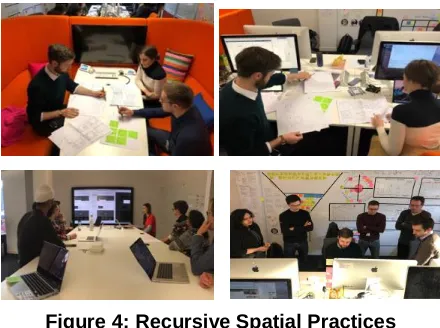
The outputs from these interactions would then be transferred back into Jira. As the task progressed through implementation, the emergent spaces of interaction extended increasingly into digital tools which are configured to bring team members together for discussion and review of digital artefacts as shown in Figure 4.
The progression and flow of interactions across physical and digital spaces is illustrated with the following quote from a designer:
“Once we have decided on the direction in meetings, we move to work to digital prototypes to see if our ideas our are feasible which we wouldn’t be able to physically draw to that fidelity… we talk through and modify the digital work live because we are sat together side-by-side. At some point we are ready to bring in and review with others, I would take my computer and present to the team for their review and ideas.”
These two examples show how the use of digital tools modulated the production of these recursive workspaces. This type of modulation created more permanent and stable assemblages of physical and digital features. We found that this type of spatial practices produces spaces that support ongoing team work and routines making use of physical features (such as the seat sequencing, wall of work, communal area around desks, booth and titanic table) and digital features (such as Slack channels with a permanent status, e.g. #General, GitHub Automated notifications, JIRA tasking management platform, Webex/Zoom)
[image:8.612.315.535.224.388.2]*
Spatial Practices for ephemeral activities
The second type of spatial practices involved modulations of physical and digital that supported ephemeral or short-lived interactions, which were often invoked to support problem solving or respond to immediate needs within the team. These temporal arrangements followed a distinct pattern of modulation, that is the way digital tools influenced the production of space was different. The features of both physical and digital environments invoked to produce this type of spatial practices were also distinct.
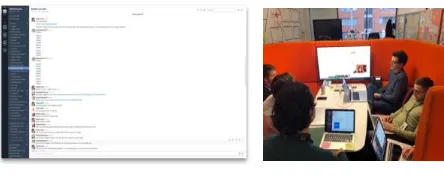
A good example of this type of spatial practice happened when the team was faced with a high priority issue, such as a major defect detected in the code. The process involved to gather the team, which require them to abandon planned activities to come together to focus on working on the problem until resolved. The process would involve the creation of a ‘war room’. This would consist of an assemblage involving physical congregation at the booth around the shared visual display. Once seated in close physical proximity, team members would track activity over time using a dedicated Slack #war-room channel and a Jira ticket as shown in Figure 5.
The issue was collectively triaged by the team using GitHub and software development and performance monitoring tools. This type of practice was ad-hoc and short lived. Both the practice and the spaces are created for the purpose of the practice and cease to exist immediately after its purpose is achieved, that means for example that the Slack channel is closed and team members return to their seats. The following quote shows the dynamic that underpins this type of spatial practice
“We had an impromptu meeting with the team in the team space - by standing up and saying and also posting an ‘@here’ in slack with ‘Who has some time? I really need to discuss this’, a few of us would then come together, we do that quite a bit.” Designer
In this type of spatial practice, the way digital tools modulate the production of space is different from the
previous type of spatial practices for more recursive activities. In this case, the digital tools and space operated in sync to support quick reaction and immediacy in discussion and focused observation of the problem. The attention was fully on the problem and the type of arrangements created to support the project were loose and informal, rather than more structural arrangements in the first type of spatial practices. This type of spatial practice involved distinct assemblages of features of physical (standing in the shared space and Booth) and digital environments (#WarRoom Slack channel, creation of temporary Slack channels, Trello task tracking boards).
This section analyses the role of physical environments in the adoption and use of digital media in the workplace. We describe the purpose and distinct characteristics of the Studio environment at IBM and digital tools used by the software development teams working there. As in the conceptualisation of code/space from Kitchin and Dodge discussed before, we notice that digital tools become essential to the functioning of the workspaces, i.e. to support the tasks, activities and interactions of the team work. As reported by the interviewed team members, the physical environment and its usages by team members can only exist as an interactional space with the concurrent usage of the supporting digital tools (otherwise it falls back to a conventional office room). Thus, the spatial practices of the development team members can only be properly understood by looking simultaneously at the interactions happening through digital tools in conjunction with the face-to-face and physical interactions happening in the workplace. Conversely, the configuration and actual usage of the digital tools is inextricably associated with the spatial arrangements of the office rooms and physical interactions between team members.
As a result, our theoretical framework enabled us to observe that the assemblages of specific elements from physical and digital environments modulate two particular types of spatial practices in our case which both include interactions via digital tools and in the physical environment: (a) pattern-building recurrent work practices; (b) ephemeral activities. In the next section, we draw implications from these findings for future theorising and empirical research.
5. Conclusion
[image:9.612.74.296.370.459.2]Research on digital work has mostly neglected or marginalised the productive and essential role played by the physical environment in the usage and appropriation of digital tools in organisations. It can even be said that physical space is somehow void in Information Systems (IS) research more broadly. Our study suggests that this
absence of space in information systems research is a major limitation particularly in understanding new forms of workplace settings and practices. We explore this important knowledge gap with a view of space as performative and constitutive in the production of workspaces. More specifically we conceptualise the spatial practices responsible for the appropriation of these workspaces by assembling features of both physical and digital environments to support organisational work.
We develop the concept of “spatial practices” based on the work of the philosopher Michel de Certeau [23]. Using this concept we identified two types of spatial practices with different digital-physical assemblages. One relied on features that privileged proximity, i.e. the “war room” scenario. Different assemblages for routine work activities involved a higher diversity of features of both physical and digital being routinely combined in a more longitudinal manner. This decision to appropriate particular spaces and assemblages based on their relative features and properties was deliberately orchestrated by the team with a view to achieving planned spatial effects.
Here our conceptual lens based on spatial practices has proven important to enable us to observe not only more strategy-seeking and place-building activities (such as the recurrent and pattern-building spatial practices) but also the alternative usages of team members and their creative “ways of operating”, the physical environment and digital tools, which enabled them to tactically repurpose existing physical and digital features in more ephemeral arrangements to fit their immediate interaction needs. We thus propose that our conceptual and methodological use of de Certeau’s spatial practices to capture the simultaneous appropriation of features of digital tools and the physical environment can offer an invaluable resource to IS researchers that are interested in achieving more nuanced understandings of how digital work is performed in modern organisations.
This ontogenetic perspective of space also allows us to conceptualise the modulating effects of digital tools in the production of space [6]. We traced the flow of interactions across physical and digital spaces to examine the types of modulations performed by the assemblages on the physical and digital interactions. This is important to show how spatial practices are associated with specific digital and physical assemblages.
This study provides a novel conceptualisation of the role of space in digital work in organisations and responds to calls for addressing the role of space in IS [6], building upon and expanding the literature conceptualising ways of working in modern organisations [40]. It also develops language and
terminology to help explore this aspect of digital work in future studies. The conceptual basis laid down by this study thus goes beyond artefact-centred approaches of sociomateriality [2], [4] by providing the foundations to developing a notion of sociospaciality in IS research. We thus hope that this study contributes towards a “spatial turn” in IS research by laying some of the foundations needed to reveal the performative and constitutive role of space in digital work.
6. References
[1] P. M. Leonardi, M. Huysman, and C. Steinfield, “Enterprise social media: Definition, history, and prospects for the study of social technologies in organizations,” Journal of Computer-Mediated
Communication, vol. 19, no. 1, pp. 1–19, 2013.
[2] K. Dale and G. Burrell, The spaces of organisation and the organisation of space: power, identity and
materiality at work. Palgrave, 2008.
[3] M. Kornberger and S. R. Clegg, “Bringing Space Back in: Organizing the Generative Building,”
Organization Studies, vol. 25, no. 7, pp. 1095–1114,
2004.
[4] S. Clegg and M. Kornberger, Space, organizations
and management theory. Copenhagen Business
School Press, 2006.
[5] S. Taylor and A. Spicer, “Time for space: A narrative review of research on organizational spaces,” International Journal of Management
Reviews, vol. 9, no. 4, pp. 325–346, 2007.
[6] R. Kitchin and M. Dodge, “The Transduction of Space,” Code/space : software and everyday life, no. 2014, pp. 65–80, 2014.
[7] H. Lefebvre, The Production of Space. Oxford: Blackwell, 1991.
[8] M. Mazmanian, W. J. Orlikowski, and J. Yates, “The Autonomy Paradox: The Implications of Mobile Email Devices for Knowledge
Professionals,” Organization Science, vol. 24, no. 5, pp. 1337–1357, 2013.
[9] A. M. Townsend, S. M. DeMarie, and A. R. Hendrickson, “Virtual teams: Technology and the workplace of the future.,” Academy of Management
Perspectives, vol. 12, no. 3, pp. 17–29, 1998.
[10] K. R. Dixon and N. Panteli, “From virtual teams to virtuality in teams,” Human Relations, vol. 63, no. 8, pp. 1177–1197, 2010.
[11] W. W. Gaver, “The Affordances of Media Spaces for Collaboration,” Cscw 92, vol. 92, no. November, pp. 17–24, 1992.
the imbrication of human and material agencies,”
MIS quarterly, vol. 35, no. 1, pp. 147–167, 2011.
[13] P. M. Leonardi, “Theoretical foundations for the study of sociomateriality,” Information and
Organization, vol. 23, no. 2, pp. 59–76, 2013.
[14] E. Vaast and E. Kaganer, “Social media affordances and governance in the workplace: An examination of organizational policies,” Journal of
Computer-Mediated Communication, vol. 19, no. 1, pp. 78–
101, 2013.
[15] A. Pickering, The Mangle of Practice: Time,
Agency, and Science, vol. 38, no. 3. University of
Chicago Press, 1995.
[16] B. Latour, Reassembling the Social: An introduction
to Actor-Network Theory. Oxford: Oxford
University Press, 2005.
[17] W. J. Orlikowski, “Sociomaterial Practices: Exploring Technology at Work,” Organization
Studies, vol. 28, no. 9, pp. 1435–1448, 2007.
[18] P. M. Leonardi, “Studying Work Practices in Organizations: Theoretical Considerations and Empirical Guidelines,” Annals of the International
Communication Association, vol. 39, pp. 235–273,
2015.
[19] J. P. De Albuquerque and M. Christ, “The tension between business process modelling and flexibility: Revealing multiple dimensions with a sociomaterial approach,” Journal of Strategic Information
Systems, vol. 24, no. 3, pp. 189–202, 2015.
[20] W. J. Orlikowski and S. V. Scott, “Sociomateriality: challenging the separation of technology, work and organization,” Academy of Management Annals, vol. 2, no. 1, pp. 433–474, 2008.
[21] P. M. Leonardi, “When Flexible Routines Meet Flexible Technologies: Affordance, Constraint, and the Imbrication of Human and Material Agencies,”
MIS Quarterly, vol. 35, no. 1, pp. 147–168, 2011.
[22] F.-X. de Vaujany and N. Mitev, “Materiality and Space: Organizations, Artefacts and Practices.,” in
Materiality and Space: Organizations, Artefacts and
Practices., London: Palgrave Macmillan, 2013.
[23] M. de Certeau, The Practice of Everyday Life. Berkeley, CA: The University of California Press, 1984.
[24] M. Dodge and R. Kitchin, “Code and the
Transduction of Space,” Annals of the Association of
American geographers, vol. 95, no. 1, pp. 162–180,
2005.
[25] A. Mackenzie, “Transduction: invention, innovation and collective life.” 2003.
[26] G. Simondon, “The Genesis of the Individual,” in
Incorporations, J. Crary and S. Kwinter, Eds. New
York: Zone Books, 1992, pp. 297–319.
[27] J. Baptista, “Institutionalisation as a process of interplay between technology and its organisational context of use,” Journal of Information Technology, vol. 24, no. 4, pp. 305–319, 2009.
[28] J. Wajcman and E. Rose, “Constant connectivity: rethinking interruptions at work,” Organization
Studies, vol. 32, no. 7, pp. 941–961, 2011.
[29] M. Easterby-Smith, R. Thorpe, and P. Jackson,
Management Research. Sage, 2012.
[30] R. Weber, “The Rhetoric of Positivism Versus Interpretivism: A Personal View,” MIS Quarterly, vol. 28, no. 1, pp. iii–xii, 2004.
[31] R. K. Yin, Case Study Research: Design and
Methods, vol. 4. California: SAGE Publications, Inc,
2009.
[32] IBM, “IBM News room - 2014-03-27 IBM Commits $100 Million to Globally Expand Unique Consulting Model That Fuses Strategy, Data and Design - United States.” 27-Mar-2014.
[33] J. Maxwell, “Designing a Qualitative Study,” The SAGE Handbook of Applied Social Research
Methods, pp. 214–253, 2009.
[34] M. Saunders, P. Lewis, and A. Thornhill, Research
Methods for Business Students. 2008.
[35] M. Alvesson, “Methodology for Close up Studies : Struggling with Closeness and Closure,” Higher
Education, vol. 46, no. 2, pp. 167–193, 2017.
[36] D. Coghlan and T. Brannick, Doing Action Research
in Your Own Organization. Sage Publications Ltd,
2014.
[37] S. Kvale, InterViews: An Introduction to Qualitative
Research Interviewing. Sage Publications, Inc,
1996.
[38] J. Collis and R. Hussey, Business Research: A practical guide for undergraduate and postgraduate
students. London: Palgrave, 2009.
[39] C. Robson, Real World Research A Resource for
Social Scientists and Practitioner-Researchers. John
Wiley & Sons, 1993.
[40] D. M. Fetterman, Ethnography Step By Step, 3rd ed. Sage Publications, Inc., 2010.
[41] J. Saldana, The Coding Manual for Qualitative
Researchers, Third Edit. Sage Publications Ltd,
2015.