warwick.ac.uk/lib-publications
Original citation:
Knighton, Richard C., Emerson-King, Jack, Rourke, Jonathan, Ohlin, André and Chaplin,
Adrian B. (2018) Solution, solid-state, and computational analysis of agostic interactions in a
coherent set of low-coordinate rhodium(III) and iridium(III) complexes. Chemistry - A
European Journal, 24 (19). pp. 4927-4938. doi:10.1002/chem.201705990
Permanent WRAP URL:
http://wrap.warwick.ac.uk/98030
Copyright and reuse:
The Warwick Research Archive Portal (WRAP) makes this work of researchers of the
University of Warwick available open access under the following conditions.
This article is made available under the Creative Commons Attribution 4.0 International
license (CC BY 4.0) and may be reused according to the conditions of the license. For more
details see:
http://creativecommons.org/licenses/by/4.0/
A note on versions:
The version presented in WRAP is the published version, or, version of record, and may be
cited as it appears here.
&
Agostic Interactions
|Hot Paper|
Solution, Solid-State, and Computational Analysis of Agostic
Interactions in a Coherent Set of Low-Coordinate Rhodium(III) and
Iridium(III) Complexes
Richard C. Knighton,
[a]Jack Emerson-King,
[a]Jonathan P. Rourke,
[a]C. Andr8 Ohlin,
[b]and
Adrian B. Chaplin*
[a]Abstract: A homologous family of low-coordinate com-plexes of the formulationtrans-[M(2,2’-biphenyl)(PR3)2][BArF4]
(M=Rh, Ir; R=Ph, Cy,iPr,iBu) has been prepared and exten-sively structurally characterised. Enabled through a compre-hensive set of solution phase (VT1H and31P NMR
spectros-copy) and solid-state (single crystal X-ray diffraction) data, and analysis in silico (DFT-based NBO and QTAIM analysis), the structural features of the constituent agostic interactions have been systematically interrogated. The combined data substantiates the adoption of stronger agostic interactions
for the IrIIIcompared to RhIIIcomplexes and, with respect to
the phosphine ligands, in the order PiBu3>PCy3>PiPr3>
PPh3. In addition to these structure–property relationships,
the effect of crystal packing on the agostic interactions was investigated in the tricyclohexylphosphine complexes. Com-pression of the associated cations, through inclusion of a more bulky solvent molecule (1,2-difluorobenzene vs. CH2Cl2) in the lattice or collection of data at very low
tem-perature (25 vs. 150 K), lead to small but statistically signifi-cant shortening of the M@H@C distances.
Introduction
The coordination chemistry of C@H bonds is an important facet of contemporary organometallic chemistry.[1–3] Adoption
of 3-centre-2-electron M@H@C bonds can help stabilise other-wise reactive low-coordinate metal complexes that are impli-cated in many catalytic reactions, and from a fundamental per-spective represent an opportunity to gain insight into transi-tion-metal-mediated C@H bond activation reactions.[4] As a
consequence of the weakly interacting nature of C@H bonds, well-defined examples are almost exclusively limited to intra-molecular systems that are promoted through the chelate effect. As first articulated by Brookhart and Green, the consis-tent interactions are termed “agostic” and typified by M@H@C contacts of<3 a.[1,5]The characterisation of alkane complexes
is significantly more experimentally demanding, but has been achieved in solution using time-resolved spectroscopic
meth-ods under low temperature regimes,[3,6] and recently in the
solid-state by X-ray crystallography through application of single-crystal to single-crystal transformations.[7]
Given that the development of C@H bond activation chemis-try has been closely connected with the organometallic chemistry of rhodium and iridium,[8]it is perhaps unsurprising
that a large number of well-defined complexes of these group 9 metals featuring agostic interactions have been re-ported.[9–15] Indeed amongst known examples a number of
families can be identified, with MIII complexes of the
formula-tiontrans,cis-[ML2H2]+ (A: M=Rh, Ir; L=phosphine or NHC),[9]
[M(Binor-S)L]+ (B: Binor-S=1,2,4,5,6,8-dimetheno-S-indacene;
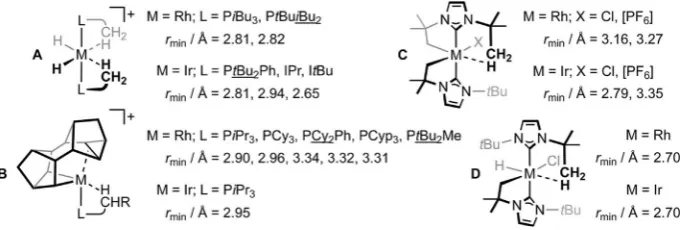
L=phosphine),[10] and bearing cyclometalated ItBu (C, D) the
most outstanding (Figure 1).[11] Structurally related clusters of
this nature are of interest to gauge an understanding of the effect of the metal alongside subtle variations of the ligand composition on the constituent agostic interactions. Unfortu-nately, as they currently stand, neither the size nor specific membership of these three families is well suited to an analysis of this nature.
Whilst it is conceivably possible to extend the membership of the aforementioned sets, the synthetic chemistry underlying the isolation of these highly reactive organometallics presents a number of practical challenges. Recognising a degree of commonality amongst A–C and others,[12] namely sawhorse
metal geometries with hightrans influence ligands in the cis -equatorial positions, and building upon the previous report of low-coordinate RhIII complex trans-[Rh(2,2’-biphenyl)(PiPr
3)2]
[BArF
4] (1c; ArF=3,5-(CF3)2C6H3),[13] we reasoned that utilising
2,2’-biphenyl as an ancillary ligand would be a straightforward [a]Dr. R. C. Knighton, J. Emerson-King, Dr. J. P. Rourke, Dr. A. B. Chaplin
Department of Chemistry, University of Warwick Gibbet Hill Road, Coventry CV4 7AL (UK) E-mail: [email protected]
[b]Dr. C. A. Ohlin
Department of Chemistry, Ume, University Linneausvag 6, 907 34 Ume, (Sweden)
Supporting information and the ORCID identification number(s) for the au-thor(s) of this article can be found under https://doi.org/10.1002/ chem.201705990.
means to gather a set of solution and solid-state data for agos-tic interactions between phosphine ligand substituents and RhIIIand IrIIIcentres. To this end, and with a view to elucidating
structure-property relationships within such data, we report the synthesis and extensive characterisation of low-coordinate complexes of the formulation trans-[M(2,2’-biphenyl)(PR3)2]
[BArF
4] (M=Rh,1; Ir,2; R=Ph,a; Cy,b;iPr,c;iBu,d; Figure 2).
This series of complexes encompasses both aryl and alkyl phosphine ligands (i.e. Ph vs. Cy), cyclic and acyclic alkyl phos-phine substituents (i.e. Cy vs.iPr) and the possibility to adopt bothg- andd-agostic interactions (i.e.iPr vs.iBu). DFT calcula-tions have also been carried out to aid structural interrogation.
Results and Discussion
Synthesis
The preparation of1chas previously been achieved via oxida-tive addition of biphenylene to the latent low coordinate com-plex [Rh(C6H5F)(PiPr3)2][BArF4].[13] Guided by methodology
de-veloped by Jones and Crabtree for the preparation of trans -[M(2,2’-biphenyl)(PPh3)2Cl] (M=Rh,3a; Ir, 4a),[16,17] we instead
chose to employ more systematic and synthetically robust pro-tocols that proceed via facile substitution reactions of MIII
pre-cursors [Rh(2,2’-biphenyl)(dtbpm)Cl] (5; dtbpm=bis(di-tert -bu-tylphosphino)methane) and [Ir(2,2’-biphenyl)(COD)Cl]2 (6;
COD=1,5-cyclooctadiene) with the desired phosphine, fol-lowed by chloride abstraction to afford low coordinate deriva-tives1 and2, respectively (Scheme 1). In this way, five-coordi-nate intermediates3and4were readily obtained (37–83% iso-lated yield) and subsequently treated with Na[BArF
4] in CH2Cl2
at RT (3,4b–d) or 508C (4a) to afford target complexes1and
2 that, following filtration to remove insoluble sodium salts, were isolated by slow crystallisation from CH2Cl2/pentane
(liquid-liquid diffusion at RT; 32–80 % isolated yields) and ex-tensively characterised (vide infra). Notably, samples of1and2
obtained in this way were all suitable for interrogation in the solid-state using X-ray diffraction.
Solid-state structures of 1 and 2
Single crystalline samples of 1 and 2, grown as described above, were analysed in the solid-state using X-ray diffraction under typical experimental conditions (i.e. MoKa radiation,T=
150 K).[18] Agostic interactions are evident in the complexes
bearing trialkylphosphines, while the triphenylphosphine deriv-atives are conspicuously obtained as adducts of solvent in the solid-state, namely 1a·CH2Cl2 and 2a·CH2Cl2.[19] For a given
phosphine,1and2are in general isomorphous;[20]those of1
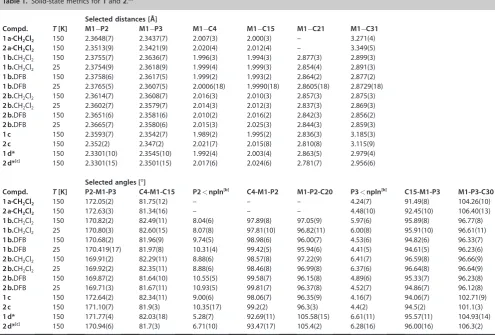
are depicted in Figure 3, with selected metrics for 1 and 2
compiled in Table 1. The salient features and experimental at-tempts to perturb crystal packing in1band2b, are discussed below in turn.
Dichloromethane is typically considered a weakly coordinat-ing ligand and complexes of the platinum group metals are uncommon (<25 deposited in the Cambridge Structural Data-base v. 5.38). Indeed, 1a·CH2Cl2 and 2a·CH2Cl2 represent the
[image:3.595.128.471.66.181.2]first crystallographically characterised homologous metal series. Binding of the halocarbon in these complexes occurs with essentially linear Cl80-M1-C4 bond angles and M1@Cl80
Figure 2.Low-coordinate rhodiumIIIand iridiumIIIcomplexes studied.
Figure 1.Structurally related sets of low-coordinate RhIIIand IrIIIcomplexes featuring agostic interactions (rmin=closest M@H@C contact) characterised in the
solid-state by X-ray diffraction.
[image:3.595.106.231.398.452.2]bond lengths of 2.6067(8) and 2.5567(12) a, for the rhodium and iridium variants, respectively. The latter are in line with RhIII (2.488–2.763 a)[21] and IrIII (2.533–2.612 a)[22] precedents
and consistent with the stronger metal-ligand bonding
expect-ed in the heavier congener. Although chelation of dichlorome-thane to platinum group metals is known,[23]the remaining
[image:4.595.52.548.70.231.2]co-ordination site on the metal centre remains essentially vacant (M1···Cl82 >4 a) without any significant stabilising (agostic or
Figure 3.Solid-state structures of1a·CH2Cl2,1b.CH2Cl2,1c, and1d*(left to right). All data collected at 150 K, thermal ellipsoids at the 50 % probability level.
Only one of the two unique cations shown for1c(non-disordered); anions, CH2Cl2solvent molecules (1a,1b), and minor disordered components (C70/C70A
Cy group in1b) omitted for clarity. Selected bond lengths (a) and angles (8):1a·CH2Cl2, Rh1@Cl80, 2.6067(8); Cl82@H31, 3.375(2); Cl82@H41, 3.203(2);
C4-Rh1-Cl80, 174.33(8); Equivalent metrics for2a·CH2Cl2, Ir1@Cl80, 2.5567(12); Cl82@H31, 3.325(2); Cl82@H41, 3.134(3); C4-Ir1-Cl80, 175.25(11).
Table 1.Solid-state metrics for1and2.[a]
Selected distances [a]
Compd. T[K] M1@P2 M1@P3 M1@C4 M1@C15 M1@C21 M1@C31 1a·CH2Cl2 150 2.3648(7) 2.3437(7) 2.007(3) 2.000(3) – 3.271(4) 2a·CH2Cl2 150 2.3513(9) 2.3421(9) 2.020(4) 2.012(4) – 3.349(5)
1b.CH2Cl2 150 2.3755(7) 2.3636(7) 1.996(3) 1.994(3) 2.877(3) 2.899(3)
1b.CH2Cl2 25 2.3754(9) 2.3618(9) 1.999(4) 1.999(3) 2.854(4) 2.891(3)
1b.DFB 150 2.3758(6) 2.3617(5) 1.999(2) 1.993(2) 2.864(2) 2.877(2)
1b.DFB 25 2.3765(5) 2.3607(5) 2.0006(18) 1.9990(18) 2.8605(18) 2.8729(18)
2b.CH2Cl2 150 2.3614(7) 2.3608(7) 2.016(3) 2.010(3) 2.857(3) 2.875(3)
2b.CH2Cl2 25 2.3602(7) 2.3579(7) 2.014(3) 2.012(3) 2.837(3) 2.869(3)
2b.DFB 150 2.3651(6) 2.3581(6) 2.010(2) 2.016(2) 2.842(3) 2.856(2)
2b.DFB 25 2.3665(7) 2.3580(6) 2.015(3) 2.025(3) 2.844(3) 2.859(3)
1c 150 2.3593(7) 2.3542(7) 1.989(2) 1.995(2) 2.836(3) 3.185(3)
2c 150 2.352(2) 2.347(2) 2.021(7) 2.015(8) 2.810(8) 3.115(9)
1d* 150 2.3301(10) 2.3545(10) 1.992(4) 2.003(4) 2.863(5) 2.979(4)
2d*[c] 150 2.3301(15) 2.3501(15) 2.017(6) 2.024(6) 2.781(7) 2.956(6)
Selected angles [88]
Compd. T[K] P2-M1-P3 C4-M1-C15 P2<npln[b] C4-M1-P2 M1-P2-C20 P3<npln[b] C15-M1-P3 M1-P3-C30 1a·CH2Cl2 150 172.05(2) 81.75(12) – – – 4.24(7) 91.49(8) 104.26(10) 2a·CH2Cl2 150 172.63(3) 81.34(16) – – – 4.48(10) 92.45(10) 106.40(13)
1b.CH2Cl2 150 170.82(2) 82.49(11) 8.04(6) 97.89(8) 97.05(9) 5.97(6) 95.89(8) 96.77(8)
1b.CH2Cl2 25 170.80(3) 82.60(15) 8.07(8) 97.81(10) 96.82(11) 6.00(8) 95.91(10) 96.61(11)
1b.DFB 150 170.68(2) 81.96(9) 9.74(5) 98.98(6) 96.00(7) 4.53(6) 94.82(6) 96.33(7)
1b.DFB 25 170.419(17) 81.97(8) 10.31(4) 99.42(5) 95.94(6) 4.41(5) 94.61(5) 96.23(6)
2b.CH2Cl2 150 169.91(2) 82.29(11) 8.88(6) 98.57(8) 97.22(9) 6.41(7) 96.59(8) 96.66(9)
2b.CH2Cl2 25 169.92(2) 82.35(11) 8.88(6) 98.46(8) 96.99(8) 6.37(6) 96.64(8) 96.64(9)
2b.DFB 150 169.87(2) 81.64(10) 10.55(5) 99.58(7) 96.15(8) 4.89(6) 95.33(7) 96.23(8)
2b.DFB 25 169.71(3) 81.67(11) 10.93(5) 99.81(7) 96.37(8) 4.52(7) 94.86(7) 96.12(8)
1c 150 172.64(2) 82.34(11) 9.00(6) 98.06(7) 96.35(9) 4.16(7) 94.06(7) 102.71(9)
2c 150 171.10(7) 81.9(3) 10.35(17) 99.2(2) 96.3(3) 4.4(2) 94.5(2) 101.1(3)
1d* 150 171.77(4) 82.03(18) 5.28(7) 92.69(11) 105.58(15) 6.61(11) 95.57(11) 104.93(14)
2d*[c] 150 170.94(6) 81.7(3) 6.71(10) 93.47(17) 105.4(2) 6.28(16) 96.00(16) 106.3(2)
[image:4.595.49.545.309.644.2]p) interaction with a phosphine substituent (M1···C31/C41 >3.2 a). The phosphine ligands in closely related trans,cis -[M(2,2’-bipyridine)(PPh3)2H2]+ (M=Rh and Ir) are known to
adopt a wide variety of conformations.[24]
Under the aforementioned experimental conditions the tri-cyclohexylphosphine complexes crystallise with one molecule of dichloromethane in the asymmetric unit, namely1b.CH2Cl2
and2b.CH2Cl2. In each case, the adoption of two significantg
-agostic interactions with the metal centres is apparent in the solid-state structures with M1@C21/C31 distances of 2.877(3)/ 2.899(3) and 2.857(3)/2.875(3) a, for the rhodium and iridium congeners, respectively at 150 K. The close approaches of the C@H bonds to the metal centre are accompanied by signifi-cantly distorted phosphine geometries: C4-M1-P2/C15-M1-P3 angles greater than 908(i.e. deviation from ideal metal coordi-nation geometry) and compression of the M1-P2-C20/M1-P3-C30 angles compared to those of the other phosphine sub-stituents (i.e. ligand yawing).
The presence of a solvent molecule in the lattice presented an opportunity to explore the effect of crystal packing on the constituent agostic interactions. With this in mind, single crys-tals of1b and2b were also grown from weakly coordinating 1,2-difluorobenzene (DFB)[25] and pentane (liquid–liquid
diffu-sion at RT) leading to includiffu-sion of the fluoroarene into the lat-tice, namely1b.DFB and2b.DFB. The new crystals are isomor-phic (P-1), but, reflecting the larger solvent molecule, bear slightly larger unit cells (DVcellca. +2%, Table 2). This
enlarge-ment does not directly parallel the associated increase solvent void volume (Vsolv.void), resulting in a small compression of the
remaining unit cell contents at 150 K (D{[email protected]}[email protected]%,
1b;@1.2%,2b) and, interestingly, shorter agostic interactions
(Rh1@C21, @1.3:1.1 pm; Rh1@C31, @2.2:1.1 pm; Ir1@C21,
@1.5:1.3 pm; Ir1@C31, @1.9:1.1 pm). Compression of 1b
and2bcan also be achieved by cooling the crystalline samples from 150 to 25 K (D{[email protected]}[email protected]%, 1b.CH2Cl2; @1.3%
1b.DFB; @1.8%,2b.CH2Cl2; @1.0%, 2b.DFB). Using this latter
approach the most pronounced compression was achieved in the dichloromethane-containing samples, where statistically significant contractions of the M1@C21 bond lengths are ob-served (@2.3:1.5 pm, 1b.CH2Cl2; @2.0:1.3 pm, 2b.CH2Cl2).
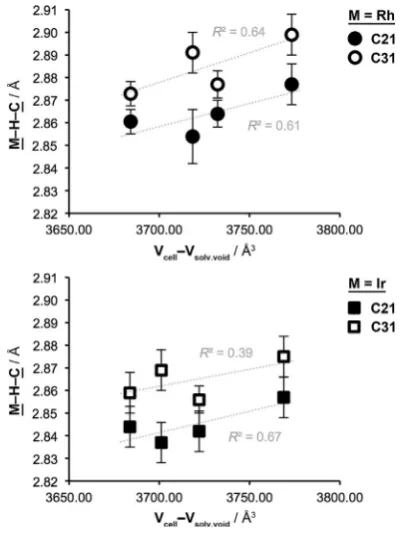
Although the nature of the compression varies, analysis of the combined data reveals a noticeable correlation between mo-lecular volume in the solid-state and agostic bond length for the tricyclohexylphosphine complexes (Figure 4). Similar changes have been noted in a uranium complex using variable pressure X-ray crystallography.[26]
In contrast to the preceding structures, the X-ray structures of 1cand2cfeature two crystallographically independent tri-isopropylphosphine ligated metal complexes, one of which is extensively disordered (see the Supporting Information for full details). The well-ordered cations (Rh1/Ir1) are stabilised by one strong g-agostic interaction as evidenced through M1@
C21 contacts<3 a (2.836(3) a,1c; 2.810(8) a, 2c), marked de-viation of the associated phosphine (P2) from ideal coordina-tion geometry (C4-M1-P2=98.06(7)8,1c; 99.2(2)8,2c), and the
orientation of the associated substituent (M1-P2-C20=
96.35(9)8, 1c; 96.3(3)8, 2c). A case can also be made for a weaker supplementary g-agostic from the other phosphine ligand (P3). The associated M1@C31 contacts are >3 a (3.185(3) a,1c; 3.115(9) a),2c); however, distortion of the iso-propyl groups towards the metal is discernable from the met-rics (Table 1), albeit less pronounced than on P2 (and moreover the phosphines of1band2b). The adoption of two agostic in-teractions of different magnitude is also evident in the disor-dered cations, although the nature of the disorder in these complexes precludes any meaningful analysis of the metrics: the remainder of the discussion is consequently focused only on the well-ordered cations.
It is not immediately obvious why the agostic bonding pat-tern differs between complexes of PCy3and PiPr3. Close
inspec-tion of the phosphine ligands reveals equivalent conformainspec-tions only for the ligands that adopt the strongest agostic
interac-Table 2.Selected cell properties and metrics for1band2b.
Compd. T
[K] V[acell3] 1[gcm@3] V[asolv.void3][a] VVsolv.void/ cell
M1@C21
[a] M1[a]@C31
1b.CH2Cl2 150 4015.18(16) 1.459 241.84 6.0 % 2.877(3) 2.899(3)
1b.CH2Cl2 25 3929.92(16) 1.491 211.50 5.4 % 2.854(4) 2.891(3)
1b.DFB 150 4083.44(17) 1.458 351.21 8.6 % 2.864(2) 2.877(2)
1b.DFB 25 4006.63(14) 1.486 322.48 8.0 % 2.8605(18) 2.8729(18)
2b.CH2Cl2 150 4012.84(10) 1.534 244.00 6.1 % 2.857(3) 2.875(3)
2b.CH2Cl2 25 3915.30(11) 1.572 214.31 5.5 % 2.837(3) 2.869(3)
2b.DFB 150 4086.31(15) 1.530 364.19 8.9 % 2.842(3) 2.856(2)
2b.DFB 25 4019.58(11) 1.555 335.86 8.4 % 2.844(3) 2.859(3)
[a] Solvent void calculated using the contact surface of the refined structure minus solvent (Mercury 3.9, probe radius of 1.2 a and approximate grid spacing of 0.2 a).
[image:5.595.68.270.454.721.2]tions (P2); the non-interacting substitutes of the other ligand (P3), however, differ by rotation about the P@C bonds.[27] We
speculate that the origin of these differences is ligand sterics:
1cand2c, bearing the bulkier phosphine ligand (%Vbur@ 2.28
a=32.3 vs. 31.8),[28] are ultimately too congested to enable
close approaches of two substituents. In the context of elec-tronically stabilising the metal centre, this effect appears to be counterbalanced by shorter M1@C21 interactions in1cand2c
(2.836(3) and 2.810(8) a) compared to1band2b(2.877(3) and 2.857(3) a).
In the case of the triisobutylphosphine derivatives 1d and
2d, meaningful analysis in the solid-state was impeded by ex-tensive disorder of the phosphine ligands (see the Supporting Information for full details), necessitating alternative analysis of samples bearing instead the [Al{OC(CF3)3}4]@ counter anion;
1d* and 2d*. Although even in this case there are some
subtle crystallographic differences between the rhodium and iridium congeners, these samples enable interrogation of non-disordered isostructural triisobutylphosphine complexes (1d*
shown in Figure 3, see the Supporting Information for full de-tails). Contrasting the other trialkylphosphine variants, which featureg-agostic interactions, these complexes each show two
d-agostic interactions, with M1@C21/C31 distances of 2.863(5)/ 2.979(4) and 2.781(7)/2.956(6) a for the rhodium and iridium congeners, respectively. A difference easily reconciled when recognising the more flexible nature of the isobutyl substitu-ent, which enables such interactions to be formed with signifi-cantly reduced distortion of the ligand. For instance, the triiso-butylphosphine ligands in 1d* and 2d* are associated with distinctly more perpendicular C4-M1-P2/C15-M1-P3 and open M1-P2-C20/M1-P3-C30 angles than the other trialkylphosphine derivatives (Table 1).
Analysis of the metrics associated with the agostic interac-tions within the 1b–d and 2b–d homologous series enables an important general feature to be elucidated: more pro-nounced agostic interactions are formed in the iridium com-plexes, as evidenced through statistically shorter M1@C21/M1@
C31 contacts of around 4 pm (Table 1). This assertion is rein-forced through longer M1@C4/C15 distances (ca. 2 pm), associ-ated with the trans disposed 2,2’-biphenyl ligand (consistent with trans influence arguments), greater deviation of the C4-M1-P2/C15-M1-P3 angles from 908 (ca. 0.78), and a less linear P2-M1-P3 bond angle (ca. 1.08). Moreover, given that there are no statistically significant differences observed for the M1-P2-C20/M1-P3-C30 angles, it would appear that ligand yawing is a comparatively higher energy process than deviation from ideal metal-phosphine coordination geometry, for iridium compared to rhodium. Within the data no meaningful correlation can be
found between the M1@C21/C31 and M1@C4/C15 bond
lengths, nor between the differencesD(M1@C21, M1@C31) and
D(M1@C4, M1@C15) calculated for each complex. This is per-haps not surprising when considering that variation of the M1@C4/C15 distances relative to the associated error is very low amongst the separate rhodium (1.989(2)–2.003(4) a) and iridium (2.010(2)–2.024(6) a) data sets collected at 150 K.
Characterisation of 1 and 2 using NMR spectroscopy
The NMR spectra of1b–dand2b–dmeasured in CD2Cl2
solu-tion at 298 K (500 MHz) are notable for the absence of low fre-quency1H resonances[1]and time averagedC
2vsymmetry,
indi-cating that persistent agostic interactions are not adopted under ambient conditions. This is perhaps not surprising given the inherently weak nature of 3-centre-2-electron M@-H@C bonds, associated distortion of the phosphine ligand from ideal coordination geometry, and capacity for fast exchange between substituents on the NMR time scale. In attempt to probe the latter, low temperature 1H (500 MHz) and 31P
(202 MHz) NMR data were acquired in CD2Cl2, down to 185K:
the practical working limit for the solvent. Whilst in each case the onset of signal decoalescence was observed in the 1H
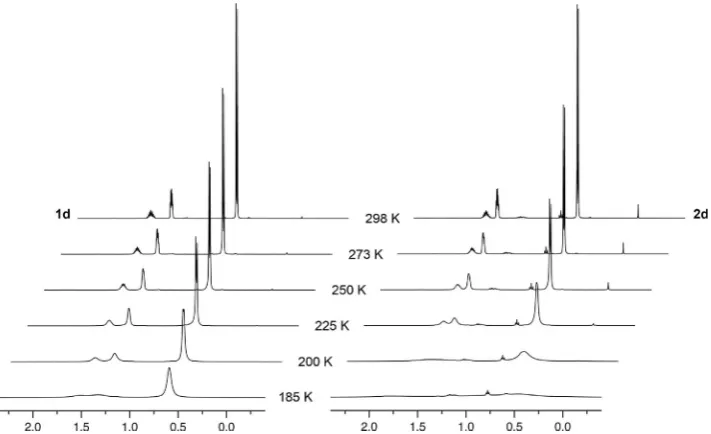
spectra on cooling, in no instance was the slow exchange regime reached (see the Supporting Information). Consequent-ly, conclusive interpretation and quantitative comparison of the variable temperature data was not possible. Nevertheless some general trends can be elucidated from qualitative inspec-tion of the NMR data. For instance, as gauged though relative changes in the line broadening of the1H signals, the onset of
decoalescence occurs at noticeably higher temperatures for the iridium trialkylphosphine complexes 2b–d compared to the rhodium variants1b–d. For the triisobutylphosphine deriv-atives, for example, appreciable line broadening is apparent in the 1H NMR spectrum of 2d on cooling from 298 to 225 K,
whereas additional cooling to 200 K is required for similar changes in the spectrum of1d(Figure 5). Reinforcing interpre-tation of the solid-state data, this observation is consistent with stronger agostic interactions in the heavier group 9 con-geners. In a similar manner analysis of the1H NMR spectra
indi-cates that more persistent M@H@C bonding is adopted in 1d
and2dthan the other trialkylphosphine complexes and more-over in the relative order PiBu3>PCy3>PiPr. Although such a
trend is not borne out in the observed M1@C21/C31 distances, negative correlations can be drawn out through the extent of phosphine distortion associated with forming a significant agostic interaction, that is, the P2<npln and C4-M1-P2 angles (Table 1).
As for the trialkylphosphine complexes,1a and 2a display time averaged C2v symmetry in CD2Cl2 solution at 298 K
(500 MHz). For these complexes, however, partial decoales-cence of the1H signals of the phosphine substituents occurred
on cooling to 185 K that we attribute to P@Ph restricted rota-tion of the phosphine ligands. The slow exchange regime is most advanced for1a compared to 2a and at this tempera-ture the phosphine 31P and the four 2,2’-biphenyl 1H
resonan-ces remained sharp. The1H NMR spectrum of1a recorded at
(time averaged across all the substituents). Such an interaction would explain why P@Ph restricted rotation is observed at low temperature by1H NMR spectroscopy (largeDd
1H), but not by 31P NMR spectroscopy (smallDd
31P).
An alternative approach to gauge the degree of metal liga-tion in these homologous series could involve a chemical shift based-scale employing the13C resonances of the coordinated
carbons of the 2,2’-biphenyl ancillary ligand (dC, Table 3) that
are trans to the “free” coordination sites. Similar approaches employing the13C resonances oftrans-disposed NHC ligands[29]
or metal-carbides[30]as ligand electronic parameters have been
used to excellent effect. For 1 and 2, absolute values of dC
cannot be used due to non-negligible contributions from the different cis phosphine ligands.[31] We have attempted to
de-convolute such contributions by using the chemical shift differ-ence between1and2and their respective precursors3and4, however, it is not possible to draw a conclusive trend for all the phosphine ligands studied (Table 3). The smallest differen-ces, however, are observed for the triisobutylphosphine deriva-tives, consistent with the adoption of the strongest agostic in-teractions.
Computational insights
Supplementing the experimental findings, the structures of
low-coordinate complexes 1 and 2 have been examined in
silico using DFT-based calculations at the pbe0/def2-tzvp level of theory.[32] In accord with the preceding analysis, structures
of the associated cations were optimised starting from geome-tries of only the well-ordered/major disordered components of cations observed in the solid-state;1’and2’. In the case of the triphenylphosphine adducts, structures of both low-coordinate
1a’ and 2a’ (1a’ depicted in Figure 6) and dichloromethane complexes 1a’·CH2Cl2 and 2a’·CH2Cl2 were interrogated. The
binding of dichloromethane to low-coordinate 1a’and 2a’is calculated to be weak ([email protected]/@5.96 kcalmol@1) and
ulti-mately formation of 1a’·CH2Cl2 and 2a’·CH2Cl2 are predicted
to be significantly endoergic at 298 K (DG298K= +9.20/+
9.34 kcalmol@1). These data therefore imply retention of the
halocarbon would be entropically disfavoured in solution,[33]
reconciling the experimental evidence.
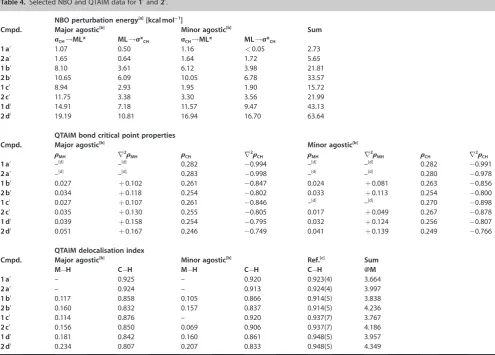
The presence of agostic interactions in the trialkylphosphine complexes was fully corroborated by analysis of 1b–d’ and
2b–d’ using both the Natural Bond Orbital (NBO) and Quan-tum Theory of Atoms in Molecules (QTAIM) approaches (Figure 7, Table 4).[34]Using the former, adoption of
3-centre-2-electron M@H@C bonds is evidenced through significant per-turbation energies associated withsCH!ML* and ML!s*CH
in-teractions (21.81–63.64 kcalmol@1), while examination of the
electron density using the latter reveals characteristic curved bond paths between the metal centre and hydrogen atom and associated critical point properties (1MH=0.017–0.051;r21MH=
+0.049–+0.167).[35] Moreover, using the more intuitive bond
delocalisation parameter, significant M@H and correspondingly reduced C@H “bond orders” are apparent from the QTAIM anal-ysis.
The associated metrics help quantify previous trends eluci-dated from the experimental work: significantly stronger
agos-Table 3.Selected NMR data for1and2(CD2Cl2, 298 K).
Compd. Sym. dP(1JRhP) DdP(D1JRhC)[a] dC(1JRhC) DdC(D1JRhC)[a]
1a C2v 19.7 (118 Hz) @9.0 (@1 Hz) 154.8 (39 Hz) @8.9 (+6 Hz)
2a C2v 11.6 @10.1 127.0 @11.4
1b C2v 13.4 (109 Hz) @0.4 (+1 Hz) 153.8 (44 Hz) @8.6 (+7 Hz)
2b C2v 3.0 +8.4 125.8 @11.4
1c C2v 25.7 (112 Hz) +2.7 (+3 Hz) 152.1 (44 Hz) @8.6 (+9 Hz)
2c C2v 17.8 +12.0 123.4 @12.4
1d C2v 18.5 (110 Hz) +5.6 (+1 Hz) 156.6 (43 Hz) @6.7 (+7 Hz)
2d C2v 14.5 +13.9 130.3 @7.9
[a] Change in parameter relative to that measured in3(M=Rh) or4(M= Ir).
Figure 5.Variable temperature1H NMR spectra of1dand2d(CD
[image:7.595.122.478.65.282.2]tic interactions are adopted in the iridium congeners, with around 40 % larger NBO donor-acceptor energies and QTAIM M@H delocalisation indices, and the degree of agostic bonding decreases in the order, PiBu3@PCy3>PiPr3 (notably for 1c’
only one agostic interaction is detected in the QTAIM analysis). Although the optimised structures of1a’and2a’show sig-nificant distortion of the phosphine substituents towards the metal, only very weak agostic interactions are inferred from the NBO analysis with the perturbation energies associated with sCH!ML* and ML!s*CH interactions <6 kcalmol@1 (cf.
>15 kcalmol@1 for the alkyl phosphine complexes). Moreover,
inspection of the donor-acceptor NBO interactions associated with the phosphine substituents proximate to the metal centre show no significant p-interactions. No bond paths between the metal centre and associated hydrogen atoms were detect-ed in the QTAIM analysis. The data are therefore consistent with very low-coordinate complexes. Indeed, the metal centres in these complexes have the lowest sum of delocalisation indi-ces for each respective metal series (3.664,1a’; 3.997,2a’).
Conclusion
A homologous family of low-coordinate complexes of the for-mulation trans-[M(2,2’-biphenyl)(PR3)2][BArF4] (M=Rh, 1; Ir, 2;
R=Ph,a; Cy,b;iPr,c;iBu,d) has been prepared and extensive-ly structuralextensive-ly characterised. The formation of these sawhorse complexes is promoted through incorporation of the high
trans influence 2,2’-biphenyl ancillary ligand and stabilised through the adoption of weak agostic interactions, at the op-posing open coordination sites, between the phosphine ligand substituents and the metal centres.
Enabled through a comprehensive set of solution phase (VT
1H and 31P NMR spectroscopy) and solid-state (single crystal
X-ray diffraction) experimental data, and analysis in silico (DFT-based NBO and QTAIM analysis), the structural features of the
constituent agostic interactions have been systematically inter-rogated. The combined data substantiates the adoption of stronger agostic interactions for the IrIIIcompared to RhIII
com-plexes and, with respect to the phosphine ligands, in the order PiBu3>PCy3>PiPr3>PPh3.
In contrast to the trialkylphosphine complexes which feature notable M@H@C bonds, the triphenylphosphine variants are in-stead only obtained in the solid-state as adducts of the weakly coordinating solvent dichloromethane employed; 1a·CH2Cl2
and 2a·CH2Cl2. The entropically unstable nature of these
ad-ducts was, however, evidenced in solution by1H and31P NMR
spectroscopy and is supported by DFT calculations. Moreover, NBO and QTAIM analysis of optimised structures of1aand2a
highlight the insubstantial nature of M@H@C bonds in these low-coordinate complexes. The formation of the strongest agostic interactions observed in triisobutylphosphine deriva-tives is attributed to the flexible nature of the isobutyl sub-stituents, and associated with Rh@C and Ir@C distances of 2.863(5)/2.979(4) and 2.781(7)/2.956(6) a, respectively, in the solid-state and reduced structural dynamics in solution. For these complexes, extensive sCH!ML* and ML!s*CH
interac-tions are apparent in the NBO perturbation analysis (1d’, 43.13;2d’, 63.64 kcalmol@1) and significant QTAIM M@H bond
delocalication indices are calculated (1d’, 0.181/0.160; 2d’, 0.234/0.207).
In addition to the above structure–property relationships, the effect of crystal packing on agostic interactions was investi-gated in 1b and 2b. Compression of the associated cations, through inclusion of a more bulky solvent molecule (1,2-di-fluorobenzene vs. CH2Cl2) in the lattice or collection of data at
very low temperature (25 K vs. 150 K), lead to small but statisti-cally significant shortening of the M@H@C distances.
Experimental Section
General synthetic methods
All manipulations were performed under an atmosphere of argon using Schlenk and glove box techniques. Glassware was oven-dried at 1508C overnight and flamed under vacuum prior to use. CH2Cl2, CD2Cl2 and 1,2-difluorobenzene were dried over CaH2,
vacuum distilled, and then stored over thoroughly vacuum-dried 3 a molecular sieves. Pentane was dried over Na/K alloy, vacuum distilled, and then stored over thoroughly vacuum-dried 3 a molec-ular sieves. [Rh(2,2’-biphenyl)(dtbpm)Cl] 5,[16] [Ir(2,2’
-biphenyl)(-COD)Cl]2 6,[17] and Na[BArF4][36] were synthesised using literature
protocols. trans-[Rh(2,2’-biphenyl)(PPh3)2Cl] 3 a[16] and trans-[Ir(2,2’
-biphenyl)(PPh3)2Cl]4a[17]were prepared using slightly adapted
[image:8.595.110.229.63.216.2]lit-erature procedures that are described below for completeness. All other solvents and reagents are commercial products and were used as received. NMR spectra were recorded on Bruker DPX, AV and HD spectrometers at 298 K unless otherwise stated. Variable temperature data was collected on a Bruker AV 500 MHz spectrom-eter. Low-resolution electrospray ionisation mass spectra (LR ESI-MS) were recorded on an Agilent 6130B single Quad spectrometer. High-resolution electrospray ionisation mass spectra (HR ESI-MS) were recorded on a Bruker MaXis II spectrometer. Microanalyses were performed by Stephen Boyer at London Metropolitan Univer-sity.
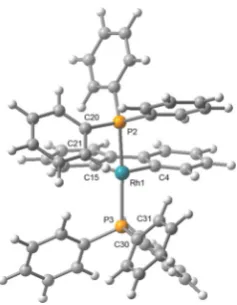
Figure 6.Optimised structure of1a’. Selected bond lengths (a) and angles (8) for1a’: Rh1@P2, 2.3413; Rh1@P3, 2.3482; Rh1@C4, 1.977; Rh1@C15, 1.969; Rh1@C21, 3.183; Rh1@C31, 3.272; P2-Rh1-P3, 166.34; C4-Rh1-C15, 82.73; P2<npln, 5.89; C4-Rh1-P2, 97.00; Rh1-P2-C20, 94.85; P3<npln, 8.00; C15-Rh1-P3, 94.58; Rh1-P3-C30, 101.30. Equivalent metrics for2a’: Ir1@P2, 2.3432; Ir1@P3, 2.3423; Ir1@C4, 1.993; Ir1@C15, 1.988; Ir1@C21, 3.243; Ir1@
Synthesis oftrans-[M(2,2’-biphenyl)(PR3)2Cl] (M=Rh, 3; Ir, 4)
3a: A solution of 5 (30.0 mg, 50.4mmol) and PPh3 (28.4 mg,
108mmol) in CH2Cl2(5 mL) was stirred at RT for 3 hours. The
prod-uct was precipitated by addition of excess Et2O (ca. 20 mL) and
[image:9.595.58.547.63.230.2]iso-lated by filtration. Yield: 25.1 mg (83%, microcrystalline yellow solid). Spectroscopic data is fully consistent with previously report-ed values.[16]
Figure 7.Key NBO orbital overlaps associated with the major agostic interaction in1d’, QTAIM molecular graph of1d’(showing bond paths, bond critical points and ring critical points), and calculated electron density topology associated with the major agostic interaction in1d’(showing bond paths and elec-tron density at bond critical points).
Table 4.Selected NBO and QTAIM data for1’and2’.
NBO perturbation energy[a][kcal mol@@1]
Cmpd. Major agostic[b] Minor agostic[b] Sum sCH!ML* ML!s*CH sCH!ML* ML!s*CH
1a’ 1.07 0.50 1.16 <0.05 2.73
2a’ 1.65 0.64 1.64 1.72 5.65
1b’ 8.10 3.61 6.12 3.98 21.81
2b’ 10.65 6.09 10.05 6.78 33.57
1c’ 8.94 2.93 1.95 1.90 15.72
2c’ 11.75 3.38 3.30 3.56 21.99
1d’ 14.91 7.18 11.57 9.47 43.13
2d’ 19.19 10.81 16.94 16.70 63.64
QTAIM bond critical point properties
Cmpd. Major agostic[b] Minor agostic[b]
1MH r21MH 1CH r21CH 1MH r21MH 1CH r21CH
1a’ –[d] –[d] 0.282 @0.994 –[d] –[d] 0.282 @0.991
2a’ –[d] –[d] 0.283 @0.998 –[d] –[d] 0.280 @0.978
1b’ 0.027 +0.102 0.261 @0.847 0.024 +0.081 0.263 @0.856
2b’ 0.034 +0.118 0.254 @0.802 0.033 +0.113 0.254 @0.800
1c’ 0.027 +0.107 0.261 @0.846 –[d] –[d] 0.270 @0.898
2c’ 0.035 +0.130 0.255 @0.805 0.017 +0.049 0.267 @0.878
1d’ 0.039 +0.158 0.254 @0.795 0.032 +0.124 0.256 @0.807
2d’ 0.051 +0.167 0.246 @0.749 0.041 +0.139 0.249 @0.766
QTAIM delocalisation index
Cmpd. Major agostic[b] Minor agostic[b] Ref.[c] Sum M@H C@H M@H C@H C@H @M
1a’ – 0.925 – 0.920 0.923(4) 3.664
2a’ – 0.924 – 0.913 0.924(4) 3.997
1b’ 0.117 0.858 0.105 0.866 0.914(5) 3.838
2b’ 0.160 0.832 0.157 0.837 0.914(5) 4.236
1c’ 0.114 0.876 – 0.920 0.937(7) 3.767
2c’ 0.156 0.850 0.069 0.906 0.937(7) 4.186
1d’ 0.181 0.842 0.160 0.861 0.948(5) 3.957
2d’ 0.234 0.807 0.207 0.833 0.948(5) 4.349
[a] Resulting from interactions ofsCHands*CHorbitals with the metal 2,2’-biphenylsMCands*MCorbitals. [b] Assignment based on M@C bond length, for
[image:9.595.51.547.296.651.2]1H NMR(500 MHz, CD
2Cl2):d=7.42 (d,3JHH=7.8 Hz, 2H, biph), 7.32
(t,3J
HH=7.4 Hz, 6H, Ph), 7.27 (br, fwhm=30 Hz, 12 H, Ph), 7.17 (t, 3J
HH=7.6 Hz, 12H, Ph), 6.57 (t, 3JHH=7.3 Hz, 2H, biph), 6.45 (td, 3J
HH=7.5 Hz, 4JHH=1.6 Hz, 2H, biph), 6.34 (dd, 3JHH=7.5 Hz, 4JHH=
1.6 Hz, 2H, biph). 13C{1H} NMR (126 MHz, CD
2Cl2): d=163.7 (dt, 1J
RhC=33 Hz, 2JPC=10 Hz), 153.9 (s, biph), 135.0 (t, JPC=5 Hz, Ph),
133.1 (s, biph), 130.7 (t,JPC=23 Hz, Ph), 130.4 (s, Ph), 128.2 (t,JPC=
5 Hz, Ph), 123.8 (s, biph), 122.9 (s, biph), 122.1 (s, biph).
31P{1H} NMR (162 MHz, CD
2Cl2): d=28.7 (d, 1JRhP=119 Hz). LR
ESI-MS(positive ion): 779.1 ([M@Cl]+, calcd 779.1)m/z.
3b: A solution of 5 (50.0 mg, 84.0mmol) and PCy3 (47.4 mg,
169mmol) in CH2Cl2(5 mL) was stirred at RT for 16 hours. The
re-sulting precipitate was filtered and washed with cold CH2Cl2 (3V
5 mL). Yield: 59.3 mg (83%, yellow solid).
1H NMR(500 MHz, CD
2Cl2):d=7.70 (d,3JHH=8.0 Hz, 2H, biph), 7.32
(dd,3J
HH=7.6 Hz,4JHH=1.6 Hz, 2H, biph), 6.92 (t,3JHH=7.3 Hz, 2H,
biph), 6.76 (dt, 3J
HH=7.5 Hz, 4JHH=1.6 Hz, 2H, biph), 2.03 (app. t,
J=12 Hz, 6H, Cy), 1.53–1.66 (m, 30 H, Cy), 1.26 (app. q,J=12 Hz, 14H, Cy), 0.99–1.18 (m, 16H, Cy). 13C{1H} NMR (126 MHz, CD
2Cl2):
d=162.4 (dt, 1J
RhC=37 Hz,2JPC=9 Hz, biph), 153.2 (s, biph), 137.2
(s, biph), 124.6 (s, biph), 122.6 (s, biph), 120.2 (s, biph), 35.3 (t,JPC=
9 Hz, Cy), 30.6 (Cy), 28.4 (t, JPC=5 Hz, Cy), 26.9 (Cy). 31P{1H} NMR
(121 MHz, CD2Cl2): d=13.8 (d, 1JRhP=108 Hz).HR ESI-MS(positive
ion): 815.4309 ([M@Cl]+, calcd 815.4315)m/z.Despite repeated
at-tempts we have been unable to obtain satisfactory microanalytical data for this compound.
3c: To a solution of 5 (17.8 mg, 30.0mmol) in CH2Cl2 (5 mL) was
added PiPr3(0.84min pentane, 71.8mL, 60.3mmol) and the
result-ing solution stirred at RT for 3 hours. The volatiles were removed in vacuo and the residue extracted with CH2Cl2(5 mL) through a
short plug of neutral Al2O3. The solvent was then removed in
vacuo to afford the pure product. Yield: 6.8 mg (37%, yellow solid).
1H NMR(500 MHz, CD
2Cl2):d=7.77 (d,3JHH=7.9 Hz, 2H, biph), 7.30
(dd,3J
HH=7.5 Hz,4JHH=1.6 Hz, 2H, biph), 6.94 (t,3JHH=7.3 Hz, 2H,
biph), 6.76 (td, 3J
HH=7.6 Hz, 4JHH=1.6 Hz, 2H, biph), 2.36–2.44 (m,
6H, CH(CH3)2), 0.98 (app. q, J=7 Hz, 36H, CH3). 13C{1H} NMR
(126 MHz, CD2Cl2): d=160.7 (dt, 1JRhC=35 Hz, 2JPC=9 Hz, biph),
154.4 (s, biph), 136.8 (s, biph), 124.7 (s, biph), 123.1 (s, biph), 120.3 (s, biph), 24.1 (t, JPC=10 Hz, CH(CH3)2), 20.3 (s, CH3). 31P{1H} NMR
(121 MHz, CD2Cl2): d=23.0 (d, 1JRhP=109 Hz).HR ESI-MS(positive
ion): 575.2436 ([M@Cl]+, calcd 575.2437) m/z. Anal. Calcd for
C30H50ClP2Rh (611.03 gmol@1): C, 58.97; H, 8.25; N, 0.00. Found: C,
58.82; H, 8.09; N, 0.00.
3d: To a solution of5 (17.8 mg, 30.0mmol) in CH2Cl2 (5 mL) was
added PiBu3(15.1mL, 60.3mmol) and the resulting solution stirred
at RT for 3 hours. The volatiles were removed in vacuo and the res-idue extracted with CH2Cl2(5 mL) through a short plug of neutral
Al2O3. The solvent was then removed in vacuo to afford the pure
product. Yield: 11.6 mg (56%, yellow solid).
1H NMR(500 MHz, CD
2Cl2):d=7.53 (d,3JHH=7.8 Hz, 2H, biph), 7.34
(dd,3J
HH=7.5 Hz,4JHH=1.6 Hz, 2H, biph), 6.96 (t,3JHH=7.3 Hz, 2H,
biph), 6.79 (td, 3J
HH=7.5 Hz, 4JHH=1.6 Hz, 2H, biph), 1.75–1.87 (m,
6H, CH2CH), 1.43 (app. dt, J=6 Hz, J=3 Hz, 12H, CH2), 0.78 (d, 3J
HH=6.7 Hz, 36H, CH3). 13C{1H} NMR (126 MHz, CD2Cl2): d=163.3
(dt,1J
RhC=36 Hz,2JPC=10 Hz, biph), 152.6 (s, biph), 134.5 (s, biph),
125.4 (s, biph), 122.9 (s, biph), 120.7 (s, biph), 32.6 (t,JPC=11 Hz,
CH2), 26.1 (t, JPC=3 Hz, CH2CH), 25.1 (s, CH3). 31P{1H} NMR
(162 MHz, CD2Cl2): d=12.9 (d, 1JRhP=109 Hz).HR ESI-MS(positive
ion): 659.3378 ([M@Cl]+, calc. 659.3376) m/z. Anal. Calcd for
C36H62ClP2Rh (695.20 gmol@1): C, 62.20; H, 8.99; N, 0.00. Found: C,
61.89; H, 8.84; N, 0.00.
4a: A solution of 6 (50.0 mg, 51.2mmol) and PPh3 (54.0 mg,
206mmol) in CH2Cl2(5 mL) was stirred at RT for 18 hours. The
prod-uct was precipitated by addition of excess Et2O (ca. 20 mL) and
iso-lated by filtration. Yield: 64.1 mg (83%, microcrystalline yellow solid). Spectroscopic data is fully consistent with previously report-ed values.[17]
1H NMR(500 MHz, CD
2Cl2): d=7.34 (d,3JHH=8 Hz, 2H, biph), 7.32
(t,3J
HH=7.5 Hz, 6H, Ph), 7.25 (br, fwhm=40 Hz, 12 H, Ph), 7.18 (t, 3J
HH=7.5 Hz, 12H, Ph), 6.47 (t, 3JHH=7.3 Hz, 2H, biph), 6.28 (td, 3J
HH=7.6 Hz, 4JHH=1.6 Hz, 2H, biph), 6.26 (dd, 3JHH=7.5 Hz, 4JHH=
1.6 Hz, 2H, biph). 13C{1H} NMR (126 MHz, CD
2Cl2): d=155.6 (s,
biph), 138.4 (t, 2J
PC=7 Hz, biph), 135.1 (t, JPC=5 Hz, Ph), 132.8 (t, 3J
PC=2 Hz, biph), 130.4 (s, Ph), 130.1 (t, JPC=27 Hz, Ph), 128.2 (t,
JPC=5 Hz, Ph), 123.8 (s, biph), 122.3 (s, biph), 121.4 (s, biph).31P{1H}
NMR(162 MHz, CD2Cl2):d=21.7 (s).LR ESI-MS(positive ion): 869.2
([M@Cl]+, calcd 869.2)m/z.
4b: A solution of 6 (60.0 mg, 61.5mmol) and PCy3 (69.3 mg,
247mmol) in CH2Cl2(5 mL) was stirred at RT for 16 hours. The
re-sulting precipitate was filtered and washed with CH2Cl2(3V5 mL).
Yield: 93.0 mg (80%, orange solid).
1H NMR(500 MHz, CD
2Cl2):d=7.53 (d,3JHH=7.8 Hz, 2H, biph), 7.25
(dd,3J
HH=7.6 Hz,4JHH=1.5 Hz, 2H, biph), 6.83 (t,3JHH=7.3 Hz, 2H,
biph), 6.64 (td, 3J
HH=7.3 Hz, 4JHH=1.5 Hz, 2H, biph), 2.15 (app. t,
J=12 Hz, 6H, Cy), 1.56–1.69 (m, 18 H, Cy), 1.56–1.42 (m, 12 H, Cy), 1.27 (app. q, J=12 Hz, 12 H, Cy), 1.18–0.97 (m, 18H, Cy). 13C{1H}
NMR (126 MHz, CD2Cl2): d=154.4 (s, biph), 137.2 (t, 2JPC=7 Hz,
biph), 135.9 (s, biph), 124.8 (s, biph), 121.9 (s, biph), 119.8 (s, biph), 35.0 (t,JPC=12 Hz, Cy), 30.6 (s, Cy), 28.4 (t,JPC=5 Hz, Cy), 26.9 (s,
Cy).31P{1H} NMR(162 MHz, CD
2Cl2):[email protected] (s).HR ESI-MS
(posi-tive ion): 905.4904 ([M@Cl]+, calcd 905.4893)m/z.Anal. Calcd for
C48H74ClIrP2 (940.73 gmol@1): C, 61.28; H, 7.93; N, 0.00. Found: C,
61.17; H, 8.01; N, 0.00.
4c: To a solution of 6 (60.0 mg, 61.5mmol) in CH2Cl2 (5 mL) was
added PiPr3(0.84min pentane, 293mL, 247mmol) and the resulting
solution stirred at RT for 16 hours. The solution was concentrated to ca. 2 mL, diluted with pentane (5 mL), and then filtered. The fil-trate was dried in vacuo and the residues washed with pentane (2 mL) at@788C to afford the pure product. Yield: 59.0 mg (69%, orange solid).
1H NMR (500 MHz, CD
2Cl2): d=7.62 (dd, 3JHH=7.9 Hz, 2H, biph),
7.23 (dd,3J
HH=7.5 Hz, 4JHH=1.6 Hz, 2H, biph), 6.84 (t,3JHH=7.3 Hz,
2H, biph), 6.61 (td,3J
HH=7.5 Hz, 4JHH=1.6 Hz, biph), 2.48–2.56 (m,
6H, CH(CH3)2), 0.98 (app. q, J=7 Hz, 36H, CH3). 13C{1H} NMR
(126 MHz, CD2Cl2): d=155.8 (s, biph), 135.8 (t, 2JPC=7 Hz, biph),
135.7 (s, biph), 124.7 (s, biph), 122.5 (s, biph), 120.0 (s, biph), 23.7 (t, JPC=13 Hz, CH(CH3)2), 20.3 (s, CH3). 31P{1H} NMR (121 MHz,
CD2Cl2): d=5.8 (s). HR ESI-MS (positive ion): 665.3012 ([M@Cl]+,
calcd 665.3013)m/z.Anal.Calcd for C30H50ClIrP2(700.34 gmol@1): C,
51.45; H, 7.20; N, 0.00. Found: C, 51.45; H, 7.39; N, 0.00.
4d: To a solution of6 (60.0 mg, 61.5mmol) in CH2Cl2 (5 mL) was
added PiBu3 (61.6mL, 247mmol) and the resulting solution stirred
at RT for 16 hours. The solution was concentrated to ca. 2 mL, di-luted with pentane (5 mL), and then filtered. The solvent was then removed in vacuo to afford the pure product. Yield=78.0 mg (81%, orange solid).
1H NMR(500 MHz, CD
2Cl2):d=7.43 (d,3JHH=7.7 Hz, 2H, biph), 7.27
(dd,3J
HH=7.5 Hz,4JHH=1.5 Hz, 2H, biph), 6.88 (t,3JHH=7.3 Hz, 2H,
biph), 6.66 (td, 3J
HH=7.6 Hz,4JHH=1.5 Hz, 2H, biph), 1.75–1.85 (m,
6H CH2CH), 1.52 (app. dt, J=6 Hz,J=3, 12 H, CH2), 0.76 (d,3JHH=
6.7 Hz, 36 H, CH3). 13C{1H} NMR (126 MHz, CD2Cl2): d=154.1 (s,
biph), 138.2 (t, 2J
PC=7 Hz, biph), 134.1 (s, biph), 125.5 (s, biph),
4 Hz, CH2CH), 25.0 (s, CH3).31P{1H} NMR(202 MHz, CD2Cl2):d=0.6
(s). HR ESI-MS (positive ion): 749.3954 ([M@Cl]+, calcd 749.3952)
m/z.Anal.Calcd for C36H62ClIrP2(784.51 gmol@1): C, 55.12; H, 7.97;
N, 0.00. Found: C, 55.26; H, 8.05; N, 0.00.
Synthesis oftrans-[M(2,2’-biphenyl)(PR3)2][BArF4] (M=Rh, 1;
Ir, 2)
General procedure: Suspensions of 3/4 (1.0 eqv., 10 mm) and Na[BArF
4]/Li[Al{OC(CF3)3}4] (1.1 eqv.) in CH2Cl2(ca. 5 mL) were stirred
at RT for 18 hours, diluted with small quantity of pentane and fil-tered. Crystalline products were obtained upon layering the filtrate with pentane. The supernatant was decanted away and the crystal-line materials washed with pentane and dried in vacuo.
1a·CH2Cl2: Prepared from 3 a (20.0 mg, 24.5mmol) and Na[BArF4]
(23.9 mg, 27.0mmol). Yield: 33.9 mg (80%, orange crystals).
1H NMR(500 MHz, CD
2Cl2):d=7.71–7.76 (m, 8H, ArF), 7.56 (br, 4H,
ArF), 7.50 (t,3J
HH=7.5 Hz, 6H, Ph), 7.32 (t, 3JHH=7.7 Hz, 12H, Ph),
6.99–7.05 (m, 14 H, Ph+biph), 6.87 (t,3J
HH=7.3 Hz, 2H, biph), 6.76
(td, 3J
HH=7.7 Hz, 3JHH=1.6 Hz, 2H, biph), 6.65 (dd, 3JHH=7.5 Hz, 3J
RhH=1.6 Hz, 2H, biph). 13C{1H} NMR(126 MHz, CD2Cl2): d=162.3
(q, 1J
CB=50 Hz, ArF), 154.8 (dt, 1JRhC=39 Hz, 2JPC=10 Hz, biph),
150.0 (s, biph), 135.4 (s, ArF), 134.0 (t,J
PC=6 Hz, Ph), 132.4 (s, Ph),
131.7 (s, biph), 129.7 (t,JPC=5 Hz, Ph), 129.4 (qq,2JFC=32 Hz,3JBC=
3 Hz, ArF), 126.9 (t,J
PC=24 Hz, Ph), 126.5 (s, biph), 125.3 (s, biph),
125.2 (q, 1J
FC=272 Hz, ArF), 123.6 (s, biph), 118.0 (sept,3JFC=4 Hz,
ArF).31P{1H} NMR(202 MHz, CD
2Cl2):d=19.7 (d, 1JRhP=118 Hz).HR
ESI-MS(positive ion): 779.1507 ([M@CH2Cl2]+, calcd 779.1498)m/z.
Anal. Calcd for C81H52BCl2F24P2Rh (1727.83 gmol@1): C, 56.31; H,
3.03; N, 0.00. Found: C, 56.42; H, 3.03; N, 0.00.
1b: Prepared from3b(30.0 mg, 35.2mmol) and Na[BArF
4] (34.3 mg,
38.8mmol). Yield: 42.4 mg (71%, yellow crystals). Additional single crystals for analysis by X-ray diffraction were grown by recrystallisa-tion of this material from 1,2-difluorobenzene/pentane.
1H NMR(500 MHz, CD
2Cl2):d=7.71–7.75 (m, 8H, ArF), 7.56 (br, 4H,
ArF), 7.48 (dd, 3J
HH=7.5 Hz, 4JHH=1.6 Hz, 2H, biph), 7.16 (t, 3JHH=
7.3 Hz, 2H, biph), 7.11 (d, 3J
HH=8.1 Hz, 2H, biph), 7.01 (td, 3JHH=
7.7 Hz,4J
HH=1.6 Hz, 2H, biph), 1.95–2.05 (m, 6H, Cy), 1.67–1.77 (m,
18H, Cy), 1.24–1.38 (m, 24H, Cy), 1.13–1.24 (m, 18H, Cy). 13C{1H}
NMR (126 MHz, CD2Cl2): d=162.3 (q, 1JCB=50 Hz, ArF), 153.8 (dt, 1J
RhC=44 Hz,2JPC=8 Hz, biph), 148.8 (d,2JRhC=4 Hz, biph), 135.4 (s,
ArF), 129.8 (s, biph), 129.4 (qq,2J
FC=32 Hz,3JBC=3 Hz, ArF), 128.0 (s,
biph), 125.5 (s, biph), 125.2 (q, 1J
FC=272 Hz, ArF), 122.1 (d,2JRhC=
2 Hz, biph), 118.0 (sept,3J
FC=4 Hz, ArF), 35.1 (t,JPC=10 Hz, Cy), 30.4
(s, Cy), 27.9 (t, JPC=5 Hz, Cy), 26.3 (s, Cy). 31P{1H} NMR(202 MHz,
CD2Cl2): d=13.4 (d, 1JRhP=109 Hz). HR ESI-MS (positive ion):
815.4325 ([M]+, calcd 815.4315)m/z.Anal.Calcd for C
80H86BF24P2Rh
(1679.19 gmol@1): C, 57.22; H, 5.16; N, 0.00. Found: C, 57.38; H,
5.26; N, 0.00.
1c: Prepared from3c(20.0 mg, 32.7mmol) and Na[BArF
4] (31.9 mg,
36.0mmol). Yield: 27.1 mg (58%, orange crystals). Spectroscopic data is fully consistent with previously reported values.[13]
1H NMR(500 MHz, CD
2Cl2):d=7.70–7.75 (m, 8H, ArF), 7.56 (br, 4H,
ArF), 7.46 (dd, 3J
HH=7.6 Hz, 4JHH=1.6 Hz, 2H, biph), 7.24 (d,3JHH=
8.1 Hz, 2H, biph), 7.15 (t, 3J
HH=7.4 Hz, 2H, biph), 6.98 (td, 3JHH=
7.8 Hz,4J
HH=1.6, 2H, biph), 2.24–2.36 (m, 6H, CH(CH3)2), 1.02 (app.
q,J=7 Hz, 36 H, CH3).13C{1H} NMR(126 MHz, CD2Cl2):d=162.3 (q, 1J
CB=50 Hz, ArF), 152.1 (dt,1JRhC=44 Hz,2JPC=8 Hz, biph), 148.6 (d, 2J
RhC=5 Hz, biph), 135.4 (s, ArF), 129.6 (s, biph), 129.4 (qq, 2JFC=
32 Hz, 3J
CB=3 Hz, ArF), 128.0 (s, biph), 125.8 (s, biph), 125.2 (q, 1J
FC=272 Hz, ArF), 122.5 (s, biph), 118.0 (sept, 3JFC=4 Hz, ArF), 24.3
(t, JPC=11 Hz, CH(CH3)2), 19.7 (s, CH3). 31P{1H} NMR (202 MHz,
CD2Cl2): d=25.7 (d, 1JRhP=112). LR ESI-MS (positive ion): 575.2
([M]+, calcd 575.2)m/z.
1d: Prepared from3d(25.1 mg, 36.1mmol) and Na[BArF
4] (35.2 mg,
39.7mmol). Yield: 39.3 mg (71%, orange crystals).
1H NMR(500 MHz, CD
2Cl2):d=7.71–7.75 (m, 8H, ArF), 7.56 (br, 4H,
ArF), 7.52 (dd,3J
HH=7.5 Hz, 4JHH=1.6 Hz, 2H, biph), 7.17 (t, 3JHH=
7.4 Hz, 2H, biph), 7.08 (d,3J
HH=8.0 Hz, 2H, biph), 6.98 (td,3JHH=
7.7 Hz, 4J
HH=1.6 Hz, 2H, biph), 1.57–1.71 (m, 6H, CH2CH), 1.43
(app. dt, J=6 Hz, J=3 Hz, 12H, CH2), 0.75 (d, 3JHH=6.6 Hz, 36H,
CH3).13C{1H} NMR(126 MHz, CD2Cl2):d=162.3 (q,1JCB=50 Hz, ArF),
156.6 (dt, 1J
RhC=43 Hz, 2JPC=9 Hz, biph), 148.7 (d, 2JRhC=4 Hz,
biph), 135.4 (ArF), 130.2 (app. t, J=2 Hz, biph), 129.4 (qq, 2J FC=
31 Hz,3J
CB=3 Hz, ArF), 128.0 (s, biph), 125.6 (biph), 125.2 (q,1JFC=
272 Hz, ArF), 123.1 (s, biph), 118.0 (sept, 3J
FC=4 Hz, ArF), 33.2 (t,
JPC=12 Hz, CH2), 25.9 (t,JPC=3 Hz, CH2CH), 25.6 (s, CH3). 31P{1H}
NMR(202 MHz, CD2Cl2):d=18.5 (d,1JRhP=110 Hz).HR ESI-MS
(pos-itive ion): 659.3383 ([M]+, calcd 659.3376) m/z. Anal. Calcd for
C68H74BF24P2Rh (1522.96 gmol@1): C, 53.63; H, 4.90; N, 0.00. Found:
C, 53.76; H, 4.81; N, 0.00.
1d*: Prepared from 3d (5.0 mg, 7.2mmol) and Li[Al{OC(CF3)3}4]
(7.7 mg, 7.9mmol). Yield: 4.4 mg (38%, orange crystals).
1H NMR(300 MHz, CD
2Cl2):d=7.52 (d,3JHH=7.6 Hz, 2H, biph), 7.18
(t,3J
HH=7.6 Hz, 2H, biph), 7.08 (d,3JHH=8.1 Hz, 2H, biph), 6.99 (t, 3J
HH=7.6 Hz, 2H, biph), 1.56–1.74 (m, 6H, CH2CH), 1.44 (br, fwhm=
12 Hz, 12H, CH2), 0.77 (d, 3JHH=6.3 Hz, 36 H, CH3). 31P{1H} NMR
(121 MHz, CD2Cl2): d=18.5 (d, 1JRhP=110 Hz). LR ESI-MS (positive
ion): 659.3 ([M]+, calcd 659.3)m/z.
2a·CH2Cl2: Prepared from 4 a (20.0 mg, 22.1mmol) and Na[BArF4]
(21.6 mg, 24.3mmol) according to a modification of the general procedure: the suspension was heating at 508C for 72 hours. Yield: 12.7 mg (32%, burgundy crystals).
1H NMR(500 MHz, CD
2Cl2):d=7.71–7.76 (m, 8H, ArF), 7.56 (br, 4H,
ArF), 7.50 (t,3J
HH=7.5 Hz, 6H, Ph), 7.33 (t, 3JHH=7.7 Hz, 12H, Ph),
7.04 (app q,J=6 Hz, 12H, Ph), 6.85 (d,3J
HH=7.9 Hz, 2H, biph), 6.77
(t,3J
HH=7.4 Hz, 2H, biph), 6.61 (td, 3JHH=7.7 Hz, 4JHH=1.6 Hz, 2H,
biph), 6.57 (dd,3J
HH=7.6 Hz, 4JHH=1.6 Hz, 2H, biph). 13C{1H} NMR
(126 MHz, CD2Cl2): d=162.3 (q, 1JCB=50 Hz, ArF), 150.8 (s, biph),
135.4 (s, ArF), 134.1 (t,J
PC=6 Hz, Ph), 132.4 (s, Ph), 130.5 (s, biph),
129.7 (t, JPC=5 Hz, Ph), 129.4 (q, 2JFC=31 Hz, ArF), 127.0 (t, 2JPC=
7 Hz, biph), 126.5 (t,JPC=28 Hz, Ph), 126.1 (s, biph), 125.2 (s, biph),
125.2 (q,1J
FC=272 Hz, ArF), 122.6 (s, biph), 118.0 (sept, ArF).31P{1H}
NMR (202 MHz, CD2Cl2): d=11.6 (s). HR ESI-MS (positive ion):
869.2088 ([M@CH2Cl2]+, calcd 869.2076) m/z. Anal. Calcd for
C81H52BCl2F24P2Ir (1817.14 gmol@1): C, 53.54; H, 2.88; N, 0.00. Found:
C, 53.67; H, 3.01; N, 0.00.
2b: Prepared from4b(30.0 mg, 30.3mmol) and Na[BArF
4] (28.2 mg,
38.8mmol). Yield: 42.0 mg (75%, orange crystals). Additional single crystals for analysis by X-ray diffraction were grown by recrystallisa-tion of this material from 1,2-C6H4F2/pentane.
1H NMR(500 MHz, CD
2Cl2):d=7.70–7.75 (m, 8H, ArF), 7.56 (br, 4H,
ArF), 7.43 (dd,3J
HH=7.6 Hz, 4JHH=1.6 Hz, 2H, biph), 7.07 (t, 3JHH=
7.4 Hz, 2H, biph), 6.92 (d,3J
HH=7.9 Hz, 2H, biph), 6.83 (td,3JHH=
7.6 Hz,4J
HH=1.6 Hz, 2H, biph), 2.06–2.16 (m, 6H, Cy), 1.68–1.81 (m,
18H, Cy), 1.34–1.46 (m, 12H, Cy), 1.10–1.29 (m, 30H, Cy). 13C{1H}
NMR (126 MHz, CD2Cl2): d=162.3 (q, 1JCB=50 Hz, ArF), 149.5 (s,
biph), 135.4 (s, ArF), 129.4 (qq,2J
FC=31 Hz,3JCB=3 Hz, ArF), 129.0 (s,
biph), 127.5 (s, biph), 125.8 (t, 2J
PC=6 Hz, biph), 125.2 (q, 1JFC=
272 Hz, ArF), 125.1 (s, biph), 121.6 (s, biph), 118.0 (s, ArF), 36.3 (t, 1J
PC=12 Hz, Cy), 30.4 (s, Cy), 27.8 (t, JPC=5 Hz, Cy), 26.3 (s, Cy).
31P{1H} NMR(202 MHz, CD
2Cl2):d=3.0 (s).HR ESI-MS(positive ion):
905.4912 ([M]+, calcd 905.4893)m/z.Anal.Calcd for C
(1768.50 gmol@1): C, 54.33; H, 4.90; N, 0.00. Found: C, 54.34; H,
5.01; N, 0.00.
2c: Prepared from4c(30.0 mg, 42.8mmol) and Na[BArF
4] (41.8 mg,
47.2mmol). Yield: 27.8 mg (64%, red crystals).
1H NMR(600 MHz, CD
2Cl2):d=7.71–7.75 (m, 8H, ArF), 7.56 (br, 4H,
ArF), 7.41 (dd, 3J
HH=7.6 Hz, 4JHH=1.6 Hz, 2H, biph), 7.05 (t, 3JHH=
7.4 Hz, 2H, biph), 6.99 (d, 3J
HH=8.0 Hz, 2H, biph), 6.79 (dt,3JHH=
7.7 Hz, 4J
HH=1.6 Hz, 2H, biph), 2.41–2.51 (m, 6H, CH(CH3)2), 1.00
(app. q, J=7 Hz, 36H, CH3). 13C{1H} NMR (151 MHz, CD2Cl2): d=
162.3 (q,1J
CB=50 Hz, ArF), 149.3 (s, biph), 135.4 (s, ArF), 129.4 (qq, 2J
FC=31 Hz,3JCB=3 Hz, ArF), 128.3 (s, biph), 127.3 (s, biph), 125.6 (s,
biph), 125.2 (q,1J
FC=272 Hz, ArF), 123.4 (t,2JPC=6 Hz, biph), 122.0
(s, biph), 118.0 (s, ArF), 25.3 (t, J
PC=13 Hz, CH(CH3)2), 19.7 (s, CH3).
31P{1H} NMR (202 MHz, CD
2Cl2): d=17.8 (s). HR ESI-MS (positive
ion): 665.3021 ([M]+, calcd 665.3013) m/z. Anal. Calcd for
C62H62BF24IrP2(1528.11 gmol@1): C, 48.73; H, 4.09; N, 0.00. Found: C,
48.81; H, 4.09; N, 0.00.
2d: Prepared from4d(22.7 mg, 28.9mmol) and Na[BArF
4] (28.2 mg,
31.8mmol). Yield: 27.0 mg (59%, yellow crystals).
1H NMR(500 MHz, CD
2Cl2):d=7.70–7.75 (m, 8H, ArF), 7.56 (br, 4H,
ArF), 7.46 (dd, 3J
HH=7.7 Hz, 4JHH=1.6 Hz, 2H, biph), 7.10 (t, 3JHH=
7.4 Hz, 2H, biph), 6.97 (d, 3J
HH=7.8 Hz, 2H, biph), 6.84 (td,3JHH=
7.6 Hz, 4J
HH=1.6 Hz, 2H, biph), 1.59–1.72 (m, 6H, CH2CH), 1.54
(app. dt, J=7 Hz, J=3 Hz, 12H, CH2), 0.71 (d, 3JHH=6.5 Hz, 36 H,
CH3).13C{1H} NMR(126 MHz, CD2Cl2):d=162.3 (q,1JCB=50 Hz, ArF),
149.4 (s, biph), 135.4 (s, ArF), 130.3 (t, 2J
PC=7 Hz, biph), 129.6 (s,
biph), 129.4 (qq,2J
FC=32 Hz,3JCB=3 Hz, ArF), 127.7 (s, biph), 125.3
(s, biph), 125.2 (q, 1J
FC=273 Hz, ArF), 122.4 (s, biph), 118.0 (sept, 3J
FC=4 Hz, ArF), 34.0 (t, JPC=14 Hz, CH2), 25.8–26.0 (m, CH2CH +
CH3).31P{1H} NMR(202 MHz, CD2Cl2):d=14.5 (s).HR ESI-MS
(posi-tive ion): 749.3952 ([M]+, calcd 749.3952) m/z. Anal. Calcd for
C68H74BF24IrP2(1612.28 gmol@1): C, 50.66; H, 4.63; N, 0.00. Found: C,
50.80; H, 4.72; N, 0.00.
2d*: Prepared from 4d (5.0 mg, 7.2mmol) and Li[Al{OC(CF3)3}4]
(7.7 mg, 7.9mmol). Yield: 4.0 mg (34%, yellow crystals).
1H NMR(400 MHz, CD
2Cl2):d=7.46 (dd, 3JHH=7.6 Hz,4JHH=1.6 Hz,
2H, biph), 7.11 (t,3J
HH=7.3 Hz, 2H, biph), 6.98 (d,3JHH=7.8 Hz, 2H,
biph), 6.84 (td, 3J
HH=7.6 Hz, 4JHH=1.6 Hz, 2H, biph), 1.59–1.74 (m,
6H, CH2CH), 1.54 (app. dt, J=7 Hz, J=3 Hz, 12H, CH2), 0.72 (d, 3J
HH=6.5 Hz, 36 H, CH3).31P{1H} NMR(162 MHz, CD2Cl2):d=13.8 (s).
LR ESI-MS(positive ion): 749.5 ([M]+, calcd 749.4)m/z.
Crystallography
CCDC 1590085–1590103 contain the supplementary crystallo-graphic data for this paper, including full details about the collec-tion, solution and refinement. These data are provided free of charge by The Cambridge Crystallographic Data Centre.
Variable temperature NMR spectroscopy
Variable temperature measurements were performed using 9.0 mm
of complex in CD2Cl2 solution (0.5 mL). Data for1 aand 2awere
collected in the presence of powdered 3 a molecular sieves. Spec-tra were recorded on a Bruker AV-500 spectrometer at 298, 273, 250, 225, 200 and 185 K; samples were held for ten minutes at the desired temperature before acquisition.
Computational methods
All molecular geometries were optimised using Gaussian 09,[37]at
the pbe0/def2-tzvp level of theory.[32] NBO analyses were carried
out using NBO 6.0, and QTAIM analyses using AIMAll.[34]
Supporting information
1H,13C{1H} and31P{1H} NMR spectra, and HR ESI-MS of1,2,3and4.
Additional discussion centred on crystallographic disorder ob-served in the solid-state structures of1and2. Optimised structures of1’,2’and isomers1 c’’and 2c’’in .xyz format. Selected output from NBO and QTAIM analysis of 1’ and 2’. CCDC 1590085-1590103.
Acknowledgements
The authors thank the EPSRC (EP/L020424/1, R.C.K; DTP stu-dentship, J.E.-K.) and the Royal Society (UF100592, UF150675, A.B.C.) for financial support. Crystallographic data for
1a·CH2Cl2, 2a·CH2Cl2, 2c, 2d, and 2d* and HR ESI-MS data
were collected using instruments purchased through support from Advantage West Midlands and the European Regional Development Fund. Crystallographic data for1a·OH2,2a·OH2,
1b, 1c, 1d,1d* and 2b were collected using an instrument that received funding from the ERC under the European Union’s Horizon 2020 research and innovation programme (grant agreement No 637313).
Conflict of interest
The authors declare no conflict of interest.
Keywords: agostic interactions · crystal engineering · ligand effects·organometallic chemistry·X-ray diffraction
[1] M. Brookhart, M. L. H. Green, G. Parkin,Proc. Natl. Acad. Sci. USA2007,
104, 6908– 6914.
[2] W. Scherer, G. S. McGrady,Angew. Chem. Int. Ed.2004,43, 1782 –1806;
Angew. Chem.2004,116, 1816 –1842.
[3] R. D. Young,Chem. Eur. J.2014,20, 12704–12718; C. Hall, R. N. Perutz,
Chem. Rev.1996,96, 3125– 3146.
[4] R. H. Crabtree, E. M. Holt, M. Lavin, S. M. Morehouse,Inorg. Chem.1985,
24, 1986 –1992.
[5] M. Brookhart, M. L. H. Green,J. Organomet. Chem.1983,250, 395 –408. [6] H. M. Yau, A. I. McKay, H. Hesse, R. Xu, M. He, C. E. Holt, G. E. Ball,J. Am. Chem. Soc.2016,138, 281 –288; R. D. Young, D. J. Lawes, A. F. Hill, G. E. Ball,J. Am. Chem. Soc.2012,134, 8294 – 8297; G. E. Ball, C. M. Brookes, A. J. Cowan, T. A. Darwish, M. W. George, H. K. Kawanami, P. Portius, J. P. Rourke,Proc. Natl. Acad. Sci. USA2007,104, 6927– 6932; D. J. Lawes, S. Geftakis, G. E. Ball,J. Am. Chem. Soc.2005,127, 4134 – 4135; S. Geftakis, G. Ball, J. Am. Chem. Soc. 1998, 120, 9953 –9954; S. E. Bromberg, H. Yang, M. C. Asplund, T. Lian, B. K. McNamara, K. T. Kotz, J. S. Yeston, M. Wilkens, H. Frei, R. G. Bergman, C. B. Harris,Science1997,278, 260–263; A. A. Bengali, R. H. Schultz, C. B. Moore, R. G. Bergman, J. Am. Chem. Soc.1994,116, 9585– 9589.
[7] F. M. Chadwick, T. Kr-mer, T. Gutmann, N. H. Rees, A. L. Thompson, A. J. Edwards, G. Buntkowsky, S. A. Macgregor, A. S. Weller,J. Am. Chem. Soc. 2016, 138, 13369 – 13378. F. M. Chadwick, N. H. Rees, A. S. Weller, T. Kr-mer, M. Iannuzzi, S. A. Macgregor,Angew. Chem. Int. Ed. 2016,55, 3677 –3681;Angew. Chem.2016,128, 3741– 3745; S. D. Pike, F. M. Chad-wick, N. H. Rees, M. P. Scott, A. S. Weller, T. Kr-mer, S. A. Macgregor,J. Am. Chem. Soc.2015,137, 820– 833; S. D. Pike, A. L. Thompson, A. G. Al-garra, D. C. Apperley, S. A. Macgregor, A. S. Weller,Science 2012, 337, 1648 –1651.
[8] T. Gensch, M. N. Hopkinson, F. Glorius, J. Wencel-Delord,Chem. Soc. Rev. 2016,45, 2900– 2936; K. Godula, D. Sames,Science2006,312, 67–72; J. Choi, A. H. R. MacArthur, M. Brookhart, A. S. Goldman,Chem. Rev.2011,
Goldberg, A. S. Goldman, Eds.,Activation and Functionalization of C@H Bonds, American Chemical Society, Washington, DC,2004; J. A. Labing-er, J. E. Bercaw,Nature2002,417, 507– 514; A. E. Shilov, G. B. Shul’pin,
Chem. Rev.1997,97, 2879 –2932; J. K. Hoyano, W. A. G. Graham,J. Am. Chem. Soc.1982,104, 3723– 3725; A. H. Janowicz, R. G. Bergman,J. Am. Chem. Soc.1982,104, 352 –354.
[9] L. J. Sewell, A. B. Chaplin, J. A. B. Abdalla, A. S. Weller, Dalton Trans. 2010, 39, 7437 – 7439; C. Y. Tang, A. L. Thompson, S. Aldridge,J. Am. Chem. Soc.2010,132, 10578 –10591; T. M. Douglas, A. B. Chaplin, A. S. Weller,Organometallics2008,27, 2918 –2921; N. M. Scott, V. Pons, E. D. Stevens, D. M. Heinekey, S. P. Nolan, Angew. Chem. Int. Ed.2005, 44, 2512 –2515;Angew. Chem. 2005, 117, 2568– 2571; A. C. Cooper, W. E. Streib, O. Eisenstein, K. G. Caulton,J. Am. Chem. Soc.1997,119, 9069 – 9070.
[10] A. B. Chaplin, A. S. Weller,J. Organomet. Chem.2013,730, 90–94; A. B. Chaplin, J. C. Green, A. S. Weller,J. Am. Chem. Soc. 2011, 133, 13162 – 13168; H. A. Sparkes, T. Kr-mer, S. K. Brayshaw, J. C. Green, A. S. Weller, J. A. K. Howard,Dalton Trans.2011,40, 10708 – 10718; S. K. Brayshaw, E. L. Sceats, J. C. Green, A. S. Weller,Proc. Natl. Acad. Sci. USA2007,104, 6921 –6926; S. K. Brayshaw, J. C. Green, G. Kociok-Kçhn, E. L. Sceats, A. S. Weller,Angew. Chem. Int. Ed. 2006, 45, 452 –456;Angew. Chem. 2006,118, 466– 470.
[11] N. M. Scott, R. Dorta, E. D. Stevens, A. Correa, L. Cavallo, S. P. Nolan,J. Am. Chem. Soc. 2005, 127, 3516– 3526; R. Dorta, E. D. Stevens, S. P. Nolan,J. Am. Chem. Soc.2004,126, 5054 – 5055.
[12] C. Y. Tang, N. Phillips, M. J. Kelly, S. Aldridge,Chem. Commun.2012,48, 11999– 12001; N. Phillips, J. Rowles, M. J. Kelly, I. Riddlestone, N. H. Rees, A. Dervisi, I. A. Fallis, S. Aldridge,Organometallics2012,31, 8075 –8078; E. Clot, O. Eisenstein, T. Dub8, J. W. Faller, R. H. Crabtree,Organometallics 2002,21, 575– 580; G. Ujaque, A. C. Cooper, F. Maseras, O. Eisenstein, K. G. Caulton,J. Am. Chem. Soc.1998,120, 361 –365.
[13] A. B. Chaplin, R. Tonner, A. S. Weller,Organometallics2010, 29, 2710 – 2714.
[14] Other notable alkyl examples include: Y. Wang, C. Qin, X. Jia, X. Leng, Z.
Huang, Angew. Chem. Int. Ed. 2017, 56, 1614– 1618; Angew. Chem.
2017,129, 1636– 1640; M. D. Millard, C. E. Moore, A. L. Rheingold, J. S. Figueroa,J. Am. Chem. Soc.2010,132, 8921 –8923. A. B. Chaplin, A. S. Weller,Organometallics2010,29, 2332– 2342; A. B. Chaplin, A. I. Pobla-dor-Bahamonde, H. A. Sparkes, J. A. K. Howard, S. A. Macgregor, A. S. Weller,Chem. Commun. 2009, 312, 244– 246; V. Lavallo, Y. Canac, A. DeHope, B. Donnadieu, G. Bertrand,Angew. Chem. Int. Ed. 2005, 44, 7236 –7239;Angew. Chem.2005,117, 7402 –7405; H. Urtel, C. Meier, F. Eisentr-ger, F. Rominger, J. P. Joschek, P. Hofmann,Angew. Chem. Int. Ed. 2001,40, 781 –784;Angew. Chem.2001,113, 803 –806; P. H. M. Budze-laar, N. P. N. Moonen, R. de Gelder, J. M. M. Smits, A. W. Gal,Eur. J. Inorg. Chem.2000, 753 –769; P. H. M. Budzelaar, R. de Gelder, A. W. Gal, Orga-nometallics1998,17, 4121 –4123.
[15] Notable aryl examples include: S. D. T. Cherry, W. Kaminsky, D. M. Heine-key,Organometallics2016,35, 2165 –2169; M. Montag, L. Schwartsburd, R. Cohen, G. Leitus, Y. Ben-David, J. M. L. Martin, D. Milstein, Angew. Chem. Int. Ed.2007, 46, 1901– 1904;Angew. Chem.2007, 119, 1933 – 1936. A. Vigalok, O. Uzan, L. J. W. Shimon, Y. Ben-David, J. M. L. Martin, D. Milstein,J. Am. Chem. Soc.1998,120, 12539 –12544.
[16] C. N. Iverson, W. D. Jones,Organometallics2001,20, 5745 –5750. [17] Z. Lu, C.-H. Jun, S. R. de Gala, M. P. Sigalas, O. Eisenstein, R. H. Crabtree,
Organometallics1995,14, 1168–1175.
[18] The solid-state structure of1chas previously been reported,[13]but was
recollected and re-refined for completeness.
[19] If the solvents employed for crystallisation were not rigorously dried, single crystals of water adducts can be obtained instead of dichlorome-thane adducts;1a·OH2and2a·OH2(structures have been deposited in
the CCDC). Herein, note that a boldface solvent molecule indicates a metal-bound complex.
[20] http://reference.iucr.org/dictionary/Isomorphous_crystals (accessed 18/ 12/2017).
[21] J. Campos, E. Carmona,Organometallics2015,34, 2212 –2221; P. Ren, S. D. Pike, I. Pernik, A. S. Weller, M. C. Willis,Organometallics2015,34, 711–723; T. Wang, J.-L. Niu, S.-L. Liu, J.-J. Huang, J.-F. Gong, M.-P. Song,
Adv. Synth. Catal.2013,355, 927–937; B. K. Corkey, F. L. Taw, R. G. Berg-man, M. Brookhart,Polyhedron2004,23, 2943 –2954; F. L. Taw, H. Mel-lows, P. S. White, F. J. Hollander, R. G. Bergman, M. Brookhart, D. M. Hei-nekey,J. Am. Chem. Soc.2002,124, 5100–5108.
[22] A. R. Chianese, M. J. Drance, K. H. Jensen, S. P. McCollom, N. Yusufova, S. E. Shaner, D. Y. Shopov, J. A. Tendler,Organometallics2014,33, 457 – 464; S. Gruber, M. Neuburger, A. Pfaltz, Organometallics 2013, 32, 4702 –4711; E. Piras, F. L-ng, H. Reegger, D. Stein, M. Wçrle, H. Gretz-macher,Chem. Eur. J.2006,12, 5849–5858.
[23] D. Huang, J. C. Huffman, J. C. Bollinger, O. Eisenstein, K. G. Caulton,J. Am. Chem. Soc.1997,119, 7398–7399.
[24] See: J. Emerson-King, R. C. Knighton, M. R. Gyton, A. B. Chaplin,Dalton Trans.2017,46, 11645 –11655.
[25] S. D. Pike, M. R. Crimmin, A. B. Chaplin, Chem. Commun. 2017, 53,
3615 –3633.
[26] P. L. Arnold, A. Prescimone, J. H. Farnaby, S. M. Mansell, S. Parsons, N. Kaltsoyannis,Angew. Chem. Int. Ed.2015,54, 6735–6739;Angew. Chem. 2015,127, 6839 –6843.
[27] This alternative conformation of1c’/2c’, viz.1c’’/2’’, is calculated to differ byDG298K= +1.20/+1.19 kcalmol@1.
[28] H. Clavier, S. P. Nolan,Chem. Commun.2010,46, 841 –861. [29] Q. Teng, H. V. Huynh,Dalton Trans.2017,46, 614–627. [30] A. Reinholdt, J. Bendix,Inorg. Chem.2017,56, 12492 –12497. [31] As readily apparent from thedCvalues measured for3and4.
[32] C. Adamo, V. Barone,J. Chem. Phys.1999,110, 6158–6169; F. Weigend, R. Ahlrichs,Phys. Chem. Chem. Phys.2005,7, 3297–305.
[33] At 185 K, using computed thermodynamic values and [CH2Cl2]=15.6m, 1a/[1a·CH2Cl2]=2V103 and 2a/[2a·CH2Cl2]=1V103, consistent with
the suggestion coordination of dichloromethane is not observed at this temperature by NMR spectroscopy.
[34] E. D. Glendening, J. K. Badenhoop, A. E. Reed, J. E. Carpenter, J. A. Boh-mann, C. M. Morales, C. R. Landis, and F. Weinhold, NBO v. 6.0, http:// nbo6.chem.wisc.edu; T. A. Keith, AIMAll v 16.10.31, http://aim.tkgrist-mill.com.
[35] M. Lein,Coord. Chem. Rev.2009,253, 625 –634.
[36] W. E. Buschmann, J. S. Miller, K. Bowman-James, C. N. Miller,Inorg. Synth. 2002,33, 83–91.
[37] M. J. Frisch, G. W. Trucks, H. B. Schlegel, G. E. Scuseria, M. A. Robb, J. R. Cheeseman, G. Scalmani, V. Barone, G. A. Petersson, H. Nakatsuji, X. Li, M. Caricato, A. Marenich, J. Bloino, B. G. Janesko, R. Gomperts, B. Men-nucci, H. P. Hratchian, J. V. Ortiz, A. F. Izmaylov, J. L. Sonnenberg, D. Wil-liams-Young, F. Ding, F. Lipparini, F. Egidi, J. Goings, B. Peng, A. Petrone, T. Henderson, D. Ranasinghe, V. G. Zakrzewski, J. Gao, N. Rega, G. Zheng, W. Liang, M. Hada, M. Ehara, K. Toyota, R. Fukuda, J. Hasegawa, M. Ishida, T. Nakajima, Y. Honda, O. Kitao, H. Nakai, T. Vreven, K. Thros-sell, J. A. Montgomery, Jr., J. E. Peralta, F. Ogliaro, M. Bearpark, J. J. Heyd, E. Brothers, K. N. Kudin, V. N. Staroverov, T. Keith, R. Kobayashi, J. Nor-mand, K. Raghavachari, A. Rendell, J. C. Burant, S. S. Iyengar, J. Tomasi, M. Cossi, J. M. Millam, M. Klene, C. Adamo, R. Cammi, J. W. Ochterski, R. L. Martin, K. Morokuma, O. Farkas, J. B. Foresman, D. J. Fox, Gaussian 09, Revision D.01, http://www.gaussian.com.