Rural Development Networks
A Mapping Exercise
The Carnegie UK Trust (CUKT) would like to thank everyone who took part in the scoping exercise of rural development networks. In particular, we would like to thank all the Fiery Spirits network members who completed the survey and forwarded it to those involved within the field of rural community development. The Carnegie UK Trust would also like to thank those network leaders who gave up their time to take part in the telephone interviews.
The authors would like to thank Geoff Fagan (CADISPA), Nick Wilding (Development Officer, CUKT) Kirsty Tait (Development Officer, CUKT) and Geoff Brown (Policy Officer, CUKT) for their feedback on early drafts of the survey questionnaire and for their advice throughout the study period.
This report was written by Martine Miller (Policy Officer) and Jennifer Wallace (Policy Manager). The report was revised in December 2012 by Jenny Brotchie (Policy Officer). Some minor errors in the original data in Tables 2, 3 and 4 have been corrected.
Photography on Front Cover by Cailean Maclean www.skye-media.com
The text of this work is licensed under the Creative Commons Attribution- ShareAlike 3.0 Unported License. To view a copy of this license visit,
i RuRal Development netwoRks
Report structure
The structure of this report is as follows:
Executive Summary Page 1
Chapter 1 provides an introduction to the study and initial outline of the fieldwork, research methodology and demographic profile of study participants. In-depth details of the methods employed, demographic profile of study participants, survey
questionnaire and topic guide for the telephone interviews can be found in Appendix 1-4. Page 6
Chapter 2 presents a typology of networks identified from the responses of survey participants. The chapter illustrates networks by their geographical reach of networks, membership size, membership type (ie open membership, fee and free but with membership),
number of staff and remit. Page 9
Chapter 3 presents rural development network leaders’ definitions of rural development networks and explores online survey
respondents’ reasons for accessing them. The chapter also outlines the information needs of rural development network users. Page 15
Chapter 4 considers the benefits of user involvement in rural development networks in terms of levels of confidence and ability to
address rural community issues. Page 25
Chapter 5 describes network leaders’ and online survey respondents’ views on how rural networks can improve the services they
offer rural communities. Page 31
List of Appendices
Methodology Appendix 1
Survey Questionnaire Appendix 2
Topic Guide for telephone interviews Appendix 3
Profile of rural development networks included in telephone interview phase Appendix 4
Demographics of study respondents Appendix 5
List of networks identified by survey participants Appendix 6
Reasons for accessing rural development networks by Geographical Reach Appendix 7.1
Reasons for accessing rural development networks by Network Type Appendix 7.2
Information survey respondents would like to receive Appendix 8
Confidence as a result of involvement with rural development networks Appendix 9
Involvement in rural networks Appendix 10
Ru ral
Develop ment
Networks
Inspiring
Empowering
Networking
Informing
Executive Summary
This section summarises the key findings from the scoping exercise to map rural development networks across the UK and Ireland. In carrying out this piece of research, the Carnegie UK Trust aimed to identify existing networks whilst also exploring why rural networks exist, their benefits to users and the key issues facing networks, particularly in the current climate of public spending cuts.
The study employed both qualitative and quantitative methods and collected data from a range of individuals and organisations. Telephone interviews were conducted with 15 leaders of rural development networks and an online survey was sent to members of Fiery Spirits, the Carnegie UK Trust’s Community of Practice (CoP). Upon completion of the online survey, participants were encouraged to forward the survey web link to their personal and professional contacts. A response of 218 online survey participants was obtained. The survey identified 222 networks and, from this list, the research team carried out further desk-based research in order to create a typology of the organisations that survey participants said they accessed.
What are rural development
networks?
Rural development networks generally exist to improve the wellbeing, capacity and resilience of rural communities. A vast number of networks are in existence across the UK and Ireland and vary in terms of their core remit, the nature of the work that they engage in and the nature of their members, ie individuals, grassroots community groups and practitioners. Networks also tend to vary in terms of their lobbying function and their geographical reach.
Many rural development networks rely on public funding and/or grants, which cover operational costs and networking functions. Within
the current climate of austerity and public spending cuts across the UK and Ireland, rural development networks and the communities they serve are presented with a challenging future, particularly in terms of network sustainability and the delivery of services.
What is the landscape of rural
development networks?
From the list of 222 networks identified by study participants, our research categorised networks into a geographical typology that consisted of:
• Local networks
• National networks
• Cross/international networks
3 RuRal Development netwoRks
Why do users access rural
development networks?
The research showed that for the most part, no substantial differences were found in terms of the reasons why survey participants chose to access networks by type. In addition, despite differences in terms of core remit and resources, users reported accessing networks for the same key reasons. The most commonly reported reasons for accessing networks were:
• To receive advice and information
• To share local learning and experiences
• To develop creative ways to solve local problems and needs
• To identify sources of funding
Our research found that survey participants were more likely to report that they use or are aware of local or national networks. This may be because local and national networks are more likely to provide up-to-date information on funding and policy developments within each jurisdiction, or they may have a more visible profile than cross/international networks.
Benefits of accessing rural
development networks
There were a number of benefits for using rural development networks. The research found that involvement with rural networks provided users with a feeling of confidence when tackling a range of issues within their community. For instance, survey respondents were confident in their ability to engage in consultations, identify funding and campaign to save local services. However, they were least confident when thinking about the ownership of community assets.
What are the issues facing rural
development networks?
From discussions with network leaders, the research found six key issues facing rural development networks:
1. Funding – Evidence from the interviews with rural development network leaders suggests that the knock-on effect of funding cuts across the UK and Ireland are being felt in terms of the reduction in the number of paid members of staff, and in terms of organisations’ abilities to continue to deliver services.
2. Engagement with users – Rural development networks’ key aim is to
engage with communities and to encourage dialogue. One of the main issues facing rural development networks is identifying creative ways to engage with communities and individuals. The research found that networks are increasingly utilising online communication tools such as Facebook, Twitter and LinkedIn. Networks are also beginning to think creatively about the format of their websites as well as the volume of information they provide their members with. Concerns were raised in relation to the shift to online networking in terms of digital uptake and broadband coverage. However, as rural development networks embrace the digital era, governments should include rural development networks in strategies to encourage online participation among the communities they represent.
4. Prominence of rural issues – The study found considerable levels of concern in relation to the perceived distinction between made rural community development and agricultural and environmental rural development among policy makers. This distinction was felt to have profound implications for the future direction of networks. For instance, the focus upon agriculture and economic development has resulted in a climate of uncertainty among both network leaders and survey respondents. Governments could alleviate concerns by ensuring that funding streams for rural community development are clear and transparent.
5. Facilitation and moderation – The research found that participants were least confident in their ability to take over the ownership of community assets or the delivery of local services. The report suggests that individuals and communities would benefit from professional mentoring and facilitation to increase the confidence and capacity of communities to take on a greater role in their local area. Governments should consider the support that is currently offered to communities to take on local assets and the delivery of services.
6. Partnership working – Rural development networks were keen to engage in joined-up working with partner organisations. There
was the view that partnership working could enable organisations to pool their resources and, in turn, improve the services they currently offer their members. Partnership working was also felt to be a way for organisations to work collaboratively to both share learning and reduce duplication of effort. Our research suggests that rural development networks would benefit from the leadership of those organisations who have successfully linked with others. These rural networks could demonstrate how they partnered with other organisations and, in turn, share their learning and experiences with others who wish to work collaboratively. The research found that some networks are already engaged in some forms of partnership working. Rural development networks should consider how to share learning and develop partnership projects.
Conclusion
Rural development networks play an important role in building community capacity. However, within the current climate of austerity and public spending cuts across the UK and Ireland, rural development networks and the communities they represent are presented with a challenging future.
Over the past 10 years, technology has enabled rural development networks to extend their
reach and improve communications with users. Online technologies have reduced start up costs, as well as the costs of running networks, as individuals move from face-to-face contact to social media. While supportive of this shift, network providers were cautious to move entirely to online networking due to concerns over digital exclusion.
Our research found that there is a proliferation of networks which has resulted in a complex and confusing landscape for users. A large number of these networks have differing remits and resources and concerns were raised, both by users and providers in terms of efficiency and duplication of effort. There were calls for networks to develop stronger links and work in partnership with networks that have a common purpose.
Finally, funding for networks is highly variable, insecure and favours new rather than continuing networks. There were considerable concerns raised about the sustainability of existing networks, both NGO and government-funded.
5 RuRal Development netwoRks
Recommendations
The Carnegie UK Trust therefore set out the following recommendations:
That rural community development networks in each jurisdiction:
• Meet to explore how they can best represent the voices and interests of their users in policy debates.
• Share experiences of partnership working and consider further how they can work together to increase both the efficiency and effectiveness of their networks. This may include merging networks.
That governments within the UK and Government of Ireland:
• Call together a summit of identified rural networks to discuss the future of rural development networks and opportunities for partnership working, thus enabling the sector to improve its efficiency and effectiveness.
• Carry out a mapping exercise within their jurisdiction to enable joined-up working by identifying all potential local and national network partners. This mapping should be made available to the sector and members of the public to enable them to identify sources of information and advice.
Chapter 1
Introduction
Where?
7 RuRal Development netwoRks
1.1 Background
Rural development networks generally exist to improve the wellbeing, capacity and resilience of rural communities. A vast number of networks are in existence across the UK and Ireland and each vary in terms of their core remit, the nature of the work that they engage in and the nature of their members, ie individuals, grassroots community groups and practitioners. Networks also tend to vary in terms of their lobbying function and their geographical reach.
Many rural development networks rely on public funding and/or grants, which cover operational costs and networking functions. Within
the current climate of austerity and public spending cuts across the UK and Ireland, rural development networks and the communities they serve are presented with a challenging future, particularly in terms of network sustainability and the delivery of services.
Against this backdrop, the current study seeks to explore networks that currently exist and present the reasons why individuals chose to access them. The study also aims to provide a snapshot of the key issues that rural development
networks are currently experiencing.
1.2 About this report
This report presents results from a study
conducted by the Carnegie UK Trust that sought to map rural development networks across the UK and Ireland. This report focuses on data collected and analysed during the months of June to October 2011 and includes:
• Findings from 218 online survey respondents. Data was collected over a four-week period 29th June – 27th July 2011.
• Findings from telephone interviews conducted with 15 rural development network leaders, interviewed between 19th
July – 16th August 2011.
• Desk-based research of 222 organisations identified in the online survey to create a typology of rural development networks.
While the panel interviews allow us to explore key issues facing rural development networks in detail, the survey provides information from a wider range of participants involved in rural community development. In addition to the primary research outlined above, desk based research was carried out to obtain additional information about the networks identified in the responses of survey participants.
1.3 Methodology
This study employed both qualitative and quantitative methods and collected data from a range of individuals and organisations in order to explore the role of rural development networks, the functions they perform and the key issues that networks, individuals and communities face as a result of the changing landscape of local and national rural development policy. The methods employed are described in more detail in Appendix 1, while the questionnaire and interview topic guide are provided in Appendices 2 and 3. In summary, the study includes:
Research with individuals with an interest in and/or working in the field of rural development
• An online survey of sent to members of Fiery Spirits1, the Carnegie UK Trust Community of
Practice (CoP).
• Upon completion, survey participants were encouraged to forward the survey web link to their personal and professional contacts.
• The survey attracted 218 responses.
1 Introduction
Research with leaders of rural development networks
• National rural development networks were specifically selected to be included in the qualitative phase of our study.
• Telephone interviews were conducted with 15 leaders (chief executives, directors and project managers) of rural development networks across the UK and Ireland.
Secondary analysis of rural development networks’ websites
• Using data gathered from the responses of online survey participants, 222 rural development networks were identified
• Desk-based research was undertaken in order to obtain additional information on this list of networks. This phase of research involved gathering publicly available information from networks’ websites such as remit,
geographical reach, membership and staffing size.
1.4 Demographics of telephone and
survey respondents
Telephone interview respondents
Telephone interviews conducted with 15 leaders of national rural development networks were comprised as follows:
• six organisations that worked directly with individuals and community groups
• five umbrella networks, which have been defined as networks of networks
• four government-funded networks
Further detail on the profile of rural development networks included in the telephone interview phase of our study can be found in Appendix 4.
Survey respondents
The online survey received 218 survey responses, of which three in 10 (30%, n=66) reported that they were users of a rural development network. Around two fifths (37%, n=80) indicated that they were involved in the day-to-day running of a network2 and a third (33%, n=72) reported
that they were both users of networks and
involved with the day-to-day running of a network.
For the remainder of this report, those who indicated that they were involved with the running of a network, and both users of networks and involved with the day-to-day running of networks have been combined for analysis purposes and will be referred to as ‘producers’3 for the remainder of the report
(Table 1).
The demographic profile of both telephone and survey respondents are described in more detail in Appendix 5.
Table 1 Sample composition
N %
User of a network 66 30
Producers 152 70
Base 218 100
Chapter 2
Typology of Rural Networks
Local
Nationa
l
Cross N
ational
Interna
tional
Governm
ent Fund
ed
NGOs
Academ
ic
Private S
ector
Private
Sector
Academ
ic
NGOs
Governm
ent
Fu nded
Internatio
nal
Cross
Nationa
l
Nationa
l
2 Typology of Rural Networks
Chapter Summary
The research identified 222 networks used by those interested in rural issues. These were categorised into a geographical typology:
• Local networks
• National networks
• Cross/International networks
Rural development networks’ remits were:
• Largely specific to rural issues, though some report using generic networks for information and advice that they find useful in a rural context
• Mostly local or national networks, with few working on a cross-jurisdictional basis In terms of membership:
• The median membership was 300, with some very large generic networks, but the vast majority were operating with under 500 members.
• Mostly run on a membership basis, with a roughly-even split between those charging a fee and those that were free to join. In terms of staffing:
11 RuRal Development netwoRks
2.1 Introduction
This chapter presents the typology of rural networks. It is based on information accessed from the websites of the 222 networks
that were identified through the responses of survey participants (Appendix 6). As website information is partial, we do not have information on each element of the typology for every network. The mapping of the rural networks was also carried out using a snowballing approach for survey recipients. Therefore, while we are sure that the networks identified represent a large proportion of rural networks currently in existence, it should only be considered as a partial snapshot of the sector.
2.2 Typology
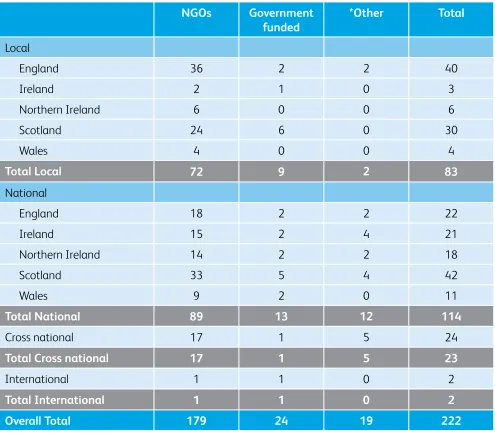
A geographical typology emerged from the rural development networks that were identified in the responses of survey participants (Table 2). Rural networks were found to operate across a variety of geographical regions, for example, locally-based networks, national networks, and networks that transcended both national and international regions. In addition to geographic remit, differences in terms of the organisational governance were observed. For example, networks identified were categorised into ‘non-governmental’ organisations, ‘government-funded’ organisations or ‘other’, ie academic
Table 2 – Typology of networks
Typology of Networks Non-government Organsiations (NGOs)4
Government
Organisations5 Other6 Total
Local Networks – networks that work directly with individuals and community groups within a small geographical area
72 9 2 83
National Networks – networks that operate at a national level (these are split into Direct and Umbrella organisations
89 13 12 114
Direct – networks that work directly with individuals and community groups
80 13 12 105
Umbrella – networks that are essentially networks of networks
9 - - 9
Cross/International national –
national networks that transcend jurisdictional boundaries or operate at an international level
18 2 5 25
Total 179 24 19 222
4 By NGO we mean voluntary sector, charity and other not-for-profit organisations
5 By ‘Government Organisations’ we mean local community projects/group and national networks that are delivered by governments or solely funded by government bodies
or private sector organisations. Using this classification, we found that the reasons why survey respondents’ chose to access networks were somewhat related to the type of network they used (see Section 3.2.3).
2.3 Detailed information on
identified networks
The section that follows presents information obtained from accessing networks’ websites. In particular, we were interested in identifying the core remit of each network and examined whether this was affected by geographical reach, ie did local networks tend to focus solely on rural issues? Do national networks have a broad, non-specific remit that covers both urban and rural areas?
Typology by Sector
[image:16.842.306.801.69.503.2]Table 3 shows that a large proportion of networks identified by survey participants were non-government organisations (NGOs). Of these, half (50%, n=89) operated at a national level whereas four in 10 (40%, n=72) operated within a small locality. Around one in 10 (9%, n=17) networks operated across a number of jurisdictions within the UK and Ireland. The majority (54%, n=13) of government-funded networks that were identified within the survey operated at a national level.
Table 3 – Typology by Sector
NGOs Government funded
*Other Total
Local
England 36 2 2 40
Ireland 2 1 0 3
Northern Ireland 6 0 0 6
Scotland 24 6 0 30
Wales 4 0 0 4
Total Local 72 9 2 83
National
England 18 2 2 22
Ireland 15 2 4 21
Northern Ireland 14 2 2 18
Scotland 33 5 4 42
Wales 9 2 0 11
Total National 89 13 12 114
Cross national 17 1 5 24
Total Cross national 17 1 5 23
International 1 1 0 2
Total International 1 1 0 2 Overall Total 179 24 19 222
13 RuRal Development netwoRks
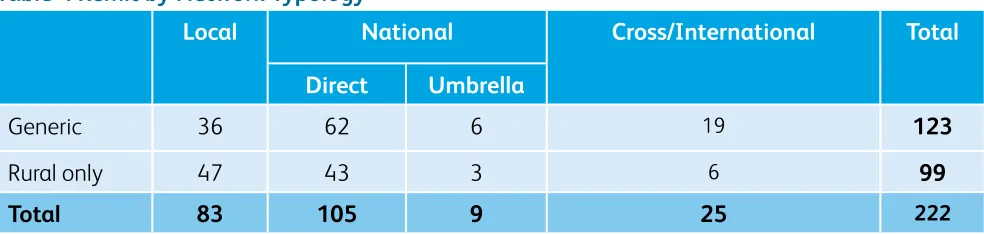
Following on from the operational reach, we were interested in establishing the geographic focus of organisations. For example, did networks have a specific rural focus or did they operate across both rural and urban spheres? Using information provided on networks’ websites, we were able to establish that 123 had a fairly general remit that covered programmes of work within both urban and rural communities, whereas 99 had a specific rural focus (Table 4). From the networks identified, those operating within a specific local area
tended to focus solely on rural issues (56%, n=47), whereas national networks were more likely to work on issues affecting both rural and urban areas (90%, n=68).
2.4 Number of members
[image:17.842.307.799.66.183.2]Of the 222 networks, we were able to find information on membership numbers for 61 networks. These ranged in size from six to 160,000 with a mean of 12,964 but a median of 300. We can conclude that the average membership is affected by a few very large, generic networks. As Table 5 below shows, 19 (31%) of the rural networks we identified were small, while 12 (20%) of the rural networks were medium, 22 (36%) were large and eight (13%) were very large.
Table 4 Remit by Network Typology
Local National Cross/International Total Direct Umbrella
Generic 36 62 6 19 123
Rural only 47 43 3 6 99
Total 83 105 9 25 222
Table 5 Membership size by Remit of network
Membership size Generic Rural only Total
Small (under 100) 7 12 19
Medium (100 – 499) 8 4 12
Large (500 -10,000) 13 9 22
Very large (over 10,000) 4 4 8
Total* 32 29 61
Table 6 Number of staff by Remit of network
Number of staff Generic Rural only Total
Small (one or fewer) 5 9 14
Medium (1 – 20) 34 32 66
Large (21 – 100) 11 5 16
Very large (over 100) 3 1 4
Total* 53 47 100
2.5 Membership type
We accessed information about the
membership type of 159 networks. Of them:
• four were closed membership
• 72 charged a fee for membership
• 56 required membership but membership is free
• 23 were open access and did not require membership.
We were not able to identify any relationship between geography or remit on the approach to membership. However, in terms of governance, those networks run by governments tended to be open access, with only one requiring membership (though this was free and enabled access to the full website).
2.6 Staffing
We were able to access information on staffing from 100 networks, ranging from no staff to 1300 staff. The average number of staff was 27, with the median number of staff being four. Again, the number of staff is affected by a few, very large, generic networks. As Table 6 shows, six of the rural networks we identified had over 20 staff (13%), compared to over a quarter of generic networks (26%, n=14).
2.7 Summary of typology
Our review of networks identified a geographical typology – local, national, government and cross/international networks. From accessing information on networks’ websites, we found a number of key differences in relation to:
• Geography
• Remit
• Membership type and number
• Staffing
• Governance
The remainder of this report presents the
Chapter 3
3 Defining Rural Development Networks
Chapter Summary
Rural development networks were defined in terms of their:
• Membership – whether they are membership based and therefore perceived as ‘bottom-up’, or government driven, perceived as ‘top-down’
• Ability to increase capacity and skills of the communities they represent
• Networking functions, information provision and sharing best practice, enabling users to link with one another
• Means of engagement with network users – online versus face-to-face
• Distinction between rural development and rural community development (and the dominance of agriculture over community development) Why access rural development networks?
• Despite finding no substantive differences in the reasons why participants accessed rural networks, the three most common reasons for using rural development networks were to obtain advice and information, to identify sources of funding and to share local learning and experiences.
The top five topics of interest among users and producers were:
• funding, support and advice for social enterprises, environmental issues, food issues and energy issues Networks provided a variety of information such as:
• guides, policy briefings, case studies, templates, training opportunities, and conferences
17 RuRal Development netwoRks
This chapter, using data from telephone interviews, presents network leaders’ definitions of rural development networks (see Appendix 4 for more details on networks included in telephone interview). The chapter also explores survey respondents’ reasons for accessing rural networks and identifies the information needs of users.
3.1 Definitions of a rural
development network
During the panel telephone interviews, leaders of networks operating at national levels were asked to define what they perceived rural development networks to be. Views on what constituted a rural development network were similar across all network leaders. For instance, leaders of networks that worked directly alongside individuals and community groups, umbrella and government-funded networks commonly defined rural development networks in terms of their origins and remit, and in relation to their functions and outputs.
Networks working directly with individuals and communities – leader definition
Among this group of network leaders, a common distinction was drawn between ‘bottom-up’ networks, established by and for their members, and ‘top-down’ networks that were perceived to have been created in response to a government agenda. It was felt that
‘bottom-up’ networks were member defined with work plans dictated by the needs of their members. This was in contrast to ‘top-down’ networks, where remits were viewed as being directed by external influence.
Leaders commonly described rural development networks as existing to primarily increase the capacity and skills of the rural communities that they represented. In doing so, rural networks enable communities to share best practice, facilitate the exchange of information and provide support through online and face-to-face networking opportunities. One network leader suggested:
‘A network should be able to respond to the needs of people and help up-skill them, offer
advice at the moment they need it. A network should be able to respond
quickly with accurate information’ Network Leader
Umbrella and government-funded networks – leader definition
Similar to leaders of networks working directly with individuals and community groups, leaders of umbrella and government-funded rural development networks defined rural networks in terms of how they were organised and their outputs. Rural development networks were felt to be driven by their members and possessed an overarching capacity to share information and
resources, to disseminate information and to identify partnership working among community groups. When thinking about how rural
development networks were organised, leaders of umbrella networks defined the core remit of networks as being member-led and stressed that they existed solely to enhance the skills, capacity and confidence of their members. There was the view that when networks are not led by their members, they should question their existence:
‘ . . . when a network becomes the institution in itself, it actually then
doesn’t do what it’s supposed to do according to its constitution’
Network Leader
facilities, such as video conferencing, in combination with face-to-face networking opportunities. One leader noted:
‘ . . . as networkers, we need to become more creative about how we enable
people to share . . . information . . . The . . . definition of networking, so to speak, is that of the exchange of information. How we do it and who we do it with changes over time
depending on common interests’
Network Leader
Distinction between rural development and rural community development
When defining rural development networks, leaders raised concerns in relation to what they described as the growing distinction between rural development and rural
community development. It was suggested that there has been an increase in the dominance of agricultural policy, which is reflected in local, national and international government policy and funding streams. It was felt that this shift in priority has implications for the way in which government bodies approach rural issues. One leader stressed:
‘We are concerned . . . that there’s a growing trend to focus on economic and
agricultural development which leaves behind the ordinary people who are struggling at the present minute because of
the recession, because of the centralisation of services, because of the cutbacks. And rural community development and
community development in general is beginning to fall off the table’
Network Leader
While analysis of our survey data does show that a number of rural community development networks currently exist, it is possible that the shift in focus to agricultural policy is likely to reduce the funding available for rural
community development. This has the potential to reduce the number of networks operating within the field and therefore reduce the likelihood of keeping rural community issues at the forefront of governmental thought.
3.2 Why access rural development
networks?
We were interested in finding out about the reasons why individuals access rural
development networks. The section that follows presents data from interviews with network leaders on the type of information and the communication formats that their networks use to engage with their members.
Type of information provided
Network leaders described the type of information provided by rural development
networks both in terms of the nature of the information and the means in which it was distributed. When asked specifically about their network websites, all network leaders reflected on the importance of their website as a key driver for engaging with their members. The types of information that networks provided via their website were:
• Policy briefings
• Funding initiatives
• Best practice guides and tools
• Thematic issues (such as housing, poverty, broadband connection, etc)
• Information or ‘fact’ packs
• Case studies
• Profiling of community groups/projects
• Contact details of community groups/ projects
• Publications (produced by the networks themselves or circulation of other’s)
• Sample documents and templates
• Project databases
• Events (seminars and conferences)
• Training opportunities
19 RuRal Development netwoRks
‘one of the most . . . valued things is information on funding, information on support that’s available for people who are wanting to develop projects, wanting to develop new initiatives. So there’s a fair degree of self-interest in that people want to
be kept up to date with that’
Network Leader
In addition to the information provided by networks, members also contributed to website content, either by uploading their own content (where members had access to their network’s interactive forum/blogging facilities) or by directly approaching networks to upload information on their behalf. In this sense, there was the view that networks were both proactive and reactive, meaning that networks actively responded to the information needs of their members, as well as providing information on wider rural policy issues.
Information needs of users
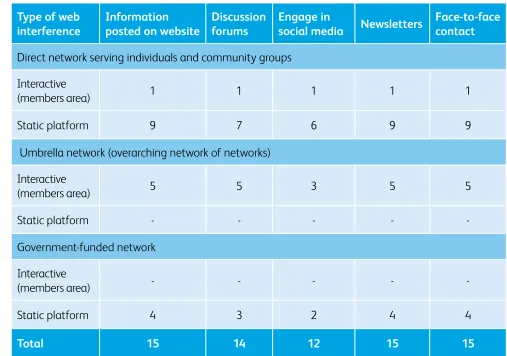
[image:23.842.294.801.68.424.2]To understand the information needs of users, network leaders were asked to describe the type of web interface their network used to engage and communicate with their members. For most, network websites were fairly static platforms that were used primarily as a source of information. Leaders of networks with static websites stressed that while it was their intention to move to a ‘more interactive’ platform in the future, this was something
Table 7 – Information Matrix Type of web
interference Information posted on website Discussion forums Engage in social media Newsletters Face-to-face contact
Direct network serving individuals and community groups
Interactive
(members area) 1 1 1 1 1
Static platform 9 7 6 9 9
Umbrella network (overarching network of networks)
Interactive
(members area) 5 5 3 5 5
Static platform - - - -
-Government-funded network
Interactive
(members area) - - - -
-Static platform 4 3 2 4 4
Figure 1.1 – Reasons for accessing rural development networks by typology (%)7
*Please note small numbers in some categories
that they had not been able to achieve due to financial constraints. Furthermore, while network leaders recognised the benefits that interactive platforms could offer their members, almost all had begun to adopt social networking tools such as Facebook, Twitter and LinkedIn, which proved to be extremely successful in terms of engagement with and between members.
Where network members had access to specific ‘member areas’ of their network’s website, they were able to upload their own content, interact and network with other members. Table 7 illustrates the forms of communication that networks engaged in with their members.
Reason for accessing networks (survey responses)
This section presents data collected as part of the online survey. Survey participants were asked to indicate the reasons why they accessed rural development networks. Participants were first asked to list three networks they accessed most frequently. Participants were then asked to look at a list and select a reason that captured why they specifically chose to access them (see Appendix 7.1 & 7.2).
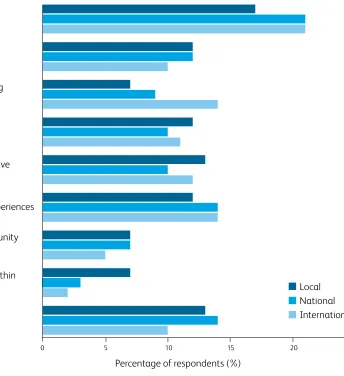
Figure 1.1 shows the reasons why survey respondents access local, national and cross/ international networks (Appendix 7.1). The reasons why participants accessed networks
For advice and information
To engage in face-to-face networking opportunities
To engage in online networking opportunities
To foster partnership working
To develop creative ways to solve local problems and needs
To share local learning and experiences
To ensure that my local community has a voice in relevant matters
To communicate local plans within my community
To identify sources of funding
0 5 10 15 20 25
Local National International
Percentage of respondents (%)
21 RuRal Development netwoRks
were broadly similar across each type of network and the most common reasons why participants used these networks was to:
• Receive advice and information (local 17%, n=35; national 21%, n=166; cross/ international 22%, n=40)
• To share local learning and experiences
(12%, n=26; national 14%, n=107; cross/ international 14%, n=27)
• To identify sources of funding (NGO 13%, n=27; government 14%, n=107; cross/ international 10%, n=18)
While Figure 1.1 shows that survey participants were more likely to access national networks (14%, n=107) and local (13%, n=27) than cross/international networks (10%, n=18) to identify sources of funding and more likely to access international networks (14%, n=27) than local (7%, n=14) and national (9%, n=73) networks to engage in online networking opportunities, caution should be used when attributing any associations to these networks due to the small number of participants in these categories.
[image:25.842.453.784.86.450.2]When categorising networks in terms of their governance, ie NGO, government and other, again we found no real differences in the reasons why participants chose to access networks (Appendix 7.2). However, Figure 1.2
Figure 1.2 – Reasons for accessing rural development networks by type of network (%)8
NGO Government Other
0 5 10 15 20 25
For advice and information
To engage in face-to-face networking opportunities
To engage in online networking opportunities
To foster partnership working
To develop creative ways to solve local problems and needs
To share local learning and experiences
To ensure that my local community has a voice in relevant matters
To communicate local plans within my community
To identify sources of funding
Percentage of respondents (%)
shows that the most common reasons why participants accessed ‘NGO’s’, ‘government-funded’ and ‘other’ networks were:
• To receive advice and information (NGO 20% n=186; government 22%, n=46; other 23%, n=8)
• To share local learning and experiences
(NGO 13%, n=121; government 16%, n=33; other 17%, n=6)
• To identify sources of funding (NGO 13%, n=118; government 14%, n=29; cross/ international 11%, n=4)
Despite finding no substantive difference in the reasons why participants accessed rural development networks by geographical remit or governance, the three most common reasons why participants use rural networks were to:
• Obtain advice and information
• Identify sources of funding
• Share local learning and experiences.
What users of networks like finding out from rural networks
When looking to the survey data to explore the type of information that survey respondents9
would like to receive from rural development networks (Appendix 8) we found that the top five topics of most interest were:
• Funding – Around half (52%, n=34) of users and around three fifths of producers (58%, n=88) were interested in finding out about funding
• Support and advice for social enterprises
– Over two fifths (44%, n=29) of users and almost half (48%, n=73) of producers were interested in finding out about support and advice for social enterprises
• Environmental issues – Over two in five (44%, n=29) users and around half (52% n=79) of producers reported that they were interested in receiving information on environmental issues
• Food – Over a third (35%, n=23) of users and under half (45%, n=68) of producers were interested in finding out about food issues
• Energy – Around a third (35% n=23) of users and around two fifths (44%, n=67) of producers were interested in energy issues
Means of communicating with members (panel interviews)
The remainder of this chapter summaries data collected from telephone interviews with leaders of rural development networks. One of the overarching aims of rural development networks is to promote the successful engagement with and between members. With this in mind, all network leaders noted that their networks utilised a variety of tools when communicating with their members. These were:
• Weekly, monthly and quarterly e-newsletters
• Six monthly magazines (providing case studies)
• Network website
• Online discussion forum
• Social media (Facebook, Twitter, Linked-in)
• Interactive member area of network website
• Information phone lines/telephone exchange groups
• Video conferencing
• Face-to-face meetings with groups
• Field trips
The key advantage of using a range of communication tools was that it enabled members to pick and choose a format that was appropriate for them. It was also suggested that having a range of methods was particularly beneficial for members who were perhaps less engaged with online technologies. In such instances, network leaders stressed the importance of face-to-face networking, the publication of newsletters and the possessing ability to answer member queries by telephone.
Newsletters
Newsletters were a popular form of
communication with members and were used by all network types to notify members of training events and networking opportunities. Newsletters were also used to profile particular community groups or projects and also featured articles sharing best practice from further afield.
23 RuRal Development netwoRks
Discussion forums
Network leaders actively sought to explore new ways of encouraging dialogue among their members and they often acted upon the advice and feedback from members. For example, several network leaders mentioned that members actively requested discussion forums within their networks’ website. However, at the time of interview, all network leaders commonly reported that member contributions to discussion forums were relatively low and encouraging member participation was felt to be a difficult task. Despite this, one network leader highlighted that while member contributions to discussions forums were low, analysis of their website traffic statistics showed that access to the forums was high, therefore suggesting that members used discussion forums as a source of information.
Social media
Social media was something that most networks had begun to engage in. Network leaders
described their initial apprehension when adopting social media tools such as Facebook, Twitter and Linked-in. However, they found that despite their initial concerns, members actively responded to Facebook and Twitter in a more successful way than on their main network website.
‘[Facebook] has been really successful in getting members to engage with the
network and one another’
Network Leader
‘We did a quick examination of it [social networking] . . . and we were surprised to find that actually it’s probably accounting for more connection and real engagement between members than even the website . . . we’re beginning to realise it’s actually more
effective than we thought’
Network Leader
It was felt that the reason for the success of social networking media was due to the fact members were already actively engaged with social media either on a professional or personal level.
Networks tended to use social media as a means of alerting members about their networks’ activities and in a sense, social media was used as a means of driving members back to the main network website. For example, one government network leader suggested that their website was a place where they generated information, whereas Facebook and Twitter was utilised as a means of raising awareness of website content and network activities. Social media was therefore used as a way of generating response among members and directing them back to the network’s website.
Despite the success of social media, network leaders raised concerns in terms of the level of staffing resources required to manage social networking media effectively. Concerns were also
raised in relation to the exclusion of certain groups who would not normally utilise online technology. This was something that networks were balancing with offline communication strategies.
Interactive member areas
There was noticeable enthusiasm among all network leaders to have a space for members to create and upload their own content on network websites. Among leaders whose networks had interactive web areas, there was the view that those platforms provided a space were members could interact and discuss thematic issues that were a common concern. One leader of an umbrella network
suggested that their interactive members’ area was an extremely fast way of communicating policy and funding initiatives. They also suggested that it was an effective method for filtering information down to small-scale community groups and projects.
For those who did not have interactive web areas, there was a common view that this was something they would ideally like to adopt, although they had been prevented from doing so due to financial and staffing constraints. One umbrella network leader reflected:
‘we toyed with the idea . . . and still haven’t discounted it. But we’ve only got a small staff team, and just trying to service the network is quite difficult . . . But we would never discount
For others, there was a sense that while their networks had discussed plans for an interactive platform in the future, they were currently experiencing significant successes in terms of engaging with members through Facebook and Twitter.
Informal contact face-to-face meetings, field trips and phone calls
Network leaders also described how their networks were engaged in a variety of ‘offline’ activities in relation to networking and the dissemination of information. For example, networks encouraged members to visit other network members and community groups through field trips and face-to-face meetings. All network leaders felt that face-to-face contact with members was crucial. A common view was that face-to-face encounters were the best way to interact with members. One government-funded network leader suggested that they had very strong links on a personal level with their members and that one-to-one contact was the preferred method of communication. However, this was achieved due to the fact that the area they represented was relatively small and it was recognised that this is not always possible to achieve in other regions.
There was the view that while websites provided the information content, it was the personal, face-to-face encounters that were the key ’advice-giving’ aspect of their work. However, while personal contact was viewed as the preferred method for engaging with members, network leaders recognised that face-to-face contact was often limited by time and financial constraints. In response to this, networks were focusing on holding fewer but higher-quality networking events that were driven by the priorities of their members.
Chapter 4
4 Benefits of involvement in rural development networks
Chapter Summary
Benefits of involvement with rural development networks:
• 71% of both users and producers reported that they were extremely or quite confident in their ability to engage and participate in their local community as a result of their involvement in rural networks
• A majority of both users and producers (52%) were least confident in their ability to take over the delivery of local services
• Producers (82%) were significantly more likely than users (61%) to agree or strongly agree that they had been able to engage in face-to-face networking as a result of their involvement in rural development networks
• Producers (70%) were significantly more likely than users (43%, n=23) to agree or strongly agree that they had increased their partnership working with others in their local community.
• Producers (61%) were significantly more likely than users (28%) to report that they agreed or strongly agreed that their involvement in rural networks had ensured that their local community had a voice in relevant matters.
• Producers (58%) were significantly more likely than users (30%) to report that they agreed or strongly agreed that they had been able to communicate local plans within their local community.
• The majority of producers (94%) and users (85%) agreed or strongly agreed that they had been able to receive information and advice from their involvement in rural networks.
• 82% of producers and 70% of users agreed or strongly agreed that they had been able to identify sources of funding through their involvement in rural development networks.
Confidence in network:
• Producers were most confident in their networks’ ability to engage in events and projects to share best practice (73%), deliver events to share best practice (73%), influence rural policy (73%) and continue to deliver existing services (65%)
27 RuRal Development netwoRks
This chapter presents data from survey
respondents and explores the benefits that are to be gained from accessing rural development networks.
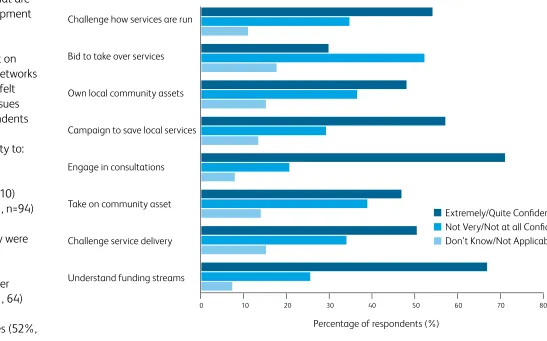
Survey respondents were asked to reflect on their involvement in rural development networks and in turn, indicate how confident they felt in tackling a range of rural community issues (Appendix 9). Figure 2 shows that respondents were most likely to report that they were extremely or quite confident in their ability to:
• Engage in consultations (71%, n=117)
• Identify sources of funding (67%, n=110)
• Campaign to save local services (57%, n=94) However, respondents reported that they were least confident in their ability to:
• Negotiate with landowners to take over ownership of community assets (39%, 64)
• Own local assets (37%, n=60)
• Bid to take over the delivery of services (52%, n=86)
[image:31.842.237.784.79.420.2]While survey respondents were confident that they could engage in consultations, identify funding and campaign to save local services, they were least confident when thinking about the ownership of community assets. This finding is particularly relevant in a climate where communities across all jurisdictions are
Figure 2 – Confidence tackling rural issues as a result of involvement in rural networks
Challenge how services are run
Bid to take over services
Own local community assets
Campaign to save local services
Engage in consultations
Take on community asset
Challenge service delivery
Understand funding streams
0 10 20 30 40 50 60 70 80
Extremely/Quite Confident Not Very/Not at all Confident Don’t Know/Not Applicable
increasingly under pressure to take on a greater role in the ownership of community assets. This suggests that this may be an area in which networks could support their members.
Facilitation
In order to assess the ways in which rural development networks facilitated individuals’ ability to engage with their local community, respondents were asked to report to what extent they felt that their own involvement in rural development networks had enabled them to participate in a range of activities.
Overall, producers reported higher levels of agreement than users in terms of their ability to engage and receive a range of services through their involvement with rural networks (see Appendix 10). One possible reason for this is perhaps due to the fact that producers are involved with the day-to-day running of networks and as a result, may possess greater level of awareness of where to access required information and how to make the best possible use of networks. Those involved with networks may also have a greater overall awareness of existing community projects and networking events within their local area.
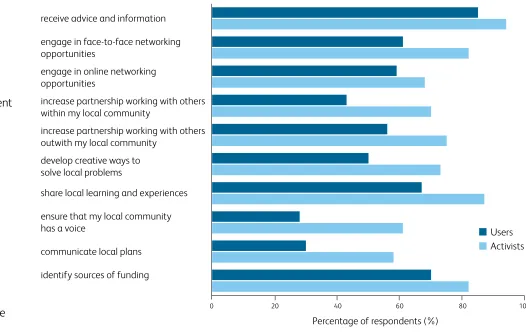
[image:32.842.264.790.95.430.2]Figure 3 shows that producers (82%, n=107) were significantly10 more likely than users (61%,
Figure 3 – Involvement in rural networks by type of respondent (“Agree/strongly agree that involvement in rural networks has enabled me to ...”)
0 20 40 60 80 100
receive advice and information
engage in face-to-face networking opportunities
engage in online networking opportunities
increase partnership working with others within my local community
increase partnership working with others outwith my local community
develop creative ways to solve local problems
share local learning and experiences
ensure that my local community has a voice
communicate local plans
identify sources of funding
Users Activists
Percentage of respondents (%)
29 RuRal Development netwoRks
n=33) to report that they agreed or strongly agreed that they had been able to engage in face-to-face networking opportunities as a result of their involvement with rural networks. Around seven in 10 (68%, n=77) producers agreed or strongly agreed that they had been able to engage in online networking opportunities, compared with three fifths (59%, n=32) of users. Producers (70%, n=80) were also significantly more likely than users (43%, n=23) to report that they agreed or strongly agreed that they had increased their partnership working with others within their community. Producers (75%, n=86) were also more likely than users (56%, n=30) to agree or strongly agree that they had been able to increase their partnership working with other communities or community projects.
[image:33.842.260.789.82.414.2]Around three in four (73%, n=86) producers reported that they agreed or strongly agreed that their involvement with rural networks had enabled them to develop creative ways to solve local problems, compared with half (50%, n=27) of users. The vast majority of producers (87%, n=99) reported that they agreed or strongly agreed that rural networks had enabled them to share local learning and experiences, compared with users (67%, n=36). Producers (61%, n=69) were significantly more likely than users (28%, n=15) to have agreed or strongly agreed that their involvement in rural networks had ensured that their local community had a voice in relevant matters. Similarly, producers
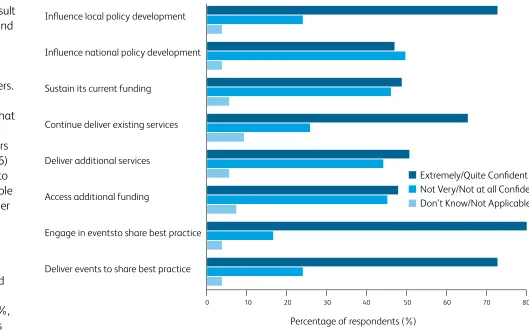
Figure 4 – Confidence in organisation’s ability over next five years
*Only asked of those who indicated that they were producers
Influence local policy development
Influence national policy development
Sustain its current funding
Continue deliver existing services
Deliver additional services
Access additional funding
Engage in eventsto share best practice
Deliver events to share best practice
0 10 20 30 40 50 60 70 80
Extremely/Quite Confident Not Very/Not at all Confident Don’t Know/Not Applicable
(58%, n=66) were significantly more likely than users (30%, n=16) to report that they agreed or strongly agreed that they had been able to communicate local plans within their local community.
While disparities did exist between users’ and producers’ levels of agreement across most question items, similarities were found in terms of those reporting that they had received information and advice. For example, the vast majority of users (85%, n=46) and producers (94%, n=107) agreed or strongly agreed that they had received advice and information. Similarly, a large majority of users (70%, n=38) and producers (82%, n=93) agreed or strongly agreed that they had been able to identify sources of funding through their involvement in rural networks.
Capacity of existing networks
Those producers who were involved with the running of networks were asked to consider how confident they were in terms of their organisation’s ability to engage in a range of activities over the next five years (Appendix 11).
Figure 4 above shows that out of the activities listed, respondents felt most confident in terms of their organisations’ ability to:
• Engage in events and projects that share best practice in rural development (80%, n=87)
• Deliver events and projects that share best practice in rural development (73%, n=79)
• Influence local policy development on rural issues (73%, n=79)
• Continue delivering existing services to rural communities (65%, n=71)
Respondents were least confident in their organisations’ ability to:
• Influence national policy on rural development issues (50%, n=54)
• Sustain current funding for rural development activities (46%, n=50)
• Access additional funding for rural development activities (45%, n=49)
• Deliver additional services to rural communities (44%, n=48)
Chapter 5
5 Key issues for rural development networks
Section Summary
Key issues for rural development networks were:
• Funding – cuts across the UK and Ireland were felt in terms of the reduction in the number of paid members of staff, and in terms of organisations’ abilities to continue to deliver services.
• Engagement with users – networks increasingly utilised online communication tools such as Facebook, Twitter and LinkedIn. They were also beginning to think creatively about the format of their websites as well as the volume of information they provide their members with. However, concerns were raised in relation to the shift to online networking in relation to digital uptake and broadband coverage.
• Communication and technology – The Internet has provided networks with the opportunity to disperse information to more people, as social media gives them with the opportunity to network virtually. This was embraced by some networks, but not others.
• Representation and visibility – Those who were actively involved with the delivery of services were least confident in their organisations’ ability to influence national rural policy.
• Prominence of rural issues – the distinction made between rural community development and agricultural, environmental rural development among policy makers was felt to have profound implications for the future direction of networks. For instance, the focus upon agriculture and economic development has resulted in a climate of uncertainty among both network leaders and survey respondents.
• Facilitation and moderation – Survey participants were least confident in their ability to take over the ownership of community assets or the delivery of local services
33 RuRal Development netwoRks
This chapter presents findings from rural development network leaders’ accounts of the key issues that rural networks face in the current economic and political landscape.
5.1 Funding
Network leaders identified four key areas where the effects of funding cuts had been felt, both within their own networks and that of their members. The key areas were:
• the effects of funding reductions in terms of staff resources
• the effects of funding in relation to their ability to sustain networking activities and website functions
• the effects of financial cuts in relation to organisational cut-backs and restructuring.
• Administration and bureaucracy experienced when applying for funding was also
discussed.
Reduction in funded staff and the knock-on effects
The knock-on effects of funding cuts were discussed in terms of the reduction of staff resources within both leaders’ own networks and that of their members’ organisations. Network leaders discussed the impact that this reduction had, both in terms of their ability to respond to member requests for information and requests
to host and fund networking events. The fear among network leaders was that if their networks were not able to adequately respond to members’ requests, members would begin to disengage and take the view that the networks were unfit for purpose.
Similar to their members, rural networks also experienced the effects of reduced funding in terms of justifying paid staff time and maintaining the delivery of the network’s services. One network leader described the pressure of accounting for each hour of their time and ensuring that time was spent in a constructive way:
‘. . . every hour I spend is running our resources down so . . . I have to feel that
I’m really using that time well’
Network Leader
For some leaders, particularly those whose network worked directly with individuals and groups, the solution to the financial and staffing cuts was a shift to more online operations that could be easily managed and moderated with minimal resources. While it was felt that networks had to maintain the flow of information and communication for their members, they had to do this in a way that did not rely on staff. One network had already begun to look for ways for supporting networking activities without any staffing or
funding costs. It was suggested that the reliance on funding within the current financial climate would inevitable result in a failure to deliver.
In addition, one leader spoke of how their network had been able to survive without funding. It was suggested that the key was to set up structures that enabled members and communities to be self-sufficient, to network and share learning among themselves. There was the view that in such circumstances, it was possible to run networks entirely on voluntary resources. However, one contrasting opinion raised concerns for those networks that engage in lobbying activities. It was suggested that lobbying networks do require some form of staffing and cannot operate with zero funding.
Making organisational cuts where possible
However, for others, there was a cautionary view that merging with other rural development networks was not necessarily a cost-cutting measure or easy thing to achieve. For example, it was felt consideration had to be given to organisational, as indicated below:
‘the issue of merging, it’s quite a difficult one . . . if you are being honest . . .
would you have as many networks as you’ve got in Scotland? The answer
would be no but, of course, they’ve all developed organically. I mean there’s a
strong identity with the networks and they’re all member led, and it makes it very difficult to begin to look at formal mergers . . . you can have closer working relationships,
but it’s a big step from mergers”
Network Leader
Despite funding cuts, there was the suggestion that some networks had been able to continue to access support that both they and their members required by developing partnerships and interdependencies with other networks. In addition, there was the a feeling networks could continue to look for new opportunities of operating by developing ‘horizontal links’ as opposed to the previous ‘vertical links’ that they previously relied upon, ie funding support. For example:
‘in the situation of economic difficulty . . . organisations and networks . . . can actually
seem more relevant and more useful’ Network Leader
Notwithstanding, there was a view that some community organisations were expecting to witness the complete withdrawal of funding by 2012. It was against this backdrop of cuts that one network leader suggested that their network had already begun to witness a downturn in membership subscriptions. It was felt that this was due to member organisations looking to cut down on what was perceived to be non-essential expenses. One way of doing this was to cancel membership fees to rural development networks.
Administration and bureaucracy involved with funding process
Leaders of networks, specifically those working directly with individuals and community groups, described the bureaucratic and administrative processes involved in applying for funding as being a key issue for community organisations. It was suggested that the process of applying to government agencies was overly burdensome for organisations. In addition, there was the view that funding bodies should adapt to the needs of rural organisations. One network leader described the difficulties in receiving European funding that they had been awarded. In this
instance, the network received their funding 18 months in arrears, which was inoperable for community organisations. There was the feeling that:
‘wherever we get the money from has to actually understand how
voluntary organisations work’
Network Leader
5.2 Priority of rural community
development
Network leaders felt that there had been a distinct change in focus and priority of rural community development among government and funding bodies. This was largely discussed in terms of the prominence of rural community development within the wider rural development agenda and in terms of lobbying power and government support for rural community development.
Definition of rural
Network leaders discussed the need for rural community development to receive more recognition and prominence among government departments and funding bodies. There was the view that definitions and