Journal of the American Chemical Society
An environmentally-responsive
reciprocal replicating network
Craig C. Robertson,
‡Harold W. Mackenzie,
†Tamara Kosikova and Douglas Philp*
School of Chemistry and EaStCHEM, University of St Andrews, North Haugh St Andrews, Fife KY16 9ST, United Kingdom
*Corresponding author e-mail: [email protected] Fax: +44 (0)1334 463808; Tel: +44 (0)1334 467264.
ORCID IDs:
Abstract
A reciprocal replication system is constructed from four building blocks, A, B, C, and D, which react in a pairwise manner through either a 1,3-dipolar cycloaddition or the condensation reaction between an amine and an aldehyde to create two templates, trans-TAB and TCD. These templates are equipped with complementary recognition sites—two carboxylic acids (trans-TAB) or two 4,6-dimethylamidopyridines (TCD)—that enable each template to direct the formation of its complementary partner through two mutually-reinforcing crosscatalytic pathways, in which the templates trans-TAB or TCD preorganize the appropriate building blocks within two catalytically-active ternary complexes: [C•D•trans-TAB] and [A•B•TCD]. The template-directed processes within these complexes generate a heteroduplex [trans-TAB•TCD], which is shown to possess significant stability through kinetic simulation and fitting. As a consequence, the individual crosscatalytic pathways perform more efficiently in template-directed experiments when the concentration of the template being formed is below that of the template added as instruction. Comprehensive analysis of the system when A, B, C, and D are mixed together directly, using a series of 1H NMR spectroscopic kinetic experiments, demonstrates that the
behavior of the reciprocal system is more than the simple sum of its parts—as part of the interconnected network, the product of each reaction clearly directs the fabrication of its reciprocal partner, facilitating both higher rates of formation for both templates and improved diastereoselectivity for trans-TAB. A simple change in experimental conditions (from dry to ‘wet’ CDCl3) demonstrates the sensitivity of the replication pathways within
Introduction
Networks constructed from individual components that interact and react with each other in pre-defined ways are a common feature at almost every length scale in the world around us—from the human immune system to patterns of weather in the atmosphere. The functions and behaviors expressed by these networks at a whole system level are derived from the interconnections1 between their individual components. In the last 20 years, there
has been significant growth in many disciplines1,2 in the study of complexity and complex
systems,3 and the properties4 that can emerge through the interactions of their constituent
components. In chemistry, the nascent field5 of systems chemistry has started to create
synthetic chemical entities that can be assembled into complex networks that exhibit system-level behaviors4a,b,g,5b,6 and functions by exploiting a bottom-up approach. Central to
these strategies are the processes7 that surround molecular replication. The auto- and
crosscatalytic properties of synthetic replicators, coupled with their highly specific self- and mutual recognition properties, make them ideal building blocks from which to construct complex networks. Proponents of the systems chemistry approach have to date produced an array of replicating systems based on oligonucleotides,8 peptides,9 and small synthetic
molecules.10 These studies demonstrate clearly that replication is not the sole preserve of
nucleic acids augmented by extensive enzymatic machinery. These replicators have been embedded within systems that can exhibit error-correction,11 stereospecific replication,12
Boolean logic,13 as well as the capacity to respond to the reaction environment.9g,h,j,10c,13d,14 The
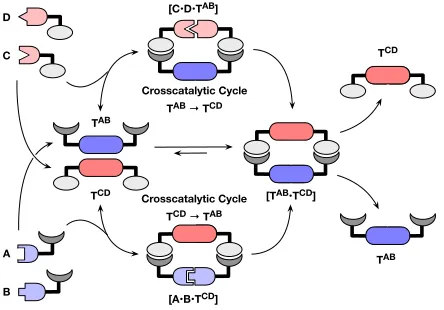
vast majority of synthetic replicators described to date rely on self-complementary templates, especially those based on simple organic compounds. In these so-called minimal replicating systems, a template that is complementary to itself directs its own formation through an autocatalytic cycle. It is, however, possible to construct a replicating system from two mutually complementary templates in which the catalytic effects are reciprocal. In such systems, each of the two non-identical, but mutually-complementary, templates directs the formation of its partner through two interlinked crosscatalytic cycles. The processes involved in reciprocal replication are encapsulated schematically in Figure 1.
shown in Figure 1, component A can react only with B and component C can react only with
D. The bimolecular reactions of these two pairs of reagents create two templates, TAB and
[image:4.612.197.419.262.417.2]TCD(Figure 1). These templates do not have the necessary self-complementary recognition sites required for self-replication. Instead, the reciprocal nature of the non-covalent interactions between the two templates allows the TCD template to crosscatalyze the formation of TAB through the assembly of the catalytically-active ternary complex [A•B•TCD]. In the same manner, template TABis able to crosscatalyze the formation of TCD through the assembly of the catalytically-active ternary complex [C•D•TAB].
Figure 1 Two templates, TAB and TCD, containing complementary recognition sites (light and dark gray) are
formed initially through the bimolecular reactions between A and B (blue) and between C and D (red).Once formed, these templates can participate in two template-directed crosscatalytic cycles, where TAB catalyzes the
formation of TCD throughthe assembly of C and D in a catalytically-active ternary complex [C•D•TAB], and vice versa. However, neither template TAB nor TCD possess the recognition sites required for self-replication.
Taken together, these two crosscatalytic cycles (TAB → TCD and TCD → TAB) represent a formal reciprocal
replication cycle.
Ultimately, these processes afford the template heteroduplex [TAB•TCD] that can dissociate to return one molecule each of TABand TCD back to the start of the respective catalytic cycles. These two interlinked cross-catalytic cycles represent a formal reciprocal replication cycle. It is important to note that the complexity of this system can increase dramatically depending on the nature of the chemical reactions employed to create the two templates from their constituents. In the case where the reaction between A and B and the reaction between C and D are chemically orthogonal, only the reciprocal replication cycle discussed above is present. However, if the system loses this chemical orthogonality and
Crosscatalytic Cycle TAB→TCD
Crosscatalytic Cycle TCD→TAB
TAB
TCD
C
A D
B [A•B•TCD]
[C•D•TAB]
[TAB•TCD]
TCD
reaction between, for example, A and C becomes possible, then additional minimal replication cycles can emerge through the formation of self-complementary templates.
Although several replicating networks involving oligonucleotides and peptides that participate in crosscatalytic interactions have been described previously,8b,c,f,9a,d,h,11,14a
examples that are based on small, synthetic organic molecules are somewhat rare. Both the Rebek15 laboratory and our own16 have reported examples of systems that exhibit reciprocal
template effects based on small organic molecules. However, in both these cases, a lack of orthogonality between the chemical ligation reactions used to construct the templates allowed the systems15a,16a to create selfish, autocatalytic templates and their presence
diminished the overall importance of reciprocal replication in these systems. In order to create a purely reciprocal replicating system, unwanted reactivity between replicator components must be eliminated. In order to achieve this goal, we developed an orthogonal reactivity strategy for the creation of the two complementary templates shown in Figure 2. Critical elements in replicator design are the recognition elements that drive the catalytic processes within the replication cycle. We have demonstrated previously10a-c,e,f,13c,16,17 that hydrogen bonding between an amidopyridine and a carboxylic
acid can be applied to direct autocatalytic processes. Accordingly, maleimide A and nitrone
B are equipped with carboxylic acid recognition sites. Amine C and aldehyde D are equipped with complementary amidopyridine recognition sites, ensuring that templates
TAB and TCD are mutually complementary. The association constant (Ka) for these recognition partners, determined18 by 1H NMR spectroscopic titration, is 3470 ± 300 M−1 in
CDCl3 at 283 K.
A key design element in our strategy is the use of the 1,3-dipolar cycloaddition between maleimide and nitrone (Figure 2). This reaction has been applied successfully in our laboratory10a–c,e,13c,16,17a,b to create several minimal replicating systems. Previously, we
have also shown19 that imine formation between an aniline and an aromatic aldehyde can
which forms TAB, to be chemically orthogonal to the reaction between amine C and aldehyde
[image:6.612.69.540.122.418.2]D, which forms imine TCD.
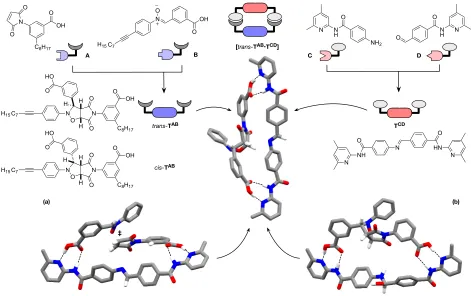
Figure 2 Four building blocks, A, B, C, and D, react in a pairwise manner to give two templates, trans-TAB and TCD, which are equipped with mutually complementary recognition sites (carboxylic acid and
4,6-dimethylamidopyridien) that enable these templates to participate in two crosscatalytic pathways mediated by the formation of two catalytically active complexes: [C•D•trans-TAB] and [A•B•TCD]. Calculated structures
of (a) the transition state (‡) accessed by [A•B•TCD] and (b) the hemiaminal intermediate on the pathway to
the corresponding template heteroduplex [trans-TAB•TCD]. Calculations performed at the ωB97X/def2-SVP
level of theory using the polarized continuum solvation model for chloroform. Hydrogen bonds are represented using dashed blacked lines. Carbon atoms are colored gray, nitrogen atoms blue, oxygen atoms red, and hydrogen atoms white. Most hydrogen atoms are omitted for clarity.
The 1,3-dipolar cycloaddition reaction between A and B creates two diastereoisomeric products, trans-TAB and cis-TAB. In order to understand the influence that template TCD might have on this process, we conducted a series of DFT calculations at the ωB97X/def2-SVP level of theory using a continuum solvation model for CHCl3. These
calculations reveal (Figure 2) that TCD is highly complementary to trans-TAB. Further, the transition state leading to trans-TAB (Figure 2a) is accommodated on template TCD without significant distortion, suggesting that imine TCD should be capable of catalyzing the
N O
O
O
OH
C8H17
N NH O N O HN N
trans-TAB TCD
N N H O
O
A B C D
N N O H H O O O OH C7
C8H17 O HO H15 H N N O H H O O O OH C7
C8H17
O HO
H15
H
cis-TAB
[trans-TAB•TCD]
formation of trans-TAB. By contrast, cis-TAB possesses a folded structure that is not at all complementary with TCD. This observation suggests that TCD would be incapable of catalyzing the formation of cis-TAB and that the overall formation of TAB should proceed diastereoselectively in the presence of TCD. Calculations also demonstrate that trans-TAB is capable of accommodating the hemiaminal intermediate (Figure 2b), associated with the formation of imine TCD without significant distortion, suggesting that trans-TAB may also be capable of catalyzing the formation of imine TCD. Taken together, these results suggest that a reciprocal replication cycle can be established using trans-TAB and TCD.
Results and discussion
In order to identify the presence of the crosscatalytic pathways and to assess their efficiencies, the pairwise reactions of maleimide A with nitrone B and aniline C with aldehyde D were examined first in isolation (e.g., A and B were reacted in solution in the absence of either C and D or preformed template). Subsequently, the reactions of the two pairs of reagents were analyzed in the presence of the relevant reciprocal template (e.g., reaction of A with B was examined in the presence of TCD and vice versa). In each kinetic experiment, an equimolar solution of the required reagents (10 mM) was prepared in CDCl3
and the appearance of products was monitored at regular intervals at 10 °C over 15 h by 500 MHz 1H NMR spectroscopy. The concentrations of the products were determined by
deconvolution of the resonances arising either from protons in the bicyclic ring system present in TAB in the range δ 4.5 to 6.0 or the resonance arising from the imine proton in TCD around δ 8.2 in comparison to appropriate resonances arising from the starting materials.
35% conversion to imine TCD. These results confirm that, in the absence of an appropriate reciprocal template, both trans-TABand TCD are formed slowly, and, in the case of trans-TAB, with low diastereoselectivity.
Figure 3 (a) Maleimide A reacts with nitrone B to give two diastereoisomeric products, trans-TAB (blue) and cis-TAB (black) in the absence of template (filled circles) and in the presence of 20 mol% (open circles) and 46
mol% (open squares) of preformed TCD. (b) Aniline C reacts with aldehyde D to give TCD (red) in the absence
of template (filled circles) and in the presence of 20 mol% of preformed trans-TAB (open circles). The full lines
represent the best fits of the appropriate kinetic models to the experimental data (see Supporting Information). Reaction conditions: [A] = [B] or [C] = [D] = 10 mM, 10 °C, CDCl3. The reaction profiles were determined by
deconvolution of 500 MHz 1H NMR spectroscopic data; all concentrations have been corrected for the amount
of template added.
0 5 10 15
0 2 4 6 8 10
0 5 10 15
0 2 4 6 8 10
Time / h
Concentration / mM
Time / h
Concentration / mM
No T
20 mol% TCD
TCD B
A
trans-TAB cis-TAB
No T
20 mol% trans-TAB D
C (a)
(b)
In order to examine the capacity of imine TCD to function as a template for the formation of trans-TAB, the reaction between maleimide A and nitrone B was repeated in the presence of 20 mol% of preformed TCD added at t = 0 h. The concentration vs. time profile for this reaction (Figure 3a, open circles) is strikingly different to that for the uninstructed process. The production of trans-TAB (open blue circles) is enhanced significantly. At t = 2 h,
trans-TAB reaches a concentration of 2.52 mM, i.e., a value that exceeds the amount of trans
-TAB produced after 15 h in the absence of instruction by TCD. After 15 h, the concentrations of trans-TAB and cis-TAB had reached 4.72 mM and 0.75 mM, respectively, an overall conversion to both diastereoisomers of 55% ([trans-TAB]:[cis-TAB] = 6.3:1).
The reaction between maleimide A and nitrone B was also examined in the presence of 46 mol% of preformed TCD added at t = 0 h. Again, the concentration vs. time profile for this reaction (Figure 3a, open squares) displays a significant enhancement in the formation
of trans-TAB when compared to the uninstructed process. The production of trans-TAB (open
blue squares) is enhanced significantly. At t = 2 h, trans-TAB reaches a concentration of 5.19 mM, a value that exceeds the amount of trans-TAB produced after 15 h in the presence of 20 mol% of TCD. After 15 h, the concentrations of trans-TAB and cis-TAB had reached 7.08 mM and 0.35 mM, respectively, an overall conversion to both diastereoisomers of 74% ([trans
-TAB]:[cis-TAB] = 20.3:1). These results mirror the prediction from our DFT calculations, which suggested that TCD should be an effective template for the formation of trans-TAB, resulting in an increase in the rate and diastereoselectivity for this reaction. By contrast, the conversion to cis-TAB exhibited no significant change in the presence of TCD. Taken together, these observations verify our hypothesis that the imine TCD can direct the formation of trans
-TAB, but not cis-TAB.
slower rate, reaching a concentration of 3.47 mM after 15 h, which represents an overall conversion of 35%. Clearly, the marked changes observed in the rate and extent of formation of imine TCD in the presence of trans-TAB confirm the efficiency of the second crosscatalytic pathway required for the establishment of the fully operational reciprocal system. Whilst it would be desirable to explore the effect of different concentrations of TAB on the formation of TCD more fully, unfortunately, the limited solubility of trans-TAB in CDCl3, arising from the presence of two carboxylic acids, precluded the examination of this crosscatalytic pathway at higher loadings of trans-TAB template.
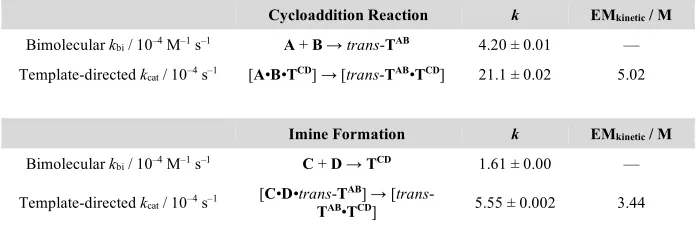
In order to quantify the changes observed in the two crosscatalytic pathways following the introduction of the reciprocal templates, we fitted the experimental data shown in Figure 3 to the appropriate kinetic models (for details, see the Supporting Information, Section S5). The data gave excellent fits (Figure 3, solid lines) to these models and allowed us to extract the key kinetic and thermodynamic parameters for the two control (uninstructed) and two template-directed pathways. Specifically, employing models that describe the key interactions and reactions leading to the formation of trans-TAB and TCD, we were able to determine the bimolecular rate constants (kbi) for the formation of trans-TAB and cis-TAB, the unimolecular rate constant (kcat) for the formation of trans-TAB on TCD template (via the ternary complex [A•B•TCD]) and the heteroduplex association constant (KaHeteroduplex) (Table 1). In addition, were able to determine the rates of the forward20 reaction to give TCD, both in the absence and presence of trans-TAB as instruction (Table 1). These parameters were used subsequently to calculate (Table 1) the kinetic21,22 and thermodynamic23 effective
molarities (EMkinetic and EMthermo, respectively) for the two template-directed crosscatalytic
Table 1 Overview of rate constants determined for the bimolecular and template-directed cycloaddition reaction and imine formation to give trans-TAB and TCD, respectively. The heteroduplex association constant
(KaHeteroduplex) was estimated to be 3.35 × 10⁷ M–1. The kbi for the formation of cis-TAB was determined to be
1.40 × 10⁻⁴ M–1 s–1.
Cycloaddition Reaction k EMkinetic / M
Bimolecular kbi / 10–4 M–1 s–1 A + B→ trans-TAB 4.20 ± 0.01 —
Template-directed kcat / 10–4 s–1 [A•B•TCD] → [trans-TAB•TCD] 21.1 ± 0.02 5.02
Imine Formation k EMkinetic / M
Bimolecular kbi / 10–4 M–1 s–1 C + D→TCD 1.61 ± 0.00 —
Template-directed kcat / 10–4 s–1 [C•D•trans-T
AB] →
[trans-TAB•TCD] 5.55 ± 0.002 3.44
Examination of the parameters summarized in Table 1 reveals that, in the presence
TCD, the formation of trans-TAB is associated with an EMkinetic of 5.02 M, whereas, the formation of TCD (via the key catalytically-active complex [C•D•trans-TAB]) is associated with an EMkinetic of 3.44 M. These results demonstrate that the mutually complementary
templates trans-TAB and TCD are capable of accelerating the formation of each other efficiently via the two crosscatalytic template-directed pathways.
A key element in this system is the heteroduplex [trans-TAB•TCD] (Figure 2)—the stability of this duplex controls the availability of the catalytically-active templates in solution. This duplex is expected to be very stable and an assessment of its stability was not possible directly24 using 1H NMR spectroscopic methods. From our kinetic simulation and
fitting, we were able to confirm that the [trans-TAB•TCD] complex is, indeed, very stable, having an association constant (KaHeteroduplex) that is in excess 107 M−1. This association constant
corresponds to a connection EM25 (EMthermo) of 2.8 M indicating that there is a high level of
complementarity between these two templates.The direct consequence of the stable [trans
-TAB•TCD] complex is the apparent biphasic character of the kinetic profiles for the template-directed experiments shown in Figure 3 (blue and red open symbols). For example, when the formation of trans-TAB is being instructed by TCD, as long as the concentration of trans
that of TCD, the efficiency of the system is reduced dramatically as the stability of the [trans
-TAB•TCD] heteroduplex now controls the availability of free TCD in solution. This effect can be seen clearly in the data shown in Figure 3a—the change in reaction rate occurs at [trans
-TAB] = 2 mM when 20 mol% of TCD is added and at about 4.5 mM when 46 mol% of TCD is added. An identical argument can be constructed for the reverse catalytic situation where
TCD is constructed on trans-TAB.
Having characterized the individual pathways present in the reciprocal system, we next set out to combine the four starting materials within a single experiment. In this situation, we envisaged that the insitu formation of trans-TAB would catalyze the formation of imine TCD and vice versa, allowing the formation of a reciprocal, mutually reinforcing replicating system. To this end, an equimolar mixture (10 mM) of A, B, C, and D was prepared in CDCl3 and the formation of TAB and TCD (Figure 4a) was monitored at 10 °C
over 40 h using 500 MHz 1H NMR spectroscopy.
Examination of the concentration-time profiles of the products formed from the four-component system (Figure 4a) reveals that the major products are the two reciprocal templates trans-TAB and TCD. The data reveals the presence of a small initial lag period for the formation of trans-TAB and a more pronounced initial lag period in the formation of TCD. The presence of the sigmoidal concentration-time profiles for both templates is directly related to the processes and reactions inherent (Figure 1) in mutually crosscatalytic reciprocal replication. Specifically, at the start of the reaction, the reciprocal templates can only be formed through the uncatalyzed bimolecular pathways. The rates at which trans-TAB and TCD are formed start to increase once the template-mediated processes begin to operate efficiently, i.e., when the concentration of each template exceeds the value of Kd for
Figure 4 A reciprocal replication network is constructed by the reaction of maleimide A, nitrone B, aniline C, and aldehyde D to give two diastereoisomeric products, trans-TAB (blue) and cis-TAB (black), and imine TCD
(red) (a) in the absence of any added template as instruction, and in the presence of (b) 30 mol% of preformed
trans-TAB, or (c) 30 mol% of preformed TCD. The impact of the added template on the formation of trans-TAB
and TCD is demonstrated by comparison of the concentration ratios calculated at t = 5 h and 40 h, and the ratios
of initial rates for the formation of the templates. Reaction conditions: [A] = [B] = [C] = [D] = 10 mM, 10 °C, CDCl3. The reaction profiles were determined by deconvolution of 500 MHz 1H NMR spectroscopic data; all
concentrations have been corrected for the amount of template added. A description of the error analysis is provided in the Supporting Information.
Comparison of this experiment with the uninstructed formation of trans-TAB or TCD in isolation (data in Figure 3, filled circles) reveals striking differences in behavior. In the case of trans-TAB, the overall conversion to this product in the four-component system after 5 h (Figure 4a) was 20%, with the diastereoselectivity being 6.3:1 in favor of trans-TAB. These values can be compared with those from the data in Figure 3a at t = 5 h— conversion = 7% and a diastereoselectivity of only 3:1 in favor of trans-TAB. Similarly, the condensation of C and D to form imine TCD was also enhanced within the four-component system—the conversion of C and D to TCD reached 11% after 5 h (Figure 4a) in comparison to <3% in the data shown in Figure 3b after the same time. These results demonstrate the mutually-reinforcing effect of the two crosscatalytic cycles when they operate together within a shared
0.0 1.5 3.0 4.5 6.0 7.5 0.0 1.5 3.0 4.5 6.0 7.5 0.0 1.5 3.0 4.5 6.0 7.5 0.0 1.5 3.0 4.5 6.0 7.5 0.0 1.5 3.0 4.5 6.0 7.5 0.0 1.5 3.0 4.5 6.0 7.5 0.0 1.5 3.0 4.5 6.0 7.5 0.0 1.5 3.0 4.5 6.0 7.5 0.0 1.5 3.0 4.5 6.0 7.5 0.0 1.5 3.0 4.5 6.0 7.5 0.0 1.5 3.0 4.5 6.0 7.5 0.0 1.5 3.0 4.5 6.0 7.5
0 10 20 30 40
0 2 4 6 8 10
Time / h
Concentration / mM
0 10 20 30 40
0 2 4 6 8 10
Concentration / mM
Time / h
C D
B A
No T
+30 mol% TCD +30 mol% trans-TAB
0 10 20 30 40
0 2 4 6 8 10
Concentration / mM
Time / h
Reagents
5 h 40 h
Concentration Ratio Initial Rate Ratio
5 h 40 h
Concentration Ratio Initial Rate Ratio cis-TAB
trans-TAB TCD
(a) (b)
(c)
Concentration Ratio = [T (Instructed)]t [T (Uninstructed)]t
environment and these template-directed replication processes enhance both the rates of formation of trans-TAB and TCD and the diastereoselectivity for the formation of trans-TAB. This situation is in direct contrast to the conditions used to acquire the data presented in Figure 3. In these experiments, the concentration of the instructing template remains constant throughout the entire duration of the experiment, since only two out of the four possible building blocks are present at a time. By contrast, the data in Figure 4 relates to experiments where all four building blocks are present and, consequently, the concentrations of the instructing templates are variable across the time course of the experiments. Thus, the comparison between the data shown in Figure 3 and Figure 4 must be limited to a qualitative assessment evidencing the nature of the mutually reinforcing nature of the reciprocal relationship between replicators TAB and TCD.
In order to demonstrate the importance of template effects in this reciprocal replication system, two template-instructed experiments were performed. Firstly, the four reagents A to D were reacted at starting concentrations of 10 mM in CDCl3 at 10 °C in the
presence of 30 mol% of preformed trans-TAB added at t = 0 h. These data (Figure 4b) show a rapid increase in the concentration of imine TCD, the initial rate of formation of TCD is 1.01 mM h–1 (compared to 0.20 mM h–1 in the absence of template), with the concentration
concentration of TCD becomes comparable to that of the instructing template, product inhibition resulting from the extremely stable [trans-TAB•TCD] duplex becomes progressively dominant in the system. As trans-TAB does not catalyze directly its own formation, it may seem counterintuitive to expect that the addition of trans-TAB to the system will affect the rate and extent of formation of itself. Nevertheless, this experiment reveals that the addition of trans-TAB does indeed have an effect on the rate of its own formation as a result of the reciprocal nature of the entire system. The initial rate of formation of trans
-TAB = 0.71 mM h–1 (compared to 0.40 mM h–1 in the absence of template), with the
concentration of trans-TAB reaching 3.25 mM after 5 h. Once again after this point, the rate of formation of trans-TAB slows and the concentration of trans-TAB increases a further 4.20 mM to 7.45 mM at the end of the experiment after 40 h. Despite the fact that trans-TAB does not template its own formation, the increase in the rate of production of TCD, engendered by the addition of trans-TAB as an instruction, results in an initial rate ratio for the formation of
trans-TAB of 1.76 by virtue of its crosscatalytic connection to TCD. This enhancement in the
rate of formation of trans-TAB also results in a dramatic increase in the diastereoselectivity for the formation of trans-TAB after 5 h to 19.3:1. The enhancement in the formation of TAB in the presence of TCD was also evidenced by the significant changes in the concentration vs. time profile of TAB observed in the presence of preformed TAB (Figure 4b) when compared to the uninstructed scenario (Figure 4a). These changes arise as a result of the efficient crosscatalytic formation of TAB on TCD—our kinetic analyses demonstrate that TCD is a much better catalyst for the formation of TAB (kcat = 21.1 × 10⁻⁴ s–1) than TAB is for the formation of
TCD (kcat = 5.55 × 10⁻⁴ s–1).
Secondly, the four reagents A to D were reacted at starting concentrations of 10 mM in CDCl3 at 10 °C in the presence of 30 mol% of preformed TCD added at t = 0 h. These data
differences. The ratio of initial rates for the formation of trans-TAB is 2.56 and the concentration ratio calculated for trans-TAB is 2.45 after 5 h. Once again, this enhancement in the rate of formation of trans-TAB also manifests in a dramatic increase in the diastereoselectivity for the formation of trans-TAB after 5 h to 29:1. By contrast, at 40 h, the concentration ratio for trans-TAB has a value of 1.10, although the diastereoselectivity for the formation of trans-TAB remains high, at 32:1. These observations once again indicate that the most significant effects arising from the addition of the preformed template are most significant at early reaction times. This result is again consistent with the behavior observed in the experiments where trans-TAB is formed in isolation (data in Figure 3a)—once the concentration of trans-TAB becomes comparable to that of the instructing template added initially, product inhibition arising from the extremely stable [trans-TAB•TCD] duplex becomes progressively dominant in the system. In contrast to the previous experiment, TCD does not benefit from either an enhancement in initial rate or, indeed, extent of its formation in the same manner as trans-TAB when it was used as the instructing template. The concentration ratios calculated for TCD at both 5 h and 40 h are close to one (1.02 and 0.86, respectively). The same trend is observed for the initial rate ratio for TCD, which is found to be 0.96. This observation can be rationalized by the fact that formation of TCD is a dynamic process and the total concentration of TCD that can be achieved is subject to a global equilibrium condition for the system. As we have added TCD to this reaction at an initial concentration of 3 mM, the reaction starts at a point that is inherently closer to this global equilibrium position for the formation of TCD. As a consequence, we would expect the formation of TCD to behave differently in this situation compared to the other two experiments in which the initial concentration of TCD is zero.
The effect of reaction environment on the reciprocal replicators
The kinetic experiments described thus far confirm conclusively that the two reciprocal templates, trans-TAB and TCD, are the dominant products that emerge from a reagent pool that contains A, B, C and D. However, under appropriate conditions, nitrone
B, which is used in the creation of trans-TAB, is susceptible to hydrolysis. Under hydrolytic conditions, this nitrone affords aldehyde 1 and hydroxylamine 2 (Figure 5a) and, in this situation, hydroxylamine 2 can react with aldehyde D to afford a new nitrone B*, which is equipped with an amidopyridine recognition site. Nitrone B* can then react in a 1,3-dipolar cycloaddition reaction with maleimide A to form cycloadduct trans-TAB*. However, in contrast to trans-TAB, which can, by virtue of its two identical recognition sites, act only as a catalyst for the formation of TCD, trans-TAB* possesses recognition sites that render this template self-complementary. As a consequence, trans-TAB* is capable26 of directing its own
formation through an autocatalytic template-directed pathway (Figure 5b). This possibility gives rise to an interesting scenario in which the environment in which the replicators derived from A, B, C, and D operate can promote either the reciprocal replication cycle mediated by trans-TAB and TCD, or, alternatively, a minimal replication pathway mediated
by trans-TAB*, or, indeed, a mixture of both of these pathways. Thus far, the environmental
conditions were selected specifically to avoid hydrolysis and thereby ensure that the reciprocal replication cycle is dominant.
Figure 5 (a) In wet CDCl3, nitrone B can hydrolyze to afford aldehyde 1 and hydroxylamine 2. When these
conditions are employed for the reaction of A, B, C, and D, hydroxylamine 2 can react with aldehyde D to afford nitrone B*, bearing the 4,6-dimethylamidopyridine recognition site. (b) Reaction of nitrone B* with maleimide A produces trans-TAB* (magenta), which is capable of directing its own formation by the assembly
of A and B* into a catalytically-active ternary complex [A•B*•trans-TAB*]. (c) Under dry conditions, reagents A to D react to produce the reciprocal replicator trans-TAB and minimal self-replicator trans-TAB* in a ratio of
49:1. Under wet conditions, the ratio of [trans-TAB]:[ trans-TAB*] decreases markedly to 5:1, and the addition of
preformed trans-TAB* decreases this ratio even further to 3:1. All concentrations have been corrected for the
amount of template added. A description of the error analysis is provided in the Supporting Information.
In order to create the environmental conditions necessary to promote nitrone hydrolysis, we saturated CDCl3 with water27 to create conditions that were suitably ‘wet’.
Specifically, CDCl3 was stirred for 20 min with D2O before the aqueous and the organic
layers were allowed to separate. Recovery of the organic layer afforded a sample of CDCl3
in which the concentration of D2O was >1500 ppm, as determined by Karl–Fisher titration.
This sample of CDCl3 was used to prepare a four-component experiment in which A, B, C,
and D (each at a starting concentration of 10 mM) were allowed to react with each other for 40 h at 10 °C. Analysis of this experiment after this time by 500 MHz 1H NMR spectroscopy
revealed that the concentration of trans-TAB had decreased from 8.6 mM to 6.2 mM, while the concentration of trans-TAB* had increased from <200 µM to 1.3 mM (Figure 5c). Under these ‘wet’ conditions, therefore, the reciprocal and minimal templates trans-TAB and
trans-TAB* were present in a ratio of 5:1—representing a 10-fold increase in the contribution of the minimal replicator to replication in this system, a dramatic change induced by a simple
0 2 4 6 8 10 0 2 4 6 8 10 N O
C7H15 N H O N N N H O O H2O
N O HO
O
C7H15
HOHN
C7H15
trans-TAB*
[A•B*•trans-TAB*]
trans-TAB*
[trans-TAB*•trans-TAB*] Minimal Autocatalytic Cycle O HO O N O O O HO
C8H17
N N O H H O O O OH C7
C8H17
H15
O HN N
trans-TAB*
Concentration / mM
(a)
(c)
(b)
Dry Wet
trans-TAB
trans-TAB*
change in the environmental conditions. It is well established that minimal replication pathways can be promoted by the addition of an autocatalytic template at the start of the reaction. Accordingly, we performed an experiment in which 20 mol% of preformed trans-TAB* was added to a mixture of the four building blocks, A to D, at 10 mM in ‘wet’ CDCl3. The presence of trans-TAB* in this experiment engendered a further enhancement in the quantity of the minimal self-replicator formed and trans-TAB* reached a concentration of 2.1 mM after 40 h—representing a 3:1 ratio of the reciprocal template trans-TAB to the minimal template trans-TAB*.
Although the reciprocal template trans-TAB remained as the dominant species in the system, even in the presence of added preformed trans-TAB*, the marked increase in the contribution of the minimal self-replication pathway demonstrates the considerable power of both template instruction and environmental conditions in determining the outcome of replication processes. It can be envisaged that a similar reciprocal system constructed from building blocks that are more susceptible to hydrolysis would permit the construction of a replication system in which a change in the reaction environment could be used to steer the system towards either reciprocal or minimal replication pathways with increased selectivity. Such changes can be further complemented by changes in other environmental parameters such light, temperature, or pH, which can alter9g,h,j,13d,14b the efficiencies of the
replication pathways and even turn them on28 and off.
Conclusions
templates are examined in isolation. The reciprocal replication network also responds to the introduction of instructional templates. When either of the two templates are added to the reaction mixture containing all four reagents, the network responds to this instruction by enhancing the formation of both its reciprocal partner and the instructional template itself by virtue of the symbiotic nature of the reciprocal catalytic relationships within the network. The creation of this reciprocal replicating system opens the way for the implementation of the complex functions29 provided by networks constructed from oligonucleotides and
peptides using simple, synthetic organic molecules. Critical to the success of the reciprocal replicating system reported here is the orthogonality of the reactions that form the two templates. We envisage applying this technology to the creation of responsive networks in which the replication pathways can be controlled by template inputs as well as environmental factors, such as pH or water content.
Acknowledgements
The financial support for this work was provided by EaStCHEM and the Engineering and Physical Sciences Research Council (Grant EP/K503162/1). The authors acknowledge the contributions of Eleftherios Kassianidis, Evan Wood and Thomas Smith to early, exploratory work in this area.
Competing financial interests
The authors declare no competing financial interests.
Supporting Information
Author Information
Corresponding author
* [email protected]; Fax: +44 (0)1334 463808; Tel: +44 (0)1334 467264.
Present Addresses
‡ Department of Chemistry, University of Sheffield, Brook Hill, Sheffield S3 7HF, United
Kingdom
† Institute of Structural and Molecular Biology, Division of Biosciences, University College
Notes and References
(1) (a) Newmann, M. E. J. SIAM Rev.2003, 45, 167. (b) Barabaśi, A.-L. Rev. Mod. Phys. 2002, 74, 1. (c) Strogatz, S. H. Nature2001, 410, 268.
(2) (a) Mitchell, M. Complexity: A Guided Tour; Oxford University Press: New York, 2009. (b) Watts, D. J. Small Worlds: The Dynamics of Networks between Order and Randomness; Princeton University Press: NJ, 2003. (c) Barabaśi, A.-L. Linked: The New Science of
Networks; Perseus Book Group: New York, 2002.
(3) (a) Holovatch, Y.; Kenna, R.; Thurner, S. Eur. J. Phys. 2017, 38, 023002. (b) Ladyman, J.; Lambert, J.; Wiesner, K. Eur. J. Phil. Sci. 2013, 3, 33. (c) Barabási, A.-L.; Oltvai, Z. N.
Nature Rev. Genet.2004, 5, 101. (d) Goldenfeld, N.; Kadanoff, L. P. Science1999, 284, 87. (e) Kauffman, S. A. At Home in the Universe: The Search for the Laws of
Self-Organization and Complexity; Oxford University Press Inc.: New York, 1995.
(4) (a) Armao IV, J. J.; Lehn, J.-M. Angew. Chem., Int. Ed. 2016, 55, 13450. (b) Semenov, S. N.; Kraft, L. J.; Ainla, A.; Zhao, M.; Baghbanzedeh, M.; Campbell, V. E.; Kang, K.; Fox, J. M.; Whitesides, G. M. Nature2016, 537, 656. (c) Lehn, J.-M. Proc. Natl. Acad. Sci. U. S. A.2002, 99, 4763. (d) Arthur, W. B. Science1999, 284, 107. (e) Rind, D. Science 1999, 284, 105. (f) Weng, G.; Bhalla, U. S.; Iyengar, R. Science 1999, 284, 92. (g) Whitesides, G. M.; Ismagilov, R. F. Science1999, 284, 89.
(5) (a) The Emergence of Systems Chemistry, Kisakürek, M. V. Ed.; Natural and Life
Sciences Publishers: Switzerland, 2018. (b) Ashkenasy, G.; Hermans, T. M.; Otto, S.; Taylor, A. F.; Chem. Soc. Rev.2017, 46, 2543. (c) Islam, S.; Powner, M. W. Chem.2017,
2, 470. (d) de la Escosura, A.; Briones, C.; Ruiz- Mirazo, K. J. Theor. Biol.2015, 381, 11. (e) Mattia, E.; Otto, S. Nat. Nanotechnol.2015, 10, 111. (f) Ruiz-Mirazo, K.; Briones, C.; de la Escosura, A. Chem. Rev.2014, 114, 285. (g) Nitschke, J. R. Nature2009, 462, 736. (h) Stankiewicz, J.; Eckardt, L. H. Angew. Chem., Int. Ed.2006, 45, 342.
(6) (a) Taylor, J. W.; Eghtesadi, S. A.; Points, L. J.; Cronin, L. Nat. Commun. 2017, 8, 237. (b) Wong, A. S. Y.; Pogodaev, A. A.; Vialshin, I. N.; Helwig, B.; Huck, W. T. S. J. Am. Chem. Soc. 2017, 139, 8146. (c) Wong, A. S. Y.; Huck, W. T. S. Beilstein J. Org. Chem. 2017, 13, 1486. (d) Lehn, J.-M. Angew. Chem., Int. Ed. 2013, 52, 2836. (e) Giuseppone, N. Acc. Chem. Res. 2012, 45, 2178.
(7) (a) Kosikova, T.; Philp, D. Chem. Soc. Rev. 2017, 46, 7274. (b) Bissette, A. J.; Fletcher, S. P. Angew. Chem., Int. Ed.2013, 52, 12800. (c) Philp, D.; Huck, J. Supramolecular
Chemistry: From Molecules to Nanomaterials; John Wiley & Sons, Ltd.: New York, 2012;
Vol. 4, p 1415. (d) Vidonne, A.; Philp, D. Eur. J. Org. Chem.2009, 2009, 593. (e) Patzke, V.; von Kiedrowski, G. ARKIVOC2007, 46, 293. (f) Wintner, W. A.; Conn, M. M.; Rebek, J., Jr. Acc. Chem. Res. 1994, 27, 198. (g) von Kiedrowski, G. Bioorg. Chem. Front. 1993, 3, 113.
A.; Brandsch, R.; von Kiedrowski, G. Nature1998, 396, 245. (f) Sievers, D.; von
Kiedrowski, G. Chem. —Eur. J. 1998, 4, 629. (g) Sievers, D.; von Kiedrowski, G. Nature 1994, 369, 221. (h) von Kiedrowski, G.; Wlotzka, B.; Helbing, J.; Matzen, M.; Jordan, S.
Angew. Chem., Int. Ed. Engl.1991, 30, 423. (i) von Kiedrowski, G. Angew. Chem., Int.
Ed. Engl.1986, 25, 932.
(9) (a) Altay, Y.; Tezcan, M.; Otto, S. J. Am. Chem. Soc. 2017, 139, 13612. (b) Colomb-Delsuc, M.; Mattia, E.; Sadownik, J. W.; Otto, S. Nat. Commun. 2015, 6, 7427. (c)
Carnall, J. M. A.; Waudby, C. A.; Belenguer, A. M.; Stuart, M. C. A.; Peyralans, J. J.-P.; Otto, S. Science2010, 327, 1502. (d) Dadon, Z.; Wagner, N.; Ashkenasy, G. Angew. Chem., Int. Ed.2008, 47, 6128. (e) Li, X.; Chmielewski, J. J. Am. Chem. Soc.2003, 125, 11820. (f) Issac, R.; Chmielewski, J. J. Am. Chem. Soc.2002, 124, 6808. (g) Yao, S.; Ghosh, I.; Zutshi, R.; Chmielewski, J. Angew. Chem., Int. Ed.1998, 37, 478. (h) Yao, S.; Ghosh, I.; Zutshi, R.; Chmielewski, J. Nature1998, 396, 447. (i) Severin, K.; Lee, D. H.; Kennan, A. J.; Ghadiri, M. R. Nature1997, 389, 706. (j) Yao, S.; Ghosh, I.; Zutshi, R.; Chmielewski, J. J. Am. Chem. Soc.1997, 119, 10559. (k) Lee, D. H.; K Granja, J. R.; Martinez, J. A.; Severin, K.; Ghadri, M. R. Nature1996, 382, 525.
(10) (a) Sadownik, J. W.; Kosikova, T.; Philp, D. J. Am. Chem. Soc.2017, 139, 17565. (b) Kosikova, T.; Philp, D. J. Am. Chem. Soc. 2017, 139, 12579. (c) Bottero, I.; Huck, J.; Kosikova, T.; Philp, D. J. Am. Chem. Soc.2016, 138, 6723. (d) Dieckmann, A.; Beniken, S.; Lorenz, C. D.; Doltsinis, N. D.; von Kiedrowski, G. Chem. — Eur. J.2011, 17, 468. (e) Kassianidis, E.; Philp, D. Angew. Chem., Int. Ed.2006, 45, 6344. (f) Pearson, R. J.; Kassianidis, E.; Slawin, A. M. Z.; Philp, D. Chem. — Eur. J.2006, 12, 6829. (g)
Kindermann, M.; Stahl, I.; Reimold, M.; Pankau, W. M.; von Kiedrowski, G. Angew.
Chem., Int. Ed.2005, 44, 6750. (h) Wang, B.; Sutherland, I. O. Chem. Commun.1997,
1495. (i) Feng, Q.; Park, T. K.; Rebek, J., Jr. Science 1992, 256, 1179. (j) Rotello, V.; Hong, J.-I.; Rebek, J., Jr. J. Am. Chem. Soc.1991, 113, 9422. (k) Tjivikua, T.; Ballester, P.; Rebek, J., Jr. J. Am. Chem. Soc. 1990, 112, 1249.
(11) Severin, K.; Lee, D. H.; Martinez, J. A.; Vieth, M.; Ghadiri, M. R. Angew. Chem., Int. Ed.1998, 37, 126.
(12) (a) Kawasaki, T.; Matsumoto, A.; Sato, I.; Soai, K. Synthesis of
Pyrimidine-Terminated Chiral Large Molecular Architectures with Functions of Self-Replication and Self-Improvement by Asymmetric Autocatalysis. In Advances in Asymmetric
Autocatalysis and Related Topics; Pályi, G.; Kuri, R.; Zucchi, C. Eds.; Academic Press:
Cambridge, Massachusetts, 2017, pp 149–165. (b) Saghatelian, A.; Yokobayashi, Y.; Soltani, K.; Ghadiri, M. R. Nature 2001, 409, 797.
(13) (a) Samiappan, M.; Dadon, Z.; Ashkenasy, G. Chem. Commun. 2011, 47, 710. (b)
(14) (a) Pal, A.; Malakoutikhah, M.; Leonetti, G.; Tezcan, M.; Colomb-Delsuc, M.; Nguyen, V. D.; van der Gucht, J.; Otto, S. Angew. Chem. Int. Ed. 2015, 54, 7852. (b) Rottelo, V.; Feng, Q.; Hong, J.-I.; Rebek, J., Jr. Competition, Reciprocity and Mutation at the Molecular Level: Irradiation of a Synthetic Replicator Generates a Superior Species. In Self-Production of Supramolecular Structures; Fleischaker, G. R.; Coonna, S.; Luisi, P. L. Eds.; NATO ASI Series (Series C: Mathematical and Physical Sciences), vol. 446; Springer: Dordrecht, 1994, pp 291–293.
(15) (a) Pieters, R. J.; Huc, I.; Rebek, J., Jr. Tetrahedron1995, 51, 485. (b) Pieters, R. J.; Huc, I.; Rebek, J., Jr. Angew. Chem., Int. Ed. Engl.1994, 33, 1579.
(16) (a) Kassianidis, E.; Pearson, R. J.; Wood, E. A.; Philp, D. Faraday Discuss.2010, 145, 235. (b) Kassianidis, E.; Philp, D. Chem. Commun. 2006, 4072.
(17) (a) Kosikova, T.; Hassan, N. I.; Cordes, D. B.; Slawin, A. M. Z.; Philp, D. J. Am. Chem. Soc.2015, 137, 16074. (b) Sadownik, J. W.; Philp, D. Angew. Chem., Int. Ed.2008, 47, 9965. (c) Pearson, R. J.; Kassianidis, E.; Slawin, A. M. Z.; Philp, D. Org. Biomol. Chem. 2004, 2, 3434. (d) Quayle, J. M.; Slawin, A. M.; Philp, D. Tetrahedron Lett.2002, 43, 7229.
(18) Huck, J. PhD Thesis, University of St Andrews, St Andrews, 2011. (19) del Amo, V.; Slawin, A. M. Z.; Philp, D. Org. Lett.2008, 10, 4589.
(20) Although imine formation is in principle reversible, the formation of imine TCD from its constituent components (C and D) was fitted in the present work as an
irreversible reaction because any attempts to fit the imine formation as a reversible process have afforded values of kreverse that were ca. 108 smaller than the
corresponding value of kforward under the employed conditions (dry CDCl3).
(21) Kinetic effective molarity provides a measure of the enhancement in the template-directed reaction relative to the corresponding bimolecular reaction. The parameter EMkinetic also provides information about the concentration at which the reaction
would have to be carried out in order for the bimolecular pathway to perform with the same efficiency as the recognition-mediated pathway. As a consequence, rate acceleration is observed even if EMkinetic is < 1 M (as long as the concentration at
which the reaction is performed is lower than EMkinetic).
(22) In 1993, von Kiedrowski introduced7e the concept of catalytic efficiency (ε) and
reaction order (p) as parameters for describing and quantifying the behavior of replicating systems. The values of kinetic effective molarity (EMkinetic) reported in this
work are not directly comparable to the values of ε reported in the literature for replicating systems. Values of EMkinetic are derived from the ratio of a first order rate
does not have units of M (unless p = 1) and values of ε are not strictly comparable as they most likely have different units.
(23) Thermodynamic effective molarity provides information about the stability of the template duplex relative to the strength of the ternary complex.
(24) The estimated stability of the [trans-TAB•TCD] duplex, assuming a connection EM of 1 M, is 1.2 × 10⁷ M–1. In order to determine the stability constant of this duplex
experimentally using NMR, we would have to operate at concentrations centered the putative Kd, which in this case is around 100 nM. Working accurately and
reproducibly at concentrations is very challenging and is complicated by the fact that dynamic processes on the NMR chemical shift timescale may start to become
important at Ka values of this magnitude. Specifically, the off rate for the complex
may be coincidentally similar to the frequency separation of the bound and unbound resonances. In these circumstances, the spectrum will become exchange-broadened, making analysis impossible. The compounds have no chromophores that exhibit meaningful changes on binding, thereby precluding the use of UV-vis spectroscopy. (25) (a) Motloch, P.; Hunter, C. A. Adv. Phys. Org. Chem.2016, 50, 77. (b) Misuraca, M. C.; Grecu, T.; Freixa, Z.; Garavini, V.; Hunter, C. A.; van Leeuwen, P. W. N. M.; Segarra-Maset, M. D.; Turega, S. M. J. Org. Chem. 2011, 76, 2723. (c) Hunter, C. A.; Anderson, H. L. Angew. Chem., Int. Ed.2009, 48, 7488. (d) Badjić, J. D.; Nelson, A.; Cantrill, S. J.; Turnbull, W. B.; Stoddart, J. F. Acc. Chem. Res. 2005, 38, 723. (e) Hunter, C. A.; Tomas, S. Cell Chem. Biol. 2003, 10, 1023.
(26) The molecular framework that is at the core of replicator trans-TAB* has been investigated extensively by the Philp Laboratory. This autocatalytic framework shows an attenuated response to added template at levels above 20 mol% as a result of product inhibition and saturation of the catalytically-active ternary complex. See Ref. 10b for an extensive discussion.
(27) There are siginificant experimental difficulties associated with controlling the amount of water present in chlroform in a reproducible manner. Whilst it would be desirable to study the effect of the concentration of water on the rates of exchange between nitrones B and B*, in practice, it was only possible to obtain reproducible results when saturating the chloroform with D2O as described in the main text. In
addition, the relative stabilities of nitrones B and B* are such that exchange occurs more readily in the direction exploited here—nitrone B* is considerably more stable in a hydrolytic sense than B, making experiments that drive the network in the opposite direction challenging.
(28) Turega, S. M.; Philp, D. Chem. Commun. 2006, 3684.
For Table of Contents Only:
Reciprocal Replicating System
C A
D B
TCD TAB
TAB*
TAB
TCD
Reciprocal
+
Minimal Replicator
TAB
TCD
Wet CDCl3