1
19
thJanuary 2014
In press, International Journal of Research & Method in Education
Reflections on the role of the ‘users’: challenges in a multi-disciplinary
context of learner-centred design for children on the autism spectrum
Sarah Parsons
1* and Sue Cobb
2*corresponding: [email protected]
1. Southampton Education School, Faculty of Social and Human Sciences, University
of Southampton, UK
2 Abstract
Technology design in the field of human-computer interaction (HCI) has developed a continuum of participatory research methods, closely mirroring methodological approaches and epistemological discussions in other fields. This paper positions such approaches as examples of inclusive research (to varying degrees) within education, and illustrates the complexity of navigating and involving different user groups in the context of
multi-disciplinary research projects. We illustrate this complexity with examples from our recent work involving children on the autism spectrum and their teachers. Both groups were involved in learner-centred design processes to develop technologies to support social conversation and collaboration. We conceptualise this complexity as a triple-decker
‘sandwich’ representing Theory, Technologies and Thoughts and argue that all three layers need to be appropriately aligned for a good quality ‘product’ or outcome. However, the challenge lies in navigating and negotiating all three layers at the same time, including the views and experiences of the learners. We question the extent to which it may be possible to combine co-operative, empowering approaches to participatory design with an outcome focused agenda that seeks to develop a robust learning technology for use in real classrooms.
3 Introduction
Participatory design (PD) of educational technology encompasses a range of approaches to inclusive research that has developed within the field of human-computer interaction (HCI) over the past 30 years (Coleman et al., 2012). Here we define inclusive research broadly and in the context of the specific call for papers of this special issue i.e.:
‘…as research that seeks to involve those who tend to be the subjects or objects of research, such as learners, practitioners or parents, as agents in the conduct of research; it addresses issues that are important to them and includes their views and experiences. Such inclusive research tends to have a practical agenda of improving educational experiences as well as being concerned with democratization of the research process’ (Special Issue Call for Papers).
With the continued and current interest of how children use technologies in their everyday lives (Rideout et al., 2010), including how to support their learning both within and outside of school (e.g. Clark et al., 2009), the role of children within technology design processes has received increasing research attention (Druin, 2002; Guha et al., 2005 , Frauenberger et al., 2012 ). This increase in attention has also included greater involvement of stakeholders in such design processes, including multi-disciplinary research teams as well as teachers, other professionals and practitioners, parents and, of course, children themselves (e.g.
Porayska-Pomsta et al., 2012). Thus, PD as a methodological orientation has moved well beyond the
field of HCI to encompass a much wider range of views and disciplines, including education.
4
different conceptualisations of how children have been included in technology design research, and draw some parallels between this and other discussions within the inclusive research literature. We then move on to discuss the conceptualisation of our own work with children on the autism spectrum, before illustrating some of the challenges from a recent multi-disciplinary project.
Conceptualisations of designing technology with and for children
Nesset and Large (2004) review the theories and applications of how children have been involved in informational technology design processes. They note that user-centred design (UCD) was the main approach used by technology developers through the 1980’s-90’s as technology started to become more available to mainstream markets. UCD is characterised by potential users being brought in at a late stage of the technology development process to provide testing or evaluation of products that are ready for the market. As Nesset and Large (2004; p.141) note: ‘All research in user-centered design is focused on the impact of the technology on the child user’. Whilst this can be useful for designers in terms of including large numbers of children as ‘testers’ and in developing products swiftly (Nesset & Large, 2004), the main difficulty with such an approach is that this leaves little room for end-users to influence design for the better. This means that the power relationship between designers and users is located firmly with the former; technology designers have already made most of the decisions and can choose to what extent they consider, or act, upon users’ views (Scaife & Rogers, 1999).
5
observed, or questionnaires where children are asked about likes / dislikes of the technology, and these may be not be very engaging for children or easy for them to understand. The growing awareness that children could provide insightful inputs into technology design in the early to mid-1990’s (summarised in Scaife & Rogers, 1999) led to the development of participatory design (PD) approaches, which were intended to include children as design
partners rather than as design evaluators in technology development and research. This meant a shift in the positioning of children within the research with a movement towards greater sharing of power and control over what was developed and why.
Scaife and Rogers (1999) describe the importance of the relationships between members of the research team, including children, and how these relationships vary between different members. This creates complexity about whose voices contribute at which points in the process, requiring ‘weighing up and integrating the different contributions’ by the research team (Scaife & Rogers, 1999; p.31). Ultimately, whilst children are involved in the early stages of the design process it is the adults in the research team who make the decisions. Scaife and Rogers (1999) called their approach ‘informant design’, recognising that different people – including children - can act as useful informants at different stages of the design process because they can offer unique perspectives on different stages of the research problem. So, for example, teachers can discuss learning needs of their pupils as well as difficulties they may have in teaching particular concepts or ideas; whilst children can provide helpful insights into how learning can be motivating and fun and these ideas can be incorporated early on. Nesset and Large (2004) argue that informant design is positioned between UCD and PD perspectives because whilst children have greater involvement in the process compared to UCD approaches, their involvement is nevertheless planned and organised by the adult researchers.
Druin’s (2002) approach was to try to embed a more equal partnership with children in technology design moving beyond the child as user, tester and informant, to include them as
6
inclusion of children in technology use and design, arguing for the importance of children’s more equal involvement because:
‘While a child cannot do everything that an adult can do, they should have equal opportunity to contribute in any way they can to the design process…They too have special experiences and viewpoints that can support the technology design process that other partners may not be capable of contributing’ (Druin, 2002; p.19).
Druin (2002) defines her own work in this area as co-operative inquiry, drawing upon collaborative design approaches in Scandanavian workplaces in the 1970’s which recognised the inherent ‘messiness’ and complexity of such places and, therefore, the need to include many stakeholders in the design of appropriate technological tools. Co-operative inquiry essentially seeks to implement: ‘…a new “power structure,” in which neither adults or [sic] children are completely in charge. Both must begin to work together toward common goals’ (p.22). This means planning together the work to be done, with children and adults devising questions, collecting data and developing and testing new prototypes. Methods used to support these processes have been adapted from more traditional PD approaches to make them more ‘child-friendly’, for example children (rather than adults) using video to make observations of other children in the contexts where technology is being used; taking notes using video, photographs, words and drawings rather than relying on words or transcripts of discussions only; using ‘low-tech’ prototypes (e.g. using lego, drawings, cardboard mock-ups) to illustrate what the eventual technology prototype could be like.
Such methods are not the unique preserve of co-operative inquiry, however; for example, Neale et al (2003) discuss the development of a ‘toolbox’ of methods, including a
7
use rather than reflecting on experiences and views after using the technology. Nevertheless, it was the researchers in each case who made the decisions about development through a synthesis of so-called ‘expert’ and ‘user’ views from the range of methods employed.
Thus, the main difference in the design approaches including children briefly described above is not necessarily the methods used to elicit children’s views and experiences, but rather the timing at which children’s views are sought and the relationships with children through the project over time. That is not to trivialise the impact of these differences on the process, experience and outcomes for children, but rather to emphasise that it is when and how the methods are deployed that tends to characterise particular kinds of approaches to inclusive PD. Notably, then, in HCI research there has been a continuum of children’s participation along which researchers have travelled that closely mirrors discussion and examples in other fields (e.g. Beresford and Evans, 1999; Thomson and Gunter; 2006; Kellett et al., 2004; Fleming., 2012; Lewis et al., 2008; Porter et al., 2006; Nind and Vinha, in press). The thread that weaves through such accounts, whether explicitly or implicitly, is the extent to which empowerment of the ‘users’ takes place in relation to decision-making, contributions, confidence and relationships. Rodríguez and Brown (2009) characterise this as participants moving from ‘voice’ to ‘agency’, with a concomitant shift from the ‘expert’ position of university researchers to a more shared notion of power and decision-making in research.
8
and political will is required for inclusive design in HCI to be socially and ethically aware. Their argument focuses on accessibility considerations for disabled people and suggests that to promote accessibility and inclusivity of technologies, disabled users should be involved from the ‘first steps’ (p.486) of development in order to aim for more universal design.
Extending this idea further, Harrison et al, (2011) argue for a ‘third paradigm’ in HCI research based on standpoint epistemology, which draws upon feminist philosophies of research to argue for the importance of understanding ‘embodied meaning-making’ and the ‘social, cultural, and physical situatedness of both users and analysts’ (p.385). However, in contrast to Abascal and Nicolle’s (2005) argument aiming for universal design, Harrison et al (2011) suggest that more local, nuanced approaches to design are needed that provide detailed insights into the needs of particular users. In other words, their argument about inclusive design is for particularisation rather than universality. Specifically, they suggest that: ‘Since all possibilities cannot be designed for, one strategy is to design an interface with respect to its intended embodied location’ (p.388).
Harrison et al (2011) therefore argue against methodological determinism and in favour of ‘situated knowledges’ that require sensitivity, awareness and flexibility of a range of possible methods, and epistemological assumptions, in order to make methods ‘locally meaningful’ (p.391). Furthermore, they call upon researchers to be reflexive and critical in their
9
work as ‘learner-centred design’ and this is discussed next before illustrating the challenges we faced with some examples.
Learner-centred design
‘Learner-centred design’ (LCD) characterises a particular approach to PD with children in the sense that it is specifically educational technologies that are the focus alongside careful consideration of educational aims as well as learner characteristics (Soloway et al, 1994; Nesset & Large, 2004; Good & Robertson, 2006). In other words, it is not just children’s views as children that matter, but also their experiences and needs as learners; in particular, focusing on the role that technology can play in supporting constructivist approaches to learning (Soloway et al., 1994). Thus, LCD is very much about providing appropriate and effective scaffolding for children’s cognition through the use of technologies. Crook (1991) argued that educational computer use needed to be considered a socially and culturally constructed and embedded activity in which interactions, both within and around the computer, can be supported and evaluated. That is, consideration of the wider context is essential and this includes the pedagogic, facilitative role taken by teachers, as well as peer interaction and dialogue.
Soloway et al (1994) reflected some of this wider context in their TILT model [Tools,
Interfaces, Learner’s needs, Tasks] for conceptualising LCD, placing the learner at the centre and connecting them to other factors that should guide the design of learner-centred
10
(2006) proposed their conceptualisation of the LCD process which they termed CARRS: Context, Activities, Roles, Stakeholders, Skills.
In line with Scaife and Rogers’ (1999) informant design, the CARRS model recognises the importance and value of including a range of ‘Stakeholders’ in the design process, including children, and also the different relationships and responsibilities that members of the design team will have in relation to the project being undertaken. Again, this is a helpful framework for considering a range of influential factors but the model (as intended) focuses only the learner needs and activities within the technology development process, and does not
consider the wider context in which design projects may take place. Notably, for example, the role of theory in guiding design activities is not included. This is an important omission, not least because the ways in which learners, and learning, can be supported varies dramatically depending on the theoretical position adopted.
For example, such differences in approaches to learning are particularly contentious in the field of autism education – the focus of the project example included below - where there is considerable debate about the effectiveness and desirability of learning approaches informed by behaviourism compared to those informed by other learning theories (see Parsons,
11
In technology development there have been some recent examples of work involving children on the autism spectrum in design (e.g. Frauenberger et al., 2013; Porayska-Pomsta et al., 2012; Benton et al., 2012; Davis et al., 2010). Our own work involving children with autism in educational technology development and research within multi-disciplinary teams began over a decade ago (Parsons et al., 2000; Beardon, Parsons & Neale, 2001; Cobb et al., 2002). We applied a ‘toolbox’ of methods to support children’s involvement (Neale, 2001; Neale et al., 2003) and demonstrated successful learning outcomes for young people on the autism spectrum (Mitchell et al., 2007). We have continued with this work in a more recent project:
Communication and Social Participation: Collaborative Technologies for Interaction And
Learning(COSPATIAL), which was funded by the European Commission FP7 Programme to develop prototypes of collaborative technologies to help teach children on the autism
spectrum about collaboration and social conversation (Cobb et al., 2010; Gal & Weiss, 2011; Parsons et al., 2011; Weiss et al., 2012). We draw upon our experiences from this work to provide a meta-perspective on the range of factors that can influence how ‘users’ are
included in technology development research. We argue that the complexity of factors can be conceptualised as a triple-decker ‘sandwich’, which only produces a good ‘product’ when all layers are appropriately aligned.
The conceptual triple-decker: Theories, Technologies and Thoughts
The top slice of the sandwich represents the top-down, theory-driven influences on the development of the educational tasks. As noted earlier, this is a layer that has tended to be under-represented in previous conceptualisations of learner-centred design. In the context of academic research, however, theory should be omnipresent and, in the context of multi-disciplinary research in particular, will be understood and defined in very different ways (Harrison et al., 2011). The COSPATIAL project was informed by a constructivist
12
technology. We were also informed by theoretical accounts of the specific needs of the
learners; in this case the well-documented socio-cognitive difficulties experienced by children on the autism spectrum relating specifically to collaboration and reciprocity in behaviour and communication (McConnell, 2002; Williams White, Koenig & Scahill, 2007) and the good practice of targeting such core areas of need in educational intervention (Prizant & Rubin, 1999). Moreover, we adopted a position informed by the principles of Cognitive Behavioural Therapy (CBT) that effective support for social communication needs to focus both on actions as well as thinking, and also provide a means to reflect on
experiences and learning (Bauminger et al., 2009). Such approaches have demonstrated beneficial outcomes on social cognition for young people with high-functioning autism (Bauminger, 2002; 2007a & b).
There is a close alignment between these theoretical orientations in that the CBT principles (at least as we operationalized them, see Bauminger et al., 2009) and constructivist
approaches to learning require scaffolding and facilitation from adults and / or peers to take place as part of the learning process, and so such opportunities for facilitation need to be factored in from the start (cf. Crook, 1991). The emphasis on revisiting and reflecting on experiences and learning, with facilitation, therefore required that our target learners would need to have a reasonably good level of communication and understanding i.e. that they would need to be on the autism spectrum but without a significant learning disability. In addition, we wanted to focus on underrepresented groups of children in the research
literature i.e. older children and adolescents (Parsons et al., 2011; Edwards et al., 2012), and so targeted children aged 8-14 with high-functioning autism as our research participants.
The filling of the sandwich: technologies and their affordances
13
instead, carefully consider what it is that technology may uniquely offer to the mix. For us, this means being clear about the specific affordances of the technology and how we choose to exploit those both in relation to the theory in the top slice of the sandwich, as well as the needs of the context and users represented in the bottom slice of the sandwich (see below). In the COSPATIAL project, the technologies chosen were ones that supported the use and collaboration of more than one user at the same time: Collaborative Virtual Environments (CVEs) and Shared Active Surfaces (SAS) (see Figure 1); given our theoretical orientation outlined above, this particular affordance was essential. Our own work focused on the CVE and so this is what we will concentrate on here.
***Insert Figure 1 about here***
The bespoke CVE was a 3-D interactive virtual space, which could be navigated in real-time, and allow more than one user to interact with the scene, and with each other, concurrently. The use of a CVE represents a significant advance on existing published research in the use of virtual reality (VR) technologies for autism (Parsons & Cobb, 2011) by moving well beyond the restrictions of one-user / one-computer configurations (e.g. Parsons et al., 2004) and didactic learning approaches common in earlier computer-based studies (e.g. Silver & Oakes, 2001; Bosseler & Massaro, 2003). There are unique affordances of VEs for supporting
learning generally including ‘…improved contextualisation of learning and richer/more effective collaborative learning as compared to tasks made possible by 2-D alternatives’ (Dalgarno & Lee, 2010; p.10), as well as for supporting learners with autism specifically. For example, Parsons and Mitchell (2002) argue that the visual, navigational and interactive features of (single-user) VEs can incorporate the effective educational intervention
14
can be directly controlled and manipulated and adapted for individual needs (Parsons & Mitchell, 2002).
Collaborative VEs incorporate these affordances but offer additional benefits too,
particularly that communication (verbal, spoken) and responding can be more naturalistic between users, compared to a single-user platform where interactions with a programme by a user will receive a computer-programmed, rather than human-generated, response. Moreover, and of particular relevance to the cognitive difficulties documented in autism regarding socio-communicative perspective-taking (Williams White et al., 2007), CVEs provide a virtual platform where different users share the same virtual space but will always experience this from their own first-person viewpoint. This means that each user inevitably has a different perspective on any scene or interaction compared to other users and so this is an important feature that can be worked with. Finally, the presence of other users both within the virtual space as well as supporting a child whilst sat next to them in the classroom (for example) provides opportunity for facilitation of understanding from both peers and teachers (Yelland & Masters, 2007). Again, given our emphasis on the importance of
collaboration and facilitation, it was essential that such interactions were a core part of what the CVE technology could provide.
The bottom slice of the sandwich: thoughts and territory of the users
15
pupils in the real world and so this required taking into account social and organisational factors of schools (Neale et al., 2003), including existing technology infrastructure (which can create significant challenges for the use of new technologies; Newbutt, 2013).
Millen’s doctoral research (Millen, Cobb & Patel, 2011a; 2011b) describes the methods and processes used for engaging and working with children, both with and without autism, over time. Given the particular communication preferences and needs of students on the autism spectrum, supporting their involvement and feedback requires the adaptation of some participatory design approaches (Frauenberger et al, 2013). For example, low-tech
prototyping (e.g. building models from lego, card, story-boards) is commonly used in many participatory design approaches with children (Nesset & Large, 2004) but making the imaginative leap between low-tech and actual prototype may be difficult for some children on the spectrum. Nevertheless, in line with our own epistemological positions regarding the value of including user views in the design process (Parsons & Cobb, 2013), we sought to place user views at the centre of our approach in order to promote their meaningful participation in the development of COSPATIAL prototypes (Parsons et al., 2011). The following brief analysis based on a small part of one of our prototypes highlights how hard this is to do in the complex context of a multi-disciplinary project i.e. the ‘user voice’ is just one element to be considered amongst many.
Making the sandwich: illustrations from the COSPATIAL project
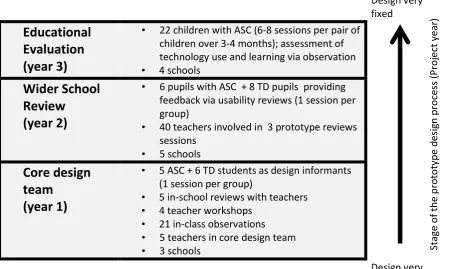
As noted above, an important objective for us was that the technology developed in the project should be useful for, and useable in, school settings and so this required a good understanding of the target learners as well as the context in which the technology was to be used. To gather this knowledge we established three levels of schools engagement in the project: (1) a core design team of five teachers from three different schools (one mainstream and two autism specialist schools) plus project researchers who were closely involved in early decisions and iterative ideas generation about how to use CVE technology for student
16
together with teachers from two of the schools engaged in level 1, reviewed concept design and prototypes of the CVEs that were developed (40 teachers in total); and (3) a further four schools who were involved in final evaluation studies to assess use and suitability of the CVEs for student learning. Figure 2 illustrates the different levels of involvement of these schools, the number of design activities (development and / or evaluation) that took place, and the scope for potential to influence the design and development of the prototypes at these different stages.
***Insert Figure 2 about here***
Notably, the learning context was very well represented by significant involvement of
teachers and children in the early stages of the project. During this time the core design team decided on two key areas of social interactions that teachers said were difficult (and
important) to teach - collaboration and social conversation - following workshops to
illustrate the key features of the CVE technology, as well as the main conceptual approach of the project. Consequently, early design decisions were made in a context where we were simultaneously negotiating all three layers of the sandwich within the core design team. There appeared to be a good alignment between the learning needs of the target users, the pedagogic wishes of the teachers, the specific affordances of the CVE technology in being able to support the interaction of more than one user at the same time, and the theoretical approach taken.
17
one of our main concepts as an example: the COSPATIAL Block Challenge (full details of this scenario and its iterative development can be found in Cobb et al., 2010).
This scenario concept was for a two-player problem-solving game where each player has different but interdependent objectives to achieve. The objective was for the players to work together to build a tower of blocks that had different patterns when viewed from each side (see Figure 3). Each player was presented with information about the pattern that should be viewed from their side of the tower but no information about the target pattern for the other player. In order for both players to achieve their target patterns, they would need to
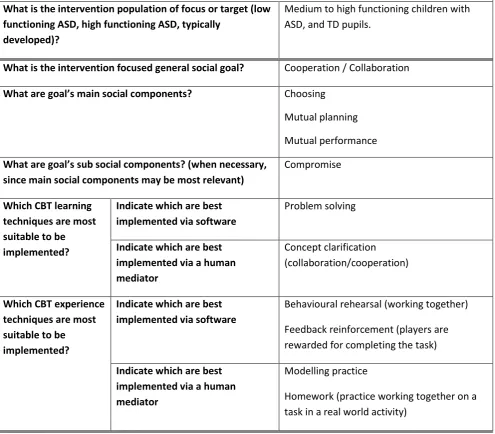
communicate with each other to find out what colour pattern their partner required and they would need to work together to jointly rotate individual blocks until the correct colours were showing on each side of the tower. The CBT scenario grid for this scenario is shown in Table 1 (from Weiss et al., 2010).
***Insert Table 1 about here***
This CBT grid illustrates that the main social components of collaboration that were targeted by the development of Block Challenge were mutual planning (cognitive), mutual
18
Figure 6). Thus, there was a strong push factor from the top theory-driven slice of the
sandwich that guided the development of this scenario. In addition, this concept was liked by the teachers and was premised on targeting key skills of collaboration and turn-taking
utilising some of the main identified affordances of the CVE (perspective-taking, non-face-to-face communication). However, in translating the concept into the CVE software there were many instances of misunderstanding and differences in expectations leading to compromises that had to be made.
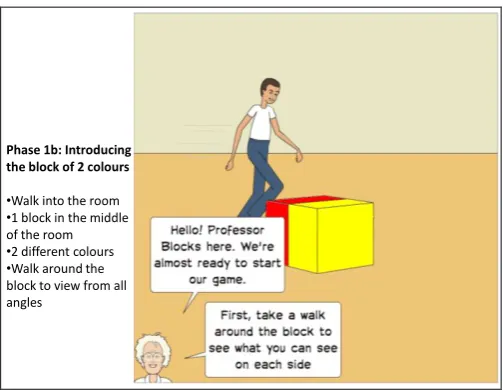
A specific example was the degree to which (and how) facilitation, to support concept clarification, should take place within the CVE. In the case of the Block Challenge activity this was instantiated through modelling an example of a visual perspective-taking task which requires participants to mentalise what someone else can see (based on Hamilton et al., 2009). This was developed as a training activity to be completed prior to performance of the collaborative tower building activity (main task). With hindsight, we realised that, whilst we had put considerable thought into the details of the main task, this was not the case for planning of the training activity. The concept elaboration storyboard included only images for the training activity (see Figure 4), depicting the idea that a two-colour 3-dimensional block would be placed in the VE and the student would move around the block to see it from different sides. The intention was that moving around the block would facilitate student understanding of how the block would look (differently) from different perspectives.
***Insert Figures 3 & 4 about here***
However, whilst this was agreed by the core development team at the teacher workshops, implementation in the VE revealed the need for additional design decisions and revisions which were added through a series of prototype review sessions involving different
19
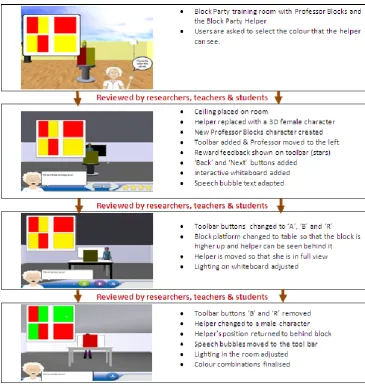
scaffolding) about how to interact with the VE (see Figure 5). Initial review of this prototype by teachers and the typically developing (TD) children revealed that it was not immediately obvious to the user how to move around the room to see the block from different sides. To overcome this, 3-D objects were placed in different corners of the virtual room and Professor Blocks provided prompts to encourage the user to move to the object in order to explore the 3-D space.
Through a series of iterative walkthroughs of CVE prototypes, involving teachers and students, further design changes were made to the training environment (see Figure 6). These were useful changes to make based on user feedback but in making these changes a major tension was revealed between the different preferences of users (children vs. teachers), the desirable affordances of the CVE technology, and the implementation of theory.
Specifically, the need to facilitate student interaction within the CVE, both to overcome navigation control difficulties but also in order to guide them through the learning activity in a structured sequence, restricted use of some of the natural affordances of the technology - in this case, free navigation to explore the 3-D space. The constraint on exploration was driven by the need to focus student learning and was experienced again in the Block Challenge main activity; initially the design of the CVE allowed students to move their avatars around the virtual space to explore the blocks in the room from which to choose the block required. During testing, it was observed that the students enjoyed this feature but got distracted by chasing the avatar of the other player around the room. In order to focus attention on the learning objective, teachers requested that the free navigation feature was removed. This resulted in restricted movement control wherein the students could only turn their avatars around to see what blocks were in the room but not move around the room.
***Insert Figures 5 & 6 about here***
20
that we deviated from using some of the affordances of CVEs that were initially considered to be attractive in the application of this technology in education viz: free navigation and interaction with the CVE (allowing the user to make the own decisions about what they want to do and in what order) and flexibility (to allow teachers to adapt the learning experience to suit specific needs of individual learners). This resulted in two major consequences: firstly, building constraints into the VE was very time consuming and difficult and, secondly, some of the more able students were bored and frustrated by the constrained activity in the
evaluation of the technology, leading to reduced motivation to continue or complete the task.
This did not mean that the Block Challenge scenario was unsuccessful (an unappealing ‘sandwich’); three important affordances of CVEs were utilised in this scenario (3D
visualisation, perspective-taking, and collaborative interaction) and feedback from teachers during formative and summative evaluation studies was positive (Parsons et al., 2012). Rather, what we seek to illustrate is that our experience throughout the design process was messy, and became impaired by tensions arising from the conflicting requirements, and differences in expectations of these from different stakeholders. These tensions were not experienced by our design team alone; the team developing the shared active surface scenarios also experienced considerable tensions and ‘constructive misunderstandings’ (Zancanaro, 2012). Thus, through a series of decisions made with good reasons via different user groups at different stages of development, we ended up with a CVE training scenario that was boring (for some) and difficult to use and seemed to jar with many of our initial intentions. Crucially also, because of the significant time investment in creating this scenario we were then very reluctant to rethink and revise our plans.
Conclusions
This is an example from just one small part of one of the COSPATIAL prototypes and, in this paper, we can only provide glimpses into the complexity of the processes involved.
multi-21
disciplinary project like this. In the example of the training environment, we see a sandwich that might have started off looking and sounding like a good product but, in trying to make the sandwich, we ended up with fillings that did not necessarily align well with either the top or bottom slice of our triple-decker.
For example, in prioritising the perspective-taking aspects of the Block Challenge task that aligned strongly with underlying theoretical concepts relating to ‘theory of mind’ difficulties, we ended up diminishing the key affordance of flexibility (of exploration and interaction) that can be achieved in CVEs. This, in turn, led to reduced enjoyment of the use of the CVE for some of the users because their movements were constrained within the task. The feedback regarding the impact of the constraints on exploration and movement through the CVE came too late for us to make changes to this aspect of this task. Therefore, even though the bottom slice of the sandwich – the experiences and views of the users (teachers and children) - was well covered in our project design activities, this was not sufficient for avoiding problems in developing a useable end-product.
22
was more difficult to meet learning needs effectively because there was a difference in views. It could be that future projects need to specify and differentiate the ‘central users’ from other stakeholders and work differently with these distinct groups.
The particular challenge of which users to prioritise and when highlights that, without due reflection, it is easy to take a rather rose-tinted perspective on the involvement of users in projects like this as a way of achieving important ethical and epistemological objectives; namely, taking a more inclusive approach to educational technology development in the belief that it is the ‘right thing to do’ and that, as a consequence, this will result in better learning outcomes for children (Parsons & Cobb, 2013). Additionally, we have even claimed that by taking a learner-centred approach it is possible to navigate and possibly ameliorate some of the tensions that arise within complex educational technology projects:
“Multi-disciplinary teams are necessary for accomplishing this kind of research but there can be inevitable challenges regarding the (sometimes conflicting) views from different academic disciplines regarding expectations and priorities for research methods, questions and analyses. Nevertheless, it can be possible to work positively within these differing views if user needs and views are accorded appropriately high status within the development of the project” (Parsons et al., 2011; pp.29-30).
23
user roles within the project, especially through being involved from the very early stages of the project (cf. Abascal & Nicolle, 2005). Therefore, we were inclusive – but only up to a point; user voices sometimes were not given due prominence (and maybe at times, given too much prominence) and this leaves us with many questions for the future.
There remain significant challenges in how the integration of user views can be more
effectively achieved and there is also a need for much clearer conceptualisation of the nature of the project and what is being aimed for - very much in agreement with Harrison et al.’s (2011) plea for researchers to be transparent about their political and intellectual
commitments. In other words, we need to be clear about the extent to which users may or may not be involved in decision-making and to ensure that they understand the reasons why / why not. Ultimately, we had a strong social justice agenda - we wanted to create something useable and available for schools, to make outputs that could make a difference to children’s learning outcomes in the real world rather than simply being a research exercise. Perhaps this was too ambitious because it could be that in trying to value and include the user whilst simultaneously aiming to produce a ‘finished product’ we were working on two competing or even opposing objectives.
Martin and Sherington (1997) make a distinction between ‘research driven’ and
‘development driven’ projects, the former reflecting the pursuit of a research agenda and the latter focusing more on the processes of empowering people to make decisions and changes. They argue that these different drivers necessitate different relationships between the
(traditionally defined) researchers and the researched, with development projects requiring more collegiate and collaborative relationships and research projects involving more
24
‘With this role of design partner, the impact that technology has on children may not be as significant as the impact children can have on the technology design process.’ (2002; p.19)
25 Acknowledgements
26 References
Abascal, J., & Nicolle, C. (2005). Moving towards inclusive design guidelines for socially and ethically aware HCI. Interacting with Computers, 17(5), 484-505.
Aberson, B., Shure, M. B., & Goldstein, S. (2007). Social problem-solving intervention can help children with ADHD. Journal of Attention Disorders, 11(1), 4-7.
Aronson, E. & Patnoe, S. (2011). Cooperation in the classroom: the Jigsaw Method (3rd edition). Pinter & Martin Ltd.
Bauminger, N. (2002). The facilitation of social-emotional understanding and social interaction in high functioning children with autism: Intervention outcomes. Journal of Autism and Developmental Disorders, 32, 283-298.
Bauminger, N. (2007a). Individual Social-Multi-Modal Intervention for HFASD. Journal of Autism and Developmental Disorders, 37, 1593-1604.
Bauminger, N. (2007b). Group Social-Multimodal Intervention for HFASD. Journal of Autism and Developmental Disorders, 37, 1605-1615.
Bauminger N., Battocchi, A., Cobb, S., Eden, S., Gal, E., Glover, T., Hoshmand, S., Parsons, S., Weiss, P.L. & Zancanaro, M. (2009) State of art report on current practice in social competence training. FP7 Deliverable 1:1 – available at http://cospatial.fbk.eu/deliverables Beardon, L., Parsons, S. & Neale, H. (2001) An inter-disciplinary approach to investigating the use of virtual reality environments for people with Asperger Syndrome. Educational and Child Psychology, 18, 53-62.
Benton, L., Johnson, H., Ashwin, E., Brosnan, M. and Grawemeyer, B. (2012) Developing IDEAS: supporting children with autism within a participatory design team. In: CHI '12 Proceedings of the SIGCHI Conference on Human Factors in Computing Systems.
Association for Computing Machinery (ACM), New York, pp. 2599-2608. ISBN 9781450310154
Beresford, P., & Evans, C. (1999). Research note: Research and empowerment. British Journal of Social Work, 29(5), 671-677.
Bleumers, L., All, A., Mariën, I., Schurmans, D., Van Looy, J., Jacobs, A., Willaert, K. & de Grove, F. (2012) State of Play of Digital Games for Empowerment and Inclusion: A Review of the Literature and Empirical Cases. EUR 25652 – Joint Research Centre – Institute for Prospective Technological Studies. Luxembourg: Publications Office of the European Union. doi:10.2791/36295
27
Brown, D. J., McHugh, D., Standen, P., Evett, L., Shopland, N., & Battersby, S. (2011). Designing location-based learning experiences for people with intellectual disabilities and additional sensory impairments. Computers & Education, 56(1), 11-20.
Clark, W., Logan, K., Luckin, R., Mee, A., & Oliver, M. (2009). Beyond Web 2.0: mapping the technology landscapes of young learners. Journal of Computer Assisted Learning, 25(1), 56-69.
Cobb, S., Beardon, L., Eastgate, R., Glover, T., Kerr, S., Neale, H., Parsons, S., Benford, S., Hopkins, E., Mitchell, P., Reynard, G. and Wilson, J.R. (2002)Applied virtual environments to support learning of social interaction skills in users with Asperger’s Syndrome. Digital Creativity, 13, 11-22.
Cobb, S.V.G., Hawkins, T., Millen, L., and Wilson, J.R. (2013) Development and Evaluation of Virtual Environments for Education. In K. Hale and K. Stanney (Eds.), Virtual
Environment Handbook, 2nd Edition (in press) CRC Press:.
Cobb S., Millen, L., Glover, T., Hawkins, T., Patel, H., Eastgate, R., Parsons, S. & Garib-Penna, S. (2010) Collaborative VE: Experience Report and Prototypes. COSPATIAL project deliverable report D4.1.2. Available from: http://cospatial.fbk.eu/deliverables. Last accessed 4th September 2013.
Cobb, S. Parsons, S., Millen, L., Eastgate, R. & Glover, T. (2010). Design and development of collaborative technology for children with autism: cospatial. Proceedings of INTED2010 Conference. 8-10 March 2010, Valencia, Spain, 4374-4383.
Cobb, S.V.G., Neale, H.R, Crosier, J.K. and Wilson, J.R. (2002). Development and
Evaluation of Virtual Environments for Education. In K. Stanney (Ed.), Virtual Environment Handbook, Chapter 47, Lawrence Erlbaum. 911-936.
Coleman, R., Clarkson, J., Dong, H., Cassim, J. (2012). Design for Inclusivity: A Practical Guide to Accessible, Innovative and User-Centred Design. Gower Publishing Limited: Hampshire, UK.
Crook, C. (1991). Computers in the zone of proximal development: implications for evaluation. Computers & Education, 17(1), 81-91.
Crosier, J.K., Cobb, S.V. and Wilson, J.R. (2002) Key Lessons for the Design and Integration of Virtual Environments in Secondary Science, Computers and Education, 38, 77-94.
Dalgarno, B., & Lee, M. J. (2010). What are the learning affordances of 3‐D virtual environments?. British Journal of Educational Technology, 41(1), 10-32.
Davis, M., Dautenhahn, K., Powell, S., & Nehaniv, C. (2010). Guidelines for researchers and practitioners designing software and software trials for children with autism. Journal of Assistive Technologies, 4(1), 38-48.
28
Druin, A. (2002). The role of children in the design of new technology. Behaviour and Information Technology, 21(1), 1-25.
Edwards, T. L., Watkins, E. E., Lotfizadeh, A. D., & Poling, A. (2012). Intervention research to benefit people with autism: How old are the participants?. Research in Autism Spectrum Disorders, 6(3), 996-999.
Fleming, J. (2012). Young People's Participation—Where Next? Children & Society. DOI:10.1111/j.1099-0860.2012.00442.x (Online Early)
Frauenberger, C., Good, J., Alcorn, A., & Pain, H. (2013). Conversing through and about technologies: Design critique as an opportunity to engage children with autism and broaden research (er) perspectives. International Journal of Child-Computer Interaction, 1(2), 38– 49.
Frauenberger, C., Good, J., Keay-Bright, W. & Pai, H. (2012). Interpreting Input from
Children: a Designerly Approach. CHI 2012, May 5–10, 2012, Austin, Texas, USA, 2377-2386. Gal, E., Weiss, P.L. (2011). Using innovative technologies as therapeutic and educational tools for children with Autism Spectrum Disorder. Israeli Journal of Occupational Therapy, 20, E35-55.
Good, J., & Robertson, J. (2006). CARSS: A framework for learner-centred design with children. International Journal of Artificial Intelligence in Education, 16(4), 381-413. Guha, M.L., Druin, A., Chipman, G., Fails, J.A., Sims, S. & Farber, A. (2005). Working with young children as technology design partners. Communications of the ACM – Interaction design and children, 48(1), 39-42.
Hamilton, A. F. D. C., Brindley, R., & Frith, U. (2009). Visual perspective taking impairment in children with autistic spectrum disorder. Cognition, 113(1), 37-44.
Harrison, S., Sengers, P., & Tatar, D. (2011). Making epistemological trouble: Third-paradigm HCI as successor science. Interacting with Computers, 23(5), 385-392. Higgins, S., Xiao, Z., & Katsipataki, M. (2012).The Impact of Digital Technology on
Learning: A Summary for the Education Endowment Foundation (Full Report). Available from www.educationendowmentfoundation.org.uk (last accessed 8th September 2013). Jordan, R. (2005). Autistic spectrum disorders. Chapter in B. Norwich and A. Lewis (Eds) (2005) Special teaching for special children?: pedagogies for inclusion, McGraw-Hill International (pp.110-122).
Kellett, M., Forrest (aged ten), R., Dent (aged ten), N. and Ward (aged ten), S. (2004), ‘Just teach us the skills please, we'll do the rest’: empowering ten-year-olds as active researchers.
Children & Society, 18: 329–343. doi: 10.1002/chi.807
Lewis, A., Parsons, S., Robertson, C., Feiler, A., Tarleton, B., Watson, D., ... & Marvin, C. (2008). Participation in research: Reference, or advisory, groups involving disabled people: reflections from three contrasting research projects. British Journal of Special Education,
29
Martin, A., & Sherington, J. (1997). Participatory research methods—implementation, effectiveness and institutional context. Agricultural systems, 55(2), 195-216
McConnell, S. R. (2002). Interventions to facilitate social interaction for young children with autism: Review of available research and recommendations for educational intervention and future research. Journal of Autism and Developmental Disorders, 32(5), 351-372.
Millen, L., Cobb, S. and Patel, H. (2011a). A method for involving children with autism in design. In: Proceedings of the 10th International Conference on Interaction Design and Children (IDC '11). Ann Arbor, USA.. 185-188
Millen, L., Cobb, S.V.G. & Patel, H (2011b). Participatory design approach with children with autism. International Journal on Disability and Human Development (IJDHD), 10(4), 289-294.
Mitchell, P., Parsons, S. & Leonard, A. (2007) Using virtual environments for teaching social understanding to adolescents with autistic spectrum disorders. Journal of Autism and Developmental Disorders, 37(3), 589-600.
Neale, H. (2001). Using virtual reality to teach social skills to people with Asperger's
Syndrome: Explaining Virtual Reality and User-Centred Methodology. 12th Annual Durham
International Conference on Autism, April 4th-6th, 2001, Autism North.
Neale, H., Cobb, S. and Kerr, S. (2003). An inclusive design toolbox for development of educational Virtual Environments. Presented at: Include2003, Royal College of Art, London, 25-28 March 2003
Nesset, V., & Large, A. (2004). Children in the information technology design process: A review of theories and their applications. Library & Information Science Research, 26(2), 140-161.
Newbutt, N. (2013) Exploring Communication and Representation of the Self in a Virtual World by Young People with Autism, Unpublished PhD Thesis, University College Dublin. Nind, M. & Vinha, H. (in press) Doing research inclusively: bridges to multiple possibilities in inclusive research. British Journal of Learning Disabilities. DOI: 10.1111/bld.12013 [Online Early]
Nind, M., & Wearmouth, J. (2006). Including children with special educational needs in mainstream classrooms: implications for pedagogy from a systematic review. Journal of Research in Special Educational Needs, 6(3), 116-124.
Norwich, B. & Lewis, A. (Eds) (2005) Special teaching for special children?: pedagogies for inclusion, McGraw-Hill International.
Parsons, S., Beardon, L., Neale, H. R., Reynard, G., Eastgate, R., Wilson, J. R., Cobb, S. V., Benford, S., Mitchell, P., & Hopkins, E. (2000). Development of social skills amongst adults with Asperger's Syndrome using virtual environments: The AS Interactive project. 3rd
30
Parsons, S. & Cobb, S. (2011) State-of-the art of Virtual Reality Technologies for children on the autism spectrum. European Journal of Special Needs Education, 26(3), 355-36
Parsons, S. & Cobb, S. (2013) Who chooses what I need? Child voice and user-involvement in the development of learning technologies for children with autism. EPSRC Observatory for Responsible Innovation in ICT: http://torrii.responsible-innovation.org.uk/resource-detail/1445 [last accessed 8th September 2013].
Parsons, S., Garib-Penna, S., Rietdijk, W., Millen, L., Hawkins, T., Cobb, S., Weiss, P.L., Gal, E., Bauminger, N., Eden, S., Zancanaro, M., Traversari, S., Boffi, L., & Alessandrini, A. (2012)
Final report on evaluation of prototypes. Deliverable 5.2 - available at http://cospatial.fbk.eu/deliverables [last accessed 8th September 2013]
Parsons, S., Guldberg, K., MacLeod, A., Jones, G., Prunty, A. & Balfe, T. (2011) International review of the evidence on best practice in educational provision for children on the autism spectrum. European Journal of Special Needs Education, 26(1), 47-63.
Parsons, S., Millen, L., Garib-Penna, S. & Cobb, S. (2011) Participatory design in the development of innovative technologies for children and young people on the autism spectrum: the COSPATIAL project. Journal of Assistive Technologies, 5(1), 29-34.
Parsons, S. & Mitchell, P. (2002) The potential of virtual reality in social skills training for people with autistic spectrum disorders. Journal of Intellectual Disability Research, 46, 430-443.
Parsons, S., Mitchell, P., & Leonard, A. (2004) The use and understanding of virtual environments by adolescents with autistic spectrum disorders. Journal of Autism and Developmental Disorders. 34(4), 449-466.
Pellicano, E., & Stears, M. (2011). Bridging autism, science and society: moving toward an ethically informed approach to autism research. Autism Research, 4(4), 271-282.
Porayska-Pomsta, K., Frauenberger, C., Pain, H., Rajendran, G., Smith, T., Menzies, R., ... & Lemon, O. (2012). Developing technology for autism: an interdisciplinary approach.
Personal and Ubiquitous Computing, 16(2), 117-127.
Porter, J., Parsons, S., & Robertson, C. (2006). Time for review: supporting the work of an advisory group. Journal of Research in Special Educational Needs, 6(1), 11-16.
Prizant, B. M., & Rubin, E. (1999). Contemporary Issues in Interventions for Autism Spectrum Disorders: A Commentary. Journal of the Association for Persons with Severe Handicaps, 24(3), 199-208.
Rideout, M.A., Foehr, U.G. & Roberts, D.F. (2010) Generation M2: media in the lives of
8-to-18-year-olds. A Kaiser Family Foundation Study. Available from www.kff.org
31
Scaife, M. & Rogers, Y. (1999). Kids as informants: Telling us what we didn’t know or
confirming what we knew already. In A. Druin (Ed.), The design of children’s technology (pp. 27–50). San Francisco: Kaufmann.
Shure, M.B. & Spivack, G. (1982). Interpersonal problem solving in young children: A
cognitive approach to prevention. AmericanJournal of Community Psychology, 10, 341-356. Silver, M., & Oakes, P. (2001). Evaluation of a new computer intervention to teach people with autism or Asperger syndrome to recognize and predict emotions in others. Autism, 5(3), 299-316.
Soloway, E., Guzdial, M., & Hay, K. E. (1994). Learner-centered design: The challenge for HCI in the 21st century. interactions, 1(2), 36-48.
Thomson, P., & Gunter, H. (2006). From ‘consulting pupils’ to ‘pupils as researchers’: a situated case narrative. British Educational Research Journal, 32(6), 839-856.
Weiss, P.L.(T), Gal, E., Bauminger, N., Zancanaro, M., Battocchi, A., Cobb, S., Glover, T., Edlin-White,R., Millen, L., Parsons, S. & Garib-Penna, S. . (2010) A CBT-based Framework to Design Collaborative Technologies for Learning Social Competencies. COSPATIAL project deliverable report D2.2.1. Available from: http://cospatial.fbk.eu/deliverables. Last accessed 4th September 2013.
Weiss, P.L.(T), Gal, E., Zancanaro, M., Pianesi, F., Stock, O., Cobb, S., Millen, L., Hawkins, T., Nguyen, B., Glover, T., Bauminger, N., Eden, S. & Parsons, S. (2012) A CBT-based
Framework to Design Collaborative Technologies for Learning Social Competencies. COSPATIAL project deliverable report D2.2.3 Available from:
http://cospatial.fbk.eu/deliverables. Last accessed 4th September 2013.
Williams White, S., Keonig, K., & Scahill, L. (2007). Social skills development in children with autism spectrum disorders: A review of the intervention research. Journal of autism and developmental disorders, 37(10), 1858-1868.
Yelland, N., & Masters, J. (2007). Rethinking scaffolding in the information age. Computers & Education, 48(3), 362-382.
Zancanaro, M. (2012) Constructive misunderstandings: a computer scientist’s report on the design of collaborative technologies for children on the autism spectrum. Invited talk at
32 Tables and Figures
Fig 1: Shared Active Surface (SAS) and Collaborative Virtual Environment (CVE) technologies
Design very fixed
Educational
Evaluation
(year 3)
• 22 children with ASC (6-8 sessions per pair of children over 3-4 months); assessment of technology use and learning via observation
• 4 schools
Wider School
Review
(year 2)
• 6 pupils with ASC + 8 TD pupils providing feedback via usability reviews (1 session per group)
• 40 teachers involved in 3 prototype reviews sessions
• 5 schools
Core design
team
(year 1)
• 5 ASC + 6 TD students as design informants (1 session per group)
• 5 in-school reviews with teachers
• 4 teacher workshops
• 21 in-class observations
• 5 teachers in core design team
• 3 schools
Design very open
Fig 2: Schools involvement in the COSPATIAL CVE development project [Note that ASC = Autism Spectrum Conditions and TD = typically developing]
[image:32.595.67.521.322.591.2]33
Fig 3: The COSPATIAL Block Challenge activity. The screen on the left shows the viewpoint for player 1. They can see the avatar for player 2 (wearing a green top) on the other side of the room. The target for player 1 is to build a two-block tower with a yellow block in the bottom and a grey block on the top. The screen on the right shows the viewpoint for player 2. They can see the avatar for player 1 (wearing a red top) on the other side of the room. The target for player 2 is to build a two-block tower with a red two-block in the bottom and a brown two-block on the top. The first two-block has been selected and is placed in the centre of the room between the avatars. The players need to rotate the block to match their respective block tower patterns.
Phase 1b: Introducing the block of 2 colours
•Walk into the room
•1 block in the middle of the room
•2 different colours
•Walk around the block to view from all angles
[image:33.595.172.424.428.623.2]34
Fig 5: First CVE prototype of the COSPATIAL Block Challenge training activity
[image:34.595.114.480.300.687.2]35
Table 1: Description of the COSPATIAL Block Challenge scenario using the CBT template
Scenario description.
Block Challenge: A joint problem-solving game where each player has different but interdependent
objectives to achieve. This activity revolves around two or more players engaging in a problem solving task in a virtual environment. The aim of the task is to match the pattern on the target image to the pattern on your column by twisting and turning blocks in collaboration with the other players. This scenario could be greatly simplified in order to cater for a wider range of abilities. Players could have to build a block tower collaboratively to match a target pattern. E.g. “Build a tower of three red blocks” – the players would have access to a number of colour blocks and they must choose three red blocks and pick them up and move them together to match the target pattern.
What is the intervention population of focus or target (low functioning ASD, high functioning ASD, typically
developed)?
Medium to high functioning children with ASD, and TD pupils.
What is the intervention focused general social goal? Cooperation / Collaboration
What are goal’s main social components? Choosing Mutual planning Mutual performance What are goal’s sub social components? (when necessary,
since main social components may be most relevant)
Compromise
Which CBT learning techniques are most suitable to be implemented?
Indicate which are best implemented via software
Problem solving
Indicate which are best implemented via a human mediator
Concept clarification (collaboration/cooperation)
Which CBT experience techniques are most suitable to be implemented?
Indicate which are best implemented via software
Behavioural rehearsal (working together) Feedback reinforcement (players are rewarded for completing the task) Indicate which are best
implemented via a human mediator
Modelling practice