
Published Online March 2010 in SciRes.http://www.scirp.org/journal/jbise
Quantifying the effects of mutations on receptor binding
specificity of influenza viruses
Wei Hu
Department of Computer Science, Houghton College, Houghton, USA. Email: [email protected]
Received 7 January 2010; revised 11 January 2010; accepted 15 January 2010.
ABSTRACT
Hemagglutinin (HA) of influenza viruses is a cylin-drically shaped homotrimer, where each monomer comprises two disulfide-linked subdomains HA1 and HA2. Influenza infection is initiated by binding of HA1 to its host cell receptors and followed by the fusion between viral and host endosomal membranes mediated by HA2. Human influenza viruses prefer-entially bind to sialic acid that is linked to galactose by an α2,6-linkage (α2,6), whereas avian and swine influenza viruses preferentially recognize α2,3 or α
2,3/α2,6. For animal influenza viruses to cross host species barriers, their HA proteins must acquire mu-tations to gain the capacity to allow human-to-human transmission. In this study, the informational spec-trum method (ISM), a bioinformatics approach, was applied to identify mutations and to elucidate the contribution to the receptor binding specificity from each mutation in HA1 in various subtypes within or between hosts, including 2009 human H1N1, avian H5N1, human H5N1, avian H1N1, and swine H1N2. Among others, our quantitative analysis indicated that the mutations in HA1 of 2009 human H1N1 col-lectively tended to reduce the swine binding affinity in the seasonal H1N1 strains and to increase that in the pandemic H1N1 strains. At the same time, they increased the human binding affinity in the pandemic H1N1 strains and had little impact on that in the sea-sonal H1N1 strains. The mutations between the con-sensus HA1 sequences of human H5N1 and avian H5N1 increased the avian binding affinity and de-creased the human binding affinity in avian H5N1 while produced the opposite effects on those in hu-man H5N1. Finally, the ISM was employed to analyze and verify several mutations in HA1 well known for their critical roles in binding specificity switch, in-cluding E190D/G225D in H1N1 and Q192R/ S223L/ Q226L/ G228S in H5N1.
Keywords: Binding Specificity; Discrete Fourier Transform; Electron-Ion Interaction Potential; Entropy; Hemagglutinin; Influenza; Informational
Spectrum Method; Mutation; Receptor
1. INTRODUCTION
Influenza A viruses are classified into different sub-types based on the viral surface proteins hemagglutinin (HA) and neuraminidase (NA). The initial step in the influenza infection is the binding of HA to sialylated glycan receptors on the host cells. HA is also the pri-mary target for the immune response in the infected host. Human and swine influenza viruses are derived from avian viruses, facilitated by regular close contact among humans, birds, and pigs [1]. The past three in-fluenza pandemics, the Spanish flu (H1N1) in 1918, the Asian flu (H2N2) in 1957, and the Hong Kong flu (H3N2) in 1968, all had arisen from a reassortment from avian, swine, and human viruses. The current 2009 influenza pandemic was caused by a swine-origin H1N1 virus. The adaptation of the virus to a new host entails the compatibility between host and virus genetic requirements to allow efficient replication and sus-tained transmission. The host barrier for influenza vi-ruses to transmit in humans is multigenic, however, the receptor specificity of HA proteins is a key determinant. The binding preference of influenza virus HAs af-fects the host specificity for infection. In general,
hu-man influenza viruses bind preferentially to α2,6
re-ceptors, avian influenza viruses tend to bind to α2,3
receptors, and swine influenza viruses can bind to
ei-ther α2,6 receptors or both α2,6 and α2,3 receptors,
primarily based on differences in the amino acids in the HA receptor binding domain (RBD). The RBD of HA in various influenza subtypes has three structural
elements in common, one α-helix (190-helix) and two
loops (130-loop and 220-loop). Different hosts express
diverse SA isomers, i.e., α2,3 linkages in the gut of
waterfowl, α2,3 and α2,6 linkages in the lung and
in-testinal epithelium of chickens, and α2,6 linkages in the
upper respiratory epithelium and α2,3 and α2,6
to facilitate efficient human transmission, mutations in
HA are required to increase α2,5 binding and at the same
time to decrease α2,3 binding [4]. A variety of mutations
that can shift receptor preference of HA proteins have been identified.
In a study of receptor specificity of influenza A/H5 vi-ruses [5], all but two isolates exhibited high affinity to
α2,3 receptors. The two isolates with a unique S223N
change in HA demonstrated decreased affinity to α2,3 and
moderate affinity to α2,6 receptors. Another study showed
that introduction of the mutation Q192R enhanced the
binding of HA in H5N1 to α2,6 receptors, and
introduc-tion of both mutaintroduc-tions Q192R and S223N increased the binding preference significantly. Residue 192 is close to the 190 helix, and residue 223 is part of the 220 loop, where it is feasible for them to influence the binding affin-ity [6]. As for the H2, H3, H4, and H9 HAs, two substitu-tions Q226L and G228S are mainly responsible for the switch from avian to human binding [3,7,8,9].
Residues 138, 186, 190, 194, 225, 226, and 228 can modulate the binding affinity of H1N1 HA proteins, and two residues 190 and 225 play key dominant roles in binding affinity [10,11]. The sequences of the RBD of avian H1 viruses maintain a Glu at position 190 and a Gly at 225 (H3 numbering), while the human H1 viruses gen-erally have an Asp at both positions 190 and 225. It is known that E190D and G225D mutations in H1 viruses can shift binding patterns from avian to human type. In the five 1918 H1N1 HA sequences, three have a D190 and
a D225 with α2,6 affinity, and two have a D190 and a
G225 with mixed α2,6/α2,3 specificities [12]. In general,
mutations D190/D225 favor α2,6 receptors in humans,
D190/G225 like α2,6 and α2,3 receptors in swine, and
E190/G225 prefer α2,3 receptors in avian [13]. The
bio-chemical analysis in [14] quantified the multivalent HA-glycan interactions, and showed the effects of these mutations on glycan binding amplified by multivalency.
To date, the symptoms of 2009 H1N1 are mild. The fear is that the virus may continue to mutate to bring about another more lethal outbreak in the subsequent months as the 1918 Spanish flu. In [15] two representa-tive 2009 H1N1 HA sequences, A/California/4/2009 and
A/Hamburg/5/2009, were shown to bind to both α2,6
and α2,3 receptors with some minor differences in a
carbohydrate microarray analysis, as predicted in [16]. There were three amino acid mutations between these HA sequences: S83P, A197T, and V321I, which might account for these differences in binding. These findings suggested that no major change in binding affinity is necessary for pandemic virus to acquire human binding
patterns, and the dual binding to α2,6/α2,3 receptors is
one contributor to the greater virulence of the pandemic virus than seasonal flu virus.
There were two other recent reports on the mutations of the 2009 H1N1 virus. The first report [17] located the potential mutations and strongly co-mutated positions in
NA. The second report [18] focused on HA and the inter-action between HA and NA. The mutations of HA in 2009 H1N1 were found and mapped to the 3D homology model of H1, and the mutations on the five epitope regions on H1 were identified. With help from the results of the first study, two co-mutation networks were uncovered, one in HA and one in NA, where each mutation in one network co-mutates with the mutations in the other network across the two proteins HA and NA. These two networks resid-ing in HA and NA separately may provide a functional linkage between the mutations that can change the drug binding sites in NA and those that can affect the host im-mune response or vaccine efficacy in HA.
In references [19,20] the informational spectrum method (ISM) [21] was applied to investigate the inter-action between HA and its receptors, which showed that HA1 of different flu subtypes encodes one highly con-served domain that might be determinants of HA binding affinity. The study in [22] extended the results in refer-ences [19,20] by identifying multiple domains in HA1 associated with each receptor interaction pattern. These conserved domains in HA1 might be used to identify new therapeutic targets for drug development.
In references [19,20] it was found that the consensus informational spectrum (CIS) of HA1 of influenza strains have the following characteristic dominant peaks at dif-ferent IS frequencies as presented in Table 1. In this study, F(0.295) will be referred to as pandemic human H1N1 receptor interaction frequency, F(0.055) as swine receptor interaction frequency, F(0.076) as avian receptor interac-tion frequency, and F(0.236) as seasonal human H1N1 receptor interaction frequency. In addition to the dominant peak at IS frequencies in each subtype, there are secon-dary peaks at various IS frequencies [19,20,22].
Viral evolution can help influenza viruses surmount species barriers. Once adapted in a new host, they still need to continue their evolution to fit better in the new environment. In this study, we sought to investigate the effects of mutations in HA1, either within or between hosts, on binding preference shift through a quantitative analysis, the ISM. The analysis performed in this study was based on the observation that several influenza vi-ruses display dual specific recognition of receptors with
α2,6 or α2,3 linkages. Our goal was to utilize the ISM to
[image:2.595.312.539.678.722.2]uncover the amino acid polymorphisms in HA1 within or between hosts and to measure their contribution to the binding specificity switch quantitatively.
Table 1. Characteristic IS frequencies of HA proteins in 2009
H1N1, swine H1N1/H1N2, avian H5N1, and seasonal human H1N1.
Subtype H1N1 2009 H1N2/H1N1 Swine H5N1 Avian human H1N1Seasonal
Copyright © 2010 SciRes.
2. MATERIALS AND METHODS
2.3. Important Sites in HAAlthough there is a great variation due to high selection pressure in the HA1 sequences of various flu subtypes, the active site of HA1 is well conserved, which is lo-cated in a cleft composed of the residues 91, 150, 152, 180, 187, 191, and 192. The three amino acids at posi-tions 187, 191 and 192 are a part of the 190 helix. The active site cleft of HA is formed by its right edge (131_GVTAA) and left edge (221_RGQAGR) (H1 num- bering), which are also commonly referred to as the 130 loop and 220 loop, respectively [25,26].
2.1. Sequence Data
All HA sequences were retrieved from the Influenza
Virus Resource (http://www.ncbi/nlm.nih.giv/genomes/
FLU/FLU.html) of the National Center for Biotechnol-ogy Information (NCBI) on November 20, 2009. Only the full length and unique sequences were selected. There were 450 HA sequences of human 2009 H1N1, 201 HA sequences of human H5N1 from 1979 to 2009, 1228 HA sequences of avian H5N1 from 1959 to 2009, 78 HA sequences of avian H1N1 from 1976 to 2008, and 83 HA sequences of swine H1N2 from 1980 to 2009. All the sequences used in the study were aligned with MAFFT [23].
3. RESULTS
3.1. Mutations within Hosts 3.1.1 2009 Human H1N1 2.2. Entropy
After visual inspection of the alignment of 2009 human H1N1 HA1 sequences, there was either an Asp (single letter code D) at position 127 in the pandemic strains or a deletion at position 127 in the seasonal strains. Since Asp had the highest EIIP value of 0.128 [22], this dele-tion at posidele-tion 127 might influence the DFT spectral distribution. Of the 450 HA1 sequences of 2009 human H1N1 collected, there were 345 pandemic H1N1 se-quences with an Asp at position 127 and 105 seasonal H1N1 sequences with a deletion at position 127.
In information theory [24], entropy is a measure of dis-order or randomness associated with a random variable.
Let
x
be a discrete random variable that has a set ofpossible values with probabilities
where
a1,a2,a2,...an
x aiP
pi
p1,p2,p3,...pn
. The entropy Hof
x
is
x ipiH logpi
In the current study, each of the n columns in a multi-ple sequence alignment of a set of HA sequences of N residues is considered as a discrete random variable
(1 ≤i≤N) that takes on one of the 20 (n=20) amino acid
types with some probability. has its minimum
value 0 if all the residues at position i are the same, and achieves its maximum if all the 20 amino acid types
ap-pear with equal probability at position i, which can be
i
x
xiH
The CIS of the pandemic H1N1 HA1 sequences were
plotted in Figure 1(a), which have a dominant peak at
frequency F(0.295) (pandemic human H1N1 binding), and the CIS of the seasonal H1N1 HA1 sequences were
plotted in Figure 1(b), which have a dominant peak at
frequency F(0.055) (swine binding). According to the ISM concepts, this demonstrated the different receptor binding patterns of the 2009 pandemic and seasonal
H1N1 strains. Figure 2 illustrated the consensus
se-quences of the pandemic H1N1 strains (human binding preference) and seasonal H1N1 strains (swine binding preference), respectively.
verified by the Lagrange multiplier technique. A position of high entropy means that the amino acids are often
varied at this position. measures the genetic
di-versity at position i in our current study. A brief
over-view of the extensive applications of entropy in se-quence analysis, in particular the flu virus sese-quences, can be found in [17].
xiH
There were 90 amino acid substitutions between the two consensus HA1 sequences of human and swine
binding characteristics (Figure 2 and Table 2). Based on
Table 2.Mutations between swine and human bindings in HA1 sequences of 2009 H1N1.
I3L N35D S36K L43K K45R I47V Q51H N54K S56N V57I L69S I71S S72T K73A E74S K82T P83S N84S
P85S E86D H94D A96I E120T -127D S128T V129N T130K S133T S135A S137P N139A E141A S142K R146K L149I T152V
G153K N155G G156N L157S N160K A166I N167D E170G V179I P183S N184T I185S V186A K189Q T190S H193Q T194N E195A
N196D S200F V202G H205R R208K T211K K216I I227M L234V T239K I241T N245T I249V A250V L257M S258E G260N F261A
N267I N269D A270T M272V D273H K274D D276N A277T K278T Q283K V295I V298I E302K R308K A310T M314L V315A I321V
(a) (b)
[image:4.595.84.496.93.442.2](c) (d)
Figure 1. (a) CIS of HA1 of 200 CIS of HA1 of 2009
);
e ISM theory, the mutations in HA1 that increased the binding pocket, which were not listed in Table 3 because
dues 269,
0 0.05 0.1 0.15 0.2 0.25 0.3 0.35 0.4 0.45 0.5
0 50 100 150 200 250
300 CIS of HA1 of 2009 H1N1 (swine binding)
Frequency
S/
N
0 0.05 0.1 0.15 0.2 0.25 0.3 0.35 0.4 0.45 0.5
0 50 100 150 200 250
300 CIS of HA1 of 2009 H1N1 (pandemic human H1N1 binding)
Frequency
S/
N
F(0.055) F(0.295)
9 pandemic H1N1 (pandemic human H1N1 binding); (b)
seasonal H1N1 (swine H1N1 binding); (c) IS of HA1 of 2009 pandemic H1N1 (pandemic human H1N1 binding (d) IS of HA1 of 2009 seasonal H1N1 (swine H1N1 binding).
th
amplitude of F(0.295) and decreased that of F(0.055) would contribute the switch of receptor binding affinity from swine to human type. The variation amount of the amplitudes of F(0.295) and F(0.055) was calculated for each of the 90 mutations applied to each consensus HA1 sequence, swine binding or human binding. The top 32 mutations that resulted in the amplitude change at
fre-quency F(0.295) or F(0.055) (∆A) more than 6% were
listed in Table 3, suggesting that these mutations might
be critical for modulating the binding preferences be-tween swine and humans. In general, increasing the am-plitude at one frequency F(0.295) or F(0.055) will de-crease that at another frequency, but there were several exceptions. Three “hot spots”, D94, D196, and D274, found in [19] contributed to the amplitudes at
frequen-cies F(0.295) and F(0.055) with different amounts (Table
3). There were a mutation T152V at the binding site, and
two mutations S133T and S135A at the right edge of the
their ∆A value was relatively small. Table 3 also
con-tained several mutations of interest, which were T130K and S137P near the right edge of the binding pocket, and P183S, N184T, I185S, H193Q, T194N, and N196D near the active site.
In [18], three networks of co-mutations in HA of 2009 H1N1 were uncovered. The first one had resi
276, and 309, the second one had residues 34, 167, 195, and 268, and the third one had residues 129, 210, and 238, where each residue co-mutated with others in the same network. Two pairs of mutations N167D/E195A
and N269D/D276N in Table 2 were part of the
afore-mentioned co-mutation networks discovered in [18].
Their individual and combined effects on ∆A were listed
in Table 4, with the second pair having a much larger impact on the binding preference than the first. There
were two clusters of mutations in Table 2, where the
first was located at positions from 152 to 170, and the
0 0.05 0.1 0.15 0.2 0.25 0.3 0.35 0.4 0.45 0.5 0
1 2 3 4 5 6
IS of consensus HA1 sequence of 2009 H1N1 (pandemic human H1N1 binding)
Frequency
A
m
pl
itude
7
0 0.05 0.1 0.15 0.2 0.25 0.3 0.35 0.4 0.45 0.5 0
1 2 3 4 5 6
IS of consensus HA1 sequence of 2009 H1N1 (swine binding)
Frequency
A
m
pl
itude
F(0.055) )
Copyright © 2010 SciRes. wine Binding DTICIGYHANNSTDTVDTVLEKNVTVTHSVNLLENSHNGKLCLLKGIAPLQLGNCSVAGW
WLTGKNGLYPNLSKSYANNKEKEVLVLWGVH
INYYWTLLEPGDTI
[image:5.595.68.526.139.349.2]c H1N1 (pandemic human H1N1 binding) and 2009
Table 3. Changes of amplitudes of IS frequencies by top 32 mutations with large ∆A value in HA1 of 2009 H1N1.
Mutating Consensus HA1 Sequence of Swine Binding Patterns Mutating Consensus HA1 Sequence of Human Binding Patterns
JBiSE
second at positions from 257 to 278. The first cluster of mutations was contained in a pandemic human H1N1 receptor recognition domain (150:174) with the charac-teristic IS frequency at F(0.295) found in [22]. Prompted
by this finding, we searched for a similar domain near the second cluster, and found a new domain (246:286) of swine binding characteristic with the IS dominant peak at frequency F(0.055) (Figure 3).
S
Human Binding DTLCIGYHANNSTDTVDTVLEKNVTVTHSVNLLEDKHNGKLCKLRGVAPLHLGKCNIAGW **:*******************************:.****** *:*:***:**:*.:***
Swine Binding ILGNPECELLISKESWSYIVEKPNPENGTCYPGHFADYEELREQLSSVSSFERFEIFPKE
Human Binding ILGNPECESLSTASSWSYIVETSSSDNGTCYPGDFIDYEELREQLSSVSSFERFEIFPKT
******** * : .*******....:*******.* ***********************
Right edge
Swine Binding SSWPNH-TVTGVSASCSHNGESSFYRNLL
Human Binding SSWPNHDSNKGVTAACPHAGAKSFYKNLIWLVKKGNSYPKLSKSYINDKGKEVLVLWGIH
****** : .**:*:*.* * .***:**:**. *.. **:***** *:* ********:*
Left edge
Swine Binding HPPNIVDQKTLYHTENAYVSVVSSHYSRKFTPEIAKRPKVRDQEGR
Human Binding HPSTSADQQSLYQNADAYVFVGSSRYSKKFKPEIAIRPKVRDQEGRMNYYWTLVEPGDKI
**.. .**::**:. :*** * **:**:**.**** **********:******:****.* Swine Binding IFEANGNLIAPRYAFALSRGFGSGIINSNAPMDKCDAKCQTPQGAINSSLPFQNVHPVTI Human Binding TFEATGNLVVPRYAFAMERNAGSGIIISDTPVHDCNTTCQTPKGAINTSLPFQNIHPITI ***.***:.******:.*. ***** *::*:..*::.****:****:******:**:** Swine Binding GECPKYVRSAKLRMVTGLRNIPSIQSR
[image:5.595.66.515.409.725.2]Human Binding GKCPKYVKSTKLRLATGLRNVPSIQSR *:*****:*:***:.*****:******
Figure 2. Alignment of two consensus HA1 sequences of 2009 pandemi
seasonal H1N1 (swine binding). The binding sites in HA are colored in red, the left and right edges of the binding cleft in blue.
Mutations ∆A[F(0.055)]% ∆A[F(0.295)]% ∆A[F(0.055)]% ∆A[F(0.295)]%
N35D 11.025 10.814 -12.123 -12.608
K45R -6.935 2.2999 8.1835 -6.5807
S56N -8.347 -9.5275 10.448 0.093211
L69S 1.1681 6.0652 -0.70212 -8.5586
I71S 7.0299 -9.42
--7.5854 4.8054
E74S 8.719
- 3.4947 -9.8488 9.1621
K82T 6.9799 -4.8104 8.282
8.
-5.4234
P83S -7.2536 7.4623
0.
6929 -1.423
N84S -7.7848 88042 9.617
-10.047 H94D 6.739
- 5.3039 7.8366 14.058
E120T 9.7084 2.2202 11.954 -6.9883
T130K -5.6997 7.272 5.909
-5.7416 S137P 7.0562
0
8.6072 8.3647 4.9132
T152V .49754 -6.8741 -3.6229 -9.9879
L157S -9.3159 -5.0672 10.114 -9.6759
P183S 6.6852 7.4566
0.
-8.2446 2.4515
N184T 10.495 64815 -11.043 -10.482
I185S
H193Q -6.1179 9.2299 -10.327 4.6131 -8.6728 6.9435 3.3.045 7993
T194N 10.605 -4.89
-0 4
-9.7841 10.506
N196D -8.4752 .0474 6.2191 16.521
N245T -5.3848 8.7494 9.7128 -10.596
L257M 9.7014 -7.2577 -10.573 10.05
4.
S258E -8.2999 -8.3169 8.7374 3745
N269D -9.1545 8.9086 6.7895 -12.176
M272V -3.1046 -9.3909 7.0087 9.0809
-D273H -6.1335 7.448
-10.
11.253 0.73203
K274D 7.7964 052 -10.303 12.443
D276N -12.437 -3.5437 13.913 9.3104
A277T 5.1287
- -7.8075 -4.4654 6.8946
R308K 0.59247 7.761 3.5286 -6.9255
M314L Total
-7.2075 -27.0553
5.2935
0.9764
6.3119 40.4485
T Change plitudes of IS frequ by mutations containe e co-mutation networ 09 H1N1
Mutating Consensus HA1 Sequence
[image:6.595.76.522.100.667.2]of Swine Binding Patterns Mutating Consensus HA1 Sequence of Human Binding Patterns
able 4. s of am encies d in th ks in 20
discovered in [18].
Mutations ∆A[F(0.055)]% ∆A[F(0.295)]% ∆A[F(0.055)]% ∆A[F(0.295)]%
N167D 0 0 0 0
E195A -2.674 -3.7307 2.1705 -0.36167
N1 A
-N26 6N
67D,E195 2. 0
-9.1545
674 -3 7
8.9086
.730 2.
6.7895
1705 -0. 7
-12.176 361
N269D
D276N -12.437 -3.5437 13.913 9.3104
9D,D27 -20.8003 4.3377 21.7617 -3.6715
0 0.05 0.1 0.15 0.2 0.25 0.3 0.35 0.4 0.45 0.5 0
0.5 1 1.5 2 2.5 3 3.5 4 4.5
Frequency
A
m
pl
itude
IS of a domain (246:286) of HA in 2009 with swine receptor interact
Figure 3. IS of one domain (246:286) of swine binding
.
e set of HA1 sequences in avian
H1N1 associated ion
characteristic in HA1 of 2009 H1N1.
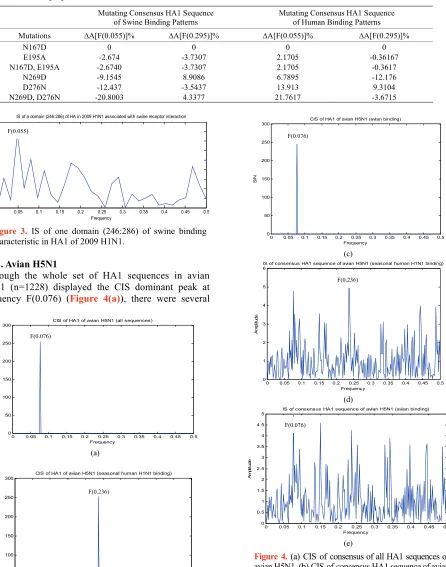
1.2. Avian H5N1 3
Although the whol
H5N1 (n=1228) displayed the CIS dominant peak at
frequency F(0.076) (Figure 4(a)), there were several
0 0.05 0.1 0.15 0.2 0.25 0.3 0.35 0.4 0.45 0.5
0 50 100 150 200 250
300 CIS of HA1 of avian H5N1 (avian binding)
) F(0.055
F(0.076)
S/
N
Frequency
(c)
0 0.05 0.1 0.15 0.2 0.25 0.3 0.35 0.4 0.45 0.5
0 1 2 3 4 5 6
Frequency
A
m
pl
itude
IS of consensus HA1 sequence of avian H5N1 (seasonal human H1N1 binding)
F(
(a)
(b)
(d)
0 0.05 0.1 0.15 0.2 0.25 0.3 0.35 0.4 0.45 0.5
0 0.5 1 1.5 2 2.5 3 3.5 4 4.5 5
Frequency
A
m
pl
itude
IS of consensus HA1 sequence of avian H5N1 (avian binding)
[image:6.595.323.524.115.648.2](e)
Figure 4. (a) CIS of consensus of all HA1 sequences of
avian H5N1. (b) CIS of consensus HA1 sequence of avian H5N1 with seasonal human H1N1 binding. (c) CIS of consensus HA1 sequence of avian H5N1 with avian binding. (d) IS of consensus HA1 sequence of avian H5N1 with seasonal human H1N1 binding. (e) IS of consensus HA1 sequence of avian H5N1 with avian binding.
CIS of HA1 of avian H5N1 (all sequences)
0 0.05 0.1 0.15 0.2 0.25 0.3 0.35 0.4 0.45 0.5
0 50 100 150 200 250 300
Frequency
S/
N
F(0.076)
0 0.05 0.1 0.15 0.2 0.25 0.3 0.35 0.4 0.45 0.5
0 50 100 150 200 250 300
CIS of HA1 of avian H5 asonal human H1N1 binding)
Frequency
S/
N
N1 (se
0.236)
F(0.076)
[image:6.595.68.276.416.720.2]Copyright © 2010 SciRes.
HA1 ak
at fr cy
utation between avian and human binding patterns in
of Avian Binding Patterns of Human Binding Patterns
JBiSE
sequences in the dataset that had a higher IS pe equency F(0.236) than that at the frequen F(0.076). Bases on this observation, the whole set of HA1 sequences in avian H5N1 collected were divided into two subsets. One had the IS dominant peak at fre-quency F(0.076), referred to as avian binding subset
(n=949), and the other had the IS dominant peak at
frequency F(0.236), referred to as human binding sub-set (n=279). The CIS of these two subsub-sets of HA1
se-quences were plotted in (b) and (c) of Figure 4, and the
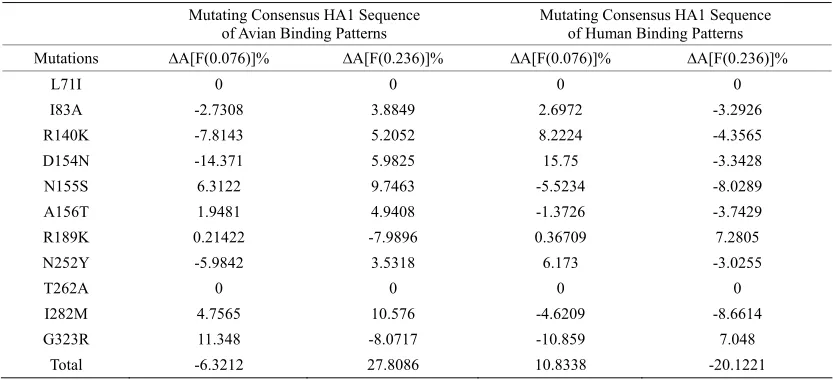
IS of their consensus HA1 sequences were plotted in (d) and (e) of Figure 4, respectively. A total of 11 amino acid changes between the two consensus HA1 sequences of avian binding and human binding were found, and the re-sulting amplitude variation from each mutation was
com-puted (Table 5). There were several mutations near the
[image:7.595.89.506.319.509.2]active site: D154N, N155S, A156T, and R189K.
Table 5. Changes of amplitudes of IS frequencies by each m
HA1 of avian H5N1.
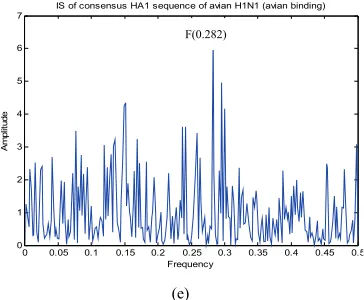
3.1.3. Avian H1N1
For avian H1N1, we used the same strategy as for avian H5N1 to divide the whole set of HA1 sequences (n=78) in this subtype into two subsets according to different binding patterns (human (n=19) vs. avian (n=59)) as reflected by two different IS characteristic frequencies
(F(0.295) vs. F(0.282))(Figure 5). Between the two con-
sensus HA1 sequences of avian (F(0.282)) and human (F(0.295)) binding, there was only one mutation N121S (Table 6). The ISM was applied to quantify this muta- tion’s contribution to the amplitude variation of the consensus HA1 sequence in each binding characteristics (Table 6).
For H1N1 viruses, the substitutions E190D/G225D were essential for avian virus HA to acquire human virus receptor specificity [13]. Here ISM was employed to verify this fact numerically (Table 7).
Mutating Consensus HA1 Sequence Mutating Consensus HA1 Sequence
Mutations ∆A[F(0.076)]% ∆A[F(0.236)]% ∆A[F(0.076)]% ∆A[F(0.236)]%
L71I 0 0 0 0
I83A -2.7308 3.8849 2.6972 -3.2926
R140K -7. 3 5. 8. -4 5
-11 8 -8. 7 -10 9 7.
814 2052 2224 .356
D154N -14.371 5.9825 15.75 -3.3428
N155S 6.3122 9.7463 -5.5234 -8.0289
A156T 1.9481 4.9408 1.3726 -3.7429
R189K 0.21422 -7.9896 0.36709 7.2805
N252Y -5.9842 3.5318 6.173 -3.0255
T262A 0 0 0 0
I282M 4.7565 10.576 4.6209 -8.6614
G323R .34 071 .85 048
Total -6.3212 27.8086 10.8338 -20.1221
Table es of amplitudes tation between an bin
HA1 of avian H1N1.
of Avian Binding Patterns of Human Binding Patterns
6.Chang of IS frequencies by each mu avian and hum ding patterns in
Mutating Consensus HA1 Sequence Mutating Consensus HA1 Sequence
Mutation ∆A [F(0.282)]% ∆A [F(0.295)]% ∆A [F(0.282)]% ∆A [F(0.295)]%
N121S -15.7142 18.6251 18.6439 -15.7008
Tab anges of s of IS frequen utations E190D/
Mutating Consensus HA1 Sequences of Avian H1N1
le 7.Ch amplitude cies by m G225D.
Mutations ∆A [F(0.282)]% ∆A [F(0.295)]% Dominant Peak Frequency
E190D -13.2024 13.0862 F(0.282)
G225D -10.4239 -0.6548 F(0.282)
E190D,G225D -22.8997 11.7994 F(0.295)
[image:7.595.88.504.634.704.2](a)
(b)
0 0.05 0.1 0.15 0.2 0.25 0.3 0.35 0.4 0.45 0.5 0
50 100 150 200 250 300
S/
N
Frequency
(c)
CIS of HA1 of avian (pandemic human binding)
0 0.05 0.1 0.15 0.2 0.25 0.3 0.35 0.4 0.45 0.5 0
1 2 3 4 5 6
Frequency
A
m
plit
ud
e
IS of consensus HA1 sequence of avian H1N1 (pandemic human H1N1 binding)
(d)
0 0.05 0.1 0.15 0.2 0.25 0.3 0.35 0.4 0.45 0.5
0 1 2 3 4 5 6 7
IS of consensus HA1 sequence vian binding)
Frequency
A
m
pl
itude
[image:8.595.334.516.83.233.2](e)
Figure 5. (a) CIS of consensus of all HA1
se-quences of avian H1N1; (b) CIS of consensus HA1 sequence of avian H1 ith pandemic human H1N1 binding; (c) CIS of consensus HA1 sequence of avian H1N1 with avian IS of con-sensus HA1 sequence of avian H1N1 with pandemic human H1N1 binding; (e) IS of consensus HA1 sequence of avian H1N1 with avian binding.
3.1.4. Swine H1N2
For swine H1N2, we used the same strategy as for avian H5N1 to divide the whole set of HA1 sequences (n=82) in this subtype into two subsets according to different binding patterns (human (n=45) vs. swine (n=37)) as reflected by two different IS characteristic frequencies
(F(0.295) vs. F(0.055)) (Figure 6). The comparis n of
e two consensus HA1 sequences (human vs. swine)
eve d to
quan tude
varia
nd-ing c
uta-tions 90S,
and n 4A,
and R
tween Hosts
of avian H1N1 (a
N1 w
binding; (d)
o th
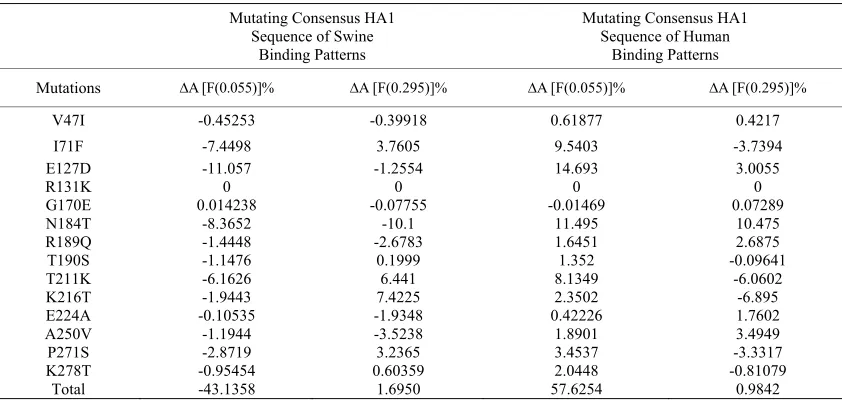
r aled 14 mutations, and the ISM was applie
tify each mutation’s contribution to the ampli tion of the consensus HA1 sequence in each bi
haracteristics (Table 8). There were several m
near the active site: N184T, R189Q, and T1 ear the edges of the binding pocket: E127D, E22
131K.
3.2. Mutations be
3.2.1. 2009 H1N1 and Swine H1N2
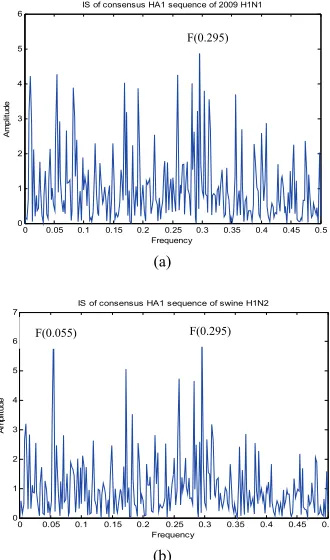
The 2009 H1N1 virus has its origin as a reassortant from a triple-reassortant virus circulating in North American swine and Eurasian avian-like swine H1N1, with its HA from the classical swine influenza viruses.
The comparison of the consensus HA1 sequences of 2009 H1N1 and swine H1N2 found 24 mutations. The ISM was applied to find the changes made by each muta-tion in the amplitude of IS of each consensus HA1
se-quence (Table 9). Mutations K130R and E224A were
near the edges of the binding pocket. There were three mutations at residues 71, 211, and 216 presented in Tables 3, 9, and 10, implying their importance in determining binding preferences of swine H1N2 and 2009 H1N1.
CIS of H 300
0 0.05 0.1 0.15 0.2 0.25 0.3 0.35 0.4 0.45 0.5
0 50 100 150 200 250
A1 of avian H1N1 (
Frequency
Am
pl
itude
all sequences)
F(0.282) F(0.282)
300
0 0.05 0.1 0.15 0.2 0.25 0.3 0.35 0.4 0.45 0.5
0 50 100 150 200 250
Frequency
S/
N
CIS of HA1 of avian H1N1 (avian binding)
F(0.282)
F(0.295)
Copyright © 2010 SciRes. JBiSE
0 0.05 0.1 0.15 0.2 0.25 0.3 0.35 0.4 0.45 0.5
0 20 40 60 80 100 120 140
Frequency
(a) (a)
S/
N
CIS of HA1 of swine H1N2 (all sequences))
0 0.05 0.1 0.15 0.2 0.25 0.3 0.35 0.4 0.45 0.5
0 50 100 150 200 250 300
Frequency
S/
N
(b)
CIS of HA1 of swine H1N2 (swine binding)
0 0.05 0.1 0.15 0.2 0.25 0.3 0.35 0.4 0.45 0.5
0 50 100 150 200 250 300
Frequency
S/
N
CIS of HA1 of swine H1N2 (pandemic human H1N1 binding)
(c)
0 0.05 0.1 0.15 0.2 0.25 0.3 0.35 0.4 0.45 0.5
0 1 2 3 4 5 6 7
IS of consensus HA1 sequence of swine H
0 0.05 0.1 0.15 0.2 0.25 0.3 0.35 0.4 0.45 0.5
0 1 2 3 4 5 6 7
Frequency
A
m
pl
itude
IS of consensus HA1 sequence of swine H1N2 (swine binding)
1N2 (pandemic human H1N1 binding)
Frequency
A
m
pl
itud
e
(d)
[image:9.595.347.512.331.611.2](e)
Figure 6. (a) CIS of cons sus of all HA1 sequences
of swine H1N2; (b) CIS of consensus HA1 sequence of swine H1N2 with pandem n H1N1 binding; (c) CIS of consensus HA1 se swine H1N2 with swine binding; (d) IS of consensus HA1 sequence of swine H1N2 with pandemic human H1N1 binding; (e) IS of consensus HA1 sequence of swine H1N2 with swine binding.
en ic huma
quence of
0 0.05 0.1 0.15 0.2 0.25 0.3 0.35 0.4 0.45 0.5 0
1 2 3 4 5
6 IS of consensus HA1 sequence of 2009 H1N1
Frequency
A
m
pl
itud
e
(a)
0 0.05 0.1 0.15 0.2 0.25 0.3 0.35 0.4 0.45 0.5 0
1 2 3 4 5 6
7 IS of consensus HA1 sequence of swine H1N2
ud
e
Figu consensus HA1 sequence of 2009 H1N1. (b) IS of consensus HA1 sequence of swine H1N2.
Mutations in the binding site not only could modulate receptor specificity but also the antigenicity of the virus [27]. It was generally believed that the key residues at the binding site were not subject to selection, but re-cently a strong positive selection at position 190 in HA of H1N1 was detected in [13]. It was observed that there
Frequency
A
m
plit
(b)
re 7. (a) IS of
F(0.055) F(0.295) F(0.055)
F(0.055)
F(0.295)
F(0.295)
F(0.295) F(0.055)
Table 8. Changes of amplitudes of IS frequencies by each mutation between swine and human binding patterns in
HA1 of swine H1N2.
Mutating Consensus HA1 Sequence of Swine
Binding Patterns
Mutating Consensus HA1 Sequence of Human
Binding Patterns
Mutations ∆A [F(0.055)]% ∆A [F(0.295)]% ∆A [F(0.055)]% ∆A [F(0.295)]%
V47I -0.45253 -0.39918 0.61877 0.4217
I71F -7.4498 3.7605 9.5403 -3.7394
E127D -11.057 -1.2554 14.693 3.0055
R131K 0 0 0 0
G170E 0.014238 -0.07755 -0.01469 0.07289
N184T -8.3652 -10.1
R189Q -1.4448 -2.6783 T190S -1.1476 0.1999
T211K -6.1626 6.441
K216T -1.9443 7.4225 E224A -0.10535 -1.9348 A250V -1.1944 -3.5238 P271S -2.8719 3.2365 K278T -0.95454 0.60359 Total -43.1358 1.6950
11.495 10.475
1.6451 2.6875
1.352 -0.09641
8.1349 -6.0602
2.3502 -6.895
0.42226 1.7602
1.8901 3.4949
3.4537 -3.3317
2.0448 -0.81079
57.6254 0.9842
were two distinct evolutionary patterns in host-driven antigenic drift of human H1N1 HAs at positions 190 and
225, i.e., the antigenic drift of 1918 pandemic HAs
oc-curred at position 225, and that of epidemic HAs
hap-pened at position 190. In contrast to these two trends, the HAs in 2009 H1N1 took a different path, which were highly conserved at both positions 190 and 225, based on the 73 HA sequences of 2009 H1N1, as of July 10,
Mutating Consens Mutating Consens 09 H1N1
Table 9. Changes of amplitudes of IS frequencies by each mutation between consensus HA1 sequences of 2009 H1N1
and swine H1N2.
us HA1 Sequence of Swine H1N2 us HA1 Sequence of 20
Mutations ∆A[F(0.055)]% ∆A[F(0.295)]% ∆A[F(0.055)]% ∆A[F(0.295)]%
K36R -5.6796 5.4297 7.2412 -4.7622
I61L 0 0 0 0
S71F -0. 2
S84N -7 D97N -4
T -8 2
K130R -4
K142N 0. 8
K146R -5
D168N 4. 7
G 0.0 - 8
R205H 1. 3
K 6
I216K -1
E224A -0 8
K2 -5 4
M257L 8.8688 -8.1637 -10.571 10.056
-0.05099 0.1242 0.071321 -0.12802
A261S 1.0216 0.76162 -0.593 -1.5978
I298V 0.093799 0.2947 -0.08087 -0.42787
K302E -3.1322 1.8998 4.0108 -1.4074
L314M -4.0997 6.3337 6.3078 -5.2087
V321I -0.49821 -0.48678 0.6555 0.49537
Total -31.7389 -27.3764 45.9990 28.7656
75109 .0341
0.59143 -8.3814
0.9072
9.614
-0.85027 10.052
.8444 -9.6342 6.0451 9.9181
120E .911 5.4563 11.964 -7.003
.3521 -4.4943 6.0754 5.9088
67563 -2.0369 -0.3604 2.8758
.7743 -2.0864 7.4097 1.4689
5193 -5.5381 -5.744 4.824
170E 11884 0.07133 -0.0105 0.06883
7024 .
1.1275 -2.4361
4
-2.393
211T 5905 -5.7011 -7.804 6.4193
.8394 3.6983 2.0037 -3.8566
.2376 -1.7644 0.6194 1.4082
39T .1394 0.52104 6.8924 0.8922
E258K -2.8787 -2.2561 3.7825 2.0134
[image:10.595.85.511.355.662.2]Copyright © 2010 SciRes.
2009. In the p esent stu had the following coun
tions 190 in HA 1 (Table
appeared t 09 H1N continued to ke
this evoluti pattern.
The alteration of receptor pecificity was
lieved to b ssential step adaptation. Seve
studies on HA discove a single mutat
D225G de the binding ty of 1918 HA
α2,6 recept resulted in α2,6/α2,3 bindi
virus, furt e, a double 190E/D22
abolished ing of 1918 α2,6 and resulted
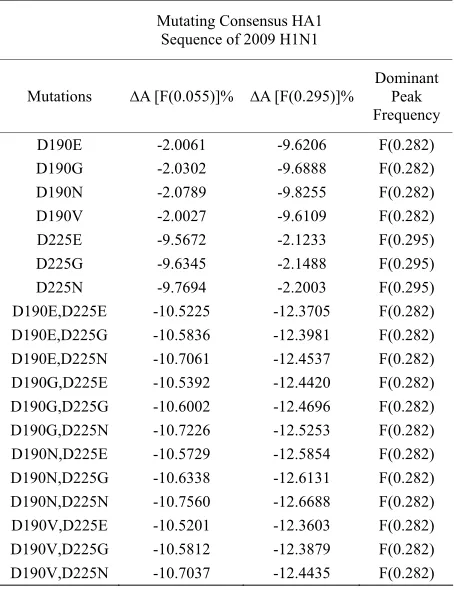
a α2,3 bin irus [28,29 umerical anal
(Table 11) ted that the ns at positions 1
and 225 w oduce simila ng affinity of 20
H1N1 HA f 1918 tation D190E
Table 10.Mutation counts in HA1 sequences of 2009 H1N
Mutation Counts
JBiSE
r dy, as of November 20, 2009, we
ts of various mutations at
and 225 of 2009 H1N 10). It
hat the 20 1 HAs ep
onary
binding s
be-e an be-e in host ral
1918 red that ion
creased affini for
ors and a mixed ng
hermor mutations D 5G
the bind HA to in
ding v ]. Our n ysis
sugges mutatio 90
ould pr r bindi 09
to that o HA. Mu de-
[image:11.595.57.286.297.386.2]1. D190G 1 D190V 5 D22 6 D225G 7 D225N 2 5E
Table 11. Changes of amplitudes of IS frequencies by
muta-tions observed in HA1 sequences of 2009 H1N1.
Mutating Consensus HA1 Sequence of 2009 H1N1
Mutations ∆A [F(0.055)]% ∆A [F(0.295)]% Peak Frequency Dominant
D190E -2.0061 -9.6206 F(0.282)
D190G -2.0302 -9.6888 F(0.282)
D190N -2.0789 -9.8255 F(0.282)
D190V -2.0027 -9.6109 F(0.282)
D225E -9.5672 -2.1233 F(0.295)
D225G -9.6345 -2.1488 F(0.295)
D225N -9.7694 -2.2003 F(0.295)
D190E,D225E -10.5225 -12.3705 F(0.282) D190E,D225G -10.5836 -12.3981 F(0.282) D190E,D225N -10.7061 -12.4537 F(0.282) D190G,D225E -10.5392 -12.4420 F(0.282)
D190G,D225G -10.6002 -12.4696 F(0.282)
D190G,D225N -10.7226 -12.5253 F(0.282)
D190N,D225E -10.5729 -12.5854 F(0.282)
D190N,D225G -10.6338 -12.6131 F(0.282)
D190N,D225N -10.7560 -12.6688 F(0.282)
D190V,D225E -10.5201 -12.3603 F(0.282)
D190V,D225N -10.7037 -12.4435 F(0.282)
D190V,D225G -10.5812 -12.3879 F(0.282)
crea that at f
sed re than
binding
finity, wh D225G opposite
effect, exhibit uman bindi ificity. The
double mutations 190E/D225G show avian binding preference.
3.2.2. Avian H d Human H5N
Most of the hi thogenic avian rains bind
strongly to avia tors. This specificity is normally a
barrier to vir mission from to humans.
However, a few have been di to bind to
human recepto ll as to avian r rs. The
com-parison of the s HA1 seque an H5N1
and human H entified three ns, R140K,
R189K, and T2 nd their impac
harac-teristic frequencies F(0.076) and F(0. s illustrated
in Table 12.
As demonst the experimen ucted in
ref-erences [5,6], utions Q192R 223L could
mediate a shi ian to human preference
in the H5N1 vi n references [3 ], mutations
Q226L and G anced the hu ding
capac-ity while redu binding cap f the H5N1
viruses. Here t was utilized ate the
out-come of these ns (Table 13). illustrated
the effect of m S223L on the two aracteristic
frequencies F(0.076) and F(0.236).
4. DISCUSSION
Under the minimal adaptive hanges necessary
for vir tation to human host is f key importance
in lear w pandemic influenza uses emerge.
Al-teratio ceptor recognition is ital step in host
dapta hich is modulated directly by a subset of
nd op-timize tissue tropism
There are severa ns in HA
pro-tein in different flu subtypes, playing critical roles in
rec in h u
HA, th sylatio HA m e
bindi ficity of [32]. T tations
v-ered in th y represen alternativ which
can switch its sub gnitio ese m s
occur i , whe ose artificially engineere
wet niques ve a v prob o
occur in nature. As ced by dy in [30] that
muta 226L a 8S in H ns c r
th ecifi the H5 ses.
-le inted the li to a e
n eotid s to p ese s
in s is s ich co n in y
the amplitude at frequency F(0.295) mo requency F(0.055), displaying the avian
af ile mutation produced the
ing the h ng spec
D ed
5N1 an 1
ghly pa H5N1 st
n recep
al trans birds
of them scovered
rs as we ecepto
consensu nces of avi
5N1 id mutatio
63A, a t on the two c
236) wa
rated in ts cond
substit and S
ft from av binding
ruses. I 0,31,32
228S enh man bin
ced avian acity o
he ISM to evalu
mutatio Figure 8
utation ch
standing c
al adap o
ning ho vir
n of re tion, w
a v a
amino acids present in the HA protein. Other determinants of host adaptation include continued viral evolution to improve transmission and replication efficiency a
.
l well-known mutatio
eptor bind e glyco
g preference s n sites in
ift. Besides m ight also
tations in impact th
ng speci HA he mu disco
is stud t es by the HA
strate reco n. Th utation
n nature
lab tech may hareas th ery low ability td by
eviden the stu
tions Q nd G22 A protei ould alte
e sp
ss, it also po
binding city of N1 viru Neverthe
out that kelihood cquire th
ecessary nucl e change roduce th mutation
[image:11.595.58.285.424.719.2]hang litudes uenc h muta 1.
[image:12.595.320.523.107.369.2]ing C 1 Seq vian
Table 12.C es of amp of IS freq ies by eac tion between consensus HA1 sequences of avian H5N1 and
Mutating Consensus HA1 Sequence of Human H5N1 human H5N
Mutat onsensus
HA uence
of A H5N1
Mutation ∆A [F(0.076)]% ∆A [F(0.236)]% ∆A [F(0.076)]% ∆A [F(0.236)]%
R140K 7.9425 -4.5900 -7.8143 5.2052
R189K -0. 7370
-3. 6.0611
41
5253 7. 0.2142 -7.9896
4.5619 6.8405
-3.0382 4.0561
T263A 7894
[image:12.595.72.524.108.200.2]-Total 3.6278 -2.91
Table 13. Changes of amplitudes of IS frequencies by
muta-tions experimented in references [5,6,30,31,32]. Mutating Consensus HA1 Sequence of Avian H5N1 Mutations ∆A [F(0.076)]% ∆A [F(0.236)]%
Q192R -3.2185 1.5596 S223L -4.0399 10.8075
Q192R, S223L -6.5711 11.6823
Q226L 0.9498 17.4463 G228S 7.3516 15.7656
Q226L, G228S 8.0339 16.9010
(a)
0 0.05 0.1 0.15 0.2 0.25 0.3 0.35 0.4 0.45 0.5 0
0.5 1 1.5 2 2.5 3 3.5 4 4.5 5
Frequency
A
m
plit
ud
e
of consensus HA1 se an H5N1
an
human transmission, an olecular
determi-nants are required. In osed that binding
to long-chain α2-6 sial essary requirement
viruses to efficien licate and
hu-ans. Ther y in asse ption to
human recepto ty from the analysis of a few
in-fluenza strains It showed that ects of the
same mutation as Q226L/G228 the binding
preference of in were not th on others
strains in H5N1. Because lab experiments are labor
in-ten ly, bioin cs approach
rea-sonable alternatives in the a f binding specificity
given the large number of virus sequences, which can process all strains with any combination of mutations within a subtype efficiently.
5. CONCLUSIONS
The increasing trend of direct transmission of avian/ swine influenza viruses to humans underscores the need to understand further the mechanism of glycan receptor recognition and specificity switch. In this study,
muta-IS quence of hum
(b)
(c)
Figure 8. (a) IS of consensus HA1 sequence of avian
H5N1; (b) IS of consensus HA1 sequence of human H5N1; (c) IS of consensus HA1 sequence of avian H5N1 mutated by S223L.
viruses such as H5N1 have not yet evolved into human ransmissible strains to cause a human pandemic. t
It appears that increased binding affinity for hum influenza receptors alone is not sufficient for efficient
d additional m [33], it was prop osides is a nec for
m e is inadequactly rep ssing the ada transmit in
r affini
[30]. the eff
s, such S, on
one stra e same
sive and cost formati es offer
nalysis o
0 0.05 0.1 0.15 0.2 0.25 0.3 0.35 0.4 0.45 0.5
0 1 2 3 4 5 6
IS of mutated consensus HA1 sequence of avian H5N1 (S223L)
Frequency
A
m
pl
itud
e
F(0.076) F(0.236)
0.4 0.45 0.5 0 0.05 0.1 0.15 0.2 0.25 0.3 0.35
0 1 2 3 4 5 6
IS of consensus HA1 sequence of avian H5N1
Frequency
A
m
plit
ud
e
F(0.076) F(0.236)
[image:12.595.59.285.237.711.2]Copyright © 2010 SciRes.
tions in HA1 within or between hosts in various flu sub-types were identified, and their contribution to binding
preference asured the ISM. Our numerical
analysis implied that the mutations in HA1 of 2009 hu-man H1N1 collectively tended to reduce the swine binding affinity in the seasonal H1N1 strains and to in-crease that in the pandemic H1N1 strains. At the same time, they increased the human binding affinity in the pandemic H1N1 strains and had little impact on that in the seasonal H1N1 strains. The mutations in HA1 of avian H5N1 and avian H1N1 exhibited reduced avian binding in the strains of avian binding propensity while showed enhanced avian binding affinity in the strains with human binding propensity. They displayed the
p-posite effects on human bi g. The mutations in HA1
of swine H1N2 reduced the ine binding affinity in the
strains with swine binding propensity and enhanced that
in the strai human binding propensity. They
showed little pact on t man binding affinity,
which was different from the mutations in HA1 of 2009
H1N1. The mutations between the consensus HA1
se-quences of 2009 H1N1 and swine H1N2 decreased both the human and swine binding affinities in swine H1N2 and increased those in 2009 H1N1. The mutations be-tween the consensus HA1 sequences of human H5N1 and avian H5N1 increased the avian binding affinity and decreased the human binding affinity in avian H5N1 while produced the opposite effects on those in human H5N1.
The mutations discover n the present study c
firmed the potential for influenza viruses to adapt to human host, and furthermore, our numerical analysis detailed the extent of binding preference changes
in-duced by e utation. mutations and their
cor-responding contribution to the binding specificity altera-tion yielded new clues to the mechanism of receptor recognition switch within and between hosts. The ISM offered a complementary and efficient approach to in-vestigate the binding affinities of all HA sequences in various subtypes, a task difficult to accomplish experi-mentally.
6. ACKNOWLEDGMENTS
We thank Houghton College fo inancial support.RE
[1]gs of the National Academy of Sciences, USA, 96(4), 1164-1166.
ovin, N., Gambaryan, A., Early alterations of the re-es of H1, H2, and H3 avian
in-09) Extrapolating from sequence–the 2009 H1N1
was me using
JBiSE
o ndin
sw
ns with
im he hu
ed i
on-ach m These
r its f
FERENCES
Webster, R.G. (1999) 1918 Spanish influenza: The secrets remain elusive. Proceedin
[2] Li, Q., Kash, J.C., Dugan, V.G., Wang, R.X., Jin, G.Z., Cunningham, R.E. and Taubenberger, J.K. (2009) Role of sialic acid binding specificity of the 1918 influenza virus hemagglutinin protein in virulence and pathogene-sis for mice. Journal of Virology, 83(8), 3754‐3761. [3] Matrosovich, M.N., Klenk, H. D. and Kawaoka, Y. (2006)
Receptor specificity, host-range, and pathogenicity of in-fluenza viruses. In Yoshihiro Kawaoka (ed.) Inin-fluenza Virology: Current Topics, Caister Academic Press, 95‐137. [4] Zambon, M. (2007). Lessons from the 1918 influenza.
Nature Biotech, 25, 433‐434.
[5] Gambaryan, A. Tuzikov, A., Pazynina, G., Bovin, N., Balish, A. and Klimov, A. (2006) Evolution of the re-ceptor binding phenotype of influenza A (H5) viruses. Virology, 344(2), 432‐438.
[6] Yamada, S., Suzuki, Y., Suzuki, T., Le, M. Q., Nidom, C. A., Sakai-Tagawa, Y., Muramoto, Y., et al. (2006) Hae-magglutinin mutations responsible for the binding of H5N1 influenza A viruses to human-type receptors. Na-ture, 444(7117), 378‐382.
[7] Matrosovich, M., Tuzikov, A., B and Klimov, A., et al. (2000) ceptor-binding properti
fluenza virus hemagglutinins after their introduction into mammals. Journal of Virology, 74(18), 8502‐8512. [8] Bateman, A.C., Busch, M.G., Karasin, A.I., Bovin, N.,
and Olsen, C.W. (2008) Amino acid 226 in the hemag-glutinin of H4N6 influenza virus determines binding af-finity for alpha2, 6-linked sialic acid and infectivity lev-els in primary swine and human respiratory epithelial cells. Journal of Virology, 82(16), 8204‐8209.
[9] Wan, H., Sorrell, E.M., Song, H., Hossain, M.J., Rami-rez-Nieto, G., et al. (2008) Replication and transmission of H9N2 influenza viruses in ferrets: Evaluation of pan-demic potential. PLoS ONE, 3(8), e2923.
[10] Rogers, G.N. and D’Souza, B.L. (1989) Receptor binding properties of human and animal H1 influenza virus iso-lates. Virology, 173, 317‐322.
[11] Matrosovich, M.N., Gambaryan, A.S., Teneberg, S., Piskarev, V.E., Yamnikova, S.S., et al. (1997) Avian in-fluenza A viruses differ from human viruses by recogni-tion of sialyloligosaccharides and gangliosides and by a higher conservation of the HA receptor-binding site. Vi-rology, 233(1), 224‐234.
[12] Reid, A.H., Janczewski, T.A., Lourens, R.M., Elliot, A.J., Daniels, R.S., Berry, C.L., Oxford, J.S. and Taubenber-ger, J.K. (2003) 1918 influenza pandemic caused by highly conserved viruses with two receptor-binding variants. Emerg Infect Disease, 9(10), 1249‐1253. [13] Shen, J., Ma, J. and Wang, Q. (2009) Evolutionary trends
of A(H1N1) influenza virus hemagglutinin since 1918. PLoS ONE, 4(11), e7789.
[14] Srinivasan, A., Viswanathan, K., Raman, R., Chandra- sekaran, A., Raguram, S., Tumpey, T.M., Sasisekharan, V. and Sasisekharan, R. (2008) Quantitative biochemical ra-tionale for differences in transmissibility of 1918 pan-demic influenza A viruses. Proceedings of the National Academy of Sciences, 105(8), 2800-2805.
[15] Soundararajan, V., Tharakaraman, K., Raman, R., Ragu-ram, S., Shriver, Z., Sasisekharan, V. and Sasisekharan R. (20
“swine” influenza virus. Nature Biotechnology, 27(6), 510‐513.
al Science and Engineering, 2(7), 550‐558. een the 2009 H1N1 aminidase: Mutations
ournal of
n, H.L., Glisic, S., Veljkovic, N., Per- er C.P. (2009). Identification of hemag-
nza viruses: 2009 H1N1,
ment in accuracy of mu
ay-Nedecký, G., Karol Haver-
alyses of influenza virus
hae-eedings of the
eals different receptor specificities. Journal of
(2006) Glycan microarray analysis of the pandemic influenza A (H1N1) 2009 virus determined
by carbohydrate microarray. Nature Biotechnology, 27 (9), 797‐799.
[17] Hu, W. (2009) Analysis of correlated mutations, stalk motifs, and phylogenetic relationship of the 2009 influ-enza A virus neuraminidase sequences. Journal of Bio-medic
[18] Hu, W. (2010) The Interaction betw
influenza A hemagglutinin and neur , Bi co-mutations, and the NA stalk motifs. J
medical Science and Engineering, 3, 1‐12.
o-magglutinins with different receptorbinding specificities. Virology, 138, 174‐177.
[28] Srinivasan, A., Viswanathan, K., Raman, R., Chandrase- karan, A., Raguram, S., et al. (2008) Quantitative bio-chemical rationale for differences in transmissibility of 1918 pandemic influenza A viruses. Proc
[19] Veljkovic, V., Nima ovic, V. and Mull
glutinin structural domain and polymorphisms which may modulate swine H1N1 interactions with human re-ceptor. BMC Structural Biology, 9, 62.
[20] Veljkovic, V., Veljkovic, N., Muller, C.P., Müller, S. Glisic, S., Perovic, V. and Köhler, H. (2009) Characteri- zation of conserved properties of hemagglutinin of H5N1 and human influenza viruses: Possible consequences for therapy and infection control. BMC Structural Biology, 7, 9‐21.
[21] Cosic, I. (1997) The resonant recognition model of mac-romolecular bioreactivity, theory and application. Berlin: Birkhauser Verlag.
Hu, W. (2010) Identification of highly conserved do-[22]
mains in hemagglutinin associated with the receptor binding specificity of influe
avian H5N1, and swine. Journal of Biomedical Science and Engineering, 3, 114-123.
[23] Katoh, K., Kuma, K., Toh, H. and Miyata, T. (2005)
MAFFT version 5: Improve ltiple
[32] aulson,
J.C., et al. (2008) Recent avian H5N1 viruses exhibit in-creased propensity for acquiring human receptor specific-ity. Journal of Molecular Biology, 381(5), 1382‐ 1394. sequence alignment. Nucleic Acids Research, 33(2), 511‐
518.
[24] MacKay, D. (2003) Information theory, inference, and learning algorithms. Cambridge University Press. [25] KováccaronOVá, A., Ruttk
líK, I. and Janecccaronek, S. (2002) Sequence similari-ties and evolutionary relationships of influenza virus A
hemagglutinins, Virus Genes, 24(1), 57‐63.
[26] Gamblin, S.J., Haire, L.F., Russell, R.J., Stevens, D.J., Xiao, B., Ha, Y., et al. (2004) The structure and receptor binding properties of the 1918 influenza hemagglutinin. Science, 303, 1838‐1842.
[27] Daniels, R.S., Douglas, A.R., Skehel, J.J., Wiley, D.C., Naeve, C.W., Webster, R.G., Rogers, G.N. and Paulson, J. C. (1984). Antigenic an
National Academy of Sciences, 105, 2800‐2805.
[29] Stevens, J., Blixt, O., Glaser, L., Taubenberger, J.K. , Pal- ese, P., et al. (2006) Glycan microarray analysis of the hemagglutinins from modern and pandemic influenza viruses rev
Molecular Biology, 355(5), 1143‐1155.
[30] Ayora-Talavera, G., Shelton, H., Scull, M.A., Ren, J., Jones, I.M., et al. (2009) Mutations in H5N1 influenza virus hemagglutinin that confer binding to human tra-cheal airway epithelium. PLoS ONE, 4(11), e7836. [31] Stevens, J., Blixt, O., Glaser, L., Taubenberger, J.K.,
Pal-ese, P., et al.
hemagglutinins from modern and pandemic influenza viruses reveals different receptor specificities. Journal of Molecular Biology, 355(5), 1143‐1155.
Stevens, J., Blixt, O., Chen, L.M., Donis, R.O., P



![Table 13. Changes of amplitudes of IS frequencies by muta-tions experimented in references [5,6,30,31,32]](https://thumb-us.123doks.com/thumbv2/123dok_us/8757764.390620/12.595.72.524.108.200/table-changes-amplitudes-frequencies-muta-tions-experimented-references.webp)
