Performance of Block Space-Time Code in Wireless
Channel Dynamics
Won Mee JANG1, Jong Hak JUNG2
1
The Peter Kiewit Institute of Information Science, Technology & Engineering, Omaha, USA
2
Department of Computer and Electronics EngineeringUniversity of Nebraska–Lincoln, Omaha, USA
Email: [email protected], [email protected]
Received March 9, 2009; revised May 8, 2009; accepted July 15, 2009
ABSTRACT
In this work, we observe the behavior of block space-time code in wireless channel dynamics. The block space-time code is optimally constructed in slow fading. The block code in quasi-static fading channels pro-vides affordable complexity in design and construction. Our results show that the performance of the block space-time code may not be as good as conventionally convolutional coding with serial transmission for some channel features. As channel approaches fast fading, a coded single antenna scheme can collect as much diversity as desired by correctly choosing the free distance of code. The results also point to the need for robust space-time code in dynamic wireless fading channels. We expect that self-encoded spread spec-trum with block space-time code will provide a robust performance in dynamic wireless fading channels.
Keywords: Space-Time Codes, Diversity, Multiple Transmit Antennas, Self-Encoded Spread Spectrum.
1. Introduction
Space-time codes introduce temporal and spatial correla-tion into signals transmitted from different antennas in order to provide diversity at the receiver as well as cod-ing gain without sacrificcod-ing bandwidth [1,2]. Most opti-mal space-time codes have been developed in block code in slow fading channels [1,3–7]. The block code in quasi-static fading channels provides affordable com-plexity in design and construction. It has been shown that in a system with t transmit and r receive antennas, and a
slow fading channel, the average channel capacity with perfect channel state information (CSI) at the receiver is about min{t,r} times larger than that of a single antenna
system [8]. Tight exponential upper bound is obtained on the decoding error probability of block codes transmitted over fully interleaved fading channels with perfect CSI at the receiver [10]. These bounds do not require integra-tion in their final version, and they are reasonably tight in a certain portion of the data region that exceeds the cut-off rate of the channel. If channel-state information is also available to the transmitter, very high capacity is achievable without the need for time diversity [9]. How-ever, mobile communication channels are dynamic and undergo slow fading to fast fading rather quickly as
mo-bile speeds and surrounding structures change. Some space-time codes have been developed for fast fading channels under the assumption of low data rates and low signal-to-noise ratios [1]. Nevertheless, as wireless Inter- net services are incorporated into mobile communica-tions, space-time codes that are optimal for fast fading channels, high data rate and low bit error rate (BER) are required.
Figure 1. Trellis diagram of block space-time code and convolutional code.
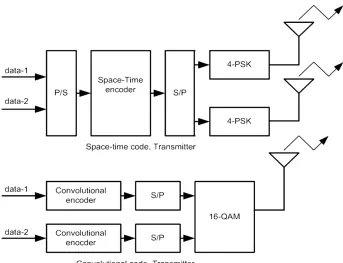
Figure 2. Transmitter structures.
Self-encoded spread spectrum (SESS) introduced in [11] eliminates the need for traditional pseudo noise (PN) code generators. As the term implies, the spreading code is obtained from the random digital information source itself. Multiuser convolutional code directly applicable to SEMA in cellular system is developed in [12]. A chip interleaving and iterative detection scheme for SEMA improve system performance significantly in fading
[image:2.595.131.474.324.587.2]2. System Model
2.1. Block Space-Time Code
We consider a base station to a mobile communication where the base-station equipped with n antennas and the
mobile is equipped with r antennas. Data are encoded by
the channel encoder, and the encoded data go through a serial-to-parallel converter and are split into n streams of
data. Each stream of data is the input to a pulse shaper. Then, the output of each shaper is modulated. We con-sider the 8-state trellis code [1] shown in Figure 1. We use the 8-state 4-PSK trellis space-time code to obtain numerical results for comparison, although our analysis can be generalized to other space time-codes. The space-time code and 4-PSK modulation using two trans-mitter antennas is shown in Figure 2. The two streams of incoming data, data-1, d1, and data-2, d2, are encoded,
pulse-shaped, modulated and transmitted in parallel over the two transmit antennas. Alternatively, the two data streams can be considered divided from a common data source. The signal constellation employed here is 4-PSK and the signal points are labeled by the elements of Z4,
the ring of integers modulo 4. The edge level c1c2in
Fig-ure 1 shows that signal c1 is transmitted over the first
antenna and that signal c2 is transmitted over the second
antenna. This code can be described in terms of a se-quence (d1,d2) of binary inputs. The output signal pair
at time t is given by [1]
1 2
t t c c
1 2 1 2
2 1
1 2 1
1
( ) (2, 2) (2,0)
(1,0) (0, 2) (0,1)
t t t t
t t t
c c d d
d d d
(1)
At each time slot t, the output of modulator-i is a
sig-nal 1
t that is transmitted using transmit antenna i for 1≤i
≤n. The n signals are transmitted simultaneously, each
from a different transmit antenna, and all signals have the same transmission period.
c
The signal at each receive antenna is the sum of the n
transmitted signals contaminated by a noise and cor-rupted by Rayleigh fadings. We assume that the elements of the signal constellation are normalized by a factor of
b
E , where Eb is the bit energy, so that the average
en-ergy of the constellation is the unity. A decision is based on the received signals at each receive antenna 1≤j≤r.
The signal j t
y received by antenna j at time t is given
by
, 1 n
j t i j
t i j t b
i
y c E
nt (2)where the noise at time t is a complex Gaussian
random variable with a zero-mean and variance N0/2 per
dimension, independent for all j and t. The coefficient
j t n , t i j
is the path gain from transmit antenna i to receive
antenna j at time t. We are interested in the behavior of
the block space-time codes that are optimally constructed for slow fading as channel dynamics change to inde-pendent path gains for every i, j and t.
A maximum-likelihood sequence detector is applied for decoding. We assume ideal channel state information; thus, the path gains t,
i j
, i=1,2,…n j=1,2,…r are
pre-cisely known to the receiver. Since j t
y is the received
signal at receive antenna j at time t, the branch metric for
a transition labeled 1 2t t n t
is given by 2
,
1 1
n n
j t i
t i j
j i
y t
(3) Viterbi decoding is then applied to obtain the path with the lowest accumulated metric.2.2. Conventional Serial Code
Convolutional coding is applied to each data stream as shown in Figure 2. The encoded symbols are serial- to-parallel converted and fed to the modulator. The re-quired bandwidth is equivalent to the block space-time code, although the bandwidth expansion produced by the encoder can be reduced considerably less than the recip-rocal of the code rate [15]. We use the convolutional code with the code rate (1/R), the constraint length (K), and the generators equal to 1/2, 3 and [5 7] in octal, re-spectively [16]. This code has a free distance (dfree) equal
to 5. The two 4-state diagram of this code is shown in Figure 1. The code can be described in terms of a se-quence of binary inputs. The output, from the first encoder at time t is given by
1,1 1,2 t t
c c
1,1 1,2 1 1 1
2 1
) (1,1) (0,1) (1,1)
t t t t t
c c d d d (
2,1
(c c
(4) Modulo 2 addition is performed to obtain the encoder output pairs. Likewise, the output of the second encoder can be generated. The encoders’ outputs are serial-to-parallel converted and fed to the modulator. The signal constellation employed here is 16-QAM for a sin-gle transmit antenna and the signal points are labeled by the elements of Z16. Considering that 16-QAM and
4-PSK display approximately 5 dB difference for 2,2
t t )
Eb/N0≥0 dB, these modulation schemes are more
favor-able for the block space-time code system. Nevertheless, our results show that the conventional serial code system can outperform the block space-time code in some chan-nel characteristics.
The output of a 16-QAM modulator can be repre-sented as a complex number,
1,1 1,2 2,1 2,2
(2 ) (2 )
t t t t t
where ζ= 1. The signal j t
y received by antenna j at
time t is given by
( ) v ( )
v
f v e U v (12) to maintain the same average received power without fading. U(v) is the unit step function. With r receiving
antennas and
1, 2
j t
t j t b
y c E ntj (6) where 1,tj is the path gain from the single transmit antenna to receive antenna j at time t. Notice that we
scaled the transmit bit energy to maintain the same aver-age bit energy in both systems for fair comparison. For Viterbi decoding, we replace Equation (3) with
1
r
V
Xthe pdf of X can be represented as a Gamma distribution with the parameter, 2r, as [19]
2 1 1 ( ) ( ) (2 1)! r x X
f x x e
r
U x (13)
2 1 1, 1 r j t
t j t
j
y
(7) Therefore,
0
0
( )
2 2 (2 / sin( / 4)
( ) r
b X
P
Q x E N
f x dx
c e
3. Performance Analysis
(14)3.1. Block Space-Time Code
In Equation (14), we applied the approximation of the symbol error probability of QPSK [20],
From Figure 1, the codeword (0, 2, 2, 0) has the free dis-tance from the all-zero codeword, (0, 0, 0, 0). The free distance is defined as the minimum Hamming weight of all possible codewords. For moderate and high sig-nal-to-noise ratios, it is well known that the free-distance term in the union bound on the BER performance domi-nates the bound [17,18]. Assuming ideal channel state information, the probability of transmitting c=(0, 0, 0, 0) and deciding in favor of e=(0, 2, 2, 0) at the decoder is
2
0 2 log
2 b si
e E M P Q N M
n
(15)
with M=4. Therefore, the probability of the bit error can be found as [17]
(
b r
P P ce) (16) where
,
2
0
( , 1, , 1, , 1, )
( ( , ) / 2 )
t
r i j
b
P i n j r t
Q d E N
c e c e l
(8) NdfreeBd /k
Bd and k are the number of nonzero information bits and
the total number of information bits, respectively, on the
dfree path. The error coefficient, Ndfree, is the total number,
or multiplicity, of the free distance code word. For the chosen codewords, c=(0, 0, 0, 0) and e=(0, 2, 2, 0), Ndfree, Bd and k are 1, 1 and 4, respectively.
where l is the block length, N0/2 is the noise variance per
dimension, 2/2 1 ( ) 2 x Q e
dxand 3.2. Conventional Serial Code
2 2
,
1 1 1
( , ) ( )
r l n
t i i
i j t t j t i
d
c e From Figure 1, the codeword, (3, 1, 3) has the free
dis-tance from the all-zero codeword, (0, 0, 0). Therefore, the probability of transmitting c=(0, 0, 0) and deciding in favor of e=(3, 1, 3) can be obtained as in Equation (8) with d2(c,e) as follows for r=1:
c e (9)
For r =1
2
2 1 1 1 1 2
1,1 1 1 2,1 1 1
2
2 1 1 2 2 2
1,1 2 2 2,1 2 2
( , ) ( ) ( )
( ) ( )
d c e c
c e c e
c e e2
(10) 2 1 1 2
1,1 1 1
2
2 1 1
1,1 2 2
2
3 1 1
1,1 3 3
( , ) ( ) ( ) ( ) d c c e c e
c e e1
(17) Applying c= (0, 0, 0, 0) and e= (0, 2, 2, 0),
2 2
2 1
2,1 1,1
( , ) 4( )
d c e 2 (11)
Using c =(0, 0, 0)and e=(3, 1, 3), Since t,
i j
is Rayleigh fading, the probability density
function (pdf) of 2 1 2 2 2
1,1 1,1 1,1
( , ) 9 9
d c e 3 2 (18)
2
t
Figure 3. Block space-time code, two transmit antennas, 8 states, 4-PSK, 1, 2 and 4 receive antennas, Rayleigh.
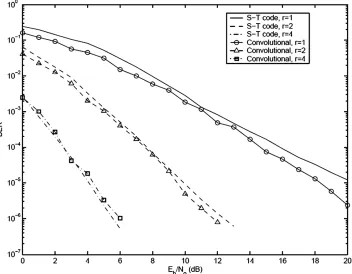
Figure 5. Analytical BER of block space-time code and convolutional code, 1, 2 and 4 receive antennas, Rayleigh.
[image:6.595.124.476.416.690.2]With r receiving antennas, the pdf of the above
equa-tion can be represented as the combinaequa-tion of two ran-dom variables, 2 2 1 3 1,1 1,1 1 r
X and 2 2 1,1 1 r
Y Consequently [19],
2 1 1 1 ( ) ( ) (2 1)! 1 ( ) ( ) ( 1)! r x X r y Y
f x x e U x
r
y y e U y
r , and (19) f
Therefore, the probability of bit error is
0 0
( )
(9 )(4 /10 ) ( ) ( ) r
b 0 X Y
P
Q x y E N f x f y dxd
c e
y(20)
In Equation (20), we employ the approximation of the symbol error probability, Pe3 ( 4Q Eb/ 5N0), for 16-
QAM modulation [20]. The probability of the bit error is obtained from Equation (16), where Ndfree , Bd and k are 1,
1 and 3 respectively.
4. Simulation Results
We assume that the perfect channel state information is available at receive antennas in the following simulations. We consider the dynamic channel characteristics of in-dependent fading for every bit interval. In Figure 3, the simulation BER and the analytical BER of the block space-time code with 8-state, 4-PSK and two transmit antennas are compared in Rayleigh fading channels for one, two and four receive antennas. The simulation BER approaches the analytical BER at high signal-to-noise ratios (SNR). With a larger number of receive antennas, the rate of the approach becomes faster. With two or more receive antennas, the difference between the simu-lation and the analysis is less than 1 dB for SNR≥6 dB. The receive antenna diversity significantly improves the system performance as expected. The BER performance of two four-state convolutional codes and a 16-QAM system with a single transmit antenna is displayed in Figure 4. The simulation BER rapidly approaches the analytical BER. The BER difference is less than 1 dB for all SNR. We observe similar effects of receive antenna diversity as in the block space-time codes. The analytical results of the two systems are shown in Figure 5. We can see that the BER of the conventional serial code is better than the block space-time code for all SNR under the same bandwidth, average transmits power, data rate and
a similar processing complexity as channel dynamics reach to independent fading in each bit interval. The dif-ference becomes larger at high SNR. We show the simu-lation BER of the block space-time code and the conven-tional serial code in Figure 6. Half of the average trans-mit power of the block space-time code is assigned to the conventional serial code transmission. Now we observe that the BER of both systems is equivalent. Our results show that for the same Eb/N0 , the performance of the
block space-time code may not be as good as the con-ventional convolutional code for some channel features. As channel dynamics reach fast fading, a coded single antenna scheme can collect as much diversity as desired by suitably choosing the free distance of code. Block space-time codes are most useful in slow fading when temporal diversity is not available. The advantage of the block space-time code can be diminished significantly as wireless channel approach fast fading.
5. Conclusions
In this paper, we show that the block space-time coding gain can be degraded below the conventional channel coding with a single transmit antenna for some channel characteristics. Our results suggest that there is a need for a robust space-time code in rapidly changing wireless channels. Our future work is to develop SESS block space-time code. Due to the inherent time diversity in SESS, we expect SESS block space-time code to provide a robust performance in dynamic wireless channels.
6. Acknowledgements
This work was supported in part by the contract award FA9550-08-1-0393 from the U.S. Air Force Office of Scientific Research. Thanks are due to Dr. J. A. Sjogren whose support has allowed the authors to investigate the feasibility of self-encoded block space-time code in dy-namic wireless fading channels.
7. References
[1] V. Tarokh, N. Seshadri, and A. R. Calderbank, “Space-time codes for high data rate wireless communi-cation: Performance criterion and code construction,” IEEE Transactions on Information Theory, Vol. 44, No. 2, pp. 744–765, March 1998.
[2] S. Alamouti, “A simple transmit diversity technique for wireless communications,” IEEE Journal on Selected Areas in Communications, Vol. 1, No. 16, pp. 1451– 1458, 1998.
Communications, Vol. 17, No. 3, pp. 451–460, March 1999.
[4] S. Baro, G. Bauch, and A. Hansmann, “Improved codes for space-time trellis-coded modulation,” IEEE Commu-nications Letters, Vol. 4, No. 1, pp. 20–22, January 2000. [5] H. E. Gamal and A. R. Hammons, “On the design of
al-gebraic space-time codes for MIMO block-fading chan-nels,” IEEE Transactions on Information Theory, Vol. 49, No. 1, pp. 151–163, January 2003.
[6] H. E. Gamal and A. R. Hammons, “On the design and performance of algebraic space-time codes for BPSK and QPSK modulation,” IEEE Transactions on Communica-tions, Vol. 50, No. 6, pp. 907–913, June 2002.
[7] A. Song, G. Wang, W. Su, and X. G. Xia, “Unitary space-time codes from Alamouti’s scheme with APSK signals,” IEEE Transactions on Wireless Communica-tions, Vol. 3, No. 6, pp. 2374–2384, November 2004. [8] G. J. Foschini and M. J. Gans, “On limits of wireless
communications in a fading environment when using multiple antennas,” Wireless Personal on Communica-tions, Vol. 6, No. 3, pp. 311–335, March 1998. [9] E. Biglieri, G. Caire, and G. Taricco, “Limiting
perform-ance of block-fading channels with multiple antennas,” IEEE Transactions on Information Theory, Vol. 47, No. 4, pp. 1273–1289, May 2001.
[10] I. Sason, S. Shamai, and D. Divsalar, “Tight exponential upper bounds on the ML decoding error probability of block codes over fully interleaved fading channels,” IEEE Transactions on Communications, Vol. 51, No. 8, pp. 1296–1305, August 2003.
[11] L. Nguyen, “Self-encoded spread spectrum and multiple access communications,” Proceedings of the IEEE 6th International Conference on Spread Spectrum Technol-ogy & Applications, ISSSTA2000, Vol. 2, pp. 394–398,
NJIT, NJ, September 6–8, 2000.
[12] J. H. Jung, W. M. Jang, and L. Nguyen, “Self-encoded multiple access multiuser convolutional codes in uplink and downlink cellular systems,” International Journal of Communications, Network and System Science, Vol. 2, No. 4, pp. 249–257, July 2009.
[13] Y. S. Kim, W. M. Jang, Y. Kong, and L. Nguyen, “Chip-interleaved self-encoded multiple access with it-erative detection in fading channels,” Journal of Commu-nications and Networks, Vol. 9, No. 1, pp. 50–55, March 2007.
[14] K. Hua, W. M. Jang, and L. Nguyen, “Cooperative self encoded spread spectrum in fading channels,” Interna-tional Journal of Communications, Network and System Science, Vol. 2, No. 2, pp. 91–96, May 2009.
[15] D. Divsalar and M. K. Simon, “Spectral characteristics of convolutionally coded digital signals,” IEEE Transactions on Communications, Vol. COM-28, No. 2, pp. 173–186, February 1980.
[16] J. G. Proakis, Digital Communications, 4th Edition, pp. 492, McGraw Hill, 2001.
[17] S. Lin and D. J. Costello, Error Control Coding, 2nd Edi-tion, PEARSON Prentice Hall, Upper Saddle River, NJ, 2004.
[18] L. C. Perez, J. Seghers, and D. J. Costello, “A distance spectrum interpretation of Turbo codes,” IEEE Transac-tions on Information Theory, Vol. 42, No. 6, pp. 1698– 1709, Part I, November 1996.
[19] A. Papoulis and S. U. Pillai, Probability, Random Vari-ables and Stochastic Processes, 4th Edition, pp. 87, 190, McGraw Hill, 2002.