Regular relations for temporal propositions
T I M F E R N A N D O
Trinity College Dublin, Ireland e-mail:[email protected]
(Received 14 June 2010; revised 22 September 2010; accepted 22 October 2010)
Abstract
Relations computed by finite-state transducers are applied to interpret temporal propositions in terms of strings representing finite contexts or situations. Carnap–Montague intensions mapping indices to extensions are reformulated as relations between strings that can serve as indices and extensions alike. Strings are related according to information content, temporal span and granularity, the bounds on which reflect the partiality of natural language statements. That partiality shapes not only strings-as-extensions (indicating what statements are about) but also strings-as-indices (underlying truth conditions).
1 Introduction
There is a substantial body of work applying automata theory to temporal reasoning, with strings (and trees) stretching to infinity to describe non-terminating computation runs (e.g. Emerson 1992; Vardi 2007). Many natural language statements, however, describe temporally bounded events, including reports in the past tense, such as Pat walked to the post office orAn event of such and such happened, that ensure the events have an end (if not a beginning). The question arises: can we employ ordinary finite-state methods (of the sort in, for example, Beesley and Karttunen 2003) to reason about strings that can be assumed finite? The main aim of this paper is to show how we might, and how that may stray from established practices. The focus is not on any particular natural language engineering application, but rather on basic conceptual issues that bear on such applications. These issues revolve around events and situations natural language statements are about—events and situations bounded in ways that merit investigation.
1.1 Linear temporal logic and finite situations
For orientation, we start with linear temporal logic (LTL) over the setZof integers and a setP of atomic formulas (e.g. Vardi 2007). LTL-formulas are evaluated against relationsV ⊆Z×P betweenZandP, withV(t, p) read ‘pis true atV , t’ and written V , t|=p
fort ∈Z and p ∈ P. Fixing the evaluation time to 0, we can describe an infinite string ofp’s through the LTL-formulaGpthat assertsV(n, p) for every non-negative integern
V ,0|=Gp ⇐⇒ (∀n≥0) V(n, p)
⇐⇒ {(n, p)|n≥0} ⊆V .
Negative integers come in to interpret past operators such asprevious, from which we can form the LTL-formulaprevious(q)∨Gp that is true atV ,0 iffG(p) is orq is true atV ,−1
V ,0|=previous(q)∨Gp ⇐⇒ V(−1, q) or (∀n≥0)V(n, p)
⇐⇒ {(−1, q)} ⊆V or{(n, p)|n≥0} ⊆V
(for q ∈ P). Assuming P is closed under complementation,1 one can, in general, map an LTL-formulaϕand integertto a setS[ϕ, t] of relationss⊆Z×P, reducing the truth ofϕatV , tto some subset ofV being inS[ϕ, t]
V , t|=ϕ ⇐⇒ (∃s∈S[ϕ, t])s⊆V (1)
(e.g. Fernando 2009a). For instance,S[previous(q)∨Gp,0] consists of the two relations
{(−1, q)}and{(n, p)| n≥0}, each describing a way forprevious(q)∨Gp to be true at 0. As this example shows, a relationsinS[ϕ, t] may or may not be finite.
Of course, if V were finite, then we can throw out all infinite relations from S[ϕ, t]. Put another way, we can restrict S[ϕ, t] to finite relations by focusing on finite subsets of V (reconstructing V as the union of its finite subsets, as in the reformulation of B¨uchi acceptance in terms of paths in Fernando 2008b). But we had better be careful about asserting line (1) above for different temporal spans (finite or not), as made clear by the formula Gp saying ‘p now and forever more’ within that span. To establish (1) for spans over only the two times 0 and 1, we put
S[Gp,0] ={{(0, p),(1, p)}} but if we add 2 to that span, we would require
S[Gp,0] ={{(0, p),(1, p),(2, p)}}.
Evidently, varying the temporal spans under consideration (from Z to its finite segments) renders (1) untenable—at least for ϕ’s such as Gp. Such complications beg the question: apart from sidestepping infinite relationss∈S[ϕ, t], why should we cut an infinite relationV ⊆Z×P down to its finite parts?
At the philosophical end, there is something to be said for grounding semantics in our finite experience, minimizing mysterious abstractions such as possible worlds by working instead with situations that are partial (e.g. Barwise and Perry 1983). From a more practical natural language processing perspective, it is far from clear that one notion of time will do. Temporal spans vary, as does temporal granularity. Every Mondaymight mean every Monday in June or every Monday in 2010, andthe
previous momentmight refer to the previous minute or previous second (among many other possibilities). The analysis of calendar expressions in Niemi and Koskenniemi (2009) is particularly instructive for our purposes.
1.2 Calendar expressions and snapshots-as-symbols
In Niemi and Koskenniemi (2009), temporal span and granularity depend on the calendar expression under consideration. For example, January and March 2008 is interpreted relative to the 12 months of 2008, represented as the string
[y y2008 [m Jan ]m [m Feb ]m [m Mar ]m. . .[m Dec ]m ]y (2)
of length 39, with 4 bracket symbols ]y, [y, [m and]m and the 13 symbols y2008, Jan, Feb, . . ., Dec. The phraseJanuary and March 2008 marks out the months of January and March in (2), leading to
[y y2008{i3 {i1 [m Jan ]m}i1}i3[m Feb ]m{i3{i2 [m Mar ]m}i2 }i3. . . (3)
[m Dec ]m ]y
with six additional symbols{i3,{i2,{i1,}i3,}i2,}i1. We can rewrite (3) as the string y2008,Jan,†3,†1 y2008,Feb y2008,Mar,†3,†2 y2008,Apr · · · y2008,Dec (4)
of length 12 (each box, a symbol) if we rewrite (2) as the string
y2008,Jan y2008,Feb y2008,Mar · · · y2008,Dec (5)
also of length 12. In (4) and (5), a symbol is a subset of some set Φ of fluents (AI-speak for temporal propositions; McCarthy and Hayes 1969), enclosed by a box (rather than by the more usual curly braces {,}) to suggest a snapshot (or frame in a cartoon strip). As noted in Karttunen (2005), we can unpack such boxes, turning (5), for example, into the string
[ y2008 Jan ] [ y2008 Feb ]· · ·[ y2008 Dec ] (6)
of length 48. If Φ is finite and includes neither [ nor ], it is trivial to devise a finite-state transducer mapping strings over the alphabet Pow(Φ) of subsets of Φ to strings over Φ∪ {[,]}, allowing us to translate regular languages and relations freely between the alphabets Pow(Φ) and Φ∪ {[,]}. Translating strings in Niemi and Koskenniemi (2009) to strings over Pow(Φ) is a more complicated affair and is another day’s work. For now, we abstract away from implementation issues for which the strings of Niemi and Koskenniemi (2009) were carefully engineered, and work with strings of snapshots.
Strings of snapshots are arguably easier to read because snapshots are ordered chronologically (as in a cartoon or film strip). Indeed, finite subsets of Z×P for LTL translate straightforwardly into strings over Pow(P ∪ {0}), with, for example,
{(−1, p),(−1, q),(1, p),(3, p)} translating to p, q 0 p p
the brackets[and]in (6) should be understood as having indeterminate granularity (in contrast to[mand]min (2) and (3)). Moreover, we may compress (4) to
y2008,Jan,†3 y2008,Mar,†3 (7)
just as Niemi and Koskenniemi compress (3) to
[y y2008{i3 [m Jan ]m}i3 {i3 [m Mar ]m}i3 ]y
with unmarked calendar periods removed (Niemi and Koskenniemi 2009: 129). Unlike the timelines depicted by (4) and (5), there are gaps between the boxes in (7) that are familiar to conceptions of time based on discrete transitions, be they the input/output pairs of programs in dynamic logic (Harel, Kozen and Tiuryn 2000) or strings of length≥3 (with intermediate states) for temporal logic. In any case, it is of interest to isolate (7) from (4), or even better, (7)’s unmarked variant
y2008,Jan y2008,Mar (8)
from (4)’s
y2008,Jan y2008,Feb y2008,Mar · · · y2008,Dec (9)
inasmuch as the mapping (9) → (8) constitutes, in the words of Niemi and Koskenniemi (2009), a ‘disambiguated intensional meaning’ ofJanuary and March 2008.
1.3 Carnap–Montague intensions and partiality
The (Carnap–Montague) intension of an expression is a function from indices to extensions (or denotations). For the expressionJanuary and March 2008 above, we can view the string (9) as an index, and (8) as an extension. Since Frege, it has been customary to identify the extension of a sentence (or statement)ϕwith one of two truth values, say True and False, essentially reducing the intension I[ϕ] of ϕ to the set of indices that I[ϕ] maps to True. For LTL, an index is a pair V , t where V ⊆Z×P andt∈Z, and
I[ϕ](V , t) = True ⇐⇒def V , t|=ϕ.
Now, the main idea behind the present work is to reconceptualize
(i) an index as a string over the alphabet Pow(Φ) built from a set Φ of fluents includingnow∈Φ through which we can encode, for instance, the pair
{(−1, p),(−1, q),(1, p),(4, r)}, 2
as the string
p, q 0 p now r
and
Table 1.Basic notions from an intension functionI[ϕ].
R[ϕ] ={(s,s)|s∈ I[ϕ](s)} Description
T[ϕ] = domain(R[ϕ]) Truth (index for entailment)
A[ϕ] = image(R[ϕ]) Aboutness (denotation as subject matter)
so that the intension I[ϕ] of ϕ maps a string s ∈ Pow(Φ)∗ to a set I[ϕ](s) ⊆ Pow(Φ)∗ of strings thatmake ϕtrue at sinasmuch as
ϕis true ats ⇐⇒ Idef [ϕ](s)=∅. (10)
If we relax the requirement that an intension be a function and require simply that it be a binary relation between indices and extensions, then we can formulate indices and extensions alike as strings overPow(Φ), identifying the intension ofϕwith the binary relation
R[ϕ]def={(s,s)∈domain(I[ϕ])×Pow(Φ)∗ |s∈ I[ϕ](s)}
on Pow(Φ)∗. A string in Pow(Φ)∗ can be understood as a situation in the sense of Barwise and Perry (1983) (as opposed to that in McCarthy and Hayes 1969). In case
I[ϕ](s) consists of exactly one situations, we can saysisthe situation described by ϕ at s, linking the event timein Reichenbach (1947) to the temporal span of s (in contrast to the timenow marks out in the index s). Indeed, events in Davidsonian semantics exemplify situations as truthmakers (Davidson 1967; Mulligan, Simons and Smith 1984). The domain of R[ϕ] consists, under (10), of the indices at which ϕis true, qualifying as thetruth set T[ϕ]of ϕ
T[ϕ]def={s∈Pow(Φ)∗ |(∃s)s R[ϕ]s}.
The image ofR[ϕ] consists of situations thatϕisabout, making it theabout set of ϕ, which we writeA[ϕ]
A[ϕ]def= {s∈Pow(Φ)∗ |(∃s)sR[ϕ]s}
(see Table 1, Fernando 2009b).
Setting aside the problem that aboutness need not be grounded in truth, let us explore the intuition that
sR[ϕ]s can be read: ϕis abouts ins. (11)
It is certainly plausible to assume thatsR[ϕ]simpliesss, for some ‘in’ relation
on strings overPow(Φ). One way to formalize (11) then is to combine the about set A[ϕ] withfor the biconditional
s R[ϕ]s ⇐⇒ s∈ A[ϕ] andss. (12)
An immediate consequence of (12) is that for transitive relations, truth ispersistent in thatT[ϕ] is closed under
for all s1,s2 ∈ Pow(Φ)∗. While (13) may hold for many sentences ϕ, there are well-known counter-examples to it, including the LTL-formula Gp in Section 1.1. Recall that the biconditional
V , t|=ϕ ⇐⇒ (∃s∈S[ϕ, t])s⊆V (14)
becomes problematic when we work with bounded temporal spans short of Z (replacing, as it were,V with its finite subsets). To link this discussion up with (12), some notation is helpful. Given a finite subsets of Z×P and an integer t, let us write str(s, t) for the shortest string overPow(P ∪ {0,now}) encoding the pair s, t. For instance,
str({(−1, p),(−1, q),(1, p),(4, r)}, 2) = p, q 0 p now r .
The notions of ‘in’then becomes essentially set inclusion⊆ str(s, t)str(s, t) ⇐⇒ t=tands⊆s while ‘about’A[ϕ] corresponds tot∈Z S[ϕ, t]
A[ϕ] ={str(s, t)|t∈Zands∈S[ϕ, t]}.
Now the difficulty (14) poses for Gp when V is replaced by its finite fragments s suggests that the best we can salvage from (14) is to step from a set S[ϕ, t] of relations between Z and P to some suitable binary relation R[ϕ, t] between such relations, and weaken (14) to
s, t|=ϕ ⇐⇒ (∃s)s R[ϕ, t]s. (15)
That is, if
R[ϕ] ={(str(s, t),str(s, t))|t∈ZandsR[ϕ, t]s}
then (15) equates the truth setT[ϕ] with the domain ofR[ϕ]. But if we are to read sR[ϕ]s as
ϕis aboutsins (16)
then we had better beware that
s∈ A[ϕ] and ss (17)
falls short of (16) for sentencesϕ such asGp. Picking out the sentences where (16) reduces to (17), let us defineϕto beabsoluteif
s R[ϕ]s ⇐⇒ s∈ A[ϕ] andss (18)
for all s,s ∈ Pow(Φ)∗. The LTL-formulas p and previous(q) are absolute; Gp is not.
for example, Beesley and Karttunen 2003) to define
ϕ|−C ψ
def
⇐⇒ (∀s∈C)ϕis true ats impliesψis true ats
⇐⇒ C∩ T[ϕ] ⊆ T[ψ].
If T[ϕ],T[ψ] and C are all regular languages, then |−C above is decidable (since
inclusion between regular languages is). Note that the strings in T[ϕ] are finite, whereas the relations V ⊆ Z×P in LTL-semantics can be infinite, collectively inducing the entailments
ϕ|−LTLψ ⇐⇒def (∀V ⊆Z×P) (∀t∈Z)V , t|=ϕimpliesV , t|=ψ.
1.4 Claims and some finite-state matters
The bounded entailments |−C provide approximations of |−LTL that we take up in
Section 3. But far from providing a new, improved way of calculating|−LTL (which we do not), the point of introducing relationsR[ϕ] is to reasonbeyond |−LTL,
(a1) breaking free from the tyranny of the clockZbuilt into the semantics behind
|−LTL and
(a2) bringing out the about setsA[ϕ] that are at best implicit in that semantics. The ‘tyranny of the clock Z’ mentioned in (a1) is twofold: its span is infinite (two ways), and its ticks (grain) are fixed by the successor (plus-1) relation (in Z). The focus below is on bounding span, although a few words about grain are offered at the conclusion on which I hope to expand elsewhere.
As for (a2), the proposed relational semanticsR[ϕ] consists not only of the indices inT[ϕ] that shapeϕ|−C ψ, but also of denotations inA[ϕ], exemplified by events
(e.g. Fernando 2009b). It is notable that Hans Kamp, famous in temporal logic for since anduntil, leaves temporal logic out ofDiscourse Representation Theory(Kamp and Reyle 1993: 492) and works instead with events. As useful as it has proved in computer science, LTL is an artificial language, unfit for linguistic analyses that posit, for instance, two forms of until, dependent on the (a)telicity of event descriptions, featuring presuppositional as well as assertional dimensions (e.g. Karttunen 1974; Condoravdi 2009). Introducing relationsR[ϕ] moves us, I claim, closer to an account of events (as denotations) and presuppositions (via indices). This is not a small claim, and I shall confine myself here to events as denotations. Analyzing presuppositions as requirements on indices calls for (in my view) adjustments to the definitions of
R[ϕ] given below.
Presuppositions and telicity aside, let us consider the past tense, and ask if the LTL clause
V , t|=Pϕ ⇐⇒def (∃t≤t)V , t|=ϕ
Table 2.Some regular notions given a regular languageL and relationR.
has-factor={(s,s)|(∃u,v)s=usv} Factor
RL ={(s,s)∈R|s∈L} L-restriction ofR
RL= domain(RL) Peirce product
L=Pow(Φ)∗−L Complement ofL
[R]L=RL Dual of Peirce product
pwith timet. But supposeϕwere constructed from the connectiveuntil, under the LTL clause
V , t|=ψ until χ ⇐⇒def (∃t≥t)V , t|=χand
whenevert≤t< t, V , t|=ψ
(such as it is2). It is natural to assume that part of aV-situation of typeψuntil pis aV-situation of typep. But forV◦={(0, q),(1, q),(2, q),(3, p)}, we have
V◦,1|=P(q until p)
even though everyV◦-situation of typeq until p stretches to 3, which is not in the past of 1. In general, for non-atomic ϕ, one cannot conclude from V , t |=ϕ and t< tthat there is aV-situation of typeϕin the past oft. To reportϕin the past tense at speech timetin V, what we require isnot somet< t such thatV , t|=ϕ but a truthmaker forϕin the past oft.3That is, it is not so much the domainT[ϕ] ofR[ϕ] that is relevant, but rather the imageA[ϕ] ofR[ϕ] and the ‘in’ relation. The next section fleshes out relations R[ϕ] and in finite-state terms. Under the conventions adopted in, for example,Regular Model Checking (Bouajjani et al. 2000), regular relations can hold only between strings of the same length. But for
(for instance) to be regular, we drop this requirement, and follow Beesley and Karttunen (2003) in permitting a finite-state transducer to make componentwise -moves (whereis the null/empty string). A notable difference between Bouajjani et al. (2000) and Beesley and Karttunen (2003) is that regular relations are closed under intersection in the former but not in the latter. What is important for our purposes, however, is that the basic notions summarized in Table 2 are regular. A factor of s is a strings such thats=usv for some strings uand v. The relation has-factordefined by
s has-factor s ⇐⇒def (∃u,v)s=usv
is computed by the finite-state transducer with three states 0,1,2, all final (accepting), 0 initial, with loops
0→α:0 and 2→α:2 for every symbolα
2 The shortcomings of this semantics as an account of Englishuntil are irrelevant to the present point; the reader is free to rename the connective characterized by the clause. 3 A Reichenbachian account of tense and aspect that is free from this Priorean defect is
plus transitions
0α→:α1→α:α1→α:α2 for every symbolα. (19)
Given a finite-state transducer for R with transitions →R and a finite automaton
for L with transitions →L, we can form a finite-state transducer for the (right)
L-restriction RL ofR defined by
RLdef={(s,s)∈R |s∈L}
by collecting the transitions
(q, q)α→:α(r, r) for qα→:αR rand (q α
→Lr or (α=andq=r))
(20)
(as in the usual construction for the intersection of regular languages, but with -moves). The domain of RLis thePeirce productRLof R with L4
RLdef= {s|(∃s)sRL s},
for which we existentially quantifyαout from (20) for
(q, q)→α (r, r) whenever (∃α)qα→:αRr and (q α
→Lr or (α=andq=r)).
And as regular languages are closed under Boolean operations, including comple-mentationLdef= Σ∗−Lover the alphabet Σ, we can form the dual [R]Lof the Peirce productRL
[R]Ldef= RL
= {s∈Σ∗ |(∀s such thatsR s)s∈L} just as ∀is the dual of∃.
In the remainder of this paper, strings are formed from the alphabet Σ =Pow(Φ), under the assumption that Φ is finite, so that there are only finitely many subsets of Φ (i.e. symbols) which we write α, α, β, etc. That is, a string s ∈ Pow(Φ)∗ is a sequence of the formα1· · ·αn, while a symbolαis a box of fluents (from Φ). Largely
a matter of convenience, this choice of alphabet provides a level of abstraction that simplifies many of the constructions below.
2 Relations R[ϕ] for some absolute formulas ϕ
This section starts with a simple generalization of set inclusion to strings over the alphabetPow(Φ), which is then used to formulate constraints such as
ϕ∧ψ ⇒ ϕ, ψ
picking out strings that containϕ∧ψonly if they containϕandψin the same box. Some refinements are then made to capture the ‘in’ relation and defineR[ϕ] for various absolute sentencesϕ.
2.1 Subsumption and constraints
Checking set inclusion⊇componentwise between strings fromPow(Φ)∗ of the same length, let
α1· · ·αn α1· · ·αm
def
⇐⇒ n=mandαi⊇αifor 1≤i≤n
for all symbolsαi, αi⊆Φ. (Exactly what is in Φ does not matter just now, as long as
Φ is finite.) In Fernando (2004),ss is pronounced:ssubsumess. The relation is computed by the finite-state transducer with a single state 0, both initial and final, and transitions
0α→:α0 for α⊆α⊆Φ.
Next, given a languageL over Pow(Φ), we let sLmeans belongs to the Peirce productL(read:ssubsumesL)
sL ⇐⇒def s∈ L
⇐⇒ (∃s∈L)ss.
Then, given another language L over Pow(Φ), let L⇒ L be the set of strings s such that every factor ofsthat subsumesLalso subsumesL
L⇒Ldef={s∈Pow(Φ)∗|for every factor s ofs,sLimpliessL}. Collecting the factors ofsthat subsumeLin theL-restriction ofhas-factor
s has-factorL s
def
⇐⇒ s has-factor s ands∈ L
⇐⇒ s has-factor s andsL,
it follows that
L⇒L= [has-factorL]L.
From the regularity of the constructs in Table 2, we can conclude thatL⇒L is a regular language ifLandL are. Indeed,
L⇒L=Pow(Φ)∗ (L∩ L)Pow(Φ)∗. Among the constraints we can formulate with⇒are
ϕ∨ψ ⇒ ϕ | ψ
picking out strings that containϕ∨ψ only if they containϕorψ in the same box,
⇒ ϕ | ϕ
requiring eitherϕor its negationϕto be in every box. and
ϕ, ϕ ⇒ ∅ banningϕandϕfrom occurring in the same box.
We can also form
to putϕat every box succeeding one containingnext(ϕ), in line with the LTL clause
V , t|=next(ϕ) ⇐⇒def V , t+ 1|=ϕ.
But to require that there bea box after every box containingnext(ϕ), we form
next(ϕ) ⇒a ϕ ,
whereL⇒a L is pronounced ‘Lafter every L’ and
L⇒a Ldef={s∈Pow(Φ)∗ |after every factor ofsthat subsumesL is a string that subsumesL}. Defining
safterL s ⇐⇒def (∃u ∗L)s=us, we get
L⇒a L= [afterL](L∗).
It is not difficult to convert a finite automaton for L into a finite-state transducer forafterL. Hence,L
a
⇒L is regular ifLandLare. In fact,
L⇒a L=(∗L)(L∗).
Modulo subsumption,L⇒a L is one form of Koskenniemi’s restrictions (Beesley and Karttunen 2003), a second one being L⇒b L, read ‘Lbefore every L,’ defined by
L⇒b Ldef= [beforeL](∗L), where
s beforeL s ⇐⇒def (∃vL∗)s=sv. As with ⇒and⇒a, L⇒b Lis regular ifLandL are, with
L⇒b L=(∗L)(L∗). We can also strengthen previous(ϕ) ⇒ ϕ to
previous(ϕ) ⇒b ϕ for the LTL clause
V , t|=previous(ϕ) ⇐⇒def V , t−1|=ϕ.
Both ⇒and⇒a are useful to analyzeϕuntil ψthrough auxiliary formulasϕntil ψ ϕuntil ψ ⇒ ψ | ϕ, ϕntil ψ
with
(Thus, ifpand q are atomic formulas, we can picturep until q roughly as p ∗ q .) Similarly, forsince under the LTL clause
V , t|=ϕsince ψ ⇐⇒def (∃t≤t)(V , t|=ψ and
whenevert< t≤t, V , t|=ϕ) we apply⇒b and auxiliary formulasϕsinc ψ
ϕsince ψ ⇒ ψ | ϕ, ϕsinc ψ
ϕsinc ψ ⇒b ψ ϕ∗. If we fix a tautologywith the vacuous constraint
⇒
then the Priorean pastPϕcan be understood as an abbreviation of since ϕ, and its future counterpartFϕasuntil ϕ.
2.2 Unpadding for information content
Although the relation is just right for formulating constraints, it is convenient to weaken it slightly to compare strings of different lengths. A candidate for the converse of the ‘in’ relationfrom Section 1.3 satisfying
str(s, t)str(s, t) ⇐⇒ t=tands⊇s
for all finite s, s ⊆ Z×P and t, t ∈ Z is the relation ◦ composing has-factor with
s ◦ s ⇐⇒def s has-factor;s
⇐⇒ (∃u,s,v)s=usvandss.
A finite-state transducer for◦ can be built from the one described in Section 1.4 above forhas-factor by generalizing the transitions in line (19) to
0α→:α1α→:α1α→:α2 forα⊆α⊆Φ.
The relation ◦ has the defect, however, that s s may fail to hold because of empty boxes in s — e.g. now ◦ now . Accordingly, we unpad a string s∈Pow(Φ)∗ by deleting all initial and final’s
unpad(s)def=
s ifsneither begins nor ends with unpad(s) ifs=s or else ifs=s
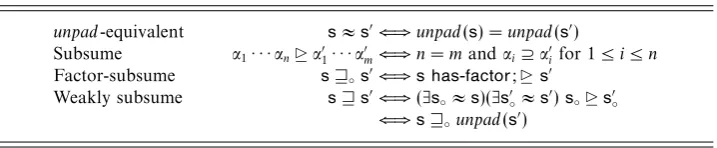
so that for example,unpad( p now ) = p now . Next, we saysands are unpad -equivalent if their unpadding is identical
s≈s ⇐⇒def unpad(s) =unpad(s)
and say a stringsweakly subsumess, writtenss, if some stringunpad-equivalent tos subsumes some stringunpad-equivalent tos
Table 3.Comparing information content
unpad-equivalent s≈s⇐⇒unpad(s) =unpad(s)
Subsume α1· · ·αnα1· · ·αm⇐⇒n=mandαi⊇αi for 1≤i≤n
Factor-subsume s◦s⇐⇒s has-factor;s Weakly subsume ss⇐⇒(∃s◦≈s)(∃s◦≈s)s◦s◦
⇐⇒s◦unpad(s)
The relationsunpad and≈are regular, and as
ss ⇐⇒ (∃s◦ ≈s)ss◦
⇐⇒ s◦unpad(s)
we can turn the finite-state transducer for ◦ above into one for by adding the loops
0→:0 and 2→:2.
Of course, if we arrange thats=unpad(s) for stringssthat we put to the right of
, we can make do with◦ instead of .
It is natural to think of strings in a language as possibilities in the same way that worlds in a proposition are under possible worlds semantics (or models of a sentence are in model-theoretic semantics). We liftto languagesL, Lthrough the Peirce product
LL ⇐⇒def L⊆ L
⇐⇒ (∀s∈L)(∃s∈L)ss
paralleling the definition in possible worlds semantics that a propositionAentails a proposition A if A⊆A. To weed out spurious possibilities, it is useful to bring in a languageC to intersect with Lfor
C[L]def=C∩ L
and then beef upLL to an entailment
L|−C L
def
⇐⇒ C[L] L
⇐⇒ C∩ L ⊆ L.
Clearly, L |−C L whenever L L. The introduction of C allows us not only to
enlarge a string inLto one inL, but also to restrict attention to strings meeting the membership conditions forC
L|−C L ⇐⇒ (∀s∈C)sLimpliessL.
2.3 Some absolute formulas
A sentenceϕ is absolute if its description relation R[ϕ] is the A[ϕ]-restriction of
, making its truth setT[ϕ] the Peirce product A[ϕ]. We now flesh out A[ϕ] for certain absolute LTL-formulasϕ—in particular, those belonging to the setP+of formulas that can be formed from a setP of atomic formulas using the connectives
∧,∨,next,previous,until,ntil,since,sinc. We start with constraints C(ϕ) forϕ∈P+, setting
C(ϕ∧ψ) def= C(ϕ)∩ C(ψ)∩(ϕ∧ψ ⇒ ϕ, ψ )
C(ϕ∨ψ) def= C(ϕ)∩ C(ψ)∩(ϕ∨ψ ⇒ ϕ |ψ )
C(next(ϕ)) def= C(ϕ)∩(next(ϕ) ⇒a ϕ)
C(previous(ϕ)) def= C(ϕ)∩(previous(ϕ) ⇒b ϕ)
C(ϕuntil ψ) def= C(ϕntil ψ)∩(ϕuntil ψ ⇒ ψ |ϕ, ϕntil ψ )
C(ϕntil ψ) def= C(ϕ)∩ C(ψ)∩(ϕntil ψ ⇒a ϕ∗ ψ )
C(ϕsince ψ) def= C(ϕsinc ψ)∩(ϕsince ψ ⇒ ψ |ϕ, ϕsincψ )
C(ϕsincψ) def= C(ϕ)∩ C(ψ)∩(ϕsincψ ⇒b ψ ϕ∗)
and forp∈P,
C(p)def= now ∗ now ⇒ ∅
saying the fluent now occurs at most once. Next, we intersect C(ϕ) with the set
now, ϕ of strings in whichϕandnow occur in a box, to form
A◦(ϕ)def=C(ϕ)∩ now, ϕ .
But what alphabetPow(Φ) are we assuming forC(ϕ) andnow, ϕ? Φ had better be finite if the Peirce productLis to be regular. It suffices (for our purposes) to let Φ be the finite subset Ψ(ϕ) ofP+∪{now}consisting ofϕand formulas mentioned in the definition ofC(ϕ) — roughlyϕ, its subformulas andnow. For example,
Ψ(ϕ∨ψ) = {ϕ∨ψ} ∪Ψ(ϕ)∪Ψ(ψ) Ψ(ϕsince ψ) = {ϕsince ψ} ∪Ψ(ϕsincψ)
Ψ(ϕsincψ) = {ϕsinc ψ} ∪Ψ(ϕ)∪Ψ(ψ) Ψ(p) = {p,now}
so that forp, q, r∈P,
Ψ((p∨q)since next(r)) = {(p∨q)since next(r), (p∨q)sinc next(r), p∨q, next(r), p, q, r,now}.
L, define the setL of -minimal strings in Lby
L def= L− L, whereisminus equality
ss ⇐⇒def ssands=s. For example,
(∗|L)=∗.
Notice that L is regular if L is (as a finite-state transducer for can be easily obtained from the one above forby requiring that there be a proper inclusion⊃). The second way of trimming a language is by projecting every string α1· · ·αn in it
to the string
ρ(α1· · ·αn)
def
= (α1∩(P ∪ {now}))· · ·(αn∩(P ∪ {now}))
restricting the symbols to subsets ofP ∪ {now}. For instance, ifp∈P then ρ(p, ψ∨ϕ now,previous(χ) ) = p now .
Clearly, as a relation,ρ is regular. Now, forϕ∈P+, we take the-minimal strings in A◦(ϕ), and applyρandunpad in succession to form
A[ϕ]def= {unpad(ρ(s))|s∈ A◦(ϕ)}.
From the closure properties of regular languages, it follows thatA[ϕ] is regular, as isR[ϕ] =A[ϕ]. To relate A[ϕ] to LTL, let us adopt the obvious interpretation of the connectivesntil
V , t|=ϕntil ψ ⇐⇒def (∃t> t)V , t|=ψ and
whenevert < t< t, V , t|=ϕ andsinc
V , t|=ϕsinc ψ ⇐⇒def (∃t< t)V , t|=ψ and
whenevert< t< t, V , t|=ϕ
against relations V ⊆Z×P and integers t∈Z. Moreover, as 0 is not one of the fluents out of which we construct strings in A[ϕ], we delete the fluent 0 in our encoding str(s, t) of a finite relation s ⊆Z×P and an integer t∈ Z to form the string str◦(s, t). For example,
str◦({(−1, p),(−1, q),(2, r)},1) = p, q now r
= str◦({(−2, p),(−2, q),(1, r)},0)
illustrating the possibility that now can be set without loss of generality to 0.5 To establish the faithfulness of the about setsA[ϕ] to LTL, we can prove by induction on ϕ∈P+ that
5That is, for all LTL-formulasϕ, relationsV ⊆Z×P and integerst,
Theorem. For allϕ∈P+, V ⊆Z×P andt∈Z,
V , t|=ϕ ⇐⇒ (∃s⊆V)str◦(s, t)∈ A[ϕ].
2.4 Irregular replace
All the clean-up onA◦(ϕ) above just to extractA[ϕ] invites the question: why not define a regular relation unwinding a non-atomic formula ϕ rather than a regular languageA[ϕ] via a system of constraints and projections? (Or for readers familiar with Beesley and Karttunen (2003), why not replace, rather than constrain?) Take, for example, the formulaPp saying pholds now or sometime in the past. It is easy enough to construct a finite-state transducer for a relation ˆR replacing Pp by p or shiftingPp backwards one square so that, for example,
Pp, q Rˆ p, q and Pp, q Rˆ Pp q .
Repeatedly applying ˆR, let tc( ˆR) be the transitive closure of ˆR. We have for all non-negative integersmandn,
m+n+1
Pp, q tc( ˆR) mp n q .
The difficulty, however, is tc( ˆR) is not regular, even though ˆRis. To see this, consider feeding strings from the language ∗ Pp, q ∗ as inputs to tc( ˆR). What output strings do we get that belong in the language p + q + (where L+ def= L∗L, as usual)? As each input string m Pp, qn can move at most n p’s into m, there can be no more
p ’s than q ’s in an output string, and we have
{s |(∃s∈ ∗ Pp, q ∗)stc( ˆR)s} ∩ p + q +={p mq n |1≤m≤n}
which is non-regular. It follows that tc( ˆR) cannot be a regular relation since the languages p+ q +and ∗ Pp, q∗ are regular. By contrast, constraints applied with -minimization and unpad intersect with p+ q + to give the regular sublanguage
p q +.
3 Conclusion
Regular relationsR[ϕ] were defined for various absolute LTL formulasϕ(collected in the setP+) from regular languagesA[ϕ] satisfying constraintsC(ϕ) that essentially reformulate well-known LTL tableau rules in finite-state terms. A theorem was isolated at the end of Section 2.3 asserting thatA[ϕ] encodes satisfaction|= relative
whereVtisV shifted to the right byt
Vt
def
={(t−t, p)|V(t, p)}.
to arbitrary relations V ⊆ Z×P over the full set Z of integers. The theorem is not surprising, but introduces machinery that is, I believe, of interest beyond the theorem. That said, the theorem does raise further questions about the relationship with LTL. Can we apply the about sets A[ϕ] to capture LTL entailments |−LTL between formulas in P+? What about non-absolute LTL formulas such asGp? We turn to these questions below, before briefly touching one of the points behind introducing regular relationsR[ϕ]—i.e., that of varying temporal granularity.
3.1 Entailments short of |−LTL A problem with reducing LTL entailments
ϕ|−LTLψ ⇐⇒def (∀V ⊆Z×P) (∀t∈Z)V , t|=ϕimpliesV , t|=ψ
toA[ϕ] A[ψ] is that a string in A[ϕ] may be too small to contain one inA[ψ]. Accordingly, the entailment
ϕ|−Cψ ⇐⇒ C∩ A[ϕ] ⊆ A[ψ]
enlarges a string in A[ϕ] to one in C before searching for a (sub)string inA[ψ]. Each string, however, has a bounded temporal span short of Z, representable as a finite segment
[i, j]def={t∈Z|i≤t≤j} fori, j∈Z. In effect,V , t|=ϕis replaced by
s, t|=ji ϕ for s⊆[i, j]×P andt∈[i, j], where for example,
s, t|=ji next(ϕ) ⇐⇒def t < jands, t+ 1|=ji ϕ s, t|=ji previous(ϕ) ⇐⇒def i < tands, t−1|=ji ϕ and
s, t|=ji Gϕ ⇐⇒def (∀t∈[t, j])s, t|=ji ϕ. For non-negative integersmandn, letCmn be the constraint
Cmn def= ( now ⇒b m) ∩ (now ⇒a n) ∩ (now ∗ now ⇒ ∅)
requiring that there be at leastmboxes before the evaluation timenow andn boxes after, and at most one occurrence ofnow. Then forϕ, ψ∈P+,
ϕ|−Cn
m ψ ⇐⇒ (∀i≤ −m)(∀j≥n)(∀s⊆[i, j]×P) (21)
s,0|=ji ϕ implies s,0|=ji ψ
withnow normalized to 0 to simplify notation. To build the negationpof an atomic proposition pintoP, we intersectCmn with the constraint
corresponding to a restriction in (21) to relationss⊆[i, j]×P satisfying s(t, p) ⇐⇒ nots(t, p)
fort∈[i, j]. Observe thatnextn(p∨p) holds at 0 for any such relations,
s,0|=ji nextn(p∨p)
but not necessarilynextn+1(p∨p). Similarly forpreviousm(p∨p). Stepping beyond absolute formulas, notice that the LTL entailment
Gp|−LTLGnext(p)
(saying ‘ifp is true now and forever more, then so isnext(p)’) doesnot go through for|−C (unlessC precludesGp), as
s, t|=ji Gnext(p) for alls⊆[i, j]×P andt∈[i, j].
3.2 Gpand some other non-absolute formulas
To sayGp is not absolute is to deny thatR[Gp] can be theA[Gp]-restriction of, whateverA[Gp] might be. But if, in place of, we define a relation ˆR by
sRˆ s ⇐⇒def (∃s)sss (sandwiched betweenand) and put
A[Gp]def= now, p p∗
then we can setR[Gp] to theA[Gp]-restriction of ˆR
sR[Gp]s ⇐⇒def sRˆ s ands∈ A[Gp].
Similarly, for the past counterpartHof Gwith the semantic interpretation
s, t|=ji Hϕ ⇐⇒def (∀t∈[i, t])s, t|=ji ϕ let
A[Hp]def= p ∗ now, p
and
sRˇ s ⇐⇒def (∃s)sss for
sR[Hp]s ⇐⇒def sRˇ s ands∈ A[Hp].
Generalizing overGpandHp, we can usein place of, ˆR or ˇR, provided we pad
A[Gp] to the left for
A[Gp]def
andA[Hp] to the right for
A[Hp]def
= p ∗ now, p ∗ so that
s R[ϕ]s ⇐⇒def ssands∈ A[ϕ]. (22)
Under (22),A[ϕ] need not be padded
A[Hp∧Gq]def
= p∗ now, p, q q ∗
although for absolute formulas, the price of strengtheningtois padding to the left and right6
A[ϕ]def
= ∗A[ϕ]∗ forϕ∈P+
(undoing the step from to ). Padding goes against the grain of defining R[ϕ] to get a handle on the temporal span of aϕ-situation (useful, for example, for past tense reports; recall Section 1.4 above). On the other hand, it is easy enough to unpad A[ϕ] for A[ϕ].
3.3 From temporal span to grain
If the image ofR[ϕ] is unpadded, then we can replace by◦ inasmuch as s s ⇐⇒ s ◦ s ifunpad(s) =s,
where
s ◦ s ⇐⇒def s has-factor;s
and factors are suffixes of prefixes (equivalently, prefixes of suffixes)
s has-factor s ⇐⇒ s has-prefix;has-suffix s
⇐⇒ s has-suffix;has-prefix s and a suffix is a tail end
s has-suffix s ⇐⇒def (∃s)s=ss and a prefix is an initial fragment
s has-prefix s ⇐⇒def (∃s)s=ss. The ‘in’ relation ˆR forGpreplaceshas-factor byhas-suffix
sRˆ s ⇐⇒def s has-suffix;s while the ‘in’ relation ˇRforHpuseshas-prefix
s Rˇ s ⇐⇒def s has-prefix;s.
Table 4.Comparing information content moduloπ.
π-equivalent s≡πs⇐⇒π(s) =π(s)
π-contain s≥πs⇐⇒(∃s◦≡πs)(∃s◦≡πs)s◦s◦
That said, an advantage of the formulationover◦
s s ⇐⇒def (∃s◦≈s)(∃s◦≈s)s◦s◦
(wheres◦ ≈s ⇐⇒def unpad(s◦) =unpad(s)) is that it generalizes from unpad to an arbitrary functionπ (Table 4).
An example of π suggested by the slogan ‘no time without change’ (Kamp and Reyle 1993: 674) reduces all adjacent identical boxesααn to one α. More precisely,
theblock compression bc(s)of a stringsis given by
bc(s)def= ⎧ ⎨ ⎩
bc(αs) ifs=ααs
αbc(βs) ifs=αβs withα=β s otherwise (length(s)≤1) so that, for example,
bc(p, q p, q p, q p, q, r p, q, r p, q ) = p, q p, q, r p, q .
For a finite-state transducer computingbc, let the set of states be the alphabet plus the initial state 0, with transitions
0α→:αα for every symbolα
αβ→:ββ for any two distinct symbolsα, β (to remember the symbol last seen)
α→α:α for every symbolα
(to remove duplications) and all states final (accepting). If a string s is construed as a sequence of observations, the effect of bc(s) is to keep time still if no change (from the previous box) is observed. Exactly what observations are allowed is the crucial issue of granularity, which amounts in the present context to what fluents may occur in a symbolα. The LTL connectivepreviousmakes each tick of the clock Zcount as an observation, thereby neutralizingbc. For instance, the string p p p is treated in LTL as
p p,previous(p) p,previous(previous(p))
which bc leaves unchanged, whereas bc(p p p ) = p . Evidently, we must apply block compression on a string only if it records all information of interest explicitly as fluents. As our interests may change, it is useful to define for any setX ⊆Φ of fluents, a functionρX on strings that restricts the observations toX by intersecting
componentwise withX
ρX(α1α2· · ·αn)
def
For example, ifX ={Jan,Feb,. . .Dec},ρX projects the string
Jan,d1 Jan,d2 · · · Feb,d29 Mar,d1 · · · Dec,d31
(over the 43 fluentsJan,Feb,. . .Dec,d1,d2,. . .,d31) representing a leap year to
Jan31 Feb29 Mar 31· · · Dec31 whichbcmaps to the string
Jan Feb Mar · · · Dec
of length 12. Composing ρX;bcfurther withunpad gives regular relations
πX(s)
def
= unpad(bc(ρX(s)))
relative to which event structures (in the sense of Kamp and Reyle 1993) can be constructed as inverse (projective) limits over finite setsX of fluents (Fernando 2007, 2010). Integrating calendar expressions with temporal propositions, the basic idea is to work with strings that have no more and no less information than what is given. Natural language descriptions do not, as a rule, mention a clock, and rarely the clockZ(however natural that may be for LTL applications).
Acknowledgments
I thank my referees for their critical and constructive comments, and Anssi Yli-Jyr¨a for his work as editor.
References
Areces, C., and ten Cate, B. 2007. Hybrid logics. In P. Blackburn, F. Wolter, and J. van Benthem (eds.), Handbook of Modal Logic, pp. 821–68. Amsterdam, The Netherlands: Elsevier.
Barwise, J., and Perry, J. 1983. Situations and Attitudes. Cambridge, MA, USA: The MIT Press.
Beesley, K. R., and Karttunen, L. 2003.Finite State Morphology. Stanford, CA, USA: CSLI Publications.
Bouajjani, A., Jonsson, B., Nilsson, M., and Touili, T. 2000. Regular model checking. In Computer Aided Verification, pp. 403–18. LNCS 1855. Berlin, Germany: Springer-Verlag. Brink, C., Britz, K., and Schmidt, R. 1994. Peirce algebras. Formal Aspects of Computing
6(3):339–58.
Condoravdi, C. 2009. Punctual until as a scalar NPI. In K. Hanson, and S. Inkelas (eds.), The Nature of the Word: Studies in Honor of Paul Kiparsky, pp. 631–53. Cambridge, MA, USA: The MIT Press.
Davidson, D. 1967. The logical form of action sentences. In N. Rescher (ed.), The Logic of Decision and Action, pp. 81–95. Pittsburgh, PA, USA: University of Pittsburgh Press. Emerson, E. A. 1992. Temporal and modal logic. In J. van Leeuwen (ed.), Handbook of
Theoretical Computer Science, volume B: Formal Methods and Semantics, pp. 995–1072. Cambridge, MA, USA: The MIT Press.
Fernando, T. 2004. A finite-state approach to events in natural language semantics.Journal of Logic and Computation 14(1): 79–92.
Fernando, T. 2008a. Branching from inertia worlds.Journal of Semantics 25(3): 321–344. Fernando, T. 2008b. Temporal propositions as regular languages. In T. Hanneforth, and K-M.
W¨urzner (eds.), Finite-State Methods and Natural Language Processing, 6th International Workshop, pp. 132–48. Potsdam, Germany: Universit¨atsverlag Potsdam.
Fernando, T. 2009a. Situations in LTL as strings. Information and Computation 207 (10): 980–99.
Fernando, T. 2009b. Situations as indices and as denotations.Linguistics and Philosophy32(2): 185–206.
Fernando, T. 2010. Constructing situations and time. Journal of Philosophical Logic, doi:10.1007/s10992-010-9155-1.
Harel, D., Kozen, D., and Tiuryn, J. 2000.Dynamic Logic. Cambridge, MA, USA: The MIT Press.
Kamp, H., and Reyle, U. 1993.From Discourse to Logic. Dordrecht: Kluwer.
Karttunen, L. 1974 Until. InPapers from the Tenth Regional Meeting of the Chicago Linguistic Society, Chicago, pp. 284–97.
Karttunen, L. 2005 The Yale Shooting Problem. http://www.stanford.edu/∼laurik/ fsmbook/examples/YaleShooting.html
McCarthy, J., and Hayes, P. 1969. Some philosophical problems from the standpoint of artificial intelligence. In M. Meltzer, and D. Michie (eds.), Machine Intelligence 4, pp. 463–502. Edinburgh, UK: Edinburgh University Press.
Mulligan, K., Simons, P., and Smith, B. 1984. Truth-makers.Philosophy and Phenomenological Research44: 287–321.
Niemi, J., and Koskenniemi, K. 2009. Representing and combining calendar information by using finite-state transducers. In J. Piskorski, B. Watson, and A. Yli-Jyr¨a (eds.), Finite-State Methods and Natural Language Processing: Post-proceedings of the 7th International Workshop FSMNLP 2008, pp. 122–33. Amsterdam, The Netherlands: IOS Press.
Reichenbach, H. 1947.Elements of Symbolic Logic. London, UK: Macmillan.