Multi-domain learning and generalization in dialog state tracking
Jason D. Williams
Microsoft Research, Redmond, WA, USA
Abstract
Statistical approaches to dialog state track-ing synthesize information across multi-ple turns in the dialog, overcoming some speech recognition errors. When training a dialog state tracker, there is typically only asmall corpus of well-matched dia-log data available. However, often there is a large corpus ofmis-matched but related data – perhaps pertaining to different se-mantic concepts, or from a different dialog system. It would be desirable to use this related dialog data to supplement the small corpus of well-matched dialog data. This paper addresses this task asmulti-domain learning, presenting 3 methods which syn-thesize data from different slots and differ-ent dialog systems. Since deploying a new dialog state tracker often changes the re-sulting dialogs in ways that are difficult to predict, we study how well each method
generalizesto unseen distributions of dia-log data. Our main result is the finding that a simple method for multi-domain learn-ing substantially improves performance in highly mis-matched conditions.
1 Introduction
Spoken dialog systems interact with users via nat-ural language to help them achieve a goal. As the interaction progresses, the dialog manager main-tains a representation of the state of the dialog in a process calleddialog state tracking. For example, in a bus schedule information system, the dialog state might indicate the user’s desired bus route, origin, and destination. Dialog state tracking is difficult because errors in automatic speech recog-nition (ASR) and spoken language understanding (SLU) are common, and can cause the system to misunderstand the user’s needs. At the same time,
state tracking is crucial because the system relies on the estimated dialog state to choose actions – for example, which bus schedule information to present to the user.
Most commercial systems use hand-crafted rules for state tracking, selecting the SLU result with the highest confidence score observed so far, and discarding alternatives. In contrast, statisti-cal approaches compute a posterior distribution
over many hypotheses for the dialog state, and in general these have been shown to be superior (Horvitz and Paek, 1999; Williams and Young, 2007; Young et al., 2009; Thomson and Young, 2010; Bohus and Rudnicky, 2006; Metallinou et al., 2013).
Unfortunately, when training a dialog state tracker, there is rarely a large corpus ofmatched
data available. For example, a pilot version of the system may be fielded in a controlled environment to collect a small initial corpus. Yet there is of-ten a large quantity of mis-matched dialog data available. For example, dialog data might be avail-able from another dialog system – such as an ear-lier version with a different recognizer, dialog con-troller, and user population – or from a related task – such as searching for restaurants instead of ho-tels.
In this paper, we tackle the general problem of
how to make use of disparate sources of data
when training a dialog state tracker. For exam-ple, should a tracker for each slot be trained on small sets of slot-specific data, or should data from all slots be combined somehow? Can dialog data from another system be used to build effective tracker for a new system for which no data (yet) exists? Once data from the new system is avail-able, is the old data still useful?
These inter-related questions can be formalized as multi-domain learning and generalization. Multi-domain learning (MDL) refers to the task of building a model – here, a state tracker – for
a target domain using training data from both the target domain and a different but related domain. Generalization refers to the ability of a model to perform well in a domain unlike that seen in any of the training data. Both multi-domain learning and generalization are active research topics in the machine learning community, with broad applica-tions. (Joshi et al., 2012) provides a comparison of popular methods on several (non-dialog) tasks, in-cluding sentiment classification in on-line product reviews.
In dialog state tracking, there are a variety of properties that could be cast as a “domain”. In this paper, we explore two obvious domains: different
dialog systems, and differentslots, where slots are informational sub-units of the dialog state, such as the origin, bus route, and departure time in a bus timetables spoken dialog system. We apply sev-eral methods for MDL across varied dialog sys-tems, slots, and combinations of both. MDL is attractive for dialog state tracking because the dis-tribution across slots and systems is related but
not identical. For example, the ranges of speech recognition confidence scores for two slots such as bus route and date may be different, or one system may use confirmations much more often than an-other. Despite these differences, there are useful patterns: regardless of the slot or system, higher confidence scores and responses of “yes” to con-firmations provide more certainty. The hope is that MDL can provide a principled way of using all available data to maximize accuracy.
An important problem in dialog state tracking is that deploying a new tracker into production will produce a new distribution of dialog data that may be unlike data observed at training time in ways that are difficult to predict. As a result, it is impor-tant to test thegeneralizationof dialog state track-ing models on data that differs from the traintrack-ing distribution. In this paper, we evaluate each of the MDL approaches on multiple held-out datasets, ranging from well-matched to very mis-matched – i.e., dialog data from the same dialog system, a modified version of the dialog system, and a com-pletely different dialog system.
We show that dialog data from multiple existing systems can be used to build good state trackers for a completely new system, and that a simple form of MDL improves generalization substan-tially. We also find that, if well-matched data from that new system is available, the effect (positive or
negative) of MDL is slight. Since in practice the level of mis-match can be difficult to predict, this suggests that training with (a particular form of) MDL is the safest approach.
This paper is organized as follows. Section 2 describes the algorithm used for state tracking and the dialog data employed. Section 3 then intro-duces methods for multi-domain learning. Section 4 presents results and Section 5 briefly concludes.
2 Preliminaries
We begin by describing the core model used for dialog state tracking, and the source data. Both of these will be important for the development of the multi-domain learning methods in Section 3.
2.1 Dialog state tracking model
There are two dominant approaches to statisti-cal methods for dialog state tracking. Genera-tiveapproaches use generative models that capture how the SLU results are generated from hidden dialog states (Horvitz and Paek, 1999; Williams and Young, 2007; Young et al., 2009; Thomson and Young, 2010). In contrast,discriminative ap-proaches use conditional models, trained in a dis-criminative fashion to directly estimate the distri-bution over a set of state hypotheses based on a large set of informative features (Bohus and Rud-nicky, 2006). Previous work has found that dis-criminative approaches yield better performance (Metallinou et al., 2013), so we base our experi-ments on a discriminative model.
We will assume that each dialog state hypothe-sis is described by a feature vectorx, consisting of |x|=Xfeatures. For example, a feature might be
the confidence score of the most recent recognition result corresponding to the hypothesis. Features can also be included which describe the current dialog context, such as how many times the target slot has been requested or confirmed. At a turn in a dialog with indexi, there are N(i) dialog state
hypotheses, each described byXfeatures. We de-note the concatenation of allN(i) feature vectors
asX(i), which has sizeXN(i).
The dialog state tracking task is to take as in-put the complete feature vectorX(i), and output a
distribution over theN(i) hypotheses, plus an
ad-ditional meta-hypothesis REST that indicates that none of the hypotheses is correct. For training, la-belsy(i)indicate which of theN(i) hypotheses is
con-Feats/hyp
Group |X| |X∗| Corpus Dialogs Mismatch to training data
A 90 54
643 TRAIN2 None – same distribution
715 TEST1 Low
750 TEST2 Medium
B 90 316 1020 TRAIN3 None – same distribution
438 TEST3 Low
[image:3.595.142.458.67.174.2]C 90 0 TEST4 High
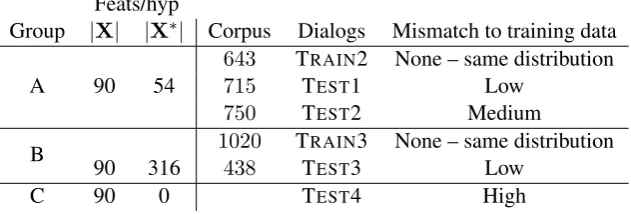
Table 1: Corpora used in this paper. |X|denotes the number ofcommonfeatures, and|X∗|denotes the
number ofsystem-specific features. The data in systems TEST1 and TEST3 has low mis-match to the
training data because they use very similar dialog managers as in TRAIN2 and TRAIN3, respectively.
The system in corpus TEST2 used a different dialog manager from TRAIN2, but the same set of system
actions, speech recognizer, and TTS, resulting in a medium level of mis-match. The system in corpus TEST4 was completely different from any system in the training data. On average there were
approxi-mately 13 system turns and 13 user turns per dialog across all corpora. The TRAIN* corpora are used
for training, and the TEST* corpora are used for testing. Complete details of the corpora are given in
(Williams et al., 2013).
struction the hypotheses are disjoint; with the ad-dition of the REST meta-hypothesis, exactly one hypothesis is correct by construction. After the di-alog state tracker has output its distribution, this distribution is passed to a separate, downstream process that chooses what action to take next (e.g., how to respond to the user).
Note that the dialog state tracker is not predict-ing the contents of the dialog state hypotheses: the dialog state hypotheses’ contents and features are given by some external process – for exam-ple, simply enumerating all SLU values observed so far in the dialog. Rather, the task is to pre-dict a probability distribution over the hypotheses, where the probability assigned to a hypothesis in-dicates the probability that it is correct.
In our previous work, we developed a discriminatively-trained maximum-entropy model for dialog state tracking (Metallinou et al., 2013). The model estimates a single weight for each feature in x; to keep learning tractable, these
weights are shared across all state hypotheses be-ing scored. The model includes L1 and L2 regu-larization. This model was found to out-perform generative models, rule-based approaches typi-cally used in industry, and competing discrimina-tive approaches. The complete details are given in (Metallinou et al., 2013) and are not crucial to this paper, because the multi-domain learning ap-proaches used here will not modify the learning algorithm, but rather modify the features, as de-scribed below.
2.2 Dialog data
match/mis-match between training and test data. In this data, there are9slots: the bus route, date, time, and three components each for the origin and destination, roughly corresponding to streets, neighborhoods, and points-of-interest like univer-sities. In this paper we will build trackers that op-erate on slots independently – i.e., at each turn, a total of 9 trackers will each output a ranked list of dialog state hypotheses for its slot.1 The state hy-potheses consist of all of the values for that slot ob-served so far in the dialog – either in an SLU result or output by the system – plus the meta-hypothesis REST that represents the case that none of the ob-served values is correct.
Each dialog state hypothesis is described by a set of features extracted from the dialog data. The Dialog State Tracking Challenge provides data from all systems in a standard format, from which we extracted 90features per dialog state hypoth-esis. We refer to these as common features, be-cause they are available for all systems. We de-note the concatenation of all common features for all hypotheses at a given turn asXA,XB, orXC,
subscripted based on the system from which they were extracted. In addition, the challenge data includes system-specific information. From the Group A and B logs we extracted 54 and 316
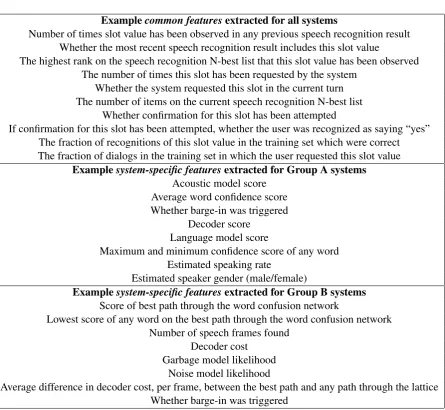
system-specific features per hypothesis, respec-tively. We denote the concatenation of all system-specific features for all hypotheses at a given turn as X∗A or X∗B, subscripted based on the system from which they were extracted. Group C logs provided no additional system-specific informa-tion. Examples of features are provided in the Ap-pendix.
3 Multi-domain learning methods 3.1 Models for multi-domain learning
In multi-domain learning (MDL), data instances are of the form (X(i), y(i), d(i)), where X(i) are
features for instancei,y(i)is the label for instance i, andd(i)is thedomainof instancei, where there are a total of Ddomains. The goal is to build a
good model forPd(y|X)– i.e., to predict the
la-bel of an instance given its features anddomain. A baseline model uses only data from domaindto
trainPd(y|X); MDL tackles the problem of how
to build models that use data from all domains to improve on this baseline. In this paper, we
con-1For simplicity, in this paper we do not considerjointstate hypotheses, which include more than one slot.
sider the fully-supervised case, where all of the training data has been labeled.
We explore four ways of constructing models. First, in theINDbaseline model, we buildD
sep-arate models using only data from a single do-main. Next, in thePOOLmodel, the data from all domains is simply pooled together into one large corpus; the single model trained on this corpus is used in all domains. Each feature vector is aug-mented to include an indicator of the domaind(i)
from which it originated, as this has been found to confer much of the benefit of more complex MDL algorithms (Joshi et al., 2012). The POOLmodel
can be viewed as the simplest form of MDL.
Next, the MDL1 model employs a simple
but powerful method for MDL developed by (Daume III, 2007). For each data instance, a syn-thetic feature vectoris formed withD+ 1blocks of size|X|. Each block is set to all zeros, except
for blockd(i)and blockD+ 1which are both set toX(i). For example, with D = 3domains, the
synthetic feature vector for X(i) from domain 1 would behX(i),0,0,X(i)i, and forX(j)from
do-main2 would beh0,X(j),0,X(j)i, where0 is a
vector of zeros of size|X|. This synthetic corpus is then used to train a single model which is used in any domain.
This approach has been found to be successful on a variety of machine learning tasks, including several NLP tasks (Daume III, 2007). To explain the intuition, consider a single feature component of X, X[k], which appears D + 1 times in the synthetic feature vectors. For model estimation, assume a standard loss function with a term that penalizes classification errors, and a regularization term that penalizes non-zero feature weights. Intu-itively, if an individual scalar featureX[k]behaves
do-Synthetic feature vector encoding for data from:
Method Target Slot Slot 1 Slot 2 · · · Slot 9
SLOTIND
1 X1 not used · · · not used
2 not used X2 · · · not used
· · · ·
9 not used not used · · · X9
SLOTPOOL all X1 X2 · · · X3
SLOTMDL1 all X1,0, . . . ,0,X1 0,X2, . . . ,0,X2 · · · 0,0, . . . ,X9,X9
SLOTMDL2
1 X1,0,X1 0,X2,X2 · · · 0,X9,X9
2 0,X1,X1 X2,0,X2 · · · 0,X9,X9
· · · ·
[image:5.595.90.510.61.229.2]9 0,X1,X1 0,X2,X2 · · · X9,0,X9
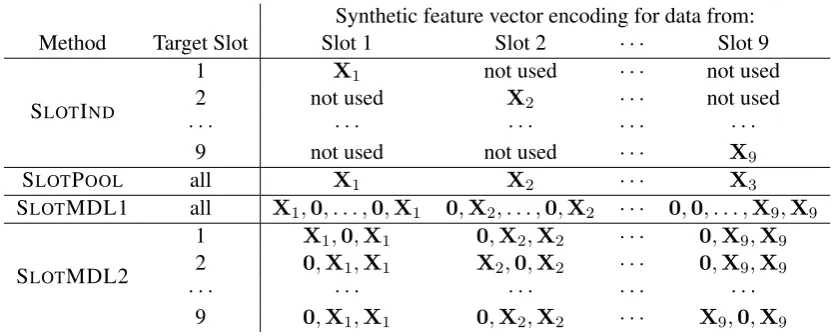
Table 2: Synthetic features constructed for each multi-domain learning method applied toslots. Here, the subscript onXindicates theslotit describes.
mains.
When the number of domains D is large, MDL1 can produce large, sparse synthetic feature vectors, confounding training. MDL2 addresses this by constructingDseparate models; in model
d, data from all domainsexcept dis pooled into
one meta-domain. Then the procedure in MDL1 is followed. For example, for model d = 1, in-stancesX(i) from domaind(i) = 1is represented
as hX(i),0,X(i)i; data from all other domains
d(i) 6= 1 is represented as h0,X(i),X(i)i. This synthetic data is then used to train a model for do-main1.
3.2 Application to dialog state tracking
In this study, we consider two orthogonal dimen-sions of domain –systemsandslots– and combi-nations of the two.
Multi-domain learning across slots means building a tracker for one slot using dialog data pertaining to that slot, plus data pertaining to other slots. In the experiments below, this is done by treating each of the 9 slots as a domain and apply-ing each of the four MDL methods above. Table 2 specifies the precise form of the synthetic feature vectors for each method.
Multi-domain learning across systems means building a tracker for one dialog system using dia-log data collected with that system, plus data from other dialog systems. Each of the two corpora in the training data – TRAIN2 from Group A and
TRAIN3 from Group B – is treated as a domain.
Since only thecommonfeatures are shared across domains (i.e., systems), model complexity can be reduced by building different models depending
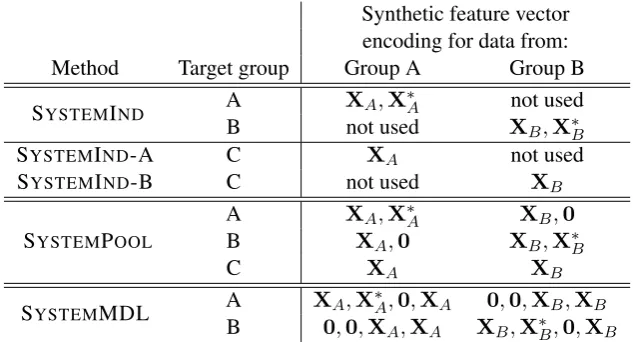
on the target group – the group the model will be tested on – and including system-specific fea-tures only for the target group. For example, when a model will be trained on data from Groups A and B, then tested on data from Group A, we in-clude common features from A and B but system-specific features from only A. Table 3 specifies the precise form of the synthetic feature vectors for each method. Also, when MDL is applied across systems, there are only 2 sources of training data, so MDL2 is identical to MDL1 (and thus isn’t shown in the results).
Applying multi-domain learning to both sys-tems and slots is done by composing the two fea-ture synthesis steps. This process is simple but can increase the size of synthetic feature vectors by up to an order of magnitude.
3.3 Evaluation method
In the experiments below, we train dialog state trackers that output a scored list of dialog state hypotheses for each slot at each turn in the dia-log. For evaluation, we measure the fraction of output lists where the top dialog state hypothesis is correct. A dialog state hypothesis is correct if it corresponds to a slot value which has been rec-ognized correctly. The dialog state tracker may include the meta-hypothesis REST among its hy-potheses – this meta-hypothesis is labeled as cor-rect if no corcor-rect values have yet been recognized for this slot.
Synthetic feature vector encoding for data from:
Method Target group Group A Group B
SYSTEMIND A XA,X∗A not used
B not used XB,X∗B
SYSTEMIND-A C XA not used
SYSTEMIND-B C not used XB
SYSTEMPOOL
A XA,X∗A XB,0
B XA,0 XB,X∗B
C XA XB
SYSTEMMDL A XA,X∗A,0,XA 0,0,XB,XB
[image:6.595.140.457.62.233.2]B 0,0,XA,XA XB,X∗B,0,XB
Table 3: Synthetic features constructed for each multi-domain learning method applied tosystems. Here, the subscript onXindicates thesystemit originated from. Asterisk super-scripts indicate system-specific
features, which are only included for the group the tracker will be tested on (i.e., thetarget group).
example, in turni, if a system confirms a bus route,
and a date appears in the speech recognition out-put, both of these slots in turniwill be included
when computing average accuracy. If the time slot appears in neither the system output nor anywhere in the speech recognition output of turni, then the
time slot in turniis excluded when computing
av-erage accuracy. The accuracy computation itself was done by the scoring tool from the Dialog State Tracking Challenge, using theschedule2accuracy metric forallslots (Williams et al., 2013; Williams et al., 2012).
For comparison, we also report performance of a simple rule-based tracker. For each slot, this tracker scans over all values recognized so far in the dialog, and returns the value which has been recognized with the highestlocalSLU confidence score.
4 Results
We first evaluated performance of multi-domain learning in isolation,excludingthe effects of gen-eralization. To do this, we divided TRAIN2 and
TRAIN3 in half, using the first halves for
train-ing and the second halves for testtrain-ing. This ex-periment gives an indication of the performance of multi-domain learning if conditions in deployment match the training data.
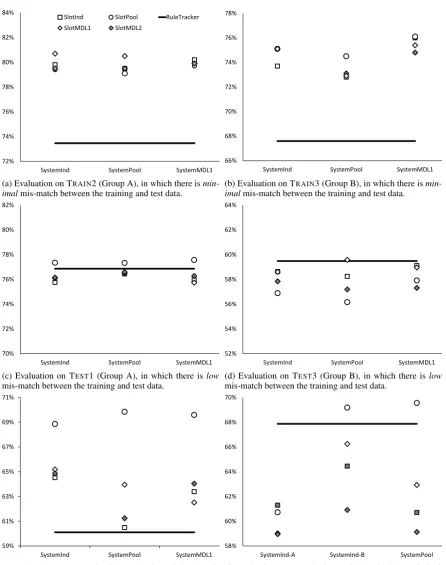
Results are shown in Figure 1a-1b. Here, the effects of multi-domain learning across systems and slots is rather small, and inconsistent. For ex-ample, pooling slot data yields best performance on TRAIN3, and worst performance in TRAIN2.
Applying MDL across systems yields best perfor-mance for TRAIN3, but not for TRAIN2. Overall,
when training and test data are very well-matched, MDL has little effect.
Of course, in practice, training and test data will
not be well-matched, so we next evaluated per-formance of multi-domain learningincludingthe effects of generalization. Here we trained using the complete TRAIN2 and TRAIN3 corpora, and
tested on TEST1, TEST2, TEST3, and TEST4.
Results are shown in Figures 1c-1f. The dom-inant trend is that, at high levels of mis-match as in TEST3 and TEST4, simply pooling together all
available data yields a large increase in accuracy compared to all other methods. The majority of the increase is due to pooling across slots, though pooling across systems yields a small additional gain. This result echos past work, where pooling data is often competitive with more sophisticated methods for multi-domain learning (Joshi et al., 2012).
In our case, one possible reason for this result is that simply pooling the data introduces a sort of regularization: note that the models with SLOT
-POOL and SYSTEMPOOL have the highest ratio
of training data to model parameters. The MDL methods also use all the data, but via their larger synthetic feature vectors, they increase the number of model parameters. The smaller model capacity of the POOLmodels limit the ability to completely
72% 74% 76% 78% 80% 82% 84%
SystemInd SystemPool SystemMDL1 SlotInd SlotPool RuleTracker SlotMDL1 SlotMDL2
(a) Evaluation on TRAIN2 (Group A), in which there is min-imalmis-match between the training and test data.
66% 68% 70% 72% 74% 76% 78%
SystemInd SystemPool SystemMDL1
(b) Evaluation on TRAIN3 (Group B), in which there is min-imalmis-match between the training and test data.
70% 72% 74% 76% 78% 80% 82%
SystemInd SystemPool SystemMDL1
(c) Evaluation on TEST1 (Group A), in which there islow mis-match between the training and test data.
52% 54% 56% 58% 60% 62% 64%
SystemInd SystemPool SystemMDL1
(d) Evaluation on TEST3 (Group B), in which there islow mis-match between the training and test data.
59% 61% 63% 65% 67% 69% 71%
SystemInd SystemPool SystemMDL1
(e) Evaluation on TEST2 (Group A), in which there is mediummis-match between the training and test data.
58% 60% 62% 64% 66% 68% 70%
SystemInd-A SystemInd-B SystemPool
[image:7.595.70.517.55.621.2](f) Evaluation on TEST4 (Group C), in which there ishigh mis-match between all of the training data and test data.
Figure 1: Average accuracy of different approaches to multi-domain learning in dialog state tracking. Squares show SLOTIND, circles SLOTPOOL, unshaded diamonds SLOTMDL1, and shaded diamonds
SLOTMDL2. The solid line shows performance of a simple rule-based tracker, which is not trained on
data. In all plots, the vertical axis is shown on the same scale for comparability (12%from bottom to top), and indicates average accuracy of the top dialog state (c.f., Section 3.3). In panels 1a and 1b, training is done on the first halves of TRAIN2 and TRAIN3, and testing on the second halves. In the other panels,
training uses all of TRAIN2 and TRAIN3. In panel 1f, the categories for TEST4 – for which there is no
in mis-matched conditions.
5 Conclusion
This paper has examined multi-domain learning and generalization in dialog state tracking. Two dimensions of domain have been studied – learn-ing across slots and learnlearn-ing across systems – and three simple methods for multi-domain learning have been studied. By using corpora of real di-alogs from the Dialog State Tracking Challenge, generalization has been studied through varying levels of mis-match between training and test data. The results show that simply pooling together data yields large benefits in highly mis-matched conditions and has little effect in well-matched conditions. In practice of course, the level of mis-match a new tracker will produce is difficult to pre-dict. So the safest strategy seems to be to always pool together all available data.
There are a variety of issues to examine in future work. First, the MDL methods used in this study were chosen for their simplicity and versatility: by augmenting features, no changes were required to the learning method. There exist other methods of MDL whichdomodify the learning, and in some cases yield better performance. It would be inter-esting to test them next, perhaps including meth-ods that can construct deeper representations than the maximum entropy model used here.
More broadly, this study has been limited to su-pervised multi-domain learning, in whichlabeled
data from multiple domains is available at training time. It would clearly be desirable to develop a method forunsupervised adaptation, in which the model is adjusted as theunlabeledtest data is ex-perienced.
For now, the contribution of this study is to pro-vide at least an initial recommendation to prac-titioners on how to best make use of disparate sources of dialog data when building a statistical dialog state tracker.
Acknowledgements
Thanks to Dan Bohus for making his machine learning software available.
References
Alan W Black, Susanne Burger, Alistair Conkie, He-len Hastie, Simon Keizer, Oliver Lemon, Nicolas Merigaud, Gabriel Parent, Gabriel Schubiner, Blaise Thomson, Jason D. Williams, Kai Yu, Steve Young,
and Maxine Eskenazi. 2011. Spoken dialog chal-lenge 2010: Comparison of live and control test re-sults. InProc SIGdial Workshop on Discourse and Dialogue, Portland, Oregon.
Dan Bohus and Alex Rudnicky. 2006. A ‘K hypothe-ses + other’ belief updating model. InProc Amer-ican Association for Artificial Intelligence (AAAI) Workshop on Statistical and Empirical Approaches
for Spoken Dialogue Systems, Boston.
Hal Daume III. 2007. Frustratingly easy domain adap-tation. InProceedings of the 45th Annual Meeting of the Association of Computational Linguistics, pages 256–263, Prague, Czech Republic, June. Associa-tion for ComputaAssocia-tional Linguistics.
Eric Horvitz and Tim Paek. 1999. A computational architecture for conversation. In Proc 7th Interna-tional Conference on User Modeling (UM), Banff,
Canada, pages 201–210.
Mahesh Joshi, Mark Dredze, William W Cohen, and Carolyn Rose. 2012. Multi-domain learning: When do domains matter? In Proc Joint Conference on Empirical Methods in Natural Language Process-ing and Computational Natural Language LearnProcess-ing, Jeju, Korea.
Angeliki Metallinou, Dan Bohus, and Jason D. Williams. 2013. Discriminative state tracking for spoken dialog systems. In Proc Association for Computational Linguistics, Sofia.
Blaise Thomson and Steve Young. 2010. Bayesian update of dialogue state: A POMDP framework for spoken dialogue systems. Computer Speech and
Language, 24(4):562–588.
Jason D Williams and Steve Young. 2007. Partially observable Markov decision processes for spoken dialog systems. Computer Speech and Language, 21(2):393–422.
Jason D Williams, Antoine Raux, Deepak Ramachan-dran, and Alan W Black. 2012. Dialog state tracking challenge handbook. Technical report, Mi-crosoft Research.
Jason D. Williams, Antoine Raux, Deepak Ramachan-dran, and Alan Black. 2013. The dialog state track-ing challenge. InSubmitted to SigDial 2013. Jason D. Williams. 2012. Challenges and
oppor-tunities for state tracking in statistical spoken dia-log systems: Results from two public deployments.
IEEE Journal of Selected Topics in Signal Process-ing, Special Issue on Advances in Spoken Dialogue Systems and Mobile Interface, 6(8):959–970. Steve Young, Milica Gaˇsi´c, Simon Keizer, Franc¸ois
Mairesse, Jost Schatzmann, Blaise Thomson, and Kai Yu. 2009. The hidden information state model: a practical framework for POMDP-based spoken di-alogue management. Computer Speech and
Appendix
Examplecommon featuresextracted for all systems
Number of times slot value has been observed in any previous speech recognition result Whether the most recent speech recognition result includes this slot value
The highest rank on the speech recognition N-best list that this slot value has been observed The number of times this slot has been requested by the system
Whether the system requested this slot in the current turn The number of items on the current speech recognition N-best list
Whether confirmation for this slot has been attempted
If confirmation for this slot has been attempted, whether the user was recognized as saying “yes” The fraction of recognitions of this slot value in the training set which were correct The fraction of dialogs in the training set in which the user requested this slot value
Examplesystem-specific featuresextracted for Group A systems
Acoustic model score Average word confidence score Whether barge-in was triggered
Decoder score Language model score
Maximum and minimum confidence score of any word Estimated speaking rate
Estimated speaker gender (male/female)
Examplesystem-specific featuresextracted for Group B systems
Score of best path through the word confusion network
Lowest score of any word on the best path through the word confusion network Number of speech frames found
Decoder cost Garbage model likelihood
Noise model likelihood
[image:9.595.79.525.216.626.2]Average difference in decoder cost, per frame, between the best path and any path through the lattice Whether barge-in was triggered