English-to-Hindi system description for WMT 2014:
Deep Source-Context Features for Moses
Marta R. Costa-juss`a1, Parth Gupta2, Rafael E. Banchs3 and Paolo Rosso2 1Centro de Investigaci´on en Computaci´on, Instituto Polit´ecnico Nacional, Mexico
2NLE Lab, PRHLT Research Center, Universitat Polit`ecnica de Val`encia 3Human Language Technology, Institute for Infocomm Research, Singapore
1[email protected],2{pgupta,prosso}@dsic.upv.es, 3[email protected]
Abstract
This paper describes the IPN-UPV partici-pation on the English-to-Hindi translation task from WMT 2014 International Evalu-ation Campaign. The system presented is based on Moses and enhanced with deep learning by means of a source-context fea-ture function. This feafea-ture depends on the input sentence to translate, which makes it more challenging to adapt it into the Moses framework. This work reports the experimental details of the system putting special emphasis on: how the feature func-tion is integrated in Moses and how the deep learning representations are trained and used.
1 Introduction
This paper describes the joint participation of the Instituto Polit´ecnico Nacional (IPN) and the Uni-versitat Polit`ecnica de Valencia (UPV) in cooper-ation with Institute for Infocomm Research (I2R) on the 9th Workshop on Statistical Machine Trans-lation (WMT 2014). In particular, our participa-tion was in the English-to-Hindi translaparticipa-tion task.
Our baseline system is an standard phrase-based SMT system built with Moses (Koehn et al., 2007). Starting from this system we propose to in-troduce a source-context feature function inspired by previous works (R. Costa-juss`a and Banchs, 2011; Banchs and Costa-juss`a, 2011). The main novelty of this work is that the source-context fea-ture is computed in a new deep representation.
The rest of the paper is organized as follows. Section 2 presents the motivation of this seman-tic feature and the description of how the source context feature function is added to Moses. Sec-tion 3 explains how both the latent semantic in-dexing and deep representation of sentences are used to better compute similarities among source
contexts. Section 4 details the WMT experimental framework and results, which proves the relevance of the technique proposed. Finally, section 5 re-ports the main conclusions of this system descrip-tion paper.
2 Integration of a deep source-context feature function in Moses
This section reports the motivation and descrip-tion of the source-context feature funcdescrip-tion, to-gether with the explanation of how it is integrated in Moses.
2.1 Motivation and description
Source context information in the phrase-based system is limited to the length of the translation units (phrases). Also, all training sentences con-tribute equally to the final translation.
We propose a source-context feature func-tion which measures the similarity between the input sentence and all training sen-tences. In this way, the translation unit should be extended from source|||target to
source|||target|||trainingsentence, with the
trainingsentence the sentence from which the source and target phrases were extracted. The measured similarity is used to favour those translation units that have been extracted from training sentences that are similar to the current sentence to be translated and to penalize those translation units that have been extracted from unrelated or dissimilar training sentences as shown in Figure 2.1.
In the proposed feature, sentence similarity is measured by means of the cosine distance in a reduced dimension vector-space model, which is constructed either by means of standard latent se-mantic analysis or using deep representation as de-cribed in section 3.
S1: we could not book the room in time
T1:hm smy m\ EVkV aArE?ft nhF\ kr sk\
S2: I want to write the book in time T2:m{\ smy m\ EktAb ElKnA cAhtA h
Input: i am reading a nice book
book : EktAb
book : aArE?ft krnA S2
S1 Input
Figure 1: Illustration of the method
2.2 Integration in Moses
As defined in the section above and, previously, in (R. Costa-juss`a and Banchs, 2011; Banchs and Costa-juss`a, 2011), the value of the proposed source context similarity feature depends on each individual input sentence to be translated by the system. We are computing the similarity between the source input sentence and all the source train-ing sentences.
This definition implies the feature function de-pends on the input sentence to be translated. To implement this requirement, we followed our pre-vious implementation of an off-line version of the proposed methodology, which, although very in-efficient in the practice, allows us to evaluate the impact of the source-context feature on a state-of-the-art phrase-based translation system. This prac-tical implementation follows the next procedure:
1. Two sentence similarity matrices are com-puted: one between sentences in the develop-ment and training sets, and the other between sentences in the test and training datasets. 2. Each matrix entry mij should contain the
similarity score between theith sentence in
the training set and thejthsentence in the
de-velopment (or test) set.
3. For each sentencesin the test and develop-ment sets, a phrase pair listLS of all
poten-tial phrases that can be used during decoding is extracted from the aligned training set. 4. The corresponding source-context similarity
values are assigned to each phrase in listsLS
according to values in the corresponding sim-ilarity matrices.
5. Each phrase listLSis collapsed into a phrase
table TS by removing repetitions (when
re-moving repeated entries in the list, the largest value of the source-context similarity feature is retained).
6. Each phrase table is completed by adding standard feature values (which are computed in the standard manner).
7. Moses is used on a sentence-per-sentence ba-sis, using a different translation table for each development (or test) sentence.
3 Representation of Sentences
We represent the sentences of the source language in the latent space by means of linear and non-linear dimensionality reduction techniques. Such models can be seen as topic models where the low-dimensional embedding of the sentences represent conditional latent topics.
3.1 Deep Autoencoders
The non-linear dimensionality reduction tech-nique we employ is based on the concept of deep learning, specifically deep autoencoders. Autoen-coders are three-layer networks (input layer, hid-den layer and output layer) which try to learn an identity function. In the neural network represen-tation of autoencoder (Rumelhart et al., 1986), the visible layer corresponds to the input layer and hidden layer corresponds to the latent features. The autoencoder tries to learn an abstract repre-sentation of the data in the hidden layer in such a way that minimizes reconstruction error. When the dimension of the hidden layer is sufficiently small, autoencoder is able to generalise and derive powerful low-dimensional representation of data. We consider bag-of-words representation of text sentences where the visible layer is binary feature vector (v) where vi corresponds to the presence
or absence of ith word. We use binary restricted
Boltzmann machines to construct an autoencoder as shown in (Hinton et al., 2006). Latent repre-sentation of the input sentence can be obtained as shown below:
p(h|v) =σ(W ∗v+b) (1)
whereW is the symmetric weight matrix between visible and hidden layer and b is hidden layer bias vector andσ(x)is sigmoid logistic function
Autoencoders with single hidden layer do not have any advantage over linear methods like PCA (Bourlard and Kamp, 1988), hence we consider deep autoencoder by stacking multiple RBMs on top of each other (Hinton and Salakhut-dinov, 2006). The autoencoders have always been difficult to train through back-propagation until greedy layerwise pre-training was found (Hinton and Salakhutdinov, 2006; Hinton et al., 2006; Ben-gio et al., 2006). The pre-training initialises the network parameters in such a way that fine-tuning them through back-propagation becomes very ef-fective and efficient (Erhan et al., 2010).
3.2 Latent Semantic Indexing
Linear dimensionality reduction technique, latent semantic indexing (LSI) is used to represent sen-tences in abstract space (Deerwester et al., 1990). The term-sentence matrix (X) is created wherexij
denotes the occurrence ofithterm injth sentence.
MatrixXis factorized using singular value decom-position (SVD) method to obtain topmprinciple components and the sentences are represented in thismdimensional latent space.
4 Experiments
This section describes the experiments carried out in the context of WMT 2014. For English-Hindi the parallel training data was collected by Charles University and consisted of 3.6M English words and 3.97M Hindi words. There was a monolingual corpus for Hindi comming from different sources which consisted of 790.8M Hindi words. In ad-dition, there was a development corpus of news data translated specifically for the task which con-sisted of 10.3m English words and 10.1m Hindi words. For internal experimentation we built a test set extracted from the training set. We se-lected randomly 429 sentences from the training corpus which appeared only once, removed them from training and used them as internal test set. Monolingual Hindi corpus was used to build a larger language model. The language model was computed doing an interpolation of the language model trained on the Hindi part of the bilingual corpus (3.97M words) and the language model trained on the monolingual Hindi corpus (790.8M words). Interpolation was optimised in the de-velopment set provided by the organizers. Both language models interpolated were 5-grams using Kneser-Ney smoothing.
The preprocessing of the corpus was done with the standard tools from Moses. English was low-ercased and tokenized. Hindi was tokenized with the simple tokenizer provided by the organizers. We cleaned the corpus using standard parameters (i.e. we keep sentences between 1 and 80 words of length).
For training, we used the default Moses op-tions, which include: the grow-diag-final and
word alignment symmetrization, the lexicalized reordering, relative frequencies (conditional and posterior probabilities) with phrase discounting, lexical weights and phrase bonus for the trans-lation model (with phrases up to length 10), a language model (see details below) and a word bonus model. Optimisation was done using the MERT algorithm available in Moses. Optimisa-tion is slow because of the way integraOptimisa-tion of the feature function is done that it requires one phrase table for each input sentence.
During translation, we dropped unknown words and used the option of minimum bayes risk de-coding. Postprocessing consisted in de-tokenizing Hindi using the standard detokenizer of Moses (the English version).
4.1 Autoencoder training
The architecture of autoencoder we consider was
n-500-128-500-nwherenis the vocabulary size. The training sentences were stemmed, stopwords were removed and also the terms with sentences frequency1 less than 20 were also removed. This
resulted in vocabulary sizen=7299.
The RBMs were pretrained using Contrastive Divergence (CD) with step size 1 (Hinton, 2002). After pretraining, the RBMs were stacked on top of each other and unrolled to create deep autoen-coder (Hinton and Salakhutdinov, 2006). During the fine-tuning stage, we backpropagated the re-construction error to update network parameters. The size of mini-batches during pretraining and fine-tuning were 25 and 100 respectively. Weight decay was used to prevent overfitting. Addition-ally, in order to encourage sparsity in the hid-den units, Kullback-Leibler sparsity regularization was used. We used GPU2based implementation of
autoencoder to train the models which took around 4.5 hours for full training.
1total number of training sentences in which the term
ap-pears
2NVIDIA GeForce GTX Titan with Memory 5 GiB and
4.2 Results
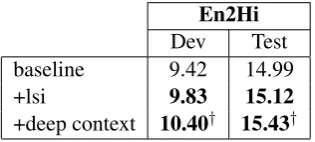
Table 1 shows the improvements in terms of BLEU of adding deep context over the baseline system for English-to-Hindi (En2Hi) over devel-opment and test sets. Adding source-context infor-mation using deep learning outperforms the latent semantic analysis methodology.
En2Hi
Dev Test baseline 9.42 14.99
+lsi 9.83 15.12
+deep context 10.40† 15.43†
Table 1: BLEU scores for En2Hi translation task..
†depicts statistical significance (p-value<0.05).
Our source-context feature function may be more discriminative in a task like English-to-Hindi where the target language has a larger vocabulary than the source one.
Table 2 shows an example of how the translation is improving in terms of lexical semantics which is the goal of the methodology presented in the pa-per. The most frequent sense of wordcryisronA, which literally means “to cry” while the example in Table 2 refers to the sense ofcryascFK, which means toscream. Our method could identify the context and hence the source context feature (scf) of the unit cry|||cFK is higher than for the unit
scf(cry|||ronA) as shown in Table 3 and for this particular input sentence.
5 Conclusion
This paper reports the IPN-UPV participation in the WMT 2014 Evaluation Campaign. The system is Moses-based with an additional feature function based on deep learning. This feature function in-troduces source-context information in the stan-dard Moses system by adding the information of how similar is the input sentence to the different training sentences. Significant improvements over
System Translation
Source soft cry from the depth
Baseline ghrAiyo\ s mlAym ron lgt +deep context ghrAiyo\ s mlAymcFK
[image:4.595.103.261.175.246.2]Reference ghrAiyo\ s koml cFK
Table 2: Manual analysis of a translation output.
cp pp scf
cry|||ronA 0.23 0.06 0.85 cry|||cFK 0.15 0.04 0.90
Table 3: Probability values (conditional, cp, and posterior, pp, as standard features in a phrase-based system) for the word cry and two Hindi translations.
the baseline system are reported in the task from English to Hindi.
As further work, we will implement our feature function in Moses using suffix arrays in order to make it more efficient.
Acknowledgements
This work has been supported in part by Spanish Ministerio de Econom´ıa y Compet-itividad, contract TEC2012-38939-C03-02 as well as from the European Regional Develop-ment Fund (ERDF/FEDER). The work of the second and fourth authors is also supported by WIQ-EI (IRSES grant n. 269180) and DIANA-APPLICATIONS (TIN2012-38603-C02-01) project and VLC/CAMPUS Microcluster on Multimodal Interaction in Intelligent Systems.
References
Rafael E. Banchs and Marta R. Costa-juss`a. 2011. A semantic feature for statistical machine translation. In Proceedings of the Fifth Workshop on Syntax, Semantics and Structure in Statistical Translation, SSST-5, pages 126–134.
Yoshua Bengio, Pascal Lamblin, Dan Popovici, and Hugo Larochelle. 2006. Greedy layer-wise training of deep networks. InNIPS, pages 153–160.
Herv´e Bourlard and Yves Kamp. 1988. Auto-association by multilayer perceptrons and singu-lar value decomposition. Biological Cybernetics, 59(4):291–294, September.
Scott Deerwester, Susan T. Dumais, George W. Fur-nas, Thomas K. Landauer, and Richard Harshman. 1990. Indexing by latent semantic analysis. Jour-nal of the American Society for Information Science, 41(6):391–407.
[image:4.595.73.304.667.737.2]Geoffrey Hinton and Ruslan Salakhutdinov. 2006. Re-ducing the dimensionality of data with neural net-works. Science, 313(5786):504 – 507.
Geoffrey E. Hinton, Simon Osindero, and Yee Whye Teh. 2006. A fast learning algorithm for deep belief nets. Neural Computation, 18(7):1527–1554. Geoffrey E. Hinton. 2002. Training products of
ex-perts by minimizing contrastive divergence. Neural Computation, 14(8):1771–1800.
Philipp Koehn, Hieu Hoang, Alexandra Birch, Chris Callison-Burch, Marcello Federico, Nicola Bertoldi, Brooke Cowan, Wade Shen, Christine Moran, Richard Zens, Chris Dyer, Ondˇrej Bojar, Alexandra Constantin, and Evan Herbst. 2007. Moses: Open source toolkit for statistical machine translation. In
Proceedings of the 45th Annual Meeting of the ACL on Interactive Poster and Demonstration Sessions, ACL ’07, pages 177–180.
Marta R. Costa-juss`a and Rafael E. Banchs. 2011. The bm-i2r haitian-cr´eole-to-english translation system description for the wmt 2011 evaluation campaign. InProceedings of the Sixth Workshop on Statistical Machine Translation, pages 452–456, Edinburgh, Scotland, July. Association for Computational Lin-guistics.