Better Semantic Frame Based MT Evaluation
via Inversion Transduction Grammars
Dekai Wu LoChi-kiu Meriem Beloucif Markus Saers
HKUST
Human Language Technology Center Department of Computer Science and Engineering Hong Kong University of Science and Technology
{jackielo|mbeloucif|masaers|dekai}@cs.ust.hk
Abstract
We introduce an inversion transduc-tion grammar based restructuring of the MEANT automatic semantic frame based MT evaluation metric, which, by leveraging ITG language biases, is able to further improve upon MEANT’s already-high correlation with human adequacy judgments. The new metric, called IMEANT, uses bracketing ITGs to biparse the reference and machine transla-tions, but subject to obeying the semantic frames in both. Resulting improvements support the presumption that ITGs, which constrain the allowable permutations between compositional segments across the reference and MT output, score the phrasal similarity of the semantic role fillers more accurately than the simple word alignment heuristics (bag-of-word alignment or maximum alignment) used in previous version of MEANT. The approach successfully integrates (1) the previously demonstrated extremely high coverage of cross-lingual semantic frame alternations by ITGs, with (2) the high accuracy of evaluating MT via weighted f-scores on the degree of semantic frame preservation.
1 Introduction
There has been to date relatively little use of in-version transduction grammars (Wu, 1997) to im-prove the accuracy of MT evaluation metrics, de-spite long empirical evidence the vast majority of translation patterns between human languages can be accommodated within ITG constraints (and the observation that most current state-of-the-art SMT systems employ ITG decoders). We show that ITGs can be used to redesign the MEANT seman-tic frame based MT evaluation metric (Lo et al.,
2012) to produce improvements in accuracy and reliability. This work is driven by the motiva-tion that especially when consideringsemanticMT metrics, ITGs would be seem to be a natural basis for several reasons.
To begin with, it is quite natural to think of sentences as having been generated from an ab-stract concept using a rewriting system: a stochas-tic grammar predicts how frequently any parstochas-ticu- particu-lar realization of the abstract concept will be gen-erated. The bilingual analogy is a transduction
grammargeneratinga pairof possible realizations
ofthe sameunderlying concept. Stochastic
trans-duction grammars predict how frequently a partic-ular pair of realizations will be generated, and thus represent a good way to evaluate how well a pair of sentences correspond to each other.
The particular class of transduction gram-mars known as ITGs tackle the problem that the (bi)parsing complexity for general syntax-directed transductions (Aho and Ullman, 1972) is exponential. By constraining a syntax-directed transduction grammar to allow only monotonic
straightandinvertedreorderings, or equivalently permitting only binary or ternary rank rules, it is possible to isolate the low end of that hierarchy into a single equivalence class ofinversion transduc-tions. ITGs are guaranteed to have a two-normal form similar to context-free grammars, and can be biparsed in polynomial time and space (O(n6) time andO(n4)space). It is also possible to do ap-proximate biparsing in O(n3) time (Saers et al., 2009). These polynomial complexities makes it feasible to estimate the parameters of an ITG us-ing standard machine learnus-ing techniques such as expectation maximization (Wu, 1995b) .
At the same time, inversion transductions have also been directly shown to be more than sufficient to account for the reordering that occur within se-mantic frame alternations (Addankiet al., 2012). This makes ITGs an appealing alternative for
uating the possible links between both semantic role fillers in different languages as well as the predicates, and how these parts fit together to form entire semantic frames. We believe that ITGs are not only capable of generating the desired tural correspondences between the semantic struc-tures of two languages, but also provide meaning-ful constraints to prevent alignments from wander-ing off in the wrong direction.
In this paper we show that IMEANT, a new met-ric drawing from the strengths of both MEANT and inversion transduction grammars, is able to exploit bracketing ITGs (also known as BITGs or BTGs) which are ITGs containing only a sin-gle non-differentiated non terminal category (Wu, 1995a), so as to produce even higher correlation with human adequacy judgments than any matic MEANT variants, or other common auto-matic metrics. We argue that the constraints pro-vided by BITGs over the semantic frames and ar-guments of the reference and MT output sentences are essential for accurate evaluation of the phrasal similarity of the semantic role fillers.
In common with the various MEANT semantic MT evaluation metrics (Lo and Wu, 2011a, 2012;
Loet al., 2012; Lo and Wu, 2013b), our proposed
IMEANT metric measures the degree to which the basic semantic event structure is preserved by translation—the “who did what to whom, for whom, when, where, how and why” (Pradhan et al., 2004)—emphasizing that a good translation is one that can successfully be understood by a human. In the other versions of MEANT, sim-ilarity between the MT output and the reference translations is computed as a modified weighted f-score over the semantic predicates and role fillers. Across a variety of language pairs and genres, it has been shown that MEANT correlates better with human adequacy judgment than both n-gram based MT evaluation metrics such as BLEU (Papineni et al., 2002), NIST (Doddington, 2002), and ME-TEOR (Banerjee and Lavie, 2005), as well as edit-distance based metrics such as CDER (Leusch et
al., 2006), WER (Nießenet al., 2000), and TER
(Snoveret al., 2006) when evaluating MT output (Lo and Wu, 2011a, 2012; Loet al., 2012; Lo and Wu, 2013b; Macháček and Bojar, 2013). Further-more, tuning the parameters of MT systems with MEANT instead of BLEU or TER robustly im-proves translation adequacy across different gen-res and different languages (English and Chinese)
(Lo et al., 2013a; Lo and Wu, 2013a; Loet al.,
2013b). This has motivated our choice of MEANT as the basis on which to experiment with deploying ITGs into semantic MT evaluation.
2 Related Work
2.1 ITGs and MT evaluation
Relatively little investigation into the potential benefits of ITGs is found in previous MT eval-uation work. One exception is invWER, pro-posed by Leuschet al.(2003) and Leusch and Ney (2008). The invWER metric interprets weighted BITGs as a generalization of the Levenshtein edit distance, in which entire segments (blocks) can be inverted, as long as this is done strictly compo-sitionally so as not to violate legal ITG biparse tree structures. The input and output languages are considered to be those of the reference and ma-chine translations, and thus are over the same vo-cabulary (say,English). At the sentence level, cor-relation of invWER with human adequacy judg-ments was found to be among the best.
Our current approach differs in several key respects from invWER. First,invWER operates purely at the surface level of exact token match, IMEANT mediates between segments of refer-ence translation and MT output using lexical BITG probabilities.
Secondly, there is no explicit semantic model-ing in invWER. Providmodel-ing they meet the BITG constraints, the biparse trees in invWER are com-pletely unconstrained. In contrast, IMEANT em-ploys the same explicit, strong semantic frame modeling as MEANT, on both the reference and machine translations. In IMEANT, the semantic frames always take precedence over pure BITG biases. Compared to invWER, this strongly con-strains the space of biparses that IMEANT permits to be considered.
2.2 MT evaluation metrics
Like invWER, other common surface-form ori-ented metrics like BLEU (Papineniet al., 2002), NIST (Doddington, 2002), METEOR (Banerjee and Lavie, 2005; Denkowski and Lavie, 2014), CDER (Leusch et al., 2006), WER (Nießen et
al., 2000), and TER (Snover et al., 2006) do
where BLEU strongly disagrees with human judg-ments of translation adequacy.
Such observations have generated a recent surge of work on developing MT evaluation metrics that would outperform BLEU in correlation with hu-man adequacy judgment (HAJ). Like MEANT, the TINE automatic recall-oriented evaluation metric (Rios et al., 2011) aims to preserve basic event structure. However, its correlation with human ad-equacy judgment is comparable to that of BLEU and not as high as that of METEOR. Owczarzak
et al.(2007a,b) improved correlation with human
fluencyjudgments by using LFG to extend the
ap-proach of evaluating syntactic dependency struc-ture similarity proposed by Liu and Gildea (2005), but did not achieve higher correlation with
hu-man adequacy judgments than metrics like
ME-TEOR. Another automatic metric, ULC (Giménez and Màrquez, 2007, 2008), incorporates several semantic similarity features and shows improved correlation with human judgement of translation quality (Callison-Burch et al., 2007; Giménez and Màrquez, 2007; Callison-Burch et al., 2008; Giménez and Màrquez, 2008) but no work has been done towards tuning an SMT system using a pure form of ULC perhaps due to its expensive run time. Likewise, SPEDE (Wang and Manning, 2012) predicts the edit sequence needed to match the machine translation to the reference translation via an integrated probabilistic FSM and probabilis-tic PDA model. The semanprobabilis-tic textual similarity metric Sagan (Castillo and Estrella, 2012) is based on a complex textual entailment pipeline. These aggregated metrics require sophisticated feature extraction steps, contain many parameters that need to be tuned, and employ expensive linguis-tic resources such as WordNet or paraphrase tables. The expensive training, tuning and/or running time renders these metrics difficult to use in the SMT training cycle.
3 IMEANT
In this section we give a contrastive description of IMEANT: we first summarize the MEANT ap-proach, and then explain how IMEANT differs.
3.1 Variants of MEANT
MEANT and its variants (Loet al., 2012) measure weighted f-scores over corresponding semantic frames and role fillers in the reference and machine translations. The automatic versions of MEANT
replace humans with automatic SRL and align-ment algorithms. MEANT typically outperforms BLEU, NIST, METEOR, WER, CDER and TER in correlation with human adequacy judgment, and is relatively easy to port to other languages, re-quiring only an automatic semantic parser and a monolingual corpus of the output language, which is used to gauge lexical similarity between the se-mantic role fillers of the reference and translation. MEANT is computed as follows:
1. Apply an automatic shallow semantic parser to both the reference and machine transla-tions. (Figure 1 shows examples of auto-matic shallow semantic parses on both refer-ence and MT.)
2. Apply the maximum weighted bipartite matching algorithm to align the semantic frames between the reference and machine translations according to the lexical similari-ties of the predicates. (Lo and Wu (2013a) proposed a backoff algorithm that evaluates the entire sentence of the MT output using the lexical similarity based on the context vector model, if the automatic shallow semantic parser fails to parse the reference or machine translations.)
3. For each pair of the aligned frames, apply the maximum weighted bipartite matching algo-rithm to align the arguments between the ref-erence and MT output according to the lexical similarity of role fillers.
4. Compute the weighted f-score over the matching role labels of these aligned predi-cates and role fillers according to the follow-ing definitions:
q0
i,j ≡ ARG jof aligned frameiin MT q1
i,j ≡ ARG jof aligned frameiin REF
w0
i ≡ #tokens filled in aligned frametotal #tokens in MT iof MT
w1
i ≡ #tokens filled in aligned frametotal #tokens in REFiof REF wpred ≡ weight of similarity of predicates
wj ≡ weight of similarity of ARG j
ei,pred ≡ the pred string of the aligned frameiof MT
fi,pred ≡ the pred string of the aligned frameiof REF
ei,j ≡ the role fillers of ARGjof the aligned frameiof MT
[IN] 至此,在中国内地停售了近两个月的SK-II全线产品恢复销售。
[REF] Until after their sales had ceased in mainland China for almost two months , sales of the complete range of SK – II products have now been resumed .
ARGM-TMP
PRED ARGM-LOC ARG1 PRED
ARGM-LOC PRED ARG1 PRED ARG1
ARG0 ARGM-TMP
[MT1] So far , nearly two months sk - ii the sale of products in the mainland of China to resume sales .
PRED
ARG0 ARG1
[MT2] So far , in the mainland of China to stop selling nearly two months of SK - 2 products sales resumed .
ARGM-TMP PRED ARG1 ARG1 PRED
[MT3] So far , the sale in the mainland of China for nearly two months of SK - II line of products .
PRED PRED
ARG0
ARG1 ARGM-TMP
ARGM-ADV
ARG0
[image:4.595.97.263.327.553.2]ARGM-EXT
Figure 1: Examples of automatic shallow semantic parses. Both the reference and machine translations are parsed using automatic English SRL. There are no semantic frames for MT3 since there is no predicate in the MT output.
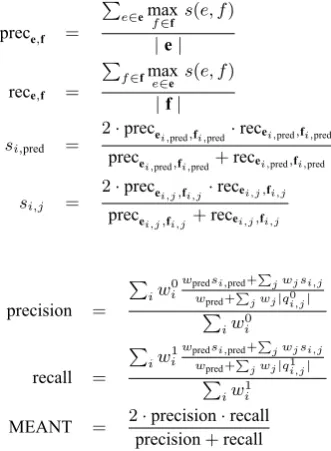
prece,f = ∑
e∈emaxf∈ f s(e, f) |e|
rece,f = ∑
f∈fmaxe∈e s(e, f) |f|
si,pred =
2·prece
i,pred,fi,pred·recei,pred,fi,pred prece
i,pred,fi,pred+recei,pred,fi,pred
si,j =
2·prece
i,j,fi,j·recei,j,fi,j precei,j,fi,j+recei,j,fi,j
precision = ∑
iw0iwpredsi,pred+ ∑
jwjsi,j w∑pred+∑jwj|q0i,j|
iwi0
recall = ∑
iw1iwpredsi,pred+ ∑
jwjsi,j w∑pred+∑jwj|q1i,j|
iwi1
MEANT = 2·precision·recall precision+recall
where qi,j0 andq1i,j are the argument of typej in frameiin MT and REF respectively.wi0andw1i are the weights for frame iin MT/REF respectively. These weights estimate the degree of contribution of each frame to the overall meaning of the sen-tence. wpredandwj are the weights of the lexical similarities of the predicates and role fillers of the arguments of typej of all frame between the ref-erence translations and the MT output.There is a total of 12 weights for the set of semantic role la-bels in MEANT as defined in Lo and Wu (2011b). For MEANT, they are determined using super-vised estimation via a simple grid search to opti-mize the correlation with human adequacy judg-ments (Lo and Wu, 2011a). For UMEANT (Lo and
Wu, 2012), they are estimated in an unsupervised manner using relative frequency of each semantic role label in the references and thus UMEANT is useful when human judgments on adequacy of the development set are unavailable.
si,pred andsi,j are the lexical similarities based on a context vector model of the predicates and role fillers of the arguments of typejbetween the ref-erence translations and the MT output. Loet al. (2012) and Tumuluruet al.(2012) described how the lexical and phrasal similarities of the semantic role fillers are computed. A subsequent variant of the aggregation function inspired by Mihalcea et al.(2006) that normalizes phrasal similarities ac-cording to the phrase length more accurately was used in more recent work (Loet al., 2013a; Lo and Wu, 2013a; Loet al., 2013b). In this paper, we will assess IMEANT against the latest version of MEANT (Loet al., 2014) which, as shown, uses f-score to aggregate individual token similarities into the composite phrasal similarities of semantic role fillers,since this has been shown to be more ac-curate than the previously used aggregation func-tions.
In an alternative quality-estimation oriented line of research, Lo et al. (2014) describe a cross-lingual variant called XMEANT capable of eval-uating translation quality without the need for ex-pensive human reference translations, by utiliz-ing semantic parses of the original foreign in-put sentence instead of a reference translation. Since XMEANT’s results could have been due to either (1) more accurate evaluation of phrasal similarity via cross-lingual translation probabili-ties, or (2) better match of semantic frames with-out reference translations, there is no direct evi-dence whether ITGs contribute to the improvement in MEANT’s correlation with human adequacy judgment. For the sake of better understanding whether ITGs improve semantic MT evaluation, we will also assess IMEANT against cross-lingual XMEANT.
3.2 The IMEANT metric
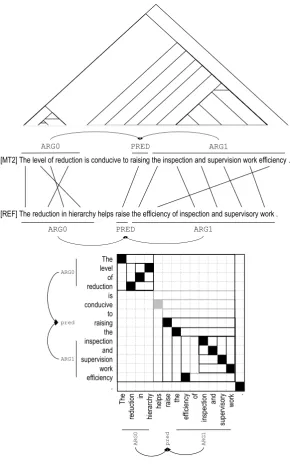
Although MEANT was previously shown to pro-duce higher correlation with human adequacy judgments compared to other automatic metrics, our error analyses suggest that it still suffers from a common weakness among metrics employing lex-ical similarity, namely that word/token alignments between the reference and machine translations are severely under constrained. No bijectivity or permutation restrictions are applied, even between compositional segments where this should be nat-ural. This can cause role fillers to be aligned even when they should not be. IMEANT, in contrast, uses a bracketing inversion transduction grammar to constrain permissible token alignment patterns between aligned role filler phrases. The semantic frames above the token level also fits ITG com-positional structure, consistent with the aforemen-tioned semantic frame alternation coverage study of Addankiet al.(2012). Figure 2 illustrates how the ITG constraints are consistent with the needed permutations between semantic role fillers across the reference and machine translations for a sam-ple sentence from our evaluation data, which as we will see leads to higher HAJ correlations than MEANT.
Subject to the structural ITG constraints, IMEANT scores sentence translations in a spirit similar to the way MEANT scores them: it utilizes an aggregated score over the matched semantic role labels of the automatically aligned semantic frames and their role fillers between the reference and machine translations. Despite the structural
differences, like MEANT, at the conceptual level IMEANT still aims to evaluate MT output in terms of the degree to which the translation has preserved the essential “who did what to whom,for whom, when, where, how and why” of the foreign input sentence.
Unlike MEANT, however, IMEANT aligns and scores under ITG assumptions. MEANT uses a maximum alignment algorithm to align the tokens in the role fillers between the reference and ma-chine translations, and then scores by aggregating the lexical similarities into a phrasal similarity us-ing an f-measure. In contrast, IMEANT aligns and scores by utilizing a length-normalized weighted BITG (Wu, 1997; Zens and Ney, 2003; Saers and Wu, 2009; Addankiet al., 2012). To be precise in this regard, we can see IMEANT as differing from the foregoing description of MEANT in the defi-nition ofsi,pred andsi,j, as follows.
G ≡ ⟨{A},W0,W1,R,A⟩
R ≡ {A→[AA],A→ ⟨AA⟩,A→e/f}
p([AA]|A) = p(⟨AA⟩|A) = 1 p(e/f|A) = s(e, f)
si,pred = lg−1 lg
(
P(A⇒∗ ei,pred/fi,pred|G
))
max(|ei,pred|,|fi,pred|)
si,j = lg−1 lg
(
P(A⇒∗ ei,j/fi,j|G ))
max(|ei,j|,|fi,j|)
whereGis a bracketing ITG whose only non ter-minal is A, andRis a set of transduction rules with e∈ W0∪{ϵ}denoting a token in the MT output (or
thenulltoken) andf ∈ W1∪{ϵ}denoting a token in the reference translation (or thenulltoken). The rule probability (or more accurately, rule weight) functionpis set to be 1 for structural transduction rules, and for lexical transduction rules it is de-fined using MEANT’s context vector model based lexical similarity measure. To calculate the inside probability (or more accurately, inside score) of a pair of segments,P
(
A⇒∗ e/f|G
)
, we use the al-gorithm described in Saers et al. (2009). Given this,si,pred andsi,j now represent the length nor-malized BITG parse scores of the predicates and role fillers of the arguments of typejbetween the reference and machine translations.
4 Experiments
[REF] The reduction in hierarchy helps raise the efficiency of inspection and supervisory work .
[MT2] The level of reduction is conducive to raising the inspection and supervision work efficiency .
ARG0 PRED ARG1
ARG0 PRED ARG1
The level of reduction is conducive to raising the inspection and supervision work efficiency .
The
red
uctio
n in
hiera
rchy helps raise th
e
ef
ficien
cy of
insp
ectio
n
and
su
pe
rvi
so
ry .
work
pred ARG0
ARG1
pred
[image:6.595.153.444.60.528.2]ARG0 ARG1
Figure 2: An example of aligning automatic shallow semantic parses under ITGs, visualized using both biparse tree and alignment matrix depictions, for the Chinese input sentence层级的减少有利于提⾼检查 监督⼯作的效率。. Both the reference and machine translations are parsed using automatic English SRL. Compositional alignments between the semantic frames and the tokens within role filler phrases obey inversion transduction grammars.
already-high correlation with human adequacy judgments.
4.1 Experimental setup
We perform the meta-evaluation upon two differ-ent partitions of the DARPA GALE P2.5 Chinese-English translation test set. The corpus includes the Chinese input sentences, each accompanied by one English reference translation and three partic-ipating state-of-the-art MT systems’ output.
For the sake of consistent comparison, the first evaluation partition, GALE-A, is the same as the one used in Lo and Wu (2011a), and the second evaluation partition, GALE-B, is the same as the one used in Lo and Wu (2011b).
Table 1: Sentence-level correlation with human adequacy judgements on different partitions of GALE P2.5 data. IMEANT always yields top correlations, and is more consistent than either MEANT or its recent cross-lingual XMEANT quality estimation variant. For reference, the hu-man HMEANT upper bound is 0.53 for GALE-A and 0.37 for GALE-B—thus, the fully automated IMEANT approximation is not far from closing the gap.
metric GALE-A GALE-B
IMEANT 0.51 0.33
XMEANT 0.51 0.20
MEANT 0.48 0.33
METEOR 1.5 (2014) 0.43 0.10
NIST 0.29 0.16
METEOR 0.4.3 (2005) 0.20 0.29
BLEU 0.20 0.27
TER 0.20 0.19
PER 0.20 0.18
CDER 0.12 0.16
WER 0.10 0.26
4.2 Results
The sentence-level correlations in Table 1 show that IMEANT outperforms other automatic met-rics in correlation with human adequacy judgment. Note that this was achieved with no tuning what-soever of the default rule weights (suggesting that the performance of IMEANT could be further im-proved in the future by slightly optimizing the ITG weights).
On the GALE-A partition, IMEANT shows 3 points improvement over MEANT, and is tied with the cross-lingual XMEANT quality estimator discussed earlier.IMEANT produces much higher HAJ correlations than any of the other metrics.
On the GALE-B partition, IMEANT is tied with MEANT, and is significantly better correlated with HAJ than the XMEANT quality estimator. Again, IMEANT produces much higher HAJ correlations than any of the other metrics.
We note that we have also observed this pattern consistently in smaller-scale experiments—while the monolingual MEANT metric and its cross-lingual XMEANT cousin vie with each other on different data sets, IMEANT robustly and consis-tently produces top HAJ correlations.
In both the GALE-A and GALE-B partitions, IMEANT comes within a few points of the human
upper bound benchmark HAJ correlations com-puted using the human labeled semantic frames and alignments used in the HMEANT.
Data analysis reveals two reasons that IMEANT correlates with human adequacy judgement more closely than MEANT. First, BITG constraints in-deed provide more accurate phrasal similarity ag-gregation, compared to the naive bag-of-words based heuristics employed in MEANT. Similar re-sults have been observed while trying to estimate word alignment probabilities where BITG con-straints outperformed alignments from GIZA++ (Saers and Wu, 2009).
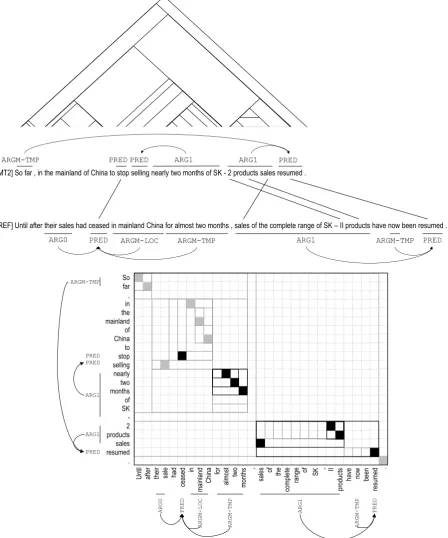
Secondly, the permutation and bijectivity con-straints enforced by the ITG provide better lever-age to reject token alignments when they are not appropriate, compared with the maximal align-ment approach which tends to be rather promiscu-ous. A case of this can be seen in Figure 3, which shows the result on the same example sentence as in Figure 1. Disregarding the semantic parsing er-rors arising from the current limitations of auto-matic SRL tools, the ITG tends to provide clean, sparse alignments for role fillers like the ARG1 of the resumed PRED, preferring to leave tokens likecompleteandrangeunaligned instead of aligning them anyway as MEANT’s maximal alignment al-gorithm tends to do. Note that it is not simply a matter of lowering thresholds for accepting token alignments: Tumuluruet al. (2012) showed that the competitive linking approach (Melamed, 1996) which also generally produces sparser alignments does not work as well in MEANT, whereas the ITG appears to be selective about the token alignments in a manner that better fits the semantic structure.
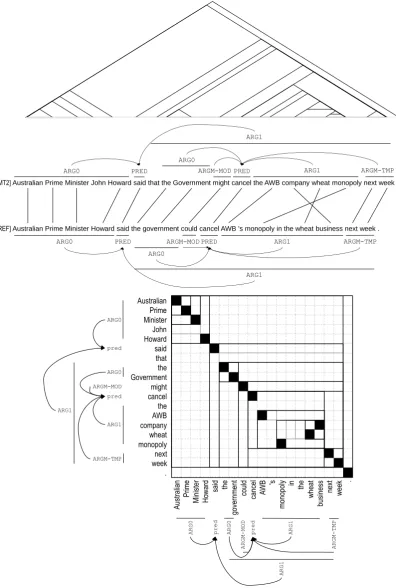
For contrast, Figure 4 shows a case where IMEANT appropriately accepts dense alignments.
5 Conclusion
[REF] Until after their sales had ceased in mainland China for almost two months , sales of the complete range of SK – II products have now been resumed .
ARG0 PRED ARGM-LOC ARG1 PRED
[MT2] So far , in the mainland of China to stop selling nearly two months of SK - 2 products sales resumed .
ARGM-TMP PRED PRED ARG1 ARG1 PRED
ARGM-TMP ARGM-TMP
So far , in the mainland of China to stop selling nearly two months of SK - 2 products sales resumed .
Unt
il
aft
er
th
eir sale had
ce
ase
d in
m
ainla
nd
C
hina fo
r
alm
ost two , sales of the
co
m
plet
e
PRED PRED
ARG1 ARGM-TMP
ARG1
PRED
PRED ARG1 PRED
ARGM
-LOC
ARG0
ran
ge of SK - II
prod
ucts have now been
resu
m
ed .
m
on
th
s
ARGM
-TMP
ARGM
-TMP
Figure 3: An example where the ITG helps produce correctly sparse alignments by rejecting inappro-priate token alignments in the ARG1 of theresumedPRED, instead of wrongly aligning tokens likethe, complete, andrangeas MEANT tends to do. (The semantic parse errors are due to limitations of automatic SRL.)
informative permutation and bijectivity biases, in-stead of the maximal alignment and bag-of-words assumptions used by MEANT. At the same time, IMEANT retains the Occam’s Razor style
simplic-ity and representational transparency characteris-tics of MEANT.
[image:8.595.76.525.70.609.2][REF] Australian Prime Minister Howard said the government could cancel AWB 's monopoly in the wheat business next week . [MT2] Australian Prime Minister John Howard said that the Government might cancel the AWB company wheat monopoly next week .
ARG0
ARG0 PRED
ARG0 PRED PRED ARG1
ARG0
ARGM-MOD ARGM-TMP
ARG1 PRED
ARGM-MOD ARG1 ARGM-TMP
ARG1
Australian Prime Minister John Howard said
the Government might cancel the AWB company wheat monopoly
Au
stra
lia
n
Pri
m
e
M
iniste
r
Howa
rd
sa
id the
go
ve
rnmen
t
co
uld
ca
nce
l
AW
B 's
m
on
op
oly in the next
week that
.
whe
at
bu
sine
ss
ne
xt
wee
k .
pred pred ARG0 ARG0
ARGM
-MO
D
ARG1
ARGM
-TM
P
ARG1
pred
pred ARG0
ARG0
ARGM-MOD
[image:9.595.100.497.62.651.2]ARGM-TMP ARG1 ARG1
Figure 4: An example of dense alignments in IMEANT, for the Chinese input sentence澳⼤利亚总理霍
华德表⽰,政府可能于下周取消AWB公司⼩麦专卖的业务。(The semantic parse errors are due to limitations
of automatic SRL.)
IMEANT could perform even better than it already does here.We plan to investigate simple
6 Acknowledgments
This material is based upon work supported in part by the Defense Advanced Research Projects Agency (DARPA) under BOLT contract nos. HR0011-12-C-0014 and HR0011-12-C-0016, and GALE contract nos. HR0011-06-C-0022 and HR0011-06-C-0023; by the European Union un-der the FP7 grant agreement no. 287658; and by the Hong Kong Research Grants Council (RGC) research grants GRF620811, GRF621008, and GRF612806. Any opinions, findings and conclu-sions or recommendations expressed in this mate-rial are those of the authors and do not necessar-ily reflect the views of DARPA, the EU, or RGC. Thanks to Karteek Addanki for supporting work, and to Pascale Fung, Yongsheng Yang and Zhao-jun Wu for sharing the maximum entropy Chinese segmenter and C-ASSERT, the Chinese semantic parser.
References
Karteek Addanki, Chi-kiu Lo, Markus Saers, and Dekai Wu. LTG vs. ITG coverage of cross-lingual verb frame alternations. In 16th An-nual Conference of the European Association for Machine Translation (EAMT-2012), Trento, Italy, May 2012.
Alfred V. Aho and Jeffrey D. Ullman. The The-ory of Parsing, Translation, and Compiling. Prentice-Halll, Englewood Cliffs, New Jersey, 1972.
Satanjeev Banerjee and Alon Lavie. METEOR: An automatic metric for MT evaluation with im-proved correlation with human judgments. In Workshop on Intrinsic and Extrinsic Evaluation Measures for Machine Translation and/or Sum-marization, Ann Arbor, Michigan, June 2005. Chris Callison-Burch, Miles Osborne, and Philipp
Koehn. Re-evaluating the role of BLEU in ma-chine translation research. In11th Conference of the European Chapter of the Association for Computational Linguistics (EACL-2006), 2006. Chris Callison-Burch, Cameron Fordyce, Philipp Koehn, Christof Monz, and Josh Schroeder. (meta-) evaluation of machine translation. In Second Workshop on Statistical Machine Trans-lation (WMT-07), 2007.
Chris Callison-Burch, Cameron Fordyce, Philipp Koehn, Christof Monz, and Josh Schroeder.
Further meta-evaluation of machine transla-tion. InThird Workshop on Statistical Machine Translation (WMT-08), 2008.
Julio Castillo and Paula Estrella. Semantic tex-tual similarity for MT evaluation. In7th Work-shop on Statistical Machine Translation (WMT 2012), 2012.
Michael Denkowski and Alon Lavie. METEOR universal: Language specific translation eval-uation for any target language. In 9th Work-shop on Statistical Machine Translation (WMT 2014), 2014.
George Doddington. Automatic evaluation of machine translation quality using n-gram co-occurrence statistics. In The second interna-tional conference on Human Language Technol-ogy Research (HLT ’02), San Diego, California, 2002.
Jesús Giménez and Lluís Màrquez. Linguistic fea-tures for automatic evaluation of heterogenous MT systems. In Second Workshop on Statisti-cal Machine Translation (WMT-07), pages 256– 264, Prague, Czech Republic, June 2007.
Jesús Giménez and Lluís Màrquez. A smorgas-bord of features for automatic MT evaluation. In Third Workshop on Statistical Machine Transla-tion (WMT-08), Columbus, Ohio, June 2008. Philipp Koehn and Christof Monz. Manual and
automatic evaluation of machine translation be-tween european languages. InWorkshop on Sta-tistical Machine Translation (WMT-06), 2006. Gregor Leusch and Hermann Ney. Bleusp, invwer,
cder: Three improved mt evaluation measures.
InNIST Metrics for Machine Translation
Chal-lenge (MetricsMATR), at Eighth Conference of the Association for Machine Translation in the Americas (AMTA 2008), Waikiki, Hawaii, Oct 2008.
Gregor Leusch, Nicola Ueffing, and Hermann Ney. A novel string-to-string distance measure with applications to machine translation evalu-ation. InMachine Translation Summit IX (MT Summit IX), New Orleans, Sep 2003.
Ding Liu and Daniel Gildea. Syntactic features for evaluation of machine translation. InWorkshop on Intrinsic and Extrinsic Evaluation Measures for Machine Translation and/or Summarization, Ann Arbor, Michigan, June 2005.
Chi-kiu Lo and Dekai Wu. MEANT: An inexpen-sive, high-accuracy, semi-automatic metric for evaluating translation utility based on seman-tic roles. In49th Annual Meeting of the Asso-ciation for Computational Linguistics: Human Language Technologies (ACL HLT 2011), 2011. Chi-kiu Lo and Dekai Wu. SMT vs. AI redux: How semantic frames evaluate MT more ac-curately. In Twenty-second International Joint Conference on Artificial Intelligence (IJCAI-11), 2011.
Chi-kiu Lo and Dekai Wu. Unsupervised vs. super-vised weight estimation for semantic MT evalu-ation metrics. InSixth Workshop on Syntax, Se-mantics and Structure in Statistical Translation (SSST-6), 2012.
Chi-kiu Lo and Dekai Wu. Can informal genres be better translated by tuning on automatic se-mantic metrics? In 14th Machine Translation Summit (MT Summit XIV), 2013.
Chi-kiu Lo and Dekai Wu. MEANT at WMT 2013: A tunable, accurate yet inexpensive se-mantic frame based mt evaluation metric. In 8th Workshop on Statistical Machine Transla-tion (WMT 2013), 2013.
Chi-kiu Lo, Anand Karthik Tumuluru, and Dekai Wu. Fully automatic semantic MT evaluation.
In7th Workshop on Statistical Machine
Trans-lation (WMT 2012), 2012.
Chi-kiu Lo, Karteek Addanki, Markus Saers, and Dekai Wu. Improving machine translation by training against an automatic semantic frame based evaluation metric. In51st Annual Meet-ing of the Association for Computational Lin-guistics (ACL 2013), 2013.
Chi-kiu Lo, Meriem Beloucif, and Dekai Wu. Im-proving machine translation into Chinese by tuning against Chinese MEANT. In Interna-tional Workshop on Spoken Language Transla-tion (IWSLT 2013), 2013.
Chi-kiu Lo, Meriem Beloucif, Markus Saers, and Dekai Wu. XMEANT: Better semantic MT evaluation without reference translations. In
52nd Annual Meeting of the Association for Computational Linguistics (ACL 2014), 2014. Matouš Macháček and Ondřej Bojar. Results of the
WMT13 metrics shared task. In Eighth Work-shop on Statistical Machine Translation (WMT 2013), Sofia, Bulgaria, August 2013.
I. Dan Melamed. Automatic construction of clean broad-coverage translation lexicons. In 2nd Conference of the Association for Ma-chine Translation in the Americas (AMTA-1996), 1996.
Rada Mihalcea, Courtney Corley, and Carlo Strap-parava. Corpus-based and knowledge-based measures of text semantic similarity. In The Twenty-first National Conference on Artificial Intelligence (AAAI-06), volume 21, 2006. Sonja Nießen, Franz Josef Och, Gregor Leusch,
and Hermann Ney. A evaluation tool for ma-chine translation: Fast evaluation for MT re-search. InThe Second International Conference on Language Resources and Evaluation (LREC 2000), 2000.
Karolina Owczarzak, Josef van Genabith, and Andy Way. Dependency-based automatic eval-uation for machine translation. In Syntax and Structure in Statistical Translation (SSST), 2007.
Karolina Owczarzak, Josef van Genabith, and Andy Way. Evaluating machine translation with LFG dependencies. Machine Translation, 21:95–119, 2007.
Kishore Papineni, Salim Roukos, Todd Ward, and Wei-Jing Zhu. BLEU: a method for automatic evaluation of machine translation. In 40th An-nual Meeting of the Association for Compu-tational Linguistics (ACL-02), pages 311–318, Philadelphia, Pennsylvania, July 2002.
Sameer Pradhan, Wayne Ward, Kadri Hacioglu, James H. Martin, and Dan Jurafsky. Shallow se-mantic parsing using support vector machines.
In Human Language Technology Conference
of the North American Chapter of the Asso-ciation for Computational Linguistics (HLT-NAACL 2004), 2004.
Markus Saers and Dekai Wu. Improving phrase-based translation via word alignments from stochastic inversion transduction grammars. In Third Workshop on Syntax and Structure in Statistical Translation (SSST-3), pages 28–36, Boulder, Colorado, June 2009.
Markus Saers, Joakim Nivre, and Dekai Wu. Learning stochastic bracketing inversion trans-duction grammars with a cubic time biparsing algorithm. In11th International Conference on Parsing Technologies (IWPT’09), pages 29–32, Paris, France, October 2009.
Matthew Snover, Bonnie Dorr, Richard Schwartz, Linnea Micciulla, and John Makhoul. A study of translation edit rate with targeted human an-notation. In 7th Biennial Conference Asso-ciation for Machine Translation in the Ameri-cas (AMTA 2006), pages 223–231, Cambridge, Massachusetts, August 2006.
Anand Karthik Tumuluru, Chi-kiu Lo, and Dekai Wu. Accuracy and robustness in measuring the lexical similarity of semantic role fillers for au-tomatic semantic MT evaluation. In 26th Pa-cific Asia Conference on Language, Informa-tion, and Computation (PACLIC 26), 2012. Mengqiu Wang and Christopher D. Manning.
SPEDE: Probabilistic edit distance metrics for MT evaluation. In7th Workshop on Statistical Machine Translation (WMT 2012), 2012. Dekai Wu. An algorithm for simultaneously
brack-eting parallel texts by aligning words. In33rd Annual Meeting of the Association for Compu-tational Linguistics (ACL 95), pages 244–251, Cambridge, Massachusetts, June 1995.
Dekai Wu. Trainable coarse bilingual grammars for parallel text bracketing. In Third Annual Workshop on Very Large Corpora (WVLC-3), pages 69–81, Cambridge, Massachusetts, June 1995.
Dekai Wu. Stochastic inversion transduction grammars and bilingual parsing of parallel cor-pora. Computational Linguistics, 23(3):377– 403, 1997.