Improving machine translation by training against
an automatic semantic frame based evaluation metric
Chi-kiu Lo and Karteek Addanki and Markus Saers and Dekai Wu HKUST
Human Language Technology Center Department of Computer Science and Engineering Hong Kong University of Science and Technology
{jackielo|vskaddanki|masaers|dekai}@cs.ust.hk
Abstract
We present the first ever results show-ing that tunshow-ing a machine translation sys-tem against a semantic frame based ob-jective function, MEANT, produces more robustly adequate translations than tun-ing against BLEU or TER as measured across commonly used metrics and human subjective evaluation. Moreover, for in-formal web forum data, human evalua-tors preferred MEANT-tuned systems over BLEU- or TER-tuned systems by a sig-nificantly wider margin than that for for-mal newswire—even though automatic se-mantic parsing might be expected to fare worse on informal language. We argue that by preserving the meaning of the trans-lations as captured by semantic frames right in the training process, an MT sys-tem is constrained to make more accu-rate choices of both lexical and reorder-ing rules. As a result, MT systems tuned against semantic frame based MT evalu-ation metrics produce output that is more adequate. Tuning a machine translation system against a semantic frame based ob-jective function is independent of the trans-lation model paradigm, so, any transla-tion model can benefit from the semantic knowledge incorporated to improve trans-lation adequacy through our approach.
1 Introduction
We present the first ever results of tuning a statis-tical machine translation (SMT) system against a semantic frame based objective function in order to produce a more adequate output. We compare the performance of our system with that of two baseline SMT systems tuned against BLEU and TER, the commonly used n-gram and edit distance
based metrics. Our system performs better than the baseline across seven commonly used evalu-ation metrics and subjective human evaluevalu-ation on adequacy. Surprisingly, tuning against a seman-tic MT evaluation metric also significantly out-performs the baseline on the domain of informal web forum data wherein automatic semantic pars-ing might be expected to fare worse. These results strongly indicate that using a semantic frame based objective function for tuning would drive develop-ment of MT towards direction of higher utility.
Glaring errors caused by semantic role confu-sion that plague the state-of-the-art MT systems are a consequence of using fast and cheap lexi-cal n-gram based objective functions like BLEU to drive their development. Despite enforcing flu-ency it has been established that these metrics do not enforce translation utility adequately and often fail to preserve meaning closely (Callison-Burchet al., 2006; Koehn and Monz, 2006).
We argue that instead of BLEU, a metric that fo-cuses on getting the meaning right should be used as an objective function for tuning SMT so as to drive continuing progress towards higher utility. MEANT (Loet al., 2012), is an automatic seman-tic MT evaluation metric that measures similarity between the MT output and the reference transla-tion via semantic frames. It correlates better with human adequacy judgment than other automatic MT evaluation metrics. Since a high MEANT score is contingent on correct lexical choices as well as syntactic and semantic structures, we be-lieve that tuning against MEANT would improve both translation adequacy and fluency.
Incorporating semantic structures into SMT by tuning against a semantic frame based evaluation metric is independent of the MT paradigm. There-fore, systems from different MT paradigms (such as hierarchical, phrase based, transduction gram-mar based) can benefit from the semantic informa-tion incorporated through our approach.
2 Related Work
Relatively little work has been done towards bi-asing the translation decisions of an SMT system to produce adequate translations that correctly pre-servewho did what to whom, when, where and why (Pradhanet al., 2004). This is because the devel-opment of SMT systems was predominantly driven by tuning against n-gram based evaluation met-rics such as BLEU or edit distance based metmet-rics such as TER which do not sufficiently bias SMT system’s decisions to produce adequate transla-tions. Although there has been a recent surge of work aimed towards incorporating semantics into the SMT pipeline, none attempt to tune against a semantic objective function. Below, we describe some of the attempts to incorporate semantic in-formation into the SMT and present a brief survey on evaluation metrics that focus on rewarding se-mantically valid translations.
Utilizing semantics in SMT In the past few years, there has been a surge of work aimed at in-corporating semantics into various stages of the SMT. Wu and Fung (2009) propose a two-pass model that reorders the MT output to match the SRL of the input, which is too late to affect the translation decisions made by the MT system dur-ing decoddur-ing. In contrast, traindur-ing against a se-mantic objective function attempts to improve the decoding search strategy by incorporating a bias towards meaningful translations into the model in-stead of postprocessing its results.
Komachiet al.(2006) and Wuet al.(2011) pre-process the input sentence to match the verb frame alternations in the output side. Liu and Gildea (2010) and Azizet al.(2011) use input side SRL to train a tree-to-string SMT system. Xionget al. (2012) trained a discriminative model to predict the position of the semantic roles in the output. All these approaches are orthogonal to the present question of whether to train toward a semantic ob-jective function. Any of the above models could potentially benefit from tuning with semantic met-rics.
MT evaluation metrics As mentioned previ-ously, tuning against n-gram based metrics such as BLEU (Papineni et al., 2002), NIST (Dod-dington, 2002), METEOR (Banerjee and Lavie, 2005) does not sufficiently drive SMT into mak-ing decisions to produce adequate translations that correctly preserve ”who did what to whom,
when, where and why”. In fact, a number of large scale meta-evaluations (Callison-Burch et al., 2006; Koehn and Monz, 2006) report cases where BLEU strongly disagrees with human judg-ments of translation accuracy. Tuning against edit distance based metrics such as CDER (Leusch et al., 2006), WER (Nießenet al., 2000), and TER (Snoveret al., 2006) also fails to sufficiently bias SMT systems towards producing translations that preserve semantic information.
We argue that an SMT system tuned against an adequacy-oriented metric that correlates well with human adequacy judgement produces more ade-quate translations. For this purpose, we choose MEANT, an automatic semantic MT evaluation metric that focuses on getting the meaning right by comparing the semantic structures of the MT out-put and the reference. We briefly describe some of the alternative semantic metrics below to justify our choice.
ULC (Giménez and Màrquez, 2007, 2008) is an aggregated metric that incorporates several se-mantic similarity features and shows improved correlation with human judgement on translation quality (Callison-Burch et al., 2007; Giménez and Màrquez, 2007; Callison-Burch et al., 2008; Giménez and Màrquez, 2008) but no work has been done towards tuning an MT system against ULC perhaps due to its expensive running time. Lambertet al.(2006) did tune on QUEEN, a sim-plified version of ULC that discards the seman-tic features and is based on pure lexical features. Although tuning on QUEEN produced slightly more preferable translations than solely tuning on BLEU, the metric does not make use of any seman-tic features and thus fails to exploit any potential gains from tuning to semantic objectives.
Although TINE (Rioset al., 2011) is an recall-oriented automatic evaluation metric which aims to preserve the basic event structure, no work has been done towards tuning an SMT system against it. TINE performs comparably to BLEU and worse than METEOR on correlation with human ade-quacy judgment.
newswire BLEU NIST METEOR no_syn METEOR WER CDER TER MEANT BLEU-tuned 29.85 8.84 52.10 55.42 67.88 55.67 58.40 0.1667 TER-tuned 25.37 6.56 48.26 51.24 66.18 52.58 56.96 0.1578 MEANT-tuned 25.91 7.81 50.15 53.60 67.76 54.56 58.61 0.1676
Table 1: Translation quality of MT system tuned against MEANT, BLEU and TER on newswire data
forum BLEU NIST METEOR no_syn METEOR WER CDER TER MEANT BLEU-tuned 9.58 4.10 31.77 34.63 80.09 64.54 76.12 0.1711 TER-tuned 6.94 2.21 28.55 30.85 76.15 57.96 74.73 0.1539 MEANT-tuned 7.92 3.11 30.40 33.08 77.32 61.01 74.64 0.1727
Table 2: Translation quality of MT system tuned against MEANT, BLEU and TER on forum data
3 Tuning SMT against MEANT
We now show that using MEANT as an objec-tive function to drive minimum error rate training (MERT) of state-of-the-art MT systems improves MT utility not only on formal newswire text, but even on informal forum text, where automatic se-mantic parsing is difficult.
Toward improving translation utility of state-of-the-art MT systems, we chose to use a strong and competitive system in the DARPA BOLT program as our baseline. The baseline system is a Moses hierarchical model trained on a collection of LDC newswire and a small portion of Chinese-English parallel web forum data, together with a 5-gram language model. For the newswire experiment, we used a collection of NIST 02-06 test sets as our de-velopment set and NIST 08 test set for evaluation. The development and test sets contain 6,331 and 1,357 sentences respectively with four references. For the forum data experiment, the development and test sets were a held-out subset of the BOLT phase 1 training data. The development and test sets contain 2,000 sentences and 1,697 sentences with one reference.
We use ZMERT (Zaidan, 2009) to tune the base-line because it is a widely used, highly competi-tive, robust, and reliable implementation of MERT that is also fully configurable and extensible with regard to incorporating new evaluation metrics. In this experiment, we use a MEANT implementation along the lines described in Loet al.(2012).
In each experiment, we tune two contrastive conventional 100-best MERT tuned baseline sys-tems on both newswire and forum data genres; one tuned against BLEU, an n-gram based evaluation metric and the other using TER, an edit distance based metric. As semantic role labeling is expen-sive we only tuned using 10-best list for MEANT-tuned system. Tuning against BLEU and TER took
around 1.5 hours and 5 hours per iteration respec-tively whereas tuning against MEANT took about 1.6 hours per iteration.
4 Results
Of course, tuning against any metric would maxi-mize the performance of the SMT system on that particular metric, but would be overfitting. For example, something would be seriously wrong if tuning against BLEU did not yield the best BLEU scores. A far more worthwhile goal would be to bias the SMT system to produce adequate translations while achieving the best scores across all the metrics. With this as our objective, we present the results of comparing MEANT-tuned systems against the baselines as evaluated on com-monly used automatic metrics and human ade-quacy judgement.
Cross-evaluation using automatic metrics Ta-bles 1 and 2 show that MEANT-tuned systems achieve the best scores across all other metrics in both newswire and forum data genres, when avoid-ing comparison of the overfit metrics too similar to the one the system was tuned on (the cells shaded in grey in the table: NIST and METEOR are n-gram based metrics, similar to BLEU while WER and CDER are edit distance based metrics, similar to TER). In the newswire domain, however, our system achieves marginally lower TER score than BLEU-tuned system.
sys-Figure 1: Examples of machine translation output and the corresponding semantic parses from the[B] BLEU-,[T]TER-and[M]MEANT-tuned systems together with[IN]the input sentence and[REF]the reference translation. Note that the MT output of the BLEU-tuned system has no semantic parse output by the automatic shallow semantic parser.
tem as the most adequate translation. In this exam-ple, the MEANT-tuned system has translated the two predicates “攻占” and “施行” in the input sen-tence into the correct form of the predicates “at-tack” and “adopted” in the MT output, whereas the BLEU-tuned system has translated both of them incorrectly (translates the predicates into nouns) and the TER-tuned system has correctly translated only the first predicate (into “seized”) and dropped the second predicate. Moreover, for the frame “攻 占” in the input sentence, the MEANT-tuned sys-tem has correctly translated the ARG0 “哈玛斯好战 份子” into “Hamas militants” and the ARG1 “加
萨 走 廊” into “Gaza”. However, the TER-tuned
system has dropped the predicate “施行” so that the corresponding arguments “The Palestinian Au-thority” and “into a state of emergency” have all been incorrectly associated with the predicate “攻 占/seized”. This example shows that the transla-tion adequacy of SMT has been improved by tun-ing against MEANT because the MEANT-tuned system is more accurately preserving the semantic structure of the input sentence.
Our results show that MEANT-tuned system maintains a balance between lexical choices and word order because it performs well on n-gram based metrics that reward lexical matching and edit distance metrics that penalize incorrect word
order. This is not surprising as a high MEANT score relies on a high degree of semantic structure matching, which is contingent upon correct lexi-cal choices as well as syntactic and semantic struc-tures.
[image:4.595.77.515.64.167.2]Human subjective evaluation In line with our original objective of biasing SMT systems towards producing adequate translations, we conduct a hu-man evaluation to judge the translation utility of the outputs produced by MEANT-, BLEU- and TER-tuned systems. Following the manual eval-uation protocol of Lambertet al.(2006), we ran-domly draw 150 sentences from the test set in each domain to form the manual evaluation set. Table 3 shows the MEANT scores of the two manual evaluation sets. In both evaluation sets, like in the test sets, the output from the MEANT-tuned sys-tem score slightly higher in MEANT than that from the BLEU-tuned system and significantly higher than that from the TER-tuned system. The output of each tuned MT system along the input sentence and the reference were presented to human ators. Each evaluation set is ranked by two evalu-ators for measuring inter-evaluator agreement.
[image:4.595.68.519.64.285.2]inter-newswire forum BLEU-tuned 0.1564 0.1663 TER-tuned 0.1203 0.1453 MEANT-tuned 0.1633 0.1737
Table 3: MEANT scores of each system in the 150-sentence manual evaluation set.
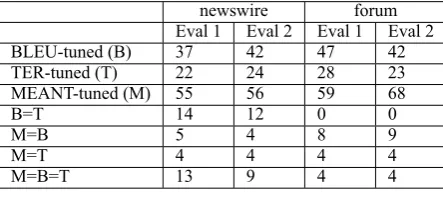
newswire forum Eval 1 Eval 2 Eval 1 Eval 2 BLEU-tuned (B) 37 42 47 42 TER-tuned (T) 22 24 28 23 MEANT-tuned (M) 55 56 59 68
B=T 14 12 0 0
M=B 5 4 8 9
M=T 4 4 4 4
M=B=T 13 9 4 4
Table 4: No. of sentences ranked the most ade-quate by human evaluators for each system.
H1 newswire forum MEANT-tuned>BLEU-tuned 80% 95% MEANT-tuned>TER-tuned 99% 99%
Table 5: Significance level of accepting the alter-native hypothesis.
evaluator agreement is 84% and 70% for newswire and forum data genres respectively.
We performed the right-tailed two proportion significance test on human evaluation of the SMT system outputs for both the genres. Table 5 shows that the MEANT-tuned system generates more ad-equate translations than the TER-tuned system at the 99% significance level for both newswire and web forum genres. The MEANT-tuned system is ranked more adequate than the BLEU-tuned sys-tem at the 95% significance level on the web fo-rum genre and for the newswire genre the hypoth-esis is accepted at a significance level of 80%. The high inter-evaluator agreement and the signif-icance tests confirm that MEANT-tuned system is better at producing adequate translations compared to BLEU- or TER-tuned systems.
Informal vs. formal text The results of table 4 and 5 also show that—surprisingly—the human evaluators preferred MEANT-tuned system put over BLEU-tuned and TER-tuned system out-put by a far wider margin on the informal forum text compared to the formal newswire text. The MEANT-tuned system is better than both base-lines at the 80% significance level for the formal text genre. For the informal text genre, it per-forms the two baselines at the 95% significance level. Although one might expect an semantic
frame dependent metric such as MEANT to per-form poorly on the domain of inper-formal text, sur-prisingly, it nonetheless significantly outperforms the baselines at the task of generating adequate out-put. This indicates that the design of the MEANT evaluation metric is robust enough to tune an SMT system towards adequate output on informal text domains despite the shortcomings of automatic shallow semantic parsing.
5 Conclusion
We presented the first ever results to demon-strate that tuning an SMT system against MEANT produces much adequate translation than tuning against BLEU or TER, as measured across all other commonly used metrics and human subjec-tive evaluation. We also observed that tuning against MEANT succeeds in producing adequate output significantly more frequently even on the informal text such as web forum data. By pre-serving the meaning of the translations as captured by semantic frames right in the training process, an MT system is constrained to make more accu-rate choices of both lexical and reordering rules. The performance of our system as measured across all commonly used metrics indicate that tuning against a semantic MT evaluation metric does pro-duce output which is adequate and fluent.
We believe that tuning on MEANT would prove equally useful for MT systems based on any paradigm, especially where the model does not incorporate semantic information to improve the adequacy of the translations produced and using MEANT as an objective function to tune SMT would drive sustainable development of MT to-wards the direction of higher utility.
Acknowledgment
This material is based upon work supported in part by the Defense Advanced Research Projects Agency (DARPA) under BOLT contract no. HR0011-12-C-0016, and GALE contract nos. HR0011-06-C-0022 and HR0011-06-C-0023; by the European Union under the FP7 grant
agree-ment no. 287658; and by the Hong Kong
[image:5.595.73.295.149.252.2]References
Wilker Aziz, Miguel Rios, and Lucia Specia. Shal-low semantic trees for SMT. In Proceedings of the Sixth Workshop on Statistical Machine Translation (WMT2011), 2011.
Satanjeev Banerjee and Alon Lavie. METEOR: An automatic metric for MT evaluation with im-proved correlation with human judgments. In Proceedings of the ACL Workshop on Intrinsic and Extrinsic Evaluation Measures for Machine Translation and/or Summarization, pages 65– 72, Ann Arbor, Michigan, June 2005.
Chris Callison-Burch, Miles Osborne, and Philipp Koehn. Re-evaluating the role of BLEU in Ma-chine Translation Research. InProceedings of the 13th Conference of the European Chapter of the Association for Computational Linguis-tics (EACL-06), pages 249–256, 2006.
Chris Callison-Burch, Cameron Fordyce, Philipp Koehn, Christof Monz, and Josh Schroeder. (Meta-) evaluation of Machine Translation. In Proceedings of the 2nd Workshop on Statistical Machine Translation, pages 136–158, 2007.
Chris Callison-Burch, Cameron Fordyce, Philipp Koehn, Christof Monz, and Josh Schroeder. Further Meta-evaluation of Machine Transla-tion. In Proceedings of the 3rd Workshop on Statistical Machine Translation, pages 70–106, 2008.
George Doddington. Automatic evaluation of machine translation quality using n-gram co-occurrence statistics. In Proceedings of the 2nd International Conference on Human Lan-guage Technology Research, pages 138–145, San Diego, California, 2002.
Jesús Giménez and Lluís Màrquez. Linguistic features for automatic evaluation of heteroge-nous MT systems. In Proceedings of the Sec-ond Workshop on Statistical Machine Transla-tion, pages 256–264, Prague, Czech Republic, June 2007.
Jesús Giménez and Lluís Màrquez. A smorgasbord of features for automatic MT evaluation. In Pro-ceedings of the Third Workshop on Statistical Machine Translation, pages 195–198, Colum-bus, Ohio, June 2008.
Philipp Koehn and Christof Monz. Manual and Automatic Evaluation of Machine Translation between European Languages. InProceedings
of the Workshop on Statistical Machine Trans-lation (WMT-06), pages 102–121, 2006.
Mamoru Komachi, Yuji Matsumoto, and Masaaki Nagata. Phrase reordering for statistical ma-chine translation based on predicate-argument structure. In Proceedings of the 3rd Interna-tional Workshop on Spoken Language Transla-tion (IWSLT 2006), 2006.
Patrik Lambert, Jesús Giménez, Marta R Costa-jussá, Enrique Amigó, Rafael E Banchs, Lluıs Márquez, and JAR Fonollosa. Machine Transla-tion system development based on human like-ness. In Spoken Language Technology Work-shop, 2006. IEEE, pages 246–249. IEEE, 2006.
Gregor Leusch, Nicola Ueffing, and Hermann Ney. CDer: Efficient MT Evaluation Using Block Movements. InProceedings of the 13th Conference of the European Chapter of the As-sociation for Computational Linguistics (EACL-06), 2006.
Ding Liu and Daniel Gildea. Semantic role fea-tures for machine translation. InProceedings of the 23rd international conference on Computa-tional Linguistics (COLING-10), 2010.
Chi-kiu Lo, Anand Karthik Tumuluru, and Dekai Wu. Fully Automatic Semantic MT Evaluation. InProceedings of the Seventh Workshop on Sta-tistical Machine Translation (WMT2012), 2012.
Sonja Nießen, Franz Josef Och, Gregor Leusch, and Hermann Ney. A Evaluation Tool for Ma-chine Translation: Fast Evaluation for MT Re-search. InProceedings of the 2nd International Conference on Language Resources and Evalu-ation (LREC-2000), 2000.
Kishore Papineni, Salim Roukos, Todd Ward, and Wei-Jing Zhu. BLEU: a method for automatic evaluation of machine translation. In Proceed-ings of the 40th Annual Meeting of the Associa-tion for ComputaAssocia-tional Linguistics, pages 311– 318, Philadelphia, Pennsylvania, July 2002.
Sameer Pradhan, Wayne Ward, Kadri Hacioglu, James H. Martin, and Dan Jurafsky. Shallow Se-mantic Parsing Using Support Vector Machines. InProceedings of the 2004 Conference on Hu-man Language Technology and the North Amer-ican Chapter of the Association for Computa-tional Linguistics (HLT-NAACL-04), 2004.
Proceed-ings of the Sixth Workshop on Statistical Ma-chine Translation, pages 116–122. Association for Computational Linguistics, 2011.
Matthew Snover, Bonnie Dorr, Richard Schwartz, Linnea Micciulla, and John Makhoul. A study of translation edit rate with targeted human an-notation. InProceedings of the 7th Conference of the Association for Machine Translation in the Americas (AMTA-06), pages 223–231, Cam-bridge, Massachusetts, August 2006.
Dekai Wu and Pascale Fung. Semantic Roles for SMT: A Hybrid Two-Pass Model. In Proceed-ings of the 2009 Conference of the North Amer-ican Chapter of the Association for Computa-tional Linguistics - Human Language Technolo-gies (NAACL-HLT-09), pages 13–16, 2009.
Xianchao Wu, Katsuhito Sudoh, Kevin Duh, Ha-jime Tsukada, and Masaaki Nagata. Extract-ing preorderExtract-ing rules from predicate-argument structures. In Proceedings of the 5th Interna-tional Joint Conference on Natural Language Processing (IJCNLP-11), 2011.
Deyi Xiong, Min Zhang, and Haizhou Li. Mod-eling the Translation of Predicate-Argument Structure for SMT. InProceedings of the Joint conference of the 50th Annual Meeting of the As-sociation for Computational Linguistics (ACL-12), 2012.

![Figure 1: Examples of machine translation output and the corresponding semantic parses from the [B]BLEU-, [T] TER-and [M] MEANT-tuned systems together with [IN] the input sentence and [REF] thereference translation](https://thumb-us.123doks.com/thumbv2/123dok_us/213120.520479/4.595.77.515.64.167/examples-translation-corresponding-semantic-systems-sentence-thereference-translation.webp)