The Effect of Cognitive Load on a Statistical Dialogue System
M. Gaˇsi´c∗, P. Tsiakoulis∗, M. Henderson∗, B. Thomson∗, K. Yu∗, E. Tzirkel∗∗and S. Young∗ ∗Cambridge University Engineering Department
Trumpington Street, Cambridge CB2 1PZ, UK
{mg436, pt344, mh521, brmt2, ky219, sjy}@eng.cam.ac.uk
∗∗General Motors Advanced Technical Centre, Israel
Abstract
In recent years statistical dialogue systems have gained significant attention due to their potential to be more robust to speech recogni-tion errors. However, these systems must also be robust to changes in user behaviour caused by cognitive loading. In this paper, a statistical dialogue system providing restaurant informa-tion is evaluated in a set-up where the sub-jects used a driving simulator whilst talking to the system. The influences of cognitive load-ing were investigated and some clear differ-ences in behaviour were discovered. In partic-ular, it was found that users chose to respond to different system questions and use different speaking styles, which indicate the need for an incremental dialogue approach.
1 Introduction
A spoken dialogue system enables a user to obtain information while using their hands to perform some other task, which in many cases is the user’s primary task. A typical example is an in-car spoken dialogue system where the spoken interaction is secondary to the main task of driving the car (Weng et al., 2004). This domain is particularly challenging since it in-volves dealing with the errors caused by the varying noise levels and changes in user behaviour caused by the cognitive load.
A statistical approach to dialogue modelling has been proposed as a means of automatically optimis-ing dialogue policies. In particular, the partially ob-servable Markov decision process (POMDP) model for dialogue provides a representation of varying levels of uncertainty of the user input, yielding more
robust dialogue policies (Williams and Young, 2007; Thomson and Young, 2010; Young et al., 2010).
Another thread of research deals with speech interfaces for in-car applications, see (Baron and Green, 2006) for a review. Past research has inves-tigated the extent to which speaking is cognitively less demanding than typing (Gartner et al., 2001; Tsimhoni et al., 2004; Kun et al., 2007). In addi-tion, considerable research has examined how driv-ing safety is influenced by a dialogue system (Lai et al., 2001; Lee et al., 2001; Nielsen et al., 2008). However, to the best of our knowledge, little work has been done to investigate the effect of the cog-nitive load when interacting with a real conversa-tional spoken dialogue system. The work presented in (Mishra et al., 2004) suggests that the user speech is more disfluent when the user is performing an-other task. However, this work is based on a Wiz-ard of Oz framework, where a human provides the system’s responses. Also, a push-to-talk button was used for every utterance which will have affected the natural flow of the dialogue. It is important to know if the change of cognitive load has an effect on the speaking style and whether the system can alter its behaviour to accommodate for this.
In this paper we try to answer these questions by examining dialogues where users drove a car simu-lator and talked to an open-microphone fully auto-mated spoken dialogue system at the same time.
The rest of the paper is organised as follows. Sec-tion 2 provides an overview of the dialogue system used and section 3 describes the evaluation set-up. The analysis of the results is given in Section 4. Sec-tion 5 concludes the paper.
Table 1: Example dialogue task
You are looking for a cheap restaurant and it should be in the east part of town. Make sure you get the address of the venue.
2 System overview
The user speaks to the system, and the acoustic sig-nal is converted by the speech recogniser into a set of sentence hypotheses, which represents a proba-bility distribution over all possible things that the user might have said. The sentence hypotheses are converted into an N-best list of dialogue acts by a semantic decoder. Since the dialogue state cannot be directly observed it maintains a probability dis-tribution over all states, which is called the belief state. The belief state is updated at every user turn using Bayesian inference treating the input dialogue acts as evidence. Based on belief state, the optimal system act is selected using a policy and which is trained automatically using reinforcement learning. The abstract system dialogue act is converted to an appropriate utterance by a natural language genera-tor and then converted to speech by an HMM-based speech synthesiser. To enable in-car speech inter-action via mobile phone, a VoIP interface is imple-mented. The domain is Cambridge restaurant infor-mation with a database of about 150 venues and 7 slots that users can query.
3 Evaluation set-up
Our goal is to understand system performance when driving. However, due to the safety restric-tions, performance was tested using a driving simu-lator. The following sections explain the set-up.
3.1 Car simulator
The car simulator used in the evaluation was the same as in (Davies and Robinson, 2011). It con-sists of a seat, a steering wheel and pedals, which give a realistic cab-like environment for the par-ticipants. There is also a projection screen which largely fills the visual field of the driver. The sim-ulation software is a modified version of Rockstar Games’ Grand Theft Auto: San Andreas, with over
500 km of roads. For the purpose of the evaluation, the subjects were asked to drive on the main motor-way, to keep the lane and not to drive over 70mph.
3.2 Subjects
For the study28subjects were recruited, 22 where native speakers. Each subject had to complete three scenarios: (1) to drive the car simulator for 10 min-utes, (2) to talk to the system for 7 dialogues and (3) to talk to the system for 7 dialogues while driving. The scenarios were in counter-balanced order.
While they were driving, the speed and the road position were recorded. If the scenario involved talking to the system, the instructor read out the di-alogue task (see an example in Table 1) and dialled the phone number. In addition, the subject had the dialogue task displayed on a small screen next to the driving wheel. The subject talked to the system us-ing loud speaker mode on the mobile phone. 4 Results
To examine the influence of cognitive load, the following examinations were performed. First, we investigate if the subjects felt any change in the cog-nitive load (Section 4.1). Then, in Section 4.2, we examine how the driving was influenced by the sub-jects talking to the system. Finally, we investigate how successfully the subjects were able to complete the dialogue tasks while driving (Section 4.3). This is followed with an examination of the conversa-tional patterns that occurred when the subjects were driving whilst talking to the system (Section 4.4).
4.1 Cognitive load
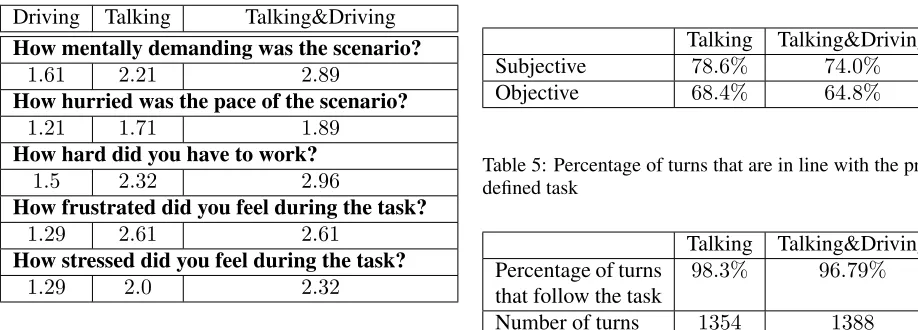
Table 2: Subjective evaluation of the cognitive load
Driving Talking Talking&Driving
How mentally demanding was the scenario?
1.61 2.21 2.89
How hurried was the pace of the scenario?
1.21 1.71 1.89
How hard did you have to work?
1.5 2.32 2.96
How frustrated did you feel during the task?
1.29 2.61 2.61
How stressed did you feel during the task?
1.29 2.0 2.32
Table 3: Analysis of driving speed to determine which measures are larger for Talking&Driving than Driving
Measure Percentage of
users Confidence in-terval Higher speed 8% [1%,25%] Larger std.dev 77% [56%,91%] Larger entropy 85% [65%,95%]
4.2 Driving performance
For 26 subjects we recorded position on the road and the speed. Since these measurements vary sig-nificantly across the subjects, for each subject we calculated the average speed, the standard deviation and the entropy and similarly for the average posi-tion in the lane. For the speed, we computed how many subjects had a higher average speed when they were talking and driving versus when they were just talking and similarly for the standard deviation and the entropy. The results are given in Table 3. It can be seen that the user’s speed is lower when they are driving and talking, however, the increase in the standard deviation and the entropy suggest that their driving is more erratic. No significant differences were observed for the road position.
4.3 Dialogue task completion
Each participant performed14dialogues,7for each scenario. In total, there were196dialogues per sce-nario. After each dialogue they told the instruc-tor if they thought the dialogue was successful, and this information was used to compute the subjective
Table 4: Subjective and Objective Task completion (196 Dialogues per scenario)
[image:3.612.72.531.91.256.2]Talking Talking&Driving Subjective 78.6% 74.0% Objective 68.4% 64.8%
Table 5: Percentage of turns that are in line with the pre-defined task
Talking Talking&Driving Percentage of turns
that follow the task 98.3% 96.79% Number of turns 1354 1388
completion rate. In addition, all dialogues were tran-scribed and analysed to see if the system provided information the user asked for and hence calculate an objective completion rate. The results are given in Table 4. These differences are not statistically sig-nificant due to the small sample size. However, it can be seen that the trend is that the dialogues where the subject was not performing another task at the same time were more successful. Also, it is inter-esting that the subjective scores are higher than the objective ones. This can be explained by the fact that the dialogue tasks were predefined and the subjects do not always pay sufficient attention to their task descriptions.
4.4 Conversational patterns
Given that the subjects felt the change of cognitive load when they were talking to the system and op-erating the car simulator at the same time, we were interested to see if there are any changes in the dia-logues which might suggest this.
First, we examine how well they follow the given task on a turn-to-turn basis. For example, if the task is to find a cheap restaurant and if at some point in the dialogue the user says I’d like an expensive restaurant that turn is not consistent with the task. The results are given in Table 5 and they are statisti-cally significant (p <0.01).
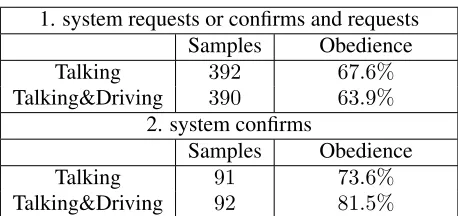
Table 6: User obedience to system questions
1. system requests or confirms and requests Samples Obedience Talking 392 67.6% Talking&Driving 390 63.9%
2. system confirms
Samples Obedience Talking 91 73.6% Talking&Driving 92 81.5%
an expensive restaurant the latter turn is clearly a contradiction. The percentage of contradicting turns is less than1% and the difference between the sce-narios is not statistically significant. This suggests that while users tend to forget the task they are given when they are driving, they still act rationally despite the increase in the cognitive load.
The next analysis concerns the user obedience, i.e. the extent to which subjects answer the sys-tem questions. We grouped the syssys-tem questions in two classes. The first class represents the questions where the system requests a value for a particular slot, for instanceWhat part of town are you looking for? and the questions where the system confirms and requests at the same time, for instanceYou are looking for a cheap restaurant. What part of town are you looking for?The second class correspond to system confirmations, for exampleDid you say you are looking for a cheap restaurant? The percent-age of the obedient user turns per class is given in Table 6. Due to the small sample size these results are not statistically significant. Still, it is interest-ing to see that when drivinterest-ing the subjects appear to be more obedient to the system confirmations than when they are just talking. When the system makes a confirmation, the user can answer with simple yes or no, whereas when the system requests the value of a particular slot, the user needs to think more to provide an answer.
[image:4.612.72.301.90.198.2]The number of barge-ins, the number of filler words and the average speech intensity vary con-siderably among the subjects. Therefore, we aver-age these statistics per user and examine the number of users for which the particular measure is greater for the scenario where they talked to the system and drove the simulator at the same time. The results
Table 7: Analysis of measures related to the speaking style which values are larger for Talking&Driving than Talking
Measure % of users Conf. interval More barge-ins 87% [69%,96%] More fillers 73% [54%,88%] Higher intensity 67% [47%,83%]
(Table 7) show that the number of barge-ins and the number of fillers is significantly greater for the sce-nario when they are talking and driving and the in-tensity on average tend to be greater.
5 Conclusion and Future work
There are several important observations arising from this study. Firstly, dialogues with cognitively loaded users tend to be less successful. This sug-gests that the system should alter its behaviour to match user behaviour and alleviate the cognitive load in order to maintain the level of performance. This necessitates rapid on-line adaptation of dia-logue policies.
The second observation is that cognitively loaded users tend to respond to some types of system ques-tions more than others. This indicates that the user model within a POMDP dialogue system should be conditioned on a measure of cognitive load.
Finally, this study has found that users barge-in and use filler words significantly more often when they are cognitively loaded. This suggests the need for a much richer turn-taking model which allows the system to use back-channels and barge-in when the user hesitates. An obvious candidate is the in-cremental approach (Schlangen and Skantze, 2009; DeVault et al., 2009) which allows the system to pro-cess partial user inputs, back-channels, predict short term user input and interrupt the user during hesita-tions. While incremental dialogue is a growing area of study, it has not so far been examined in the con-text of dialogue for secondary tasks. We signpost this as an important area for future work.
Acknowledgments
References
A Baron and P Green. 2006. Safety and Usability of Speech Interfaces for In-Vehicle Tasks while Driving: A Brief Literature Review. Technical Report UMTRI-2006-5.
I Davies and P Robinson. 2011. Emotional investment in naturalistic data collection. In International Con-ference on Affective Computing and Intelligent Inter-action.
D DeVault, K Sagae, and DR Traum. 2009. Can I fin-ish? Learning when to respond to incremental inter-pretation results in interactive dialogue. In 10th An-nual SIGDIAL meeting on Discourse and Dialogue. U Gartner, W Konig, and T Wittig. 2001. Evaluation of
Manual vs. Speech Input When Using a Driver Infor-mation System in Real Traffic. InInternational Driv-ing Symposium on Human Factors in DrivDriv-ing Assess-ment, Training and Vehicle Design.
A Kun, T Paek, and ˇZ Medenica. 2007. The effect of speech interface accuracy on driving performance. In Interspeech.
J Lai, K Cheng, P Green, and O Tsimhoni. 2001. On the Road and on the Web? Comprehension of synthetic and human speech while driving. InSIGCHI.
JD Lee, B Caven, S Haake, and TL Brown. 2001. Speech-based Interaction with In-vehicle Computers: The Effect of Speech-based E-mail on Drivers’ Atten-tion to the Roadway. Human Factors, 43:631–640. R Mishra, E Shriberg, S Upson, J Chen, F Weng, S
Pe-ters, L Cavedon, J Niekrasz, H Cheng, and H Bratt. 2004. A wizard of Oz framework for collecting spo-ken human-computer dialogs. InInterspeech.
BS Nielsen, B Harsham, B Raj, and C Forlines. 2008. Speech-Based UI Design for the Automobile. Hand-book of Research on User Interface Design and Eval-uation for Mobile Technology, pages 237–252. David Schlangen and Gabriel Skantze. 2009. A general,
abstract model of incremental dialogue processing. In Proceedings of the 12th Conference of the European Chapter of the Association for Computational Linguis-tics, EACL ’09, pages 710–718.
B Thomson and S Young. 2010. Bayesian update of dialogue state: A POMDP framework for spoken di-alogue systems. Computer Speech and Language, 24(4):562–588.
O Tsimhoni, D Smith, and P Green. 2004. Address Entry While Driving: Speech Recognition Versus a Touch-Screen Keyboard. Human Factors, 46:600–610. F Weng, L Cavedon, B Raghunathan, D Mirkovic,
H Cheng, H Schmidt, H Bratt, R Mishra, S Peters, L Zhao, S Upson, E Shriberg, and C Bergmann. 2004.
Developing a conversational dialogue system for cog-nitively overloaded users. InProceedings of the Inter-national Congress on Intelligent Transportation Sys-tems.
JD Williams and SJ Young. 2007. Partially Observable Markov Decision Processes for Spoken Dialog Sys-tems. Computer Speech and Language, 21(2):393– 422.