DCU-Symantec Submission for the WMT 2012 Quality Estimation Task
Raphael Rubino†‡, Jennifer Foster†, Joachim Wagner†, Johann Roturier‡, Rasul Samad Zadeh Kaljahi†‡,Fred Hollowood‡
†Dublin City University,‡Symantec, Ireland
‡firstname [email protected]
Abstract
This paper describes the features and the ma-chine learning methods used by Dublin City University (DCU) and SYMANTEC for the WMT 2012 quality estimation task. Two sets of features are proposed: oneconstrained, i.e. respecting the data limitation suggested by the workshop organisers, and oneunconstrained, i.e. using data or tools trained on data that was not provided by the workshop organisers. In total, more than 300 features were extracted and used to train classifiers in order to predict the translation quality of unseen data. In this paper, we focus on a subset of our feature set that we consider to be relatively novel: fea-tures based on a topic model built using the Latent Dirichlet Allocation approach, and fea-tures based on source and target language syn-tax extracted using part-of-speech (POS) tag-gers and parsers. We evaluate nine feature combinations using four classification-based and four regression-based machine learning techniques.
1 Introduction
For the first time, the WMT organisers this year pro-pose a Quality Estimation (QE) shared task, which is divided into two sub-tasks: scoring and ranking automatic translations. The aim of this workshop is to define useful sets of features and machine learn-ing techniques in order to predict the quality of a machine translation (MT) outputT (Spanish) given a source segmentS (English). Quality is measured using a 5-point likert scale which is based on post-editing effort, following the scoring scheme:
1. The MT output is incomprehensible
2. About 50-70% of the MT output needs to be edited
3. About 25-50% of the MT output needs to be edited
4. About 10-25% of the MT output needs to be edited
5. The MT output is perfectly clear and intelligi-ble
The final score is a combination of the scores as-signed by three evaluators. The use of a 5-point scale makes the scoring task more difficult than a binary classification task where a translation is considered to be either good or bad. However, if the task is successfully carried out, the score produced is more useful.
Dublin City University and Symantec jointly ad-dress the scoring task. For each pair(S, T)of source segmentSand machine translationT, we train three classifiers and one classifier combination using the training data provided by the organisers to predict 5-point Likert scores. In this paper, we present the classification results on the test set along with addi-tional results obtained using regression techniques. We evaluate the usefulness of two new sets of fea-tures:
1. topic-based features using Latent Dirichlet Al-location (LDA (Blei et al., 2003)),
2. syntax-based features using POS taggers and parsers (Wagner et al., 2009)
The remainder of this paper is organised as fol-lows. In Section 2, we give an overview of all the
features employed in our QE system. Then, in Sec-tion 3, we describe the topic and syntax-based fea-tures in more detail. Section 4 presents the vari-ous classification and regression techniques we ex-plored. Our results are presented and discussed in Section 5. Finally, we summarise and outline our plans in Section 6.
2 Features Overview
In this section, we describe the features used in our QE system. In the first subsection, the features in-cluded in our constrained system are presented. In the second subsection, we detail the features in-cluded in our unconstrained system. Both of these systems include the 17 baseline features provided for the shared task.
2.1 Constrained System
The constrained system is based only on the data provided by the organisers. We extracted 70 fea-tures in total (including the baseline feafea-tures) and we present them here according to the type of infor-mation they capture.
Word and Phrase-Level Features
• Ratio of source and target segment length: the number of source words divided by the number of target words
• Ratio of source and target number of punc-tuation marks: the number of source punctua-tion marks divided by the number of target ones
• Number of phrases comprising the MT out-put: given a phrase-table, we assume that a sentence composed of several phrases indicates uncertainty on the part of the MT system.
• Average length of source and target phrases: concatenating short phrases may result in lower fluency compared to the use of longer ones.
• Ratio of source and target averaged phrase length
• Number of source prepositions and conjunc-tions word: our assumption here is that seg-ments containing a relatively high number of prepositions and conjunctions may be more complex and difficult to translate.
• Number of source out-of-vocabulary words
Language Model Features
All the language models (LMs) used in our work aren-gram LMs with Kneser-Ney smoothing built with the SRI Toolkit (Stolcke, 2002).
• Backward 2-gram and 3-gram source and target log probabilities: as proposed by Duchateau et al. (2002)
• Log probability of target segments on
5-gram MT-output-based LM: using MOSES (Koehn et al., 2007) trained on the provided parallel corpus, we translated the En-glish side of this corpus into Spanish, assuming that the MT output contains mistakes. This MT output is used to build a LM that models the behavior of the MT system. We assume that for a given MT output, a high n-gram probability (or a low perplexity) of the LM indicates that the MT output contains mistakes.
MT-system Features
• 15 scores provided by Moses: phrase-table, language model, reordering model and word penalty (weighted and unweighted)
• Number ofn-bests for each source segment • MT output back-translation: from Spanish to
English using MOSES trained on the provided parallel corpus, scored with TER (Snover et al., 2006), BLEU (Papineni et al., 2002) and the Levenshtein distance (Levenshtein, 1966), based on the source segments as a translation reference
Topic Model Features
• Probability distribution over topics: Source and target segment probability distribution over topics for a10-dimension topic model
• Cosine distance between source and target topic vectors
More details about these two features are provided in Section 3.1.
2.2 Unconstrained System
MT System Features
As for ourconstrainedsystem, we use MT output back-translation from Spanish to English, but this time using Bing Translator1 in addition to Moses. Each back-translated segment is scored with TER, BLEU and the Levenshtein distance, based on the source segments as a translation reference.
Source Syntax Features
Wagner et al. (2007; 2009) propose a series of features to measure sentence grammaticality. These features rely on a part-of-speech tagger, a probabilis-tic parser and a precision grammar/parser. We have at our disposal these tools for English and so we ap-ply them to the source data. The features themselves are described in more detail in Section 3.2.
Target Syntax Features
We use a part-of-speech tagger trained on Spanish to extract from the target data the subset of grammat-icality features proposed by Wagner et al. (2007; 2009) that are based on POS n-grams. In addition we extract features which reflect the prevalence of particular POS tags in each target segment. These are explained in more detail in Section 3.2 below.
Grammar Checker Features
LANGUAGETOOL(based on (Naber, 2003)) is an open-source grammar and style proofreading tool that finds errors based on pre-defined, language-specific rules. The latest version of the tool can be run in server mode, so individual sentences can be checked and assigned a total number of errors (which may or may not be true positives).2 This number is used as a feature for each source segment and its corresponding MT output.
3 Topic and Syntax-based Features
In this section, we focus on the set of features that aim to captureadequacyusing topic modelling andgrammaticalityusing POS tagging and syntactic parsing.
1
http://www.microsofttranslator.com/ 2
The list of English and Spanish rules is available at: http://languagetool.org/languages.
3.1 Topic-based Features
We extract source and target features based on a topic model built using LDA. The main idea in topic modelling is to produce a set of thematic word clus-ters from a collection of documents. Using the par-allel corpus provided for the task, a bilingual corpus is built where each line is composed of a source seg-ment and its translation separated by a space. Each pair of segments is considered as a bilingual docu-ment. This corpus is used to train a bilingual topic model after stopwords removal. The resulting model is one set of bilingual topicszcontaining words w with a probabilityp(wn|zn, β)(withnequal to the
vocabulary size in the whole parallel corpus). This model can be used to infer the probability distri-bution of unseen source and target segments over bilingual topics. During the test step, each source segment and its translation are considered individu-ally, as two monolingual documents. This method allows us to compare the source and target topic dis-tributions. We assume that a source segment and its translation share topic similarities.
We propose two ways of using topic-based fea-tures for quality estimation: keeping source and tar-get topic vectors as two sets ofkfeatures, or com-puting a vector distance between these two vectors and using one feature only. To measure the prox-imity of two vectors, we decided to used the Co-sinedistance, as it leads to the best results in terms of classification accuracy. However, we plan to study different metrics in further experiments, like the Manhattan or the Euclidean distances. Some parameters related to LDA have to be studied more carefully too, such as the number of topics (dimen-sions in the topic space), the number of words per topic, the Dirichlet hyperparameterα, etc. In our experiments, we built a topic model composed of10 dimensions using Gibbs sampling with 1000 itera-tions. We assume that a higher dimensionality can lead to a better repartitioning of the vocabulary over the topics.
lan-guage model to a specific topic using Latent Se-mantic Analysis (LSA, or Latent SeSe-mantic Index-ing, LSI (Deerwester et al., 1990)). More recently, some studies were conducted on the use of LDA to adapt SMT systems to specific domains (Gong et al., 2010; Gong et al., 2011) or to extract bilingual lexi-con from comparable corpora (Rubino and Linar`es, 2011). Extracting features from a topic model is, to the best of our knowledge, the first attempt in ma-chine translation quality estimation.
3.2 Syntax-based Features
Syntactic features have previously been used in MT for confidence estimation and for building automatic evaluation measures. Corston-Oliver et al. (2001) build a classifier using 46 parse tree features to pre-dict whether a sentence is a human translation or MT output. Quirk (2004) uses a single parse tree feature in the quality estimation task with a 4-point scale, namely whether a spanning parse can be found, in addition to LM perplexity and sentence length. Liu and Gildea (2005) measure the syntactic similarity between MT output and reference translation. Al-brecht and Hwa (2007) measure the syntactic simi-larity between MT output and reference translation and between MT output and a large monolingual corpus. Gimenez and Marquez (2007) explore lexi-cal, syntactic and shallow semantic features and fo-cus on measuring the similarity of MT output to ref-erence translation. Owczarzak et al. (2007) use la-belled dependencies together with WordNet to avoid penalising valid syntactic and lexical variations in MT evaluation. In what follows, we describe how we make use of syntactic information in the QE task, i.e. evaluating MT output without a reference trans-lation.
Wagner et al. (2007; 2009) use three sources of linguistic information in order to extract features which they use to judge the grammaticality of En-glish sentences:
1. For each POS n-gram (withnranging from 2 to 7), a feature is extracted which represents the frequency of the least frequent n-gram in the sentence according to some reference corpus. TreeTagger (Schmidt, 1994) is used to produce POS tags.
2. Features provided by a hand-crafted,
broad-coverage precision grammar of English (Butt et al., 2002) and a Lexical Functional Grammar parser (Maxwell and Kaplan, 1996). These in-clude whether or not a sentence could be parsed without resorting to robustness measures, the number of analyses found and the parsing time. 3. Features extracted from the output of three probabilistic parsers of English (Charniak and Johnson, 2005), one trained on Wall Street Journal trees (Marcus et al., 1993), one trained on a distorted version of the treebank obtained by automatically creating grammatical error and adjusting the parse trees, and the third trained on the union of the original and dis-torted versions.
These features were originally designed to distin-guish grammatical sentences from ungrammatical ones and were tested on sentences from learner cor-pora by Wagner et al. (2009) and Wagner (2012). In this work we extract all three sets of features from the source side of our data and the POS-based subset from the target side.3 We use the publicly available pre-trained TreeTagger models for English and Spanish4. The reference corpus used to obtain POS n-gram frequences is the MT translation model training data.5
In addition to the POS-based features described in Wagner et al. (2007; 2009), we also extract the fol-lowing features from the Spanish POS-tagged data: for each POS tag P and target segment T, we ex-tract a feature which is the proportion of words in T that are tagged asP. Two additional features are extracted to represent the proportion of words inT that are assigned more than one tag by the tagger,
3
Unfortunately, due to time constraints, we were unable to source a suitable probabilistic phrase-structure parser and a pre-cision grammar for Spanish and were thus unable to extract parser-based features for Spanish. We expect that these features would be more useful on the target side than the source side.
4http://www.ims.uni-stuttgart.de/ projekte/corplex/TreeTagger/
5
and the proportion of words inT that are unknown to the tagger.
4 Machine Learning
In this section, we describe the machine learning methods that we experimented with. Our final sys-tems submitted for the shared task are based on clas-sification methods. However, we also performed some experiments with regression methods.
We evaluate the systems on the test set using the official evaluation script and the reference scores. We report the evaluation results as Mean Aver-age Error (MAE) and Root Mean Squared Error (RMSE).
4.1 Classification
In order to apply classification algorithms to the set of features associated with each source and tar-get segment, we rounded the training data scores to the closest integer. We tested several classifiers and empirically chose three algorithms: Support Vector Machine using sequential minimal optimiza-tion and RBF kernel (parameters optimized by grid-search) (Platt, 1999), Naive Bayes (John and Lang-ley, 1995) and Random Forest (Breiman, 2001) (the latter two techniques were applied with default pa-rameters). We use the Weka toolkit (Hall et al., 2009) to train the classifiers and predict the scores on the test set. Each method is evaluated individu-ally and then combined by averaging the predicted scores.
4.2 Regression
We applied three different regression techniques: SVM epsilon-SVR with RBF kernel, Linear Regres-sion and M5P (Quinlan, 1992; Wang and Witten, 1997). The two latter algorithms were used with default parameters, whereas SVM parameters (γ, c and) were optimized by grid-search. We also per-formed a combination of the three algorithms by av-eraging the predicted scores. We apply a linear func-tion on the predicted scoresS in order to keep them in the correct range (from1to5) as detailed in (1), whereS0 is the rescaled sentence score,Smin is the
lowest predicted score andSmax is the highest
pre-dicted score.
S0 = 1 + 4× S−Smin
Smax−Smin
(1)
5 Evaluation
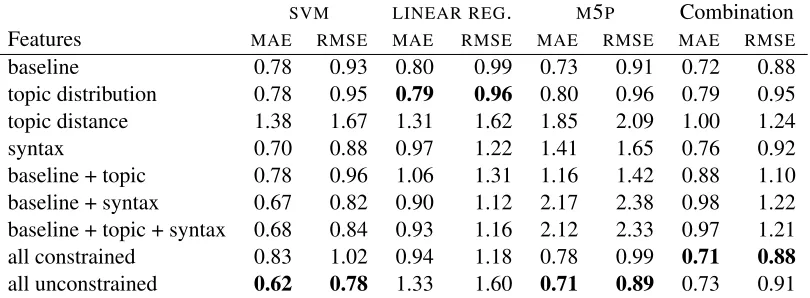
Table 1 shows the results obtained by our classifi-cation approach on various feature subsets. Note that the two submitted systems used the combined classifier approach with the constrained and uncon-strained feature sets. Table 2 shows the results for the same feature combinations, this time using re-gression rather than classification.
The results of quality estimation using classifica-tion methods show that the baseline and the syntax-based features with the classifier combination leads to the best results with an MAE of 0.71 and an RMSE of0.87. However, these scores are substan-tially lower than the ones obtained using regression, where the unconstrained set of features with SVM leads to an MAE of0.62and an RMSE of0.78.
It seems that the classification methods are not suitable for this task according to the different sets of features studied. Furthermore, the topic-distance feature is not correlated with the quality scores, ac-cording to the regression results. On the other hand, the syntax-based features appear to be the most in-formative and lead to an MAE of0.70.
6 Conclusion
We presented in this paper our submission for the WMT12 Quality Estimation shared task. We also presented further experiments using different ma-chine learning techniques and we evaluated the im-pact of two sets of features - one set which is based on linguistic features extracted using POS tagging and parsing, and a second set which is based on topic modelling. The best results are obtained by our un-constrained system containing all features and us-ing an-SVR regression method with a Radial Basis Function kernel. This setup leads to a Mean Aver-age Error of 0.62 and a Root Mean Squared Error of0.78. Unfortunately, we did not submit our best configuration for the shared task.
SMO NAIVE BAYES RANDOM FOREST Combination
Features MAE RMSE MAE RMSE MAE RMSE MAE RMSE
baseline 0.74 0.89 0.85 1.10 0.84 1.06 0.71 0.88
topic distribution 0.84 1.02 1.09 1.38 0.91 1.15 0.78 0.98 topic distance 0.88 1.11 0.93 1.17 1.04 1.23 0.84 1.04
syntax 0.78 0.97 1.01 1.27 0.83 1.05 0.72 0.90
baseline + topic 0.82 1.01 1.00 1.31 0.84 1.05 0.75 0.95 baseline + syntax 0.76 0.94 1.01 1.25 0.79 0.98 0.71 0.87
baseline + topic + syntax 0.82 1.04 1.03 1.29 0.79 0.98 0.74 0.93 all constrained 0.99 1.26 1.12 1.46 0.71 0.88 0.86◦ 1.12◦
[image:6.612.105.510.260.409.2]all unconstrained 0.97 1.25 0.80 1.02 0.79 0.99 0.75• 0.97•
Table 1: MAE and RMSE results for different sets of features using three classification methods. The results with◦
and•correspond to theDCU-SYMC constrainedand theDCU-SYMC unconstrainedsystems respectively, submitted for the shared task.
SVM LINEAR REG. M5P Combination
Features MAE RMSE MAE RMSE MAE RMSE MAE RMSE baseline 0.78 0.93 0.80 0.99 0.73 0.91 0.72 0.88 topic distribution 0.78 0.95 0.79 0.96 0.80 0.96 0.79 0.95 topic distance 1.38 1.67 1.31 1.62 1.85 2.09 1.00 1.24 syntax 0.70 0.88 0.97 1.22 1.41 1.65 0.76 0.92 baseline + topic 0.78 0.96 1.06 1.31 1.16 1.42 0.88 1.10 baseline + syntax 0.67 0.82 0.90 1.12 2.17 2.38 0.98 1.22 baseline + topic + syntax 0.68 0.84 0.93 1.16 2.12 2.33 0.97 1.21 all constrained 0.83 1.02 0.94 1.18 0.78 0.99 0.71 0.88
all unconstrained 0.62 0.78 1.33 1.60 0.71 0.89 0.73 0.91
Table 2: MAE and RMSE results for different sets of features using three regression methods.
References
J. Albrecht and R. Hwa. 2007. A re-examination of ma-chine learning approaches for sentence-level MT eval-uation. InProceedings of the 45th Annual Meeting of the ACL, pages 880–887.
D.M. Blei, A.Y. Ng, and M.I. Jordan. 2003. Latent Dirichlet Allocation. The Journal of Machine Learn-ing Research, 3:993–1022.
Jordan Boyd-Graber and David M. Blei. 2009. Multilin-gual topic models for unaligned text. InProceedings of the 25th Conference on Uncertainty in Artificial In-telligence, pages 75–82.
L. Breiman. 2001. Random forests. Machine learning, 45(1):5–32.
M. Butt, H. Dyvik, T. Holloway King, H. Masuichi, and C. Rohrer. 2002. The parallel grammar project. In
Proceedings of the Coling Workshop on Grammar En-gineering and Evaluation.
E. Charniak and M. Johnson. 2005. Course-to-fine n-best-parsing and maxent discriminative reranking. In
Proceedings of the 43rd Annual Meeting of the ACL, pages 173–180, Ann Arbor.
S. Corston-Oliver, M. Gamon, and C. Brockett. 2001. A machine learning approach to the automatic evalu-ation of machine translevalu-ation. InProceedings of 39th Annual Meeting of the Association for Computational Linguistics, pages 148–155, Toulouse, France, July. S. Deerwester, S.T. Dumais, G.W. Furnas, T.K. Landauer,
and R. Harshman. 1990. Indexing by Latent Semantic Analysis. Journal of the American Society for Infor-mation Science, 41(6):391–407.
J. Duchateau, K. Demuynck, and P. Wambacq. 2002. Confidence scoring based on backward language mod-els. In Proceedings IEEE international confer-ence on acoustics, speech, and signal processing, ICASSP’2002, volume 1, pages 221–224.
Z. Gong, Y. Zhang, and G. Zhou. 2010. Statistical ma-chine translation based on lda. InUniversal Commu-nication Symposium (IUCS), 2010 4th International, pages 286–290.
Z. Gong, G. Zhou, and L. Li. 2011. Improve smt with source-side ”topic-document” distributions. In MT Summit, pages 496–501.
M. Hall, E. Frank, G. Holmes, B. Pfahringer, P. Reute-mann, and I.H. Witten. 2009. The weka data min-ing software: an update. ACM SIGKDD Explorations Newsletter, 11(1):10–18.
G.H. John and P. Langley. 1995. Estimating continuous distributions in bayesian classifiers. InEleventh con-ference on uncertainty in artificial intelligence, pages 338–345. Morgan Kaufmann Publishers Inc.
P. Koehn, H. Hoang, A. Birch, C. Callison-Burch, M. Federico, N. Bertoldi, B. Cowan, W. Shen, C. Moran, R. Zens, et al. 2007. Moses: Open source toolkit for statistical machine translation. In ACL, pages 177–180.
V.I. Levenshtein. 1966. Binary codes capable of cor-recting deletions, insertions, and reversals. In Soviet Physics Doklady, volume 10-8, pages 707–710. D. Liu and D. Gildea. 2005. Syntactic features for
eval-uation of machine translation. InProceedings of the ACL Workshop on Intrinsic and Extrinsic Evaluation Measures for Machine Translation and/or Summariza-tion, pages 25–32, Ann Arbor, Michigan.
M. P. Marcus, B. Santorini, and M. A. Marcinkiewicz. 1993. Building a large annotated corpus of en-glish: the penn treebank. Computational Linguistics, 19(2):313–330.
John Maxwell and Ron Kaplan. 1996. An Efficient Parser for LFG. InProceedings of LFG-96, Grenoble. D. Mimno, H.M. Wallach, J. Naradowsky, D.A. Smith, and A. McCallum. 2009. Polylingual topic models. InProceedings of EMNLP: Volume 2-Volume 2, pages 880–889. Association for Computational Linguistics. D. Naber. 2003. A rule-based style and grammar
checker. Technical report, Bielefeld University Biele-feld, Germany.
K. Owczarzak, J. van Genabith, and A. Way. 2007. La-belled dependencies in machine translation evaluation. InProceedings of the Second Workshop on Statistical Machine Translation, pages 104–111, Prague, Czech Republic, June.
K. Papineni, S. Roukos, T. Ward, and W.J. Zhu. 2002. Bleu: a method for automatic evaluation of machine translation. InACL, pages 311–318.
J.C. Platt. 1999. Fast training of support vector machines using sequential minimal optimization. InAdvances in kernel methods, pages 185–208. MIT Press.
R. J. Quinlan. 1992. Learning with continuous classes. In5th Australian Joint Conference on Artificial Intel-ligence, pages 343–348, Singapore. World Scientific. C. Quirk. 2004. Training a sentence-level machine
trans-lation confidence measure. InProceedings of LREC, Lisbon, June.
R. Rubino and G. Linar`es. 2011. A multi-view approach for term translation spotting. Computational Linguis-tics and Intelligent Text Processing, 6609:29–40. H. Schmidt. 1994. Probabilistic part-of-speech tagging
using decision trees. InProceedings of the Interna-tional Conference on New Methods in Natural Lan-guage Processing.
M. Snover, B. Dorr, R. Schwartz, L. Micciulla, and J. Makhoul. 2006. A study of translation edit rate with targeted human annotation. InProceedings of Associ-ation for Machine TranslAssoci-ation in the Americas, pages 223–231.
A. Stolcke. 2002. SRILM-an extensible language mod-eling toolkit. In InterSpeech, volume 2, pages 901– 904.
Y.C. Tam, I. Lane, and T. Schultz. 2007. Bilingual lsa-based adaptation for statistical machine translation.
Machine Translation, 21(4):187–207.
J. Wagner, J. Foster, and J. van Genabith. 2007. A com-parative evaluation of deep and shallow approaches to the automatic detection of common grammatical er-rors. InProceedings of EMNLP-CoNLL, pages 112– 121, Prague, Czech Republic, June.
J. Wagner, J. Foster, and J. van Genabith. 2009. Judg-ing grammaticality: Experiments in sentence classifi-cation. CALICO Journal, 26(3):474–490.
J. Wagner. 2012. Detecting grammatical errors with treebank-induced probabilistic parsers. Ph.D. thesis, Dublin City University.