Dedicated Workflow Management for OKBQA Framework
Jiseong Kim, GyuHyeon Choi, Key-Sun ChoiMachine Reading Laboratory Semantic Web Research Center Department of Computer Science
KAIST, Daejeon, Korea
{jiseong, wiany11, kschoi}@kaist.ac.kr
Abstract
Nowadays, a question answering (QA) system is used in various areas such a quiz show, personal assistant, home device, and so on. The OKBQA framework supports developing a QA system in an intuitive and collaborative ways. To support collaborative development, the framework should be equipped with some functions, e.g., flexible system configuration, debugging supports, intuitive user interface, and so on while considering different developing groups of different domains. This paper presents OKBQA controller, a dedicated workflow manager for OKBQA framework, to boost collaborative development of a QA system.
1 Introduction
Recently, a QA system have been on the rise being applied to diverse domains, e.g., quiz show (IBM Watson), personal assistant (Apple Siri, Microsoft Cortana), home device (Amazon Echo), and so on.
To make a QA system, the OKBQA framework focuses on constructing an OKBQA pipeline-based QA system. The OKBQA pipeline is based on the state-of-the-art researches such as template genera-tion (Unger et al., 2012), disambiguagenera-tion (Usbeck et al., 2014), query generagenera-tion (Kim and Cohen, 2014), and so on, which is depicted in Figure 1.
The main goal of the OKBQA framework is to supportcollaborative developmentof an OKBQA pipeline-based QA system, To support the collaborative development, the framework should be equipped with key functions:
• Pipeline construction based on OKBQA specificationAs modules of the OKBQA pipeline are developed by different groups of different domains, I/O specification is crucial to integrate modules developed independently into an integrated whole system. The OKBQA specification specifies that an I/O format of OKBQA module should be a JSON format and their interface should be imple-mented as a REST API. That is, the (OKBQA) framework should be capable of linking modules of JSON-formatted I/O with a RESTful service. By compliance with the OKBQA specification, modules developed by a different groups can be integrated into one QA system.
• Flexible pipeline configurationBy open collaboration, an QA system can be constructed by mod-ules developed by different developers. To support a developer who wants to construct his QA sys-tem by reusing some modules developed by other developers, the framework should be equipped with the function of configuring which modules will compose his QA system.
• Debugging supportsAs different users can develop a module of a QA system independently, some modules can cause a crash of an entire system by diverse errors. To support developers chasing a cause of errors, the framework should be capable of showing exceptional information about which module is crashed, the input causing the crash, and the reason why the module is crashed.
• Intuitive user interfaceTo support developers of diverse domains, the framework should provide an intuitive and common user interface that can lower the entry barrier of QA system development. This work is licensed under a Creative Commons Attribution 4.0 International Licence. Licence details:
http://creativecommons.org/licenses/by/4.0/
Figure 1: Workflow of an OKBQA pipeline
The above-mentioned functions are traditionally dealt by a workflow manager, which is a kind of a module for linking other modules to construct an integrated system. In this paper, we present a dedicated workflow manager for the OKBQA framework, so-calledOKBQA controller, to boost the collaborative development of an OKBQA pipeline-based QA system.
2 OKBQA Controller
The OKBQA controller is a dedicated workflow manager for constructing a OKBQA pipeline by linking OKBQA modules as shown in Figure 1. The controller makes a pipeline work by transferring I/O of each module sequentially. The controller realizes and provides the key functions described in Section 1, which is detailed in the following sections.
2.1 Pipeline construction based on OKBQA specification
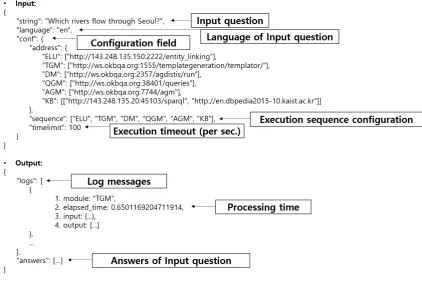
The controller makes a pipeline work consistently with the OKBQA specification by linking RESTful modules of JSON-formatted I/O. The I/O of the controller, depicted in Figure 2, are also compliant with the OKBQA specification as other OKBQA modules; The controller’s I/O have a JSON format and interface is implemented in a RESTful service. By compliance with the OKBQA specification, modules can be developed in a consistent ways w.r.t. their I/O and interface implementation, so the reusability of modules can be significantly enhanced.
2.2 Flexible pipeline configuration
Figure 2: I/O of an OKBQA controller
of modules by the controller’s input fields ”address” and ”sequence” as shown in Figure 2. By configur-ing the number and executconfigur-ing sequence of modules, developers can construct their own pipeline different from the original OKBQA pipeline to apply new idea and improve their own QA system further; For ex-ample, one idea is that if disambiguated results are provided to a template generation process as an input, there is a possibility that results of a template generation module could be improved.
2.3 Debugging supports
To support efficient debugging for collaborative development, the controller provides a fault alarming function through a log message that is the field ”log” in controller’s output as shown in Figure 2. The log message provides the information such as input, output, and processing time of each module, name of module throwing exception, a cause of exception, and so on; these information can be useful for chasing a cause of errors that are caused by not only our module, but also the others’. When a module throws an exception, the controller will stop executing a pipeline and return an exceptional message on log; e.g. Figure 3 shows an example of the message. By the message, developers can easily notice which module is problematic and what to do for fixing it. It is an essential function to easily chase and fix errors caused by modules developed by different developers.
2.4 Web-based user interface
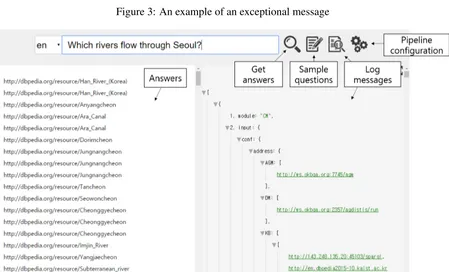
The controller provides a Web-based user interface1 to developers as shown in Figure 4. Through the
graphical supports by the interface, developers can set a system configuration, integrate their modules with other developers’ modules to construct an integrated QA system, and test constructed QA system by asking the pre-defined natural language questions in an easy and intuitive way.
2.5 Conclusion
We have presented a dedicated workflow manager for the OKBQA framework, so-called OKBQA con-troller. We showed that the OKBQA controller has an essential functions to develop a QA system in a
[image:3.595.73.496.67.354.2]Figure 3: An example of an exceptional message
Figure 4: A Web-based user interface for an OKBQA controller
collaborative way. However, there are some points to be improved and further developed. We will keep searching needs of developers and mirroring their needs to our successive versions of the controller.
Acknowledgements
This work was supported by Institute for Information & communications Technology Promotion(IITP) grant funded by the Korea government(MSIP) (No. R0101-16-0054, WiseKB: Big data based self-evolving knowledge base and reasoning platform). And also this work was supported by the Bio & Medical Technology Development Program of the NRF funded by the Korean government, MSIP(2015M3A9A7029735).
References
Unger, Christina and B¨uhmann, Lorenz and Lehmann, Jens and Ngonga Ngomo, Axel-Cyrille and Gerber, Daniel and Cimiano, Philipp. 2012. Template-based question answering over RDF data. Proceedings of the 21st
international conference on World Wide Web(pp. 639–648). ACM.
[image:4.595.76.525.202.474.2]