Customizing an Information Extraction System to a New Domain
Mihai Surdeanu, David McClosky, Mason R. Smith, Andrey Gusev, and Christopher D. Manning
Department of Computer Science Stanford University
Stanford, CA 94305
{mihais,mcclosky,mrsmith,manning}@stanford.edu [email protected]
Abstract
We introduce several ideas that improve the performance of supervised information ex-traction systems with a pipeline architecture, when they are customized for new domains. We show that: (a) a combination of a se-quence tagger with a rule-based approach for entity mention extraction yields better perfor-mance for both entity and relation mention extraction; (b) improving the identification of syntactic heads of entity mentions helps rela-tion extracrela-tion; and (c) a deterministic infer-ence engine captures some of the joint domain structure, even when introduced as a post-processing step to a pipeline system. All in all, our contributions yield a 20% relative increase in F1 score in a domain significantly differ-ent from the domains used during the devel-opment of our information extraction system.
1 Introduction
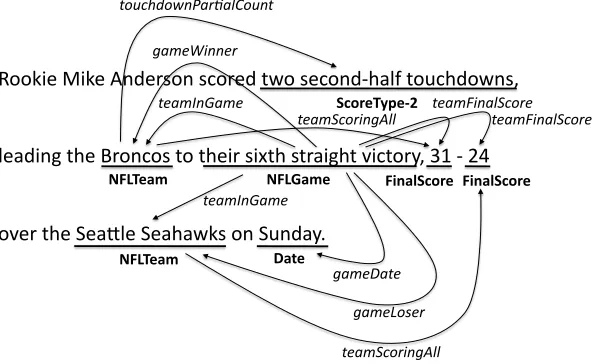
Information extraction (IE) systems generally con-sist of multiple interdependent components, e.g., en-tity mentions predicted by an enen-tity mention detec-tion (EMD) model connected by reladetec-tions via a re-lation mention detection (RMD) component (Yao et al., 2010; Roth and Yih, 2007; Surdeanu and Cia-ramita, 2007). Figure 1 shows a sentence from a sports domain where both entity and relation men-tions are annotated. When training data exists, the best performance in IE is generally obtained by su-pervised machine learning approaches. In this sce-nario, the typical approach for domain customiza-tion is apparently straightforward: simply retrain on data from the new domain (and potentially tune
model parameters). In this paper we argue that, even when considerable training data is available, this is not sufficient to maximize performance. We apply several simple ideas that yield a significant perfor-mance boost, and can be implemented with minimal effort. In particular:
• We show that a combination of a conditional random field model (Lafferty et al., 2001) with a rule-based approach that is recall oriented yields better performance for EMD and for the downstream RMD component. The rule-based approach includes gazetteers, which have been shown to be important by Mikheev et al. (1999), among others.
• We improve the unification of the predicted se-mantic annotations with the syntactic analy-sis of the corresponding text, i.e., finding the syntactic head of a given semantic constituent. Since many features in an IE system depend on syntactic analysis, this leads to more consistent features and better extraction models.
• We add a simple inference engine that gener-ates additional relation mentions based solely on the relation mentions extracted by the RMD model. This engine mitigates some of the limi-tations of a text-based RMD model, which can-not extract relations can-not explicitly stated in text. We investigate these ideas using an IE system that performs recognition of entity mentions followed by extraction of binary relations between these men-tions. We used as target a sports domain that is sig-nificantly different from the corpora previously used with this IE system. The target domain is also sig-nificantly different from the dataset used to train the
Rookie Mike Anderson scored two second-‐half touchdowns,
leading the Broncos to their sixth straight victory, 31 -‐ 24
over the SeaAle Seahawks on Sunday.
ScoreType-‐2
FinalScore FinalScore NFLGame
NFLTeam
NFLTeam Date
teamInGame gameWinner touchdownPar4alCount
teamScoringAll
teamInGame
gameDate
gameLoser
teamScoringAll
[image:2.612.163.459.55.237.2]teamFinalScore teamFinalScore
Figure 1: Sample sentence from the NFL domain. The domain contains entity mentions (underlined with entity types in bold) and binary relations between entity mentions (indicated by arrows; relation types are italicized).
supporting natural language processing tools (e.g., syntactic parser). Our investigation shows that, de-spite their simplicity, all our proposals help, yielding a 20% relative improvement in RMD F1 score.
The paper is organized as follows: Section 2 sur-veys related work. Section 3 describes the IE system used. We cover the target domain that serves as use case in this paper in Section 4. Section 5 introduces our ideas and evaluates their impact in the target do-main. Finally, Section 6 concludes the paper.
2 Related Work
Other recent works have analyzed the robustness of information extraction systems. For example, Flo-rian et al. (2010) observed that EMD systems per-form badly on noisy inputs, e.g., automatic speech transcripts, and propose system combination (sim-ilar to our first proposal) to increase robustness in such scenarios. Ratinov and Roth (2009) also in-vestigate design challenges for named entity recog-nition, and showed that other design choices, such as the representation of output labels and using fea-tures built on external knowledge, are more impor-tant than the learning model itself. These works are conceptually similar to our paper, but we propose several additional directions to improve robustness, and we investigate their impact in a complete IE sys-tem instead of just EMD.
Several of our lessons are drawn from the BioCre-ative challenge1 and the BioNLP shared task (Kim
1http://biocreative.sourceforge.net/
et al., 2009). These tasks have shown the impor-tance of high quality syntactic annotations and using heuristic fixes to correct systematic errors (Schuman and Bergler, 2006; Poon and Vanderwende, 2010, among others). Systems in the latter task have also shown the importance of high recall in the earlier stages of pipeline system.
3 Description of the Generic IE System
We illustrate our proposed ideas using a simple IE system that implements a pipeline architecture: en-tity mention extraction followed by relation men-tion extracmen-tion. Note however that the domain cus-tomization discussion in Section 5 is independent of the system architecture or classifiers used for EMD and RMD, and we expect the proposed ideas to ap-ply to other IE approaches as well.
We performed all pre-processing (tokenization, part-of-speech (POS) tagging) with the Stanford CoreNLP toolkit.2 For EMD we used the Stanford named entity recognizer (Finkel et al., 2005). In all our experiments we used a generic set of features (“macro”) and the IO notation3for entity mention la-bels (e.g., the lala-bels for the tokens “over the Seattle Seahawks on Sunday” (from Figure 1) are encoded as “O O NFLTEAMNFLTEAMO DATE”).
2http://nlp.stanford.edu/software/
corenlp.shtml
3The IO notation facilitates faster inference than the IOB
Argument Features
– Head words of the two arguments and their combination
– Entity mention labels of the two arguments and their combination Syntactic
Features
– Sequence of dependency labels in the dependency path linking the heads of the two arguments – Lemmas of all words in the de-pendency path
– Syntactic path in the constituent parse tree between the largest con-stituents headed by the same words as the two arguments (similar to Gildea and Jurafsky (2002)) Surface
Features
– Concatenation of POS tags be-tween arguments
[image:3.612.82.292.54.295.2]– Binary indicators set to true if there is an entity mention with a given type between the two argu-ments
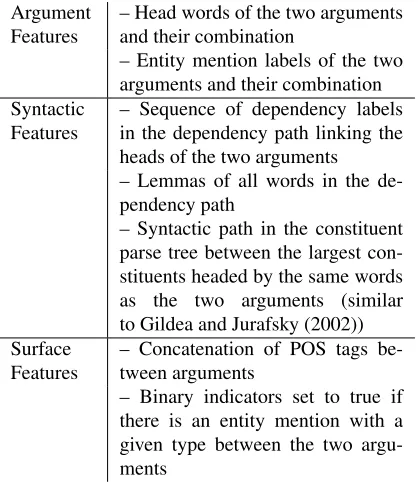
Table 1: Feature set used for RMD.
The RMD model was built from scratch as a multi-class classifier that extracts binary relations between entity mentions in the same sentence. Dur-ing trainDur-ing, known relation mentions become pos-itive examples for the corresponding label and all other possible combinations between entity men-tions in the same sentence become negative exam-ples. We used a multiclass logistic regression classi-fier with L2 regularization. Our feature set is taken from (Yao et al., 2010; Mintz et al., 2009; Roth and Yih, 2007; Surdeanu and Ciaramita, 2007) and mod-els the relation arguments, the surface distance be-tween the relation arguments, and the syntactic path between the two arguments, using both constituency and dependency representations. For syntactic in-formation, we used the Stanford parser (Klein and Manning, 2003) and the Stanford dependency repre-sentation (de Marneffe et al., 2006).
For RMD, we implemented an additive feature se-lection algorithm similar to the one in (Surdeanu et al., 2008), which iteratively adds the feature with the highest improvement in F1 score to the current feature set, until no improvement is seen. The algorithm was configured to select features that yielded the best combined performance on the dataset from Roth and Yih (2007) and the training partition of ACE 2007.4 We used ten-fold cross
val-4LDC catalog numbers LDC2006E54 and LDC2007E11
Documents Words Entity Relation
Mentions Mentions
110 70,119 2,188 1,629
Table 2: Summary statistics of the NFL corpus, after our conversion to binary relations.
idation on both datasets. We decided to use a stan-dard F1 score to evaluate RMD performance rather than the more complex ACE score because we be-lieve that the former is more interpretable. We used gold entity mentions for the feature selection pro-cess. Table 1 summarizes the final set of features selected.
Despite its simplicity, our approach achieves comparable performance with other state-of-the-art results reported on these datasets (Roth and Yih, 2007; Surdeanu and Ciaramita, 2007). For exam-ple, Surdeanu and Ciaramita report a RMD F1 score of 59.4 for ACE relation types (i.e., ignoring sub-types) when gold entity mentions are used. Under the same conditions, our RMD model obtains a F1 score of 59.2.
4 Description of the Target Domain
In this paper we report results on the “Machine Reading NFL Scoring” corpus.5 This corpus was developed by LDC for the DARPA Machine Read-ing project. The corpus contains 110 newswire arti-cles on National Football League (NFL) games. The annotations cover game information, such as partici-pating teams, winners and losers, partial (e.g., a sin-gle touchdown or three field goals) and final scores. Most of the annotated relations in the original corpus are binary (e.g. GAMEDATE(NFLGAME, DATE)) but some are n-ary relations or include other at-tributes in addition of the relation type. We reduce these to annotations compatible with our RMD ap-proach as follows:
• We concatenate the cardinality of each scoring event (i.e. how many scoring events are be-ing talked about) to the correspondbe-ing SCORE -TYPE entity label. Thus SCORETYPE-2 in-dicates that there were two of a given type of scoring event (touchdown, field goal, etc.). This operation is necessary because the cardi-nality of scoring events is originally annotated as an additional attribute of the SCORETYPE
[image:3.612.330.526.55.91.2]Entity Mentions Correct Predicted Actual P R F1
Date 141 190 174 74.2 81.0 77.5
FinalScore 299 328 347 91.2 86.2 88.6
NFLGame 71 109 147 65.1 48.3 55.5
NFLPlayoffGame 8 25 38 32.0 21.1 25.4
NFLTeam 651 836 818 77.9 79.6 78.7
ScoreType-1 329 479 525 68.7 62.7 65.5
ScoreType-2 49 68 79 72.1 62.0 66.7
ScoreType-3 17 26 36 65.4 47.2 54.8
ScoreType-4 6 11 14 54.5 42.9 48.0
Total 1571 2076 2188 75.7 71.8 73.7
Relation Mentions Correct Predicted Actual P R F1
fieldGoalPartialCount 33 41 101 80.5 32.7 46.5
gameDate 32 36 115 88.9 27.8 42.4
gameLoser 22 44 124 50.0 17.7 26.2
gameWinner 6 15 123 40.0 4.9 8.7
teamFinalScore 95 101 232 94.1 40.9 57.1
teamInGame 49 105 257 46.7 19.1 27.1
teamScoringAll 202 232 321 87.1 62.9 73.1
touchDownPartialCount 156 191 322 81.7 48.4 60.8
[image:4.612.140.472.52.322.2]Total 595 766 1629 77.7 36.5 49.7
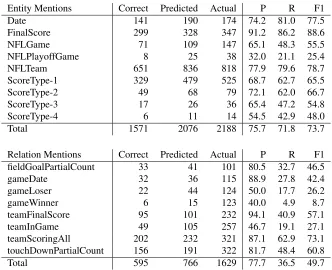
Table 3: Baseline results: stock system without any domain customization. Correct/Predicted/Actual indicate the num-ber of mentions (entities or relations) that are correctly predicted/predicted/gold. P/R/F1 indicate precision/recall/F1 scores for the corresponding label.
entity and our EMD approach does not model mention attributes.
• We split all n-ary relations into several new binary relations. For example, the original TEAMFINALSCORE(NFLTEAM, NFLGAME, FINALSCORE) relation is split into three binary relations: TEAMSCORINGALL(NFLTEAM, FINALSCORE), TEAMINGAME(NFLGAME, NFLTEAM), and TEAMFINALSCORE (NFL-GAME, FINALSCORE).
Figure 1 shows an example annotated sentence af-ter the above conversion and Table 2 lists the corpus summary statistics for the new binary relations.
The purpose behind this corpus is to encourage the development of systems that answer structured queries that go beyond the functionality of informa-tion retrieval engines, e.g.:
“For each NFL game, identify the win-ning and losing teams and each team’s fi-nal score in the game.”
“For each team losing to the Green Bay Packers, tell us the losing team and the number of points they scored.”6
6These queries would be written in a formal language but
5 Domain Customization
Table 3 lists the results of the generic IE system de-scribed in Section 3 on the NFL domain. Through-out this paper we will report results using ten-fold cross-validation on all 110 documents in the cor-pus.7 We consider an entity mention as correct if both its boundaries and label match exactly the gold mention. We consider a relation mention correct if both its arguments and label match the gold relation mention. For RMD, we report results using the ac-tual mentions predicted by our EMD model (instead of using gold entity mentions for RMD). For clar-ity, we do not show in the tables some labels that are highly uncommon in the data (e.g., SCORETYPE-5 appears only four times in the entire corpus); but the “Total” results include all entity and relation men-tions.
Table 3 shows that the stock IE system obtains an
are presented here in English for clarity.
7Generally, we do not condone reporting results using
Entity Mentions P R F1
Date 74.2 81.0 77.5
FinalScore 91.3 87.3 89.2
NFLGame 61.2 48.3 54.0
NFLPlayoffGame 33.3 21.1 25.8
NFLTeam 77.9 81.3 79.5
ScoreType-1 68.8 62.3 65.4
ScoreType-2 72.1 62.0 66.7
ScoreType-3 65.4 47.2 54.8
ScoreType-4 54.5 42.9 48.0
Total 75.6 72.5 74.0
Relation Mentions P R F1
fieldGoalPartialCount 78.0 31.7 45.1
gameDate 91.4 27.8 42.7
gameLoser 50.0 18.5 27.1
gameWinner 40.0 4.9 8.7
teamFinalScore 94.1 40.9 57.1
teamInGame 45.9 19.5 27.3
teamScoringAll 87.0 64.8 74.3
touchDownPartialCount 82.4 49.4 61.7
[image:5.612.84.290.51.322.2]Total 77.6 37.1 50.2
Table 4: Performance after gazetteer-based features were added to the EMD model.
EMD F1 score of 73.7 and a RMD F1 score of 49.7. These are respectable results, in line with state-of-the-art results in other domains.8 However, there are some obvious areas for improvement. For exam-ple, the score for a few relations (e.g.,GAMELOSER andGAMEWINNER) is quite low. This is caused by the fact that these relations are often not explicitly stated in text but rather implied (e.g., based on team scores). Furthermore, the low recall of entity types that are crucial for all relations (e.g., NFLTEAMand NFLGAME) negatively impacts the overall recall of RMD.
5.1 Combining a Rule-based Model with Conditional Random Fields for EMD
A straightforward way to improve EMD perfor-mance is to construct domain-specific gazetteers and include gazetteer-based features in the model. We constructed a NFL-specific gazetteer as follows: (a) we included all 32 NFL team names; (b) we built a lexicon for NFLGame nouns and verbs that included game types (e.g., “semi-final”, “quarter-final”) and
8
As a comparison, the best RMD system in ACE 2007 ob-tained an ACE score of less than 35%, even though the ACE score gives credit for approximate matches of entity mention boundaries (Surdeanu and Ciaramita, 2007).
Entity Mentions P R F1
Date 74.2 81.0 77.5
FinalScore 91.3 87.3 89.2
NFLGame 61.2 48.3 54.0
NFLPlayoffGame 33.3 21.1 25.8
NFLTeam 71.4 96.9 82.3
ScoreType-1 68.8 62.3 65.4
ScoreType-2 72.1 62.0 66.7
ScoreType-3 65.4 47.2 54.8
ScoreType-4 54.5 42.9 48.0
Total 72.8 78.4 75.5
Relation Mentions P R F1
fieldGoalPartialCount 81.2 38.6 52.3
gameDate 93.9 27.0 41.9
gameLoser 51.1 19.4 28.1
gameWinner 38.9 5.7 9.9
teamFinalScore 94.1 40.9 57.1
teamInGame 47.4 24.5 32.3
teamScoringAll 87.0 68.8 76.9
touchDownPartialCount 81.6 56.5 66.8
[image:5.612.324.529.52.321.2]Total 77.2 40.6 53.2
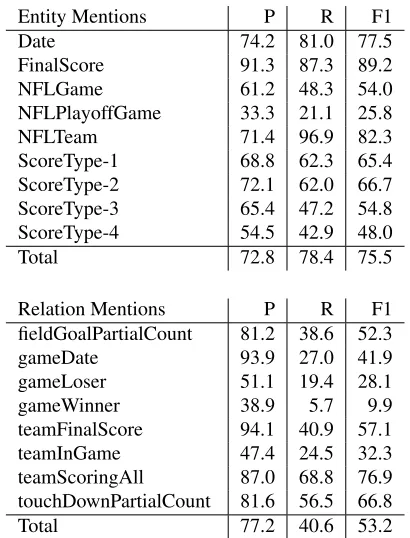
Table 5: Performance after gazetteer-based features were added to the EMD model, and NFLTeam entity mentions were extracted using the rule-based model rather than classification.
typical game descriptors. The game descriptors were manually bootstrapped from three seed words (“victory”, “loss”, “game”) using Dekang Lin’s dependency-based thesaurus.9 This process added other relevant game descriptors such as “triumph”, “defeat”, etc. All in all, our gazetteer includes 32 team names and 50 game descriptors. The gazetteer was built in less than four person hours.
We added features to our EMD model to indi-cate if a sequence of words matches a gazetteer en-try, allowing approximate matches (e.g., “Cowboys” matches “Dallas Cowboys”). Table 4 lists the results after this change. The improvements are modest: 0.3 for both EMD and RMD, caused by a 0.8 improve-ment for NFLTEAM. The score for NFLGAME suf-fers a loss of 1.5 F1 points, probably caused by the fact that our NFLGAMEgazetteer is incomplete.
These results are somewhat disappointing: even though our gazetteer contains an exhaustive list of NFL team names, the EMD recall for NFLTEAM is still relatively low. This happens because city
9
names that are not references to team names are rela-tively common in this corpus, and the CRF model fa-vors the generic city name interpretation. However, since the goal is to answer structured queries over the extracted relations, we would prefer a model that favors recall for EMD, to avoid losing candi-dates for RMD. While this can be achieved in dif-ferent ways (Minkov et al., 2006), in this paper we implement a very simple approach: we recognize NFLTEAMmentions with a rule-based system that extracts all token sequences that begin, end, or are equal to a known team name. For example, “Green Bay” and “Packers” are marked as team mentions, but not “Bay”. Note that this approach is prone to in-troducing false positives, e.g., “Green” in the above example. For all other entity types we use the CRF model with gazetteer-based features. Table 5 lists the results for this model combination. The table shows that the RMD performance is improved by 3 F1 points. The F1 score for NFLTEAMmentions is also improved by 3 points, due to a significant in-crease in recall (from 81% to 97%).
Of course, this simple idea works only for en-tity types with low ambiguity. In fact, it does not improve results if we apply it to NFLGAME or SCORETYPE-*. However, low ambiguity entities are common in many domains (e.g., medical). In such domains, our approach offers a straightforward way to address potential recall errors of a machine learned model.
[image:6.612.325.529.52.319.2]5.2 Improving Head Identification for Entity Mentions
Table 1 indicates that most RMD features (e.g., lex-ical information on arguments, dependency paths between arguments) depend on the syntactic heads of entity mentions. This observation applies to other natural language processing (NLP) tasks as well, e.g., semantic role labeling or coreference res-olution (Gildea and Jurafsky, 2002; Haghighi and Klein, 2009). It is thus crucial that syntactic heads of mentions be correctly identified. Originally we employed a common heuristic: we first try to find a constituent with the exact same span as the given en-tity mention in the parse tree of the entire sentence, and extract its head. If no such constituent exists, we parse only the text corresponding to the mention and return the head of the generated tree (Haghighi
Entity Mentions P R F1
Date 69.5 75.9 72.5
FinalScore 90.9 88.8 89.8
NFLGame 60.5 51.0 55.4
NFLPlayoffGame 37.0 26.3 30.8
NFLTeam 72.4 98.3 83.4
ScoreType-1 69.7 62.1 65.7
ScoreType-2 76.9 63.3 69.4
ScoreType-3 64.3 50.0 56.3
ScoreType-4 72.7 57.1 64.0
Total 73.2 79.2 76.1
Relation Mentions P R F1
fieldGoalPartialCount 81.2 55.4 65.9
gameDate 93.9 27.0 41.9
gameLoser 51.2 17.7 26.3
gameWinner 50.0 8.9 15.2
teamFinalScore 96.5 47.4 63.6
teamInGame 48.3 33.5 39.5
teamScoringAll 86.7 72.9 79.2
touchDownPartialCount 89.1 61.2 72.6
[image:6.612.355.497.446.526.2]Total 78.5 45.9 57.9
Table 6: Performance with the improved syntactic head identification rules.
and Klein, 2009). Here we argue that the last step of this heuristic is flawed: since most parsers are heav-ily context dependent, they are likely to not parse correctly arbitrarily short text fragments. For exam-ple, the Stanford parser generates the incorrect parse tree:
The syntactic head is “5” for the mention “a 5-yard scoring pass” instead of “pass.”10 This problem is exacerbated out of domain, where the parse tree of the entire sentence is likely to be incorrect, which will often trigger the parsing of the isolated men-tion text. For example, in the NFL domain, more than 25% of entity mentions cannot be matched to a constituent in the parse tree of the corresponding sentence.
10We tokenize around dashes in this domain because scores
teamFinalScore(G, S) :- teamInGame(T, G), teamScoringAll(T, S).
teamFinalScore(G, S) :- gameWinner(T, G), teamScoringAll(T, S).
teamFinalScore(G, S) :- gameLoser(T, G), teamScoringAll(T, S).
teamInGame(G, T) :- teamScoringAll(T, S), teamFinalScore(G, S).
gameWinner(G, T1) :- teamInGame(G, T1), teamInGame(G, T2),
teamFinalScore(G, S1), teamFinalScore(G, S2), teamScoringAll(T1, S1), teamScoringAll(T2, S2),
greaterThan(S1, S2).
gameLoser(G, T1) :- teamInGame(G, T1), teamInGame(G, T2),
[image:7.612.119.506.53.186.2]teamFinalScore(G, S1), teamFinalScore(G, S2), teamScoringAll(T1, S1), teamScoringAll(T2, S2), lessThan(S1, S2).
Table 7: Deterministic inference rules for the NFL domain as first-order Horn clauses. G,T, andSindicate game, team, and score variables.
In this work, we propose several simple heuristics that improve the parsing of isolated mention texts:
• We append “It was ” to the beginning of the text to be parsed. Since entity mentions are noun phrases (NP), the new text is guaranteed to be a coherent sentence. A similar heuristic was used by Moldovan and Rus for the parsing of WordNet glosses (2001).
• Because dashes are uncommon in the Penn Treebank, we remove them from the text before parsing.
• We guide the Stanford parser such that the final tree contains a constituent with the same span as the mention text.11
After implementing these heuristics, the Stanford parser correctly parses the mention in the above ex-ample as a NP headed by “pass”. Table 6 lists the overall extraction scores after deploying these heuristics. The table shows that the RMD F1 score is a considerable 4.7 points higher than before this change (Table 5).
5.3 Deterministic Inference for RMD
Figure 1 underlines the fact that relations in the NFL domain are highly inter-dependent. This is a com-mon occurrence in many extraction tasks and do-mains (Poon and Vanderwende, 2010; Carlson et al., 2010). The typical way to address these situa-tions is to jointly model these relasitua-tions, e.g., using Markov logic networks (MLN) (Poon and Vander-wende, 2010). However, this implies a complete redesign of the corresponding IE system, which would essentially ignore all the effort behind exist-ing pipeline systems.
11This is supported by the parser API.
Relation Mentions P R F1
fieldGoalPartialCount 81.2 55.4 65.9
gameDate 93.9 27.0 41.9
gameLoser 45.9 27.4 34.3
gameWinner 45.6 25.2 32.5
teamFinalScore 96.5 47.4 63.6
teamInGame 48.1 44.7 46.4
teamScoringAll 86.7 72.9 79.2
touchDownPartialCount 89.1 61.2 72.6
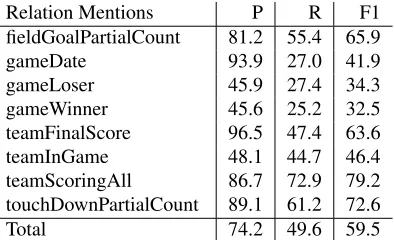
Total 74.2 49.6 59.5
Table 8: Performance after adding deterministic infer-ence. The EMD scores are not affected by this change, so they are not listed here.
In this work, we propose a simple method that captures some of the joint domain structure indepen-dently of the IE architecture and the EMD and RMD models. We add a deterministic inference compo-nent that generates new relation mentions based on the data already extracted by the pipeline model. Ta-ble 7 lists the rules of this inference component that were developed for the NFL domain. These rules are domain-dependent, but they are quite simple: the first four rules implement transitive-closure rules for relation mentions centered around the same NFL-GAMEmention; the last two add domain knowledge that is not captured by the text extractors, e.g., the game winner is the team with the higher score. Ta-ble 8, which lists the RMD scores after inference, in-dicates that the inference component is responsible for an increase of approximately 2 F1 points, caused by a recall boost of approximately 4%.
[image:7.612.330.527.229.349.2]Without Inference With Inference
P R F1 P R F1
Skip gameWinner, gameLoser 78.6 45.6 57.7 75.1 48.4 58.8
Skip teamInGame 77.0 43.6 55.7 71.7 49.4 58.5
Skip teamInGame, teamFinalScore 74.5 37.1 49.6 70.9 47.6 56.9
[image:8.612.147.471.55.127.2]Skip nothing 78.5 45.9 57.9 74.2 49.6 59.5
Table 9: Analysis of different combination strategies between the RMD classifier and inference: the RMD model skips the relation types listed in the first column; the inference component generates all relation types. The other columns show relation mention scores under the various configurations.
EMD RMD
F1 F1
Baseline 73.7 49.7
+ gazetteer features 74.0 50.2
+ rule-based model for NFLTeam 75.5 53.2
+ improved head identification 76.1 57.9
+ inference 76.1 59.5
Table 10: Summary of domain customization results. that inference helps in all configurations, and, most importantly, it is robust: even though the RMD score without inference decreases by up to 8 F1 points as relations are removed, the score after inference varies by less than 3 F1 points (from 56.9 to 59.5 F1). This proves that deterministic inference is ca-pable of generating relation mentions that are either missed or cannot be modeled by the RMD classifier.
Finally, Table 10 summarizes the experiments presented in this paper. It is clear that, despite their simplicity, all our proposed ideas help. All in all, our contributions yielded an improvement of 9.8 F1 points (approximately 20% relative) over the stock IE system without these changes. Our best IE sys-tem was used in a blind evaluation within the Ma-chine Reading project. In this evaluation, systems were required to answer 50 queries similar to the examples in Section 4 and were evaluated on the correctness of the individual facts extracted. Note that this evaluation is more complex than the exper-iments reported until now, because the correspond-ing IE system requires additional components, e.g., the normalization of all DATE mentions and event coreference (i.e., are two different game mentions referring to the same real-world game?). For this evaluation, we used an internal script for date nor-malization and we did not implement event corefer-ence. This system was evaluated at 46.7 F1 (53.7 precision and 41.2 recall), a performance that was approximately 80% of the F1 score obtained by hu-man annotators. This further highlights that strong
IE performance can be obtained with simple models.
6 Conclusions
This paper introduces a series of simple ideas that improve the performance of IE systems when they are customized to new domains. We evaluated our contributions on a sports domain (NFL game sum-maries) that is significantly different from the do-mains used to develop our IE system or the language processors used by our system.
Our analysis revealed several interesting and non-obvious facts. First, we showed that accurate identi-fication of syntactic heads of entity mentions, which has received little attention in IE literature, is cru-cial for good performance. Second, we showed that a deterministic inference component captures some of the joint domain structure, even when the under-lying system follows a pipeline architecture. Lastly, we introduced a simple way to tune precision and recall by combining our entity mention extractor with a rule-based system. Overall, our contributions yielded a 20% improvement in the F1 score for rela-tion menrela-tion extracrela-tion.
We believe that our contributions are model inde-pendent and some, e.g., the better head identifica-tion, even task independent. Some of our ideas re-quire domain knowledge, but they are all very sim-ple to imsim-plement. We thus expect them to impact other problems as well, e.g., coreference resolution, semantic role labeling.
Acknowledgments
[image:8.612.82.293.178.262.2]References
Andrew Carlson, Justin Betteridge, Richard C. Wang, Es-tevam R. Hruschka Jr., and Tom M. Mitchell. 2010. Coupled semi-supervised learning for information ex-traction. In Proceedings of the Third ACM Interna-tional Conference on Web Search and Data Mining (WSDM).
Marie-Catherine de Marneffe, Bill MacCartney, and Christopher D. Manning. 2006. Generating typed dependency parses from phrase structure parses. In LREC.
Jenny Rose Finkel, Trond Grenager, and Christopher Manning. 2005. Incorporating non-local information into information extraction systems by gibbs sampling. InProceedings of the 43nd Annual Meeting of the As-sociation for Computational Linguistics (ACL 2005). Radu Florian, John Pitrelli, Salim Roukos, and Imed
Zi-touni. 2010. Improving mention detection robustness to noisy input. InProc. of Empirical Methods in Nat-ural Language Processing (EMNLP).
Daniel Gildea and Daniel Jurafsky. 2002. Automatic la-beling of semantic roles. Computational Linguistics, 28(3).
Aria Haghighi and Dan Klein. 2009. Simple coreference resolution with rich syntactic and semantic features. In Proc. of Empirical Methods in Natural Language Processing (EMNLP).
Jin-Dong Kim, Tomoko Ohta, Sampo Pyysalo, Yoshi-nobu Kano, and Jun’ichi Tsujii. 2009. Overview of BioNLP’09 shared task on event extraction. In Pro-ceedings of the Workshop on BioNLP: Shared Task, pages 1–9. Association for Computational Linguistics. Dan Klein and Christopher D. Manning. 2003. Accu-rate unlexicalized parsing. InProceedings of the 41st Meeting of the Association for Computational Linguis-tics.
John Lafferty, Andrew McCallum, and Fernando Pereira. 2001. Conditional Random Fields: Probabilistic mod-els for segmenting and labeling sequence data. In Proc. of the International Conference on Machine Learning (ICML).
Andrei Mikheev, Marc Moens, and Claire Grover. 1999. Named entity recognition without gazetteers. In EACL, pages 1–8.
Einat Minkov, Richard C. Wang, Anthony Tomasic, and William W. Cohen. 2006. Ner systems that suit user’s preferences: Adjusting the recall-precision trade-off for entity extraction. InProc. of HLT/NAACL. M. Mintz, S. Bills, R. Snow, and D. Jurafsky. 2009.
Dis-tant supervision for relation extraction without labeled data. InProc. of the Conference of the Association for Computational Linguistics (ACL-IJCNLP).
Dan I. Moldovan and Vasile Rus. 2001. Logic form transformation of wordnet and its applicability to ques-tion answering. InProceedings of the Annual Meeting of the Association for Computational Linguistics. Hoifung Poon and Lucy Vanderwende. 2010. Joint
in-ference for knowledge extraction from biomedical lit-erature. InProceedings of the North American Chapter of the Association for Computational Linguistics -Human Language Technologies Conference (NAACL-HLT).
Lev Ratinov and Dan Roth. 2009. Design challenges and misconceptions in named entity recognition. InProc. of the Annual Conference on Computational Natural Language Learning (CoNLL).
D. Roth and W. Yih. 2007. Global inference for entity and relation identification via a linear programming formulation. InIntroduction to Statistical Relational Learning. MIT Press.
Jonathan Schuman and Sabine Bergler. 2006. Postnom-inal prepositional phrase attachment in proteomics. In Proceedings of the HLT-NAACL BioNLP Workshop on Linking Natural Language and Biology, pages 82–89. Association for Computational Linguistics, June. Mihai Surdeanu and Massimiliano Ciaramita. 2007.
Ro-bust information extraction with perceptrons. In Pro-ceedings of the NIST 2007 Automatic Content Extrac-tion Workshop (ACE07).
Mihai Surdeanu, Massimiliano Ciaramita, and Hugo Zaragoza. 2008. Learning to rank answers on large online qa collections. InProceedings of the 46th An-nual Meeting of the Association for Computational Linguistics (ACL 2008).