Proceedings of the SIGDIAL 2011: the 12th Annual Meeting of the Special Interest Group on Discourse and Dialogue, pages 49–58,
The Impact of Task-Oriented Feature Sets on
HMMs for Dialogue Modeling
Kristy Elizabeth Boyer
Eun Young Ha
Robert Phillips*
James Lester
Department of Computer Science
North Carolina State University
*Dual affiliation with Applied Research Associates, Inc. Raleigh, North Carolina, USA
{keboyer, eha, rphilli, lester}@ncsu.edu
Abstract
Human dialogue serves as a valuable model for learning the behavior of dialogue systems. Hidden Markov models’ sequential structure is well suited to modeling human dialogue, and their theoretical underpinnings are consistent with the conception of dialogue as a stochastic process with a layer of implicit, highly influen-tial structure. HMMs have been shown to be effective for a variety of descriptive and pre-dictive dialogue tasks. For task-oriented dia-logue, understanding the learning behavior of HMMs is an important step toward building unsupervised models of human dialogue. This paper examines the behavior of HMMs under six experimental conditions including different task-oriented feature sets and preprocessing approaches. The findings highlight the im-portance of providing HMM learning algo-rithms with rich task-based information. Additionally, the results suggest how specific metrics should be used depending on whether the models will be employed primarily in a de-scriptive or predictive manner.
1
Introduction
Human dialogue serves as a valuable model for learning the behavior of dialogue systems. For this reason, corpus-based approaches to dialogue man-agement tasks have been an increasingly active area of research (Bangalore, Di Fabbrizio, & Stent, 2006; Di Eugenio, Xie, & Serafin, 2010; Georgila, Lemon, Henderson, & Moore, 2009; Rotaru & Litman, 2009). Modeling the dialogue policies that
humans employ permits us to directly extract con-versational and task-based expertise. These tech-niques hold great promise for scaling gracefully to large corpora, and for transferring well across do-mains.
The richness and flexibility of human dialogue introduce nondeterministic and complex patterns that present challenges for machine learning ap-proaches. One approach that has been successfully employed in dialogue modeling is the hidden Mar-kov model (HMM) (Rabiner, 1989). These models are well suited to the sequential nature of dialogue (Stolcke et al., 2000). Moreover, their theoretical underpinnings are consistent with the conception of dialogue as a stochastic process whose observations are influenced by a layer of implicit, yet highly rel-evant, structure (Boyer et al., 2009; Woszczyna & Waibel, 1994).
HMMs have been shown to perform well on important dialogue management tasks such as au-tomatic dialogue act classification (Stolcke et al., 2000). Our work has employed HMMs for a differ-ent goal: learning dialogue policies, or strategies, from corpora (Boyer, Phillips, et al., 2010; Boyer, Phillips, Ingram, et al., in press). This work can be viewed from two perspectives. First, a descriptive
goal of the work is to learn models that describe the nature of human dialogues in succinct probabilistic terms, in a way that facilitates important qualitative investigations. The second and complementary goal
is predictive: learning models that accurately
pre-dict the dialogue moves of humans, in order to cap-ture a dialogue policy that can be used within a system.
Both of these goals are of paramount im-portance in tutorial dialogue, in which tutors and students engage in dialogue in support of a learning task (Boyer, Ha, et al., 2010; VanLehn et al., 2007). Descriptive modeling represents a critical step to-ward more fully understanding the phenomena that contribute to the high effectiveness of human tutor-ing, which has to date been unmatched by tutorial dialogue systems. Predictive models, on the other hand, may be used directly as dialogue policies within systems.
The HMMs considered here were learned from an annotated corpus of textual human-human tuto-rial dialogue. In this domain, HMMs have been shown to correspond qualitatively to widely held conceptions of tutorial dialogue strategies, and ad-jacency pair analysis before model learning has been shown to enhance this qualitative correspond-ence (Boyer et al., 2009). Moreover, HMMs can identify in an unsupervised fashion structural com-ponents that correlate with student knowledge gain (Boyer, Phillips, Ingram, et al., in press).
However, to date, several important questions have not been explored. The answers to these ques-tions have implicaques-tions for learning HMMs for task-oriented dialogues. The questions include the following: 1) How reliably does the HMM learning framework converge to the hyperparameter N, the best-fit number of hidden states? 2) What are the effects of preprocessing approaches, specifically, adjacency pair analysis, on the resulting HMMs? 3) How do different feature sets for task-oriented dialogue impact the descriptive fit and predictive power of learned HMMs? This paper addresses these questions. The findings suggest that model stability and predictive power benefit from the richest possible input sequences, which include not only dialogue acts but also information about the task state and the absence of particular tutor dia-logue moves. Additionally, we find that traditional measures of HMM goodness-of-fit may not identify the most highly predictive models under some con-ditions.
2
Background
HMMs have been used for dialogue modeling tasks for many years. Early work utilized HMMs to model underlying linguistic structure for the pur-poses of identifying speech acts and reducing per-plexity for speech recognition (Stolcke et al., 2000;
Woszczyna & Waibel, 1994). These projects treat-ed underlying dialogue structure as the hidden lay-er, and dialogue utterances as observations. This treatment is analogous to the work presented in this paper, except that our observations are dialogue act tags only, rather than being constituent words in each utterance. Our goals are also different: to cre-ate a qualitatively interpretable model of dialogue structure that corresponds to widely accepted no-tions of task-oriented dialogue, and to learn a high-ly predictive dialogue policy from a human-human dialogue corpus.
HMMs rely on treating dialogue as a sequential Markov process in which each observation depends only on a finite set of preceding observations. Some other approaches that rely on this assumption treat dialogue as a Markov decision process or partially observable Markov decision process, in which state changes are associated with actions and rewards (e.g., Young et al., 2010). Such work focuses on learning an optimal policy, typically utilizing a combination of human and simulated dialogue cor-pora. Reinforcement learning techniques can then be applied to learn the optimal policy based on the observed rewards. In contrast, we start with a rich corpus of human-human dialogue, which may have poor coverage in some areas (though the dialogue act tags were empirically derived and therefore mit-igate this problem to some extent), and subsequent-ly learn a model that explains the variance in that human corpus as well as possible.
3
Corpus
The corpus was collected during a human-human tutoring study. Students solved an introductory computer programming problem in the Java pro-gramming language. Tutors were located in a sepa-rate room and communicated with students through textual dialogue while viewing a synchronized view of the student’s problem-solving workspace. Forty-eight students interacted for approximately one hour each with a tutor. Students exhibited sta-tistically significant learning gains from pretest to posttest, indicating that the tutoring was effective (Boyer, Phillips, Ingram, et al., in press). The cor-pus contains 1,468 student moves and 3,338 tutor moves. Overlapping utterances, which are common in dialogue platforms such as instant messaging, were prevented by permitting only one user to con-struct a dialogue message at a time. Because the corpus is textual, utterances were segmented at tex-tual message boundaries except when the lead dia-logue annotator noted the presence of two separate dialogue acts within non-overlapping chunks of text. In these events the utterance was segmented by the primary annotator prior to being tagged by the second dialogue act annotator.
In addition to dialogue act annotation, the cor-pus was manually annotated for task structure and correctness (Section 3.2), and for delayed tutor feedback (Seciton 3.3). The appendix displays an excerpt from the annotated corpus.
3.1
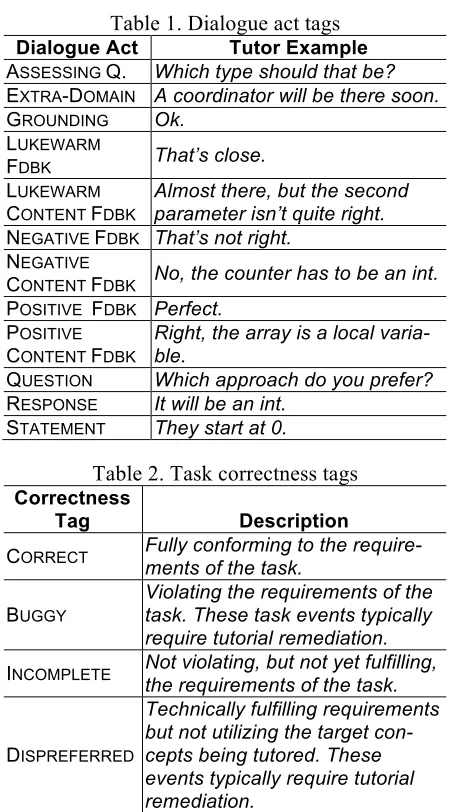
Dialogue Act AnnotationAs part of prior work, the corpus was annotated with dialogue acts for both tutor (Boyer, Phillips, Ingram, et al., in press) and student (Boyer, Ha, et al., 2010) utterances (Table 1). One annotator tagged the entire corpus, while a second annotator independently tagged a randomly selected 10% of tutoring sessions. The inter-annotator agreement Kappa score was 0.80.
3.2
Task AnnotationThe corpus includes 97,509 keystroke-level task events (computer programming actions), all taken by the student. Tutors viewed synchronously, but could not edit, the computer program. The task ac-tions were manually clustered and labeled for sub-task structure (Boyer, Phillips, et al., 2010). The task structure annotation was hierarchical, with
[image:3.612.313.540.175.581.2]leaves corresponding to specific subtasks such as creating a temporary variable in order to swap two variables’ values (subtask 3-c-iii-2). Each problem-solving cluster, or subtask, was then labeled for correctness (Table 2). These correctness labels are utilized in the models presented in this paper. The Kappa agreement statistic for the correctness anno-tation on 20% of the corpus was 0.80.
Table 1. Dialogue act tags Dialogue Act Tutor Example ASSESSING Q. Which type should that be?
EXTRA-DOMAIN A coordinator will be there soon.
GROUNDING Ok.
LUKEWARM
FDBK That’s close. LUKEWARM
CONTENT FDBK
Almost there, but the second parameter isn’t quite right.
NEGATIVE FDBK That’s not right. NEGATIVE
CONTENT FDBK No, the counter has to be an int. POSITIVE FDBK Perfect.
POSITIVE CONTENT FDBK
Right, the array is a local varia-ble.
QUESTION Which approach do you prefer?
RESPONSE It will be an int.
STATEMENT They start at 0.
Table 2. Task correctness tags Correctness
Tag Description
CORRECT Fully conforming to the
require-ments of the task.
BUGGY
Violating the requirements of the task. These task events typically require tutorial remediation.
INCOMPLETE Not violating, but not yet fulfilling,
the requirements of the task.
DISPREFERRED
Technically fulfilling requirements but not utilizing the target con-cepts being tutored. These events typically require tutorial remediation.
3.3
Annotation for Delayed Tutor Feedbackse-mantics of the computer program compared to the desired outcome. The human tutors were working with only one student at a time and were carefully monitoring student task actions during the dialogue, so we take the absence of a dialogue move at a rel-evant point to be an intentional choice by the tutor to delay feedback as part of the tutorial strategy. The automatic annotation for delayed feedback in-troduced two new event tags: NO-MENTION of cor-rectly completed subtasks, and NO-REMEDIATION of existing bugs within the task.
The intuition behind these tags is that within a learned dialogue policy, specifically modeling when not to intervene is crucial. Typically human tutors mention correctly completed subtasks, but at times other tutorial goals eclipse the importance of doing so. The NO-MENTION tag captures these in-stances. On the other hand, typically when working with novices, human tutors remediate an existing bug quickly. However, tutors may choose to delay this remediation for a variety of reasons such as remediating a different bug instead or asking a con-ceptual question to encourage the student to reflect on the issue. The NO-REMEDIATION tag captures these instances of the absence of remediation given that a bug was present. These two annotations for delayed feedback were performed automatically (Boyer, Phillips, Ha, et al., in press).
3.4
Adjacency Pair ModelingPrior work has demonstrated that adjacency pairs can be identified in an unsupervised fashion from a corpus (Midgley, Harrison, & MacNish, 2006). This technique relies on statistical analysis to de-termine the significant dependencies that exist be-tween pairs of dialogue acts, or in our task-oriented corpus, pairs of dialogue acts or task actions. After the pairs of dependent events are identified, they are joined within the corpus algorithmically (Boyer et al., 2009). Joining a pair of dependent moves in this way is equivalent to introducing a deterministic (probability=1) succession between observation symbols. This type of dependency cannot be learned in the traditional first-order HMM frame-work, but is desirable when two observations are strongly linked.1
1 Enhanced HMM structures, such as autoregressive HMMs, which allow for direct graphical links between observation symbols, can learn such a dependency but only in stochastic terms.
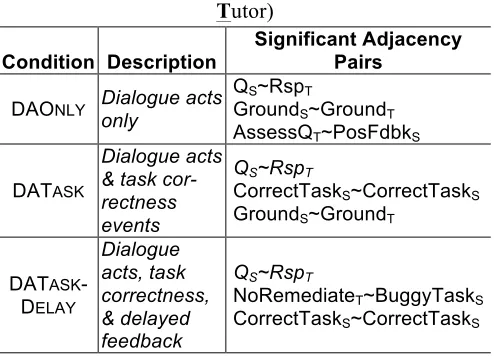
[image:4.612.303.550.156.334.2]The experiment that is described in Section 4 utilizes different feature sets to learn and compare HMMs. Table 3 shows these feature sets and their most highly statistically significant adjacency pairs. Table 3. Experimental conditions and top three ad-jacency pairs (subscripts denote speaker, Student or
Tutor)
Condition Description
Significant Adjacency Pairs
DAONLY Dialogue acts
only
QS~RspT
GroundS~GroundT
AssessQT~PosFdbkS
DATASK
Dialogue acts & task cor-rectness events
QS~RspT
CorrectTaskS~CorrectTaskS
GroundS~GroundT
DATASK -DELAY
Dialogue acts, task correctness, & delayed feedback
QS~RspT
NoRemediateT~BuggyTaskS
CorrectTaskS~CorrectTaskS
4
Models
HMMs were selected as the modeling framework for this work because their sequential nature is well suited to the structure of human dialogue, and their “hidden” variable corresponds to widely held con-ceptions of dialogue as having an unobservable, but influential, layer of stochastic structure. For exam-ple, in tutoring, an “explanation” mode is common, in which the tutor presents new information and the student provides acknowledgments or takes task actions accordingly. Although the presence of the “explanation” goal is not directly observable in most dialogues, it may be inferred from the obser-vations. These sequences correspond to the input observations for learning an HMM.
4.1
Hidden Markov ModelsHMMs explicitly model hidden states within a doubly stochastic structure (Rabiner, 1989).A first-order HMM, in which each hidden state depends only on the immediately preceding hidden state, is defined by the following components:
• ∑ = {σ1, σ2, …, σM}, the observation
sym-bol alphabet
• Π=[πi], i=1,…,N, the initial probability dis-tribution, where πi is the probability of the model beginning in hidden state si in S • A=[aij], a transition probability distribution,
where aij is the probability of the model transitioning from hidden state i to hidden state j for i,j=1,…,N
• B=[bik], an emission probability distribu-tion where bik is the probability of state i
(i=1,…,N) emitting (or generating)
obser-vation symbol k (k=1,…,M).
4.2
Dialogue Modeling with HMMsIn this work, the observation symbol alphabet ∑is given. For each experimental condition, ∑ is either 1) all dialogue act tags, 2) all dialogue acts plus task correctness tags, or 3) dialogue act, task cor-rectness, and delayed feedback tags. The transition probability distribution A, emission probability dis-tribution B, and initial probability distribution Π are learned by the standard Baum-Welch algorithm for optimizing HMM parameters (Rabiner, 1989). This algorithm is susceptible to becoming trapped in local optima, so our approach uses ten-time random restart with new initial parameters for each model to reduce the probability of selecting a model that represents only a local optimum.
The hyperparameter N, which is the best number of hidden states, is also learned rather than fixed. This process involves running the full HMM train-ing algorithm, includtrain-ing random restarts in ten-fold cross-validation, across the data and selecting the N
that corresponds to the best mean goodness-of-fit measure. For HMMs, a typical goodness-of-fit measure is log-likelihood, which captures how like-ly the observations would be under the current model. The log is taken for practical reasons, to avoid numerical underflow. Higher log-likelihood corresponds to improved model fit. However, typi-cally it is desirable to penalize a higher number of hidden states, since increasing the model complexi-ty results in tradeoffs that may not be fully warrant-ed by the improvement in model fit. In this work, we utilize the Akaike Information Criterion (AIC), a standard penalized log-likelihood metric (Akaike, 1976).
AIC = 2*N – 2*ln(likelihood) Lower values of AIC indicate better model fit.
4.3
Experimental ConditionsHMMs were learned using three separate feature sets, each providing a progressively more complete picture of the task-oriented dialogues: dialogue acts only (DAONLY), dialogue acts and task events (DATASK), and dialogue acts with both task cor-rectness events and tags for delayed tutor feedback (DATASKDELAY).
In addition to the three different feature sets, each condition included one of two types of pre-processing. Each type of model was trained on un-altered sequences of the annotated tags, which we refer to as the UNIGRAM condition. Additionally, each type of model was trained on sequences with statistically dependent adjacency pairs joined in a preprocessing step as described in Section 3.4. The UNIGRAM and ADJPAIR conditions were explored for each of the three feature sets, resulting in six experimental conditions. These conditions were chosen in order to explore the convergence behav-ior of HMMs under the different feature sets and preprocessing, and to compare measures of descrip-tive fit with measures of predicdescrip-tive power.
4.4
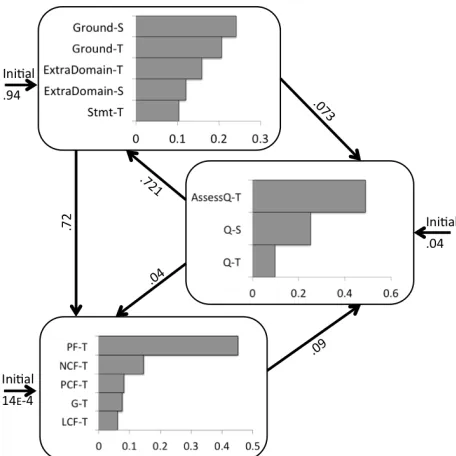
Learned HMMsFigures 1 and 2 show a subset of the DAONLY UNIGRAM model and the DATASKDELAY ADJPAIR model. These figures depict the structure of our HMMs: each hidden state is associated with an emission probability distribution over the possible observation symbols.
5
Goodness-of-Fit Curves
Figure 1. Subset of learned HMM (N=13) for DAONLY UNIGRAM condition
Figure 2. Subset of learned HMM (N=9) for DATASKDELAY ADJPAIR condition
5.1
Impact of Experimental ConditionsFor the DAONLY condition, both the UNIGRAM and ADJPAIR models generally improve until N=12 or 13, after which the fit generally worsens. A
differ-ent pattern emerges for the DATASK condition, in which the UNIGRAM sequences are optimally fit to a model with 16 states, while the ADJPAIR se-quences are fit to a model with 8 states. Finally, for the DATASKDELAY condition, the UNIGRAM se-quences are best fit by a model with 10 hidden states, while the ADJPAIR sequences are fit best by 9. Typically, we see that ADJPAIR sequences are fit to slightly simpler models in terms of the hy-perparameter N, number of hidden states.
Figure 3. Number of hidden states and cor-responding adjusted AIC, shifted to a
mini-Ad
ju
st
e
d
AI
C
a) Dialogue ActsOnly (DAONLY)
N (number of hidden states)
Ad
ju
st
e
d
AI
C
b) Dialogue Act and Task Events (DATASK)
N (number of hidden states)
Ad
ju
st
e
d
AI
C
c) Dialogue Act, Task, & Delayed Feedback (DATASKDELAY)
[image:6.612.66.296.338.614.2]Stability in the hyperparameter N is an im-portant consideration because an underlying as-sumption of our work is that the hidden states correspond to unobserved stochastic structures of
the real world process—that is, we hypothesize
that a “true” value for N exists. We would like models to exhibit decreasing variation in goodness of fit measures around this true N. To examine this stability we consider the three best AIC values for each condition and their corresponding Ns: the set {Nk-best | k=1,2,3}. The range of this set indicates
how “far apart” the best three Ns are: for example, in the DAONLY UNIGRAM condition, the top three models have Ns of {13,10,15}, yielding a range of
5. Intuitively, a small value for this metric indicates that the model has converged tightly on N.
[image:7.612.316.544.236.373.2]Figure 4 shows the stability results for the six different experimental conditions. As shown in the figure, for the DATASK and DATASKDELAY condi-tions, the ADJPAIR models achieve the smallest range among the top three values of N; these mod-els converge most tightly to the “best” value.
Figure 4. Stability of N (range of {N1best, N2best,
N3best}) – smaller implies tighter convergence to
“best” N
6
Predictive Analysis
Section 5 presented an analysis of the goodness-of-fit curves of HMMs learned from the corpus. The measures of stability and discrimination for N cap-ture important aspects of the behavior of HMMs toward this parameter, which is conceived of as representing “true” real-world stochastic behavior. In this way, Section 5 has presented a descriptive view of HMM dialogue models.
This section presents a predictive view of the models. Specifically, we consider prediction accu-racy, defined as the percent of tutor dialogue moves
that the model is able to correctly predict given the dialogue history sequence up to that point.
6.1
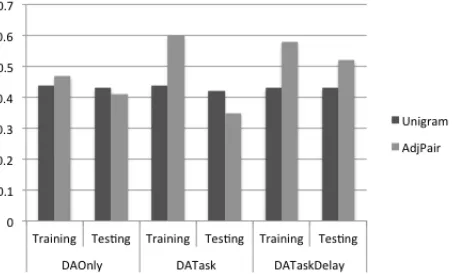
Impact of Dependent Adjacency PairsWe first explore whether the preprocessing step of joining dependent adjacency pairs impacted predic-tion accuracy. The predicpredic-tion accuracy of the best-fit model in each condition is displayed in Figure 5. This figure includes prediction accuracy on training data, which were used to learn model parameters, as well as prediction accuracy on testing data, which were withheld from model training.
Figure 5. Prediction accuracy for tutor moves
As shown in Figure 5, joining the adjacency pairs improved model performance on the training sets of all three conditions, indicating that the varia-tion within the training data was better explained by ADJPAIR models. (This measure of predictive power is different from a goodness-of-fit criterion as described in the previous section, a relationship that will be discussed further in Section 7.) In con-trast to the training set performance, the ADJPAIR models performed better than UNIGRAM models for the testing set only in the DATASKDELAY condi-tion.
6.2
Impact of Task-Oriented Feature Sets [image:7.612.67.302.356.501.2]suggesting possible overfitting to the training set. This relationship is discussed further in Section 7. The DATASKDELAY model performs well during both training and testing, though with a slight de-crease in accuracy on the testing set.
6.3
Relationship Between Predictive and De-scriptive MetricsMeasures of fit such as log-likelihood and AIC cap-ture the likelihood of observing the data given a model. Predictive accuracy, on the other hand, measures the probability that the model can predict the next observation given a partial sequence. In general, we would expect these measures to corre-late well; however, there is not perfect correlation between these metrics because the mechanism by which log-likelihood (and thereby AIC) is derived involves maximizing likelihood over complete se-quences, while prediction is performed over partial sequences.
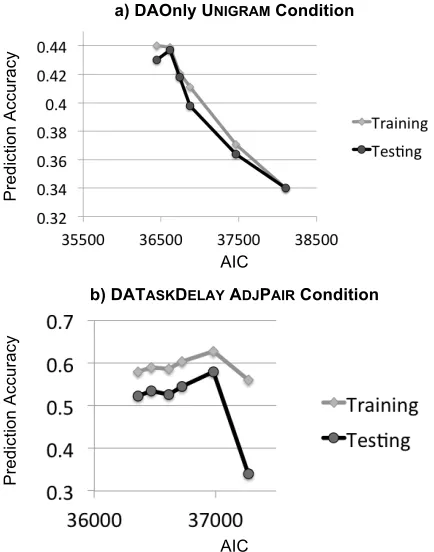
To examine how well AIC and prediction accu-racy correlate, Figure 6 displays these values for a subset of the models in the DAONLY UNIGRAM condition and the DATASKDELAY ADJPAIR condi-tion. These two conditions represent the extremes of the experimental conditions, with DAONLY con-taining the least information about the task-oriented dialogue while DATASKDELAY contains the most information.
As shown in Figure 6, the correlation for DAONLY UNIGRAM roughly conforms to what would be expected: lower AIC, indicating better model fit, is associated with the highest prediction accuracies. The relationship is less clear for the DATASKDELAY ADJPAIR condition. While its worst AIC is associated with the lowest prediction accuracy as expected, the best AIC is not associated with the highest prediction accuracy. This phenom-enon may be due to the lack of spread among AIC values overall for this condition; as seen in Figure 3, the DATASKDELAY ADJPAIR condition has the flattest AIC curve of all conditions, indicating that for this condition the difference between best-fit and worst-fit models is smaller than for any other condition. The inconsistent relationship between AIC and prediction accuracy, therefore, may be the product of noise surrounding a large set of “good” models, whereas for the DAONLY UNIGRAM condi-tion, the set of good models is smaller.
7
Discussion
The results suggest several important findings re-garding feature sets and preprocessing for learning HMMs of task-oriented dialogue. First, the models’ convergence patterns to a best-fit N, number of hidden states, indicate that more information em-bedded within the sequences may correspond with a flatter goodness-of-fit curve. Adding more infor-mation to the input sequences may introduce some regularities that partly mitigate the limitations of even a poorly fit HMM. This additional infor-mation may come in the form of adjacency pairs discovered in an unsupervised fashion, which im-proved the stability of convergence on the best-fit
N under the DATASK and DATASKDELAY condi-tions. This increased stability is likely due to the fact that under these conditions, leveraging adja-cency pair information augments the HMM’s struc-ture with contextual dependencies that could otherwise not be learned under the traditional HMM framework.
For predictive accuracy, the benefits of richer input sequences are also highlighted. The most highly predictive models included all three sources
Pr
e
d
ic
tio
n
Ac
cu
ra
cy
a) DAOnly UNIGRAM Condition
AIC
Pr
e
d
ic
tio
n
Ac
cu
ra
cy
b) DATASKDELAY ADJPAIR Condition
[image:8.612.314.531.76.352.2]AIC
of information: dialogue acts, task events, and de-layed feedback tags. However, with the addition of this rich information to the input sequences and the accompanying flatter goodness-of-fit curve as dis-cussed above, we noted an irregular pattern of cor-relation between goodness-of-fit and predictive accuracy that is worthy of future exploration. Spe-cifically, it appears that the most highly predictive DATASKDELAY ADJPAIR model, which is the most highly predictive of all models in all conditions, does not correspond to the best (lowest) AIC for that condition (Figure 3). This finding suggests that when a predictive task is the primary goal, a predic-tive metric should be used to select the best-fit model. Additional support for such an approach is provided by the close correspondence between training and testing set prediction accuracy.
8
Conclusion
Understanding how HMMs behave under different feature sets is an important step toward learning effective models of task-oriented dialogue. This paper has examined how HMMs converge to a best number of hidden states under different experi-mental conditions. We have also considered how well HMMs under these conditions predict tutor dialogue acts within a corpus of task-oriented tutor-ing, a crucial step toward learning dialogue policies from human corpora. The findings highlight the importance of adding rich task-based features to the input sequences in order to learn HMMs that con-verge tightly on the best-fit number of hidden states. The results also indicate that caution should be used when utilizing traditional goodness-of-fit metrics, which are appropriate for descriptive ap-plications, if the goal is to learn a highly predictive model.
This line of research is part of a larger research program of learning unsupervised models of human task-oriented dialogue that can be used to define the behavior of dialogue systems. Developing a framework for learning a dialogue policy from hu-man corpora, as discussed here, is a critical step toward that goal. Future work should focus on un-supervised dialogue act classification, and address the challenges of user plan recognition.
Acknowledgments. This work is supported in part by National Science Foundation through Grants REC-0632450, IIS-0812291, DRL-1007962 and the STARS
Alliance Grant CNS-0739216. Any opinions, findings, conclusions, or recommendations expressed in this re-port are those of the participants, and do not necessarily represent the official views, opinions, or policy of the National Science Foundation.
References
Akaike, H. (1976). An information criterion (AIC).
Math. Sci., 14(153), 5-9.
Bangalore, S., Di Fabbrizio, G., & Stents, A. (2006). Learning the structure of task-driven human-human dialogs. Proceedings of ACL ’06, 201-208. Boyer, K. E., Ha, E. Y., Phillips, R., Wallis, M. D.,
Vouk, M. A., & Lester, J. C. (2010). Dialogue Act Modeling in a Complex Task-Oriented Domain.
Proceedings of SIGDIAL (pp. 297-305). Boyer, K. E., Phillips, R., Ha, E. Y., Wallis, M. D.,
Vouk, M. A., & Lester, J. C. (in press). Learning a Tutorial Dialogue Policy for Delayed Feedback.
Proceedings of the 24th International FLAIRS Con-ference.
Boyer, K. E., Phillips, R., Ha, E. Y., Wallis, M. D., Vouk, M. A., & Lester, J. C. (2009). Modeling dia-logue structure with adjacency pair analysis and hid-den Markov models. Proceedings of NAACL HLT, Companion Volume, 49-52.
Boyer, K. E., Phillips, R., Ha, E. Y., Wallis, M. D., Vouk, M. A., & Lester, J. C. (2010). Leveraging Hidden Dialogue State to Select Tutorial Moves.
Proceedings of the NAACL HLT 2010 Fifth Work-shop on Innovative Use of NLP for Building Educa-tional Applications (pp. 66-73).
Boyer, K. E., Phillips, R., Ingram, A., Young, E., Wallis, M., Vouk, M., et al. (in press). Investigating the Re-lationship Between Dialogue Structure and Tutoring Effectiveness: A Hidden Markov Modeling Ap-proach. International Journal of Artificial Intelli-gence in Education.
Di Eugenio, B., Xie, Z., & Serafin, R. (2010). Dialogue Act Classification, Higher Order Dialogue Structure, and Instance-Based Learning. Dialogue & Dis-course, 1(2), 1-24.
Georgila, K., Lemon, O., Henderson, J., & Moore, J. D. (2009). Automatic annotation of context and speech acts for dialogue corpora. Natural Language Engi-neering, 15(3), 315-353.
Midgley, T. D., Harrison, S., & MacNish, C. (2006). Empirical verification of adjacency pairs using dia-logue segmentation. Proceedings of SIGDIAL, 104-108.
Rotaru, M., & Litman, D. J. (2009). Discourse Structure and Performance Analysis : Beyond the Correlation.
Proceedings of SIGDIAL (pp. 178-187).
Stolcke, A., Ries, K., Coccaro, N., Shriberg, E., Bates, R., Jurafsky, D., et al. (2000). Dialogue Act Model-ing for Automatic TaggModel-ing and Recognition of Con-versational Speech. Computational Linguistics,
26(3), 339-373.
VanLehn, K., Graesser, A. C., Jackson, G. T., Jordan, P., Olney, A., & Rose, C. P. (2007). When Are Tutorial
Dialogues More Effective Than Reading? Cognitive Science: A Multidisciplinary Journal, 30(1), 3-62. Woszczyna, M., & Waibel, A. (1994). Inferring
linguis-tic structure in spoken language. Proceedings of the International Conference on Spoken Language Pro-cessing (pp. 847-850).
Young, S., Gašić, M., Keizer, S., Mairesse, F.,
Schatzmann, J., Thomson, B., et al. (2010). The Hid-den Information State model: A practical framework for POMDP-based spoken dialogue management.
Computer Speech & Language, 24(2), 150-174.
Appendix. Excerpt from task-oriented textual human-human tutoring corpus.
Speaker Utterance or Event Tag
Student: [Task action on subtask 3-c-i-4] BUGGY
Student: [Task action on subtask 3-c-ii-5] CORRECT
Tutor: [Does not provide remediation for existing bug] NOREMEDIATION
Student: [Task action on subtask 3-c-iii-1] BUGGY
Student: i don't remember off the top of my head how the swap function worked. most of the time i just copied and pasted it from some of my older code
NEGATIVECONTENTFDBK
Tutor: The easiest way to swap x and y is to make a tempo-rary variable
Student: Ok ACK
Student: do i need to pass the entire array and the indecies of the items to swap?
ASSESSQ
Tutor: if you want to use a seperate method to swap, then yes, you'll have to pass those things
POSCONTENTFDBK
Tutor: [Does not mention a correctly completed subtask] NOMENTIONCOMP
Student: oh. i guess i could just swap it in the same method. it is problably easier that way, and less code. we were showed in class how to do it separately, but i had never thought of doing it the other way.
STMT
Student: [Task action on subtask 3-c-iii-2] DISPREFERRED
Tutor: Both ways work, but it’s definitely less code to just do it inside this method.
STMT