Scanning methods and language modeling for binary switch typing
Brian Roark†, Jacques de Villiers†, Christopher Gibbons◦and Melanie Fried-Oken◦ †
Center for Spoken Language Understanding ◦Child Development & Rehabilitation Center Oregon Health & Science University
{roark,jacques}@cslu.ogi.edu {gibbons,mfo}@ohsu.edu
Abstract
We present preliminary experiments of a binary-switch, static-grid typing interface making use of varying language model contri-butions. Our motivation is to quantify the de-gree to which language models can make the simplest scanning interfaces – such as show-ing one symbol at a time rather than a scan-ning a grid – competitive in terms of typing speed. We present a grid scanning method making use of optimal Huffman binary codes, and demonstrate the impact of higher order language models on its performance. We also investigate the scanning methods of highlight-ing just one cell in a grid at any given time or showing one symbol at a time without a grid, and show that they yield commensurate performance when using higher order n-gram models, mainly due to lower error rate and a lower rate of missed targets.
1 Introduction
Augmentative and Alternative Communication (AAC) is a well-defined subfield of assistive tech-nology, focused on methods that assist individuals for whom conventional spoken or written communi-cation approaches are difficult or impossible. Those who cannot make use of standard keyboards for text entry have a number of alternative text entry meth-ods that permit typing. One of the most common of these alternative text entry methods is the use of a binary switch – triggered by button-press, eye-blink or even through event related potentials (ERP) such as the P300 detected in EEG signals – that allows the individual to make a selection based on some method for scanning through alternatives (Lesher et al., 1998). Typing speed is a challenge, yet critically important for usability. One common approach is row/column scanning on a matrix of characters, symbols or images (a ‘spelling grid’), which allows the user of a binary yes/no switch to select the row and column of a target symbol, by simply indicating ‘yes’ (pressing a button or blinking an eye) when the
row or column of the target symbol is highlighted. Figure 1 shows the 6×6 spelling grid used for the P300 Speller (Farwell and Donchin, 1988).
For any given scanning method, the use of a bi-nary switch to select from among a set of options (letter, symbols, or images) amounts to the assign-ment of binary codes to each symbol. For example, the standard row/column scanning algorithm works by scanning each row until a selection is made, then scanning each column until a selection is made, and returning the symbol at the selected row and column. This can be formalized as follows:
1 for i = 1to (# of rows)do
2 HIGHLIGHTROW(i) 3 if YESSWITCH
4 for j = 1to (# of columns)do
5 HIGHLIGHTCOLUMN(j) 6 if YESSWITCH
7 return(i, j)
8 return(i,0)
9 return(0,0)
where the function YESSWITCH returns true if the button is pressed (or whatever switch event counts as a ‘yes’ response) within the parameterized latency. If the function returns(0,0)then nothing has been selected, requiring rescanning. If the function re-turns(i,0)fori > 0, then rowihas been selected, but columns must be rescanned. Under this scanning method, the binary code for the letter ‘J’ in the ma-trix in Figure 1 is 010001; the letter ‘T’ is 000101.
The length of the binary code for a symbol is
re-M G
A C E F
_ 9 7
6 5
3 4 Y Z 1
X W U
T S
R Q O
N H B
L K I
V
8 P J
[image:1.612.374.478.573.682.2]2 D
Figure 1: Spelling grid such as that used for the P300 speller (Farwell and Donchin, 1988). ‘ ’ denotes space.
lated to the time required to type it. In the ma-trix in Figure 1, the space character is in the bot-tom right-hand corner, yielding the maximum binary code length for that grid size (12), despite that, in typical written English we would expect the space character to be used about 20% of the time. A more efficient strategy would be to place the space charac-ter in the upper left-hand corner of the grid, leading to the much shorter binary code ‘11’.
Ordering symbols in a fixed grid so that frequent symbols are located in the upper left-hand corner is one method for making use of a statistical model of the language so that likely symbols receive the short-est codes. Such a language model, however, does not take into account what has already been typed, but rather assigns its code identically in all contexts. In this paper we examine alternative fixed-grid scan-ning methods that do take into account context in the language models used to establish codes, i.e., the codes in these methods vary in different contexts, so that high probability symbols receive the short-est codes and hence require the fewshort-est keystrokes. We show that n-gram language models can provide a large improvement in typing speed.
Before presenting our methods and experimental results, we next provide further background on alter-native text entry methods, language modeling, and binary coding based on language models.
2 Preliminaries and background 2.1 Alternative text entry
Of the ways in which AAC typing interfaces differ, perhaps most relevant to the current paper is whether the symbol positions are fixed or can move dynam-ically, because such dynamic layouts facilitate in-tegration of richer language models. For example, if we re-calculate character probabilities after each typed character, then we could re-arrange the char-acters in the grid so that the most likely are placed in the upper left-hand corner for row/column scan-ning. Conventional wisdom, however, is that the cognitive overhead of processing a different grid ar-rangement after every character would slow down typing more than the speedup due to the improved binary coding (Baletsa et al., 1976; Lesher et al., 1998). The GazeTalk system (Hansen et al., 2003), which presents the user with a 3×4 grid and captures which cell the user’s gaze fixates upon, is an instance of a dynamically changing grid. The cell layouts are configurable, but typically one cell contains a set of likely word completions; others are allocated to space and backspace; and around half of the cells are
allocated to the most likely single character contin-uation of the input string, based on language model predictions. Hansen et al. (2003) report that users produced more words per minute with a static key-board than with the predictive grid interface, illus-trating the impact of the cognitive overhead that goes along with this sort of scanning.
The likely word completions in the GazeTalk sys-tem illustrates another common way in which lan-guage modeling is integrated into AAC typing sys-tems. Much of the language modeling research within the context of AAC has been for word com-pletion/prediction for keystroke reduction (Darragh et al., 1990; Li and Hirst, 2005; Trost et al., 2005; Trnka et al., 2006; Trnka et al., 2007; Wandmacher and Antoine, 2007). The typical scenario for this is allocating a region of the interface to contain a set of suggested words that complete what the user has be-gun typing. The expectation is to derive a keystroke savings when the user selects one of the alternatives rather than typing the rest of the letters. The cogni-tive load of monitoring a list of possible completions has made the claim that this speeds typing contro-versial (Anson et al., 2004); yet some results have shown this to speed typing under certain conditions (Trnka et al., 2007).
One innovative language-model-driven AAC typ-ing interface is Dasher (Ward et al., 2002), which uses language models and arithmetic coding to present alternative letter targets on the screen with size relative to their likelihood given the history. Users can type by continuous motion, such as eye gaze or mouse cursor movement, targeting their cur-sor at the intended letter and moving the curcur-sor from left-to-right through the interface, while its movements are tracked. This is an extremely effec-tive typing interface alternaeffec-tive to keyboards, pro-vided the user has sufficient motor control to per-form the required systematic visual scanning. The most severely impaired users, such as those with locked-in syndrome (LIS), have lost the voluntary motor control sufficient for such an interface.
1 A←V initializeAas symbol setV
2 k←1 initialize bit positionkto 1 3 while |A|>1do
4 P← {a∈A:a[k] = 1}
5 Q← {a∈A:a[k] = 0}
6 Highlight symbols inP
7 if selectedthen A←P
8 else A←Q
9 k←k+ 1
10 returna∈A Only 1 element inA
Figure 2: Algorithm for binary code symbol selection
that the number of items in the grid caused prob-lems for these patients, because of difficulty orient-ing attention to specific locations in the spellorient-ing grid (Sellers et al., 2003). This is another illustration of the need to reduce the cognitive overhead of such in-terfaces. Yet the success of classification of ERP in a simpler task for this population indicates that the P300 is a binary response mechanism of utility for this task (Sellers and Donchin, 2006).
Simpler interactions via brain-computer inter-faces (BCI) hold much promise for effective text communication. Yet these simple interfaces have yet to take full advantage of language models to ease or speed typing. In this paper we will make use of a static grid, or a single letter linear scanning inter-face, yet scan in a way that allows for the use of contextual language model probabilities when con-structing the binary code for each symbol.
2.2 Binary codes for typing interfaces
Row/column scanning, as outlined in the previous section, is not the only means by which the spelling grid in Figure 1 can be used as a binary response typing interface. Rather than highlighting full rows or full columns, arbitrary subsets of letters could be highlighted, and letter selection again driven by a binary response mechanism. An algorithm to do this is as follows. Assign a unique binary code to each symbol in the symbol setV (letters in this case). For each symbol a ∈ V, there are|a| bits in the code representing the letter. Leta[k]be thekthbit of the code for symbola. We will assume that no symbol’s binary code is a prefix of another symbol’s binary code. Given such an assignment of binary codes to the symbol setV, the algorithm in Figure 2 can be used to select the target symbol in a spelling grid.
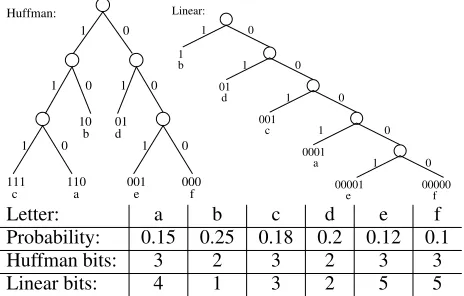
One key question in this paper is how to produce such a binary code, which is how language models can be included in scanning. Figure 3 shows two different binary trees, which yield different binary codes for six letters in a simple, artificial example.
Huffman: 1
0 1
1 0
1 0 1
0
0
000 f e a c
b d
001 110 111
01 10
Linear:
1 0 1
c 01
d b 1
f e
a
00000 00001
0001 001
1 0
0 1
0 1
0
Letter: a b c d e f
[image:3.612.316.548.67.215.2]Probability: 0.15 0.25 0.18 0.2 0.12 0.1 Huffman bits: 3 2 3 2 3 3 Linear bits: 4 1 3 2 5 5 Figure 3: Two binary trees for encoding letters based on letter probabilities: (1) Huffman coding; and (2) Linear coding via a right-branching tree (right-linear). Expected bits are 2.55 for Huffman and 2.89 for linear coding.
Huffman coding (Huffman, 1952) builds a binary tree that minimizes the expected number of bits ac-cording to the provided distribution. There is a lin-ear complexity algorithm for building this tree given a list of items sorted by descending probability.
Another type of binary code, which we will call a linear code, provides a lot of flexibility in the kind of interface that it allows, relative to the other methods mentioned above. In this binary code, each itera-tion of the WHILE loop in the Figure 2 algorithm would have a setP on line 4 with exactly one mem-ber. With such a code, the spelling grid in Figure 1 would highlight exactly one letter at a time for selection. Alternately, symbols could be presented one at a time with no grid, which we call rapid serial visual presentation (RSVP, see Fig.7). Linear cod-ing builds a simple right-linear tree (seen in Figure 3) that preserves the sorted order of the set, putting higher probability symbols closer to the root of the tree, thus obtaining shorter binary codes. Linear coding can never produce codes with fewer expected bits than Huffman coding, though the linear code may reach the minimum under certain conditions.
The simplicity of an interface that presents a sin-gle letter at a time may reduce user fatigue, and even make typing feasible for users that cannot maintain focus on a spelling grid. Additionally, single symbol auditory presentation would be possible, for visually impaired individuals, something that is not straight-forwardly feasible with the sets of symbols that must be presented when using Huffman codes.
pre-diction interface is the only means by which text is input, rather than a separate window with com-pletions being provided. In principle, the symbols that are being predicted (hence typed) can be from a vocabulary that includes multiple symbol strings such as words. However, a key requirement in a composition-based typing interface is an open vo-cabulary– the user should be able to type any word, whether or not it is in some fixed vocabulary. In-cluded in such a mechanism is the ability to repair: delete symbols and re-type new ones. In contrast, a word prediction component must be accompanied by some additional mechanism in place for typing words not in the vocabulary. The current problem is to use symbol prediction for that core typing inter-face, and this paper will focus on predicting single ASCII and control characters, rather than multiple character strings. The task is actually very similar to the well known Shannon game (Shannon, 1950), where text is guessed one character at a time.
Character prediction is done in the Dasher and GazeTalk interfaces, as discussed in an earlier sec-tion. There is also a letter prediction component to the Sibyl/Sibylle interfaces (Schadle, 2004; Wand-macher et al., 2008), alongside a separate word pre-diction component. Interestingly, the letter predic-tion component of Sibylle (Sibyletter) involves a lin-ear scan of the letters, one at a time in order of proba-bility (as determined by a 5-gram character language model), rather than a row/column scanning of the P300 speller. This approach was based on user feed-back that the row/column scanning was a much more tiring interface than the linear scan interface (Wand-macher et al., 2008), which is consistent with the results previously discussed on the difficulty of ALS individuals with the P300 speller interface.
Language modeling for a typing interface task of this sort is very different from other common lan-guage modeling tasks. This is because, at each sym-bol in the string, the already typed prefix string is given – there is no ambiguity in the prefix string, modulo subsequent repairs. In contrast, in speech recognition, machine translation, optical character recognition or T9 style text input, the actual pre-fix string is not known; rather, there is a distribu-tion over possible prefix strings, and a global in-ference procedure is required to find the best string as a whole. For typing, once the symbol has been produced and not repaired, the model predicting the next symbol is given the true context. This has sev-eral important ramifications for language modeling,
including the availability of supervised adaptation data and the fact that the models trained with rel-ative frequency estimation are both generrel-ative and discriminative. See Roark (2009) for extensive dis-cussion of these issues. Here we will consider n-gram language models of various orders, estimated via smoothed relative frequency estimation (see §
3.1). The principal novelty in the current approach is the principled incorporation of error probabilities into the binary coding approaches, and the experi-mental demonstration of how linear coding for grids or RSVP interfaces compare to Huffman coding and row/column scanning for grids.
3 Methods
3.1 Character-based language models
For this paper, we use character n-gram models. Carpenter (2005) has an extensive comparison of large scale character-based language models, and we adopt smoothing methods from that paper. It presents a version of Witten-Bell smoothing (Wit-ten and Bell, 1991) with an optimized hyperparam-eterK, which is shown to be as effective as Kneser-Ney smoothing (Kneser and Kneser-Ney, 1995) for higher order n-grams. We refer readers to that paper for de-tails on this standard n-gram language modeling ap-proach. For the experimental results presented here, we trained unigram and 8-gram models from the NY Times portion of the English Gigaword corpus.
We performed extensive normalization of this corpus, detailed in Roark (2009). We de-cased the resulting corpus and selected sentences that only included characters that would appear in our 6×6 spelling grid. Those characters are: the 26 letters of the English alphabet, the space character, a delete symbol, comma, period, double and single quote, dash, dollar sign, colon and semi-colon. We used a 42 million character subset of this corpus for training the model. Finally, we appended to this corpus approximately 112 thou-sand words from the CMU Pronouncing Dictionary (www.speech.cs.cmu.edu/cgi-bin/cmudict), which also contained only the symbols from the grid. For hyper-parameter settings, we used a 100k character development set. Our best performing hyper-parameter for the Witten-Bell smoothing was K = 15, which is comparable to optimal settings found by Carpenter (2005) for 12-grams.
3.2 Binary codes
Figure 4: Row/column scanning interface.
to all next symbols in the symbol setV. After sort-ing the set in order of decreassort-ing probability, we can use these probabilities to build binary coding trees for the set. Hence the binary code assigned to each symbol in the symbol set differs depending on what has been typed before. For Huffman coding, we used the algorithm from Perelmouter and Birbaumer (2000) that accounts for any probability of error in following a branch of the tree, and builds the optimal coding tree even when there is non-zero probability of taking a branch in error. Either linear or Huffman codes can be built from the language model proba-bilities, and can then be used for a typing interface, using the algorithm presented in Figure 2.
3.3 Scanning systems
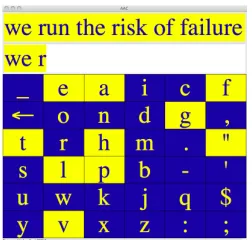
For these experiments, we developed an interface for controlled testing of typing performance under a range of scanning methods. These include: (i) row/column scanning, both auto scan (button press selects) and step scan (lack of button press selects); (ii) Scanning with a Huffman code, either derived from a unigram language model, or from an 8-gram language model; and (iii) Scanning with a linear code, either on the 6×6 grid, or using RSVP, which shows one symbol at a time. Each trial involved giv-ing subjects a target phrase with instructions to type the phrase exactly as displayed. All errors in typing were required to be corrected by deleting (via←) the incorrect symbol and re-typing the correct symbol.
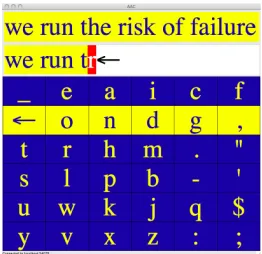
Figure 4 shows our typing interface when config-ured for row/column scanning. At the top of the application window is the target string to be typed by the subject (‘we run the risk of failure’). Below that is the buffer displaying what has already been typed (‘we run t’). Spaces between words must also be typed – they are represented by the underscore character in the upper left-hand corner of the grid. Spaces are treated like any other symbol in our lan-guage model – they must be typed, thus they are
pre-Figure 5: Error in row/column scanning interface.
dicted along with the other symbols. Figure 5 shows how the display updates when an incorrect character is typed. The errors are highlighted in red, followed by the backarrow symbol to remind users to delete.
If a row has not been selected after a pass over all rows, scanning begins again at the top. After row selection, column scanning commences; if a column is not selected after three passes from left-to-right over the columns, then row scanning re-commences at the following row. Hence, even if a wrong row is selected, the correct symbol can still be typed.
[image:5.612.361.492.59.186.2]mecha-Figure 6: Huffman scanning interface.
nism in row/column scanning for recovering if the wrong row is selected. Section 3.4 details our novel method for recalculating the binary codes based on an error rate parameter. At no point in typing is any character ruled out from being selected.
The grids shown in Figures 4-6 can be straightfor-wardly used with linear coding as well, by simply highlighting one cell at a time in descending proba-bility order. Additionally, linear coding can be used with an RSVP interface, shown in Figure 7, which displays one character at a time.
Each interface needs a scan rate, specifying how long to wait for a button press before advancing. The scan rate for each condition was set for each individ-ual during a training/calibration session (see§4.1).
3.4 Errors in Huffman and Linear scanning In this section we briefly detail how we account for the probability of error in scanning with Huffman and linear codes. The scanning interface takes a pa-rameterp, which is the probability that, when a se-lection is made, it is correct. Thus1−pis the proba-bility of an error. Recall that if a selection leads to a single symbol, then that symbol is typed. Otherwise, if a selection leads to a set with more than one sym-bol, thenallsymbol probabilities (even those not in the selected set) are updated based on the error prob-ability and scanning continues. If a non-target (in-correct) symbol is selected, the delete (backarrow) symbol must be chosen to correct the error, after which the typing interface returns to the previous position. Three key questions must be answered in such an approach: (1) how are symbol probabilities updated after a keystroke, to reflect the probability of error? (2) how is the probability of backarrow es-timated? and (3) when the typing interface returns to the previous position, where does it pick up the scanning? Here we answer all three questions.
[image:6.612.359.494.57.171.2]Consider the Huffman coding tree in Figure 3. If the left-branch (‘1’) is selected by the user, the prob-ability that it was intended ispversus an error with
Figure 7: RSVP scanning interface.
probability1−p. If the original probability of a sym-bol isq, then the updated probability of the symbol ispqif it starts with a ‘1’ and(1−p)qif it starts with a ‘0’. After updating the scores and re-normalizing over the whole set, we can build a new binary cod-ing tree. The user then selects a branch at theroot of the new tree. A symbol is finally selected when the user selects a branch leading to a single symbol. The same approach is used with a linear coding tree. The probability of requiring the delete (backar-row) character can be calculated directly from the probability of keystroke error – in fact, the probabil-ity of backarrow is exactly the probabilprobabil-ity of error 1−p. To understand why this is the case, consider that a non-target (incorrect) symbol can be chosen according to the approach in the previous paragraph only with a final keystroke error. Any keystroke error that does not select a single symbol does not eliminate the target symbol, it merely re-adjusts the target symbol’s probability along with all other sym-bols. Hence, no matter how many keystrokes have been made, the probability that a selected symbol was not the target symbol is simply the probability that the last keystroke was in error, i.e.,1−p.
Finally, if backarrow is selected, the previous po-sition is revisited, and the probabilities are reset as though no prior selection had been made.
4 Empirical results
4.1 Subjects and scan rate calibration
[image:6.612.123.249.58.178.2]strings were used in this study. We used an Ablenet JellybeanR button as the binary switch. For these
trials, to estimate error rates in modeling, we fixed p= 0.95, i.e., 5% error rate.
The scan rate for row/column scanning is typi-cally different than for Huffman or linear scanning, since row/column scanning methods allow for an-ticipation: one can tell from the current highlight-ing whether the desired row or column will be high-lighted next. For the Huffman and linear scanning approaches that we are investigating, that is not the case: any cell can be highlighted (or symbol dis-played) at any time, even multiple times in a row. Hence the scan rate for these methods depends more on reaction time than row/column scanning, where anticipation allows for faster rates.
The scan rate also differs between the two row/column scanning approaches (auto scan and step scan), due to the differences in control needed to advance scanning with a button press versus se-lecting with a button press. We thus ran scan rate calibration under three conditions: row/column step scan; row/column auto scan; and Huffman scan-ning, using a unigram language model. The Huff-man scanning scan rate was then used for all of the Huffman and linear scanning approaches.
Calibration involved two stages for each of the three approaches, and the first stage of all three is completed before running the second stage, thus fa-miliarizing subjects with all interfaces prior to final calibration. The first stage of calibration starts with slow scan rate (1200 ms dwell time), then speeds up the scan rate by reducing dwell time by 200 ms when a target string is successfully typed. Success here means that the string is correctly typed with less than 10% error rate. The subject gets three tries to type a string successfully at a given scan rate, after which they are judged to not be able to complete the task at that rate. In the first stage, this stops the stage for that method and the dwell time is recorded. In the second stage, calibration starts at a dwell time 500 ms higher than where the subject failed in the first stage, and the dwell time decreases by 100 ms in-crements when target strings are successfully typed. When subjects cannot complete the task at a dwell time, the dwell time then increases at 50 ms incre-ments until they can successfully type a target string. Table 1 shows the mean (and std) scan rates (dwell time) for each condition. Step scanning generally had a slower scan rate than auto scanning, and Huff-man scanning (unsurprisingly) was slowest.
4.2 Testing stage and results
In the testing stage of the protocol, there were six conditions: (1) row/column step scan; (2) row/column auto scan; (3) Huffman scanning with codes derived from the unigram language model; (4) Huffman scanning with codes derived from the 8-gram language model; (5) Linear scanning on the 6×6 spelling grid with codes derived from the 8-gram language model; and (6) RSVP single letter presentation with codes derived from the 8-gram language model. The ordering of the conditions for each subject was randomized. In each condition, in-structions were given (identical to inin-structions dur-ing calibration phase), and the subjects typed prac-tice phrases until they successfully reached error rate criterion performance (10% error rate or lower), at which point they were given the test phrases to type. Recall that the task is to type the stimulus phrase exactly as presented, hence the task is not com-plete until the phrase has been correctly typed. To avoid non-termination scenarios – e.g., the subject does not recognize that an error has occurred, what the error is, or simply cannot recover from cascad-ing errors – the trial is stopped if the total errors in typing the target phrase reach 20, and the sub-ject is presented with the same target phrase to type again from the beginning, i.e., the example is re-set. Only 2 subjects in the experiment had a phrase reset in this way (just one phrase each), both in row/column scanning conditions. Of course, the time and keystrokes spent typing prior to reset are included in the statistics of the condition.
num-Scan rate (ms) Speed (cpm) Bits per character Error rate Long code rate Scanning condition mean (std) mean (std) mean (std) opt. mean (std) mean (std) row/column step scan 425 (116) 20.7 (3.6) 8.5 (2.6) 4.5 6.3 (5.1) 29.9 (19.0) auto scan 310 (70) 19.1 (2.2) 8.4 (1.2) 4.5 5.4 (2.8) 33.8 (11.5) Huffman unigram 475 (68) 12.5 (2.3) 8.4 (1.9) 4.4 4.4 (2.2) 39.2 (13.5) 8-gram 475 (68) 23.4 (3.7) 4.3 (1.1) 2.6 4.1 (2.2) 19.3 (14.2) Linear grid 8-gram 475 (68) 23.2 (2.1) 4.2 (0.7) 3.4 2.4 (1.5) 5.0 (4.1)
[image:8.612.75.548.61.167.2]RSVP 8-gram 475 (68) 20.3 (5.1) 6.1 (2.6) 3.4 7.7 (5.4) 5.2 (4.0)
Table 1: Typing results for 10 users on 5 test strings (total 31 words, 145 characters) under six conditions.
ber of incorrect symbols typed divided by the total symbols typed. The long code rate is the percent-age of correctly typed symbols for which a longer than optimal code was used to type the symbol, by making an erroneous selection that does not result in typing the wrong symbol.
We also included a short survey, using a Likert scale for responses, and mean scores are shown in Table 2 for four questions: 1) I was fatigued by the end of the trial; 2) I was stressed by the end of the trial; 3) I liked this trial; and 4) I was frustrated by this trial. The responses showed a consistent prefer-ence for Huffman and linear grid conditions with an 8-gram language model over the other conditions.
[image:8.612.74.299.367.449.2]Survey Row/Column Huffman Linear Question step auto 1-grm 8-grm grid RSVP Fatigued 3.2 2.4 3.6 2.0 2.4 2.8 Stressed 2.7 2.4 2.7 1.5 1.8 2.6 Liked it 2.2 3.3 2.3 4.2 3.8 3.2 Frustrated 3.2 1.7 3.1 1.7 1.7 2.3 Table 2: Mean Likert scores to survey questions (5 = strongly agree; 1 = strongly disagree)
4.3 Discussion of results
While this is a preliminary study of just 10 sub-jects, several things stand out from the results. First, comparing the three methods using just unigram fre-quencies to inform scanning (row/column and Huff-man unigram), we can see that HuffHuff-man unigram scanning is significantly slower than the other two, mainly due to a slower scan rate with no real im-provement in bits per character (real or optimal). All three methods have a high rate of longer than opti-mal codes, leading to nearly double the bits per char-acter that would optimally be required.
Next, with the use of the 8-gram language model in Huffman scanning, both the optimal bits per char-acter and the difference between real and optimal are reduced, leading to nearly double the speed. Inter-estingly, use of the linear code on the grid leads to fewer bits per character than Huffman scanning, de-spite nearly 1 bit increase in optimal bits per
charac-ter, due to a decrease in error rate and a very large decrease in long code rate. We speculate that this is because highlighting a single cell at a time draws the eye to that cell, making visual scanning easier.
Finally, despite using the same model, RSVP is found to be slightly slower than the Huffman 8-gram or Linear grid conditions, though commensu-rate with the row/column scanning, mainly due to an increase in error rate. Monitoring a single cell, rec-ognizing symbol identity and pressing the switch is apparently somewhat harder than finding the symbol on a grid and waiting for the cell to light up.
5 Summary and future directions
We have presented methods for including language modeling in simple scanning interfaces for typing, and evaluated performance of novice subjects with typical motor control. We found that language mod-eling can make a very large difference in the us-ability of the Huffman scanning condition. We also found that, despite losing bits to optimal Huffman coding, linear coding leads to commensurate typ-ing speed versus Huffman codtyp-ing presumably due to lower cognitive overhead of scanning and thus fewer mistakes. Finally, we found that RSVP was somewhat slower than grid scanning with the same language model and code.
Acknowledgments
This research was supported in part by NIH Grant #1R01DC009834-01 and NSF Grant #IIS-0447214. Any opinions, findings, conclusions or recommen-dations expressed in this publication are those of the authors and do not necessarily reflect the views of the NSF or NIH.
References
D. Anson, P. Moist, M. Przywars, H. Wells, H. Saylor, and H. Maxime. 2004. The effects of word com-pletion and word prediction on typing rates using on-screen keyboards. Assistive Technology, 18(2):146– 154.
G. Baletsa, R. Foulds, and W. Crochetiere. 1976. Design parameters of an intelligent communication device. In
Proceedings of the 29th Annual Conference on Engi-neering in Medicine and Biology, page 371.
M. Baljko and A. Tam. 2006. Indirect text entry using one or two keys. InProceedings of the Eigth Inter-national ACM Conference on Assistive Technologies (ASSETS), pages 18–25.
B. Carpenter. 2005. Scaling high-order character lan-guage models to gigabytes. InProceedings of the ACL Workshop on Software, pages 86–99.
J.J. Darragh, I.H. Witten, and M.L. James. 1990. The reactive keyboard: A predictive typing aid. Computer, 23(11):41–49.
L.A. Farwell and E. Donchin. 1988. Talking off the top of your head: toward a mental prosthesis utiliz-ing event-related brain potentials. Electroenceph Clin. Neurophysiol., 70:510–523.
J.P. Hansen, A.S. Johansen, D.W. Hansen, K. Itoh, and S. Mashino. 2003. Language technology in a pre-dictive, restricted on-screen keyboard with ambiguous layout for severely disabled people. InProceedings of EACL Workshop on Language Modeling for Text Entry Methods.
D.A. Huffman. 1952. A method for the construction of minimum redundancy codes. In Proceedings of the IRE, volume 40(9), pages 1098–1101.
R. Kneser and H. Ney. 1995. Improved backing-off for m-gram language modeling. In Proceedings of the IEEE International Conference on Acoustics, Speech, and Signal Processing (ICASSP), pages 181–184. G.W. Lesher, B.J. Moulton, and D.J. Higginbotham.
1998. Techniques for augmenting scanning commu-nication. Augmentative and Alternative Communica-tion, 14:81–101.
J. Li and G. Hirst. 2005. Semantic knowledge in word completion. In Proceedings of the 7th International ACM Conference on Computers and Accessibility.
I.S. MacKenzie and R.W. Soukoreff. 2003. Phrase sets for evaluating text entry techniques. InProceedings of the ACM Conference on Human Factors in Computing Systems (CHI), pages 754–755.
J. Perelmouter and N. Birbaumer. 2000. A binary spelling interface with random errors. IEEE Transac-tions on Rehabilitation Engineering, 8(2):227–232. B. Roark. 2009. Open vocabulary language modeling
for binary response typing interfaces. Technical Report #CSLU-09-001, Center for Spoken Language Processing, Oregon Health & Science University.
cslu.ogi.edu/publications/ps/roark09.pdf.
I. Schadle. 2004. Sibyl: AAC system using NLP tech-niques. InProceedings of the 9th International Con-ference on Computers Helping People with Special needs (ICCHP), pages 1109–1015.
E.W. Sellers and E. Donchin. 2006. A p300-based brain-computer interface: initial tests by als patients. Clini-cal Neuropsysiology, 117:538–548.
E.W. Sellers, G. Schalk, and E. Donchin. 2003. The p300 as a typing tool: tests of brain-computer interface with an als patient.Psychophysiology, 40:77.
C.E. Shannon. 1950. Prediction and entropy of printed English. Bell System Technical Journal, 30:50–64. K. Trnka, D. Yarrington, K.F. McCoy, and C. Pennington.
2006. Topic modeling in fringe word prediction for AAC. InProceedings of the International Conference on Intelligent User Interfaces, pages 276–278. K. Trnka, D. Yarrington, J. McCaw, K.F. McCoy, and
C. Pennington. 2007. The effects of word predic-tion on communicapredic-tion rate for AAC. In Proceed-ings of HLT-NAACL; Companion Volume, Short Pa-pers, pages 173–176.
H. Trost, J. Matiasek, and M. Baroni. 2005. The lan-guage component of the FASTY text prediction sys-tem. Applied Artificial Intelligence, 19(8):743–781. T. Wandmacher and J.Y. Antoine. 2007. Methods to
in-tegrate a language model with semantic information for a word prediction component. InProceedings of the Conference on Empirical Methods in Natural Lan-guage Processing (EMNLP), pages 506–513.
T. Wandmacher, J.Y. Antoine, F. Poirier, and J.P. De-parte. 2008. Sibylle, an assistive communication sys-tem adapting to the context and its user. ACM Transac-tions on Accessible Computing (TACCESS), 1(1):6:1– 30.
D.J. Ward, A.F. Blackwell, and D.J.C. MacKay. 2002. DASHER – a data entry interface using continuous gestures and language models. Human-Computer In-teraction, 17(2-3):199–228.