Proceedings of the NAACL HLT 2010 Fifth Workshop on Innovative Use of NLP for Building Educational Applications, pages 74–79,
Towards Using Structural Events To Assess Non-native Speech
Lei Chen, Joel Tetreault, Xiaoming Xi Educational Testing Service (ETS)
Princeton, NJ 08540, USA
{LChen,JTetreault,XXi}@ets.org
Abstract
We investigated using structural events, e.g., clause and disfluency structure, from tran-scriptions of spontaneous non-native speech, to compute features for measuring speaking proficiency. Using a set of transcribed au-dio files collected from the TOEFL Practice Test Online (TPO), we conducted a sophisti-cated annotation of structural events, includ-ing clause boundaries and types, as well as disfluencies. Based on words and the anno-tated structural events, we extracted features related to syntactic complexity, e.g., the mean length of clause (MLC) and dependent clause frequency (DEPC), and a feature related to disfluencies, the interruption point frequency per clause (IPC). Among these features, the IPC shows the highest correlation with holis-tic scores (r=−0.344). Furthermore, we in-creased the correlation with human scores by normalizing IPC by (1) MLC (r = −0.386), (2) DEPC (r = −0.429), and (3) both (r =
−0.462). In this research, the features derived from structural events of speech transcriptions are found to predict holistic scores measuring speaking proficiency. This suggests that struc-tural events estimated on speech word strings provide a potential way for assessing non-native speech.
1 Introduction
In the last decade, a breakthrough in speech pro-cessing is the emergence of a lot of active research work on automatic estimation of structural events, e.g., sentence structure and disfluencies, on sponta-neous speech (Shriberg et al., 2000; Liu, 2004;
Os-tendorf et al., 2008). The detected structural events have been successfully used in many natural lan-guage processing (NLP) applications (Ostendorf et al., 2008).
However, the structural events in speech data haven’t been largely utilized by the research on us-ing automatic speech recognition (ASR) technology to assess speech proficiency (Neumeyer et al., 2000; Zechner et al., 2007), which mainly used cues de-rived at the word level, such as timing information of spoken words. The information beyond the word level, e.g., clause/sentence structure of utterances and disfluency structure, has not been or is poorly represented. For example, in Zechner et al. (2007), only special words for filled pauses such asumand
uhwere obtained from ASR results to represent dis-fluencies.
Given the successful usage of structural events on a wide range of NLP applications and the fact that the usage of these events is missing in the auto-matic speech assessment research, a research ques-tion emerges: Can we use structural events of spon-taneous speech to assess non-native speech profi-ciency?
We will address this question in this paper. The paper is organized as follows: Section 2 reviews previous research. Section 3 describes our annota-tion convenannota-tion. Secannota-tion 4 reports on the data col-lection, annotation, and quality control. Section 5 reports on features based on structural event anno-tations. Section 6 reports on our experiments. Sec-tion 7 discusses our findings and plans for future re-search work.
2 Previous Work
In the last decade, a large amount of research (Os-tendorf et al., 2008) has been conducted on detection of structural events, e.g., sentence structure and dis-fluency structure, in spontaneous speech. In these research works, the structural events were detected with a quite high accuracy. Furthermore, the de-tected sentence and disfluency structures have been found to help many of the following NLP tasks, e.g., speech parsing, information retrieval, machine translation, and extractive speech summary (Osten-dorf et al., 2008).
In the second language acquisition (SLA) and child language development research fields, the lan-guage development is measured according to flu-ency, accuracy, and complexity (Iwashita, 2006). The syntactic complexity of learners’ writing data has been extensively studied in the SLA commu-nity (Ortega, 2003). Recently, this study has been extended to the learner’s speaking data (Iwashita, 2006). Typical metrics for examining syntactic com-plexity include: length of production unit (e.g., T-unit, which is defined as essentially a main clause plus any other clauses which are dependent upon it (Hunt, 1970), clauses, verb phrases, and sen-tences), amount of embedding, subordination and coordination, range of structural types, and structure sophistication.
Iwashita (2006) investigated several measures for syntactic complexity on the data from learners of Japanese. The author reported that some measure-ments, e.g., T-unit length, the number of clauses per unit, and the number of independent clauses per T-Unit, were good at predicting learners’ proficiency levels.
In addition, some previous studies used measure-ments related to disfluencies to assess speaking pro-ficiency. For example, Lennon (1990) used a dozen features related to speed, pauses, and several dis-fluency markers, such as filler pauses per T-unit, to measure four German-speaking women’s English improvement during a half year study in England. He found a significant change in filled pauses per T-unit during the studying process.
The features related to syntactic complexity and the features related to ”smoothness” (disfluency) of speech were jointly used in some previous
stud-ies. For example, Mizera (2006) used fluency fac-tors related to speed, voiced smoothness (frequen-cies of repetitions or self-corrections), pauses, syn-tactic complexity (mean length of T-units), and accuracy, to measure speaking proficiency on 20
non-native English speakers. In this experiment, disfluency-related factors, such as total voiced dis-fluencies, had a high correlation with fluency (r =
−0.45). However, the syntactic complexity factor only showed a moderate correlation (r = 0.310). Yoon (2009) implemented an automated disfluency detection method and found that the disfluency-related features lead to the moderate improvement in the automated speech proficiency scoring.
There were limitations on using the features re-ported in these SLA studies on standard language tests. For example, only a very limited number of subjects (from20to30speakers) were used in these studies. Second, the speaking content was narra-tions of picture books or cartoon videos rather than standard test questions. Therefore, we conducted a study using a much larger data set obtained from real speech tests to address these limitations.
3 Structural Event Annotation Convention
To annotate structural events of speech content, we have developed a convention based on previous stud-ies and our observations on the TOEFL Practice On-line (TPO) test data. Defining clauses is a relatively simple task; however, defining clause boundaries and specifying which elements fall within a particu-lar clause is a much more challenging task for spo-ken discourse, due to the presence of grammatical errors, fragments, repetitions, self corrections, and conversation fillers.
Foster et al. (Foster et al., 2000) review various units for analyzing spoken language, including syn-tactic, semantic and intonational units, and propose a new analysis of speech unit (AS-Unit) that they claim is appropriate for many different purposes. In this study, we focused on clauses given the charac-teristics of spontaneous speech. Also, we defined clause types based on grammar books such as (Azar, 2003). The following clause types were defined:
• Independent clause (I) is the main clause that can stand along syntactically as a complete sen-tence. It consists minimally a subject and a fi-nite verb (a verb that shows tense, person, or singular/plural, e.g.,he goes,I went, andI was).
• Subordinate clause is a clause in a complex sentence that cannot stand alone as a complete sentence and that functions within the sentence as a noun, a verb complement, an adjective or an adverb. There are three types of subordi-nate clauses: noun clause (NC), relative clause that functions as an adjective (ADJ), adverbial clause that functions as an adverb (ADV).
• Coordinate clause (CC) is a clause in a com-pound sentence that is grammatically equiva-lent to the main clause and that performs the same grammatical function.
• Adverbial phrase (ADVP) is a separate clause from the main clause that contains a non-finite verb (a verb that does not show tense, person, or singular/plural).
The clause boundaries and clause types were an-notated on the word transcriptions. Round brack-ets were used to indicate the beginning and end of a clause. Then, the abbreviations described above for clause types were added. Also, if a specific bound-ary serves as the boundaries for both the local and global clause, the abbreviation of the local clause was followed by that of the global. Some examples of clause boundaries and types are reported in Ta-ble 1.
In our annotation manual, a speech disfluency contains three parts:
• Reparandum: the speech portion that will be repeated, corrected, or even abandoned. The end of the reparandum is called the interruption point (IP), which indicates the stop of a normal fluent speech stream.
• Editing phrase: optional inserted words, e.g.,
um.
• Correction: the speech portion that repeats, corrects, or even starts new content.
In our annotation manual, the reparandum was en-closed by “*”, the editing phrase was enen-closed by “%”, and the correction was enclosed by “$”. For example, in the following utterance, “He is a * very mad * % er % $ very bad $ cop”, “very mad” was corrected by “very bad” and an editing phrase, er, was inserted.
4 Data Collection and Annotation
4.1 Audio data collection and scoring
About 1300 speech responses from the TPO test were collected and transcribed. Each item was scored by two experienced human raters indepen-dently using a 4-point holistic score based on the scoring rubrics designed for the test.
In the TPO test, some tasks required test-takers to provide information or opinions on familiar topics based on their personal experience or background knowledge. Others required them to summarize and synthesize information presented in listening and/or reading materials. Each test-taker was required to finish six items in one test session. Each item has a
45or60seconds response time.
4.2 Annotation procedure
Two annotators (who were not the human raters mentioned above) with a linguistics background and past linguistics annotation experience were first pre-sented with a draft of the annotation convention. After reading through it, the annotators, as well as the second and third author completed four iterative loops of rating4or5responses per meeting. All four discussed differences in annotations and the conven-tion was refined as needed. After the final iteraconven-tion of comparisons, the raters seemed to have very few disagreement and thus began annotating sets of re-sponses. Each set consisted of roughly 50-75 re-sponses and then a kappa set of 30-50 responses which both annotators completed. Accordingly, be-tween the two annotators, a set comprised roughly
130to200responses. Each response takes roughly
Clause type Example
SS (That’s right|SS)
I (He turned away|I) as soon as he saw me|ADV) NC ((What he did|NC) shocked me|I)
[image:4.612.151.464.70.181.2]ADJ (She is the woman (I told you about|ADJ)|I) ADV (As soon as he saw me|ADV) (he turned away|I) CC (I will go home|I) (and he will go to work|CC) ADVP (While walking to class|ADVP) (I ran into a friend|I)
Table 1: Examples of clause boundary and type annotation
4.3 Evaluation of annotation
To evaluate the quality of structural event anno-tation, we measured the inter-rater agreement on clause boundary (CB) annotation and interruption point (IP) of disfluencies1.
We used Cohen’s κ to calculate the annotator agreement on each kappa set. κis calculated on the absence or presence of a boundary marker (either a clause boundary (CB) or an interruption point (IP) between consecutive words). For each consecutive pair of words, we check for the existence of one or more boundaries, and collapse the set into one term “boundary” and then compute the agreement on this reduced annotation.
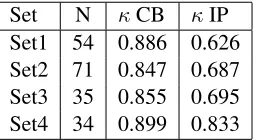
In Table 2, we list the annotator agreement for both boundary events over4kappa sets. The second column refers to the number of speech responses in the kappa set, the next two columns refer to the an-notator agreement using the Cohen’sκvalue on CB and IP annotation results.
Set N κCB κIP Set1 54 0.886 0.626 Set2 71 0.847 0.687 Set3 35 0.855 0.695 Set4 34 0.899 0.833
Table 2: Between-rater agreement of structural event an-notation
In general, a κ of 0.8-1.0 represents excellent agreement, 0.6-0.8represents good agreement, and so forth. Over each kappa set, κ for CB annota-tions ranges between 0.8 and 0.9, which is an
ex-1
Measurement on CBs and IPs can provide a rough qual-ity measurement of annotations. In addition, doing so is more important to us since automatic detection of these two types of events will be investigated in future.
cellent agreement; κ for IP annotation ranges be-tween0.6and0.8, which is a good agreement. Com-pared to annotating clauses, marking disfluencies is more challenging. As a result, a lower between-rater agreement is expected.
5 Features Derived On Structural Events
Based on the structural event annotations, including clause boundaries and their types, as well as disflu-encies, some features measuring syntactic complex-ity and disfluency profile were derived.
Since simple sentence (SS), independent clause (I), and conjunct clause (CC) represent a complete idea, we treat them as an approximate to a T-unit (T). The clauses that have no complete idea, are depen-dent clauses (DEP), including noun clauses (N), rel-ative clauses that function as adjective (ADJ), adver-bial clauses (ADV), and adveradver-bial phrases (ADVP). The total number of clauses is a summation of the number of T-units (T), dependent clauses (DEP), and fragments2(denoted as F). Therefore,
NT = NSS+NI+NCC
NDEP = NN C+NADJ+NADV +NADV P
NC = NT +NDEP +NF
Assuming Nw is the total number of words in
the speech response (without pruning speech re-pairs), the following features, including mean length of clause (MLC), dependent clauses per clause (DEPC), and interruption points per clause (IPC), are derived:
M LC = Nw/NC
2
[image:4.612.123.251.504.574.2]DEP C = NDEP/NC
IP C = NIP/NC
Furthermore, we elaborated the IPC feature. Dis-fluency is a complex behavior and is influenced by a variety of factors, such as proficiency level, speak-ing rate, and familiarity with speakspeak-ing content. The complexity of utterances is also an important fac-tor on the disfluency pattern. For example, Roll et al. (Roll et al., 2007) found that complexity of expression computed based on the language’s pars-ing tree structure influenced the frequency of disflu-encies in their experiment on Swedish. Therefore, since disfluency frequency was not only influenced by the test-takers’ speaking proficiency but also by the utterance’s syntactic structure’s difficulty, we re-duced the impact from the syntactic structure so that we can focus on speakers’ ability. For this purpose, we normalized IPC by dividing by some features re-lated to syntactic-structure’s complexity, including MLC, DEPC, and both. Therefore, the following elaborated disfluency-related features were derived:
IP Cn1 = IP C/M LC IP Cn2 = IP C/DEP C
IP Cn3 = IP C/M LC/DEP C
6 Experiment
For each item, two human raters rated it separately with a score from 1 to 4. If these two scores are consistent (the difference between two scores is ei-ther zero or one), we put this item in an item-pool. Finally, a total of1,257audio items were included in the pool. Following the score-handling protocol used in the TPO test, we used the first human rater’s score as the item score. From the obtained item-pool, we selected speakers with more than three items so that the averaged score per speaker can be estimated on several items to achieve a robust score computation3. As a result,175speakers4 were se-lected.
3The mean holistic score of these speakers is2.786, which
is close to the mean holistic score of the selected item-pool (2.785), indicating that score distribution was kept after focus-ing on speakers with more than three items.
4
If a speaker was assigned in a Kappa set in the annotation as described in Section 4, this speaker would have as many as12 annotated items. Therefore, the minimum number of speakers from the item-pool was about105(1257/12).
For each speaker, his or her annotations of words and structural events were used to extract the fea-tures described in Section 5. Then, we computed the Pearson correlation among the obtained features with the averaged holistic scores per speaker.
Feature r
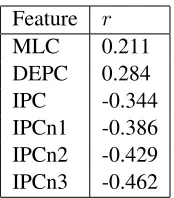
[image:5.612.384.471.147.246.2]MLC 0.211 DEPC 0.284 IPC -0.344 IPCn1 -0.386 IPCn2 -0.429 IPCn3 -0.462
Table 3: Correlation coefficients (rs) between the fea-tures derived from structural events with human scores averaged on test takers
Table 3 reports on the correlation coefficient (r) between the proposed features derived from structural events with holistic scores. Relying on three simple structural event annotations, i.e., clause boundaries, dependent clauses, and interrup-tion points in speech disfluencies, some promising correlations between features with holistic scores were found. Between the two syntactic complex-ity features, the DEPC has a higher correlation with holistic scores than the MLC (0.284>0.211). It ap-pears that a measurement about clauses’ embedding profile is more informative about a speaker’s profi-ciency level. Second, compared to features measur-ing syntactic complexity, the feature measurmeasur-ing the disfluency profile is better to predict human holis-tic scores on this non-native data set. For example, IPC has arof−0.344, which is better than the fea-tures about clause lengths or embedding. Finally, by jointly using the structural events related to clauses and disfluencies, we can further achieve a further improvedr. Compared to IPC, IPCn3 has a relative
34.30%correlation increase. This is consistent with our idea of reducing utterance-complexity’s impact on disfluency-related features.
7 Discussion
fluency and accuracy points of view. However, in-formation beyond recognized words, e.g., the struc-ture of clauses and disfluencies, has only received limited attention. Although several previous SLA studies used features derived from structural events to measure speaking proficiency, these studies were limited and the findings from them were difficult to directly apply to on large-scale standard tests.
In this paper, using a large-sized data set col-lected in the TPO speaking test, we conducted an sophisticated annotation of structural events, includ-ing boundaries and types of clauses and disfluen-cies, from transcriptions of spontaneous speech test responses. A series of features were derived from these structural event annotations and were eval-uated according to their correlations with holistic scores. We found that disfluency-related features have higher correlations to human holistic scores than features about syntactic complexity, which con-firms the result reported in (Mizera, 2006). In spon-taneous speech utterances, simple syntactic structure tends to be utilized by speakers. This is in contrast to sophisticated syntactic structure appearing in writ-ing. This may cause that complexity-related features are poor at predicting fluency scores. On the other hand, disfluencies, a pattern unique to spontaneous speech, were found to play a more important role in indicating speaking proficiency levels.
Although syntactic complexity features were not highly indicative of holistic scores, they were useful to further improve disfluency-related features’ corre-lation with holistic scores. By normalizing IPC us-ing measurements representus-ing syntactic complex-ity, we can highlight contributions from speakers’ proficiency levels. Therefore, in our experiment, IPCn3 shows a34.30%relative improvement in its correlation coefficient with human holistic scores over the original IPC.
The study reported in this paper suggests promise that structural events beyond speech recognition re-sults can be utilized to measure non-native speaker proficiency levels. Recently, in the NLP research field, an increasing amount of effort has been made on structural event detection in spontaneous speech (Ostendorf et al., 2008). Therefore, such progress can benefit the study of automatic estima-tion of structural events on non-native speech data.
For our future research plan, first, we will
inves-tigate automatically detecting these structural events from speech transcriptions and recognition hypothe-ses. Second, the features derived from the obtained structural events will be used to augment the features in automatic speech assessment research to provide a wider construct coverage than fluency and pronun-ciation features do.
References
B. Azar. 2003. Fundamentals of English grammar. Pearson Longman, White Plains, NY, 3rd edition. P. Foster, A. Tonkyn, and G. Wigglesworth. 2000.
Mea-suring spoken language: A unit for all reasons. Ap-plied Linguistics, 21(3):354.
K. W. Hunt. 1970. Syntactic maturity in school chil-dren and adults. InMonographs of the Society for Re-search in Child Development. University of Chicago Press, Chicago, IL.
N. Iwashita. 2006. Syntactic complexity measures and their relation to oral proficiency in Japanese as a for-eign language. Language Assessment Quarterly: An International Journal, 3(2):151–169.
P. Lennon. 1990. Investigating fluency in EFL: A quanti-tative approach.Language Learning, 40(3):387–417. Y. Liu. 2004. Structural Event Detection for Rich
Tran-scription of Speech. Ph.D. thesis, Purdue University. G. J. Mizera. 2006. Working memory and L2 oral
flu-ency. Ph.D. thesis, University of Pittsburgh.
L. Neumeyer, H. Franco, V. Digalakis, and M. Weintraub. 2000. Automatic Scoring of Pronunciation Quality.
Speech Communication, 30:83–93.
L. Ortega. 2003. Syntactic complexity measures and their relationship to L2 proficiency: A research syn-thesis of college-level L2 writing. Applied Linguistics, 24(4):492.
M. Ostendorf et al. 2008. Speech segmentation and spo-ken document processing. Signal Processing Maga-zine, IEEE, 25(3):59–69, May.
M. Roll, J. Frid, and M. Horne. 2007. Measuring syntac-tic complexity in spontaneous spoken Swedish. Lan-guage and Speech, 50(2):227.
E. Shriberg, A. Stolcke, D. Hakkani-Tur, and G. Tur. 2000. Prosody-based automatic segmentation of speech into sentences and topics. Speech Communi-cation, 32(1-2):127–154.
S. Yoon. 2009. Automated assessment of speech fluency for L2 English learners. Ph.D. thesis, University of Illinois at Urbana-Champaign.