DCU-ADAPT: Learning Edit Operations for Microblog Normalisation
with the Generalised Perceptron
Joachim Wagner and Jennifer Foster ADAPT Centre
School of Computing Dublin City University
Dublin, Ireland
{jwagner|jfoster}@computing.dcu.ie
Abstract
We describe the work carried out by the DCU-ADAPT team on the Lexical Nor-malisation shared task at W-NUT 2015. We train a generalised perceptron to an-notate noisy text with edit operations that normalise the text when executed. Fea-tures are charactern-grams, recurrent neu-ral network language model hidden layer activations, character class and eligibil-ity for editing according to the task rules. We combine predictions from 25 models trained on subsets of the training data by selecting the most-likely normalisation ac-cording to a character language model. We compare the use of a generalised percep-tron to the use of conditional random fields restricted to smaller amounts of training data due to memory constraints. Fur-thermore, we make a first attempt to ver-ify Chrupała (2014)’s hypothesis that the noisy channel model would not be useful due to the limited amount of training data for the source language model, i.e. the lan-guage model on normalised text.
1 Introduction
The W-NUT Lexical Normalisation for English Tweets shared task is to normalise spelling and to expand contractions in English microblog mes-sages (Baldwin et al., 2015). This includes one-to-many and one-to-many-to-one replacements as in “we’re” and “l o v e”. Tokens containing characters other than alphanumeric characters and the apostrophe are excluded from the task, as well as proper nouns and acronyms that would be acceptable in well-edited text. (The input, however, does not identify such tokens and unnecessarily modifying them is penalised in the evaluation.)
To make evaluation easier, participants are fur-ther required to align output tokens to input
to-kens, e.g. when the four tokens “l”, “o”, “v” and “e” are amalgamated to the single token “love”, three empty tokens must follow in the output. This is easy for approaches that process the input token by token but may require extra work if the input string is processed differently.
We participate in the constrained mode that al-lows off-the-shelf tools but no normalisation lexi-cons and additional data to be used. Furthermore, we do not use any lexicon of canonical English but learn our normalisation model purely from the provided training data.
Our approach follows previous work by Chrupała (2014) in that we train a sequence la-beller to annotate edit operations that are intended to normalise the text when applied to the input text. However, while Chrupała uses conditional random fields for sequence labelling, we further experiment with using a generalised Perceptron and with using a simple noisy channel model with charactern-gram language models trained on the normalised side of the training data to select the fi-nal normalisation from a set of candidate normali-sation generated from an ensemble of sequence la-bellers and from selectively ignoring some of the proposed edit operations.
2 Experimental Setup
2.1 Data Set and Cross-validation
The microblog data set of the shared task contains 2,950 tweets for training and 1,967 tweets for fi-nal testing. Each tweet is tokenised and the tokens of the normalised tweets are aligned to the input, allowing for one, many-to-one and one-to-many alignments.
For five-fold cross-validation, we sort the train-ing data by tweet ID and split it into 5 sets of roughly the same number of tokens. (The num-ber of tweets varies from 579 to 606.) Systems are trained on four sets and tested on the
ing set. Since the sequence labellers require a development set, we split the union of the four sets again into 5 sets to carry out nested cross-validation, training 25 models in total for each sys-tem.
2.2 Feature Extraction
For extracting recurrent neural network language model features, we use Elman1 (Chrupała, 2014), a modification of the RNNLM toolkit2(Mikolov et al., 2010; Mikolov, 2012) that outputs hidden layer activations. We use the off-the-shelf model from Chrupała (2014)3. The input are the characters of the tweet4in one-hot encoding. The network has a hidden layer with 400 neurons and it predicts the next byte. Following Chrupała (2014), we reduce the 400 activations to 10 binary features: We se-lect the 10 most active neurons in order and apply a threshold (0.5) to the activation. The value of the
i-th feature expresses which neuron wasi-th active and whether its activation was below 0.5, e.g. the first feature states which neuron is most active and whether or not its activation is below 0.5. As there are 400 neurons and 2 possible binarised activa-tions, there are 800 possible values.5
Edit operations are extracted from the parallel training data searching for the lowest edit distance and recording the edit operations with dynamic programming. We customise the edit costs func-tion to always postpone inserfunc-tions to after delet-ing characters so that each input character can be assigned exactly one edit operation from the set
{do nothing, delete character, insert string before character}. To capture insertions at the end of the tweet, we append a NULL byte to all tweets.
The above setup, features and edit operations are identical to Chrupała (2014) to the best of our knowledge. We further add a character class fea-ture{NULL, control, space, apostrophe, punctua-tion, digit, quote, bracket, lowercase letter, upper-case letter, non-ASCII, other} and a feature indi-cating whether the character is part of a token that is eligible for editing according to the shared task 1https://bitbucket.org/gchrupala/elman 2http://rnnlm.org/
3https://bitbucket.org/gchrupala/ codeswitch/overview
4More precisely, we process UTF-8 bytes. For the train-ing data, this is the same as characters as the traintrain-ing set does not contain any multi-byte UTF-8 characters.
5These RNN-LM hidden layer activation features have been used successfully in text segmentation and word-level language identification (Chrupała, 2013; Barman et al., 2014).
rules, i.e. whether or not the characters encoun-tered since the last space or start of tweet only are letters, digits, apostrophes and spaces.
2.3 Sequence Labelling
For character-level sequence labelling, we try(a)
Sequor6 (Chrupała and Klakow, 2010), an imple-mentation of the generalised perceptron (Collins, 2002),7 with 10 iterations, and (b) Wapiti8 (Lavergne et al., 2010)’s implementation of con-ditional random fields (Lafferty et al., 2001) using l-bfgs optimisation with a history of 5 steps, elas-tic net regularisation (ρ1 = 0.333andρ2= 0.001)
and no hard limit on the number of iterations. We extend the feature templates of Chrupała (2014)9 by including our additional two features. The tem-plate generates unigram, bigram and trigram char-acter features within a +/- 2 window. All remain-ing features are included as unigrams of the cur-rent value.
Due to the nested cross-validation (see above), Sequor is trained on 64% (0.82) of the training
data, 16% (0.8×0.2) is used as development set and 20% (1/5) for testing. For Wapiti, we use only 16% for training (and the remaining 64% for de-velopment set) in each cross-validation fold due to memory constraints.10
2.4 Generating Candidates
We produce candidate normalisations from the edit operations proposed by the sequence model. However, if we allowed each insert and delete op-eration to be either realised or not, we would pro-duce up to 2N candidates, whereN is the
num-ber of edit operations. WithN = 140(maximum lengths of a tweet), handling these many candi-dates is not feasible. Instead, we recursively split the sequence of edit operations produced by the sequence labeller into up to eight sections. To find good split points, we propose to minimise
p
|eL−eR|+ max({0,10−s})/2 (1)
6https://bitbucket.org/gchrupala/ sequor
7The generalised perceptron has been shown to match per-formance of state-of-the-art methods in word segmentation, POS tagging, dependency parsing and phrase-structure pars-ing (Zhang and Clark, 2011).
8https://wapiti.limsi.fr/
9We thank Grzegorz Chrupała for providing his template and for translating it to the Sequor template format.
whereeLandeRare the number of insert or delete
operations to the left and right respectively, ands
is the number of consecutive no-operations to the left. The first term tries to balance the number of edit operations on each side while the second term introduces a preference to not split clusters of edit operations.
For each section, we either use the edit opera-tions produced by the sequence labeller or do not edit the section. As we split each sequence into no more than eight sections, we produce up to
28 = 256candidates.11 Only one candidate,
iden-tical to the input, will be produced if there are no delete or insert operations and two candidates will be produced if there is just one delete or insert op-eration.
In training, we may potentially produce up to
5×256 =1,280 candidates per tweet as the nested
cross-validation gives us five sequence labellers per cross-validation run. During testing, up to
25×256 = 6,400 candidates may be produced.
(The actual maximum number of candidates may be lower when labellers agree on the edit opera-tions.)
2.5 Applying Edit Operations
After producing candidate edit operation se-quences that use subsets of the edit operations pre-dicted by a sequence model, the edit operations are executed to produce candidates strings for the normalised tweets. As the shared task asks for to-kenised output aligned to the input tokens, we ap-ply the edit operations to each token in the follow-ing sequence:
1. Apply all edit operations at character posi-tions that correspond to input tokens.
2. Apply insert operations recorded at the space between tokens and at the end of the tweet to the preceding token.
3. Apply delete operations at the space between tokens, moving the contents of the token to the right to the end of the token to the left, leaving behind an empty token. (Delete op-erations at the end-of-tweet marker are ig-nored.)
Due to time constraints, we do not attempt to improve the alignment of output tokens to input tokens.
11Splitting the eight sections again would produce216 = 65,536 candidates.
2.6 Language Modelling
For language modelling, we train SRILM (Stol-cke, 2002) on the normalised tweets of the training data. As we want to build charactern-gram mod-els and SRILM has no direct support for this, we re-format the candidate strings to make each char-acter a token. To distinguish space charchar-acters from token separators, we represent them with double underscores.
2.7 Candidate Selection
We use the noisy channel model12 to select the most plausible source ˆsfor the observed targett
from the set of candidatesS(t):
arg max
s∈S(t) P(t|s)P(s) (2)
P(s) is provided by the language model (Sec-tion 2.6). Standard models give high probability to making few or no edits. However, we trust our sequence models as Chrupała (2014) reported en-couraging results. Therefore, we give high prob-ability to using the predicted edit operations. We consider two models forP(t|s):
P1(t|s) =
0.979 if all edit operations are used
0.020 if s=t
0.001 otherwise
(3) and
P2(t|s) =
(
1 if all edit operations are used
0 otherwise
(4) Note thatP1 is not a proper probability model as
there is never exactly one “otherwise” case but
2i−2cases whereiis the number of sections
con-sidered in candidate generation, causing the total to be either 0.999 or between 1.001 and0.999 + 0.001×(28−2) = 1.253.P
2effectively excludes
the original input and all candidates that use only some but not all of the edit operations suggested by the sequence labellers. Since there are five se-quence labellers per cross-validation fold due to nested cross-validation and 25 sequence labellers during testing,P2effectively selects between 5 or
25 candidates.13
12The noisy channel model has been applied success-fully to spelling correction (Kemighan et al., 1990; Wilcox-O’Hearn et al., 2008) and machine translation (Way, 2010), among other areas.
2 3 4 5 6 WB 14.70 9.97 7.91 7.31 7.19 KN 14.73 9.83 7.81 7.33 7.43 GT 14.63 9.88 7.91 7.45 7.44
Table 1: Average language model perplexity over the five cross-validation runs forn-gram sizesn= 2, ...,6 and smoothing methods WB = Witten-Bell, KN = Keyser-Ney and GT = Good-Turing. Standard deviation σ ≤ 0.23 for all configura-tions.
2.8 Evaluation Measures
We evaluate our best systems using the evalution script provided by the shared task organisers. It counts:
• The number of correctly modified tokens, i.e. tokens that need to be replaced by a new non-empty token and the system correctly pre-dicts this token.
• Number of tokens needing normalisation, i.e. tokens that are modified in the gold output. However, again, tokens that are to be deleted are ignored, e.g. “l o v e” to “love” counts as one event only despite the replacement of three tokens with empty tokens.
• The number of tokens modified by system, i.e. tokens for which a substitution with a non-empty token is proposed by the system.
Based on these numbers, precision, recall and F1-score are calculated and we select the system and configuration to be used on the test set based on highest average F1-score over the 5 cross-validation runs.
3 Results
We use charactern-gram language models in the noisy channel model for candidate selection. To address sparsity of data that arises when test sen-tences containn-grams that are rare or unseen in the training data, we try Witten-Bell, Keyser-Ney and Good-Turing smoothing. Table 1 shows av-erage cross-validation perplexity for these three smoothing methods and n = 2, ...,6. Over all five cross-validation folds, the language model that gives the lowest perplexity when trained n-best list before applying more complex models to token-level candidate selection.
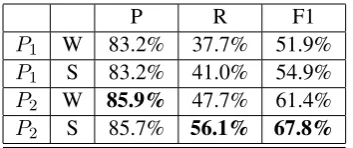
P R F1
P1 W 83.2% 37.7% 51.9%
P1 S 83.2% 41.0% 54.9%
P2 W 85.9% 47.7% 61.4%
[image:4.595.84.277.62.120.2]P2 S 85.7% 56.1% 67.8%
Table 2: Average cross-validation results over the five cross-validation runs for transition models
P1 and P2, W = Wapiti CRF sequence labeller
(trained on only 16% of the training data), S = Sequor generalised perceptron sequence labeller (trained on 64% of the training data), P = preci-sion, R = recall, F1 = F1 measure. Standard devi-ationσ≤0.03for all cells.
on the training data and applied to the internal test set is the 6-gram model with Witten-Bell smoothing. This confirms the recommendations in the SRILM documentation to use Witten-Bell smoothing when the vocabulary is small such as when building a character language model.
Table 2 shows cross-validation results for the four systems resulting from the choices between transition modelsP1 andP2 and using the Wapiti
CRF or the Sequor generalised perceptron se-quence labeller. The differences are not large in precision but for recall, the model P1 performs
poorly. Also the CRF consistently has lower re-call than the respective perceptron model. Inter-estingly, the CRF achieves best precision. On F1-score, the best result is obtained with model P2,
which reduces the noisy channel model to selec-tion between sequence modeller hypotheses, to-gether with the Sequor sequence modeller.
On the final test set, our best system using P2
and Sequor has precision 81.90%, recall 55.09% and F1 65.87%, placing it fifth out of six submis-sions in the “constrained” category.
4 Discussion
A possible explanation for the low recall obtained with theP1model is that this noise model cannot
counter the effect that shorter sentences generally receive higher language model probability scores and therefore there is a tendency to reject edit op-erations that insert additional characters.
level, but in the token-level evaluation, we make two errors: wrongly appending “ laughing out” to the previous token and wrongly normalising “lol” to just “loud” instead of “laughing out loud”.
Since the model P1 did not come out best, we
cannot reject Chrupała (2014)’s hypothesis that the noisy channel model would not be useful. However, our observations also do not provide much support for this hypothesis as we did not in-clude standard models from previous work (Cook and Stevenson, 2009; Han et al., 2013) in our ex-periment.
5 Conclusions
We trained two sequence modellers to predict edit operations that normalise input text when exe-cuted and experimented with applying the noisy channel model to selecting candidate normalisa-tion strings.
Future work should:
• Train the CRF on the full training data, either using a more memory-friendly (but possibly slower) optimisation method or using an even larger machine.
• Experiment with LSTM sequence modelling (Hochreiter and Schmidhuber, 1997; Gers, 2001), which has been applied successfully to speech recognition and caption genera-tion (Graves and Jaitly, 2014; Vinyals et al., 2015).
• Combine models with voting rather than lan-guage model score.
• For the noisy channel model, try stan-dard models from previous work (Cook and Stevenson, 2009; Han et al., 2013).
• To better understand the selection prefer-ences of the noisy channel model, com-pare the F1-score obtained when evaluating against the gold data to the F1-score obtained when evaluating the system output against its own input, i.e. are we biased towards doing nothing?
• Introduce a brevity penalty to counter the ef-fect of selecting short candidate normalisa-tions in the noisy channel model.
• Automatically revise the alignment to in-put token according to global co-occurrence statistics.
• Carry out a full error analysis of what the sys-tem does well and where it fails.
Acknowledgments
This research is supported by Science Foun-dation Ireland through the CNGL Programme (Grant 12/CE/I2267) in the ADAPT Centre (www.adaptcentre.ie) at Dublin City University. We thank the anonymous reviewers for their com-ments on this paper. Furthermore, we thank Grze-gorz Chrupała for sharing his feature templates and for his suggestion to try Sequor.
References
Timothy Baldwin, Marie Catherine de Marneffe, Bo Han, Young-Bum Kim, Alan Ritter, and Wei Xu. 2015. Shared tasks of the 2015 workshop on noisy user-generated text: Twitter lexical normal-ization and named entity recognition. In Proceed-ings of the Workshop on Noisy User-generated Text (WNUT 2015), Beijing, China.
Utsab Barman, Joachim Wagner, Grzegorz Chrupała, and Jennifer Foster. 2014. DCU-UVT: Word-level language classification with code-mixed data. InProceedings of the First Workshop on Computa-tional Approaches to Code Switching. EMNLP 2014, Conference on Empirical Methods in Natural Lan-guage Processing, pages 127–132, Doha, Qatar, Oc-tober. Association for Computational Linguistics. Grzegorz Chrupała and Dietrich Klakow. 2010.
A named entity labeler for German: Exploiting Wikipedia and distributional clusters. In Nico-letta Calzolari (Conference Chair), Khalid Choukri, Bente Maegaard, Joseph Mariani, Jan Odijk, Ste-lios Piperidis, Mike Rosner, and Daniel Tapias, editors, Proceedings of the Seventh conference on International Language Resources and Evaluation (LREC’10), Valletta, Malta, May. European Lan-guage Resources Association (ELRA).
Grzegorz Chrupała. 2013. Text segmentation with character-level text embeddings. InProceedings of the ICML 2013 Workshop on Deep Learning for Au-dio, Speech and Language Processing, Atlanta, GA,
USA. https://sites.google.com/site/
deeplearningicml2013/accepted_ papers.
Grzegorz Chrupała. 2014. Normalizing tweets with edit scripts and recurrent neural embeddings. In Proceedings of the 52nd Annual Meeting of the As-sociation for Computational Linguistics (Volume 2: Short Papers), pages 680–686, Baltimore, Mary-land, June. Association for Computational Linguis-tics.
of the 2002 Conference on Empirical Methods in Natural Language Processing (EMNLP’02), pages 1–8, Morristown, NJ, USA, July. Association for Computational Linguistics.
Paul Cook and Suzanne Stevenson. 2009. An un-supervised model for text message normalization. In Proceedings of the Workshop on Computational Approaches to Linguistic Creativity, pages 71–78, Boulder, Colorado, June. Association for Computa-tional Linguistics.
Felix Gers. 2001. Long Short-Term Memory in Recurrent Neural Networks. Ph.D. thesis, ´Ecole Polytechnique F´ed´erale de Lausanne, D´epartement d’Informatique, Lausanne. Switzerland. http://
www.felixgers.de/papers/phd.pdf.
Alex Graves and Navdeep Jaitly. 2014. Towards end-to-end speech recognition with recurrent neu-ral networks. In Eric P. Xing and Tony Jebara, ed-itors, Proceedings of The 31st International Con-ference on Machine Learning, volume 32 ofJMLR Workshop and Conference Proceedings. http:
//jmlr.org/proceedings/papers/v32/.
Bo Han, Paul Cook, and Timothy Baldwin. 2013. Lexical normalization for social media text. ACM Transactions on Intelligent Systems and Technol-ogy (TIST) - Special section on twitter and mi-croblogging services, social recommender sys-tems, and CAMRa2010: Movie recommenda-tion in context archive, 4(1):5:1–5:27. doi 10.1145/2414425.2414430.
Sepp Hochreiter and J¨urgen Schmidhuber. 1997. Long short-term memory. Neural Computation, 9(8):1735–1780. doi:10.1162/neco.1997.9.8.1735. Mark D. Kemighan, Kenneth W. Church, and
William A. Gale. 1990. A spelling correction pro-gram based on a noisy channel model. In Hans Karlgren, editor,COLING-90: Papers presented to the 13th International Conference on Computational Linguistics on the occasion of the 25th Anniversary of COLING and the 350th Anniversary of Helsinki University, Volume 2. http://www.aclweb.
org/anthology/C/C90/.
John Lafferty, Andrew McCallum, and Fernando CN Pereira. 2001. Conditional random fields: Prob-abilistic models for segmenting and labeling se-quence data. pages 282–289.
Thomas Lavergne, Olivier Capp´e, and Franc¸ois Yvon. 2010. Practical very large scale crfs. In Proceed-ings of the 48th Annual Meeting of the Association for Computational Linguistics, pages 504–513, Up-psala, Sweden, July. Association for Computational Linguistics.
T. Mikolov, M. Karafi´at, L. Burget, J. ˇCernock´y, and S. Khudanpur. 2010. Recurrent neural network based language model. InProceedings of the 11th Annual Conference of the International Speech
Communication Association (INTERSPEECH 2010), Makuhari, Chiba, Japan. International Speech Communication Association (ICSA). http://www.fit.vutbr.cz/research/ groups/speech/publi/2010/mikolov_
interspeech2010_IS100722.pdf.
Tom´aˇs Mikolov. 2012. Statistical Language Mod-els based on Neural Networks. Ph.D. thesis, Brno University of Technology, Faculty of In-formation Technology, Department of Computer Graphics and Multimedia, Brno, Czech Republic. http://www.fit.vutbr.cz/˜imikolov/
rnnlm/thesis.pdf.
Andreas Stolcke. 2002. SRILM — an extensible lan-guage modeling toolkit. In John H. L. Hansen and Bryan Pellom, editors,Proceedings of the 7th Inter-national Conference on Spoken Language Process-ing (ICSLP2002), volume 2, pages 901–904, Baixas, France. International Speech Communication Asso-ciation (ISCA).
Oriol Vinyals, Alexander Toshev, Samy Bengio, and Dumitru Erhan. 2015. Show and tell: A neural image caption generator. http://arxiv.org/ abs/1411.4555, to appear in Computer Vision and Pattern Recognition.
Andy Way. 2010. Machine translation. In Alexander Clark, Chris Fox, and Shalom Lappin, editors,The Handbook of Computational Linguistics and Nat-ural Language Processing, pages 531–573. Wiley Blackwell, Chichester, UK, July.
Amber Wilcox-O’Hearn, Graeme Hirst, and Alexander Budanitsky. 2008. Real-word spelling correction with trigrams: A reconsideration of the Mays, Damerau, and Mercer model. In Alexander Gelbukh, editor, Computational Linguistics and Intelligent Text Processing - 9th International Con-ference, CICLing 2008, Haifa, Isarael, February 17–23, 2008 - Proceedings, volume 4919/2008, pages 605–616. Springer Berlin/Heidelberg, Germany. 2006 draft version available on http://ftp.cs.toronto.edu/pub/gh/WilcoxOHearn-etal-2006.pdf.