Extractive Multi-Document Summaries Should Explicitly Not Contain
Document-Specific Content
Rebecca Mason and Eugene Charniak
Brown Laboratory for Linguistic Information Processing (BLLIP) Brown University
Providence, RI 02912
{rebecca,ec}@cs.brown.edu
Abstract
Unsupervised approaches to multi-document summarization consist of two steps: find-ing a content model of the documents to be summarized, and then generating a summary that best represents the most salient informa-tion of the documents. In this paper, we present a sentence selection objective for ex-tractive summarization in which sentences are penalized for containing content that is spe-cific to the documents they were extracted from. We modify an existing system, HIER -SUM(Haghighi & Vanderwende, 2009), to use our objective, which significantly outperforms the original HIERSUM in pairwise user eval-uation. Additionally, our ROUGE scores ad-vance the current state-of-the-art for both su-pervised and unsusu-pervised systems with sta-tistical significance.
1 Introduction
Multi-document summarization is the task of gener-ating a single summary from a set of documents that are related to a single topic. Summaries should con-tain information that is relevant to the main ideas of the entire document set, and should not contain in-formation that is too specific to any one document. For example, a summary of multiple news articles about theStar Warsmovies could contain the words “Lucas ”and “Jedi”, but should not contain the name of a fan who was interviewed in one article. Most approaches to this problem generate summaries ex-tractively, selecting whole or partial sentences from the original text, then attempting to piece them to-gether in a coherent manner. Extracted text is
se-lected based on its relevance to the main ideas of the document set. Summaries can be evaluated manu-ally, or with automatic metrics such as ROUGE (Lin, 2004).
The use of structured probabilistic topic models has made it possible to represent document set con-tent with increasing complexity (Daum´e & Marcu, 2006; Tang et al., 2009; Celikyilmaz & Hakkani-Tur, 2010). Haghighi and Vanderwende (2009) demonstrated that these models can improve the quality of generic multi-document summaries over simpler surface models. Their most complex hier-archial model improves summary content by teasing out the words that are not general enough to repre-sent the document set as a whole. Once those words are no longer included in the content word distri-bution, they are implicitly less likely to appear in the extracted summary as well. But this objective does not sufficiently keep document-specific content from appearing in multi-document summaries.
In this paper, we present a selection objective that
explicitly excludes document-specific content. We re-implement the HIERSUM system from Haghighi and Vanderwende (2009), and show that using our objective dramatically improves the content of ex-tracted summaries.
2 Modeling Content
The easiest way to model document content is to find a probability distribution of all unigrams that appear in the original documents. The highest frequency words (after removing stop words) have a high like-lihood of appearing in human-authored summaries (Nenkova & Vanderwende, 2005). However, the raw
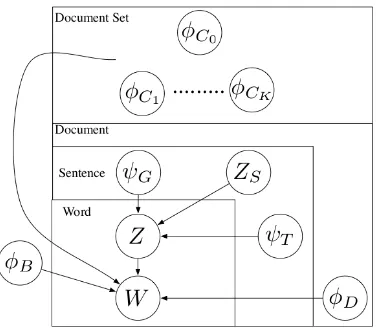
Figure 1: The graphical model for HIERSUM(Haghighi & Vanderwende, 2009).
unigram distribution may contain words that appear frequently in one document, but do not reflect the content of the document set as a whole.
Probabilistic topic models provide a more prin-cipled approach to finding a distribution of content words. This idea was first presented by Daum´e and Marcu (2006) for their BAYESUM system for query-focused summarization, and later adapted for non-query summarization in the TOPICSUMsystem by Haghighi and Vanderwende (2009). 1 In these systems, each word from the original documents is drawn from one of three vocabulary distributions. The first,φb, is the background distribution of
gen-eral English words. The second, φd, contains
vo-cabulary that is specific to that one document. And the third,φc, is the distribution of content words for
that document set, and contains relevant words that should appear in the generated summary.
HIERSUM (Haghighi & Vanderwende, 2009) adds more structure to TOPICSUMby further split-ting the content distribution into multiple sub-topics. The content words in each sentence can be gener-ated by either the general content topic or the con-tent sub-topic for that sentence, and the words from the general content distribution are considered when building the summary.
1
The original BAYESUMcan also be used without a query, in which case, BAYESUMand TOPICSUMare the exact same model.
3 KL Selection
The KL-divergence between two unigram word dis-tributions P and Q is given by KL(P||Q) = P
wP(w) log P(w)
Q(w). This quantity is used for sum-mary sentence selection in several systems includ-ing Lerman and McDonald (2009) and Haghighi and Vanderwende (2009), and was used as a feature in the discrimitive sentence ranking of Daum´e and Marcu (2006).
TOPICSUMand HIERSUMuse the following KL objective, which finds S∗, the summary that min-imizes the KL-divergence between the estimated content distributionφc and the summary word
dis-tributionPS:
S∗= min
S:|S|≤LKL(φc ||PS)
A greedy approximation is used to findS∗. Start-ing with an empty summary, sentences are greedily added to the summary one at a time until the sum-mary has reached the maximum word limit,L. The values ofPSare smoothed uniformly in order to
en-sure finite values ofKL(φc||PS).
4 Why Document-Specific Words are a Problem
The KL selection objective effectively ensures the presence of highly weighted content words in the generated summary. But it is asymmetric in that it allows a high proportion of words in the summary to be words that appear infrequently, or not at all, in the content word distribution. This asymmetry is the reason why the KL selection metric does not sufficiently keep document-specific words out of the generated summary.
Consider what happens when a document-specific word is included in summary S. Assume that the word wi does not appear (has zero probability) in
the content word distributionφc, but does appear in
the document-specific distributionφdfor document d. Then wi appearing in S has very little impact
on KL(φc||PS) = Pjφc(wj) logPφSc((wwjj)) because φc(wi) = 0. There will be a slight impact because
the presence of the wordwiinSwill cause the
length used for the DUC summarization task) the difference is negligible.
The reason why we do not simply substitute a symmetrical metric for comparing distributions (e.g., Information Radius) is because we want the se-lection objective to dispreferonlydocument-specific words. Specifically, the selection objective should not disprefer background English vocabulary.
5 KL(c)-KL(d) Selection
In contrast to the KL selection objective, our ob-jective measures the similarity of both content and document-specific word distributions to the ex-tracted summary sentences. We combine these mea-sures linearly:
S∗= min
S:|S|≤LKL(φc||PS)−KL(φd||PS)
Our objective can be understood in comparison to the MMR criterion by (Carbonell & Goldstein, 1998), which also utilizes a linear metric in order to maximize informativeness of summaries while min-imizing some unwanted quality of the extracted sen-tences (in their case, redundancy). In contrast, our criterion utilizes information about what kind of in-formation should not be included in the summary, which to our knowledge has not been done in previ-ous summarization systems.2
For comparison to the previous KL objective, we also use a greedy approximation forS∗. However, because we are extracting sentences from many doc-uments, the distributionφdis actually several
distri-butions, a separate distribution for each document in the document set. The implementation we used in our experiments is that, as we consider a sen-tencesto be added to the previously selected sen-tences S, we set φd to be the document-specific
distribution of the document that s has been ex-tracted from. So each time we add a sentence to the summary, we find the sentence that minimizes
KL(φc||PS∪s)−KL(φd(s)||PS∪s). Another
imple-mentation we tried was combining all of theφd
dis-tributions into one distribution, but we did not notice any difference in the extracted summaries.
2
A few anonymous reviewers asked if we tried to optimize the value ofλforKL(φc||PS)−λKL(φd||PS). The answer is yes, but optimizingλto maximize ROUGE results in sum-maries that are perceptibly worse, and manually tuningλdid not seem to produce any benefit.
6 Evaluation
6.1 Data
We developed our sentence selection objective us-ing data from the Document Understandus-ing Con-ference3(DUC) 2006 summarization task, and used data from DUC 2007 task for evaluations. In these tasks, the system is given a set of 25 news arti-cles related to an event or topic, and needs to gen-erate a summary of under 250 words from those documents.4 For each document set, four human-authored summaries are provided for use with eval-uations. The DUC 2006 data has 50 document sets, and the DUC 2007 data has 45 document sets.
6.2 Automatic Evaluation
Systems are automatically evalatued using ROUGE (Lin, 2004), which has good correlation with hu-man judgments of summary content. ROUGE com-paresn-gram recall between system-generated sum-maries, and human-authored reference summaries. The first two metrics we compare are unigram and bigram recall, R-1 and R-2, respectively. The last metric, R-SU4, measures recall of skip-4 bigrams, which may skip one or two words in between the two words to be measured. We set ROUGE to stem both the system and reference summaries, scale our results by 102 and present scores with and without stopwords removed.
The ROUGE scores of the original HIERSUM sys-tem are given in the first row of table 1, followed by the scores of HIERSUM using our KL(c-d) se-lection. The KL(c-d) selection outperforms the KL selection in each of the ROUGE metrics shown. In fact, these results are statistically significant over the baseline KL selection for all but the unigram metrics (R-1 with and without stopwords). These results show that our KL(c-d) selection yields sig-nificant improvements in terms of ROUGE perfor-mance, since having fewer irrelevant words in the summaries leaves room for words that are more rel-evant to the content topic, and therefore more likely to appear in the reference summaries.
The last two rows of table 1 show the scores of two recent state-of-the-art multi-document
sum-3
http://duc.nist.gov/
System ROUGE w/o stopwords ROUGE w/ stopwords R-1 R-2 R-SU4 R-1 R-2 R-SU4 HIERSUMw/ KL 34.6 7.3 10.4 43.1 9.7 15.3 HIERSUMw/ KL(c)-KL(d) 35.6 9.9 12.8 43.2 11.6 16.6
PYTHY 35.7 8.9 12.1 42.6 11.9 16.8
[image:4.612.126.491.61.146.2]HYBHSUM 35.1 8.3 11.8 45.6 11.4 17.2
Table 1: ROUGE scores on the DUC 2007 document sets. The first two rows compare the results of the unigram HIERSUMsystem with its original and our improved selection metrics. Bolded scores represent where our system has a significant improvement over the orignal HIERSUM. For further comparison, the last two rows show the ROUGE scores of two other state-of-the-art multi-document summarization systems (Toutanova et al., 2007; Celikyilmaz & Hakkani-Tur, 2010). See section 6.2 for more details.
marization systems. Both of these systems se-lect sentences discriminatively on many features in order to maximize ROUGE scores. The first, PYTHY (Toutanova et al., 2007), trains on dozens of sentence-level features, such as n-gram and skip-gram frequency, named entities, sentence length and position, and also utilizes sentence compression. The second, HYBHSUM (Celikyilmaz & Hakkani-Tur, 2010), uses a nested Chinese restaurant process (Blei et al., 2004) to model a hierarchical content distribution with more complexity than HIERSUM, and uses a regression model to predict scores for new sentences.
For both of these systems, our summaries are sig-nificantly better for R-2 and R-SU4 without stop-words, and comparable in all other metrics.5 These results show that our selection objective can make a simple unsupervised model competitive with more complicated supervised models.
6.3 Manual Evaluation
For manual evaluation, we performed a pairwise comparison of summaries generated by HIERSUM with both the original and our modified sentence se-lection objective. Users were given the two sum-maries to compare, plus a human-generated refer-ence summary. The order that the summaries ap-peared in was random. We asked users to select which summary was better for the following
ques-5
Haghighi and Vanderwende (2009) presented a version of HIERSUMthat models documents as a bag of bigrams, and pro-vides results comparable to PYTHY. However, the bigram HI
-ERSUMmodel does not find consistent bags of bigrams.
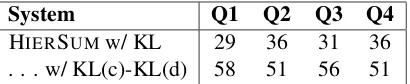
System Q1 Q2 Q3 Q4 HIERSUMw/ KL 29 36 31 36 . . . w/ KL(c)-KL(d) 58 51 56 51
Table 2: Results of manual evaluation. Our criterion out-performs the original HIERSUMfor all attributes, and is significantly better for Q1 and Q3. See section 6.3 for details.
tions:6
Q1 Which was better in terms of overall content?
Q2 Which summary had less repetition?
Q3 Which summary was more coherent?
Q4 Which summary had better focus?
We took 87 pairwise preferences from participants over Mechanical Turk.7 The results of our evalu-ation are shown in table 2. For all attributes, our criterion performs better than the original HIERSUM selection criterion, and our results for Q1 and Q3 are significantly better as determined by Fisher sign test (two-tailed P value<0.01).
These results confirm that our objective noticably improves the content of extractive summaries by se-lecting sentences that contain less document-specific
6
These are based on the manual evaluation questions from DUC 2007, and are the same questions asked in Haghighi and Vanderwende (2009).
7
[image:4.612.326.531.237.279.2]information. This leaves more room in the summary for content that is relevant to the main idea of the document set (Q1) and keeps out content that is not relevant (Q4). Additionally, although neither crite-rion explicitly addresses coherence, we found that a significant proportion of users found our summaries to be more coherent (Q3). We believe this may be the case because the presence of document-specific information can distract from the main ideas of the summary, and make it less likely that the extracted sentences will flow together.
There is no immediate explanation for why users found our our summaries less repetitive (Q2), since if anything the narrowing of topics due to the neg-ativeKL(φd||PS) term should make for more
rep-etition. We currently hypothesize that the improved score is simply a spillover from the general improve-ment in docuimprove-ment quality.
7 Conclusion
We have described a new objective for sentence se-lection in extractive multi-document summarization, which is different in that it explicitly gives negative weight to sentences that contain document-specific words. Our objective significantly improves the per-formance of an existing summarization system, and improves on current best ROUGE scores with sig-nificance.
We have observed that while the content in our extracted summaries is often comparable to the con-tent in human-written summaries, the extracted sum-maries are still far weaker in terms of coherence and repetition. Even though our objective significantly improves coherence, more sophisticated methods of decoding are still needed to produce readable sum-maries. These problems could be addressed through further refinement of the selection objective, through simplification or compression of selected sentences, and through improving the coherence of generated summaries.
References
Blei, D. M., Griffiths, T. L., Jordan, M. I., & Tenen-baum, J. B. (2004). Hierarchical topic models and the nested chinese restaurant process. Advances in Neural Information Processing Systems.
Carbonell, J., & Goldstein, J. (1998). The use
of mmr, diversity-based reranking for reordering documents and producing summaries. Proceed-ings of the 21st annual international ACM SIGIR conference on Research and development in infor-mation retrieval(pp. 335–336). New York, NY, USA: ACM.
Celikyilmaz, A., & Hakkani-Tur, D. (2010). A hy-brid hierarchical model for multi-document sum-marization.Proceedings of the 48th Annual Meet-ing of the Association for Computational LMeet-inguis- Linguis-tics(pp. 815–824). Stroudsburg, PA, USA: Asso-ciation for Computational Linguistics.
Daum´e, III, H., & Marcu, D. (2006). Bayesian query-focused summarization.ACL-44: Proceed-ings of the 21st International Conference on Com-putational Linguistics and the 44th annual meet-ing of the Association for Computational Lmeet-inguis- Linguis-tics(pp. 305–312). Morristown, NJ, USA: Asso-ciation for Computational Linguistics.
Gillick, D., & Liu, Y. (2010). Non-expert evaluation of summarization systems is risky. Proceedings of the NAACL HLT 2010 Workshop on Creating Speech and Language Data with Amazon’s Me-chanical Turk (pp. 148–151). Stroudsburg, PA, USA: Association for Computational Linguistics.
Haghighi, A., & Vanderwende, L. (2009). Exploring content models for multi-document summariza-tion. Proceedings of Human Language Technolo-gies: The 2009 Annual Conference of the North American Chapter of the Association for Compu-tational Linguistics(pp. 362–370). Boulder, Col-orado: Association for Computational Linguis-tics.
Lerman, K., & McDonald, R. (2009). Contrastive summarization: an experiment with consumer re-views. Proceedings of Human Language Tech-nologies: The 2009 Annual Conference of the North American Chapter of the Association for Computational Linguistics, Companion Volume: Short Papers (pp. 113–116). Stroudsburg, PA, USA: Association for Computational Linguistics.
the Workshop on Text Summarization Branches Out (WAS 2004). Barcelona, Spain.
Nenkova, A., & Vanderwende, L. (2005). The im-pact of frequency on summarization (Technical Report). Microsoft Research.
Tang, J., Yao, L., & Chen, D. (2009). Multi-topic based query-oriented summarization. SDM’09
(pp. 1147–1158).