Proceedings of the 50th Annual Meeting of the Association for Computational Linguistics, pages 21–29,
Accurate Unsupervised Joint Named-Entity Extraction from Unaligned
Parallel Text
Robert Munro
Department of Linguistics Stanford University Stanford, CA 94305 [email protected]
Christopher D. Manning
Department of Computer Science Stanford University Stanford, CA 94305 [email protected]
Abstract
We present a new approach to named-entity recognition that jointly learns to identify named-entities in parallel text. The sys-tem generates seed candidates through local, cross-language edit likelihood and then boot-straps to make broad predictions across both languages, optimizing combined contextual, word-shape and alignment models. It is com-pletely unsupervised, with no manually la-beled items, no external resources, only us-ing parallel text that does not need to be eas-ily alignable. The results are strong, with F > 0.85 for purely unsupervised named-entity recognition across languages, compared to just F = 0.35 on the same data for su-pervised cross-domain named-entity recogni-tion within a language. A combinarecogni-tion of un-supervised and un-supervised methods increases the accuracy toF = 0.88. We conclude that we have found a viable new strategy for unsu-pervised named-entity recognition across low-resource languages and for domain-adaptation within high-resource languages.
1 Introduction
At first pass, our approach sounds like it shouldn’t work, as ‘unsupervised’ tasks significantly under-perform their supervised equivalents and for most cross-linguistic tasks ‘unaligned’ will mean ‘unus-able’. However, even among very loosely aligned multilingual text it is easy to see why named-entities are different: they are the least likely words/phrases to change form in translation. We can see this in the following example which shows the named-entities in both a Kr`eyol message and its English translation:
Lopital Sacre-Coeur ki nan vil Milot, 14 km nan sid vil Okap, pre pou li resevwa moun malad e lap mande pou moun ki malad yo ale la.
Sacre-Coeur Hospital which located in this village Milot 14 km south of Oakp is ready to receive those who are injured. Therefore, we are asking those who are sick to report to that hospital.
The example is taken from the parallel corpus of English and Haitian Kr`eyol text messages used in the 2010 Shared Task for the Workshop on Machine Translation (Callison-Burch et al., 2011), which is the corpus used for evaluation in this paper.
The similarities in the named-entities across the translation are clear, as should be the intuition for how we can leverage these for named-entity ex-traction. Phrases with the least edit distance be-tween the two languages, such as ‘Lopital Sacre-Coeur’, ‘Milot’, and ‘Okap’, can be treated as high-probability named-entity candidates, and then a model can be bootstrapped that exploits predictive features, such as word shape (e.g.: more frequent capitalization) and contextual cues such as the pre-ceding ‘vil’ in two cases above.
However, the problem of identifying entities in this way is non-trivial due to a number of complicat-ing factors. The inexact translation repeats the non-entity ‘hospital’ which limits machine-translation-style alignments and has an equal edit-distance with the entity ‘Loptial’. The entity ‘Hospital’ and ‘Lo-pital’ are not an exact match and are not perfectly aligned, changing position within the phrase. The
capitalization of entities is not always so consistent (here and in short-message communications more generally). A typographic error in the translation writes ‘Okap’ as ‘Oakp’. ‘Okap’ is itself slang for ‘Cap-Ha¨ıtien’ and other messages translated this lo-cation across the different spellings (‘Cap-Haitien’, ‘Cap Haitien’, ‘Kap’, ‘Kapayisyen’, etc.), which in-creases the edit distance. There are few resources for Haitian Kr`eyol such as gazatteers of place names (except at the Department/major Town/City level – at the time these messages were sent, Google Maps and Open Street Map listed only a handful of loca-tions in Haiti, and such resources tend not to include slang terms). Finally, what was one sentence in the original message is split into two in the translation.
As Kay points out, most parallel texts shouldn’t be alignable, as different contexts mean different translation strategies, most of which will not result in usable input for machine translation (Kay, 2006). This is true of the corpus used here – the translations were made for quick understanding by aid workers, explaining much of the above: it was clearer to break the translation into two sentences; it reduced ambi-guity to repeat ‘hospital’ rather than leave it under-specified; the typo simply didn’t matter. We con-firmed the ‘unalignability’ of this corpus using the GIZA++ aligner in the Moses toolkit (Koehn et al., 2007); by noting Microsoft Research’s work on the same data where they needed to carefully retranslate the messages for training (Lewis, 2010); and from correspondence with participants in the 2011 Work-shop on Machine Translation who reported the need for substantial preprocessing and mixed results.
We do not rule out the alignability of the corpus altogether – the system presented here could even be used to create better alignment models – noting only that it is rare that translations can be used straight-of-the-box, while in our case we can still make use of this data. Even with perfect alignment, the accuracy for named-entity extraction in Haitian Kr`eyol could only be as accurate as that for English, which in this case was F = 0.336 with a supervised model, so alignment is therefore only part of the problem.
For the same reasons, we are deliberately omitting another important aspect of cross-linguistic named-entity recognition: transliteration. Latin Script may be wide-spread, especially for low resource languages where it is the most common script for
transcribing previously non-written languages, but some of the most widely spoken languages include those that use Arabic, Bengali, Cyrillic, Devanagari (Hindi) and Hanzi (Chinese) scripts, and the meth-ods proposed here would be even richer if they could also identify named entities across scripts. A first pass on cross-script data looks like it is possible to apply our methods across scripts, especially because the seeds only need to be drawn from the most con-fident matches and across scripts there seem to be some named entities that are more easier to translit-erate than others (which is not surprising, of course – most cross-linguistic tasks are heterogeneous in this way). However, with a few notable exceptions like Tao et al. (2006), transliteration is typically a super-vised task. As with machine translation it is likely that the methods used here could aid transliteration, providing predictions that can be used within a fi-nal, supervised transliteration model (much like the semi-supervised model proposed later on).1
1.1 The limitations of edit-distance and supervised approaches
Despite the intuition that named-entities are less likely to change form across translations, it is clearly only a weak trend. Even if we assume oracle knowl-edge of entities in English (that is, imagining that we have perfect named-entity-recognition for En-glish), by mapping the lowest edit-distance phrase in the parallel Kr`eyol message to each entity we can only identify an entity with about 61%, accuracy. Without oracle knowledge – training on an existing English NER corpora, tagging the English transla-tions, and mapping via edit distance – identifies an entity with only around 15% accuracy. This is not particularly useful and we could probably achieve the same results with naive techniques like cross-linguistic gazetteers.
Edit distance and cross-linguistic supervised named-entity recognition are not, therefore, partic-ularly useful as standalone strategies. However, we are able to use aspects of both in an unsupervised approach.
1
In this paper we focus on named-entity identifica-tion, only briefly touching on named-entity classifi-cation (distinguishing between types of entities), pri-marily because the named-entity identification com-ponent of our system is more novel and therefore deserves greater attention.
We use 3,000 messages in Haitian Kr`eyol and their English translations, with named-entities tagged in an evaluation set of 1,000 of the messages. To keep the task as unsupervised a possible, the sys-tem was designed and parameters were set without observing the actual tags.
1.2 Strategy and potential applications
Our approach is two-step for pairs of low resource languages, and three-step for pairs of languages where one has named-entity resources:
1. Generate seeds by calculating the edit like-lihood deviation. For all cross-language pairs of messages, extract the cross-language word/phrase pairs with the highest edit like-lihood, normalized for length. Calculate the intramessage deviation of this edit likelihood from the mean pair-wise likelihood from all candidate pairs within the message. Across all messages, generate seeds by selecting the word/phrase pairs with the highest and lowest intramessage edit likelihood deviation.
2. Learn context, word-shape and alignment els. Using the seeds from Step 1, learn mod-els over the context, word-shape and align-ment properties (but not edit distance). Apply the models to all candidate pairs. Because we have the candidate alignments between the lan-guages, we can also jointly learn to identify named-entities by leveraging the context and word-shape features in the parallel text, in com-bination with the alignment predictions.
3. Learn weighted models over the context, word-shape, alignment and supervised predictions (with high-resource languages only). Using the seeds from Step 1 and predictions from Step 2, learn models over the broader features and su-pervised predictions from a model in the high-resource language, applying the models to all candidate pairs.
The results are very strong, with F > 0.85
for purely unsupervised named-entity recognition across languages. This is compared to justF = 0.35
for supervised approaches across domains within a language (MUC/CoNLL-trained English applied to the English translations of the messages).
The combined unsupervised/supervised methods increase the accuracy toF = 0.88. Inter-annotator agreement is around0.95, so this may be close to the best possible result.
This leads us to conclude that cross-linguistic un-supervised named-entity recognition, even when not alignable via machine-translation methods, is a pow-erful, scalable technique for named-entity recogni-tion in low resource languages.
The potential applications of are broad. There are some 5,000 languages in the connected world, most of which will have no resources other than loose translations, so there is great application potential. For high-resource languages, the results here indi-cate that the technique can be used to increase ac-curacy in cross-domain named-entity recognition, a consistent problem across even closely-related do-mains. For the specific corpus used there is also direct practical value – the messages include high volumes of time-critical requests for aid, citing lo-cations that did not appear on any map in a language with few resources.
2 STEP 1: Establish Edit Likelihood Deviation
As we state in the introduction, we cannot simply tag in English and then find the least-edit distance word/phrase in the parallel Kr`eyol.
We evaluated several different edit distance func-tions, including the well-known Levenshtein and slightly more complex Jaro-Winkler measures. We also extended the Levenshtein measure by reducing the edit penalty for pairs of letters of phonetic relat-edness, such as ‘c’ and ‘k’, following the subword modeling work of Munro and Manning on this cor-pus and previous subword modeling for short mes-sages (Munro, 2011; Munro and Manning, 2010).2
2
The more sophisticated edit distance functions gave more accurate predictions (which is unsurpris-ing), but the advantages were lost in the following step when calculating the deviation from the norm, with all approaches producing more or less the same seeds. Rather than the String Similarity Estimate be-ing the key factor, we conclude that our novel treat-ment of edit distance (calculating the local devia-tion) is the critical factor in generating seeds for the model.
All else being equal, then, we report results from the simplest approach to edit distance, normalizing Levenshtein’s measure, LEV() by length to a 0-1 scale. Candidate words/phrases were limited to a maximum of four words, delimited by space or punctuation, simply to cap the cost of the LEV(). Given a stringSin messageM,MSand and its
can-didate pairM′S′, and a length functionLEN(), this gives usSSE(MS, M′S′) =
1−
(2(LEV(MS, M′S′)) + 1
LEN(MS) +LEN(M′S′) + 1
The+1smoothing is to avoid too much variation at smaller lengths, which is fairly common practice in subword models looking at morphological varia-tion (Tchoukalov et al., 2010).
The String Similarity Estimate is a global measure that is not sensitive to the contexts of the given pairs. Suppose a sentence wasn’t a translation, but simply a repetition, or that much of the translation was a direct (non-translated) quote of the original. Both occur in the data we used.
We propose, then, that the best candidate seeds for named-entities are those that display the highest likelihood relative to the other candidate pairs within the same pairs of messages. In other words, when there are two phrases with very little edit distance, but when there is very high cross-language edit dis-tance between the contexts of the phrases. We define this as Edit Likelihood Deviation,ELD().
There are many ways to calculating deviation. Again, to keep it as simple as possible we report re-sults using the most well-known deviation metric, z-scores. Given average and standard deviation func-tionsAV()andSD(), givesELD(MS, M′S′) =
(SSE(MS, M′S′))−AV(SSE(M0−n, M′0−m))
[image:4.612.321.532.72.228.2]SD(SSE(M0−n, M′0−m))
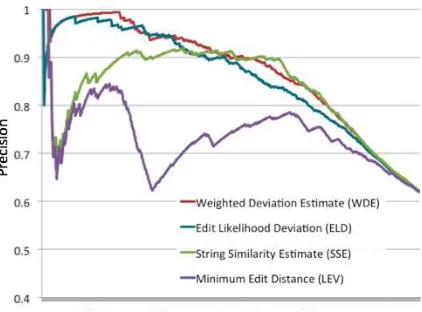
Figure 1: A comparison of the different approaches to generating seeds from edit distance. The comparison shows that local deviation, the novel method introduced in this paper, is the most successful. With about 10% of the most confident entity candidates by Edit Likeli-hood Deviation or Weighted Deviation Estimate, there is greater than95%precision, giving a clean enough divi-sion of the data to seed a model.
At this point, we have the global string similarity of each candidate entity pair across languages,SSE(), and the local string similarity deviation of each can-didate pair,ELD().
A combination was also explored that combined the two, creating an equally weighted product of
SSE and ELD(), Weighted Deviation Estimate,
W DE() (equation omitted for space). As Figure 1 shows, there is only a slight improvement from the combination of the two, showing that Edit Like-lihood Deviation, the novel approach here, con-tributes the most to identifying candidate seeds.
We can calculate the first accuracies here by as-suming that the best candidate in each message pair was an entity. All results also summarized at the end of the paper:
Precision Recall F-value
Kr`eyol: 0.619 0.619 0.619
English: 0.633 0.633 0.633
The results are reasonably strong for methods that made few assumptions about the data and were not optimized, with errors in a little under half the pre-dictions.
esti-mates between messages now take into account both local and global edit likelihoods, allowing us to rank the candidates byW DEand sample the most likely and least likely. Here, we simply took the top and bottom 5%.3
3 STEP 2: Learn joint alignment and word-shape models using the likelihood estimates as seeds.
Taking the seeds from Step 1, we can then treat them as training items in a linear model.
We used the Stanford Maximum Entropy Classi-fier. Model-choice is only important in that a dis-criminative learner is required. The 5% ‘non-entity’ pairs were still the highest String Similarity for their particular message/translation, but simply did not deviate greatly from the average within that mes-sage/translation. Therefore, we are explicitly target-ing the border between entities and non-entities in the high String Similarity part of the vector space. This sampling strategy would not work for a gener-ative learner.
For the same reason, though, we do not include raw edit distance or the String Similarity Estimate among the features. If we did, then the model will simply relearn and overfit this bias and give all the weight to edit distance.
We build the model on features that include con-text (the entity itself and surrounding words), word-shape features (capitalization, punctuation, segmen-tation, and numerical patterns), and alignment (ab-solute and relative character offsets between the can-didates in the messages and translation). For word-shape features, we used a simple representation that converted all sequences of capitalized letters, lower-case letters, and non-letter characters into ‘C’, ‘c’ and ‘n’, respectively. Therefore, ‘Port-au-Prince’, ‘Port au Prince’ and ‘Port.a.Prons’ would all get the same word-shape feature, ‘CcncnCc’. We
al-3There are clearly many more parameters and variants of
[image:5.612.317.526.73.238.2]equations that could be explored. As an unsupervised approach, it is by conscious choice that only the most well-known equa-tions are used and tunable parameters are set at sensible defaults (like the equal weights here). This is to keep the experiments as cleanly ‘unsupervised’ as possible, and to demonstrate that the accurate results here are not simply a quirk of a particular equa-tion, but a broadly applicable approach to generating seeds by local deviation estimates.
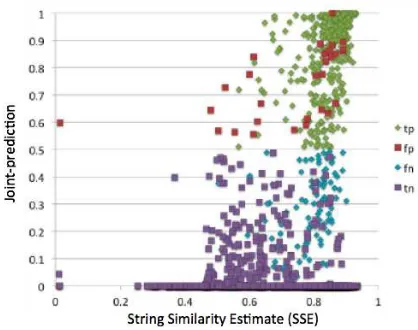
Figure 2: Comparing the predictions for the String Sim-ilarity for the same candidates, to the jointly-learned model. (Coding scheme: tp = true-positive, etc.) The distribution shows that while String Similarity correlates with named-entities, it is not a clean division. Note espe-cially the mass of true-negatives in the bottom-right cor-ner of the graph. These would be a relatively high vol-ume of false-positives for String Similarity alone, but the model that bootstraps knowledge of context, word-shape and alignment has little trouble distinguishing them and correctly assigning them zero-probably of being an entity.
lowed the model to also find character-ngrams over these shapes to capture features which would rep-resent characteristics like ‘is-capitalized’, ‘contains-internal-capital’, and ‘is-multiword-phrase’.
As a relatively small set of features, we also model the intersection of each of them. This al-lows the model to learn, for example, that words that are perfectly aligned, but are both all lower-case, are weighted0.06more likely as a non-entity. Despite the simplicity and low number of features, this is a fairly powerful concept to model.
As with all unsupervised methods that bootstrap predictions through seeded data, the success relies on a representative feature space to avoid learning only one part of the problem. The results are strong:
Precision Recall F-value
Kr`eyol: 0.907 0.687 0.781
English: 0.932 0.766 0.840
strong for both Kr`eyol and English, indicating that the seeding method in Step 1 did, in fact, produce candidates that occurred in broad range of contexts, overcoming one of the limits of gazetteer-based ap-proaches.
Perhaps the most obvious extension is to jointly learn the models on both languages, using the candi-date alignment models in combination with the con-texts in both the original text and the translation:
Precision Recall F-value
Kr`eyol: 0.904 0.794 0.846
English: 0.915 0.813 0.861
This improves the results for both, especially the Kr`eyol which can now take advantage of the more consistent capitalization and spelling in the English translations.
For many supervised learners, 0.846 would be a strong result. Here, we are able to get this in Hatian Kr`eyol using only unsupervised methods and a few thousand loosely translated sentences.
4 STEP 3: Learning weighted models over the context, word-shape, alignment and supervised predictions (with
high-resource languages)
The natural extension to the supervised comparison is to combine the methods. We included the Stanford NER predictions in the features for the final model, allowing the bootstrapped model to arrive at the op-timal weights to apply to the supervised predictions in the given context.
From the perspective of supervised NER, this can be thought of as leveraging unsupervised align-ment models for domain-adaptation. The Stanford NER predictions were added as features in the final model, directly for the English phrases and across the candidate alignments for the Kr`eyol phrases.
Taken alone, the unsupervised strategies clearly improve the results, but for someone coming from a supervised learning background in NER (which will be most NER researchers) this should provide an in-tuition as to exactly how good. We cannot compare the Kr`eyol as there is no supervised NER corpus for Kr`eyol, and our labeled evaluation data is too small to train on. However, we can compare the English results to near state-of-the-art NER taggers.
We compared our system to the predictions made by the Stanford NER parser trained on MUC and CoNLL data (Sang, 2002; Sang and De Meulder, 2003):
Precision Recall F-value
English: 0.915 0.206 0.336
The low cross-domain result is expected, but 0.336 for supervised cross-domain predictions within a language is much less than 0.861 for unsupervised cross-language predictions. This clearly shows that the methods and evaluation used here really do demonstrate a new strategy for NER. It also shows that domain-specificity might be even be more im-portant than language-specificity when we can boot-strap our knowledge of context.4
Combining the two approaches, we get the most accurate results:
Precision Recall F-value
Kr`eyol: 0.838 0.902 0.869
English: 0.846 0.916 0.880
Even though English is a high-resource language, this is still a very good result for cross-domain adap-tation, with F > 0.5 improvement over the super-vised model alone. It is clear that this strategy could be used for domain adaptation more broadly wher-ever loose translations exists.
While not as big a gain in accuracy as the previ-ous steps, theF >0.02gain is still significant. Al-though untested here, it is easy to imagine that with a small amount of labeled data or improved gazetteers the supervised approach should further. About 10% of the error can be attributed to capitalization, too, which is a slight bias against the MUC/CoNLL trained data where the capitalization of named enti-ties was consistent. A realistic deployment approach would be to create an initial model using the unsu-pervised methods described in this paper and then to further bootstrap the accuracy through supervised la-beling. This particular approach to semi-supervised learning is outside the scope of this paper.
4For the edge cases and entity boundary errors, we always
4.1 Distinguishing Types of Entity
NER often distinguishes types of Entities (eg: Peo-ple, Locations, Organizations); a frequent subtask sometimes called named-entity discrimination or named-entity classification. We discuss this briefly.
By seeding the data with the Stanford NER pre-dictions for ‘Person’, ‘Location’, and ‘Organization’ and learning a three-way distinction within the enti-ties, we saw that it wasn’t a difficult problem for this particular corpus. The main potential complication was between organizations and locations (especially for radio stations) but there were relatively few or-ganizations in the data so the micro-fvalue would change very little. No doubt, in other texts the lo-cation/organization division would compose a big-ger part of the problem. These observations about distinguishing NERs are consistent with the known problems in NER more broadly. The Stanford NER only made predictions for 114 of the entities that were confidently mapped to their Kr`eyol counter-parts in Step 1:
Precision Recall F-value
English: 0.512 0.782 0.619
To exploit any signal here, let alone a respectable
F = 0.619 is a good result, but clearly more im-provements are possible.
5 Analysis
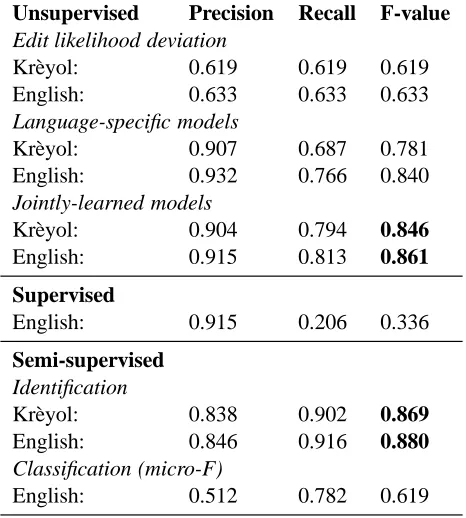
The results presented in the paper are summarized in Table 1. Taken together, they make it clear that this is a very promising new method for named-entity recognition in low resources languages, and for domain-adaptation in high-resource languages.
Analysis of the consistent errors shows several clear patterns. Products like ‘aquatab’ were a com-mon false positive, although a product could be a named-entity in certain coding schemas. Dates, fig-ures and currency (‘250gd’) were also frequent false positives, but would be reasonably easy to filter as they follow predictable patterns.
Some cognates and borrowings also
made it through as false-positives: ‘antibi-otics’/‘antibiotik’, ‘drinking water’/‘drinking wa-ter’, ‘medicine’/‘medicament’, ‘vitamin c’/‘vitamine c’, ‘cyber’/‘cyber’, ‘radio’/‘radyo’, although ‘cyber
cafe’ almost always referred to a specific location and ‘radio’ was often part of an organization name, ‘radio enspirasyon’.
The false-negatives were almost all very low-frequency words or high-low-frequency words that were more commonly used as non-entities. This is con-sistent with named-entity recognition more broadly.
6 Background and Related Work
We were surprised that no one had previously re-ported looked at leveraging cross-linguistic named-entity recognition in this way. Perhaps previous researchers had found (like us) that edit distance alone was not particularly useful in cross-linguistic named-entity recognition, and therefore not pursued it. While the approach is novel, the general observa-tion that named-entities change form less than other words cross-linguistically is one of the oldest in lan-guage studies. Shakespeare’s ‘River Avon’ simply means ‘River River’, as ‘Avon’ is, literally, ‘River’ in the pre-English Celtic language of the region.
For parallel short-message corpora, named-entity recognition is completely unresearched, but there is growing work in classification (Munro and Man-ning, 2010; Munro, 2011) and translation (Lewis, 2010), the latter two using the same corpus as here.
Past ‘Multilingual Named-Entity Recognition’ systems meant training the same supervised system on different languages, which was the focus of the past CoNLL tasks. While the goal of these systems was the same as ours – broad cross-linguistic cov-erage for named-entity recognition – this is not the same ‘cross-linguistic’ as the one employed here.
on transliteration – an important aspect of translation that we simply aren’t addressing here.
Most earlier work used a tagger in one language in combination with machine translation-style align-ments models. Among these, Huang et al. is the most closely related to our work as they are translat-ing rare named-entities, and are therefore in a similar low-resource context (Huang et al., 2004). As with the NIST project, most work building on Huang et al. has been in transliteration.
Although not cross-linguistic, Piskorski et al.’s work on NER for inflectional languages (2009) also relied on the similarities in edit distance between the intra-language variation of names.
In gazetteer-related work, Wang et al. and others since, have looked at edit distance within a language, modeling the distance between observed words and lists of entities (Wang et al., 2009). Similarly, there is a cluster of slightly older work on unsupervised entity detection, also within one language (Pedersen et al., 2006; Nadeau et al., 2006), but all relying on web-scale quantities of unlabeled data.
While the implementation is not related, it is also worth highlighting Lin et al.’s very recent work on unsupervised language-independent name trans-lation the mines data from Wikipedia ‘infoboxes’, (Lin et al., 2011) however the infoboxes give a fairly and highly structured resource, that might be consid-ered more supervised than not.
In alignment work, the foundational work is Yarowsky et al.’s induction of projections across aligned corpora (Yarowsky et al., 2001), most suc-cessfully adapted to cross-linguistic syntactic pars-ing (Hwa et al., 2005). The machine translation sys-tems used named-entity recognition are too many to list here, but as we say, the system we present could aid translation considerably, especially in the con-text of low resources languages and humanitarian contexts, a recent focus in the field (Callison-Burch et al., 2011; Lewis et al., 2011).
7 Conclusions
We have presented a promising a new strategy for named-entity recognition from unaligned paral-lel corpora, finding that unsupervised named-entity recognition across languages can be bootstrapped from calculating the local edit distance deviation
be-Unsupervised Precision Recall F-value Edit likelihood deviation
Kr`eyol: 0.619 0.619 0.619
English: 0.633 0.633 0.633
Language-specific models
Kr`eyol: 0.907 0.687 0.781
English: 0.932 0.766 0.840
Jointly-learned models
Kr`eyol: 0.904 0.794 0.846
English: 0.915 0.813 0.861
Supervised
English: 0.915 0.206 0.336
Semi-supervised Identification
Kr`eyol: 0.838 0.902 0.869
English: 0.846 0.916 0.880
Classification (micro-F)
[image:8.612.313.546.78.337.2]English: 0.512 0.782 0.619
Table 1: A summary of the results presented in this paper showing promising new methods for unsupervised and semi-supervised named-entity recognition.
tween candidate entities. Purely unsupervised ap-proaches are able to identify named entities with
F = 0.846accuracy for Kr`eyol andF = 0.861for English, leveraging the candidate alignments for im-proved accuracy in both cases. Combined with su-pervised learning, the accuracy rises toF = 0.869
and F = 0.880 respectively, which is approaching the level of accuracy achieved by in-domain super-vised systems. It is rare for unsupersuper-vised systems to be competitive with supervised approaches as ac-curacy is usually lost for coverage, but here it looks like the method can be effective for both.
References
C.. Callison-Burch, P. Koehn, C. Monz, and Zaidan. O. 2011. Findings of the 2011 workshop on statistical machine translation. In Proceedings of the Sixth
Work-shop on Statistical Machine Translation.
F. Huang, S. Vogel, and A. Waibel. 2004. Improving named entity translation combining phonetic and se-mantic similarities. In Proc. of HLT-NAACL, pages 281–288.
R. Hwa, P. Resnik, A. Weinberg, C. Cabezas, and O. Ko-lak. 2005. Bootstrapping parsers via syntactic projec-tion across parallel texts. Natural language
engineer-ing, 11(3):311–325.
M. Kay. 2006. Translation, Meaning and Refer-ence. Intelligent Linguistic Architectures: Variations
on Themes by Ronald M. Kaplan, page 3.
P. Koehn, H. Hoang, A. Birch, C. Callison-Burch, M. Federico, N. Bertoldi, B. Cowan, W. Shen, C. Moran, R. Zens, et al. 2007. Moses: Open source toolkit for statistical machine translation. In
Proceed-ings of the 45th Annual Meeting of the ACL on Inter-active Poster and Demonstration Sessions, pages 177–
180. Association for Computational Linguistics. W. Lewis, R. Munro, and S. Vogel. 2011. Crisis mt:
Developing a cookbook for mt in crisis situations. In
Proceedings of the Sixth Workshop on Statistical Ma-chine Translation.
W. Lewis. 2010. Haitian Creole: How to Build and Ship an MT Engine from Scratch in 4 days, 17 hours, & 30 minutes. In 14th Annual Conference of the European
Association for Machine Translation.
W.P. Lin, M. Snover, and H. Ji. 2011. Unsuper-vised Language-Independent Name Translation Min-ing from Wikipedia Infoboxes. ProceedMin-ings of the
EMNLP Workshop on Unsupervised Learning in NLP,
page 43.
R. Munro and C.D. Manning. 2010. Subword varia-tion in text message classificavaria-tion. In Proceedings of
the Annual Conference of the North American Chap-ter of the Association for Computational Linguistics (NAACL 2010).
R. Munro. 2011. Subword and spatiotemporal mod-els for identifying actionable information in haitian kreyol. In Fifteenth Conference on Computational
Natural Language Learning (CoNLL 2011).
D. Nadeau, P. Turney, and S. Matwin. 2006. Unsuper-vised named-entity recognition: Generating gazetteers and resolving ambiguity. Advances in Artificial
Intel-ligence, pages 266–277.
T. Pedersen, A. Kulkarni, R. Angheluta, Z. Kozareva, and T. Solorio. 2006. An unsupervised language inde-pendent method of name discrimination using second
order co-occurrence features. Computational
Linguis-tics and Intelligent Text Processing, pages 208–222.
J. Piskorski, K. Wieloch, and M. Sydow. 2009. On knowledge-poor methods for person name matching and lemmatization for highly inflectional languages.
Information retrieval, 12(3):275–299.
E.F Tjong Kim Sang and F. De Meulder. 2003. Intro-duction to the CoNLL-2003 shared task: Language-independent named entity recognition. In Proceedings
of the seventh conference on Natural language learn-ing at HLT-NAACL 2003-Volume 4, pages 142–147.
Association for Computational Linguistics.
E.F. Tjong Kim Sang. 2002. Introduction to the CoNLL-2002 shared task: language-independent named entity recognition, proceedings of the 6th conference on nat-ural language learning. August, 31:1–4.
Z. Song and S. Strassel. 2008. Entity translation and alignment in the ACE-07 ET task. Proceedings of LREC-2008.
R. Steinberger and B. Pouliquen. 2007. Cross-lingual named entity recognition. Lingvisticæ Investigationes, 30(1):135–162.
T. Tao, S.Y. Yoon, A. Fister, R. Sproat, and C.X. Zhai. 2006. Unsupervised named entity transliteration using temporal and phonetic correlation. In Proceedings of
the 2006 Conference on Empirical Methods in Natural Language Processing, pages 250–257. Association for
Computational Linguistics.
T. Tchoukalov, C. Monson, and B. Roark. 2010. Mor-phological analysis by multiple sequence alignment.
Multilingual Information Access Evaluation I. Text Re-trieval Experiments, pages 666–673.
W. Wang, C. Xiao, X. Lin, and C. Zhang. 2009. Effi-cient approximate entity extraction with edit distance constraints. In Proceedings of the 35th SIGMOD
in-ternational conference on Management of data, pages
759–770. ACM.
D. Yarowsky, G. Ngai, and R. Wicentowski. 2001. In-ducing multilingual text analysis tools via robust pro-jection across aligned corpora. In Proceedings of
the first international conference on Human language technology research, pages 1–8. Association for