Kleene, a Free and Open-Source Language
for Finite-State Programming
Kenneth R. Beesley SAP Labs, LLC P.O. Box 540475 North Salt Lake, UT 84054
USA
Abstract
Kleene is a high-level programming language, based on the OpenFst library, for constructing and manipulating finite-state acceptors and transducers. Users can program using reg-ular expressions, alternation-rule syntax and right-linear phrase-structure grammars; and Kleene provides variables, lists, functions and familiar program-control syntax. Kleene has been approved bySAP AGfor release as free, open-source code under the Apache License, Version 2.0, and will be available by Au-gust 2012 for downloading from http:// www.kleene-lang.org. The design, im-plementation, development status and future plans for the language are discussed.
1 Introduction
Kleene1 is a finite-state programming language in
the tradition of the AT&T Lextools (Roark and Sproat, 2007),2 the SFST-PL language (Schmid,
2005),3the Xerox/PARCfinite-state toolkit (Beesley
and Karttunen, 2003)4andFOMA(Huld´en, 2009b),5
all of which provide higher-level programming for-malisms built on top of low-level finite-state li-braries. Kleene itself is built on the OpenFst library
1Kleene is named after American mathematician Stephen
Cole Kleene (1909–1994), who investigated the properties of regular sets and invented the metalanguage of regular expres-sions.
2http://www.research.att.com/˜alb/
lextools/
3http://www.ims.uni-stuttgart.de/
projekte/gramotron/SOFTWARE/SFST.html
4http://www.fsmbook.com
5http://code.google.com/p/foma/
(Allauzen et al., 2007),6developed by Google Labs
andNYU’s Courant Institute.
The design and implementation of the lan-guage were motivated by three main principles, summarized as Syntax Matters, Licensing Matters and Open Source Matters. As for the syntax, Kleene allows programmers to specify weighted or unweighted finite-state machines (FSMs)— including acceptors that encode regular languages and two-projection transducers that encode regu-lar relations—using reguregu-lar expressions, alternation-rule syntax and right-linear phrase-structure gram-mars. The regular-expression operators are bor-rowed, as far as possible, from familiar Perl-like and academic regular expressions, and the alterna-tion rules are based on the “rewrite rules” made pop-ular by Chomsky and Halle (Chomsky and Halle, 1968). Borrowing from general-purpose program-ming languages, Kleene also provides variables, lists and functions, plus nested code blocks and familiar control structures such asif-elsestatements and
whileloops.
As for the licensing, Kleene, like the OpenFst li-brary, is released under the Apache License, Version 2.0, and its other dependencies are also released un-der this and similar permissive licenses that allow commercial usage. In contrast, many notable finite-state implementations, released under the GPL and similar licenses, are restricted to academic and other non-commercial use. The Kleene code is also open-source, allowing users to examine, correct, augment and even adopt the code if the project should ever be abandoned by its original maintainer(s).
6http://www.openfst.org
It is hoped that Kleene will provide an attractive development environment for experts and students. Pre-edited Kleene scripts can be run from the com-mand line, but a graphical user interface is also pro-vided for interactive learning, programming, testing and drawing ofFSMs.
Like comparable implementations of finite-state machines, Kleene can be used to implement a vari-ety of useful applications, including spell-checking and -correction, phonetic modeling, morphological analysis and generation, and various kinds of pat-tern matching. The paper continues with a brief de-scription the Kleene language, the current state of development, and plans for the future.
2 Implementation
The Java-language Kleene parser, implemented with JavaCC and JJTree (Copeland, 2007),7 is
Unicode-capable and portable. Successfully parsed state-ments are reduced to abstract syntax trees (ASTs), which are interpreted by calling C++functions in the OpenFst library via the Java Native Interface (JNI).
3 Kleene Syntax
3.1 Regular Expressions
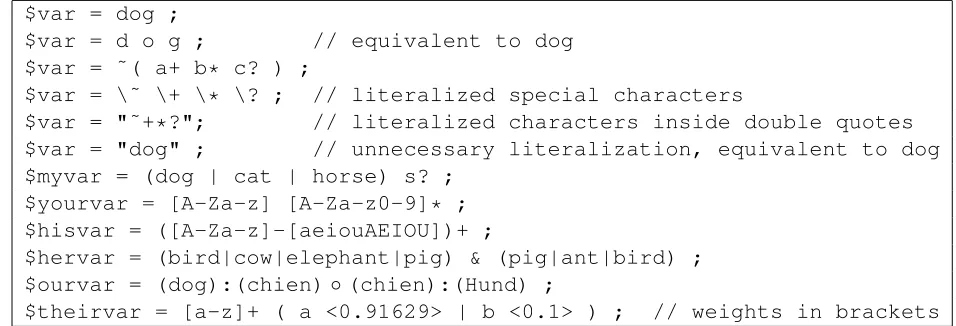
Basic assignment statements have a regular expres-sion on the right-hand side, as shown in Table 1. As in Perl regular expressions, simple alphabetic char-acters are literal, and concatenation is indicated by juxtaposition, with no overt operator. Parentheses can be used to group expressions. The postfixed*
(the “Kleene star”),+(the “Kleene plus”), and? de-note zero-or-more, one-or-more, and optionality, re-spectively. Square-bracketed expressions have their own internal syntax to denote character sets, includ-ing character ranges such as[A-Z]. The union op-erator is|. Basic regular operations missing from Perl regular expressions include composition (◦ or
_o_), crossproduct (:), language intersection (&), language negation (∼) and language subtraction (-). Weights are indicated inside angle brackets, e.g.
<0.1>.
Special characters can be literalized with a pre-ceding backslash or inside double quotes, e.g.\*or
"*"denotes a literal asterisk rather than the Kleene
7https://javacc.dev.java.net
plus. To improve the readability of expressions, spaces are not significant, unless they appear inside square brackets or are explicitly literalized inside double quotes or with a preceding backslash.
In a language like Kleene where alphabetic sym-bols are literal, and the expressiondogdenotes three literal symbols, d, o andg, concatenated together, there must be a way to distinguish variable names from simple concatenations. The Kleene solution is to prefix variable names that are bound toFSM val-ues with a dollar-sign sigil, e.g. $myvar. Once defined, a variable name can be used inside subse-quent regular expressions, as in the following ex-ample, which models a fragment of Esperanto verb morphology.
$vroot = don | dir | pens | ir ; // "give", "say", "think", "go" $aspect = ad ;
// optional repeated aspect
$vend = as | is | os | us | u | i ; // pres, past, fut, cond, subj, inf $verbs = $vroot $aspect? $vend ; // use of pre-defined variables
Similarly, names of functions that returnFSMs are distinguished with the$ˆsigil. To denote less com-mon operations, rather than inventing and prolifer-ating new and arguably cryptic regular-expression operators, Kleene provides a set of predefined func-tions including
$ˆreverse(regexp)
$ˆinvert(regexp)
$ˆinputProj(regexp)
$ˆoutputProj(regexp)
$ˆcontains(regexp)
$ˆignore(regexp,regexp)
$ˆcopy(regexp)
Users can also define their own functions, and func-tion calls are regular expressions that can appear as operands inside larger regular expressions.
3.2 Alternation-Rule Syntax
$var = dog ;
$var = d o g ; // equivalent to dog $var = ˜( a+ b* c? ) ;
$var = \˜ \+ \* \? ; // literalized special characters
$var = "˜+*?"; // literalized characters inside double quotes $var = "dog" ; // unnecessary literalization, equivalent to dog $myvar = (dog | cat | horse) s? ;
$yourvar = [A-Za-z] [A-Za-z0-9]* ; $hisvar = ([A-Za-z]-[aeiouAEIOU])+ ;
$hervar = (bird|cow|elephant|pig) & (pig|ant|bird) ; $ourvar = (dog):(chien)◦(chien):(Hund) ;
[image:3.612.66.544.56.219.2]$theirvar = [a-z]+ ( a <0.91629> | b <0.1> ) ; // weights in brackets
Table 1: Kleene Regular-Expression Assignment Examples.
input-expression->output-expression/left-context_right-context
Table 2: The Simplest Kleene Alternation-Rule Template.
The simplest rules have the template shown in Ta-ble 2, and are interpreted into transducers that map the input to the output in the specified context. Such rules, which cannot be reviewed in detail here, are commonly used to model phonetic and orthographi-cal alternations.
3.3 Right-Linear Phrase Structure Grammars
While regular expressions are formally capable of describing any regular language or regular relation, some linguistic phenomena—especially productive morphological compounding and derivation—can be awkward to describe this way. Kleene therefore provides right-linear phrase-structure grammars that are similar in semantics, if not in syntax, to the Xe-rox/PARC lexc language (Beesley and Karttunen, 2003, pp. 203–78).
A Kleene phrase-structure grammar is defined as a set of productions, each assigned to a variable with a$>sigil. Productions may include right-linear ref-erences to themselves or to other productions, which might not yet be defined. The productions are parsed immediately but are not evaluated until the entire grammar is built into anFSMvia a call to the built-in function$ˆstart(), which takes one production variable as its argument and treats it as the starting production of the whole grammar. The following example models a fragment of Esperanto noun
mor-photactics, including noun-root compounding.
$>Root = (kat | hund | elefant | dom) ( $>Root | $>AugDim ) ; $>AugDim = ( eg | et )? $>Noun ; $>Noun = o $>Plur ;
$>Plur = j? $>Case ; $>Case = n? ;
$net = $ˆstart($>Root) ;
The syntax on the right-hand side of productions is identical to the regular-expression syntax, but allow-ing right-linear references to productions of the form
$>Name.
4 KleeneFSMs
Each Kleene finite-state machine consists of a stan-dard OpenFst FSM, under the default Tropical Semiring, wrapped with a Java object8 that stores
the private alphabet9of each machine.
In Kleene, it is not necessary or possible to de-clare the characters being used; characters appearing in regular expressions, alternation rules and right-linear phrase-structure grammars are stored auto-matically as FSM arc labels using their Unicode
8Each Java object of the class Fst contains a long integer
field that stores a pointer to the OpenFst machine, which actu-ally resides in OpenFst’s C++memory space.
9The alphabet, sometimes known as thesigma, contains just
code point value, and this includes Unicode sup-plementary characters. Programmer-defined multi-character symbols, represented in the syntax with surrounding single quotes, e.g. '+Noun' and
'+Verb', or, using another common convention,
'[Noun]'and'[Verb]', also need no declara-tion and are automatically stored using code point values taken from a Unicode Private Use Area.
The dot (.) denotesanycharacter, and it translates non-trivially into reserved arc labels that represent OTHER(i.e. unknown) characters.10
5 Status
5.1 Currently Working
As of the date of writing, Kleene is an advanced beta project offering the following:
• Compilation of regular expressions, right-linear phrase-structure grammars, and several alternation-rule variations intoFSMs.
• Robust handling of Unicode, including sup-plementary characters, plus support for user-defined multi-character symbols.
• Variables and maintenance of symbol tables in a frame-based environment.
• Pre-defined and user-defined functions.
• Handling of lists ofFSMs, iteration over lists, and functions that handle and return lists.
• A graphical user interface, including tools to drawFSMs and test them manually.
• File I/O ofFSMs in anXMLformat.
• Interpretation of arithmetic expressions, arithmetic variables and functions, including boolean functions; and if-then statements and while loops that use boolean operators and functions.
10The treatment ofFSM-specific alphabets and the handling
ofOTHERcharacters is modeled on the Xerox/PARC implemen-tation (Beesley and Karttunen, 2003, pp. 56–60).
5.2 Future Work
The work remaining to be done includes:
• Completion of the implementation of alternation-rule variations.
• Writing of runtime code and APIs to apply FSMs to input and return output.
• Conversion of FSMs into stand-alone exe-cutable code, initially in Java and C++.
• Expansion to handle semirings other than the default Tropical Semiring of OpenFst.
• Testing in non-trivial applications to determine memory usage and performance.
6 History and Licensing
Kleene was begun informally in late 2006, became part of a company project in 2008, and was under development until early 2011, when the project was canceled. On 4 May 2012,SAP AGreleased Kleene as free, open-source code under the Apache License, Version 2.0.11
The Kleene source code will be repackaged ac-cording to Apache standards and made available for download by August of 2012 at http://www. kleene-lang.org. A user manual, currently over 100 pages, and an engineering manual will also be released. Precompiled versions will be provided for Linux, OS X and, if possible, Windows.
Acknowledgments
Sincere thanks are due to the OpenFst team and all who made that library available. A special per-sonal thanks goes to M˚ans Huld´en, who graciously released his algorithms for interpreting alternation rules and language-restriction expressions, and who went to great lengths to help me understand and re-implement them. I also acknowledge mySAPLabs colleagues Paola Nieddu and Phil Sours, who con-tributed to the design and implementation of Kleene, and my supervisor Michael Wiesner, who supported the open-source release. Finally, I thank Lauri Kart-tunen, who introduced me to finite-state linguistics and has always been a good friend and mentor.
11http://www.apache.org/licenses/
References
Cyril Allauzen, Michael Riley, Johan Schalkwyk, Woj-ciech Skut, and Mehryar Mohri. 2007. OpenFst: A general and efficient weighted finite-state transducer library. In Proceedings of the Ninth International Conference on Implementation and Application of Au-tomata (CIAA 2007), volume 4783 ofLecture Notes in Computer Science, pages 11–23. Springer.
Kenneth R. Beesley and Lauri Karttunen. 2003. Finite State Morphology. CSLI Publications, Palo Alto, CA. Noam Chomsky and Morris Halle. 1968. The Sound
Pattern of English. Harper and Row, New York. Tom Copeland. 2007. Generating Parsers with JavaCC.
Centennial Books, Alexandria, VA.
M˚ans Huld´en. 2009a. Finite-State Machine Construc-tion Methods and Algorithms for Phonology and Mor-phology. Ph.D. thesis, The University of Arizona, Tucson, AZ.
M˚ans Huld´en. 2009b. Foma: a finite-state compiler and library. InProceedings of the EACL 2009 Demonstra-tions Session, pages 29–32, Athens, Greece.
Brian Roark and Richard Sproat. 2007. Computa-tional Approaches to Morphology and Syntax. Oxford Surveys in Syntax & Morphology. Oxford University Press, Oxford.