Mobilising Knowledge: Determining key elements for
success and pitfalls in developing Community Based
Tourism
DODDS, Rachel, ALI, Alisha <http://orcid.org/0000-0002-7667-4293> and GALASKI, Kelly
Available from Sheffield Hallam University Research Archive (SHURA) at:
http://shura.shu.ac.uk/11568/
This document is the author deposited version. You are advised to consult the publisher's version if you wish to cite from it.
Published version
DODDS, Rachel, ALI, Alisha and GALASKI, Kelly (2018). Mobilising Knowledge: Determining key elements for success and pitfalls in developing Community Based Tourism. Current Issues in Tourism, 21 (13), 1547-1568.
Copyright and re-use policy
See http://shura.shu.ac.uk/information.html
Key elements of success and barriers in community based tourism
Abstract
Community based tourism (CBT) has often been cited as an alternative to mass tourism and an approach for tourism to become more sustainable. If developed well, CBT can become a poverty alleviation mechanism and a way to access improvements in quality of life, providing empowerment and greater economic benefit to individuals in local communities. Despite the plethora of literature on CBT and evaluation of models, there is little analysis of the facilitators and barriers to achieving it. Through the use of case studies in both academic and grey literature, this paper serves as an instructive review of the CBT literature to synthesise the key elements of success and the challenges.
Introduction
Community participation in development has gained traction in the literature since the 1970s due to its recognition by leading international bodies such as the United Nations, US Agency for International Development and the World Bank (Cater, 1993; Giampiccoli & Mtapuri, 2012). Development practitioners have learned that community involvement can enact the principles of sustainable development and bring forth transformations to the lives of locals (Tosun, 2000). In the tourism literature, there has been a focus on local communities and their needs and capabilities (Murphy, 1985; Ruiz-Ballesteros, 2011; Kontogeorgopoulos, Churyen, & Duangsaeng, 2014) as tourism is promoted as a conservation and community development tool. This has also been emphasised by major conservation and non-governmental organisations (NGOs) as seen in Agenda 21 (Vaughan, 2000), the World Bank and the Global Environmental Facility (Markandya, Taylor, & Pedroso, 2005) and Conservation International (2008).
Tourism is seen as an effective tool in creating supplemental income in areas where conservation affects local populations’ traditional livelihoods (Campbell, 2002; Forstner, 2004; Markandya et al. 2005; Vaughan 2000). Supplemental is emphasised because it is important to note, ‘tourism only has limited potential for securing rural livelihoods’ (Forstner, 2004, p. 512) and these communities should not have an over-dependence on tourism for their sustenance (Roe, Grieg-Gran, & Schalken, 2001). The term that explains this form of tourism is community-based tourism (CBT). CBT is tourism that is community-managed, comprising of several locally owned businesses with the goal of providing benefits to the community often with the objective of contributing to conservation (when taking place in or near protected areas) (Tolkach & King, 2015). It is promoted as a mechanism to improve livelihoods and create community development opportunities (Mtapuri & Giampiccoli, 2013) and is characterised by being located in, owned and managed by the community, which consequently receives a significant portion of the benefits (Trejos & Chiang, 2009; Sebele, 2010; Tolkach & King, 2015).
CBT is rooted in community development and participation in the creation and planning of tourist products (Lopez-Guzman, Sanchez-Canizares, & Pavon, 2011; Salazar, 2012). It is
theorised that CBT is a worthwhile choice for stimulating the development of rural economies due to the perceived economic benefits to locals (Mehmetoglu, 2001), greater promotion of the destination (Boo & Busser, 2006) and a higher quality tourist experience with a focus on heightened environmental awareness (e.g., Lee, 2011; Lepp, 2007). Despite these highlighted benefits of successful CBT, many CBT enterprises and initiatives do not see these results and cannot claim success.
To date, little attention has been focused on assessing the existing literature of CBT to determine key success criteria or barriers in order to mobilise global knowledge for increasing the development of successful CBT. Academics and practitioners have been criticised for failing to demonstrate the real contributions of the sustainable development of tourism (McKercher & Prideaux, 2014). This paper seeks to address this critique by arguing that CBT can be successful through developing a shared understanding of the critical facilitating factors as well as
understanding the key barriers to success. The objective of this research therefore is to review and evaluate both academic and grey literature to a) identify key elements necessary for
community based tourism, b) identify success criteria for the development of CBT, c) outline key barriers that inhibit successful CBT and d) put forth a framework to better understand CBT. This research is not a repetition of the review of CBT already compiled by researchers such as
Armstrong (2012) and Tasci, Croes and Villanueva (2014). The value of this paper is to highlight critical success factors of CBT by connecting academia with industry practice through evaluation of grey literature and case studies. Grey literature is understood as literature from industry or other realms of real practice. Using this form of literature broadens the scope to more relevant studies, thereby providing a more complete view of available evidence (Mahood, Eerd and Irvin (2012). It is hoped that knowledge of these critical barriers and facilitators will be beneficial for developing policy and practice when designing and implementing CBT initiatives.
Defining and Assessing Community Based Tourism
CBT is based on the concept of sustainable development as it promotes local community participation for more just and holistic development (Stone & Stone, 2011). CBT shares the goals of sustainable development in that it strives to be socially equitable, ecologically sound and economically viable for the long-term. CBT differs from many other forms of tourism in that it does not solely aim to maximise profits for absent investors, but to maximise benefits for community shareholders. It is an alternative form of tourism with sustainable community development as its goal. With a basis on celebrating local (rural, indigenous, etc.) cultures, CBT ensures that communities do not decline and disappear and that communities themselves can be viewed strategically as an approach in augmenting the resilience of social and ecological systems, hence making a contribution to sustainable development (Ruiz- Ballesteros, 2011).
Moreover, CBT alludes to a more mutually beneficial relationship between the community and the tourists where the tourists are not afforded priority but rather are part of the system (Wearing & McDonald, 2002; Matarrita-Cascante, Brennan, & Luloff, 2010; Kontogeorgopoulos et al., 2014). This form of tourism is more concerned with the impact of tourism on the community and its environmental resources and is focused on “managing tourism resources with the participation of local people” (REST, 2003:11).
2005; Goodwin & Santalli, 2009; Choi & Sirakaya, 2006; Manyara & Jones, 2007). There are private sector businesses providing community benefits, individually owned community-based businesses, cooperatives, community associations, and concessions provided to private sector on community owned reserves, among others. Overall, there are three main types of CBT:
1. A project in which community members are employed using a rotation system and profits are allocated for community projects or dividends to residents
2. A project that involves family or group initiatives within the communities, based on community assets
3. A joint venture between a community or family and an outside business partner (Ping ND, p. 6).
CBT “must also embrace individual initiatives within the community” (World Wildlife Fund (WWF), 2001). It is important to note that in defining CBT, emphasis should be placed more on measurable benefits gained by community members from a triple bottom line perspective (economic, social and environmental), rather than a stronger focus on the ownership structure.
This paper will first discuss key elements for facilitating successful CBT and then outline barriers. Then a model will be presented to outline how these key elements are interdependent within CBT before concluding with lessons learned that may help to mobilise knowledge for future CBT development.
Success Criteria and Key Elements for Community Based Tourism Development
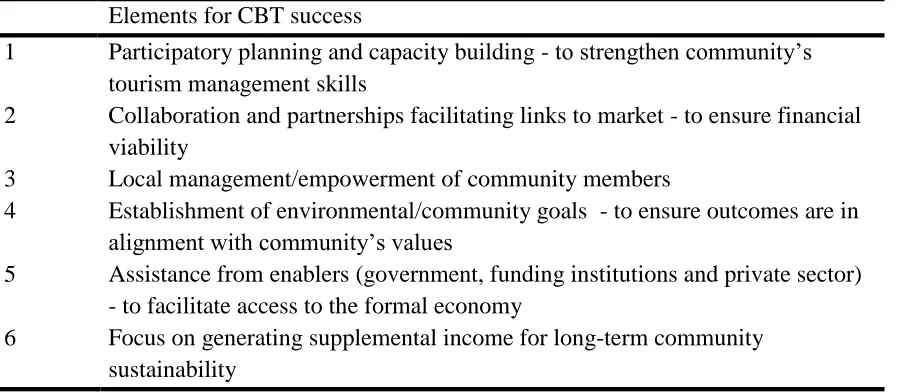
From a review of the literature, six key elements are found to facilitate CBT success. Table 1 outlines key factors that measure what should be considered a successful CBT initiative.
Table 1. Key elements for CBT success
Elements for CBT success
1 Participatory planning and capacity building - to strengthen community’s tourism management skills
2 Collaboration and partnerships facilitating links to market - to ensure financial viability
3 Local management/empowerment of community members
4 Establishment of environmental/community goals - to ensure outcomes are in alignment with community’s values
5 Assistance from enablers (government, funding institutions and private sector) - to facilitate access to the formal economy
6 Focus on generating supplemental income for long-term community sustainability
[image:4.612.70.523.460.656.2]To obtain the goal of community management and ownership, non-formal education and capacity building are key to establishing a foundation of tourism management skills among residents (Novelli & Gebhardt, 2007). From the planning stage, participatory tourism resource mapping, asset identification and visioning exercises are needed. Tasci et al. (2014) discuss how upskilling of local communities in areas such as tour guiding, language, communication, hygiene and safety are essential in delivering CBT initiatives.
Education and training are key components of capacity building and courses including hospitality and tourism management at the community level, as well as general business skills such as marketing, communication, finance and governance are imperative for success. It should be recognised by planners of such initiatives that training takes time, years perhaps. Depending on the range and level of training a CBT enterprise may require, the process may be ongoing as circumstances change over time. This capacity building is important in giving communities the tools they need to understand the possibilities involved in CBT and to become more active participants in the process (Hennink, Kiiti, Pillinger, & Jayakaran, 2012; Stronza & Gordillo, 2008). This gives the communities a foothold in facing the open, competitive market (Dixey, 2008) and empowers people to begin to transform from beneficiaries to business managers.
Identifying the cohesiveness (or togetherness) of the community is important at the outset. Communities often hold varying views on bringing tourism so close to home, and this can create tensions and conflicts, going against the very aim of CBT for community development. The ability of community members to work together and the degree to which a common goal is shared among members greatly affects the potential for success. An example of such cohesiveness can be found in India in the Zemithang, Tawang district where a community leader or “Kanchen” is appointed by the village. He then appoints four villagers to take responsibility for the village’s ceremonies and events. This has built an inherent ability to delegate tasks and manage logistical projects together (Lepcha, for WWF, ND). Another example can be found in the Huchuy Qosco village of Peru where the community of 65 families elect an executive committee to manage the community association. This executive committee holds monthly assemblies to address all issues concerning their CBT enterprise (a village restaurant). Major changes and decisions on use of profits within the community are voted upon by all members (each family is a representative) and ultimately the executive committee approves decisions brought forward by members and the restaurant administration (Galaski, 2015).
(Colchester, 2002). The course evaluates several CBT case studies and prompts each participant to share their experiences. In 2001, 20 international participants were taught how to apply participatory planning techniques to develop a CBT program within their own countries and communities. In addition to classroom style group learning, the course included a field component, where participants visited an example of CBT in to gain a better understanding through observation and interaction with people who have been going through the process and managing CBT in a related context.
Sebele (2010) notes that members of the Makuleke community in South Africa have benefitted from capacity building and training opportunities, as they have been able to gain employment from their improved skillset and knowledge. Another successful CBT initiative that required a participatory planning and training approach is the St. Lucia Anse La Raye Seafood Friday event (Henry, 2009). Initially, the Anse La Raye Village Council and wider community were consulted on the design of the project and tourism visioning was used to develop the plan. Additionally, a management committee was established to manage all aspects of the event and skills training was provided to ensure the committee had the capacity to run the event successfully. One of the keys to the success of the project was the inclusive consultation and shared visioning that included the skills training and product development in a participatory manner.
2. Collaboration and partnerships facilitating links to market
Collaboration lowers risk of failure for CBT and it is rare to find CBT initiated and controlled entirely by the community (Scheyvens, 2002). External advice and links are a necessity to ensure success (Iorio & Corsale, 2014; Ebrahimi & Khalifah, 2014) as many rural tourism providers often lack many of the skills and knowledge required to participate in tourism. For example, some community enterprises may have hospitality skills, but may lack awareness of demand factors, knowledge of product presentation, comprehension of the markets they work within and marketing networks (Bramwell & Lane, 2000; Mitchell & Hall, 2005). Local participation is only as possible as the participants’ capacity allow them to be, making it crucial for collaboration with government, NGOs and the private sector to ensure commercial viability.
Various models of CBT initiatives exist ranging from public to private sector partnerships and joint ventures. Debates exist on the community benefits of these arrangements and some feel that external agents should not be heavily involved (Halstead, 2003). However, without these external arrangements, a CBT project may never produce results and intended benefits. For example, by partnering with domestic or international tour companies that purchase CBT products or services, the initiative becomes part of a network of available activities promoted by that operator. Affiliating with operators lowers risk because it is easier to reach nearby markets if offering products such as day trips, meals, or overnight excursions. Marketing to the domestic market through partnerships with local hotels and operators can also help to build capacity in order to better cater to foreign markets in the future. Support from NGOs, government officials, and private sector companies can counter against the usual barriers associated with CBT and can create a positive cycle of development (Tasci et al., 2014, Kontogeorgopoulos et al., 2014).
direct ownership, direct employment, and supply of goods and services to the tourism enterprise by local producers. Conservation and land management to help protect gorillas has been a benefit of the enterprise as revenue sharing is done by providing five per cent of revenues from park fees into community projects around National Parks. The projects the funds have been used for range from environment protection (tree planting, soil erosion control, and fencing in protected areas to limit access by poachers), education, health care, water and sanitation, basic infrastructures, food security, to other income generation activities.
In a study of Thailand (Ping, ND), it is suggested that a regional level of development of CBT could enable such initiatives, as this would provide a natural network of support. In Thailand, the north, south, east and west parts of the country are very distinct in nature, which makes a regional strategy more sensible. A regional or national network can assist not only with marketing efforts, but funding capabilities and knowledge-exchange between parishes and/or individual communities would be strengthened. Another example of successful collaboration is the El Nido Foundation (ENF). El Nido is located in the northern part of Palawan, a Philippine province and is an example of a community-minded, private sector corporation committed to sharing the benefits of development and tourism with the local community. In 1994 it was founded through an endowment from the joint owners of Ten Knots, a private company that has developed private resorts in the region and is committed to developing the local tourist economy (Asia Pacific Economic Cooperation, 2010).
Possibly the most important consideration for successful CBT is creating market linkages at the planning stage which can help to develop a market-ready product, such as in the case of joint ventures with operators or hotels as they cannot only provide direct access to markets, but can also provide capacity-building through direct employment and training. Edgar Adventures in Peru is such an example. This business began when Edgar began leading tours for G Adventures in the Puno/Lake Titicaca region in 1996. Over several years the popularity of the area, and the growth of G Adventures, now the world’s largest adventure travel company, led to the need for an operator to run all trips for G Adventures in the area. This included homestays on various islands on Lake Titicaca. A decade and a half later, Edgar Adventures has since become a successful, award-winning inbound tour operator and connects over 20,000 travellers per year with family accommodation enterprises.
offerings.
Occasionally large or foreign tour operators do work directly with communities. Such is the case with the community of Ccaccaccollo, Peru. G Adventures and its foundation, Planeterra, helped establish a women’s weaving group in 2005 in the village to provide an experience that includes natural dyeing and weaving demonstrations as well as a market-style presentation area (Planeterra.org). Many travellers, as part of their larger tour, pass through the Sacred Valley en route to Machu Picchu. This initiative has provided direct and steady income to the women and their families in this community. As a volume of 15,000-20,000 visitors travel to the area with this company each year, it was feasible to work directly with the community, however, it did not happen without challenges. A full time employee was responsible for managing the relationship and getting the programs going. The project still requires continuous monitoring by both G Adventures’ tour operations team and local Planeterra staff.
3. Local management and empowerment of community members
Local management, while said to be an important factor of CBT, is often trumped by participants’ actual ability to manage tourism businesses. Mtapuri & Giampiccoli (2013) and Ramsa & Mohd’s (2004) argue that CBT must be controlled and operated by the communities as Bunzinde, Kalavar &, Melubo, (2014) identify that there is a strong relationship between empowerment and the well-being of the community. According to Ife (2002, p. 208), “community empowerment should provide people with the resources, opportunities, vocabulary, knowledge and skills to increase their capacity to determine their own future and to participate in matters that affect their lives.” Research in local community empowerment is still
preliminary, however, care must be taken in understanding the empowerment norms of different cultures as this can vary (Boley, Maruyama, & Woosnam, 2015) which will impact on the success of CBT initiatives.
Additionally, the validity of this participation argument due to the capacity of participants must be questioned in order to “understand the complexity of tourism” as well as their limited access to power and resources (Wall, quoted in Martain-Haverbeck, 2006, p. 39). Therefore the elements of local management and empowerment of CBT are inextricably linked to the elements of capacity building and participatory approaches of the CBT development process. These factors also imply the importance of the elements of market linkages and collaboration, as both can supplement the limited capacity of rural community members to manage their enterprises independently.
their lives were improved through participation in small-scale tourism (Martain-Haverbeck, 2006).
An example of a successfully managed joint venture is Rocktail Bay, a lodge in Southern Africa which the community has shares, receiving dividends from the lodge from lease payments paid by Wilderness Safaris, who also pays the community shares of operating profits (Neilson & Spencley, 2010; Spenceley, 2005). The system was set up on a lease payment where the community receives dividends from its shares in the lodge owning company (Wilderness Safaris) when the profits are sufficient. The local Mqobela community is an equity holder in both the lodge owning company and the lodge operating company. Thus the business model already combines business operations with community benefit.
Another example is the Namibian government who has established land conservancies by devolving wildlife management and tourism development to indigenous people throughout the country. It is renowned as “among the most successful efforts by developing nations to decentralise natural resource management and simultaneously combat poverty” (World Resources Institute, 2005). Conservancies are managed by committees, made up of local people, who receive capacity building and training from government and NGOs. The Namibian Community Based Tourism Trust (NACOBTA) organisation is also known for its community tourism investment opportunities and joint ventures that allow community-managed land conservancies to enter into partnerships with tourism companies to undergo developments that continue to conserve the land and natural resources while generating income to communities. Botswana has also done a similar initiative (Mbaiwa, 2008).
A caveat is warranted here to collective ownership and management in CBT. The Overseas Development Institute suggested that collective management is often ineffective and can “undermine incentives to work” (Mitchell & Muckosy, 2008, p. 2). Traditional management structures are often in place in more successful CBT initiatives. Placing too much importance on the community-owned or managed format, however, may inhibit a project and preclude opportunities to join forces with other organisations such as tour operators or hotels that can provide other benefits. Mohamad & Hamzah (2013) suggest a community cooperative as a business model to support CBT activities. These authors highlight how some CBT programs in Malaysian homestays have been ineffective and that a community cooperative model is able to increase economic benefits, maintain a management structure, and optimise external partnerships.
4. Establishment of environmental and community development goals
example, Thailand’s Chi Phat ecotourism project’s mission was to create alternative income for local communities and to protect the region’s biodiversity (APEC, 2010). After collaboratively defining goals and objectives, the participants have seen fruits of their labour. There are now 15 guide trainees (who receive training in tour group management, communication, eco-interpretation, GPS navigation, First Aid), 24 hospitality (food vendors, guesthouse and home-stay operators) trainees, and a number of Committee members who received training. Twenty-nine guides and other trainees successfully completed a Red Cross First Aid course. The project also established a community fund into which a percentage of all tourism income is deposited. This Fund is used to maintain the operations of the CBT site and for essential services and facilities for the entire Chi Phat Commune. Another success is that the community now is concerned about the destruction of the local environment but before felt helpless because of poverty. Now most villagers have enthusiastically accepted the ecotourism venture as an alternative livelihood for their community rather than solely logging. Another example can be seen in Peru. A100-seat Parwa Community Restaurant’s business plan, managed by the Huchuy Qosco Association in Peru’s Sacred Valley incorporated environmental and community development goals as well as business goals. After one year of operations, the community-owned business, funded by G Adventures and the Multilateral Investment Fund of the International Development Bank (MIF/IDB), reinvested profits into the business and also followed the community development plan to fund three additional social projects: a village computer lab and library, a scholarship fund, and homecare program for the village’s elderly (Galaski, 2015).
Due to the common setting of CBT near protected areas, there is generally a criterion that the enterprise be in line with conservation and waste management goals or generally, environmental sustainability. In Indonesia, near Mt. Ranjani, it was found that one of the major benefits of developing CBT in and around the protected area was increased knowledge about conservation and more effective park management as littering and garbage control was enforced by communities and park staff together (Asia-Pacific Environmental Innovation Strategies (APEIS), 2002).
When evaluating CBT’s success, environmental conservation goals were not considered high on the priority list by managers when determining whether or not an initiative was successful (Goodwin & Santilli, 2009). It is difficult to stay focused on environmental goals if the desire for increased economic impacts is prioritised by managers and community members. This means that many CBT initiatives are not always being planned or managed with all areas of social, environmental and economic goals as a priority, and that these must be better linked in the planning process so that CBT that is successful economically is also providing conservation and waste management benefits and vice versa.
5. Assistance from enablers of CBT: government, funding institutions and private sector involvement
training or funding and therefore institutional structures, funding programs and private sector partnerships are all enablers for success. CBT requires support from such enablers in order to be well promoted and found among the infinite options of tourism activities available to tourists as well as to gain access to technical and financial resources. CBT initiatives often develop in countries where there are national policies for implementing CBT, and where there is an existence of technical and financial assistance for CBT development. An example is South Africa where CBT has been facilitated by turning over rights to land, wildlife and other natural resources to rural communities which has resulted in joint ventures between communities and the private sector for managing tourism. One of the enabling factors for CBT development in the Caribbean has been the European Union, which has provided financial and technical assistance to governments with a focus on CBT in their tourism development programs. For example, the World Bank’s Project Appraisal Document for a Rural Economic Development Project for Jamaica addressed the need for enabling rural CBT enterprises by linking the rural enterprises’ of agricultural producers and tourism product and service providers to markets (World Bank 2009, p. 33). Another example is Thailand where the success of Mae Kampong can be attributed to the support from external actors to the community for research, workshops, focus groups, and assessments conducted in the area, ensuring CBT was a feasible option (Kontogeorgopoulos et al., 2014).
Debates exist on the value of government and private sector support for CBT but despite the diversity on opinions, it is clear that for CBT to develop in the long-term, backing is necessary whether it be form the public or private domains (Mtapuri & Giampiccoli, 2013). Costa Rica has long been known for ecotourism, ranging from luxury eco-lodges, to adventure sports outfitters and environmental conservation programs that include a tourism component, and now with larger scale resort development, the incorporation of day trips to rain forests and canopy tours. The Costa Rican Tourism Board (ICT) in 2008 announced a promotion plan to focus efforts on rural tourism, recognising the beneficial role it could play in its rural communities. Two NGOs, ACTUAR and COOPRENA, act as community tourism operators promoting packages to rural communities through websites, brochures, and a guidebook (Authentic Costa Rica: The Guide to Rural Community Tourism) that outlines close to 60 established CBT operations in the country. Similar NGOs exist in Namibia, Thailand, and Uganda (Caribbean Tourism Organisation, 2007). Guatemala has also committed to skills training for Mayan people by providing intensive courses through the tourism board (Instituto Guatemalteco de Turismo (INGUAT)) on tourism in rural areas that enable small community associations and individuals to manage tourism initiatives. A study of a Guatemalan CBT suggests that the country’s Peace Accords of 1996 opened up opportunities for indigenous people to be integrated into the national economy through participation in tourism (Martain-Haverbeck, 2006). In fact the Guatemalan community of San Juan La Laguna, included into G Adventures’ tours, received training from INGUAT prior to receiving further customized training to become accommodation and tour suppliers for the company. The village also received substantial capacity building and marketing funding from Guatemalan NGOs Fundacion Solar and Associacion Ati’t Ala’. This prepared them to be ready for international visitors and subsequently to attract G Adventures and include them in the company’s co-financed project with the MIF/IDB (Galaski, 2015).
more effective than grants that directly fund an enterprise. When community enterprises provide in-kind or monetary contributions there is a greater sense of ownership and ability to become more self-sufficient. Microfin (Caribbean Finance Limited) uses a cycle of short-term loans to fund micro-enterprises throughout the Caribbean, including in community tourism (CTO et al., 2007). International financial assistance for CBT has been channeled through complex networks of organisations linked to community-based projects including the Global Environment Facility’s Small Grants Programme (SGP), Fundecooperación and the Central American Association for the Economy, Health and the Environment (Asociación Centroamericana para la Economía, la Salud y el Ambiente or ACEPESA, see http://www.acepesa.org/) (Trejos & Chiang, 2009).
6. Creating supplemental income for long-term community sustainability
Financial solvency is a key issue, as without this, long-term success cannot exist. Financial success includes several factors that are also outlined in the points above. Financial feasibility of an enterprise is directly related to market linkages and the development of market-ready product. Funders should not fund initiatives that do not already have market linkages or sound financial plans because those initiatives might collapse once funding is over (Goodwin & Santilli, 2009).
Where tourism activities can be considered supplemental to other income-generating activities, financial sustainability and funding from outside agencies is more easily attainable by either communities or individuals. For example if coffee farmers enter coffee tourism, the tourism activity will be supplemental to farming income. One successful CBT initiative in Guatemala explores a case where a musical group who performed for tourists were farmers by day, and that one of the important benefits they perceived was the socio-cultural benefit of sharing their traditional customs and therefore preserving their culture and pride in it (Martain-Haverbeck, 2006, p. 94).
A Thailand study also suggests that CBT should not be seen as a complete solution for the financial income of a community, especially since one of the aims is to keep visitor numbers low enough to minimise negative impacts (Ping, ND). Alternative complementary forms of livelihood should also be pursued. Additionally, communities can become dependent on tourism income that results in vulnerability during seasonal lows, macroeconomic factors such as recessions, natural disasters and other influencing factors that reduce visitors to the country and subsequently the community. For example, agriculture and conservation initiatives such as reforestation or tours of natural areas have been used to generate family businesses in tourism, based on traditions and expertise in several areas in Costa Rica. Coffee farms, banana plantations, and animal-raising have all become agricultural tourism attractions which has led to many families opening up small cabins on their property to visitors to generate supplemental income. Agricultural tours and volunteer experiences also provide additional forms of income. Initiatives such as this are more successful when they are collaborative. For example, the Catarata Ecotourism Lodge, located near the major tourist town of La Fortuna, Costa Rica, is managed by an association of five farming families. In addition to the cabin accommodation that families provide, the associated farms offer activities such as horseback riding, a butterfly farm, and other agriculture plantations. This allows the families to maintain their agricultural traditions and stay in rural communities while earning supplemental income that helps them increase their standard of living.
that focus on activities that can be marketed as day trips and/or part of tour packages to mainstream operators or complementary services to dominant tourism activities in the area hold much potential for CBT (Goodwin & Santilli, 2009). As described in the previous section, partnerships with the private sector (e.g., tour operators and other accommodations) as well as alliances with national CBT associations help to close the knowledge and skills gap and increase market exposure, aiding with commercialisation and therefore leading to financial sustainability. The Overseas Development Institute (ODI) argue that in fact too much focus on developing small-scale CBT rather than facilitating linkages between poor communities and the mainstream tourism industry is doing local communities a “disservice” as CBT has not been proven to reduce poverty “at-scale” (Mitchell & Muckosy, 2008, p. 2). Factors that hinder CBT from being a successful development strategy are described in the following section.
The criteria discussed above are a high-level outline; however, they provide the necessary elements that can be simplified and adapted for any community context. These elements can also be used to inform policy and practice in delivering CBT projects. This critical review allows for understanding the importance of each element which provides the context so that any community can define its partners, its value proposition, its natural, human, and financial needs, its “distribution channels” or methods of selling and communicating to its customers, who its customers are, how it will earn money, and how that money will be funneled towards community development. Therefore these key elements are essential for successful CBT and could be used to guide communities with similar needs and situations, taking into account the individual characteristics and unique needs of the location and people from socio-cultural, ecological and economic perspectives.
Barriers to Successful CBT
CBT “is a complex process” (de Groot, 2015, p.72) and as Moscardo, (2008, p.175) states “the reality in practice has not often matched the ideals in principle”. These failures include the lack of access to markets, lack of market-ready products, too much focus on marketing directly to foreign visitors, and a lack of empowerment of local communities. These barriers relate directly to the main themes of CBT that include financial viability, marketing, product development, land ownership/management and capacity building and it should be noted that some areas overlap, as barriers are often not isolated. Specifically, financial solvency is a critical issue as many other issues stem from this. Unless external funding is available, with the high implementation cost, CBT in developing countries can be challenging (Malatji & Mtapuri, 2012; Iorio & Corsale, 2014). The following barriers are all connected to this critical issue and therefore are linked as a contributing factor.
Table 2. Barriers of successful CBT
Barriers of successful CBT
1 Financial viability - lack of funding and finance skills 2 Marketing – little direct marketing to foreign visitors 3 Product development - non market-ready product 4 Capacity building - lack of access to markets
[image:13.612.67.507.611.713.2]centralised governance)
1. Financial viability: lack of funding and finance skills
A number of failures are documented in the CBT literature but the most prevalent is the inability for CBT ventures to be financially viable. Tangible examples of these failures have been documented in the research of Dixey (2005) who found that three of the 25 CBT in Zambia were sustainable and Goodwin and Santilli (2009) who found only six of the 15 CBT initiatives surveyed to be economically viable. Initiatives that improve social capital and empower people to improve their own lives are certainly successful to a degree, but such initiatives that do not generate enough economic impacts to reach financial sustainability cannot be considered successful CBT because the empowerment may only come from the planning stages where funding is provided for the participatory processes.
CBT associations and enterprises also often lack in financial sustainability. Most often it is due to lack of business expertise among members (Forstner, 2004; Gascon, 2013; Kontogeorgopoulos et al., 2014) and strong links to the market. Many CBT ventures offer little return on investment or are relied upon too heavily for the livelihoods of a community. Accommodation ventures are most often established as CBT experiences but often remain at low occupancy and products or services development may not match that of the skills or traditions of the community. Research on 200 CBT initiatives in Latin America conducted by Rainforest Alliance and Conservation International indicates averages of only 5% occupancy for accommodation ventures. Many initiatives were unable to attract enough business to be economically viable due to either unsuccessful marketing or other issues. These results show evidence that conditions for financial sustainability are not being focused upon at the outset of project plans (Mitchell & Muckosy, 2008).
One financial problem is that CBT ventures often try to start with their own funding that is inadequate. An alternative is for such ventures to approach financial institutions or governments for loans but without proper business and marketing plans this does not result in adequate funding either. Often this is due to a lack of expertise or understanding of how loans or financing work and even though there are many opportunities for micro-financing, payback or grace periods are not well managed. In a Jamaican report in 2009, it was found that 60% of 36 community-based tourism enterprise’s (CBTE) surveyed had received multiple grants, often without the requirement to show improvement in the business, and also found it difficult to access traditional sources of financing from banks due to a lack of financial records or plans (Jamaica Ministry of Tourism and Entertainment, JSIF, & World Bank, 2015).
ventures, providing funds for infrastructure, equipment, training, etc.; however, there is little thought to the long-term management and marketing of such ventures in many cases. It has been found by such programs as the UNDP’s Global Environmental Facility Small Grants Program, and local programs such as Microfin in the Caribbean that cost sharing and loan systems are more effective than grants that directly fund an enterprise. When community enterprises provide in-kind or monetary contributions there is a greater sense of ownership and ability to become more self-sufficient. Microfin (Caribbean Finance Limited) uses a cycle of short-term loans to fund micro-enterprises throughout the Caribbean, including in CBT (CTO et al., 2007).
2. Marketing: little capacity for direct marketing to foreign visitors
clientele. Hence external relationships need to be pursued to ensure greater market linkages and access (Mtapuri & Giampiccoli, 2013).
3. Product development: non market-ready product
Almost always, CBT is developed based on the community’s assets, the community’s objectives, and the desire to achieve some form of economic development based on attracting visitors. This has happened because the core of CBT planning has been to determine how best to use it as a development tool (Scheyvens, 2002; Asker et al., 2010; Stronza, 2008). The problem with a focus too far on the supply side of the spectrum is that projects are developed based on what the area has to offer, and not on what is demanded by those that are going to buy, whether they be direct tourists or tour operators that have a an established client base. Unfortunately there are many CBT projects around the world that have failed because of this style of design.
The persistent issues include:
Products are not designed based on market demand
Products are not developed in partnership with external collaborators who can assist in providing necessary skills and/or training and provide market access
The private sector, which ultimately has established knowledge of product development, what works in destinations logistically, and ultimately, what sells, is not consulted by funding agencies and/or government agencies that are facilitating the development of CBT
Many CBT ventures commence before vigorous market research, including identification of end buyers, is conducted to determine the feasibility of CBT ventures
These “issues” are mirrored in “lessons learned” in the evaluations of past World Bank projects in many countries, as well as funded projects by other development agencies who also argue that the first activity before going forward with CBT planning is to complete market research and determine if in fact the community is appropriate for CBT development, or, if other businesses should be pursued (World Bank, 2009, Hausler, 2005, WWF, 2001). Tourism demand at all levels, the unique selling points of the area, target markets, trends and motivations of tourists, the political situation, and arguably most important, the community’s location (for the simple reason that some regions are too difficult to reach) should all be analysed.
4. Capacity Issues: lack of access to markets
countries throughout the world. Rural destinations must, therefore, create a unique identity, and define the tourist groups (segments) it can attract (Clarke, 2005). They must also create networks among small enterprises in order to get noticed, and build capacity in terms of business skills, marketing, advertising and promotions, etc. and create partnerships with the private sector (e.g., tour operators and other accommodations) as well as alliances with national CBT associations where available.
5. Land management/ governance: lack of empowerment of local communities
If CBT initiatives aim to monitor and control negative impacts on natural resources, especially as part of a conservation strategy, it requires that the government empower local decision-making and management of local tourism businesses, as they are the closest to the resources and can aid in their protection if given the authority. It is also important to consider that empowerment norms may vary across cultures (Boley, Maruyama, & Woosnam, 2015). As demonstrated in the Guatemalan example above, indigenous people did not even have the status in their society to be integrated in the tourism industry until the 1996 Peace Accords. Similarly in some areas in Thailand, there is a lack of support from the government until a tourism initiative has become visible. Therefore there is difficulty in developing initiatives from the bottom up. Many local communities feel this general lack of expressed interest from significant external actors delays the implementation process, and also encourages community members to form negative opinions pertaining to CBT (Tasci et al., 2014). In the Greater Mekong Sub-region countries (Laos, Cambodia, Thailand, Vietnam and Yunnan, China), the government-owned nature of national parks and protected areas inhibits the ability of local communities to be sole managers of CBT and therefore top-down planning approaches are common. That being said, each of these countries includes CBT as part of its master tourism plans, recognising that it is an important part of the country’s overall tourism strategy (Khanal & Babar, 2007).
In Thailand, it was found that due to the lack of regulation enforcement, private businesses take advantage of communities by bringing in large groups of tourists and then CBT initiatives find it hard to compete (Ping, ND). Another related issue to the lack of community empowerment and involvement in planning is the notion that tourism imposed on communities can create resentment and a distancing between locals and tourists. The opposite may also be true as there is a contradiction embedded in CBT. While hard to manage, it should at the very least be acknowledged by planners and managers.
If authentic cultural experiences are the main draw of CBT, it is important that communities feel a sense of ownership, pride and desire to share their culture with visitors. The success of CBT rests on this factor. If CBT is to be about the experience, from a consumer perspective, it must also be about the experience from the community’s perspective, and that can only happen if local people are seeing benefits from a CBT initiative and are part of its design.
Conclusion
development strategies at higher government levels focused on rural poverty (Salazar, 2012; Mtapuri & Giampiccoli, 2013; Tasci et al., 2014). Despite the attractiveness and benefits of CBT in tackling poverty and addressing environmental issues, there have been many difficulties with the viability and long-term sustainability of CBT projects. The key element that determines overall success of CBT is financial. A framework to develop CBT is ultimately dependent on both external and internal factors but financial viability is the overarching element that defines success. The community needs training and capacity building in order to meet guests’ needs but they also need enough customers to make the training and capacity investment financially viable. Training and skill building are usually provided by external agencies and these external agencies must see financial viability in order to collaborate and partner with CBT ventures. Successful CBT also declares that communities must not be too dependent on external agencies (private business or public governments/training institutions, etc.), or otherwise they are not empowered to run and manage their own enterprises. They therefore must be prepared to become independent businesses through external assistance (marketing, market access, capacity building and funding), without which they often fail to attract the number of tourists to make their venture financially viable, thereby failing to provide supplemental income, empower community members and build capacity within the community.
In order to mobilise the expansion of successful CBT projects worldwide, there are four main lessons that can be applied. First, CBT requires a communal understanding of structural divisions to operate cohesively, as well as the provision of external skills to achieve outcomes. This distribution of knowledge requires more than willingness to participate, but also the ability to continuously communicate with a community and work closely with external partners.
Second, more emphasis must be placed on measurable benefits gained by community members from a triple bottom line perspective (economic, social and environmental), than solely on the ownership structure. Lives can be significantly improved through CBT, but there are currently many barriers hindering success. High implementation costs can outweigh the benefits, and communities frequently feel a loss of control over their surroundings if they do not have control. It is essential to outline a plan and have clear goals that ensure equitable dissemination of benefits, while allowing community stakeholders to have a voice in the process. Funding ventures should be longer-term approaches to training, in order to strengthen the ability of the owners and managers to run their businesses effectively, identify opportunities for diversification and expansion, and maintain financial records that can be used for additional financing in the future.
Third, CBT initiatives must be developed according to the strengths of each community. Cultural differences, community structures and levels of development all create unique conditions for CBT and need to be considered when planning. Planning for the long-term with participation by all community members is needed. CBT must also embrace partnering and collaborating with outside agencies. While many CBT initiatives emphasise the ‘community’ nature or collective management, the potential benefits of working with external tour operators or tourism enterprises are often overlooked. Profit sharing, joint ventures and supplier models of CBT enterprise can greatly benefit the local community by providing additional sources of livelihood, job opportunities and opportunities to provide supplies for businesses in the broader tourism industry.
successful. Access to grants and training are needed for capacity building. If projects are to be financially solvent, marketing partnerships and collaboration must happen to ensure access to market. A key way to assist with this is through providing micro financing for new ventures (vs. grants). Cost-sharing and loan systems are more effective than grants that directly fund an enterprise. When community enterprises provide in-kind or monetary contributions there is a greater sense of ownership and ability to become more self-sufficient. Community based tourism will not entirely solve the multiple issues facing many communities but considering key elements and factors for success may help develop more successful CBT ventures in the future.
CBT projects are integral in delivering social change in real world socio-ecological settings and challenges discussed in this paper should not discourage the development of such projects. Given the value attached to CBT for developing economies, the importance of this paper is to demonstrate that considering key elements for, and barriers to, developing successful initiatives, CBT has more likelihood to succeed and provide intended benefits to communities.
Further research into successful CBT case studies and lessons learned as well as primary research with industry could enhance the current knowledge available and provide more guidance to donors, governments and organisations serving developing communities such as NGOs and practitioners. Robust economic studies of CBT initiatives would shine light on the effectiveness of CBT in improving livelihoods, which is cited generally as CBT’s primary purpose. Additionally, consumer research focused on domestic and international tourists’ interest, awareness of, and demand for CBT as a product would be useful to enhance overall understanding of marketing CBT to help guide burgeoning CBT enterprises in the right direction. A picture of successful CBT in the future would be initiatives designed with communities that have assets and market potential, in line with demand, using guidance from tourism product specialists. Donors would avoid funding initiatives that do not have sound financial projections and communities would be engaged and empowered to become independent and professional suppliers to the tourism industry, providing not only direct tourism products such as accommodation but the many inputs required by the industry (agricultural, foodstuffs, souvenirs, etc.) Successful CBT would also include indigenous communities, women, and other marginalised communities accessing the formal economy while receiving respect and appreciation for their unique cultures and knowledge they choose to share with visitors through positive exchange.
References
Armstrong, R. (2012). An analysis of the conditions for success of community based tourism enterprises. International Centre for Responsible Tourism, Occasional Paper, OP 21 (2012), Leeds: LBU.
Asia-Pacific Environmental Innovation Strategies (APEIS), Research on Innovative and Strategic Policy Options (RISPO) (2002) Good Practices for Community-Based Tourism in Rinjani National Park, Indonesia.
Asker, S., Boronyak, L., Naomi, N., &Paddon, M. (2010). Effective Community Based Tourism: A Best Practice Manual. APEC/Sustainable Tourism Cooperative Research Centre, Gold Coast, Australia, June 2010
Baker, J. E., & Jamieson, W. (2000). Planning for Local Level Sustainable Tourism Development: Canadian Universities Consortium, Urban Environmental Management Project, Training and Technology Transfer Program University of Calgary, Canadian International Development Agency.
Beirman, D. (2006). Connecting with culture: The challenge of sustaining community tourism”. Cornell Hotel and Restaurant Administration Quarterly, 47(4), 382-387.
Blackstock, K. (2005). A critical look at community based tourism. Community Development Journal, 40(1), 39–49.
Boley, B.B., Maruyama, N., & Woosnam, K. (2015). Measuring empowerment in an eastern context: Findings from Japan. Tourism Management, 50, 112-122.
Boo, S., & Busser, J. A. (2006). Impact analysis of a tourism festival on tourists’ destination images. Event Management, 9(4), 223-237.
Buzinde, J.M., Kalavar, C.N., & Melubo, K. (2014). Tourism and community well-being: the case of the Maasai in Tanzania. Annals of Tourism Research, 44, 20–35
Campbell, L. (2002). Conservation narratives and the ‘received wisdom’ of ecotourism: Case studies from Costa Rica. International Journal of Sustainable Development,5(3), 300-321.
CANARI (2006) Visioning and Strategic Planning for Community-based Tourism in the Caribbean, Workshop Report 6-10 November 2006, Trinidad.
Cater, E.A. (1993). Ecotourism in the third world: Problems for sustainable development. Tourism Management, 14(2), 85–107.
Chirripo Consultores (2016) Final Evaluation: Tour Operator’s Plan for Sustainable Tourism 2012-2015 Technical Cooperation Project, co-financed by the Multilateral Investment Fund of the Inter-American Development Bank. A report for the MIF/IDB. Costa Rica: Chirripo Consultores.
Clarke, J. (2005). Effective Marketing for rural tourism. In D. Hall, I. Kirkpatrick, M. Mitchell. (Eds.) Rural Tourism and Sustainable Business (pp.87-102), Toronto: Channel View Publications.
Choi, H.C., & Sirakaya, E. (2006). Sustainability Indicators for managing community tourism, Tourism Management, 27, 1274-1289.
http://www.cifor.org/publications/pdf_files/CF/Lessons_RECOFTC.pdf
Conservation International (2008). Tourism and biodiversity. Retrieved from http://www.ecotour.org/xp/ecotour/tourism_bio/ Ret. July 2008.
Costa Rican Tourism Board (ICT) Press (2008). Impulsan fortalecimiento del Turismo Rural Comunitario. Retrievedfron http://www.tourism.co.cr/costa-rica-tourism-news/costa-rica-tourism-news-in- spanish- /impulsan-fortalecimiento-del-turismo-rural-comunitario.html
CTO, EU, CANARI (2007) Competing with the Best: Good Practices in Community-Based Tourism in the Caribbean. Report from 8th European Development Fund (EDF) Caribbean Regional Sustainable Tourism Development Programme (CRSTDP), Caribbean Tourism Organization
de Groot, I. (2015).Power and empowerment in community-based tourism: opening Pandora’s box?. Tourism Review, 70(1), 72 - 84.
Dixey, L. (2005). Inventory and analysis of community based tourism in Zambia. USAID production, finance and technology programme (PROFIT), November 2005, Lusaka, Zambia.
Dixey, L. (2008). The Unsustainability of community tourism donor projects: lessons from Zambia. In A. Spenceley (Ed.), Responsible tourism critical issues for conservation and development (pp. 324-341). London: Earthscan.
Ebrahimi, S., & Khalifah, Z. (2014). Community supporting attitude toward community-based tourism development; non-participants perspective. Asian Social Science, 10(17), 29-35.
Epler Wood, M. (1998). New directions in the ecotourism industry. In K. Lindberg, M.E. Wood, D. & Engeldrum (Eds.) Ecotourism: A guide for planners and managers (pp. 45-61), Vermont: The Ecotourism Society.
Fennell, D.A. (2002) Ecotourism Program Planning. New York: CABI Publishing.
Forstner, K. (2004). Community ventures and access to markets: The role of intermediaries in marketing rural tourism products. Development Policy Review, 22(5), 497-514.
Galaski, K., & Griffin, L. (2014). Tourism development potential: SAPSC Archipelago -The Colombian Caribbean Islands of San Andres, Providencia and Santa Catalina (Inter-American Development Bank Report). Toronto: G Adventures & Planeterra Foundation.
Galaski, K. (2015). Tour Operator’s Plan for Sustainable Tourism: Final Report on Model (Inter-American Development Bank Report). Toronto: G Adventures & Planeterra Foundation.
Giampiccoli, A., & Mtapuri, O. (2012). Community based tourism: An exploration of the concept (s) from a political perspective. Tourism Review International, 16, 29-43.
Goodwin, H. & Santilli, R. (2009). Community-based tourism: a success? ICRT & GTZ. Retrieved Sept 2015 from http://www.haroldgoodwin.info/uploads/CBTaSuccessPubpdf.pdf
Gutierrez, E., Lamoureaux, K., Matus, S., & Sabunya, K. (2005). Linking tourism, communities, and conservation: a tourism assessment process: Conservation International and The George Washington University.
Harrison, D., & Schipani. S. (2007). Lao tourism and poverty alleviation: community-based tourism and the private sector. Current Issues in Tourism, 10(2 & 3), 194-230.
Halstead, L. (2003). Making community-based tourism work: An assessment of factors contributing to successful community-owned tourism development in Caprivi, Namibia. Directorate of Environmental Affairs: Namibia.
Hausler, N. (2005) Planning for Community Tourism: A complex and challenging task, Conference paper, Tourism Forum International at the Reisepavillon The International Ecotourism Society.
Hayakawa, T., Rivero, M. (2009) Local Economic Development and Tourism. En Breve Responsible Tourism Series: August 2009, Number 145, World Bank.
Hennink, M., N. Kiiti, M. Pillinger, & R. Jayakaran. (2012). Defining Empowerment: perspectives from international development organisations. Development in Practice 22(2), 202– 215.
Henry, G. (2009). Good practices in community-based tourism in the Caribbean, UWI/EBCCI heritage tourism workshop. March 30-31, 200, Caribbean Tourism Organisation.
Ife, J. (2002). Community development: Community-based alternative in the age of globalisation. Sydney: Pearson Education.
Iorio, M., & Corsale, A. (2014). Community-based tourism and networking: Viscri, Romania. Journal of Sustainable Tourism, 22(2), 234-255.
Jamal, T., & Getz, D. (1995). Collaboration theory and community tourism planning, Annals of Tourism Research, 22(1), 186-204.
Jamaica Ministry of Tourism and Entertainment, JSIF, & World Bank (2015) National Community Tourism Policy and Strategy White Paper. Last Accessed August 2015 from
Jones, H., & Epler Wood International (2008). Community based tourism enterprise in Latin America: Triple bottom line outcomes of 27 projects. EplerWood International, USA
Khanal, B.R., & Babar, J.T. (2007). Community-Based ecotourism for sustainable tourism development in the Mekong Region, Policy Brief, Hanoi Resource Centre.
Kontogeorgopoulos,K., Churyen, A., & Duangsaeng, V. (2014). Success factors in community- based tourism in Thailand: The role of luck, external support, and local leadership. Tourism Planning & Development, 11(1), 106-124.
Lapeyre, R. (2010). Community-based tourism as a sustainable solution to maximise impacts locally? The Tsiseb Conservancy case, Namibia. Development Southern Africa, 27(5), 757-772.
Lee, T. H. (2011). How recreation involvement, place attachment and conservation commitment affect environmentally responsible behavior. Journal of Sustainable Tourism, 19(7), 895-915.
Lepcha, R.S. (WWF) (ND). Report on community-based tourism feasibility study: Thembang and Zemithang Villages in Western Arunachal Pradesh. Sikkim: Ecotourism and Conservation Society of Sikkim.
Lepp, A. (2007). Residents’ attitudes towards tourism in Bigodi village, Uganda. Tourism Management, 28, 876-885.
López-Guzmán, T., Sánchez-Cañizares, S., &Pavón, V. (2011). Community-based tourism in developing countries: a case study. TOURISMOS: An International Multidisciplinary Journal of Tourism. 6(1), 69-84.
Mahood, Q, Eerd, D.W. & Irvin, E. (2012) Searching for grey literature for systematic reviews. Research Synthesis Methods Vol 5(3), 221-234
Malatji, I.M., & Mtapuri, O. (2012). Can Community-Based tourism enterprises alleviate poverty? Toward a new organization. Tourism Review International, 16(1), 1-14.
Manyara, G., & Jones, E. (2007). Community-based tourism enterprises development in Kenya: An exploration of their potential as avenues of poverty reduction. Journal of Sustainable Tourism, 15(6), 628–644.
Markandya, A., Taylor, T., & Pedroso, S. (2005). Tourism and sustainable development: lessons from recent World Bank experience. In A. Lanza, A. Markandya, & F. Pigliaru (Eds.) The economics of sustainable development. Massachussetts: Edward Elgar Ltd. P 225-251
Matarrita-Cascante, D., Brennan, M., & Luloff, A. (2010). Community agency and sustainable tourism development: The case of La Fortuna, Costa Rica. Journal of Sustainable Tourism, 18(6), 735–756.
State University.
Mbaiwa, J. E. (2008). The realities of ecotourism development in Botswana. In A. Spencelely, (Ed). Responsible tourism: critical issues for conservation and development (pp.205-223). London: Earthscan.
Mehmetoglu, M. (2001). Economic scale of community-run festivals: A case study. Event Management, 7(2), 93-102.
Moscardo, G. (2008). Building community capacity for tourism development: conclusions. InG. Moscardo (Ed). Building community capacity for tourism development
(pp.172-179).Wallingford: CABI.
MIF (No Date). Cluster action plan: sustainable tourism as a development strategy. Retrieved
Sept 2014 from from
http://www.iadb.org/mif/subtopic.cfm?language=English&topic=env&subtopic=TOUR
Mitchell, M., & Hall, D. (2005). Rural tourism as sustainable business: key themes and issues. In D. Hall, I. Kirkpatrick, & M. Mitchell. (Eds.) Rural tourism and sustainable business (pp. 3-16). Toronto: Channel View Publications.
Mitchell, J., & Muckosy, P. (2008). A misguided quest: community-based tourism in Latin America. Opinion, Overseas Development Institute, London.
Mohamad, N. H., & Hamzah, A. (2013). Tourism cooperative for scaling up community-based tourism. Worldwide Hospitality and Tourism Themes, 5(4), 315-328.
Mtapuri, O. & Giampiccoli, A. (2013) Interrogating the role of the state and non-state actors in community-based tourism ventures: Toward a model for spreading the benefits to the wider community. South African Geographical Journal, 95(1), 1-15.
Murphy, P.E. (1985). Tourism: A community approach. New York: Methuen.
Nielson, H., & Spencely, A. (2010) The success of tourism in Rwanda – Gorillas and more: Background paper for the African success stories study. World Bank and SNV.
Novelli, M., & Gebhardt, K. (2007) Community based tourism in Namibia: ‘Reality show’ or‘window dressing’? Current Issues in Tourism, 10(5), 443-479.
Pinel, D. (No Date) Create a Good Fit: A Community-Based Tourism Panning Model, Pinel & Associates Community Research & Planning. p 277-286 Accessed from
http://nsgl.gso.uri.edu/washu/washuw99003/28-Pinel.pdf
Planeterra.org (n.d.) Last accessed September 2011 from
http://www.planeterra.org/pages/ccaccaccollo_community__peru/108.php
Ramsa, Y. A., & Mohd, A. (2004). Community-based ecotourism: A new proposition for sustainable development and environmental conservation in Malaysia. Journal of Applied Science, 4, 583 – 589.
Regional Community Forestry Training Center for Asia and the Pacific (RECOFTC) (2001). Training report: community-based tourism for conservation and development, RECOFTC Report and Training Workshop Series No: 2001/5.
Responsible Ecological Social Tours Project (REST) (2003). Community based tourism handbook. Retrieved from www.rest.or.th/training/handbook.shtml
Roe, D., Grieg-Gran, M. & Schalken, W. (2001). Getting the lion’s share from tourism: private sector – community partnerships in Namibia. Volume 1 background report and review of experience and volume 2 practical action: Guidelines for the development of private sector – community partnerships. IIED in association with NACOBTA.
Ruiz-Ballesteros, E. (2011). Social-ecological resilience and community-based tourism: An approach from Agua Blanca, Ecuador. Tourism Management, 32, 655-666
Salazar, N. (2012) Community-based cultural tourism: issues, threats and opportunities, Journal of Sustainable Tourism, 20(1), 9-22.
Sebele, L. (2010). Community-based tourism ventures, benefits and challenges: Khama Rhino Sanctuary Trust, Central District, Botswana. Tourism Management, 31, 136-146.
Scheyvens, R. (2002). Tourism for development: Empowering communities. London: Prentice Hall.
Shikida, A., Yoda, M., Kino, A., & Morishige, M. (2010). Tourism relationship model and intermediary for sustainable tourism management: Case study of the Kiritappu Wetland Trust in Hamanaka, Hokkaido. Tourism and Hospitality Research, 10(2), 105-115.
Spenceley, A. (2005) From philanthropy to a different way of doing business: strategies and challenges in integrating pro-poor approaches into tourism business. Paper presented at the ATLAS Conference, Pretoria, South Africa.
Stone. L., & Stone, T. (2011) Community-based tourism enterprises: Challenges and prospects for community participation; Khama Rhino Sanctuary Trust, Botswana. Journal of Sustainable Tourism, 19(1), 97-114.