http://shura.shu.ac.uk/24671/
This document is the author deposited version. You are advised to consult the
publisher's version if you wish to cite from it.
Published version
NELSON, Pete, WHITEHEAD, Louise, FOGGIN, Jane and JOHNSON, David
(2019). Making safeguarding personal temperature check. Project Report. Sheffield,
Sheffield Hallam University. (Unpublished)
Copyright and re-use policy
See
http://shura.shu.ac.uk/information.html
Sheffield Hallam University Research Archive
Department of Social Work, Social Care and
Community Studies
2018-2019
Making Safeguarding Personal
Temperature Check - Doncaster
MBC
1
Research Team
Peter Nelson, Louise Whitehead, Jane Foggin, Dave Johnson,
Department of Social Work Social Care and Community Studies,
Sheffield Hallam University
Contact details
Peter Nelson
Department of Social Work Social Care and Community Studies,
Sheffield Hallam University
Collegiate Crescent Campus
Robert Winston Building
11-15 Broomhall Road
Sheffield S10 2BP
2 Contents
Introduction ... 9
Background ... 10
Findings ... 14
Case Examples ... 49
Discussion... 52
Conclusion and Implications for Practice ... 58
References ... 59
3 Executive Summary
Introduction
Making Safeguarding Personal is a sector-led improvement initiative which sought to align
personalisation and adult safeguarding, in response to the ‘No Secrets’ consultation exercise in 2009. It was embedded into legislation through statutory guidance for the Care Act (2014). Making
Safeguarding Personal relates to the whole spectrum of safeguarding adults activity, not just actions focussed in the context of s42 enquiries as defined in the Care Act (2014) (LGA/ADASS 2017).
The focus of Making Safeguarding Personal is to drive person-centred approaches and move away from traditional procedure driven safeguarding processes, characterised by ‘No Secrets agenda’ (2000 LGA et al., 2010). To enable this approach to flourish, a cultural change is required. This change recognises and utilises the significant resources and assets held by individuals, their families, friends and other networks in a way which is coterminous with the personalisation agenda.
Making Safeguarding Personal means safeguarding adults work is:
• Person-led
• Outcome-focused
• Engages the person and enhances involvement, choice and control
• Improves quality of life, wellbeing and safety (Care and Support Guidance (2014) Paragraph 14.15).
Background
Why has this temperature check been conducted?
4 The aim of this work was to explore the impact of the Board’s implementation plan across
Doncaster. It was agreed that the focus of this piece of work would not be aimed at Safeguarding Board members, but at managers in a range of organisations across Doncaster.
Methodology
This temperature check is an in depth qualitative exploration of the implementation of Making Safeguarding Personal (MSP) within Doncaster. Data was gathered using Individual semi-structured interviews that were held with managers within 17 organisations. The interviews explored
managerial understanding and the current level of implementation of MSP within their respective organisations. Sampling was conducted in a purposive manner to include a range of participants from private and public organisations linked to their role with MSP. Framework Analysis methods were used to generate categories, codes and themes that capture the experiences, views and perceptions of the participants. The research team took a collective approach to the analytical process in order to develop the thematic framework.
Findings
The thematic framework consisted of seven key themes:
1. Designated role/responsibility for Making Safeguarding Personal
In considering who was responsible for implementing, managing and overseeing MSP within a particular organisation there was a degree of commonality but also differences. For some
organisations responsibility lay within a role that encompassed all safeguarding responsibilities (both children and adults). In some organisations a new role was created to ensure compliance with safeguarding requirements, in other organisations it was a pre-existing role to which MSP had been added, for others the role had an adult safeguarding focus only. One organisation (Police)
distinguished between adult abuse, for which they had responsibility and adult safeguarding for which they did not. There was also difference in terms of designation, responsibility and seniority of the role; for some organisations the role was encompassed within an overall management role for which safeguarding was just one of many responsibilities. For others there was a specific
5
2. Understanding of MSP
One of the key objectives of the research was to explore how organisations understand Making Safeguarding Personal. The research concluded that there was a distinct difference in the
understanding of the term Making Safeguarding Personal across the organisations who participated in the research. Some organisations were aware of the concept of MSP as defined by the Care Act (2014) and this was implemented in safeguarding adults procedures in Doncaster. Other
organisations did not recognise MSP as being distinctively different from approaches to adult safeguarding pre-Care Act (2014). A clear pattern emerged from the data; the closer the
organisational link to Doncaster Safeguarding Adults Board, the clearer its articulated understanding of MSP was; and conversely, the further removed the organisation, the less clear they were about the MSP concept.
3. Organisations
The success of MSP relies on the development of local understanding and implementation across a wide range of organisations, structures and services. It is therefore unsurprising that 'organisations' emerged as a theme within this research. It is clear that procedural adults safeguarding is well defined in Doncaster organisations; it not as clear that MSP concepts have been universally accepted.
4. Implementation of MSP
There were a range of views amongst respondents about how far MSP is being implemented. Some were positive about a culture shift towards a more person centred approach taking place, though some were concerned that new policies and processes, whilst good, were not the whole answer. One of the emerging messages about implementing MSP was that sometimes there was a disjuncture between the policies used and the person centred philosophy of MSP, and that
resourcing and other organisational issues can be barriers. The message was one of commitment, a sense of progress, and a recognition that there is much still to be done.
5. Challenges of implementation
6 outcomes takes both time and resources which participants reported were not available. In
particular, Staff shortages and workforce churn were identified as key resource issues as staff turnover had the most significant impact on the skill mix of the workforce.
6. MSP Working Well
There was some optimism among respondents that the implementation of MSP complemented key professional values, and that with the right staff, practice was more person centred, more legally literate and that there was more effective collaboration between agencies.
7. Outcomes
Participants identified that achieving outcomes is one of the key characteristics of the MSP
approach. There were subtle differences across organisation about how they understood achieving outcomes in this context; some organisations focused on the person’s feelings of safety, others shifted to a wider focus on what the individual wanted to achieve. Some also included organisational outcomes such as customer satisfaction or how the organisation can learn from what has happened to the individual to minimise future risk of harm for that person or others. Outcomes often had to be negotiated throughout the process because either the outcome they wanted was unachievable or unrealistic, or the person changed their mind about what they wanted to achieve once the initial crisis situation has passed. Participants reported that there were challenges to identifying outcomes, including when people were unable to articulate the outcome they wished to achieve. Often
participants found that the process was too complicated. In these circumstances, it was identified that a more rounded piece of work was required to help people ascertain their outcomes and often outcomes were met outside of a s42 enquiry. Some organisations are only involved for part of the safeguarding process; therefore, it can be difficult for them to establish whether a person’s outcomes have been achieved. It was also identified that there remains a conflict between the person and the process, where outcomes for the safeguarding process were captured but issues such as the ongoing trauma of the individual were not addressed. Capturing outcomes was also a challenge. Although a range of internal recording methods were described, there was a lack of a rigor and consistency in the approach to capturing and recording outcomes.
Conclusion and Implications for Practice
This research has provided a temperature check on the implementation of Making Safeguarding Personal in Doncaster. The overall message is that organisations in Doncaster understand
7 There remain challenges of course and some organisations experience difficulties in moving away from a process driven approach, either due to organisation systems driving culture or concerns about evidencing accountability. Organisational culture appears key to implementing the values and ethos of MSP with focussed and targeted training one approach being to achieving and embedding cultural change.
To further progress implementation of MSP a number of implications for practice can be drawn from the research:
Training in respect of MSP to be ongoing and include philosophical and cultural issues alongside processes
Training to be targeted and tailored to meet the needs of individual organisations in terms of delivery patterns and content.
A common understanding of 'outcomes' is required at individual organisation and multi professional levels
A system for recording 'outcomes' at individual service user, single organisation and multi professional level could be further developed
Insufficient time and human resource can act as an inhibitor to full implementation of MSP
Limitations
8
• At times organisations can confuse Making Safeguarding Personal with talking about Adult Safeguarding
• Organisations that sit close to the Adults Safeguarding Board have a greater level of understanding and application of Making Safeguarding Personal philosophy
• The cultural and philosophical understanding of MSP at care provider level is less strong and sometimes missing
• Outcome measures across all organisations were not clearly articulated with subtle but important distinctions across organisations about what was meant by outcomes in safeguarding adults.
• Support for the implementation of MSP is seen as uneven. Training is valued and seen as useful but delivery patterns don’t always meet operational needs.
Organisational culture and MSP
• Culture emerged iteratively as an important category during the data analysis
• Organisational culture is key to implementation of MSP
• Policies and procedures are in place across organisations but the extent to which they are implemented depends on the organisational culture
• A cultural shift may be happening but this is difficult to quantify and evidence
•
Typology of MSP organisational implementation
A typology of MSP organisational implementation emerged from the research and could be used by organisations to assess their implementation of MSP:
• Systems in place and working well. Changes have been made and agencies are doing something different which is evidenced. (Doncaster College)
• MSP is congruent with the way the organisation works (St Leger) • ‘We do it anyway' (Nursing) (how do we or they know?)
• Awareness of MSP is embedded in procedures but more work is needed to change the organisational culture (DMBC)
• Aware of safeguarding requirements but not MSP (small care providers) •
Implications for practice
Training in respect of MSP to be ongoing and include cultural issues alongside processes Training to be targeted and tailored to meet the needs of individual organisations in terms of
delivery patterns and content.
A common understanding of outcomes is required at individual organisation and multi professional levels
A system for recording outcomes at individual service user, single organisation and multi professional level could be further developed
9 Introduction
Making Safeguarding Personal is a sector-led improvement initiative which sought to align
personalisation and adult safeguarding, in response to the ‘No Secrets’ consultation exercise in 2009. It was embedded into legislation through the statutory guidance for the Care Act (2014). Making Safeguarding Personal relates to the whole spectrum of safeguarding adults activity, not just actions focussed in the context of s42 enquiries as defined in the Care Act (2014) (LGA/ADASS 2017).
The focus of Making Safeguarding Personal is to drive person-centred approaches to move away from traditional procedural driven safeguarding processes, characterised by ‘No Secrets agenda’ (2000 LGA et al., 2010). This required a cultural change to see the significant resources and assets within individuals and families which may be most suited to support an adult in need of safeguarding and is considered an approach which is coterminous with personalisation. The approach requires that people are asked what outcome they want to achieve at the beginning of the process, checking in with them as things progress and finally finding out if their outcomes were achieved at the end. It also involves using a range of interventions to achieve outcomes, not simply identifying what
happened and making professional decisions about future risk. To enable this approach to flourish, a cultural change is required.
Making Safeguarding Personal means safeguarding adults work is:
• Person-led
• Outcome-focused
• Engages the person and enhances involvement, choice and control
• Improves quality of life, wellbeing and safety (Care and Support Guidance (2014) Paragraph 14.15).
The Care Act (2014) guidance incorporated Making Safeguarding Personal as the recommended approach to safeguarding, underpinned by the six principles to work to in safeguarding:
10 Background
Why has this temperature check been conducted?
Doncaster Safeguarding Adults Board has been involved with the Making Safeguarding Personal agenda since its inception. It took part in the initial ADASS/LGA pilot scheme at ‘Bronze’ level. Doncaster also took part in a regional ADASS temperature check and assessment and from this report, a recommendation was made that a further temperature check should be undertaken to explore the implementation of MSP in organisations across the partnership. In response to this, Doncaster Safeguarding Adults Board commissioned Sheffield Hallam University to undertake a local MSP temperature check.
The aim of this work was to explore the impact of the Board’s implementation plan across Doncaster. It was agreed that the focus of this piece of work would not be aimed at Safeguarding Board members, but at managers in a range of organisations across Doncaster.
This temperature check took place between June-December 2018 with organisations across the Doncaster Partnership. The focus of this study has been to interview managers in both statutory and third sector organisations and explore how the Board’s MSP strategy has been implemented.
Methodology
Design
The temperature check is an in depth qualitative exploration of the current implementation of Making Safeguarding Personal (MSP) within Doncaster. The study adopted a constructivist epistemological perspective and qualitative methodological approach. Data was gathered using Individual semi-structured interviews that were held with managers within 17 organisations. The interviews explored managerial understanding and the current level of implementation of MSP within their respective organisations.
Sampling
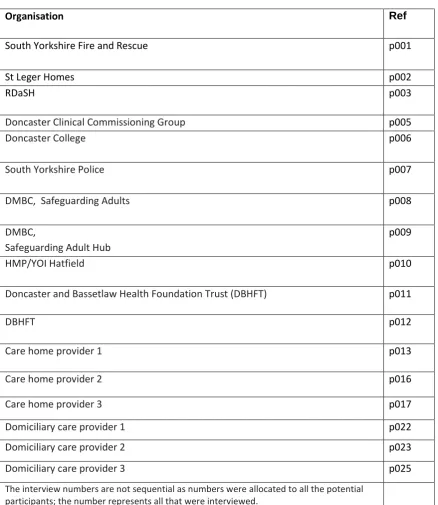
11 with organisations across the Doncaster Partnership. The sample size was limited by the funding available and consequent researcher time but was broadly successful in covering the range of participants (see table 1, page 13 for participant characteristics). Data saturation occurs at a point when the research team conclude that pragmatically there is no point in interviewing more people as no new themes will emerge from more interviews. It is not clear that data saturation was reached in the research; findings have to be viewed within this context.
Participants were initially identified in consultation with the Doncaster Safeguarding Adults Board (DSAB) manager. Staff were chosen as their role within their organisation had responsibility for MSP. Prospective participants were provided with a participant information sheet (appendix 2) and
allowed time to consider participating in the study. If they agreed, and following the signing of a consent form, (see appendix 2) semi-structured interviews were conducted either face to face in a private area at their place of work or by telephone. The interviews lasted for a range of thirty minutes to an hour and twenty minutes.
The interviews were recorded and transcribed in full. The transcriptions were anonymised and any data identifying the individual removed. The consent form acknowledged, however, that for some staff their designation and role might lead to anonymization being qualified. The data was stored securely within a protected base at Sheffield Hallam University in accordance with data protection protocol. Information relating to role and profession was retained as who said what and why was considered important for the analysis phase of the research. The number given to each participant relates to the anonymised code ascribed for purposes of data collection and analysis. See table 1 for details of participant characteristics.
Interviews took a semi-structured pattern and were conducted using an interview schedule devised collectively by the research team in consultation with the board manager. Questions were based on the ADASS questions but developed further to be appropriate for the audience. Two members of the research team were responsible for undertaking interviews.
Following transcription, the data from all individual and group interviews were entered in Microsoft Office Word on to a password protected network available only to the research team. Framework analysis methods were used to generate categories, codes and themes that capture the experiences, views and perceptions of the sample.
Analysis
12 the integration of pre-existing themes into the emerging data analysis. It has been used and is particularly useful in multi-disciplinary health research teams (Gale et al 2013).
The research team took a collective analysis approach. The whole team met together and initially read and coded three transcripts each. These were discussed and a set of categories and codes developed which formed the initial analytical framework. The researchers then read all the transcripts and developed a coding framework with new codes emerging and others which were conceptually related being merged. The categories were colour coded and quotations highlighted on the transcripts which related to the specific category. To assist with triangulation of findings the interviews were divided between team members and the process ensured the person who
undertook the interview did not code that interview. Initial categories and themes were recorded on a pro forma alongside illustrative quotations.
The team then met again and using graphical imagery, agreed a set of categories and codes. One or two categories were then taken by each member of the research team and the transcripts read again alongside the initial coding pro forma and a narrative account of the findings was produced for each category.
At the next meeting the final analytic framework was agreed and data charted on to a matrix. The matrix was then collectively reviewed, alongside the narrative account, and subsequent discussion, sought to interpret the data. The intention was to develop themes which offered some explanations for what was being presented in the data. The process was informed by the original research aims alongside concepts generated inductively from the data.
13 Table 1 Doncaster MSP Temperature Check interviewees
Organisation Ref
South Yorkshire Fire and Rescue p001
St Leger Homes p002
RDaSH p003
Doncaster Clinical Commissioning Group p005
Doncaster College p006
South Yorkshire Police p007
DMBC, Safeguarding Adults
p008
DMBC,
Safeguarding Adult Hub
p009
HMP/YOI Hatfield p010
Doncaster and Bassetlaw Health Foundation Trust (DBHFT) p011
DBHFT p012
Care home provider 1 p013
Care home provider 2 p016
Care home provider 3 p017
Domiciliary care provider 1 p022
Domiciliary care provider 2 p023
Domiciliary care provider 3 p025
14 Findings
The following section presents the findings of the research grouped under the names of codes generated by the Framework analysis. (See appendix 3)
1.
Designated role/responsibility for Making Safeguarding Personal
Summary
In considering who was responsible for implementing, managing and overseeing MSP within a particular organisation there was some commonality but also differences. For some organisations responsibility lay within a role that encompassed all safeguarding responsibilities including children and adults. This role might be a new role created to ensure compliance with safeguarding
requirements or a pre-existing one to which MSP had been added. For others the role had an adult safeguarding focus only, with one organisation (police) distinguishing between adult abuse for which they had responsibility and adult safeguarding for which they did not. In terms of designation and seniority of the role and responsibility, for some organisations the role was encompassed within an overall management role for which safeguarding was just one of many responsibilities. For others there was a specific safeguarding role with a distinction being made between strategic and operational management. For a number of organisations, it was important to identify that overall responsibility for MSP needed to be spread throughout the workforce and not located within one individual.
Detail
For some organisations there was clarity on exactly where responsibility for MSP resided alongside all other safeguarding responsibilities:
‘And it was a new post to actually ensure that the organisation was compliant with safeguarding requirements. So, my role actually covers safeguarding children and adults’
(p001).
‘My role is safeguarding children, adults and being available to work with partners as and when required both strategically and operationally’(p002).
15 ‘But I am also the designated safeguarding officer and I take particular responsibility for adults’ (p006).
And also, for one organisation a more nuanced distinction between safeguarding and abuse:
‘I’m in charge of PVP which is Protecting Vulnerable People… we deal with all child abuse and we deal with elements of adult abuse. We don’t deal with our adult safeguarding’ (p007).
With organisations where safeguarding was a significant part of the organisation’s purpose then role and responsibility was taken to include operational and resource management and oversight with strategic oversight residing in senior management:
‘But my role is to oversee all of the work that’s carried out within the safeguarding hub. Whether that be about investigating a concern, whether that be ensuring that someone’s not deprived unlawfully of their liberty. I also get involved in obviously the strategic side of things. So, looking at ensuring we have enough resources, recently getting involved in quite a hefty audit for DoLS and looking at ensuring that we are compliant with legislation… So basically, along with people management it’s also resource management I guess’ (p009).
For other organisations MSP was one of a raft of responsibilities:
‘I’m the registered manager here not just responsible for safeguarding’ (p016).
‘I’m in charge of all the residential units at HMP Hatfield which is a prison that covers two sites. So, it’s looking after, ensuring all the day-to-day running of the prison goes smoothly, looking at inmate behaviours. I’m also in charge of the Safer Custody Region and I’m charge of Violence Reduction’ (p010).
For care providers in particular responsibility for MSP was one managerial duty among many:
…. ‘We have approximately 1,200 employees delivering care and support to vulnerable people across the whole of those areas. And I am also the designated safeguarding lead for the (Domiciliary care provider 2) group as well’ (p023)
However, where this was the case safeguarding had for some priority and required seniority of role:
‘I’ve two deputies in place that manage the care overall and the relationships with people but when it comes to safeguarding that’s where I kind of leap in and take that role’ (p025).
16
‘It’s very difficult. And I think that’s one of the challenges we’ve got. Because we take a lot of calls from staff. Because staff really struggle sometimes. The patients don’t want to, don’t want help or to protect themselves and staff really struggle. And that’s where I see my role as I should go out and support the staff and be able to take it that bit further’ (p012).
This view found some support in organisations where responsibility for MSP was seen to spread more widely than one individual to encompass the wider staff group:
‘I would expect our staff to have an awareness of the issues and awareness of making safeguarding personal and be able to be that, if we do get that first call to be able to identify that and identify that that person has needs and that there are concerns. And I do think we’re getting there with that’ (p007).
‘It has to start with our front-line staff. Because if they don’t have a good understanding of safeguarding, and I don’t just mean what constitutes abuse, but a good understanding of processes. If they don’t have that then everything fails’ (p023).
Working with other organisations who were seen to have specific expertise, in order to share responsibility was identified as important by health providers both operationally and strategically:
‘The key stakeholders, well we do have a lot of work with the social workers. So we do have a social work team within the Trust who we liaise with quite frequently’ (p012).
‘And our deputy director of nursing sits on the Safeguarding Board and he’s 100 percent behind all the work we do’ (p012).
For others the inter professional net was cast more widely:
‘We work very closely with local authorities, and we work very closely with CCGs as well’ (p023).
2.
Understanding of Making Safeguarding Personal
Summary
17 the Care Act (2014) and implemented in the safeguarding adults process in Doncaster. Other
organisations did not recognise Making Safeguarding Personal as a concept which was distinctively different from approaches to adult safeguarding pre-Care Act (2014). A clear pattern emerged from the data, where an organisation had closer links to Doncaster Safeguarding Adults Board, the clearer its understanding of Making Safeguarding Personal and the further removed the organisation, the less clear they were about the Making Safeguarding Personal concept. Despite this difference it was possible to identify the components which reflect organisational understanding through the
application of Making Safeguarding Personal to practice.
Detail
Incorporation of Making Safeguarding Personal into mainstream organisational business.
Current guidance on implementation advises that organisations incorporate MSP into their existing structures (LGA/ADASS 2018). There was evidence to suggest that this is taking place in
organisations in Doncaster and that the commitment to Making Safeguarding Personal went across the spectrum of safeguarding adult work, not just within the remit of s42 enquiries:
'So, with regards to safeguarding, it just forms part of the whole person-centred approach. It’s nothing separate’ (p013).
‘Making safeguarding personal I think, I don’t think it’s anything new to a nurse. I think, well I know as a nurse, we’ve always communicated well with our patients. It’s very, I think making safeguarding personal is the same as patient-centred care’ (p012).
‘Where to a certain degree you could ask well why it is separate, yeah, because actually our service provision is wrapped around the safeguarding personalisation approach’ (p002).
Participants acknowledged that although terminology in their organisation may be different from the terminology of the Care Act (2014) and Making Safeguarding Personal but that the essential work which reflected Making Safeguarding Personal remained the same:
‘They want the communities to be safe and happy and they want to do the best for them. And they might not be able to say making safeguarding personal is this this this this this, but they’ll know the concept in broad terms’ (p007).
18
Move from process to conversations
The Making Safeguarding Personal guidance reflects that the change in values should move from a process supported by a conversation, to a conversation supported by a process:
‘Making safeguarding personal is about listening. And it’s on occasion seeing behind what an individual says, so it’s about open listening, body language etc. And it’s ensuring that you are taking on board that individuals desire or wish seriously and you do your utmost to deliver that bespoke tailored support package for them to enhance their wellbeing and their quality of life’ (p002).
‘So, when we’re discussing any care aspects with our patients, we offer them choices, we ask them what they want, have they got any concerns, any questions. So, we work together with our patient. And I think that is the same as Making Safeguarding Personal with safeguarding’ (p012).
Although there was some evidence of conversations supported by a process, this was not consistent. There was some evidence to suggest that the safeguarding process drives the approach:
'However, I do believe we still remain heavily process driven. I think we have a service that is intent often on, and I use the phrase, for want of a better phrase, hoovering up as much as possible into the safeguarding system and then processing it in a very depersonalised way’ (p008).
The Local Authority service manager acknowledged that this process- driven approach had been heavily influenced by the I.T. system:
‘I think some of our processes are dictated very heavily by our IT system. And that makes us very process driven in that respect. I also think operationally there is a process mentality that is driven by the IT system’ (p008).
Concerns about the shift away from a process-driven approach were raised by some participants who discussed the importance of accountability and how adherence to processes can support shared understanding about safeguarding adults:
19
this criteria [sic], that’s what we want. However personal it is the ethos of safeguarding someone is the same so we should be able to have a sort of clear pathway’ (p017).
Elements of Making Safeguarding Personal approach
It was possible from the analysis of the data to identify some common elements which form key parts of the Making Safeguarding Personal approach.
Person-centred
The evidence from participants indicated that their organisations had aligned a person-centred approach to adult safeguarding. This ethos was evident in how participants discussed their understanding of their organisations approach to adult safeguarding work:
‘It means very much like a person-centred approach. So, it’s about starting with the individual’ (p006).
‘I suppose exactly what it says really: it’s personal to the person’ (p013).
‘From my mind if you’re going to do safeguarding, I liken it to safe custody in prisons, it’s about working with the individual themselves and helping them to put measures in place to safeguard themselves rather than pushing something on somebody and telling them what they have to do. It’s having that agreement and working together. It’s collaborative’ (p010).
Even when participants did not appear to explicitly identify changes under Making Safeguarding Personal, they did identify that a person-centred approach underpinned their organisation’s ethos in this area of practice:
'So, well, any kind of safeguarding, but making it personal means keeping the person at risk, or in the cared for environment, safe, happy and well’ (p017).
'It’s protecting that individual. Obviously, everybody’s got individual needs and it’s making sure that we look at what they can establish themselves in doing to make sure that it’s safe for them to possibly do so’ (p022).
Participants also indicated that there had been a shift in the ethos of their organisation to reflect a move to a person-centred approach to adult safeguarding work:
20
it was, it’s more about the person than perhaps it used to be. So, it’s about what the person wants and about trying to work with the person rather than working at them, if you like, to them’ (p007).
Outcome focused
Participants indicated that the recognised that adult safeguarding had shifted to a focus on outcomes rather than output:
‘…It’s also about looking at having more bespoke personalised approaches to safeguarding people and meeting their outcomes going forward’ (p008).
Self-determination and decision-making
Self-determination was identified by the participants as a key feature of the Making Safeguarding Personal approach:
‘Ensuring that individuals are empowered and included in making choices and decisions that affect them based on their capacity to do so’ (p003).
One of the identified challenges was how organisations work with individuals who make decisions or seek outcomes which staff perceive as harmful to the person. The hospital nursing team identified the challenges hospital staff experience:
'I think it’s a challenge for the staff to understand that actually they are working in the patient’s best interests because that’s what the patient wants. The staff find it difficult’ (p011).
‘That doesn’t always sit very comfortable I’ve got to say with clinical staff and nursing staff, because they want what they believe is best for patient. And it’s not always what the patient wants for themselves’ (p011).
This issue was also identified by the fire service:
21
about that, they can make very unwise decisions. And they can do that and accepting that. And I think that is getting there. It doesn’t sit comfortably with a service that is about rescuing and saving lives’ (p001).
A home care provider identified how the staff culture had shifted to support self-determination:
‘I think with the staff culture it is, yeah, because you do get the staff, and especially these days as well that they’ll go in and they’ll see a house that is in neglect and they want to do more, and it’s taking the step back but monitoring the situation as well to understand that that is how that person is choosing to live’(p022).
The challenges in managing self-determination were identified by the safeguarding hub manager:
‘So the one thing I’ve heard since Making Safeguarding Personal that I haven’t heard since we closed the long stay hospitals is people saying but they chose not to. And we used to hear that ever such a lot when people first came out of the long stay hospitals. I can remember he chose not to have a shave. He chose to eat three pound of cheese in one sitting. And I’m hearing that a lot. We closed it because the person asked us to. And that worries me quite a lot’ (p009).
The importance of making Reasonable Adjustments was also indicated to support people to participate in the process. Reasonable adjustments as defined by the Equality Act (2010) states that changes or adjustments should be made for people who have disabilities to access education, employment, housing, goods, service and private associations. The Equality Act (2010) requires adjustments to be made if they are reasonable in three areas – changes to the way things are done, changes to physical features and provision of extra aids or services. There was evidence to suggest that reasonable adjustments were being made in the approach to safeguarding to support the individual’s involvement:
’…and we need to be making reasonable adjustments to make sure that they are involved as much as possible with any decisions that are made around either a safeguarding referral, how the process is undertaken and any outcomes from that’ (p013).
An example of a Reasonable Adjustment was given by the provider:
22 The requirement to provide advocacy support to some individuals in the context of a s42 enquiry is clearly established by the Care Act (2014); however, the challenges of this in Doncaster were identified by a participant from the Local Authority:
‘I think we need to involve advocacy a bit more, but we do have some pressures in terms of advocacy capacity and it isn’t always possible, particularly in an urgent situation to arrange for advocacy to support someone in those circumstances’ (p008).
The complexities of working with people who have capacity but make [perceived] unwise decisions, particularly decisions about their lifestyle which may compromise their welfare or safety was identified as a key part of the Making Safeguarding Personal approach. Participants acknowledged that a key part of the approach was to continue the conversation with the individual beyond the decisions the individual makes:
‘it’s for us to be able to understand their needs but also their risks and then where I think there is need for further work is where their choice is against their needs and that needs raising is the ability to have a conversation’ (p025).
'Because if somebody’s living in such a way that is harmful to them, why is that? We need to understand that a bit more, what that’s about and how they’ve got to that point. What else they may want, you know, do people want to live that, like, in certain ways. So, I think it doesn’t end the conversation I guess is my point’ (p003).
The approach to making safeguarding personal also included people who may lack capacity to make the relevant decisions about their welfare, safety or other relevant aspects was included:
‘I think it is the individuals that potentially the safeguarding is about. For some of the clients obviously that’s much easier to be able to deal with. For some of them it’s a lot more difficult. But I think it’s just about people coming together’ (p016).
Involving people who are significant in the life of the person who has experienced harm was also evident:
‘In fact, everybody that’s involved in that person should need to be consulted at some point in order to make a truly person-centred. It would be different for everyone and that’s the point isn’t it?’ (p017).
23
‘It’s about how we work with them to understand their concept of risk, what their views and wishes and feelings are. How they might find a solution for something or how they may want help around something’ (p003).
‘Understanding people’s individual circumstances and what is, what risk factors would make them, you know, at risk and in need of intervention or raising to other services. And for individuals that’s different. Whilst it falls in categories of self-neglect, abuse, general other things, it’s different for different people’ (p025).
It was acknowledged that sometimes it is crucial to take action to address risk, even if the person who may be at risk of harm or has experienced harm does not want this to happen. Discussion about this centred around criminal offences and about how best to manage this with the person:
‘Where we’re not, about us being honest, where we have to follow the law, so where we think that a criminal offence is being committed, we have to be really honest about that. And about working with and to look at how things may be different and what that different looks and feels like to them and what support they need in that’ (p003).
‘So, they’re the ones that lead, ensuring that we’ve looked at what do they want from safeguarding, what is their understanding of safeguarding. And also, what is their
understanding of the broader context of that. So, if they don’t want us to take it forward that we might have to take it forward to safeguard other people’ (p009).
3.
Organisations
Summary
The success of MSP obviously relies on the development of local understanding and implementation across a wide range of organisations, structures and services. It is therefore unsurprising that 'organisations' emerged as a theme within this research. It is clear that procedural adults
24
Detail
There are many ways that organisational culture can be described; a very simple quote suggests Organisation Culture is "how things are around here" (Cameron and Quinn 2011 p19). It would seem that for MSP to be accepted as 'how things are' the concept has to become part of the organisational culture of the organisations that sponsor it. Schein (2017) described how
organisational culture is formed from the values and beliefs that an organisation espouses and that leadership is central to this development. Discussion with managers would seem be crucial in determining if MSP had become 'how things are' in Doncaster organisations and it was comments in relation to this area that were included in this section.
A number of participants clearly believed that MSP had become embedded in their organisational culture. Although it should be noted that whilst the commentary articulated the concepts of MSP, the language that participants used often referred to safeguarding:
‘It’s like a golden thread to be honest throughout our organisation’ (p002).
‘when I first started here, the attitude was very much that safeguarding, oh we get a concern, we pass it on. And I think that has changed…
I think that has been a big cultural change and it is about, because safeguarding, safeguarding is everybody’s responsibility’ (p006).
‘Making sure that safeguarding is kind of an approach that should be inherent in everything we do and it doesn’t just become a process of what we do to people, …it’s about a process that helps them rather than a process that we put them through if something goes wrong’ (p023).
‘Yeah. I think actually now it is better. I think it definitely is better because I think it definitely keeps the person and that individual or individuals involved at the centre of it and that’s the focus’ (p016).
'I think it was just a change in perception more than anything. A change in how we deal with adult safeguarding’ (p007).
25 ‘For me making safeguarding personal is about actually moving away from the very process led in part, very process-led model that we’ve operated here in Doncaster and in my
experience that we’ve operated elsewhere’ (p008).
A comment from a participant suggested that MSP was becoming much more common in responses that were received from others:
‘We’re getting much more information. You can tell from the concerns that come in that they are having a conversation with people’ (p001).
Some participants used 'journeys' as analogies to help describe their adaptation of MSP:
‘There’s been a journey, very much so. There has been a journey. A lot of work has gone in to embedding personalisation and safeguarding throughout the organisation by managers and senior management’ (p002).
The comments below suggest the journey hasn’t ended:
‘It’s a journey that we’re nowhere near the end of’ (p023).
‘I think we’ve got probably some way to go. I don’t think we’re, I would never say that we are completely fantastic. But I do think we’re making strides in all areas of safeguarding really’ (p007).
It is also clear that there is still work to be done:
26 ‘It is. It’s very difficult. And I think that’s one of the challenges we’ve got. Because we take a lot of calls from staff. Because staff really struggle sometimes. The patients don’t want to, don’t want help or to protect themselves and staff really struggle. And that’s where I see my role as I should go out and support the staff and be able to take it that bit further’(p012).
4.
Implementation of MSP
Summary
There was a range of views amongst respondents about how far MSP is being implemented. Some were positive about the culture shift taking place towards a more person-centred approach, though some were concerned that new policies and processes, whilst good, were not the whole answer. One of the emerging messages about implementing MSP was that sometimes there was a disjuncture between the policies used and the person-centred philosophy of MSP, and that
resourcing and other organisational issues can be barriers. The message was one of commitment, a sense of progress, and a recognition that there is much still to be done.
Detail
Respondents gave a range of responses when exploring how the implementation of MSP is progressing. Some believed that progress was very good, and especially commented that the person-centred philosophy was well embedded:
‘It's like a golden thread throughout our organisation’ (p002).
Others noted that it had been largely process driven, and that whilst there was a feeling of getting there, sometime resources stood in the way. The majority of respondents considered that progress was being made and that there was much more to be done:
‘It's a journey that we're nowhere near the end of’ (p023).
Participants identified a range of triggers that were driving the changes. These included the MSP project itself and the new statutory footing that the Care Act 2014 has given to safeguarding:
‘Yeah, I think it's made a huge difference to the Local Authority (p012).
There was a varied picture in terms of how far the message that safeguarding is everyone's business has penetrated into organisations. Examples of good practice included the College, which recognised that instead of passing every potential safeguarding issue on to the local authority there is a
27 ‘that has been a big cultural change…because safeguarding is everybody's responsibility’
(p006).
Contrasting views were expressed, suggesting that for some agencies, the change was part of wider changes that were occurring for a number of reasons:
‘No I don’t believe the Care Act has had a massive impact [because] our approach to service delivery is all about the customer…and MSP is embedded effectively throughout that process’ (p002).
Measuring Outcomes
There was a wide range of views on the issue of measuring outcomes. For some agencies with quite distinctive roles (such as the emergency services) there was a view that the dialogue with service users about outcomes would not routinely encompass the safeguarding concern specifically, though it would comprise of some kind of closure and outcome with an expectation that ongoing issues would be picked up by partner agencies:
‘I think our outcomes have to be more about how we are keeping people safe…we wouldn’t demonstrate that outcome because we can only really look at have we reduced that risk of fire’(p001).
Some agencies have very specific processes in place to pick up on outcomes of the safeguarding experience, which include some form of initial questioning about safety:
‘and then at the end of the process they're asked again: do you feel safer, do you feel better, how do you feel?’ (p009).
Others considered that their overall approach to person centred care planning was wider and inclusive of safety issues without badging it separately as MSP:
‘let's make his care plan and his experience personal as a wider thing…if you narrow the focus to just MSP you might hit the target, but you might miss the point of the person's wider experience’ (p025).
Some respondents indicated that the paperwork and procedures guided them explicitly towards asking questions about whether the desired outcomes have been achieved:
28 Some good practices were also described which not only covered the collection of outcomes on a case by case basis, but also referred to collation of data about numbers of safeguarding issues and summaries of outcomes and lessons learned:
’It's not about quantifying safeguarding, it really is about outcomes. So it really stresses the lessons we are learning, the plans we are putting in place to include outcomes’ (p023).
Training
Training was clearly occurring in a number of different ways across the organisations engaged in the research. There were agencies which had made sure that staff across all levels had at least minimum levels of training:
‘everybody, whether they are delivering clinical care or support, or whether they're actually office based….still receive the same training as minimal standard with regard to
safeguarding’ (p023).
Several interviewees shared thoughts about how to make training interesting and relevant:
‘I think courses are good. You can ask people questions but the people that run the courses aren’t the people that are running the service’ (p017).
‘giving them live examples…. get them to think a little bit more about it’ (p025).
Joint training events also featured in responses, and suggestions about integrating training across agencies so that training could be passported when someone moved jobs were offered.
Respondents talked about implementing certain changes to practice such as requiring a face to face contact with the alleged victim, and about a range of methods such as use of social media to seek to put the information out to all parts of the organisation and to the public too.
Working together across agencies was recognised as bringing a number of challenges. There can be differences in perceived safety issues and what constitutes a safeguarding matter. Differences in approach with children’s services is an example of this:
‘They couldn’t see the needs of the vulnerable adults in this situation’ (p008).
29 focus on specific groups of service users, and the need to work towards a more holistic and
coordinated approach in order to achieve good quality safeguarding:
‘We all have to know what our role is and not expect each other to do each other's roles… if we all do our role properly then that should all interlink and work’ (p007).
Time constraints were flagged as a barrier to good practice especially in terms of administrative tasks, and the time needed to liaise across agencies:
‘I think it's really positive, except for time constraints of the …team to go out there and support staff’ (p012).
Other respondents also reflected on the lack of joined up IT services that created barriers to accessing information in a timely manner.
Some respondents, especially providers, felt that further clarity was needed:
‘there should be some kind of flowchart for us…. we've just been given a list of issues…. it's frustrating.’ (p017).
A further challenge that manifested in some of the interviews was the issue of self-determination of service users. Several thoughts were shared about the ethical tensions between respecting
someone's right to make decisions that could be deemed detrimental, and where the concept of best interests fits in:
‘I think it’s a challenge for staff to understand that actually they are working in the patient's best interest because that is what the patient wants’ (p011).
A small number of participants recognised that issues of capacity, self-determination and best interest are highly complex and that it could be reductive to simply operate from an assumption that if a service user is choosing to stay in a risky situation or is asking for the safeguarding involvement to be closed that it should always be acted upon:
’I'm hearing this a lot. We closed it because the person asked us to. And that worries me quite a lot’ (p009).
Resources to implement MSP were a concern for several respondents across all the sectors, in order to deliver more training and also to perhaps step-down cases from safeguarding but offer other appropriate forms of support such as a Care Act assessment:
30
Multi-Agency and Single Agency Training
Multi-agency and single-agency training to support the implementation of Making Safeguarding Personal was identified by participants.
Multi-agency training
There was acknowledgement that the Local Authority provides multi-agency safeguarding training:
‘They do get the training here in Doncaster, which doesn’t happen in other authorities. So, we do put training, enquiry training on. And quite a lot of providers have taken advantage of that’ (p009).
There was also an indication from participants that partners make a contribution to multi-agency training:
‘Yeah we do quite a bit of joint training with partners… So we put on training sessions for all the sergeants so they could cascade to their staff’ (p007).
‘Occasionally we open up some of our training sessions to multi-agency on special events like we have a safeguarding week coming up in July’ (p012).
Some providers felt that they had not been provided with the information they needed to enable them to work effectively:
‘Yet we haven’t got information apart from leaflets and booklets to give you guidance…there just doesn’t seem to be any clarity in how safeguarding should be run for each individual’ (p017).
Although participants provided positive feedback about the multi-agency training available, there was acknowledgement that there was a disconnect between the training and service delivery:
‘I think courses are good. You can ask people questions, but the people that run the courses aren’t the people that are running the service’ (p017).
31
‘There was one other that I put my name down for myself as the registered manager. But we were then told it wasn’t for me it was for social workers. And that for me kind of, I felt would have been more appropriate course from reading the brief content of it and was quite looking forward to going and doing it. And then it wasn’t for me, it was just for social workers’. (p016).
Single-agency training
Participants indicated that organisation had committed to delivering single-agency training across organisations:
‘When it was a safeguarding, sorry making safeguarding personal, all employees of [housing provider] do complete the safeguarding awareness training. And making safeguarding personal is at the forefront of that process’ (p002).
‘Inside there’s been a significant awareness raise in training’ (p007).
We do statutory and essential to role training. Which safeguarding obviously covers everybody within the trust’ (p011).
‘The training that we do is of a level 2 standard and the Care Act and MSP is all embedded in there. We also do have eLearning. So if staff do struggle to get on a face-to-face course eLearning is available’ (p012).
Organisations acknowledged the success of their single-agency training; the fire service identified that the training supported the introduction of the new policy, with the impact it had on the implementation of the policy:
‘We were changing the resource that we were using and then they actually introduced a new policy and then there was a lot of training done. So, there was a lot of buy-in’.(p001).
There were some acknowledged challenges to single-agency training; the police acknowledge that their organisation has invested in training for front-line staff, but is unsure of the impact it has had on front-line practice:
32
Whether, like I say, they can tell you what making safeguarding personal is I don’t know if I’m honest’ (p007).
Other relevant training is made available in organisations:
‘There’s training, self-harm awareness training which 100% of all staff have to go through. That’s always been developed. We’ve just got a new… I think we’re about 85% compliant in our prison at the moment. We’ve got everybody trained, and I’ll have everybody trained by November this year’ (p010).
‘People come to ours from other organisations on Thursday, the safe and well service and the fire service are coming to talk through that aspect of risk and at the last one there was a solicitor talking about mental capacity and when that kicks in because obviously that has a big impact on safeguarding’ (p025).
Some evidence from providers that training is provided for individuals who use their services about safeguarding and protection, but this was not consistent across all organisations:
‘So we actually talk about it on a very personal level here to the individuals that live here and how might they protect somebody if, you know, if one of the clients came with an allegation, or if they were non-verbal if they felt somehow their behaviour was different or they noticed some bruising or lots of different things that can indicate abuse. And we talk about that with the, about the individuals here, because obviously training can be a very general thing’ (p016).
5.
Challenges of implementation
Summary
Participants identified some challenges they have experienced in implementing Making Safeguarding Personal. The challenges included a lack of clarity about the conceptual difference of Making
33 participants reported were not available. In particular, staff shortages and workforce churn were identified as key resource issues as staff turnover had the most significant impact on the skill mix of the workforce.
Detail
Clarity about the adult safeguarding process
Where providers were not clear about Making Safeguarding Personal, a clear barrier to implementation for them was a lack of clarity about seeking advice about safeguarding adults concerns. A residential care provider (who had not been asked to undertake a s42 enquiry and did not identify Making Safeguarding Personal as a distinct concept) identified the challenge they experience when seeking advice or identifying a concern with the local authority:
‘In the past few months, there’s been so many safeguarding referrals that the council had to react by putting them into two separate categories, which can be very fuzzy and interrelated, and then with a regulator comes you discover that you’re not doing it how the council want it’ (p017).
This concern was echoed by a home care provider in a similar situation:
‘…and I think that’s where we find that there’s sometimes a link in the process that we find that’s missing, and it’s at that point where we decided actually there’s a gap in the need to be met here’ (p025).
Working with other agencies and thresholds
Challenges for implementation were identified across a range of agencies. This was particularly evident when exploring different perceptions of adult safeguarding work in the multi-agency arena. Agencies identified differing perceptions of what was seen as an adult safeguarding issue which caused some frustration between professional groups. Where this had been an issue, participants identified an important component to overcome this was to use a joined-up, holistic approach when working in a multi-agency environment:
34
the issue as opposed to a really polarised - we’ll deal with that bit, and you deal with that bit’ (p009).
The Fire Service also identified the importance of understanding the remit of organisations in the multi-agency environment, to understand the differing roles of the organisations:
‘I think what I’ve always emphasised here is that you can’t work with other organisations unless you understand what their remit is and how they’re working with people as well’ (p001):
The housing provider described how they worked in the multi-agency environment:
‘There’s a lot of agencies where it’s just children, it’s just adults, it’s just older people, it’s people with learning disabilities, but for us we, our assessments are all family assessments. We don’t identify oh well this adult needs this and the children are, you know, it’s a whole family assessment. And that in itself at times can be challenging, getting all the partners involved, because we have to ensure it’s not confusing for the end user’ (p002).
The hospital nursing team identified that information sharing between multi-agency colleagues within their organisation was positive:
‘Absolutely yeah. In an ideal world we’d all be on one same system. But saying that, you know, my colleagues in the local authority, if I want to share information or I want to do a bit of fact finding they’ll quite happily, they can give us that. It’s never been an issue really, except for time’ (p012).
Some participants acknowledged that one of the challenges in working with multi-agency colleagues was the different thresholds for tolerance and management of risk:
‘I think that is a challenge working with the other agencies whose, I know the term
thresholds has certainly gone from adults but like for [another agency] the tolerance for risk I would say is quite different. And I think for our staff tolerating that risk and what level, how do we do that?’ (p001).
35
should not be allowed, refer to adult safeguarding which is a waste of our time, it’s a waste of their time’ (p008).
Time
Time was also identified as a critical factor which can present a challenge in implementing Making Safeguarding Personal. Both residential and home care providers identified the challenges:
‘I wouldn’t say it’s the barriers against implementing it, time is always an issue. Because to try and talk to people about their support needs and to make it very outcome focused, so does that care need to move away from a time and task approach? Or is it so stupid, you actually need time to move away from a time and task approach, because outcomes, to make sure that it isn’t tokenism we actually need to spend time so that we can work with people to see what is the meaningful improvement that they want’(p023).
‘..but it’s all time and it’s all paperwork, and for example ……... So that impacts on my work. We’re a small company. So then you get delayed and things that really need to be there can’t be because there are more frontline issues that need to be addressed first’ (p017).
Resources
A lack of staff was a running theme from the participants. A number of organisations identified that they were experiencing a shortage of staff, which impacted on service delivery and by extension of this, was affecting the delivery of Making Safeguarding Personal:
36 Organisations also found that turnover of staff in their organisation had a significant impact on the skill mix of the workforce:
‘Sufficient staff with the right skills and in the right place to be able to engage with the right offenders. Which is easier, oh yeah that sounds utopia but it’s more difficult to achieve…….. The biggest problem we’ve got at the moment is the lack of experience, because a lot of experienced staff left three or four years ago. So now we’ve got this big recruitment drive and you’ve got new in-service staff being mentored by people only a couple of years ahead of them’ (p010).
A lack of staff also impacted on the organisations ability to deliver the training to the workforce they perceive is necessary to deliver Making Safeguarding Personal:
‘I think it’s always difficult because we always want more hours and more staff. Hopefully when the, our safeguarding integrated document out that will support us to put a business case forward to get some more staff so we can take the training further’(p012).
6.
MSP Working Well
Summary
There was some optimism among respondents that the implementation of MSP complemented key professional values, and that with the right staff, practice was more person centred, more legally literate and that there was more effective collaboration between agencies.
Detail
Participants generally conveyed a sense that things were changing and that a more personalised approach to safeguarding was being implemented. Some agencies saw this as being about going back to previous practices:
37 And others recognised that having the right people and structures was important:
‘We've got a good chair of the board, there's very clear plans in place...to embed… a more personalised way of working with people that previously probably didn’t event figure in terms of adult safeguarding. They were seen more as not our problems as opposed to us being able to work collectively’ (p008).
There was an explicit acknowledgement from some participants about the values underlying MSP and how these were coming through into practice through the implementation of MSP in the approach taken to adult safeguarding:
‘So it's treating people with dignity and respect…..be accountable to people really (p002) It's a part of patient-centred care…giving that holistic care that they need’ (p012). ‘There's definitely more engagement with our service users. It is more about what we're doing with them, rather than what we're doing to them’ (p023).
Some of the positive responses when asked where MSP was working well covered areas such as improved knowledge about risk, the legal parameters and personalised approaches to safeguarding so that a more nuanced understanding is achieved:
‘We've identified it, we've tried to work with people, but there's still a risk… if the adult has got capacity they can make very unwise decisions, and [staff] can do that and are accepting that’ (p001).
This was developed further by some participants who reflected that there had been increased confidence amongst staff in terms of understanding and applying legal knowledge and knowing where to go for support and advice, especially in the context of multi-agency practice: