and collaboration
DAKKA, Sam <http://orcid.org/0000-0001-9225-761X>
Available from Sheffield Hallam University Research Archive (SHURA) at:
http://shura.shu.ac.uk/14250/
This document is the author deposited version. You are advised to consult the
publisher's version if you wish to cite from it.
Published version
DAKKA, Sam (2015). Using Socrative to enhance in-class student engagement and
collaboration. International Journal on IntegratingTechnology in Eductaion, 4 (3),
13-19.
Copyright and re-use policy
See
http://shura.shu.ac.uk/information.html
Sheffield Hallam University Research Archive
DOI :10.5121/ijite.2015.4302 13
Sam M Dakka
Department of Engineering & Math, Sheffield Hallam University, Howard Street, Sheffield S1 1WB,United Kingdom
ABSTRACT
Learning and teaching experiment was designed to incorporate SRS-Student Response System to measure and assess student engagement in higher education for level 5 engineering students. The SRS system was based on getting an immediate student feedback to short quizzes lasting 10 to 15 minutes using Socrative software. The structure of the questions was a blend of true/false, multiple choice and short answer questions. The experiment was conducted through semester 2 of yearlong engineering module. The outcome of the experiment was analyzed quantitatively based on student performance and qualitatively through student questionnaire. The results indicate that using student paced assessments method using Socrative enhanced student’s performance. The results showed that 53% of the students improved their performance while 23% neither improved nor underperformed. Qualitative data showed students felt improvement in their learning experience. Overall results indicate positive impact using this technology in teaching and learning for engineering modules in higher education
KEYWORDS
Socrative, Student engagement, Collaboration, SRS
1.I
NTRODUCTION14 theory, research and practice is the best way to move forward to achieve the ultimate goal which is stimulate and further enrich students’ knowledge through collaborative and active learning and simulating industry environment.
2.U
SINGS
TUDENTR
ESPONSES
YSTEM-S
OCRATIVEAn innovative approach was incorporated into the design and planning of teaching engineering module sessions, Student Response system (SRS) as a part of the lecture. It has been demonstrated that SRS and technology based systems can enhance student engagement (Terrion and Aceti, 2012). SRS has been widely used in the past through devices called clickers which demonstrated positive impact on student engagement (Blasco et al., 2012), were students can give an immediate feedback to the lecturer questions, however clickers has initial cost associated with it in addition it has limited functionality. This has led to search for a tool or software that can be used through smartphones either through mobile connection or Wi-Fi internet connections. The software is called Socrative, and the main advantage of this software lies in its versatility of the type of questions that can be constructed and designed in addition to collaborative features between different teams. The purpose of using Socrative is to assess whether the performance and engagement of the students are enhanced as compared to traditional or other blended teaching and learning lectures. Reflecting on design and planning of teaching session, using Socrative had increased significantly the time of preparation for the session, since construction a large number of variety of questions, such as multiple choice, short answer questions and true/false questions. The element within Socrative that supports student learning and teaching is the fact that the student can get immediate feedback and therefore might reflect further and develop critical thinking approach to various engineering problems.
3.L
EARNINGA
NDT
EACHING,
A
SSESSMENTSM
ETHODSA
NDD
ESIGNO
FE
XPERIMENTSB
ASEDO
NL
EARNINGT
HEORIESDuring the progress of the module implementation of the constructive alignment theory (Biggs & Tangs, 2007) which transformed my teaching to outcome based learning and teaching was adopted. This is important as the emphasis is on how the student will use the teaching material compared with what contents to incorporate into the module. Also, what learning activities should be implemented to achieve those outcomes and how to assess those activities to measure whether those are attained.
16
4.R
ESULTSA
NDD
ISCUSSION4.1. Student Performance
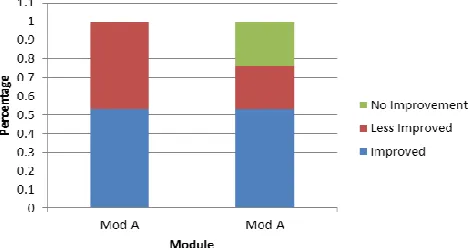
[image:5.612.215.450.354.516.2]Student paced assessments using Socrative was performed for 10 consecutive weeks at semester 2, the entire academic semester for module A. Each assessment lasted between 10 to 15 minutes and was conducted at the same time of the day and at the same day of the week in order to reduce variability associated with human factors that can affect student’s performance. The module performance (final grade) of semester two was compared to semester one for each student in order to identify whether using Socrative student paced assessments during semester 2 has improved student performance. Figure 1 illustrates the final grade for each student for semester 1 and 2. The magentaand the blue bars show the student score for semester 1 and 2 respectively. The results of figure 1 demonstrates some improvement in the student performance, in order to further corroborate this observation the data from figure1 was further analysed to account for overall student improvement versus no improvement and less improvement for semester 2 as compared to semester 1, this is illustrated in Figure 2. Inspection of figure 2 reveals that there is 53% improvement in the nominal overall grade performance of the students (first bar, adjacent to vertical axis). Grading both semesters was performed based on the same assessment criteria. The second bar on figure 2 illustrates, under the assumption grading results are within +/-3% precision margin of accuracy, that not only 53% performed better but also significant under performance is just 20%. In overall, Socrative data suggests student paced assessments did improve overall student performance understanding and enhanced student engagement.
Figure 1. Semester 1 & 2 bars respectively for each student number
[image:5.612.212.447.549.674.2]17 4.2.Student Survey
A student questionnaire was constructed similar to (Awdeh et al., 2014) and posted for students to assess and get feedback on incorporating Socrative in the lecture. It is worth emphasizing that Socrative student paced assessment was conducted during this teaching and learning experiment were the student answered the quizzes privately, to that end there was no any collaboration during the actual experiment with their peers. Despite this lack of live collaboration, table 1 illustrates, there are positive responses and students are embracing and advocate incorporating this technology into their learning and teaching environment. The feedback from the students indicates positively, that the students felt that they are actively collaborating in their learning experience, have the freedom to participate in their learning experience, improved their understanding of material, improved their learning experience, and enhanced the exchange of the information with the lecturer. Answers to questions listed under the question column corresponding to cell number 3,4,7 &8 while did not get the passing mark, this was expected as the design of this learning experiment was not based on collaboration with their peers during the active session.
Table1.Student survey scores based on 100% scale
Questions/students/average A B C D E F G H Av
I felt that I actively collaborated in my learning experience
50 75 75 75 75 75 75 25 66
I felt I have the freedom to participate in my own learning experience
50 50 75 75 75 75 100 50 69
In this Method, my classmates and faculty interactions made me feel valuable.
50 50 50 50 0 50 75 25 44
This method has favored my personal relationships with my classmates and lecturer
25 25 50 50 25 50 50 25 38
Socrative can improve my comprehension of the concepts studied in class
25 25 75 75 75 75 75 75 63
The method can lead to a better learning experience
25 75 75 100 75 100 75 75 75
Using Socrative gave me the opportunity to have more discussions with classmates
25 50 75 50 0 75 75 25 47
Using Socartive allowed the exchange of information with classmates
50 50 75 25 0 50 75 25 44
Using Socartive gave me the opportunity of more discussions with the lecturer.
50 50 75 75 0 75 75 25 53
Using Socrative allowed the exchange of information with the lecturer.
18 The score scale is based on the following respond of the students, strongly agree, agree, neutral, disagree and strongly disagree which granted the marks of 100%, 75%, 50%, 25% and 0% respectively entered in the student survey shown above.
5.C
ONCLUSIONLearning and teaching experiment was designed to incorporate student response system to measure and assess student engagement in higher education for level 5 engineering students. The SRS system was based on getting an immediate student feedback to short quizzes lasting 10 to 15 minutes using Socrative software. The structure of the questions was a blend of true/false, multiple choice and short answer questions. The experiment was conducted through semester 2 of yearlong module. The outcome of the experiment was analyzed quantitatively by comparing the overall performance of the students on semester 2 as compared to 1 and qualitatively through student questionnaire. The results indicate that using this method (student paced assessments using Socrative) despite the lack of collaboration aspects designed into the experiment did enhance the performance of the students on semester 2 as compared to semester 1. The results showed that 53% of the students improved their performance while 23% neither improved nor underperformed as compared to semester 1. So a total 76% improvement. Qualitative data based on the student questionnaire showed that the student felt that this method improved their learning experience, actively collaborated and have the freedom to participate in their learning experience and allowed the exchange of information with the lecturer. The method of team work, student paced or lecturer paced was not implemented in the teaching experiment yet, therefore the student expressed less positive responses to the elements of interaction, relationship and exchanging information with their class mates which was expected and will be the subject of future research and publication. Future work will be focused on building upon team work configuration within Socrative in the context of addressing all the elements of deep learning transformation discussed. Overall the results indicate positive impact of using this technology in teaching and learning for engineering modules in higher education.
A
CKNOWLEDGEMENTSThe authors would like to thank students on the engineering module who participated in this teaching and learning experiment.
R
EFERENCES[1] Awdeh, M., Mueen, A., Zafar, B. & Manzour, U. (2014). Using Socrative and smart
phones for the support of collaborative learning. International Journal on integration Technology in education 3(4), 18-24.
[2] Bligh, D. A. (2000). What's the use of lectures. USA: Jossey-Bass Higher and Adult Education. [3] Biggs, J. & Tang, C. (2007). Teaching for quality learning at university 3rd edition. Maidenhead:
Open University Press/McGraw Hill.
[4] Biggs, J.B. (1987) Student approaches to learning and studying. Hawthorn, Victoria: Australian research council
[5] Biggs, J.B., Kember, D. & Leung, D.Y.P. (2001). The revised two factor study process questionnaire: R-SPQ-2F. British Journal of Educational Psychology, 71,133–49
[6] Blasco-Arcas, L., Buil, I., Hernández-Ortega, B. & Sese, F. J. (2013). Using clickers in class.
The role of interactivity, active collaborative learning and engagement in learning performance. Computers & Education, 62 (3), 102-110.
19 learning activities in lectures. Active learning in Higher Education, 12(1), 23-33 Available. http://alh.sagepub.com/content/12/1/23.full.pdf+html (online).
[8] Dewey, J. (1916). Democracy and education: An introduction to the philosophy of education. NY: Freepress
[9] Dahlstrom, E. (2012). ECAR Study of undergraduate students and information technology, (Research Report). Louisville, CO: EDUCAUSE Center for Applied Research
[10]Kolb, L. (2011). Adventures with cell phones. Educational Leadership, 68(5), 39-43 [11] Piaget, J. (1950) The psychology of intelligence. London: Routledge & Kegan Paul.
[12] Prince, M. (2004). Does active learning work? A review of the research. Journal of Engineering Education. 9 3(3), 2 2 3 - 2 3 1.
[13] Terrion, J. L. & Aceti, V. (2012). Perceptions of the effects of clicker technology on student learning and engagement: a study of freshmen Chemistry students. Research in Learning Technology,
20,16150. Available.