Mid-IR Imaging and Multivariate Analysis of Dynamic
Processes in Pharmaceutically Relevant Microparticles
KELES, Hakan
Available from Sheffield Hallam University Research Archive (SHURA) at:
http://shura.shu.ac.uk/8158/
This document is the author deposited version. You are advised to consult the
publisher's version if you wish to cite from it.
Published version
KELES, Hakan (2014). Mid-IR Imaging and Multivariate Analysis of Dynamic
Processes in Pharmaceutically Relevant Microparticles. Doctoral, Sheffield Hallam
University.
Copyright and re-use policy
See
http://shura.shu.ac.uk/information.html
Sheffield Hal'am University Learning iind info?rr:?U:n Services
Adsettp Centre, City Campus Sneifisid Si 1WD
ProQuest Number: 10697207
All rights reserved INFORMATION TO ALL USERS
The qu ality of this repro d u ctio n is d e p e n d e n t upon the q u ality of the copy subm itted. In the unlikely e v e n t that the a u th o r did not send a c o m p le te m anuscript and there are missing pages, these will be note d . Also, if m aterial had to be rem oved,
a n o te will in d ica te the deletion.
uest
ProQuest 10697207
Published by ProQuest LLC(2017). C op yrig ht of the Dissertation is held by the Author. All rights reserved.
This work is protected against unauthorized copying under Title 17, United States C o d e M icroform Edition © ProQuest LLC.
ProQuest LLC.
789 East Eisenhower Parkway P.O. Box 1346
Mid-IR Imaging and Multivariate Analysis of Dynamic
Processes in Pharmaceutically Relevant Microparticles
Hakan Keles
v
A thesis submitted in partial fulfilment of the requirements of
Sheffield Hallam University
for the degree of Doctor of Philosophy
Collaborating Organisations:
EPSRC
&
Critical Pharmaceuticals Limited, Nottingham, United Kingdom
D eclaration
The work described in this thesis was carried out by the author in the Materials and
Engineering Research Institute at Sheffield Hallam University, Sheffield, United Kingdom, between October 2010 and February 2014. The author declares that this work
has not been submitted for any other degree. The work is original except where acknowledged by reference.
Author:
(Hakan Keles)
Director o f Studies:
Acknowledgements
I w ould like to thank people w hose support during this project was invaluable;
First o f all, Chris Sam m on for his help and scientific advice during this project which
helped me develop as a standalone researcher and for always being there w hen needed.
His great sense o f hum our and optim ism m ade my PhD experience a fruitful one since
O ctober 2010.
A ndrew N aylor (at CPL) and Francis C legg for the useful scientific discussions during
project m eetings.
CPL staff for providing the sam ples and for their help with bulk characterisation
techniques.
Chris Breen and Jack Y arw ood for their advice during PCAS G roup m eetings.
Christine Le M aitre (at The B iom edical Research Centre) for her help with cryo-
m icrotom y at the early stages o f the project.
All the M E R I staff, particularly Corrie H outon, Gillian Hill and D eeba Z ahoor, for their
professional approach and prom pt responses, w ithout their great help it probably w ould
not be possible to com plete this project on time.
Friends in the PCAS group;
V ictoria Boyes, Prakash M uthudoss, Fabio Pappini, M arianne Labet, M ichael Barw ood,
Subodh Sabnis, Trinh Pham , Kerstin M ader and T hom as Sm allw ood.
M y m other and m other in law for looking after Ela during my PhD studies.
E PSRC and CPL for the Industrial CA SE sponsorship that financially supported this 42
m onth project.
And my better half, Nilgun, for supporting m e by all m eans during this PhD , and
particularly for covering m ost o f m y responsibilities as a parent to Ela since A ugust
Contents
List o f A bbreviations... v
A b s tra c t...viii
1 In tro d u ctio n... 1
1.1 D rug D e liv e ry ... 2
1.2 C ontrolled R elease D rug D e liv e ry ... 3
1.3 P o ly m e rs... 5
1.3.1 Polym ers in Sustained R elease D rug D e liv e ry ... 7
1.4 P ro te in s... 11
1.4.1 B ovine Serum A lbum in (B S A )...12
1.4.2 H um an grow th horm one (h G H )...12
1.5 M ethods o f Producing Controlled Release D rug D elivery S y s te m s ... 13
1.5.1 Spray D ry in g ... 13
1.5.2 E m u ls io n ... 14
1.5.3 Supercritical Fluid T e c h n o lo g ie s...15
1.6 M id-IR Spectroscopic Im aging and A nalysis C o n c e p t... 18
1.7 Project A im s ... 20
1.8 R e fe re n c e s...22
2 Experim ental M ethods and D ata A n a ly sis... 27
2.1 Fourier Transform Infrared S pectro sco p y ... 27
2.1.1 Infrared T h e o ry ... 27
2.1.2 Fourier Transform Infrared S pectrom etry... 30
2.1.3 FTIR Im aging with Focal Plane A rray D e te c to rs ... 35
2.2 R am an M icro spectroscopy...44
2.3 Scanning Electron M icroscopy (S E M )...47
2.4 U ltraviolet-V isible (U V -V is) D issolution T e s tin g ...49
2.5 S iev in g ...49
2.6 U ltra -M ic ro to m y ... 49
2.7 G am m a Irra d ia tio n ...50
2.8 Differential Scanning C alorim etry (D S C )... 50
2.9 High Perform ance Liquid C hrom atography (H P L C )... 51
2.9.1 Size Exclusion C hrom atography (S E C )...52
3 Evaluation o f R elevant Im age A nalysis Tools and D evelopm ent o f N L C F
M ethodology- A D irect N um erical C om parison on M id-infrared Im ages O btained from
A D egrading Single M icro p article...56
3.1 In tro d u c tio n ... 56
3.2 E x p e rim e n ta l...58
3.2.1 M aterials...58
3.2.2 C riticalM ix™ P ro c ess...59
3.2.3 M acro A T R -FTIR im aging o f reactions with the G olden G ate™ Sam pling A c c e sso ry ...59
3.2.4 R eal-tim e A T R -FTIR Im aging o f R eactions... 59
3.3 Raw D ata and P re-processing... 61
3.4 U nivariate A n a ly s is ... 62
3.5 M ultivariate A n a ly s is ... 63
3.5.1 M C R -A LS- a Soft M odelling T o o l...63
3.5.2 N L C F - A Hard M odelling T o o l... 64
3.6 Results and D isc u ssio n ...68
3.6.1 Spatial R esolution C om parison ...68
3.6.2 Im age C o m p a riso n ...71
3.6.3 Interface A nalysis... 77
3.6.4 D egradation Rate C a lc u la tio n ... 83
3.7 C o n c lu sio n s...88
3.8 R e fe re n c e s ...90
4 Investigation o f Factors Influencing the H ydrolytic D egradation o f Single PLG A M ic ro p a rtic les... 95
4.1 In tro d u c tio n ...95
4.2 E x p e rim e n ta l... 97
4.2.1 M aterials... 97
4.2.2 C riticalM ix™ Processing o f P L G A s ... 97
4.2.3 y-Irradiation... 97
4.2.4 Scanning Electron M ic ro sc o p y ...97
4.2.5 M olecular W eight D e te rm in a tio n ... 97
4.2.6 D S C ... 97
4.2.7 M acro A T R -FTIR im aging o f reactions with the G olden G ate™ Sam pling A c c e sso ry ... 98
4.3 D ata P ro c essin g ...98
4.4.1 The Effect o f scCCE Process on M orphology and H ydrolytic D egradation
o f PLG A M icroparticles... 98
4.4.2 The effect o f C om position and T em perature on H ydrolytic D egradation K inetics o f scCC>2 processed P L G A ...104
4.4.3 Visual Evidence o f Lactic acid D iffusion from a D egrading PLA M icro p article... 112
4.4.4 The Effect o f y-Irradiation on H ydrolytic D egradation o f PLG A 50/50 114 4.5 Sum m ary o f the F in d in g s ... 120
4.6 C o n c lu sio n s...121
4.7 R e fe re n c e s... 123
5 Investigation o f Physiochem ical Factors A ffecting the Protein Release from y- Irradiated PLG A M ic ro p a rtic le s ...127
5.1 In tro d u c tio n ...127
5.2 E x p e rim e n ta l... 129
5.2.1 M aterials...129
5.2.2 Spray D rying o f h G H ... 129
5.2.3 Preparation o f M icroparticles U sing scCCE P ro c e s s in g ... 130
5.2.4 Sieving o f M icro p articles... 130
5.2.5 Sam ple Preperation for M icro-A T R -FT IR Im a g in g ... 130
5.2.6 y-Irradiation...130
5.2.7 A T R -FTIR S p e c tro sc o p y ... 131
5.2.8 Transm ission FTIR Im a g in g ...131
5.2.9 M icro-A TR -FTIR Im a g in g ...131
5.2.10 M acro-A TR -FT IR Im aging o f D rug Release from Individual M ic ro p a rtic les... 131
5.2.11 FTIR Im aging D ata P ro c essin g ...132
5.2.12 Scanning Electron M ic ro sc o p y ... 132
5.2.13 U V -V is Spectrophotom etry o f Pure h G H ... 133
5.2.14 In vitro D rug R e le a s e ... 133
5.2.15 D S C ...133
5.2.16 Evaluation o f hGH Stability and In te g rity ... 133
5.2.17 M olecular W eight D e te rm in a tio n ... 133
5.3 Results and D iscu ssio n ...133
5.3.1 D eterm ination o f The Spatial D istribution o f Encapsulated hG H w ithin The M ic ro p a rtic les... 133
5.3.3 Effect o f G am m a Irradiation on Redistribution and R elease o f hG H from
Single M ic ro p a rtic les...139
5.3.4 SEM o f hG H Loaded F o rm u latio n s... 140
5.3.5 D eterm ination and C om parison of D issolution Profiles O btained from FTIR Im a g e s ... 143
5.3.6 The N ature o f Released S pecies... 149
5.3.7 Effect o f y-irradiation on the C hem istry o f PLGA, PLA and Poloxam er 4 0 7 ...151
5.3.8 Sum m ary o f the F in d in g s...159
5.4 C o n c lu sio n s... 160
5.5 R e fe re n c e s ...163
6 Overall C onclusions and Further W o r k ... 167
6.1 In tro d u c tio n ... 167
6.2 Overall C o n c lu sio n s ... 167
6.3 Further W o rk ... 170
6.3.1 FTIR Im aging o f M ic ro p a rtic les...170
6.3.2 M ultivariate A nalysis o f FTIR Im ages for Studying K inetic Processes in M icroparticle S ystem s... 170
6.3.3 Real-tim e M onitoring o f Polym er D egradation U sing FTIR Im aging.... 171
6.3.4 Real-tim e M onitoring o f D rug Release U sing FTIR Im a g in g ...171
W ord C o u n t...173
A p p e n d ix ...174
PA PER I
List of Abbreviations
API Active pharmaceutical ingredient
ATR
B
BSA
cm' 1
CPL
CPU
d2o
DSC
FDA
FoV
FPA
FTIR
FWHM
GA
Ge
GPC
GRAS
h
h2o
HEPES
hGH
HPLC
Attenuated total reflection
Hydrated layer size
Bovine serum albumin
Wavenumber
Critical Pharmaceuticals Limited
Central processing unit
Heavy water
Differential scanning calorimetry
U.S.A Food and Drug Administration
Field of view
Focal plane array
Fourier transform infrared
Full width at half maximum
Glycolic acid
Germanium
Gel permeation chromatography
Generally recognised as safe
Hour
Water
4-(2-hydroxyethyl)-1 -piperazineethanesulfonic acid
Human growth hormone
IR Infrared
k D egradation rate
K Kelvin
kGy Kilo Gray
LA Lactic acid
m M inute
M C R M ultivariate curve resolution
M CR -A LS M ultivariate curve resolution-alternating least squares
M CT M ercury-cadm ium -telluride
M id-IR M edium -infrared
mm M illim etre
M n A verage m olecular w eight
M w M olecular w eight
NA N um erical aperture
N L C F N on-linear curve fitting
nm N anom etre
PBS Phosphate buffer saline
PCA Principal com ponent analysis
PDI Polydispersity index
PH Peak height
PLA Poly(lactic acid) or Polylactide
PLG A Poly(lactic-co-glycolic acid)
PG SS Particles from gas saturated solutions
RAM Random-access memory
ROI Region of interest
ScC02 Supercritical carbon dioxide
sd Spray dried
SEC Size-exclusion chromatography
SEM Scanning electron microscopy
t Time
Tc Crystallisation temperature
Tg Glass transition temperature
Tm Melting temperature
UV Ultraviolet
UV-Vis Ultraviolet-Visible
2D 2 Dimensional
3D 3 Dimensional
y Gamma
X Wavelength
° c Degree Celsius
A bstract
Sustained release m icroparticles used for parenteral drug delivery m ust be well characterized in term s o f their size range, m orphology and function. It is w idely understood that the chem istry and m orphology o f m icroparticles have a degree o f interdependence w hich strongly affects drug release behaviour from m icroparticles. This thesis investigates, for the first tim e, the use o f m id-IR im aging along with the developm ent and optim isation o f relevant m ultivariate im age analysis m ethods for studying the real-tim e degradation o f pharm aceutically relevant biodegradable polym er m icroparticles and the real-tim e release o f protein based drugs from such m icroparticle system s.
The application o f attenuated total reflection - Fourier transform infrared spectroscopic (ATR -FTIR ) im aging and analysis to m onitor the degradation o f a single m icroparticle is optim ised and the developed m ethodology is detailed. A series o f tim e resolved im ages o f a PLG A m icroparticle undergoing hydrolysis at 70 °C are obtained using A T R -FTIR im aging for the first tim e. A novel partially supervised non-linear curve fitting (NLCF) tool is developed and the output from the N L C F is evaluated by direct quantitative com parison with a traditional peak height (PH) data analysis approach and m ultivariate curve resolution alternating least squares (M C R -A LS) analysis for the sam e im ages, in order to develop an im age analysis strategy. The N L C F m ethod is shown to facilitate the calculation o f hydrolysis rate constants for both the glycolic (kG) and lactic (kL) segm ents o f the PLG A copolym er. This results in im proved spatial resolution on tim e-resolved m icroparticle im ages, so providing better insight into the dim ensions o f hydration layers and particle dim ension changes during hydrolysis when com pared to im ages derived from both PH m easurem ents and M C R -A L S. The M C R - ALS routine is show n to be faster than N L C F and its im ages are found to provide sufficient contrast to be used for qualitative com parison.
The optim ised m id-IR -A T R procedures are then applied to investigate several factors influencing the hydrolytic degradation o f a fam ily o f PLG A m icroparticles. D egradation rate constants for glycolic and lactic units are show n to increase (w hilist m aintaining a -1 .3 ratio betw een each other) with increasing initial glycolic content o f the copolym er, tem perature or y-radiation exposure. D ifferential scanning calorim etry (DSC) and gel perm eation chrom atography (GPC) results indicate a chain scission based degradation in PLGA upon y exposure. The distribution o f lactic acid is probed with IR during the hydrolysis o f a PLA m icroparticle for the first tim e, show ing a diffusional pathw ay from the degrading m icroparticle outw ards into surrounding water.
1
Introduction
This thesis investigates the use o f M id-IR spectroscopic im aging and relevant
m ultivariate data analysis techniques to characterise the degradation kinetics of
biodegradable polym er m icroparticles and the release of protein drugs from such
m atrices.
The w ork presented w ithin this thesis was conducted at Sheffield H allam U niversity in
collaboration w ith Critical Pharm aceuticals Ltd. This chapter provides a b rief
introduction into the drug delivery system s investigated within this thesis. It includes
inform ation about polym ers, proteins and controlled release drug delivery system s along
with production m ethods for such system s with particular attention to supercritical C O 2
based processes am ong which a m odified particles from gas saturated solutions (PG SS)
m ethod (C riticalM ix™ ) was used to produce the sam ples studied here by the
collaborating com pany.
In this chapter a very brief initial insight is given for M id-IR spectroscopic im aging,
including its relevance for studying polym er degradation and drug release before the
aim s o f this w ork are discussed in detail.
In C hapter 2, the theory o f the m ain m ethod o f study, FTIR spectroscopy and im aging,
is detailed and relevant data analysis techniques are discussed. O ther characterisation
m ethods including scanning electron m icroscopy, chrom atography, differential scanning
calorim etry, U V -V is dissolution testing and m icroscopic sam ple preparation m ethod
(ultra-m icrotom y) are also detailed including inform ation regarding the param eters and
m ethods used.
C hapter 3 dem ostrates the optim isation o f A T R im aging m ethod coupled w ith relevant
im age analysis techniques for studying degradation in single polym eric m icroparticles.
A direct num erical com parison o f three data analysis m ethods: peak height
m easurem ents, soft and hard m odelling, is studied using the sam e IR im age set o f a
PLGA 75/25 m icroparticle undergoing hydrolysis at 70 °C.
In C hapter 4, a range o f single PLG A m icroparticles are studied using the A T R im aging
m ethodology developed in Chapter 3. Effect o f C riticalM ix™ process, copolym er ratio
PLG A based m icroparticle system s) on hydrolytic degradation behaviour o f individual
PLG A m icroparticles is investigated and results are discussed.
In C hapter 5, a lead controlled release form ulation that consists o f PLG A /PLA polym ers,
an excipient (Poloxam er 407) and hum an grow th horm one (hGH) is initially
investigated in term s o f its com ponents’ spatial distributions in dry form in order to
validate the form ulation m odel. The release o f hG H from scuh com plex form ulation is
m onitored using A T R -FT IR im aging. Finally the effect o f y- irradiation on the stability
o f PLG A m icroparticles and on the release o f the hGH protein from the m icroparticles
is investigated using FTIR im aging, SEM analyses and using a com bination o f
conventional bulk m ethods including; differential scanning calorim etry (DSC) to
understand therm al properties o f irradiated and un-irradiated pure polym ers, gel
perm eation chrom atography (GPC) to m onitor effect o f irradiation on the m olecular
w eight o f the polym ers, U V -V is spectrophotom etry to m onitor in vitro API release from
the m icroparticles and size exclusion chrom atography (SEC) to determ ine protein
aggregation and stability.
The overall conclusions and possible further w ork are sum m arised in C hapter 6 .
1.1 Drug Delivery
The concept o f drug delivery is the adm inistration o f active pharm aceutical ingredients
(APIs) to patients, in sufficient am ounts that they reach and treat the targeted region o f
body w ithout causing any adverse effect(s). A lthough this can be achieved by several
routes including parenteral (which is achieved thorugh injection; into a vein, under the
skin or into a m uscle, or through inhalation or through absorption by intact skin), oral,
pulm onary or nasal application, the adm inistration o f proteins are lim ited to the
parenteral (often subcutaneous) type as their high m olecular w eight or poor stability
blocks their transderm al, nasal or oral delivery.
A nother problem in the delivery o f proteins and peptides is their short half-life in the
hum an body. Therefore their unfavourable pharm acokinetics m eans that they are
usually adm inistered by frequent injections, for exam ple for hum an grow th horm one
deficiency every 3 days, which is inconvenient for patients and can affect patient
com pliance. How ever, the developm ent o f sustained release form ulations can overcom e
these issues as controlled release drug delivery is used to delay the release o f drugs
1.2 Controlled Release Drug Delivery
T he use o f biodegradable polym ers is one o f the fundam ental w ays o f controlling
release system s. There are three different types o f m icro-scale controlled release
system s; ( 1) reservoir devices, w here the drug is released upon degradation o f a
biopolym er that is used to encapsulate it avoiding im m ediate release, (2 ) diffusion
devices, w here the drug is released through pores o f the biopolym er m atrix and (3)
erosion, w here the drug release is based up on degradation o f the biopolym er m atrix.
H ow ever for porous biopolym er m atrices it is often the case that com bination o f last
two hypotheses occurs as initially the surface attached drug m olecules will be released
upon contact with aqueous m edia by diffusion through pores and finally the degradation
o f biopolym er will result in release o f the drug m olecules entrapped deeper in the
biopolym er m atrix (Figure 1.1).
A)
Reservoir deviceB) Diffusion device (porous)
C) Erosion device (degradation)
W ater Water + drug
Polymer Drug
Polymer Drug
Polymer Drug Wate
Water
o
o
°
o o
Figure 1.1 Controlled release scenarios for polymer microparticles; (a) reservoir
devices, (b) diffusion of drug from porous polymer matrix and (c) erosion
mechanism where the drug molecules are released as they become free from
degrading polymer.
In recent years research in m olecular and cell biology to m eet clinical needs has
intensified the interest in biologies, a variety o f therapeutics such as vaccines,
recom binant proteins and peptides, genes, viruses and synthetic tissues, ensuing a strong
m arket grow th [1]. As a result, currently hundreds o f recom binant proteins and peptides
[image:17.612.102.511.276.486.2]There are num erous candidate biodegradable polym ers for carrying and releasing
biologies as shown in Figure 1.1 how ever concerning biocom patibility to hum an body,
the FD A approved ones are few [2,3].
Poly (lactide-co-glycolide) (PLGA ) is a FD A approved biodegradable synthetic
polyester that is physically strong and highly processable [4]. H ence PLG A has been the
m ost studied carrier m atrix for m acrom olecules such as proteins, DN A, RN A , vaccines
and peptides for treatm ent of im portant diseases such as cancer, hum an growth
deficiency and m ultiple sclerosis [3].
A nother advantage o f PLG A is that its degradation in vivo is controllable by choice o f
polym er m olecular w eight and copolym er ratio (lactide to glycolide (L /G)) and yields
lactic and glycolic acids, which are biocom patible and rapidly cleared from the body via
the renal system [2 ].
The num ber o f PLGA based form ulations that are readily adm inistered through a
syringe, has been researched increasingly resulting in m any form ulations that are
m arketed today including ones given in Table 1.1.
Table 1.1 PLGA based microparticle formulations available in the market [1,3].
1
Lupron Depot® Leuprolide TAP Prostate cancer, endometriosis
Enantone Depot® Leuprolide Takeda Prostate cancer, endometriosis
Trenantone Leuprolide Takeda Prostate cancer, endometriosis
Nutropin Depot® Growth hormone Genetech Pediatric growth hormone deficiency
Suprecur® MP Buserelin acetate Aventis Prostate cancer
Decapeptyl® Triptorelin pamoate Ferring Prostate cancer
Sandostatin LAR® Depot Octreotide acetate Novartis Acromegaly
Somatuline® LA Lanreotide Ipsen Acromegaly
Decapeptyl SR. Triptorelin Ipsen Prostate cancer
Trelstarn : Depot Triptorelin pamoate Pfizer Prostate cancer
Arestin® Minocycline Orapharma Periodontal disease
Risperidal® Constan: Risperidone Johnson & Johnson Antipsychotic
Parlodel® LAR Bromocriptine Novartis Parkinsonism
From the pharm aceutical m anufacturing technology perspective, the key goal;
controlling the release o f the drug for longer periods w ithout causing any degradation o f
the drug at production stage, can be achieved by obtaining a hom ogenous distribution o f
the drug within the m atrix. The follow ing sections will give relevant details o f the
[image:18.612.96.510.385.598.2]protein loaded polym er m icroparticle system s, with a focus on relation to the novel
m icroparticle system s characterised in this thesis.
1.3 Polymers
The self-definition o f ‘polym ers’ can be derived from the G reek w ords ‘p o ly ’ m eaning
‘m any’ and ‘m ono’ m eaning ‘o n e ’, as polym ers are m acrom olecules built up from
m onom ers covalently bonded together form ing a chain type structure. Repeating
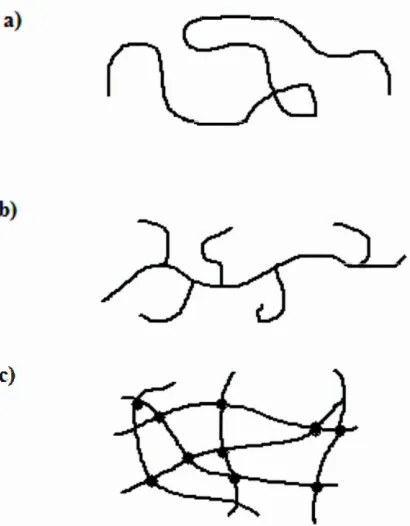
m onom er units connected together m ay form linear, branched or 3D structured (cross-
linked polym ers in w hich one chain is bonded with m onom ers o f another chain) types
as illustrated in Figure 1.2.
c)
Figure 1.2 Linear (a), branched (b) and 3-dimensional (c) structures of polymers.
Since the initial understanding o f their structure by Herm ann Staudinger [5], polym ers
becam e the m ost versatile m aterial type in our daily lives ranging from the sim plest
form as a recyclable carrier bag, to arguably m ore com plicated and im portant form s
such as long life batteries used in m obile electronic devices or biodegradable m atrices
for carrying drugs.
Polym ers can be grouped m ost generally in to two; biopolym ers (polym ers w ith natural
origin) such as chitosan and proteins, or synthetic polym ers including biodegradables
[image:19.612.200.405.227.490.2]poly(|3-malic acid)) and non-biodegradables such as silicones and some acrylic
polym ers [6]. Step grow th polym erisation and chain growth polym erisation are the two
principal m ethods for synthesising m an-m ade polym ers [7]. Step grow th polym erisation
occurs as m ultifunctional m onom ers react to form dim ers, trim ers longer oligom ers and
long chain polym ers at the end o f the reactions. Chain grow th polym erisation occurs as
the unsaturated m onom ers continuously add onto the grow ing polym eric chains.
Polym ers exhibit two types o f m orphology; crystalline in w hich m olecules are packed
in regular arrays and am orphous in which m olecules are oriented random ly and are
entangled and m ost polym ers contain both crystalline and am orphous regions
(sem icrystalline). At low tem peratures the m olecules o f an am orphous polym er vibrate
at low frequency, exhibiting solid state properties, this is term ed as the ‘glassy sta te ’.
U pon heating an am orphous polym er, due to the increase in m olecular energy, a
transition occurs from the glassy state to a rubbery state and the inflection tem perature
at which this effect occurs is called the glass transition tem perature (Tg). C rystalline
polym ers show a clear phase transition upon heating; m elting. The tem perature at w hich
this therm odynam ic effect occurs is called m elting tem perature (Tm).
Differential scanning calorim etry (DSC) which is discussed in C hapter 2 can be used to
determ ine the m elting tem perature and the glass transition tem perature o f polym ers.
Therm al properties o f polym ers are often dependent on their m olecular w eight w hich
can be given as;
M w = Equation 1.1
or their m olecular num ber w hich can be given as;
M n = ~ ~‘Mt Equation 1.2
where A, is the num ber o f m olecules with length i and M, is the m ass o f polym er chain
with length i, both define the size o f a m olecule and can both be m easured using gel
perm eation chrom atography (GPC) [8] as discussed in C hapter 2.
M ost polym ers vary in their chain lengths. Their distribution in the length o f the chains
is defined as polydispersity index (PD I) which is m olecular num ber per m olecular
weight. The decrease in m olecular w eight due to degradation, m easured w ith GPC, can
C opolym ers are substances that are usually produced by step polym erisation from
chains in which two or m ore different m onom ers are connected through covalent bonds.
C opolym ers are useful in that therm odynam ic and physicochem ical properties o f
polym ers therein can be im proved and m odified. C onsidering their form , copolym ers
can be grouped as; ‘ran d o m ’ in which two or m ore different repeating units are
distributed random ly, in which sequences o f the different m onom ers alternate w ithout
any regular pattern and block in w hich long sequences o f m onom ers are follow ed by
another o f the same or graft in w hich one type o f m onom er chain is connected to
another as branches at different points. The form ation o f copolym ers results in a
com bination o f the properties o f the original hom opolym ers and this can im prove the
properties o f the individual polym ers such as tensile strength, reactivity and
therm odynam ic properties [9].
Tw o or m ore polym ers or co-polym ers can be m ixed, typically; by heating and/or
stirring or by dissolving each in a co-solvent adding together and letting solvent
evaporate or using one m onom er as a solvent for another, resulting in a ‘b len d ’ in w hich
polym ers are connected by interm olecular forces, but not covalent bonds. D epending on
their hom ogeneity at a m olecular level, polym er blends are classed as m iscible (very
hom ogenous) or im m iscible (phase separated) show ing single or m ultiple T g in DSC
analysis, respectively.
1.3.1 Polymers in Sustained Release Drug Delivery
The use o f biodegradable and biocom patible (i.e. that can degrade in to m olecules that
are not toxic to hum an body and therefore are ejected w ithout causing any dam age)
polym ers enables the extended release o f drugs.
D uring this project, two polym ers have been used as the drug carrier m atrix, poly(lactic
acid) (PLA) and poly (lactide-co-glycolide) (PLG A ). Poloxam er407, accepted as a
GRAS (generally regarded as safe) has also been used as a processing aid in the
production o f these m icroparticles as it enhances the drug release [ 10].
1.3.1.1 Poly (lactic acid) {PLA)
PLA has 3 stereoisom ers that are the crystalline 1-PLA and d-PLA form s and the
am orphous D L -PL A [11]. The m ost com m on synthetic route to produce PLA is via the
ring opening polym erisation o f lactide w hich is catalysed by stannous octanoate (Figure
o
o
JL*
q
Stannous octanoate
►
* V V ],
Figure 1.3 Synthesis of PLA where chiral centres are indicated with X.
PLA are m ore suited as im plants than controlled release delivery devices as their
crystalline nature retards their w ater uptake causing long degradation tim es (typically
m ore than a year depending on m olecular w eight). Upon contact with aqueous m edia,
PLA undergoes hydrolysis and breaks down to lactic acid fragm ents. PLA has a T g o f
about 60-65 °C and a m elting tem perature o f about 173-178 °C [11].
1.3.1.2 Poly(lactide-co-glycolide) (PLGA)
PLG A is synthesised by the ring opening polym erisation o f the cyclic diesters o f lactic
acid and glycolic acid, catalysed by stannous octanoate (Figure 1.4) [12].
0
Y ^ °
o „1
00
+ f
"0
\0.
1
r
]
(1
0
Stannous
octanoate O
. J '
ir
o
I n fO
°+«-m
Figure 1.4 Synthesis of PLGA.
A lthough PG A is not useful as a drug delivery device due to its high crystallinity and
high m elting tem perature, as m entioned earlier in this chapter, PLG A , a copolym er o f
glycolic acid (GA) and lactic acid (LA), is the m ost used biodegradable polym er in
delivery o f biologies [13]. D epending on the ratio o f lactide to glycolide used for the
polym erization, different form s o f PLG A can be obtained. These are usually identified
by the m onom er ratio used. For exam ple PLG A 75:25 identifies a copolym er
com position o f 75% lactic acid and 25% glycolic acid. All PLG A s are am orphous rather
than crystalline and show a glass transition tem perature in the range o f 40-60 °C [12].
U nlike the hom opolym ers o f lactic acid (polylactide) and glycolic acid (polyglycolide),
which show poor solubilities, PLG A has the property o f hydrophobicity and therefore
acetate. The production o f a 50:50 m ixture o f these two polym ers also reduces the
degradation tim e o f PLA from several m onths to few weeks.
o
o
o
PLGA
Figure 1.5 Structures of PLA, PGA and PLGA.
A s show n in Figure 1.5, PLA contains an additional m ethyl group over PG A which
creates the am orphous nature by m aking chain packing m ore difficult w hereas the
absence o f this group allow s PG A to be crystalline. As PLGA is a copolym er o f these
two m onom ers it is less crystalline com pared to PGA, due to the addition o f the methyl
group. And this provides the observed differences in the degradation rates. D egradation
rates o f bulk PLG A s can be calculated using R am an and IR spectroscopies [14]. PLGA
can degrade via hydrolysis o f the ester linkage into small, w ater soluble fragm ents.
1.3.1.2.1 PLG A H ydrolysis
W hen PLG A is exposed to an aqueous solution or vapour, the ester carbonyl is subject
to nucleophilic attack by water, as show n in Figure 1.6 [15]. The ester group in these
polym ers will be hydrolysed via a tetrahedral interm ediate to give prim ary O H and
carboxyl end groups, resulting in chain cleavage. Esters are vulnerable to hydrolysis
because the electron w ithdraw ing effects o f the attached oxygen atom s result in a
partially positive ester carbon. The accum ulation o f carboxylic acid hydrolysis products
in PLG A m atrices results in autocatalysis o f the hydrolysis reaction w hich is follow ed
by addition o f a proton to carbonyl oxygen, w hich facilitates the reaction by stabilizing
HO OH
OH
0 HO
OH
n -m
HO, ■OH
0
HO OH
Figure 1.6 PLGA hydrolysis mechanism via ester links. R groups represent CH3
for lactide and H for glycolide. The resulting alcohol can abstract a proton from
the carboxylic acid during the chain cleavage step as shown, or a proton addition
to alcohol and removal from carboxylic acid can be provided by water (from [15]).
A lteration o f either the PLA :PG A ratio, m olecular w eight or PD I can change the
degradation rate o f PLG A. G lycolic acid is slightly m ore hydrophilic than lactic acid,
therefore increased glycolic acid content m ay lead to an increase in the hydrolysis rate
for the same m orphology and size o f particles [13]. Typical ratios o f lactide to glycolide
range from 50:50 to 100:0 with m olecular weights typically ranging from 10 to 100 kD a
(or 10' unified atom ic m ass units). The hydrolysis rate o f PLG A also depends on its end
groups w hich m ay be carboxylic acid, m aking the polym er m ore hydrophilic or ester-
capped, decreasing the rate.
1.3.1.3 Poloxamer 407
Poloxam er 407 (also know n as Lutrol or Pluronic F I 27), poly(ethylene
oxide)/poly(propylene oxide)/poly (ethylene oxide) (P E O -P P O -P E O ) triblock
copolym ers, is a hydrophilic surfactant and best know n for its use in m outhw ash and
contact lens solutions w here its function is to help rem ove organic m olecules such as
lipids by increasing their solubility in aqueous m edia.
y L
Surfactants are often used to increase the w ater solubility o f poorly soluble drugs, in
pharm aceutical form ulations.
In controlled release drug delivery, poloxam er 407 is shown to enhance solubilisation o f
biologies and also prolong their release [16].
1.4 Proteins
Like other bio-m acrom olecules such as nucleic acids, proteins are essential parts o f
organism s and participate in m any processes within cells. W ith varying sizes and
m olecular w eights, proteins have a range o f functions as they are able to bind to other
biom olecules, nucleic acids and metal ions [17]
Linkage betw een am ino acids result in long polym er chains called proteins. Proteins
consist o f carbon, hydrogen, nitrogen, oxygen and sulphur atom s, for exam ple,
C 990H 1532N 262O 300S7, nam ely hum an grow th horm one.
R
OH
Figure 1.8 Structure of an amino acid showing the amine in the left hanside and
carboxyl group in the right hand side circles, respectively.
There are tw enty com m on types o f am inoacids that vary in their R groups (Figure 1.8).
A m inoacids can be grouped as non-polar, uncharged polar and charged p olar [17]. Non
polar am ino acids tend to be unreactive. U ncharged polar am ino acids contain either
hydroxyl or am ine groups, w hich are capable o f hydrogen bonding to other residues and
the third group can bind to metal ions and w hich is im portant in biology [17].
The prim ary structure o f a protein is the sequence o f am inoacids o f this backbone. The
secondary protein structure is the specific geom etric shape caused by intram olecular and
interm olecular hydrogen bonding o f am ide groups. Proteins have three com m on
secondary structures, a-helix, p-sheet and turn [17]. The secondary structure o f proteins
can readily be characterised by FTIR spectroscopy [18]. The tertiary structure o f
proteins is the bending and tw isting o f the polypeptide backbone into a com pact
structure. Several polypeptide chains m ay exhibit w eak interactions form ing large
detect proteins when dissolved in a solution as proteins absorb UV light at 200nm
(peptide bonds) and - 2 8 0 nm (am inoacids with arom atic rings, Tyrosine and
T ryptophan) [19].
1.4.1 Bovine Serum Albumin (BSA)
W ith its 582 amino acids and 66267 D a total m olecular w eight, BSA is a large and
w idely used m odel protein as it is not only cheap but also stable at 60 °C up to 10 hours
[20], BSA has a total charge o f -18 (at pH 7) which is high due to its charged am ino
acids such as arginine and aspartic acid. BSA has been used as a m odel protein in this
project for the prelim inary investigations of a single polym er form ulation.
140
A
H---N et Charge -10 -8 0
a \ i
^ r
Figure 1.9 BSA structure showing the three charge domains.
1.4.2 Human growth hormone (hGH)
H um an grow th horm one (hGH) has been used to treat various diseases including
children with grow th horm one deficiency (paediatric hypopituitary dw arfism ), m uscle-
w asting disease associated with HIV, Turner's syndrom e for girls and chronic kidney
failure [21]. For children’s grow th deficiency treatm ent it is delivered via a painful
injection - 3 tim es a week, consum ing valuable hospital resources and resulting in poor
patient com pliance.
hG H contains 191 am ino acid residues and is a single chain peptide with a m olecular
w eight o f -2 2 .1 3 kD a and m elting point o f 76 °C [22]. Its secondary structure, show n in
Figure 1.10, contains four helices connected with random loops and chains and
internally cross linked by two disulfide bonds that provide stability and enable
Random loops
Random chains
Figure 1.10 hGH secondary structure (from [22]).
1.5 Methods of Producing Controlled Release Drug Delivery Systems
In order to produce m icroparticles that follow one or both o f the hypothesised scenarios
show n in Figure 1.1b and Figure 1.1c, the drug needs to be m ixed with the polym er(s)
hom ogenously and this is m ainly dependent on liquefication o f the polym er(s) during
the form ation o f the particles. C om m on m ethods for producing sustained release drug
delivery system s differ m ainly in how they are liquefied, as outlined in this section.
1.5.1 Spray Drying
Spray drying is an established m ethod in the food industry for producing a range o f dry
pow der form products including coffee and m ilk pow der [23]. The use o f spray drying
is also com m on in m icronisation (the process o f reducing particles to a size o f less than
typically 10 pm ) o f drug-polym er form ulations in the pharm aceutical industry. D uring a
typical m icronisation process a solvent such as dichlorom ethane (D CM ), in w hich the
polym er o f interest is dissolved initially, is m ixed w ith the drug, form ing a solvated
m ixture. This m ixture is then induced to atom ise and form s droplets as it is forced
through a nozzle as show n in Figure 1.11. The spray is dried by applying a hot (-6 5 °C)
[image:27.612.199.408.35.281.2]A TO M IZER
CVCLONE / SEPAR A TO R
HOT rtIR
M O S T A IF
PRCDUCT C O W E 'rIN G
=r c d u:t d i s c h a r g e
Figure 1.11 Schematic diagram of spray dryer (from [24]).
The spray drying m ethod has been studied w idely for producing PLG A based sustained
release devices as carriers for various biologies and has been show n to be successful in
producing <100 pm m icrospheres with encapsulation efficiencies up to -8 0 % [3,25,26].
H ow ever, considering the efficacy o f proteins that are very sensitive to tem perature and
the biocom patibility o f the produced form ulation, the high process tem peratures
(beyond 60 °C) and the possible existence of toxic solvent residues within
m icroparticles caused by insufficient drying, exist as critical draw backs.
1.5.2 Emulsion
E m ulsification processes can be grouped into two; single and double [3]. T he form er
involves tw o m ain steps; firstly, dissolving the polym er in an organic solvent such as
chloroform and adding the drug m olecules to this solution and secondly, adding this
m ixture into a w ater- em ulsifier m ixture and stirring. U pon evaporation o f the solvent,
the drug loaded polym er solidifies in the aqueous phase. As one can expect by the
description o f the m ethod, single em ulsification is not suitable for w ater soluble drugs
[4].
T he double em ulsion m ethod is sim ilar to the single em ulsion one, the only difference
being that the drug m olecules are dissolved in w ater before being added to the polym er
solution, such that a prim ary em ulsion is form ed on m ixing. The rest o f the procedure
follow s as in single em ulsification. A stabilizer such as polyvinyl alcohol (PV A ) m ay
Since the solvents used can cause degradation, em ulsification is not suitable for the
encapsulation o f sensitive drugs such as proteins into biodegradable polym ers such as
PLGA. R equiring the use o f large am ounts o f solvents, this m ethod is also expensive
and has potential environm ental hazards.
1.5.3 Supercritical Fluid Technologies
Substances becom e supercritical fluids (SCF) when placed above their critical point (i.e.
above their critical tem perature and critical pressure) exhibiting the flow properties o f a
gas (i.e. show ing low viscosity) and the dissolving pow er o f a liquid, thus becom ing
ideal solvents [27].
SCF, first observed by C agniard de la Tour in 1822 [28], can easily penetrate through
m aterials because they do not exhibit significant surface tension, and their solvent
pow er can be controlled by altering tem perature and/or pressure as it is related to their
density [29].
A m ong m any other m olecules including propane, ethane, am m onia and water, carbon
dioxide has becom e the fluid o f choice in SC processes because it is cheap, no n
flam m able, has GRAS (generally regarded as safe) status, is environm entally acceptable
and m ay be recycled. ScCC>2 is best know n for its ‘fam ous’ application o f caffeine
extraction from coffee beans, but perhaps m ore im portantly, its easily achievable critical
point (3 1 .1°C and 73.8 bar) also m akes it ideal for processing biologies w ithout causing
denaturation [30].
D uring the last decade, drug encapsulation o f polym er m icroparticles using supercritical
fluid technology has been reported using a num ber o f m ethods. These include expansion
o f supercritical solutions (RESS), gas anti-solvent techniques (G A S), supercritical an ti
solvent technique (SAS) and particles from gas saturated solutions (PG SS) [31]. One
disadvantage o f SCCO2 considering applicability for w ide use is that only non-polar and
som e low polar m olecular substances can dissolve in SCCO2. H ow ever for the latter
m ethod, PG SS, this is not a concern, particularly for biodegradable polym ers and m ost
biologies as they do not need to be dissolved in C O 2 as detailed in section 1.5.3.4.
1.5.3.1 Rapid Expansion o f Supercritical Solutions (RESS)
This process requires both the polym er and drug to be dissolved in SCCO2, before being
m ixed and then forced through a nozzle (typically <150 pm ) into a low er pressure zone.
process how ever since only a few polym ers are soluable in SCCO2 this m ethod has not
been w idely applied. In the case o f having to use a poor SCCO2 soluble polym er, organic
co-solvents can be added to im prove solubility; how ever this m ay cause protein
degradation. Also, the processes m ay have to be perform ed at tem peratures over 100 °C
and 200 bar, to im prove polym er solubility, which m akes it im possible to process
biologies w ithout dam aging them [31].
1.5.3.2 Gas Antisolvent Technique (GAS)
In this process, SCCO2 acts as an anti-solvent (a solvent in w hich the product is insoluble)
therefore the polym er and drug are not required to dissolve in SCCO2. A solution o f the
drug and polym er in an organic solvent is produced beforehand and SCCO2 is then
gradually added. As the polym er and drug are insoluble in the SCCO2 they com e out as
m icroparticles.
This process has been used to prepare insulin and insulin/PE G loaded PLLA
nanoparticles with -9 4 % encapsulation efficiency and very low residual content -3 0 0
ppm ) [33]. How ever, solvent residue issues cannot be overcom e w ith this technique.
1.5.3.3 Supercritical Antisolvent Technique (SAS)
A lthough this is a sim ilar process to G A S, based on SCCO2 being used as an antisolvent,
it is different in that the polym er-drug solution is forced through a nozzle or capillary
into the SCCO2 phase. The solvent then evaporates form ing encapsulated polym er
m icroparticles. U sing this process D uarte et al. produced naproxen-loaded m icrospheres
from ethylcellulose/m ethylcellulose blends for oral delivery that show ed a sustained
release o f the drug [34],
1.5.3.4 Particles from Gas Saturated Solution (PGSS)
This process, first developed for the coatings industry [35], is sim ply analogous to
painting w ith a spray coater using small particles. A fter its reported suitability for
m icronisation o f nifedipine [36], a small m olecule drug, m ore recent developm ents have
focused on production o f drug particles entrapped within polym ers in m icroparticle [37],
im plant [38] or scaffold [39] form . U nlike the aforem entioned m ethods, PG SS has the
advantage in that it w orks in the absence o f organic solvents and the polym er and drugs
do not need to be soluble in SCCO2. H ow ever the polym er needs to be sufficiently
plasticised by SCCO2. This is achievable at m oderate tem peratures (typically <40 °C)
and pressures (<150 bar) w hich have been show n to have no adverse effect on the
PGSS procedure for producing a protein encapsulated polym er form ulation is illustrated
in Figure 1.12. The polym er and drug are initially added to a high pressure vessel
(Figure 1.12-step 1). C O 2 is added and the tem perature and pressure are set to the critical
conditions o f C O 2 (Figure 1.12-step2). Then as a result, as show n in Figure 1.12-step3,
the polym er liquefies. The plasticised m ixture is then stirred with a helical im peller
(Figure 1.12-step4) to m ix the drug m olecules with liquefied polym er until a
hom ogenous m ixture is form ed as depicted in Figure 1.12-step5. This polym er/drug
m ixture is then let through a nozzle generating particles as shown in Figure 1.12-step6.
Upon spraying, the C O 2 evaporates setting the shape o f the particles as the polym er
solidifies [31]. U sing different nozzles, the particle shape and size can be controlled.
An im portant com plication o f this process may be that the escaping C O 2 can influence
polym er m orphology, for exam ple generating m acroporosity [40]. Further this process
requires high precision equipm ent which is expensive both to m odify for drug
encapsulation and to m aintain.
Figure 1.12 Schematic diagram of the processing steps of PGSS method (from
[41]).
1.5.3.4.1 A Custom Built PG SS A pparatus-C riticalM ix™
A high pressure particle rig was developed at U niversity o f N ottingham im plem enting
the PGSS process to encapsulate drugs within polym er m icroparticles [42].
The C riticalM ix™ m ethod is a novel PG SS approach developed using this rig, and was
[image:31.612.121.478.324.526.2]process with 100% encapsulation efficiency [37]. The w orkings o f the m ethod are
briefly outlined below.
W hen suitable polym ers, such as PLGA, PLA and protein particles, such as BSA, hGH,
are exposed to SCCO2 in a pressure vessel, the polym er is liquefied, thereby allow ing the
protein to be m ixed efficiently with the polym er. Follow ing m ixing, the m ixture is
depressurised through a nozzle w hereby the C O 2 returns to a gaseous state and
evaporates w hilst the polym er solidifies around the protein, resulting in the production
o f m icroparticles with the protein distributed throughout.
For the form ulations investigated in this thesis, a typical batch was prepared by adding
2.1 g o f a pre-w eighed com bination o f polym er, protein and excipients such as
Poloxam er407 to the PG SS apparatus. The apparatus was sealed, pressurised w ith C O 2
to 700 psi (48 bar) and heated to 40 °C. Once at tem perature, the pressure was increased
to 2030 psi (140 bar). The liquefied protein/polym er m ixture was then stirred at 150
rpm for 1 hour, after w hich tim e stirring was stopped and the m ixture was depressurised
through a nozzle generating m icroparticles. These w ere collected in a cyclone and
recovered as a free flow ing w hite pow der.
1.6 Mid-IR Spectroscopic Imaging and Analysis Concept
The subject o f this thesis is the developm ent o f m id-IR spectroscopic im aging and
m ultivariate analysis applied to controlled release polym er m icroparticles to investigate
kinetic processes, including degradation, drug release and particle m orphology,
‘visually’ and ‘quantitatively’.
A brief introduction is given here particularly to introduce the subject area for readers
unfam iliar with chem ical im aging and analysis concepts and to help better define the
aim s o f the project.
Natural contrast arises from m olecular vibrations in vibrational spectroscopy, m agnetic
effects in nuclear m agnetic resonance im aging, electronic transitions in electron and x-
ray m icroscopy, from chem ical labels in near field optical m icroscopy, auto or enhanced
fluorescence in fluorescence m icroscopy or surface topography (m echanically) in
scanning probe m icroscopy (Figure 1.13). For polym ers and proteins, chem ical
inform ation is richest at m id-IR wavelengths, w ithout the need o f any dyes, com plicated
specim en preparation or radiation dam age concerns. A lso obtaining spatiotem poral
been ‘th e ’ other non-invasive and non-destructive im aging m odality that facilitates
internal and surface im ages (2D and 3D) o f pharm aceuticals and living organism s on
both m icro and m acro scale [43]. Figure 1.13 dem onstrates that SEM is also well suited
to the study o f m orphology and it requires relatively sim ple sam ple preparation.
High
Chemical Information
Low
10 pm 1 pm 50 nm 1 nm 1 A
Spatial Resolution
Figure 1.13 A comparison plot of well-established microscopy methods that
particle systems can be studied with micron scale or better spatial resolution
versus chemical information. Magnetic resonance imaging (MRI), vibrational
chemical imaging (Raman and Infrared microscopic imaging, RM and IR,
respectively), x-ray photoelectron spectroscopy (XPS), energy dispersive x-ray
spectroscopy (EDS), scanning transmission x-ray microscopy (STXM), electron
energy loss spectroscopy (EELS), transmission electron microscopy (TEM),
scanning electron microscopy (SEM), fluorescence microscopy (FM), optical
microscopy (OM), nearfield scanning optical microscopy (NSOM) and atomic
force microscopy (AFM) (adapted from [44]).
M id-IR im aging facilitates the generation o f chem ical im ages using an FPA detector
w here each o f the pixels o f the focal plane array (FPA) detector acts as an individual
detector, allow ing the collection o f thousands o f IR spectra sim ultaneously. A stack o f
2D im ages can be collected within a few m inutes, proving good tem poral resolution in
slow processes with a spatial resolution dow n to 5 pm depending on the sam pling
m ethod used (Figure 1.14). H ow ever regardless o f the sam pling m ethod (transm ission,
reflection etc.) or w avelength range used (IR, X -rays etc.), particularly for kinetic
‘perfect’ chemical ^ 7
microscopy
MRI
RM
STXM
XPS
EDS EELS
FM
TEM
NSOM SEM
OM
[image:33.612.174.420.111.348.2]experim ents that last longer than a few hours, hyperspectral im ages often require
detailed analysis once collected.
Formulation in D20
0.6 0.5 c 0.4
n
0.3 .a 0.2
< 0.1
3950 2950 1950 W av en u m b ers [c m 1]
950
B) 0.6 0.2
0.5
0.6 0.5
Polymer Protein
g 0.15 w
c 0.4
ra
| 0.3
Ja0.2
ei
c 0.4
0.1 | 0-3
a 0.2 <
0.1
0
< 0.05
< 0.1
0
3950 2950 1950 950
3950 2950 1950 950 3950 2950 1950 950 W av en u m b ers [c m 1] W av en u m b ers [ c m 1] W av en u m b ers [ c m 1]
Figure 1.14 Mid-infrared spectroscopic image stack of a protein loaded polymer
microparticle in water, showing a pixel spectrum on the right (A) and pure
component spectra (B) therein to be extracted from formulation spectra for each
pixel.
1.7 Project Aims
The prelim inary aim o f this project has been to investigate and fine-tune the application
o f m id-IR im aging to characterise scCC>2 processed ‘d ry ’ m icroparticle form ulations as
received. This is based on determ ining their changing com ponents’ distributions,
particularly the drug distribution throughout individual m icroparticles using available
sam pling m ethods (described in C hapter 2) and relevant m ultivariate data analysis
m ethods (described in C hapter 3).
Follow ing dry state characterisation o f m odel drug loaded PLG A m icroparticles, the
next objective was to optim ise the experim ental conditions such that the first kinetic
im aging study on real-tim e hydrolysis o f a single PLG A m icroparticle w as conducted.
Further objectives related to this novel experim ent were to im prove this tem poral
hyperspectral data set w hich had decreasing SN R over tim e, in term s o f spatial
resolution and SNR, using soft m ultivariate m ethods and developing a hard m odelling
m ethod to obtain and com pare the m ost im portant inform ation o f such experim ent,
physicochem ical phenom ena such as sw elling, shrinking and eroding was also
investigated using soft and hard m odelling approaches.
D eveloping this pro o f o f concept, a further objective, em erging im m ediately, was to
study PLG A copolym er m icroparticles with L/G m olar com positions o f 100/0, 75/25
and 50/50 at 50 °C and 70 °C to investigate and com pare effects on their degradation
rates, again for the first tim e utilising m id-IR im aging and m ultivariate analysis.
A T R -FTIR im aging has been a fast progressing m ethod used to study drug release in
sem isolid form ulations, drug penetration, and the influence o f penetration m odifiers in
situ com m only at sam ple-solution interfaces. H ow ever there has been lack o f literature
in studying evolution o f single m icroparticles during dissolution. H ence it was o f
interest to see and m onitor drug redistribution and release in such system s and to
correlate such data to conventional drug dissolution m ethods.
Consequently an aim was set to dem onstrate the feasibility o f the A T R geom etry for
m onitoring drug release in situ from PLG A m icroparticles and to utilise data analysis
m ethods to extract associated drug release profiles.
Pharm aceuticals often need to be sterilised before use. Finally m id-IR im aging and
analysis w ere used for visualising and rationalising the effect o f gam m a irradiation (a
com m on sterilisation m ethod for biodegradable polym er based drugs) on a pipeline
product o f the collaborating com pany that has show n successful in vivo and in vitro
sustained release for the delivery o f hGH.
The overall aim o f this project can be sum m arised as the developm ent o f m id-IR
im aging and analysis as a standalone toolbox for studying kinetic processes in
biopolym eric m icroparticles. This was assisted m ainly by verification o f m orphology
using SEM , therm al properties using D SC, dissolution testing using U V -
1.8 References
[1] C.F. van der W alle, O. Olejnik, C hapter 1 - An Overview o f the Field o f Peptide and
Protein D elivery, in: C.F. van der W alle (Ed.), Peptide and Protein D elivery, 1st ed.,
A cadem ic Press, Boston, 2011, pp. 1-22.
[2] S.S. Davis, L. Ilium, S. Stolnik, Polym ers in drug delivery, C urrent O pinion in
Colloid & Interface Science. 1 (1996) 660-666.
[3] R.C. M undargi, V.R. Babu, V. R angasw am y, P. Patel, T.M . A m inabhavi,
N ano/m icro technologies for delivering m acrom olecular therapeutics using poly(d,l-
lactide-co-glycolide) and its derivatives, Journal o f Controlled Release. 125 (2008) 193-
209.
[4] C. W ischke, S.P. Schw endem an, Principles o f encapsulating hydrophobic drugs in
PLA /PLG A m icroparticles, Int. J. Pharm . 364 (2008) 298-327.
[5] H. Staudinger, K etene, eine neue K orperklasse, Berichte der deutschen chem ischen
G esellschaft. 38 (1905) 1735-1739.
[6] O. Pillai, R. Panchagnula, Polym ers in drug delivery, Curr. Opin. Chem . Biol. 5
(2001)447-451.
[7] W alton D , Lorim er P, Polym ers, O xford U niversity Press, N ew Y ork, 2000.
[8] J. M. G. Cowie, V. A rrighi, Polym ers: Chem istry and Physics o f M odern M aterials,
3rg ed., CRC Press, UK, 2008.
[9] P.L. D. W alton, Polym ers, O xford U niversity Press, New York, 2000.
[10] G. D um ortier, J. L.G rossiord, F. A gnely, J. C. Chaum eil, A R eview o f P oloxam er
407 Pharm aceutical and Pharm acological C haracteristics, Pharm aceutical R esearch. 23
(2006) 2709-2728.
[11] S. Inkinen, M. H akkarainen, A. A lbertsson, A. Sodergard, From Lactic A cid to
Poly(lactic acid) (PLA): C haracterization and A nalysis o f PLA and Its Precursors,
[12] C.E. Astete, C.M . Sabliov, Synthesis and characterization o f PLG A nanoparticles,
Journal o f Biom aterials Science, Polym er Edition. 17 (2006) 247-289.
[13] J. M. A nderson , M. S. Shive, B iodegradation and biocom patibility o f PLA and
PLG A m icrospheres, A dvanced D rug D elivery Review s. 28 (1997) 5-24.
[14] E. Vey, C. Rodger, J. Booth, M. Claybourn, A.F. M iller, A. Saiani, D egradation
kinetics o f poly(lactic-co-glycolic) acid block copolym er cast film s in phosphate buffer
solution as revealed by infrared and Ram an spectroscopies, Polym . D egrad. Stab. 96
(2011) 1882-1889.
[15] M.L. H ouchin, E.M . Topp, Chem ical degradation o f peptides and proteins in
PLGA: a review o f reactions and m echanism s, Journal o f pharm aceutical sciences. 97
(2008) 2395-2404.
[16] G. D um ortier, G rossiord J.L., F. A gnely, J.C. Chaum eil, A review o f poloxam er
407 pharm aceutical and pharm acological characteristics, Pharm aceutical Research. 23
(2006) 2709-2728.
[17] J.M . Berg, J.L. Tym oczko, L. Stryer , Protein Structure and Function, in: J.M . Berg
(Ed.), Biochem istry, 5th ed., W .H . Freem an, N ew York, 2002, pp. C hapter 3.
[18] K. Fu, K. G riebenow , L. Hsieh, A.M . K libanov, R. Langera, FTIR characterization
o f the secondary structure o f proteins encapsulated within PLG A m icrospheres, J.
C ontrolled Release. 58 (1999) 357-366.
[19] A. A itken, M. Learm onth, Protein D eterm ination by UV A bsorption, in: J. W alker
(Ed.), H um ana Press, 2002, pp. 3-6.
[20] X.M . He, J.X. Carter, Structure o f hum an serum album in, Science. 249 (1990) 302-
303.
[21] J. M. Tanner, R. H. W hitehouse, P. C. R. H ughes and F. P. Vince, E ffect o f H um an
Growth H orm one T reatm ent for 1 to 7 Y ears on G row th o f 100 C hildren, w ith G row th
H orm one D eficiency, Low B irthw eight, Inherited Sm allness, T urner's Syndrom e, and
[22] I. G om ez-O rellana, B. V arinano, J. M iura-Fraboni, S. M ilstein, D.R. Paton,
T herm odynam ic characterization o f an interm ediate state o f hum an grow th horm one,
Protein Science. 7 (1998) 1352-1358.
[23] http://w w w .niro.com /N IR O /cm sdoc.nsfA V ebD oc/w ebb8ckjc8, D ecem ber 2013.
[24] http://w w w .m alvern.de/ProcessE ng/processes/spraydrying/overview .htm ,
D ecem ber 2013.
[25] S. G uerrero, E. M uniz, C. Teijon, R. O lm o, J.M . Teijon, M .D. Blanco, K etotifen-
loaded m icrospheres prepared by spray-drying poly(D ,L -lactide) and poly(D ,L -lactide-
co-glycolide) polym ers: C haracterization and in vivo evaluation, J. Pharm . Sci. 97
(2008) 3153-3169.
[26] P.A. Rivera, M. M artinez-O harriz, M. Rubio, J.M . Irache, S. Espuelas, Fluconazole
encapsulation in PLG A m icrospheres by spray-drying, J. M icroencapsul. 21 (2004) 203- 2 1 1.
[27] S.C. Tucker, Solvent D ensity Inhom ogeneities in Supercritical Fluids, Chem . Rev.
99 (1999) 391-418.
[28] C. de la Tour , C., A nnales des C him ie et des Physique. 22 (1822) 127-132.
[29] J. W illiam s, A. Clifford, S. A l-Saidi, Supercritical fluids and their applications in
biotechnology and related areas, M ol. Biotechnol. 22 (2002) 263-286.
[30] C.A. Kelly, S.M . H ow dle, A. Naylor, G. Coxhill, L.C. Tye, L. Ilium , A.L. Lewis,
Stability o f hum an growth horm one in supercritical carbon dioxide, J. Pharm . Sci. 101
(2012) 56-67.
[31] O.R. Davies, A.L. Lewis, M .J. W hitaker, H. Tai, K.M . Shakesheff, S.M . H ow dle,
A pplications o f supercritical C 0 2 in the fabrication o f polym er system s for drug
delivery and tissue engineering, Adv. D rug Deliv. Rev. 60 (2008) 373-387.
[32] J.W . Tom , Lim Gio-Bin, P.G. D ebenedetti, R.K. Prud'hom m e, A pplications o f
Supercritical Fluids in the Controlled R elease o f D rugs, in: A nonym ous A m erican
[33] N. Elvassore, A. Bertucco, P. Caliceti, Production o f insulin-loaded poly(ethylene
glycol)/poly(l-lactide) (PEG /PLA ) nanoparticles by gas antisolvent

![Table 1.1 PLGA based microparticle formulations available in the market [1,3].](https://thumb-us.123doks.com/thumbv2/123dok_us/737176.578432/18.612.96.510.385.598/table-plga-based-microparticle-formulations-available-market.webp)
![Figure 1.10 hGH secondary structure (from [22]).](https://thumb-us.123doks.com/thumbv2/123dok_us/737176.578432/27.612.199.408.35.281/figure-hgh-secondary-structure-from.webp)


![Figure 2.5 Schematic representation of attenuated total reflection (reproduced from [7]).](https://thumb-us.123doks.com/thumbv2/123dok_us/737176.578432/49.612.162.441.38.247/figure-schematic-representation-attenuated-total-reflection-reproduced.webp)

![Figure 2.7 Geometric visualization of principal component analysis (from [14]).](https://thumb-us.123doks.com/thumbv2/123dok_us/737176.578432/55.612.205.375.109.237/figure-geometric-visualization-principal-component-analysis.webp)