CREDIBLE ENFORCEMENT
BE-FORE CREDIBLE COMMITMENT
Exploring the Importance of Sequencing
0LFKHOOH'¶$UF\
Marina Nistotskaya
WORKING PAPER SERIES 2013:4
Credible Enforcement before Credible Commitment. Exploring the Importance of Sequencing Michelle D´Arcy
Marina Nistotskaya
QoG Working Paper Series2013:4 March 2013
ISSN 1653-8919
ABSTRACT
States that are both strong and democratic are the most capable of delivering human development. Existing rational choice accounts of collective action and credible commitment have provided us with the answer as to why this is the case: effective social order depends on the ability of the state, as the external enforcer of collective agreements, to monitor compliance and punish free-riders (credible enforcement) and that the state is constrained to only act in the collective good (credible commitment). However, what these fundamentally static accounts do not provide is answers to the question of how credibly constrained Leviathans emerge, and how the two processes ² of the ac-cumulation of power and the constraining of power ² interact over time. We make a theoretical contribution by presenting a dynamic model of the state which shows that the sequencing of these two processes lead to fundamentally different outcomes. Specifically, we argue that while credible enforcement before credible commitment (i.e. democratizing after the state has become strong) can lead to a constrained Leviathan, credible commitment before credible enforcement (i.e. democratiz-ing before the state has become strong) cannot. We illustrate the theoretical argument with two con-trasting case studies of Ireland and Sweden. Our conclusions suggest that what matters for benefi-cial sobenefi-cial outcomes is not democracy per se, but the timing of democracy in state development.
Acknowledgements: For very helpful comments and suggestions we would like to thank Carl Dahl-ström, Niamh Hardiman, Garry Miller, Bo Rothstein, Jan Teorell and the participants of the QoG
Michelle '·$UF\
The Quality of Government Institute Department of Political Science University of Gothenburg [email protected]
Marina Nistotskaya
In framing a government which is to be administered by men over men, the great diffi-culty lies in this: you must first enable the government to control the governed;; and in the next place oblige it to control itself. (Federalist, no. 51)
Introduction
Social scientists have long wrestled with the question of how societies achieve and sustain efficient outcomes. Some, such as Thomas Hobbes (2005 [1651]), argue that to sustain efficient collective order individuals must agree amongst themselves to create an external agent with the authority and ability to enforce. Others, like Montesquieu (1984 [1748]), underscore the welfare-enhancing
prop-HUWLHVRILQVWLWXWLRQVZKLFK¶WLHWKHNLQJ·VKDQGV·,QPRGHUQSDUODQFHWKHILUVWSUREOHPLVNQRZQDV
a collective action problem, and the second one as the credible commitment problem.
In recent academic and policy debates, Montesquieuian interpretations would seem to have become dominant. A large democracy-promotion literature argues that through participa-tion, voice and accountability citizens can effectively constrain ² or even get rid of ² predatory rulers and hence achieve better human development outcomes (Carothers 1999;; Diamond 1996;;
+DOSHULQ6LHJHODQG:HLQVWHLQ0F)DXO¶'HPRFUDFLHVUHSUHVHQWWKHZLOORIWKHSHRSOH DQGFRQVWUDLQWKHSRZHURIWKHVWDWH·DV0LFKDHO0cFaul puts it succinctly (2010: 68). Similarly, the
UHOHYDQWOLWHUDWXUHLQSROLWLFDOHFRQRP\UDWLRQDOL]HVGHPRFUDF\·VKDOOPDUNV² elections (Barro 1973;; Ferejohn 1986) and the system of checks and balances that diffuses power amongst several actors (Falachetti and Miller 2001;; North and Weingast 1989;; Persson, Ronald and Tabellini 1997, 2000;; Shepsle 1991;; Stasavage 2002a;; Tsebelis 2002) ² as a solution to the credible commitment problem and the best way of achieving efficient social order.1 As Dani Rodrik SXWVLW´'HPRFUDF\ is a meta-LQVWLWXWLRQIRUEXLOGLQJJRRGLQVWLWXWLRQVµ
However, the recent emphasis on democracy as the meta-institution has been chal-lenged by growing empirical evidence from two directions. Firstly, there is the persistence of poor governance in many parts of the developing world despite the significant moves towards democra-cy since the early 1990s. India, South Africa or Bulgaria, which rank highly on democrademocra-cy measured by both Polity and Freedom House, are outperformed on WKH:RUOG%DQNV·V*RYHUQDQFH,QGLF a-tors by such non-democracies as Singapore, Malaysia or China. This anecdotal evidence is support-ed by a growing literature that shows that regime type has no or little effect on government
sumption, social spending or human welfare (Gauri and Khaleghian 2002;; Mulligan et al 2004;; Ross 2006;; Shandra et al 2004;; Gerring et al 2012). Secondly, there are clear variations in governance between democracies: not only between new and consolidated (Clague et al 1996), but also within old European democracies (Charron, Dijkstra and Lapuente 2010;; Kaufmann, Kraay and Mastruzzi 2009). As both new democracies in the developing world and democracies in the developed world struggle to curb corruption, collect taxes and deliver public goods, serious questions have to as to
ZKHWKHU¶W\LQJWKHKDQGVRIWKHVWDWH·LVWKHNH\WRKXPDQIORXULVKLQJ
In this paper we try to address this puzzle by focusing on the issue of sequencing. In 1788 the authors of the Federalist Paper No 51 formulated the solution to the fundamental prob-lem of the efficient social order as a matter of sequence: firstly, we need to solve the probprob-lem of collective action by enabling the government to control the governed and, secondly, that of credible commitment. In contemporary political science the idea of state-building before
democracy-SURPRWLRQFDQEHWUDFHGEDFNWR6DPXHO+XQWLQJWRQ·V3ROLWLFDO2UGHULQ&KDQJLQJ6RFLHWLHV
Huntington attributed the bleak performance of newly independent African countries in the 1960s to the rapid democratization that, he argued, undermined the authority of the state (1968: 5). The mid-2000s witnessed a revival of the idea of state-building first, especially for post conflict and
RWKHUZLVH¶ZHDN·VWDWHV)HDURQDQG/DLWLQ Fukuyama 2004a, 2004b, 2004c, 2007;; Mansfield and Snyder 1995, 2007a, 2007b;; Krasner 2004). Although the importance of sequencing has been accepted, discussions of sequencing have often turned into a normative debate about when is the
¶ULJKW·WLPHWRGHPRcratize (see the debate in the Journal of Democracy 2007, 18(3)). There has been comparatively little theoretical treatment or systematic empirical analysis paid to the issue. In particular we do not have a theoretical argument about why sequencing matters.
de-mocratization occurred, and Sweden, where the state had extensive powers of monitoring and en-forcement before allowing for popular elections and separation of powers. We conclude with some thoughts for future research, and the normative implications of our argument.
Collective Action and Credible Commitment: Existing Static Models
of the State
The first problem of an efficient social order, the collective action problem (CAP), emerges from the fact that when collectives attempt to supply themselves with public goods, the dominant strate-gy pursued by rational individuals is to free-ride (Olson 1965). All the citizens in a town would be better off if a proper sanitation system was put in place. However, everyone needs to do some-thing with their waste today and no one wants to pay for the costs of building a new sanitation system, which they will benefit from whether they contribute or not. If everyone else is throwing waste into the river, whether or not I do it does not make any difference, and if everyone else is
FRQWULEXWLQJEXW,FDQJHWDZD\ZLWKVKLUNLQJ,ZLOO6LQFHWKLVLVHYHU\RQH·VUDWLRQDOFDOFXODWLRQV
the collective action problem of waste disposal in the town will continue.
This problem cannot be solved unless there is a collective agreement to change
HYHU\RQH·VEHKDYLRUDQGDPHFKDQLVPLVLQSODFHWRPRQLWRUFRPSOLDQFHDQGSXQLVKWKRVHGHIHFWLQJ
and free-riding (Olson 1965;; Levi 1988;; Hardin 1968). In our town we can solve our CAP regard-ing waste disposal by comregard-ing to an agreement that everyone stops dumpregard-ing their waste in the river and everyone contributes to a fund to build a proper sewerage system. To give the agreement
PHDQLQJZHPXVWWKHQHQIRUFHLWE\PRQLWRULQJHDFKRWKHU·VEHKDYLRUDQGSXQLVhing defectors. If someone defects (by again dumping their waste in the river) or free-rides (by shirking on their pay-ments) and is not detected and punished, then the incentives of everyone else to comply diminish. I will only change my behavior if I think everyone else is changing theirs.
In a small group it is easier to solve CAP because it is easier to reach the agreement and, more importantly, easier to monitor and enforce compliance (Ostrom 1990). Because of the high degree of visibility in a small JURXSHYHU\RQHFDQ¶VHH·HYHU\RQHHOVHPHDQLQJWKDWLQGLYLGXDOV KDYHDKLJKDELOLW\WRMXGJHZKHWKHURUQRWHYHU\RQHHOVH·VEHKDYLRUKDVFKDQJHGDQGWRUHSRUWDQG
,QODUJHJURXSVVROYLQJ&$3VLVPXFKPRUHGLIILFXOW)LUVWO\LQGLYLGXDOV·WUXHYDOX a-tions of a prospective public good are more difficult to reveal (Miller and Hammond 1994). Sec-ondly, and more importantly, in large groups the visibility of others is inferior to that in a small
JURXSKHQFHWKHJURXS·VFDSDFLW\WRPRQLWRUDQGHQIRUFHLVZHDNHU8QGHUWKHVHFRQGLWLRQVIUHH -riding becomes the dominant strategy individuals face, and the need for an external agent who can align individual incentives with collective objectives arises (Falaschetti and Miller 2001;; Hobbs 2005 [1651];; Olson 1965). The role of the Hobbesian external agent is to supply a threat of punishment to free riding-minded individuals to work towards group objectives.2 In other words, CAPs can only be solved with the backing of an external agent with coercive capabilities.
In our hypothetical example, if residents of several towns, including mine, come to an agreement about not dumping waste in the rivers, without external enforcer I have limited ability to monitor the behavior of people in other towns because they are simply not visible to me, hence the feasibility of effective punishment for free-riding in a large closed system is much lower than in a small closed system. To make the inter-town agreement work, the residents must transfer the task of enforcing the terms of the agreement to an external agent, such as a sheriff or the state.
Effective social order is sustained if such an agent is not only truly external to the social system (is not a party to the agreement of the towns), but also if the agent is a credible en-forcer. To be a credible enforcer the sheriff needs both perfect monitoring capabilities that enable him to find the defectors and free-riders, and the ability to credibly threaten the subjects to his authority (residents of the towns) to inflict punishment for breaking the terms of the agreement. A lack of coercive capacity makes the effective enforcement of the agreement impossible as ¶FRY
e-QDQWV ZLWKRXW WKH VZRUG DUH EXW ZRUGV· +REEV FKDSWHU ;;9,, SDUDJUDSK ,Q RWKHU
words, being a credible enforcer is a crucial welfare-enhancing attribute of the external agent. If the group is the citizens of a country and the external enforcer is the state, then it becomes clear that to be a credible enforcer the state must have a high monitoring capacity, and a high capacity to project coercive power over all the subjects to its authority and to use this coercive power against those citizens found ² through monitoring ² to be free-riding. Unless the state has these powers it is not a credible enforcer and is not, as Thomas Hobbes stylized it, a Leviathan.
Transferring the task of monitoring and enforcement to an external agent raises two problems. Firstly, an external agent is, in reality, never a perfect monitor, as its ability to observe
individual contributions is costly. Perfect monitoring is prohibitively costly, and therefore infeasible (Alchian and Demsetz 1972). Even if the towns in our region appoint a sheriff to enforce our col-lective agreement on sanitation, he will never be able to be everywhere at once and even if he em-ploys others to help him, the sheer scale of the task mitigates against completely effective monitor-ing. As a result, my ability to judge whether or not the behavior of others has changed is lower;; and now there is the possibility of calculating the odds of getting caught defecting, depending on the effectiveness of the enforcer. In other words, I will factor WKHVKHULII·VHIIHFWLYHQHVVLQWRP\FDOF u-lations about how others are likely to behave, and therefore how I will behave myself.
The second problem arising from the existence of an external agent capable of in-flicting punishment is that it opens up the possibility for a breach between the interests of the ex-ternal agent and those of the group. We have transferred considerable powers to the sheriff but how can we trust that he will act in the common interest and not pursue his own agenda? By his definition as an external agent, the sheriff is outside of the group, and his interests are not aligned with ours. The arrangement with an external agent supplying incentive-aligning services for the members of the group for a share of associated efficiency gains also provides the external agent with the incentives to opportunistically manipulate the distribution of those gains to his own ad-vantage.
This problem, of how to constrain the external agent, has been the central focus on scholarship in the New Institutional literature. Starting from a seminal paper by Kydland and
Pres-FRWWDFRQVLGHUDEOHERG\RIOLWHUDWXUHKDVFRQGHPQHGWKHODFNRIFRPPLWPHQWWRWKH¶UXOHV RIWKHJDPH·E\WKHSRZHU-holder as the fundamental cause of the failure of societies to increase general welfare (Falachetti and Miller 2001;; Miller 2000;; North 1981, 1993;; North and Weingast 1989;; Shepsley 1991). The central concern of this literature is that when rational subjects foresee the product of their effort being expropriated by the opportunistic rulers they will inevitably curb their contributions.
Their answer to this problem has been to focus at the constitutional design of the state that diffuses the power of the state among several actors. Thus, in their seminal work on the Glorious Revolution of 1688 in England North and Weingast argue that the evolution of the con-stitutional arrangements in the XVIIth century England (limiting the King through the
strengthen-LQJRI3DUOLDPHQWZDVWKHNH\WRWKH¶UHPDUNDEOH·HFRQRPLFJURZWKH[SHULHQFHGE\(QJODQGODWHU
(1989: 803). Similarly, Falaschetti and Miller hold that the Madisonian constitution of 1787 in
$PHULFD VHW KLJK FRVWV ¶RISXWWLQJ WRJHWKHU D GHFLVLYHFRDOLWLRQ· WR PRQRSROL]HWKH SRZHURIWKH
state, thereby reducing the risk of welfare-undermining actions by those who control the power of the state (2001: 405). In terms of contemporary governance structures, democracy in general (Clague et al 1996;; Leblang 1996;; Knutsen 2011) and the separation of power in particularly (Hen-isz 2000;; North 1993;; Persson, Ronald and Tabellini 1997, 2000;; Shepsle 1991;; Stasavage 2002b;; Tsebelis 2002;; Weymouth 2011 ) have been seen as guarding against welfare-undermining trans-gressions of the rulers and securing property rights. In other words, a political regime that best resolves the credible commitment SUREOHP LV ´D PRGHUQ GHPRFUDWLF VRFLHW\ ZLWK XQLYHUVDO VX
f-IUDJHµ1RUWK7KHIXQGDPHQWDOFRQFOXVLRQRIWKHFUHGLEOHFRPPLWPHQWOLWHUDWXUHLVWKDW
to sustain efficient social outcomes a Leviathan is necessary but not sufficient, and its hands should
DOVR EH WLHG ¶FUHGLEOH FRPPLWPHQWV DJDLQVW RSSRUWXQLVP LV QHFHVVDU\ IRU UDWLRQDO LQGLYLGXDOV WR VXEMHFWWKHPVHOYHVWRWKHDJHQW·VDXWKRULW\·)DODFKHWWLDQG0LOOHU
An important implication of the literature on collective action and credible com-mitment is that the sustainability of an effective social order depends on individuals having a high
GHJUHHRIFRQILGHQFHWKDWWKHH[WHUQDOHQIRUFHUFDQ¶VHH·HYHU\RQHFDQSXQLVKGHIHFWRUVDQGZLOO
only act in the collective good. If one of these cRQGLWLRQVLVYLRODWHGLQGLYLGXDOV·LQFHQWLYHVWRSD r-ticipate in a social endeavor and comply with its terms will diminish, and with it so will efficient social outcomes. Thus, the extent of the cooperative (e.g. non free-riding) behavior of the members of the group, and therefore the very possibility of efficient social order, will always be conditional (Taylor 1974), tenuous and liable to fluctuations (Levi 1988: 69-70, 1996).
one, exploring how different institutional sequencing and, particularly, differences in the timing of
GHPRFUDWL]DWLRQLQVWDWHGHYHORSPHQWLPSDFWVRQWKHVWDWH·VDELOLW\WRDFKLHYHHIILFLHQWVRFLDORX t-comes.
A Dynamic Model of State-building and Democratization: Credible
Enforcer Before Credible Commitment
7KH¶FUHGLEOHFRPPLWPHQW·OLWHUDWXUHVtarts with the assumption that states are already credible forcers. However, no states are born as Leviathans to which citizens can willingly transfer
en-IRUFHPHQWIXQFWLRQV,WLVRQO\RQFHWKHVWDWHKDVEHFRPHD/HYLDWKDQWKDWFLWL]HQVFDQEH¶ZLOOLQJ· WRGRVRWKHVWDUWLQJSRLQWIRUWKH¶FUHGLEOHFRPPLWPHQW·DQDO\VLV%XWLILWLVQRWDWWKLVSRLQWWKDW
states themselves begin, then we must ask the question, firstly, of how the state becomes a credible enforcer? And then probe what happens if there is credible commitment before there is credible enforcement?
How do states become credible enforcers? If we accept the proposition of both the collective action and credible commitment literatures that credible enforcement is a necessary con-dition for citizens to comply, then it cannot be the case that states become credible enforcers
WKURXJKUHVSRQGLQJWRFLWL]HQV·SUHIHUHQFHVDVVXFKSUHIHUHQFHVGRQRWH[LVWEHIRUHWKHVWDWHKDV
become credible. Rather, before this point, individuals have very few incentives to accept the state as the external enforcer, and consequently have preferences towards non-compliance. If this is the case, it must be true that to become a credible enforcer the state has to over-ride, rather than respond
WR LQGLYLGXDO·V SUHIHUHQFHV ,W KDV WR DFTXLUH ¶H\HV· LH WKH DELOLW\ WR PRQLWRU DOO FLWL]HQV DQG ¶WHHWK· LH WKH DELOLW\ WR SXQLVK WKRVH IUHH-ULGLQJ DQG GHIHFWLQJ UHJDUGOHVV RI LQGLYLGXDO·V SUHIH r-ences to resist to this process.3
Comparative archeological accounts into the early (primary or first-generation)
VWDWHVVXJJHVWWKDWDFTXLULQJ¶H\HV·DQG¶WHHWK·DQGEHFRPLQJD/HYLDWKDQLVDSURFHVVUDWKHUWKDQD
binary switch from one state to the other (Smith 2004;; Spencer and Redmond 2004). Thus, the rise of the primary states was preceded by the emergence of chiefdoms ² complex polities with suffi-ciently centralized but not deeply sophisticated administrations. There is also a great variability in
economic and politico-DGPLQLVWUDWLYH RUJDQL]DWLRQ RI HDUO\ VWDWHV IURP ¶ZHDN VWDWHV· VXFK DV WKH
Khmer polity of Angkor to advanced states such as ancient Egypt, Inka or Rome (Smith 2004: 78-79). Similarly, considerable differences in their abilities to govern are well documents in medieval and early modern Europe states, which are direct predecessors of the contemporary European states (Ertman 1997;; Tilly 1992).
If becoming a Leviathan is a process, then the extent to which the state is credible
DQGKHQFHWKHVWUHQJWKRILQGLYLGXDOV·SUHIHUHQFHVWRUHVLVWWKHVWDWHVKRXOGEHXQGerstood as a con-tinuum. Although individuals will always have incentives to free-ride, because the state can never be a perfect enforcer, the strength of these incentives is a function of how credible the state is as an enforcer. At the very beginning of the state-building process the incentives for free-riding will be strongest because the state is least credible as an enforcer. As the state improves its monitoring and coercive capabili-ties and becomes more credible as an enforcer, the strength of the preferences to defect will weak-en, even if they never disappear.
This means that the force the state needs to use to over-ride citizen preferences will also change throughout the state-building process. It will need to be most forceful in the initial phases, when it is least credible, and individuals have the strongest incentive to resist. As its credi-bility improves, the necessary conditions come closer to being fulfilled and the strength of citizen opposition diminishes. In the latter phases of state-building the need for coercion decreases, as the
VWUHQJWKRILQGLYLGXDOV·SUHIHUHQFHVWRIUHH-ride diminishes.
When looked at in these terms ² that the state becomes a Leviathan by over-riding
UDWKHUWKDQUHVSRQGLQJWRLQGLYLGXDOV·SUHIHUHQFHVDQGWKDWLQWKH process of becoming a Leviathan there is a continuum in the strength of citizen preferences for defection and therefore the degree of
WKHFRHUFLYHFDSDFLW\QHHGHGWRHQVXUHFLWL]HQV·FRPSOLDQFH² then it becomes clear why democra-tizing before the state has become a Leviathan has profound implications for its ability to subse-quently become one and ultimately for the likelihood of achieving an efficient social order.
'HPRFUDF\ E\ GHILQLWLRQ LV GHVLJQHG WR PDNH VWDWHV UHVSRQVLYH WR WKHLU FLWL]HQV·
preferences and to limit their ability to over-ride them. Despite considerable operational differ-ences, all the existing definitions of democracy imply a system of governance that is in some
mean-LQJIXOZD\UHIOHFWLYHRIWKHSUHIHUHQFHVRIFLWL]HQV,W¶WLHVWKHKDQGV·RIWKHVWDWHDQGLWVUXOHUVDQG
cost of free-riding is low, citizens have few incentives to comply and strong ones to defect, regard-less of whether the state is democratic or not.
,IGHPRFUDF\PDNHVUXOHUVUHVSRQVLYHWRFLWL]HQV·SUHIHUHQFHVDQGWKRVHDUHVWURQJO\
held preferences to free-ULGHEHFDXVHWKHVWDWHLVQRWDFUHGLEOHHQIRUFHUWKHQWKHVWDWH·VDELOity to become a Leviathan and to solve CAPs is seriously undermined. As discussed above, before the
VWDWHKDVEHFRPHDFUHGLEOHHQIRUFHUWKHLQWHQVLW\RIFLWL]HQV·SUHIHUHQFHVWRGHIHFWLVKLJK,IWKH
state must respond to these preferences, then it gets locked into the level of state-building that it has already achieved and the state gets trapped in a cycle of low effectiveness and low compliance.
Moreover, democracy inhibits the ability of states to escape from this trap by mini-mizing the extent to whLFKWKHVWDWHFDQDSSO\IRUFHWRRYHUFRPHFLWL]HQV·SUHIHUHQFHV$VDUJXHG
above, becoming a credible enforcer, a Leviathan, requires the application of coercive force, with varying degrees of strength, depending on the stage of state-building. In the initial phases, when the
VWDWHLVOHDVWFUHGLEOHLQGLYLGXDOV·UHVLVWDQFHLVVWURQJHVWDQGWKHVWDWHQHHGVWRDSSO\WKHJUHDWHVW
force to overcome it. Consider an example from recent archeological research on early states: burned or abandoned villages are considered as evidence of the governing presence of a chiefly authority in ancient civilizations (Spencer and Redmond 2004: 174). As the state becomes more credible, less force is needed. If force is most needed in the initial stages, but democracy takes away the ability to apply that force, this means that democratizing in the earlier phases of state-building
ZLOO KDYH WKH PRVW VHULRXV FRQVHTXHQFHV IRU WKH VWDWH·V VXEVHTXHQW DELOLW\ WR EHFRPH D FUHGLEOH
enforcer. At latter stages of state-EXLOGLQJVXFKD¶GHPRFUDWLFDUUHVW·RIWKHVWDWHSRZHUVPD\PD t-ter less as the state has already acquired some credibility and the application of coercion is less needed.
To make this argument more concrete, consider the example used earlier of a group of towns with sanitation as a collective action problem. We have not all come to an agreement about waste disposal but a man arrives in our town and says that he is going to stop everyone dumping their waste in the river and is going to make people pay taxes to build a sanitation system. With only a handful of soldiers and a few monitoring agents, he is not a very credible enforcer, hence our preference is to resist his attempts to act as the external enforcer (and, in addition, we of
It is only if over time, independent of our preferences, he acquires further coercive capacity ² from processes external to what is happening in our towns ² and returns with a whole garrison of soldiers and an extensive number of monitoring agents that this situation will change. As he becomes a more credible enforcer the probability to escape the detection and punishment diminishes, so does the strength of our preferences to resist. At this point we might become con-cerned about tying his hands, because now he actually has the power to enforce.
The argument presented above suggests that different pathways of institutional se-quencing will lead to very different outcomes, and that only one of these leads to the constrained Leviathans we know to be the key to human flourishing. Allowing states to use force to become credible enforcers and then constraining them is how a state that can sustain an efficient social order comes into being. Or, in the words of WKHDXWKRUVRIWKH)HGHUDOLVW3DSHUV¶\RXPXVWILUVW HQDEOHWKHJRYHUQPHQWWRFRQWUROWKHJRYHUQHGDQGLQWKHQH[WSODFHREOLJHLWWRFRQWUROLWVHOI·,Q
contrast to those that argue that ideal institutions are logically impossible because of the inherent
WHQVLRQEHWZHHQWKHVWDWH·VQHHGWRH[HUFLVHSRZHURYHUWKHJRYHUQHGDQGWKHJRYHUQHGV·QHHGWR
constrain the state in its exercise of power (Miller 2000), we posit that ideal institutions are possible, but are only reached by one pathway of institutional sequencing: credible enforcement before cred-ible commitment. The alternative pathway of institutional sequencing, credcred-ible commitment before credible enforcement, does not lead to a welfare maximizing constrained Leviathan. Instead, tying the hands of a weak state traps societies in a sub-optimal equilibrium where citizens want to shirk on their individual contributions to public goods production and rulers cannot prevent them of doing so.
Empirical Analysis
However, they are very different in terms of their ability to solve collective action problems. The Swedish state is one of the least corrupt, most effective, highest taxing, and most expansive provid-ers of univprovid-ersal public services like education, healthcare and transport. By contrast the Irish state has faced persistent governance problems, currently ranking 25th in the world in the 2012 Transpar-ency International CPI rankings, with limited universal services in areas such as healthcare, persis-tent problems with fiscal discipline (most acutely in recent years) and one of the lowest tax yields in the OECD. These states are different in the outcome under study here, and also in the key in-dependent variable of interest ² whether or not the state was a credible enforcer when it democra-tized (described in more detail below). In this sense the case selection approximates a most similar systems design.
However, our main focus is on illustrating within case variation, and particularly how democratizing when the state was not a credible enforcer affected its ability to become one, in the Irish case;; and how being a Leviathan when the state democratized enabled the state to become an effective solver of collective action problems, in the Swedish one. The use of these two cases permits us to illustrate the two alternative pathways, and also permits better measurement of our
NH\FRQFHSWVIRUH[DPSOHMXVWKRZSRRUWKH,ULVKVWDWH·VDELOLW\WRPRQLWRUHffectively is made clear by how effective the Swedish state was).
As we are concerned with tracing causal pathways over time within case we use pro-cess tracing. 3URFHVVWUDFLQJLVDPHWKRGZKLFK¶«DWWHPSWVWRLGHQWLI\WKHLQWHUYHQLQJFDXVDOSU o-cess ² the causal chain and causal mechanism ² between an independent variable (or variables) and
WKHRXWFRPHRIWKHGHSHQGHQWYDULDEOH·*HRUJHDQG%HQQHWW-207). It involves a research
SURFHVV ZKHUHE\ ¶WKH FDXVH-effect link that connects independent variable and outcome is un-wrapped and divided into smaller steps;; then the investigator looks for observable evidence of each
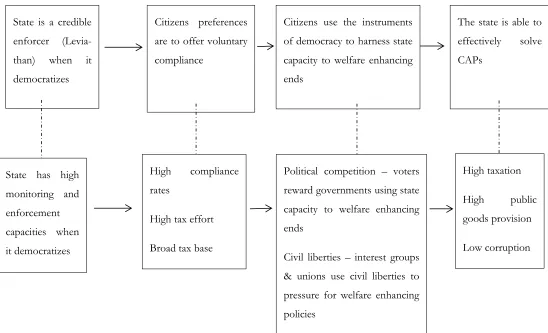
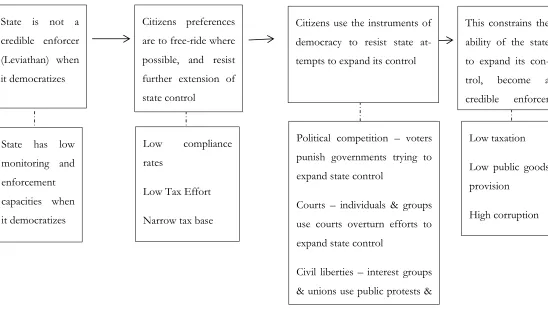
VWHS·9DQ(YHUD)LJXUHRXWOLQHVWKHVPDOOHUVWHSVRIWKHFDXVDODUJXPHQWDQGWKHREH r-servable evidence, also known as the diagnostic evidence (Collier 2011), of each step.
Sweden 1630s ± 2012: Credible Enforcement Before Credible Commitment
6ZHGHQ·VVWHSVWRZDUGVDFRQVWUDLQHG/HYLDWKDQZHUHTXLWHJUDGXDOIURPDEVROXWLVPIRUWKHPRVW
new constitution (Regeringsformen), which institutionalized ration of power in its contemporary form but still with a limited franchise, was adopted. By 1921, when tax weighting of votes was ended and the first elections under universal suffrage were held, the state was already a credible enforcer as, since at least the XVIIth century, the Swedish state had, mostly for the purposes of warfare, ac-quired formidable capacity to project power over its citizens, monitor, enforce and mobilize re-sources.
As in most European states, the processes of state expansion had been driven by military competition and warfare. Between 1520 and 1720 Sweden fought ten wars with Denmark for dominance in Northern and Baltic Europe. During this period Sweden was one of the most militarized states in Europe: in 1600, 1.5 percent of the population were troops under arms, a high-er level that France, England the Nethhigh-erlands or Russia (Tilly 1992: 59). Sweden continued to have the highest proportion of its population in a standing army of all the leading military European states well into the nineteenth century, and some have argued that the demilitarization of Swedish society did not take place until the 1920s (Arteus 1982, quoted in Knudsen and Rothstein 1994).
This militarization and the military successes it produced resulted from the creation of a state apparatus capable of controlling and mobilizing extensive resources. As the lack of mon-etization in the economy in the seventeenth century meant that the Crown was unable to hire mer-cenaries to the extent needed, moves were made towards introducing a standing army supported through transfers from the peasant economy. In 1690 Karl XI introduced the Indelningsverket, a system for paying soldiers from the produce of the peasant economy. Farm produce was paid in kind by units of five farms to support individual soldiers or officers, in terms of both food and housing. The success of WKLV V\VWHP ZKLFK SHUVLVWHGXQWLO XOWLPDWHO\ UHVWHG RQ WKH VWDWH·V
ability to broadcast power down to the lowest level of production, individual peasant households:
¶WKHFRQWUROV\VWHPLQKHUHQWLQDVWDQGLQJDUP\ELOOHWHGWKURXJKRXWWKHFRXQWU\VLGHreached every
FRUQHURIWKHODQG·/LQGJUHQ
,QVWURQJFRQWUDVWWRWKH,ULVKFDVHDFULWLFDOFRPSRQHQWRIWKH6ZHGLVKVWDWH·VEX r-geoning power was the monitoring capacity provided by the Church. Unlike in Ireland where the Catholic Church was constitutionally restricted under British rule until 1829, and so a source of resistance to state power, the Protestant Church is Sweden played a key role in expanding state reach throughout the population. One historian has gone so far as to say that the Church was the
responsible for keeping lists of those obliged to pay tax and of males eligible to become soldiers. These monitoring functions were legally enshrined in the 1686 Ecclesiastical Laws which confirmed the ChuUFKDVEHLQJVXERUGLQDWHWRWKH&URZQDQGPDGHWKH&KXUFK·VUROHLQFRQWUROOLQJWKHSRS u-lation through its list-taking one of the legal duties of Swedish clergymen. This very extensive monLWRULQJPHDQWWKDWDOWKRXJKWKHSHDVDQWU\PLJKWKDYHEHHQ¶IUHH·IUom feudal domination, they were very much under the control of the state. With this monitoring power, the state had a very high capacity to detect those defecting and free-riding and punish them.
The case for Sweden being a Leviathan as early as the beginning of the XVIIth cen-tury is also evidenced by its remarkable achievement as the pioneer of cadastral maps. A cadastral
PDSLV¶DODUJH-scale cartographic record of property ownership that preserves not only the dimen-sions and shape of an owned land parcel on the earth's surface but also the spatial relationship of all
VXFK LQGLYLGXDO SDUFHOV WR HDFK RWKHU· &RQ]HQ 6XFK UHJLVWHUV QRUPDOO\ DOVR LQFOXGH
details of the land ownership, the tenure, the cultivations (if in agricultural use), and the value of individual parcels of land. The cadastral map is widely understood as an instrument of control of
WKHJRYHUQHG%XLVVHUHWWKDWERWK¶UHIOHFWVDQGFRQVROLGDWHVWKHSRZHURIWKRVHZKRFRPPL
s-VLRQLW·.DLQDQG%DLJHQWDQG¶DKLVWRULcally important, partisan, and active tool of
state-FUDIW·&RQ]HQ-1645). As such it is difficult to underestimate the strength of the Swedish Leviathan as in 1630, almost a century before the Age of Liberty, the first mapped cadaster ( geome-triska jordebok) was carried out by a western nation (Kain and Baigent 1992: 340). It is interesting to note that not only of Swedish lands but also those lands that were in the sphere of geopolitical interests of Sweden were subject to cadastral mapping by the Swedish state.
7KHVWDWH·VVWDWXVDVD/HYLDWKDQZLWKDKLJKFDSDFLW\WRPRQLWRUDQGHQIRUFHFDQD
l-VREHVHHQLQWKHDUHDRIWD[DWLRQ$OWKRXJKWKHVWDWH·VDELOLW\WRUDLVHUHYHQXHZDVVXEVWDQWLDOO\
constrained, before industrialization, by the low degree of monetization of the economy and the weakness of towns, the usual sources of capital in early modern Europe, the Swedish state was collecting taxes, both in cash and in kind, from a broad base of the population long before democ-ratization. During the early modern period, in addition to the Indelningsverket, the Crown
economically active population were registered with the tax authority (Flora and Heidenheimer 1981: 193).
With these powers in place before meaningful democratic control over the state was institutionalized, the Swedish state has been able to consistently increase its revenue collection to the point where it is today one of the highest tax performers in the world (von Haldenwang and Ivanyna 2010) with average tax yields at 48 percent of GDP (including social security contributions) in 1990-2(&'$V6WHLQPRKDVDUJXHG¶WKHKDOOPDUNVRIWKH6ZHGLVKWD[V\VWHPKDYH
been its broad base, its stability aQGLWVKLJK\LHOG·6WHLQPR%URDGEDVHGKLJK\LHOGWD[
collection is only possible where the state has a high degree of administrative reach, i.e. where a high proportion of the population are registered with the tax authority and are effectively within the tax net. As argued above, these processes were in place well before not only 1921 when Sweden became a fully-fledged democracy, but also before the Instrument of Government of 1809 when the separation of power between the king and the non-elected estate assembly (Riksdag of the Es-tates) was provided for by law. Although we do not have the counterfactual of whether or not the Swedish state would have been able to achieve them if they had not been in place before democra-tization, we can say that the modes of taxation which emerged would not have been possible in a state that did not have such effective monitoring and enforcement capacities.
Ireland 1922-2012: Credible Commitment Before Credible Enforcement
When Ireland became an independent and democratic country in 1922 the state itself was far from being a Leviathan.4 The persistence of relatively stable English rule from the seventeenth century onwards had not been achieved through the creation of a strong Leviathan state capable of moni-toring the population, broadcasting power and maintaining control. Rather, as subsequently repli-cated in other colonies, the English authorities ruled through a relatively small, highly centralized state apparatus whose reach did not effectively extend beyond the contained geographic area of the capital. Throughout the rest of the state, the Crown ruled through a web of local power-holders (the Protestant Anglo-Irish aristocracy) who owned the majority of the land until the second half of the nineteenth century. Although there were persistent rebellions, the English forces were able to use targeted coercion to put them down. The Irish path to statehood, as Charles Tilly has argued,
¶GHPRQVWUDWHVWKHFDSDFLW\RIWKHUHJLRQ(QJODQGWRFUHDWHDUHODWLYHO\ZHDNVWDWHDORQJDFRHUFLRQ LQWHQVLYHSDWK·-9).
The weakness of the state, particularly in terms of monitoring and enforcement, is clearly demonstrated in the area of taxation. The state created by the English authorities had never acquired the capacity to raise taxes from the majority of the population, relying heavily instead on taxes from customs and excise. Taxes that were levied on a wider basis, such as the Hearth Tax of the seventeenth century, provoked high resistance, and the Hearth Tax was ultimately abolished in 1794. Even when the cost of the Napoleonic Wars led the Irish Chancellor of the Exchequer to
DQQRXQFH ¶WD[HV PXVW RSHUDWH RQ WKH EXON RI WKH SRSXODWLRQ· TXRWHG LQ 'LFNVRQ WKH
Crown was unable to bring the bulk of the peasantry within the tax net. The state instead increased customs and excise taxes further and went heavily into debt.
This then was the state structure inherited by the first Free State government in 1922. The new administration had to face the task of dealing with the civil war and making the transition between administrations. In doing so there was both a great deal of continuity in much of the administrative apparatus modus operandi (for example, they continued to collect the same taxes in the same way as the English had), while also routinizing and institutionalizing many of the
tices of the shadow state during the War of Independence (Garvin 1996). It was a very poor state with limited reach and a small tax base: in 1940 (the earliest date for which we have data), .3% of the economically active population was registered to pay tax ((Flora and Heidenheimer 1981: 193). Although some important changes have occurred in the nature of taxation since 1922, the broad patterns have remained remarkably static and, in particular, the Irish state has per-sistently failed in its attempts to broaden the tax base. Although the share of indirect taxes has fallen and that of direct taxes has increased, indirect taxes remain the single largest category of taxa-tion. The increasing share of direct taxes has mostly been driven by the introduction in 1960 of Pay As You Earn (PAYE) on employees deducted at source. By the mid-1980s 816 000 PAYE workers were paying 90 percent of total income tax (Hardiman 2002). The state has been unable to substantially expand direct taxes, particularly among groups, such as farmers and the self-employed, who have a higher capacity to evade.
Citizen preferences to free-ride
Although we cannot directly measure citizen preferences to free-ride, particularly for the period before the emergence of randomly sampled opinion surveys, we can use levels of tax compliance and evasion as indicators of at least the ability to free-ride. Although usually tax evasion, by defini-tion, remains hidden, and data for the start of our period of study is missing, data from the 1990s indicates that tax evasion was widespread and endemic. In 1993 the tax authority, the Revenue Commissioners, announced a voluntary tax amnesty where individuals could declare income and assets, without being fined and only being liable to pay tax at a fixed rate of 15 percent. The £240 million raised via the amnesty indicated that there was £1.6 billion in hidden funds within the economy (Hardiman 2002). Similarly, an inquiry into the Deposit Interest Retention Tax (DIRT) in the early 1990s uncovered evidence that from 1986 to 1999 302,000 bogus non-resident accounts, holding £1.5 billion, had been set up by residents for the purposes of tax evasion. One study in 1997 calculated that a relatively conservative estimate for overall levels of tax evasion would be 3 percent of GDP (Fagan 1994).
The Uses of Democracy to Constrain the State from Becoming a Credible Enforcer
to become more credible. This section argues that this was not simply a function of path depend-ency. Citizens have actively used the instruments of democracy ² electoral competition, independ-ent courts, and civil liberties ² to successfully resist the staWH·VDWWHPSWVWRH[WHQWLWVFRQWURODQG EHFRPHFUHGLEOH7KHIDFWWKDWWKH,ULVKVWDWH·VKDQGVZHUHWLHGEHIRUHLWEHFDPHD/HYLDWKDQKDV
played a large role in preventing it from becoming one.
Taxation, and particularly the widening of the tax net, has been a focus for political debate and conflict, particularly since the 1960s (Hardiman 2002). Governments who have prom-ised to and succeeded in cutting taxes have been rewarded at the polls for doing so. Governments who have attempted to broaden the tax base have met with significant resistance in the form of mass protests and legal challenges. This section describes these processes, with a focus on the pe-riod after 1970.
From the 1970s onwards, governments who have tried to increase taxes and broad-en the tax base have met with widespread resistance. The Fine Gael-Labour coalition governmbroad-ent who came to power in 1973 and tried to introduce new taxes of capital gains, capital acquisitions and wealth lost power in 1977 to to Fianna Fail, who went on the abolish a plethora of taxes ² both the newly introduced wealth and capital gains taxes, but also taxes on cars, and the very unpopular domestic rates charged by local authorities on all commercial properties. Although tax policy was not the only issue OHDGLQJWRWKHFRDOLWLRQ·VGHIHDW)LDQQD)DLOKDGSURPLVHGWKHWD[DEROLWLRQVLQ
advance of the election. In particular, rural farming constituencies were mobilized against the gov-ernment because of the wealth tax, which had included assets such as land.
Despite the tax abolitions undertaken early in their term, the Fianna Fail govern-ment soon had to grapple with the underlying structural issues their tax cuts had exacerbated: the inadequacy of the tax base to meet rising expenditure demands. In 1979 they attempted to raise additional taxes from one of the most under taxed constituencies ² farmers, who remained largely outside the tax net. In the 1979 budget, the government announced a 2 percent levy on farm pro-duce. The Irish Farmers Association (IFA) launched a series of protests and within a year the gov-ernment was forced to abolish the levy. They tried again with a resource tax in 1980 but compli-ance was very low, with only £700,000 of the projected £PLOOLRQEHLQJFROOHFWHG2·/HDU\
The government had to again bow to resistance and not only abolish but also repay all taxes that had been paid.
trade union movement, marched across the country (Sweeney 1983). One of their key grievances was the unfair distribution RI WKH WD[ EXUGHQ GXH WR WKH JRYHUQPHQW·V LQDELOLW\ WR H[WHQG GLUHFW
taxes beyond employees. In response the government promised a new Commission on Taxation to examine the issues. Industrial unrest around fiscal policy and budget proposals contributed to the fall of two short lived governments in the early 1980s.
Caught between citizens outside the tax net refusing to be brought within it and citizens within it refusing to pay more tax, subsequent governments were forced to look elsewhere for revenue. In the 1980s the gap between revenue and expenditure was increasingly filled through borrowing. Successive governments had failed to widen the tax net and resistance from employees made it politically challenging to tax them further. To plug the fiscal deficit governments resorted to borrowing, and debt began to grow. By 1987 debt was 117 percent of GDP (Sommers 1992).
Even when, in the face of a fiscal crisis in the late 1980s, the government again tried to broaden the tax base, they faced significant challenges through democratic mechanisms. In 1987 a minority Fianna Fail government tried to engage in base broadening and to reform and strengthen the Revenue Commissioners. In 1988 they introduced a voluntary tax amnesty and the scale of self-employed under-reporting became apparent through an unexpectedly high yield. A second amnesty in 1993 again confirmed widespread non-compliance.
The 1993 amnesty also provides an example of how judicial independence and con-stitutional protections hampered the sWDWH·VDELOLW\WRH[WHQGWKHWD[QHW7KHDELOLW\RIWKH5HYHQXH
Commissioners to use these amnesties as a means of bringing people within the tax net was un-dermined by the inclusion of a secrecy clause prohibiting Revenue from cross checking between those who availed of the amnesty and their regular tax returns. This clause effectively removed the usefulness of the Amnesty as a tool of widening the tax net. Although the Comptroller and Audi-tor General challenged the constitutionality of the clause in court, they lost the case.
Rather than broadening the tax base it a way that would make it sustainable, gov-ernments in the late 1990s and 2000s made decisions that eroded the tax base. This underlying weakness became clear again when recession began in 2008. Excluding debt from the banking crisis, the gap between revenue and public expenditure has been made clear: in 2012 it stood at 15 billion euro, or 8% of GDP (Government of Ireland 2013). In addition to cutting expenditure, there have been efforts to fill this gap between by introducing a number of new taxes: the universal social charge, the household levy, the pension levy. But they have again faced serious compliance issues: by the statutory deadline for paying the household levy the compliance rate with the house-hold levy was 50 percent (Irish Times 2012).
State Inability to Solve Collective Action Problems
$VLJQLILFDQWGLPHQVLRQRIWKH,ULVKVWDWH·VFXUUHQWILVFDOFKDOOHQJHVFDQEHVHHQWRUHVXOWLWVLQDELOLW\
to solve the collective action problem of collecting tax. The state that the democratic governments from 1922 onwards inherited from the period of British rule was weak and highly centralized, with low enforcement and monitoring capacity, and so ineffective at collecting tax from the broad base of the population. Subsequent governments have been fundamentally unable to alter this situation as citizens have used the electoral process, the right to unionize, strike and protest;; and judicial
LQGHSHQGHQFHWRFXUWDLOWKHVWDWH·VDELOLW\WRH[WHQGWKHWD[QHW7REHJLQZLWKDQHQIRUFHUODFNLQJ
credibility, the state has been unable to become a true Leviathan and its inability to solve collective action problems has persisted.
Conclusion
The literatures on collective action and credible commitment have contributed hugely to our under-standing of the kinds of states that enable human flourishing. States that are both strong and dem-ocratic are the most capable of delivering human development, as they have the infrastructural capacity to deliver improved outcomes, and the democratic character that ensures this capacity is used to enhance rather than undermine human welfare.
of issue of timing. By starting their analyses at the point at which states are already Leviathans, most existing rational choice accounts present a fundamentally static and ahistorical understanding of state-building. Here, we have tried to redress that weakness by harnessing the core insights in these theories into a dynamic model of state development. We argue that thinking historically about the key problems of effective social order ² collective action and credible commitment ² illuminates the paramount importance of sequencing for achieving it. The message of our analysis is clear: the claim that (close to) ideal institutions are logically inconsistent is incorrect. Ideal institutions are possible, but there is only one pathway to their emergence: credible enforcement before credible commitment.
As the case studies show, the Swedish state had become a credible enforcer long be-fore fully unleashing democratic control, and hence was able to use the power of the state to create one of the most efficient social orders in human history. On the other hand, the example of Ireland shows how tying the hands of a weak state can prevent the state from becoming a Leviathan in ways that lead to sub-optimal social outcomes. Illuminating as the case studies are, they serve to illustrate rather than test our argument. Much more research is needed, both to test the micro foundations of the theory and macro historical processes that unfolded and are unfolding in a varie-ty of different states. One of the most promising avenues would be to assess the impact of the historical strength of the monitoring and coercive capacities of the state on the current levels of human development. Equally important is to analyze the impact of rapid democratization experi-enced by a number of countries in the 3rd and 4th waves with different endowments in terms of the credibility of the state as enforcer on their progress towards socially beneficial outcomes.
CAUSAL CHAIN AND DIAGNOSTIC EVIDENCE
FOR PROCESS TRACING
FIGURE 1, CREDIBLE ENFORCEMENT BEFORE CREDIBLE COMMITMENT
Citizens preferences are to offer voluntary compliance
State is a credible enforcer (Levia-than) when it democratizes
Citizens use the instruments of democracy to harness state capacity to welfare enhancing ends
The state is able to effectively solve CAPs
State has high monitoring and enforcement capacities when it democratizes
High compliance rates
High tax effort Broad tax base
Political competition ² voters reward governments using state capacity to welfare enhancing ends
Civil liberties ² interest groups & unions use civil liberties to pressure for welfare enhancing policies
FIGURE 2, CREDIBLE COMMITMENT BEFORE CREDIBLE ENFORCEMENT
State has low monitoring and enforcement capacities when it democratizes
Low compliance rates
Low Tax Effort Narrow tax base
Political competition ² voters punish governments trying to expand state control
Courts ² individuals & groups use courts overturn efforts to expand state control
Civil liberties ² interest groups & unions use public protests &
Low taxation Low public goods provision
High corruption State is not a
credible enforcer (Leviathan) when it democratizes
Citizens preferences are to free-ride where possible, and resist further extension of state control
Citizens use the instruments of democracy to resist state at-tempts to expand its control
REFERENCES
%DUUR5REHUW´7KH&RQWURORI3ROLWLFLDQV$Q(FRQRPLF0RGHOµ
Public Choice
, 14:
19-42.
Buisseret, David ed. 1992.
Monarchs, Ministers and Maps: the Emergence of Cartography as a Tool
of Government in Early Modern Europe
. Chicago: Chicago University Press.
Carothers Thomas. 1999.
Aiding Democracy Abroad: A Learning Curve
. Washington DC.:
Car-negie Endowment for International Peace.
Charron, Nicholas, Lewis Dijkstra and Victor Lapuente
´
Mapping Quality of
Gov-ernment in the European Union: A Study of National and Sub-National Variation
µ
The
Quality of Government Institute Working Papers Series
, N 22.
Clague, Christopher, Philip Keefer, Stephen Knack and Mancur Olson
´3URSHUW\
and Contract Rights in Autocracies and Democracies
µ
Journal of Economic Growth
1:
243-276.
&RQ]HQ 0LFKDHO 3 ´7KH ,QKHUHQW 3RZHU LQ 0DSSLQJ 2ZQHUVKLSµ
Michigan Law
Review
, 92(6): 1637-1645.
Diamond, Larry. 1996.
Developing Democracy: Towards Consolidation
. Baltimore: John Hopkins
University Press.
Dickson, David. 1983. Taxation and Disaffection in Late Eighteenth Century Ireland. In S.
Clarke and J. S. Donnelly eds.
Irish Peasants: Violence and Political Unrest, 1789-1914
.
Man-chester: Manchester University Press
Eartman, Thomas. 1997.
Birth of the Leviathan: Building States and Regimes in Medieval and Early
Modern Europe.
Cambridge: Cambridge University Press.
Falachetti, Dino and Gary Miller. 2001.
´
Constraining the Leviathan: Moral hazard and
Credible commitment in Constitutional Design
µ
,
Journal of Theoretical Politics
, 13(4): 389-411.
Fearon, James D. and David D Laitin. 2004.
´
Neo-Trusteeship and the Problem of Weak
States
µ
,
International Security
, 29(4): 5-43.
)HUHMRKQ-RKQ´,QFXPEHQW3HUIRUPDQFHDQG(OHFWRUDO&RQWUROµ
Public Choice
, 50:
5-25.
Flora, P. & A.J. Heidenheimer eds. 1981.
The Development of Welfare States in Europe and
Amer-ica
. New Brunswick, NJ: Transaction, Inc.
Fukuyama, Francis. 2004a.
State-Building: Governance and World Order in the 21st Century
.
Itha-ca, NY: Cornell University Press.
Fukuyama, Francis. 2004b. The Imperative of State-Building,
Journal of Democracy
, 15(2):
17-31.
Fukuyama, Francis. 2004c.
´6WDWHQHVV)LUVWµ
Journal of Democracy
, 16(1): 84-88.
Fukuyama, Francis. 2007.
´/LEHUDOLVPYV6WDWH
-
%XLOGLQJµ
Journal of Democracy
, 18(3): 10-13.
Fukuyama, Francis. 2011.
The Origins of Political Order
. New York: Farrat, Straus and Jiroux.
Garvin, Tom. 1996.
1922: The Birth of the Irish State.
Dublin: Gill & McMillan
Gauri, Varun & Peyvand Khaleghian. 2002.
´
Immunization in Developing Countries: Its
Political
DQG2UJDQL]DWLRQDO'HWHUPLQDQWVµ
,
World Development
, 30 (12): 2109
²
2132.
Gehlbach, Scott
DQG 3KLOLS .HHIHU ´,QYHVWPHQW ZLWKRXW 'HPRFUDF\ 5XOLQJ
-party
Institutionalization and Credible Commitment in Autocracies
µ
Journal of Comparative
Eco-nomics
, 39: 123
²
139.
Greif, Avner, Paul Milgrom and Barry R. Weingast
´
Coordination, Commitment,
and Enforcement: The Case of the Merchant Guild
µ
Journal of Political Economy, 102(4):
745-776.
Gunnar Arteus. 1982.
Krigsmakt och Samhille i Frihetstidens Sverige
. Stockholm:
Militarhistor-iska forlaget.
Halperin Morton H., Joseph T. Siegle and Michael M. Weinstein. 2010.
The Democracy
Ad-vantage: How Democracies Promote Prosperity and Peace.
2nd ed. New York: Routledge.
Hamilton Alexander, Madison James, Jay John. [1788] 1961.
The Federalist Articles
. New
York: New American Library.
Hardiman, Niamh. 2002
´
The Development of the Irish Tax State
µ
,
Irish Political Studies
,
17(1): 29-58
Hardin, Garret. 1968. "The Tragedy of the Commons",
Science
162 (3859): 1243
²
1248.
Henisz, W. J. 2000
´7KH,QVWLWXWLRQDO(QYLURQPHQWIRU(FRQRPLF*URZWKµ
Economics and
Politics
12: 1
²
31.
Hobbes, Thomas. 2005 [1651].
Leviathan
. eBooks@Adelaide: The University of Adelaide
Library. http://ebooks.adelaide.edu.au/h/hobbes/thomas/h68l/index.html (Assessed
February 26, 2013).
Irish Times. 2012.

Number Paying Household Levy S
ORZV·
. April 21
st.
Kain Roger J. P. and Elizabeth Baigent. 1992.
The Cadastral Map in the Service of the State: A
History of Property Mapping
. Chicago: Chicago University Press.
.DXIPDQQ'DQLHO$DUW.UDD\DQG0DVVLPR0DVWUX]]L´*RYHUQDQFH0DWWHUV9,,,
´$JJUHJDWHDQG,Q
dividual Governance Indicators for 1996-
µ:RUOG%DQN3ROLF\5
e-search Working Paper No. 4978. Washington, D.C.
Knudsen, Tim and Bo Rothstein. 1994
´6WDWH%XLOGLQJLQ6FDQGLQDYLDµ
Comparative Politics
,
26 (2): 203-220
.QXWVHQ&DUO+HQULN´'HPRFUDF\'LFWDWRUVKLSDQG3URWHFWLRQRI3URSHUW\5LJKWVµ
Krasner, Stephen. 2004.
´
Sharing Sovereignty: New Institutions for Collapsed and Failing
States
µ
,
International Security
, 29(2): 85-120.
Leblang
'DYLG $ ´3URSHUW\ 5LJKWV 'HPRFUDF\ DQG (FRQRPLF *URZWKµ
Political
Research Quarterly
, 49(1): 5-26.
Levi, Margaret. 1988.
Of Rule and Revenue
, Berkeley: University of California Press.
Lindegren, Jan. 1985.
´7KH6ZHGLVK¶0LOLWDU\6WDWH·²
1720
µ
Scandinavian Journal of
His-tory
, 10(4): 305-336.
Lustick, Ian S. 1996. History, Historiography, and Political Science: Multiple Historical
Records and the Problem of Selection Bias,
American Political Science Review
, 90 (3): 605-618
Mansfield Edward D
DQG-DFN6Q\GHU´'HPRFUDWL]DWLRQDQGWKH'DQJHURI:DUµ
International Security
, 20(1): 5-38.
Mansfield Edward D. and Jack Snyder. 2007.
Electing to Fight: Why Emerging Democracies Go to
War
. Cambridge, MA: MIT Press.
Mansfield Edward D. and Jack Snyder.
´7KH6HTXHQFLQJ¶)DOODF\·µ
Journal of
Democra-cy
, 18(3): 5-9.
McFaul Michael. 2010.
Advancing Democracy Abroad: Why We Should and How We Can
. New
York: Rowman & Littlefield.
Montesquieu, M. de Secondat,
The Spirit of Laws
, Special Edition. 1984 [1748]).The Legal
Classics Library, Birmingham, AL: The John D. Lucas Printing Company.
Mulligan, Casey B., Ricard Gil, and Xavier Sala-i-
0DUWLQ ´
Do Democracies Have
Different Public Policies Than Non-democracies?
µ
Journal of Economic Perspectives
, 18(1):
51-74.
North, Douglass C. 1981.
Structure and Change in Economic History
. New York: Norton.
North, Douglass C. 1993. "Institutions and Credible Commitment",
Journal of Institutional
and Theoretical Economics
149: 11-23.
2·/HDU\2OLYLD
The Farmers and the Land Tax
, Magill October 1984
OECD. 2010.
Taxing Wages.
Paris: OECD.
OECD. 2012.
StatExtracts: Revenue Statistics: Comparative Tables, 1965-2011
.
http://stats.oecd.org/Index.aspx?QueryId=21699
Olson, Mancur. 1965.
The Logic of Collective Action. Public Goods and the Theory of Groups
.
Cam-bridge, MA: Harvard University Press.
Ostrom, Elinor. 1990.
Governing the Commons: The Evolution of Institutions for Collective Action
.
Cambridge: Cambridge University Press.
Persson, Torsten and Guido Tabellini, eds. 1994.
Monetary and Fiscal Policy
. 2 vols.
Cam-bridge, MA: Massachusetts Institute of Technology Press.
Persson, Torsten, Gerard Roland and Guido Tabellini, G. 1997
´
Separation of Powers and
3ROLWLFDO$FFRXQWDELOLW\µ
Quarterly Journal of Economics
, 112: 1163
²
202.
Persson, Torsten, Gerard Roland and Guido Tabellini, G. 2000.
´&RPSDUDWLYH3ROLWLFVDQG
3XEOLF)LQDQFHµ
,
Journal of Political Economy
, 108:1121-1161.
Porter, Bruce D. 1994.
War and the Rise of the State: the Military Foundation of the Modern Politics
.
New York: The Free Press.
Roberts, Michael. 1986.
The Age of Liberty: Sweden 1719-1772
. Cambridge: Cambridge
Uni-versity Press.
Rodrik, Dany. 2000.
´,QVWLWXWLRQV IRU +LJK
-Quality Growth: What they are and How to
$FTXLUH7KHPµ
Studies in Comparative International Development
, 35(3): 3-32.
5RVV0LFKDHO´,V'HPRFUDF\*RRGIRUWKH3RRU"µ
American Journal of Political
Sci-ence
, 50(4): 860-874.
Shepsle, Kenneth A. 1991.
´
Discretion, Institutions and the Problem of Government
Commitment
µ
In
Social Theory for a Changing Society
, Pierre Bourdieu and James Coleman,
eds. Boulder, CO: Westview Press.
Shandra, John M., Jenna Nobels, Bruce London, and John B. Williamson. 2004.
´
Depend-ency, Democracy, and Infant Mortality: A Quantitative, Cross-National Analysis of Less
Developed Countries
µ
,
Social Science and Medicine
, 59: 321-333.
Shumpeter, Joseph. 1991 (1918). The Crisis of the Taxation. In Swedber, R. ed.
Joseph
Shumpeter on the Economics and Sociology of Capitalism
. Princeton: Princeton University Press. P.
99-140.
6PLWK0LFKDHO(´7KH$UFKDHRORJ\RI$QFLHQW6WDWH(FRQRPLHVµ
Annual Review of
Anthropology
, 33: 73-102
6RPHUV0LFKDHO´7KH0DQDJHPHQWRI,UHODQG·V1DWLRQDO'HEWµ
Journal of the
Statisti-cal and Social Inquiry Society of Ireland
, XXVI (IV).
Spencer, Charles S. and Elsa M. Redmond. 2004. Primary State Formation in Mesoamerica,
Annual Review of Anthropology
, 33: 173-199.
Stasavage, David. 2002a.
´
Credible Commitment in Early Modern Europe: North and
Weingast Revisited
µ
Journal of Law, Economics and Organization
, 18 (1): 155-186.
Stasavage, David. 2002b.
´3ULYDWH ,QYHVWPHQWV DQG 3ROLWLFDO ,QVWLWXWLRQVµ
Economics and
Politics
14(1): 41-63.
Steinmo, Sven. 1993.
Taxation and Democracy: Swedish, British and American Approaches to
Fi-nancing the Modern State
. New Haven, CT: Yale University Press.
6ZHHQH\3¶7KH3$<(6HFWRU·V3HUVSHFWLYHRI7D[DWLRQDQG7UDGH8QLRQ'HPDQG
IRU5HIRUP·,ULVK7UDQVSRUWDQ*HUQHDO:RUNHUV8QLRQ0LQXWHV
nd November.
Tilly, Charles. 1992.
Coercion, Capital and European States AD 990-1992
. Malden, MA:
Black-well Publishing.
Van Evera, Stephen. 1997.
Guide to Methods for Students of Political Science
. Ithaca, NJ: Cornell
University Press
Von Haldenwang, Christian and Maksym Ivanyna. 2010.
Assessing the Tax Performance of
De-veloping Countries
. German Developmen Institute / Deutsches Institut fur
Entwicklungspoli-tic, Discussion Paper 20.